 Hispanopedia Wiki
Cada entrada de esta lista de conceptos erróneos comunes está redactada como una corrección; los conceptos erróneos en sí mismos están implícitos, no expresados. Estas entradas son resúmenes concisos; se pueden consultar los artículos principales para obtener más detalles.
Los conceptos erróneos comunes son puntos de vista o hechos que a menudo se aceptan como ciertos, pero que en realidad son falsos. Por lo general, surgen de la sabiduría convencional (como los cuentos de viejas ), estereotipos , supersticiones , falacias , una mala comprensión de la ciencia o la popularización de la pseudociencia . Algunos conceptos erróneos comunes también se consideran leyendas urbanas y, a veces, están relacionados con pánicos morales .
Artes y cultura
Negocio
- Las leyes federales de curso legal en los Estados Unidos no exigen que las empresas, personas u organizaciones privadas acepten efectivo como forma de pago, aunque debe considerarse como pago válido de deudas cuando se ofrece a un acreedor. [1]

- Adidas no es un acrónimo de "Todo el día sueño con deportes", "Todo el día sueño con fútbol" o " Todo el día sueño con sexo ". La empresa recibió el nombre de su fundador Adolf "Adi" Dassler en 1949. La primera publicación encontrada de este último acrónimo fue en 1978, como una broma. [2] [3]
- Las letras "AR" en AR-15 significan "ArmaLite Rifle", lo que refleja la empresa ( ArmaLite ) que originalmente fabricó el arma. No significan " rifle de asalto ". [4] [5]
- El Chevrolet Nova se vendió bien en los mercados latinoamericanos; General Motors no le cambió el nombre. Si bien no va significa "no va" en español, nova se entendió fácilmente como "nuevo". [6]
- La imagen común de Santa Claus (Papá Noel) como un hombre corpulento y alegre con ropas rojas no fue creada por The Coca-Cola Company como herramienta publicitaria. Santa Claus ya había adoptado esta forma en la cultura popular estadounidense a fines del siglo XIX, mucho antes de que Coca-Cola utilizara su imagen en la década de 1930. [7]
- El contorno de la botella de Coca-Cola no fue diseñado por el famoso diseñador industrial Raymond Loewy . [8] [9]
- Netflix no se fundó después de que Blockbuster le cobrara a su cofundador Reed Hastings una multa de 40 dólares por pagos atrasados . Hastings inventó la historia para resumir la propuesta de valor de Netflix , y los fundadores de Netflix en realidad se inspiraron en Amazon . [10]
- PepsiCo nunca llegó a poseer la "sexta armada más poderosa" del mundo después de un acuerdo con la Unión Soviética. En 1989, Pepsi adquirió varios buques de guerra fuera de servicio como parte de un acuerdo de trueque. [11] [12] Los petroleros fueron arrendados o vendidos y los demás barcos se vendieron como chatarra. [13] Un acuerdo posterior involucró otros 10 barcos. [14]
Comida y cocina
- El dorado no retiene la humedad de la carne; de hecho, hace que pierda algo de humedad. La carne se dora para dorarla, lo que afecta su color, sabor y textura. [15]
- Estofar la carne no le aporta humedad; de hecho, hace que pierda algo de humedad. La humedad parece añadirse cuando la cocción suave descompone el tejido conectivo y el colágeno , que lubrican y ablandan las fibras. [16] [17]
- Los mejillones y las almejas que no se abren al cocinarse pueden cocinarse completamente y ser seguros para comer. [18] [19] [20]
- Los Twinkies , un pastelito estadounidense considerado generalmente como " comida basura ", tienen una vida útil de alrededor de 25 días, a pesar de la afirmación común (generalmente jocosa) de que siguen siendo comestibles durante décadas. [21] La vida útil oficial es de 45 días. Los Twinkies normalmente permanecen en los estantes de las tiendas durante 7 a 10 días. [22]
- Los alimentos envasados, si se almacenan correctamente, se pueden consumir sin problemas después de su fecha de caducidad. Si bien algunos estados de EE. UU. regulan las fechas de caducidad de algunos productos, por lo general, las fechas de caducidad y de consumo preferente son las que recomiendan los fabricantes para garantizar una mejor calidad. [23]
- Guardar el pan en el refrigerador hace que se ponga rancio más rápido que dejarlo a temperatura ambiente. [24] [25] Sin embargo, retarda el crecimiento de moho. [26]
- La miel cristalizada no ha caducado. La cristalización de la miel se produce por temperaturas frías , un alto nivel de glucosa y la presencia de polen . La cristalización se puede revertir calentándola suavemente. [27] [28]
- Las semillas no son la parte más picante de los chiles . De hecho, las semillas contienen una cantidad baja de capsaicina , uno de los varios compuestos que inducen la sensación de picor (pungencia) en los mamíferos. La mayor concentración de capsaicina se encuentra en el tejido placentario (la médula ) al que están adheridas las semillas. [29] [30]
- La carne de pavo no tiene un contenido particularmente alto de triptófano y no provoca más somnolencia que otros alimentos. La somnolencia después de comidas copiosas, como la cena de Navidad, generalmente se debe a comer en exceso. [31]
- Los tuestes más oscuros del café no siempre contienen más cafeína que los tuestes más claros. Cuando el café se tuesta, se expande y pierde agua. Cuando el café resultante se muele y se mide volumétricamente , los tuestes más densos y claros tienen más café por taza, lo que significa que contienen más cafeína. [32] [33]
- El whisky bourbon no tiene por qué destilarse en Kentucky. [34] El bourbon también se destila en estados como Nueva York, California, Wyoming y Washington, ya que el requisito legal es únicamente que se elabore en los EE . UU . Sin embargo, Kentucky produce la mayoría del bourbon. [35] [36]
- El uso de un jabón suave en utensilios de cocina de hierro fundido bien curados no dañará el curado. [37] Esto no se debe a que los jabones modernos sean más suaves que los antiguos. [38]
- Sushi no significa marisco crudo; algunos sushi, como el kappamaki , no contienen marisco. La palabra hace referencia al arroz preparado con vinagre que contiene el plato. [39]
- La pimienta de Jamaica no es una mezcla de especias. [40] [41] Es una especia única, llamada así porque supuestamente combina los sabores y aromas de muchas especias, especialmente la canela , la nuez moscada , el clavo y la pimienta negra . [42]
Historia de la comida y la bebida
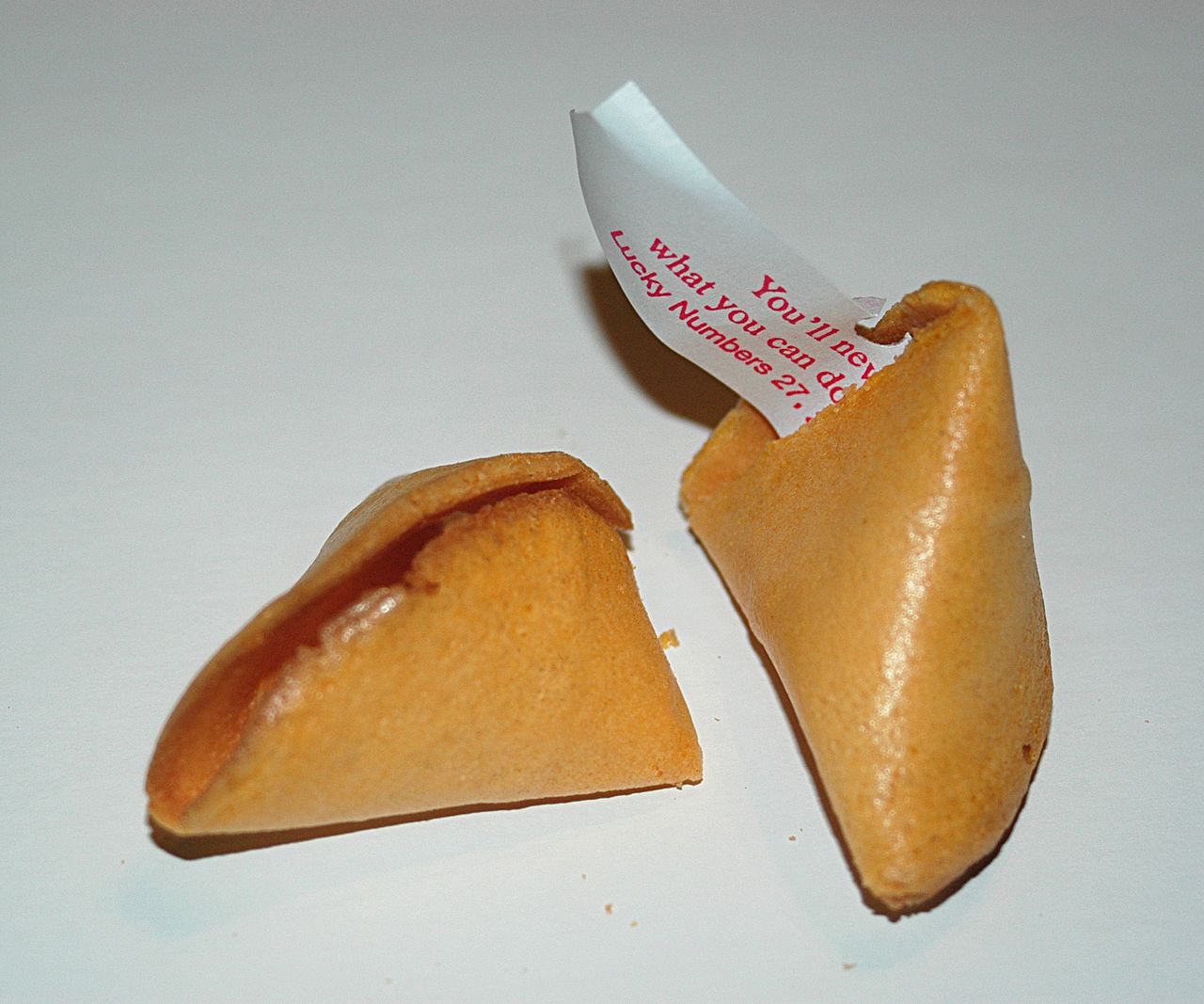
- El steak tartar no fue inventado por los guerreros mongoles que ablandaban la carne de caballo bajo sus sillas de montar. [43] Es probable que su nombre se deba a la salsa tártara francesa , que evolucionó a partir de un plato francés de principios del siglo XX en el que la salsa se servía con filetes. [44]
- Marco Polo no introdujo la pasta en Italia desde China. [45] La idea errónea se originó como material promocional en el Macaroni Journal , un boletín publicado por una asociación de fabricantes de pasta estadounidenses. [46]
- En la Edad Media no se utilizaban especias para enmascarar el sabor de la carne podrida antes de refrigerarla. Las especias eran un artículo de lujo caro; quienes podían permitírselo podían permitirse comer buena carne, y no hay documentos contemporáneos que exijan el uso de especias para disfrazar el sabor de la carne en mal estado. [47]
- Los cocineros de Catalina de Médici no introdujeron alimentos y técnicas italianas en la corte real francesa, sentando las bases para el desarrollo de la alta cocina francesa . [48]
- La crema batida no fue inventada por François Vatel en 1661 y luego nombrada en el Château de Chantilly , donde se servía de manera destacada; hay recetas similares atestiguadas al menos un siglo antes en Francia e Inglaterra. [49] [50]
- Dom Pérignon no inventó el champán. El vino empieza a burbujear naturalmente después de ser prensado, y en aquella época las burbujas se consideraban un defecto que Pérignon intentó eliminar sin éxito. [51] [52]
- Las patatas fritas no fueron inventadas por un frustrado George Speck en respuesta a un cliente, a veces identificado como Cornelius Vanderbilt , que se quejaba de que sus patatas fritas eran demasiado gruesas y no lo suficientemente saladas. [53] [54] Las recetas de patatas fritas se publicaron ya en 1817. [55] La idea errónea se popularizó gracias a una campaña publicitaria de 1973 de la St. Regis Paper Company. [56]
- George Washington Carver no fue el inventor de la mantequilla de maní. [57] La primera patente relacionada con la mantequilla de maní fue presentada por John Harvey Kellogg en 1895, y la mantequilla de maní fue utilizada por los incas siglos antes de eso. [ 58] [59] Carver recopiló cientos de usos para los maníes, además de los usos para las nueces pecanas y las batatas. [58] [60] Un artículo de opinión de William F. Buckley Jr. puede haber sido la fuente de la idea errónea. [57]
- Las galletas de la suerte no se encuentran en la cocina china , a pesar de su presencia en los restaurantes chinos de Estados Unidos y otros países occidentales. Tienen su origen en Japón y fueron introducidas en los EE. UU. por los japoneses. [61] En China, se consideran estadounidenses y son poco comunes. [62]
- Julio César no inventó la ensalada César. Su creador fue César Cardini , un restaurador italoamericano, en Tijuana, México , en 1924. [63] [64]
- Hydrox no es una imitación de las Oreos . Hydrox, inventado en 1908, es cuatro años anterior a las Oreos y al principio era más popular que ellas. El hecho de que se dijera que el nombre "Hydrox" sonara como un detergente para ropa contribuyó a su caída en el mercado. [65] [66]
- La diferencia entre el sabor de un caramelo con "sabor a plátano" y un plátano real no se debe a que el primero esté diseñado específicamente para replicar el sabor de los plátanos Gros Michel , la variedad que dominó el mercado estadounidense del plátano antes del auge de los plátanos Cavendish . Todas las variedades de plátano obtienen su sabor de una mezcla compleja de muchos compuestos, mientras que un solo compuesto, el acetato de isoamilo , le da su sabor al caramelo de plátano. El acetato de isoamilo se produce de forma natural en los plátanos, así como en muchas otras frutas y bebidas fermentadas. [67] Está más concentrado en los plátanos Gros Michel que en los plátanos Cavendish, pero su uso en la producción de caramelos se debió a su producción sencilla, no a ningún parecido específico con el sabor de un plátano. Los caramelos con sabor a él se han etiquetado como "sabor a plátano" y "sabor a pera". [68] [69]
Hornos microondas
- Los hornos microondas no están sintonizados con ninguna frecuencia de resonancia específica para las moléculas de agua en los alimentos. [70] [71] Cocinan los alimentos mediante calentamiento dieléctrico de moléculas polares, en particular agua y grasas. [72]
- Los hornos microondas no cocinan los alimentos de adentro hacia afuera. Las microondas de 2,45 GHz solo pueden penetrar aproximadamente de 1 a 1,5 pulgadas ( 2,5 a 3,8 cm) de ancho.+1 ⁄ 2 – 3+3 ⁄ 4 centímetros) en la mayoría de los alimentos. Las porciones internas de los alimentos más gruesos se calientan principalmente por el calor conducido desde las capas externas. [73] [74] [75]
- La radiación producida por un horno microondas no es ionizante, similar a la luz visible o las ondas de radio. Por lo tanto, no tiene los riesgos de cáncer asociados con la radiación ionizante , como los rayos X y las partículas de alta energía , ni hace que los alimentos sean radiactivos. Toda la radiación de microondas se disipa en forma de calor. Los estudios a largo plazo con roedores para evaluar el riesgo de cáncer hasta ahora no han logrado identificar carcinogenicidad alguna de la radiación de microondas de 2,45 GHz, incluso con niveles de exposición crónica (es decir, una gran fracción de la esperanza de vida) mucho mayores que los que los humanos probablemente encuentren en cualquier horno con fugas. El riesgo de lesión por exposición directa a las microondas no es acumulativo, sino que es el resultado de una exposición de alta intensidad que resulta en quemaduras en los tejidos, de la misma manera que un láser de alta intensidad puede quemar. [76] [77]
- Cocinar alimentos en microondas no reduce significativamente su valor nutritivo y puede conservarlos mejor que otros procesos de cocción debido a que los tiempos de cocción son más cortos. [78]
Cine y televisión
- Ronald Reagan nunca fue considerado seriamente para el papel de Rick Blaine en la película de 1942 Casablanca , que finalmente interpretó Humphrey Bogart . Un comunicado de prensa temprano del estudio mencionó a Reagan, pero el estudio ya sabía que Reagan no estaba disponible debido a su próximo servicio militar. [79] De hecho, el productor siempre había querido a Bogart para el papel. [80]
- Blancanieves y los siete enanitos de Walt Disney Studios no fue la primera película animada en ser un largometraje. El Apóstol , una película muda argentina perdida de 1917 que utilizó animación recortada , se considera la primera. [81] [82] [83] La idea errónea proviene de que Blancanieves y los siete enanitos fue el primer largometraje animado en celuloide. [84]
- La película de 1939 El mago de Oz no fue la primera película en color . El Kinemacolor se utilizó a partir de 1902 y el primer proceso Technicolor debutó en 1917. [85] [86]
Idioma
- La pronunciación de las fricativas coronales en español no surgió por imitación de un rey ceceante . Solo hay documentos que demuestran que un rey español, Pedro I de Castilla , tenía ceceo, y la pronunciación actual se originó dos siglos después de su muerte. [87] [88]
- Los lenguajes de señas no son los mismos en todo el mundo. Aparte del pidgin International Sign , cada país generalmente tiene su propio lenguaje de señas nativo, y algunos tienen más de uno. [89]
- La palabra china para "crisis" (危机) no está compuesta por los símbolos de "peligro" y "oportunidad"; el primero sí representa peligro, pero el segundo significa " punto de inflexión " (el significado original de la palabra "crisis"). [90] [91] La idea errónea se popularizó principalmente por los discursos de campaña de John F. Kennedy . [90]
- La palabra " gringo " no se originó durante la Guerra México-Estadounidense (1846-1848) como una corrupción de "Green, go home!", en referencia a los uniformes verdes de las tropas estadounidenses. [92] [93] La palabra originalmente significaba simplemente "extranjero", y es probablemente una corrupción de la palabra española griego para "griego" (en la línea del modismo "It's Greek to me "). [94] [95]
idioma en Inglés
- Irregardless es una palabra que aparece en numerosos diccionarios junto con otrostérminos no estándar , de jerga o coloquiales . [96] [97]
- Está permitido terminar una oración con una preposición . [98] La supuesta regla en contra de esto se originó en un intento de imitar el latín, pero los lingüistas modernos coinciden en que es una parte natural y orgánica del idioma inglés. [99] De manera similar, los manuales de estilo y uso modernos permiten infinitivos divididos . [100]
- Los hablantes afroamericanos del inglés vernáculo no reemplazan simplemente "is" por "be" en todos los tiempos, sin añadir ningún significado. De hecho, los hablantes de AAVE usan "be" para marcar un aspecto gramatical habitual que no se distingue explícitamente en el inglés estándar. [101]
- El " 420 " no se originó en la policía de Los Ángeles ni en el código penal por el uso de marihuana. [102] La sección 420 del Código Penal de California prohíbe la obstrucción del acceso a tierras públicas. [102] [103] El uso del "420" comenzó en 1971 en la escuela secundaria San Rafael , donde un grupo de estudiantes iba a fumar a las 4:20 p. m. [102]
- La palabra crap no se originó como una formación anterior del apellido apropiado del fontanero británico Thomas Crapper . [104] La palabra crap en última instancia proviene del latín medieval crappa . [104] [105]
- La palabra fuck no se originó en la Edad Media como un acrónimo . [106] Las siglas propuestas incluyen "fornicar con el consentimiento del rey" o "por conocimiento carnal ilícito", utilizado como señal colocada sobre los adúlteros en el cepo. Tampoco se originó como una corrupción de "pluck yew" (un modismo falsamente atribuido a los ingleses para tensar un arco largo ). [106] [107] [108] Lo más probable es que se derive del holandés medio u otras lenguas germánicas , donde significaba "empujar" o "copular con" ( fokken en holandés medio), "copular", o "golpear, empujar, copular" o "pene". [107] De cualquier manera, estas variaciones se habrían derivado de la raíz indoeuropea -peuk , que significa "pinchar". [107]
- La expresión " regla de oro " no tiene su origen en una ley inglesa que permitiera a un hombre golpear a su esposa con un palo no más grueso que su pulgar, y no hay evidencia de que tal ley haya existido jamás. [109] La expresión tiene su origen a finales del siglo XVII a partir de varios oficios en los que las cantidades se medían por comparación con el ancho o largo de un pulgar. [109] [110]
- El término " leyes azules ", que designa leyes que prohíben ciertas actividades en días específicos, no se originó a partir de que dichas leyes se escribieran originalmente en papel azul. [111] [112]
- La palabra the nunca se pronunció ni se deletreó "ye" en inglés antiguo o medio . [113] La confusión, que se ve en la frase común " ye olde ", se deriva del uso del carácter thorn (þ), que en inglés medio representaba el sonido que ahora se representa en inglés moderno por "th". [114] Esto evolucionó a medida que las primeras imprentas sustituyeron la palabra the por "yͤ", un carácter "y" con una "e" superíndice. [115]
- El insulto antiitaliano wop no tiene su origen en un acrónimo para "sin papeles" [116] o "sin pasaporte"; [117] [118] en realidad se deriva del término guappo (que significa más o menos matón ), del español guapo . [119]

- La Navidad no surgió como un plan secular para "sacar a Cristo de la Navidad". [118] X representa la letra griega chi , la primera letra de Χριστός ( Christós ), "Cristo" en griego, [120] como se encuentra en el símbolo chi-rho ΧΡ desde el siglo IV. En inglés, "X" se utilizó por primera vez como abreviatura de "Cristo" en 1021. [121] [122]
Derecho, crimen y ejército
- No es un sesgo sistémico lo que hace que la custodia exclusiva de los hijos se conceda con mayor frecuencia a las mujeres que a los hombres, sino que es más bien que los hombres rara vez la impugnan o la buscan. [123]
- En Singapur, el uso de chicles no se castiga con azotes . Aunque la importación y venta de chicles es ilegal en Singapur desde 1992 y el castigo corporal sigue siendo una pena aplicable para determinados delitos en el país, ambos hechos no están relacionados: los delitos relacionados con el uso de chicles siempre han estado sujetos únicamente a multas y encarcelamiento, y la posesión o el consumo de chicles en sí no es ilegal. [124]
- Los empleados de la organización policial internacional Interpol no pueden realizar investigaciones, detener a criminales o utilizar pasaportes falsos . [ aclaración necesaria ] El papel de Interpol es facilitar la comunicación internacional entre los organismos encargados de hacer cumplir la ley de estados soberanos . [125] [126]
- No se han probado casos de extraños que hayan matado o herido permanentemente a niños al esconder intencionalmente venenos u objetos afilados como hojas de afeitar en caramelos o manzanas durante la fiesta de Halloween y la creencia ha sido "totalmente desacreditada". Sin embargo, en al menos un caso, miembros adultos de la familia han difundido esta historia para encubrir el filicidio . [127]
- Nunca se ha documentado un caso de gatos negros domésticos torturados o sacrificados ritualmente en torno a Halloween. Cuando se han documentado muertes violentas de gatos negros en torno a Halloween, la muerte se ha atribuido generalmente a depredadores naturales, como coyotes, águilas o aves rapaces. [128]
- No es necesario esperar 24 horas antes de presentar una denuncia por desaparición de una persona . Cuando hay evidencia de violencia o de una ausencia inusual, es importante iniciar una investigación con prontitud. [129] [130] Los expertos en criminología afirman que las primeras 72 horas de una investigación de desaparición de una persona son las más críticas. [131]
Estados Unidos

- La delincuencia en los Estados Unidos disminuyó entre 1993 y 2022; la tasa de delitos violentos por cada 100.000 personas se redujo casi un 50% y la tasa de delitos contra la propiedad se redujo en más de la mitad. [132] El número de homicidios con armas de fuego también disminuyó. [133]

- Los inmigrantes indocumentados en los EE. UU. tienen tasas de criminalidad sustancialmente más bajas que los ciudadanos nacidos en los EE. UU. [134] [135] En comparación con los inmigrantes indocumentados, los ciudadanos nacidos en los EE. UU. tienen más del doble de probabilidades de ser arrestados por delitos violentos, 2,5 veces más probabilidades de ser arrestados por delitos de drogas y más de 4 veces más probabilidades de ser arrestados por delitos contra la propiedad. [135] Los inmigrantes tienen un 60% menos de probabilidades de ser encarcelados que los ciudadanos nacidos en los EE. UU. [136]
- La Primera Enmienda de la Constitución de los Estados Unidos generalmente sólo impide las restricciones gubernamentales a las libertades de religión , expresión , prensa , reunión o petición , [137] no las restricciones impuestas por otras entidades a menos que actúen en nombre del gobierno . [138] [139] Otras leyes pueden limitar la capacidad de las empresas privadas y los individuos para restringir la libertad de expresión de otros. [140]
- En los Estados Unidos, no se puede desestimar el caso de un acusado simplemente porque no se le leyeron sus derechos Miranda en el momento de su arresto. Las advertencias Miranda cubren los derechos de una persona cuando es detenida y luego interrogada por las fuerzas del orden. [141] Si a una persona no se le da una advertencia Miranda antes de que se lleve a cabo el interrogatorio, las declaraciones que haga durante el interrogatorio pueden no ser admisibles en un juicio. La fiscalía aún puede presentar otras formas de evidencia, o declaraciones hechas durante interrogatorios en los que se le leyeron al acusado sus derechos Miranda, para obtener una condena. [142]
- Estados Unidos no exige que los agentes de policía se identifiquen como tales en caso de una operación encubierta o de otro tipo, y los agentes de policía pueden mentir cuando realizan ese tipo de trabajo. [143] La defensa basada en la incitación a cometer un delito se centra en cambio en si el acusado fue indebidamente inducido por presiones indebidas de funcionarios del gobierno a cometer delitos que de otro modo no habría cometido. [144]
- En Estados Unidos no es ilegal gritar "fuego" en un teatro lleno de gente . Aunque a menudo se da como ejemplo de un discurso que no está protegido por la Primera Enmienda, no es ni ha sido nunca una ley vinculante. La frase tiene su origen en la opinión del juez Oliver Wendell Holmes Jr. en el caso Schenck v. United States de la Corte Suprema de Estados Unidos en 1919, que sostuvo que el discurso del acusado en oposición al reclutamiento durante la Primera Guerra Mundial no estaba protegido por la libertad de expresión. Sin embargo, ese caso no se trataba de gritar "fuego" y la decisión fue revocada posteriormente por Brandenburg v. Ohio en 1969. [145] [146]
- Las Fuerzas Armadas de los Estados Unidos han prohibido en general el alistamiento militar como una forma de sentencia diferida (es decir, una opción para que los convictos eviten la cárcel) desde la década de 1980. [147] Los protocolos de la Marina de los Estados Unidos desalientan la práctica, mientras que las otras cuatro ramas tienen regulaciones específicas contra ella. [148]
- Las solicitudes de última comida no tienen por qué ser atendidas. [149] Los Estados tienen diversas restricciones sobre lo que se puede solicitar, llegando incluso a no permitirlas en absoluto. [150]
- Aunque se la conoce popularmente como el "teléfono rojo", la línea directa Moscú-Washington nunca fue una línea telefónica ni se utilizaron teléfonos rojos. La primera implementación de la línea directa utilizó equipos de teletipo , que fueron reemplazados por máquinas de fax en 1988. Desde 2008, la línea directa ha sido un enlace informático seguro a través del cual los dos países intercambian correo electrónico. [151] Además, la línea directa vincula al Kremlin con el Pentágono , no con la Casa Blanca . [152] [153]
- De la misma manera, el balón nuclear , el maletín que utilizan los presidentes para lanzar ataques nucleares, no contiene un gran botón rojo para lanzar un ataque. Más bien, su uso principal es confirmar la identidad del presidente y facilitar la comunicación con el Pentágono . [154] [155] [156]
- No se afirmó que los Twinkies fueran la causa de los asesinatos del alcalde de San Francisco , George Moscone , y del supervisor Harvey Milk . En el juicio de Dan White , la defensa argumentó con éxito que la capacidad disminuida de White era resultado de la depresión. Si bien el consumo de Twinkies se citó como evidencia de esta depresión, nunca se afirmó que fuera la causa de los asesinatos. [157] [158]
- Ni la mafia ni otras organizaciones criminales utilizan ni han utilizado regularmente zapatos de cemento para ahogar a sus víctimas. [159] Solo hay dos casos documentados de este método utilizado en asesinatos: uno en 1964 y otro en 2016 (aunque, en el primero, la víctima tenía bloques de hormigón atados a sus piernas en lugar de estar encerrada en cemento). [160] El ejército francés utilizó zapatos de cemento en argelinos muertos en vuelos de la muerte durante la guerra de Argelia . [161]
- El embalsamamiento no es un requisito legal en los Estados Unidos. [162] [163] La Comisión Federal de Comercio aprobó una norma en 1984 que prohíbe hacer esta afirmación, para evitar que la industria funeraria promueva la idea errónea con fines de lucro. [164]
Literatura
- Muchas citas son incorrectas o se atribuyen a personas que nunca las pronunciaron, y las citas de autores oscuros o desconocidos a menudo se atribuyen a figuras más famosas. Entre las personas que suelen citarse incorrectamente se incluyen Mark Twain , Albert Einstein , Adolf Hitler , Winston Churchill , Abraham Lincoln , William Shakespeare , Confucio , Sun Tzu y Buda . [165]
- La novela Frankenstein de Mary Shelley de 1818 lleva el nombre del científico ficticio Victor Frankenstein , quien creó a la criatura inteligente de la novela, no a la criatura en sí, que nunca se nombra en la novela y ahora suele llamarse el monstruo de Frankenstein . [166] Sin embargo, cuando las adaptaciones posteriores comenzaron a referirse al monstruo en sí como Frankenstein, este uso se estableció bien y algunos ya no lo consideran erróneo. [167] [168]
- Ernest Hemingway no fue el autor del cuento flash " Se venden zapatos de bebé, sin usar ". [169] El cuento no se le atribuyó hasta décadas después de su muerte. [170]

Las esculturas clásicas se pintaban originalmente de colores. En la imagen se muestra una reconstrucción de cómo pudo haberse pintado originalmente el Augusto de Prima Porta .
.jpg/1280px-Italy-3090_-_Caesar_Augustus_of_Prima_Porta_(5375512570).jpg)
Bellas artes
- Las esculturas de la antigua Grecia y Roma se pintaban originalmente con colores ; hoy parecen blancas sólo porque los pigmentos originales se han deteriorado. Algunas estatuas bien conservadas aún tienen rastros de su coloración original. [171] [172]
- Miguel Ángel se puso de pie en lugar de tumbarse sobre un andamio mientras pintaba el techo de la Capilla Sixtina . [173] [174]
- El cuadro American Gothic de 1930 representa a un padre y a su hija adulta, no a un marido y a su mujer. [175] [176]
Música
Música clásica
- El intervalo musical tritono no fue prohibido por la Iglesia Católica y no se asoció con demonios durante la Edad Media. [177] [178] La música medieval temprana utilizó el tritono en el canto gregoriano para ciertos modos. [179] Guido de Arezzo ( c. 991 – c. 1033 ) fue el primer teórico en desaconsejar el intervalo. [179]
- Mozart no murió por envenenamiento , y no fue envenenado por su colega Antonio Salieri ni por nadie más. [180] El rumor se originó poco después de la muerte de Salieri y fue dramatizado en la obra de Alexander Pushkin Mozart y Salieri (1832), y más tarde en la obra de 1979 Amadeus de Peter Shaffer y la posterior película Amadeus de 1984. [181]
- El minueto en sol mayor de Christian Petzold se atribuye comúnmente a Johann Sebastian Bach , aunque la pieza fue identificada en la década de 1970 como un movimiento de una suite para clave de Petzold. La idea errónea proviene de Notebook for Anna Magdalena Bach , un libro de partituras de varios compositores (principalmente Bach) en el que se encuentra el minueto. [182] Las composiciones que son dudosas como obras de Bach están catalogadas como " BWV Anh. ", abreviatura de " Bach-Werke-Verzeichnis Anhang" ("Anexo del catálogo de obras de Bach"); el minueto está asignado a BWV Anh. 114.
- Escuchar a Mozart o música clásica no mejora la inteligencia (ni el cociente intelectual ). Un estudio de 1993 informó de una mejora a corto plazo del razonamiento espacial . [183] [184] Sin embargo, el peso de la evidencia posterior apoya un efecto nulo o efectos a corto plazo relacionados con el aumento del estado de ánimo y la excitación, con resultados mixtos publicados después del informe inicial en Nature . [185] [186] [187] [188]

- El " Vals del Minuto " tarda, en promedio, dos minutos en interpretarse tal como fue escrito originalmente. [189] Su nombre proviene del adjetivo minute , que significa "pequeño", y no del sustantivo escrito del mismo modo. [190]
Música popular
- « Edelweiss » no es el himno nacional de Austria, sino una composición original creada para el musical de 1959 Sonrisas y lágrimas . [191] El himno nacional austriaco es « Land der Berge, Land am Strome » («Tierra de las montañas, tierra sobre el río [ Danubio ]»). [192]
- La aparición de los Beatles en el Shea Stadium en 1965 no fue la primera vez que se tocaba un concierto de rock en un gran estadio deportivo al aire libre en los EE. UU. Lugares como Elvis Presley en la década de 1950 y los propios Beatles en 1964. [193]
- Los Monkees no superaron en ventas a los Beatles y los Rolling Stones en 1967. Michael Nesmith originó la afirmación en una entrevista de 1977 como una broma. [194]
- Los Rolling Stones no estaban tocando " Sympathy for the Devil " en el Altamont Free Concert de 1969 cuando Meredith Hunter fue apuñalada hasta la muerte por un miembro de la sección local de Hells Angels que estaba sirviendo como seguridad. El apuñalamiento ocurrió más tarde mientras la banda estaba tocando " Under My Thumb ". [195] [196]
- Los álbumes conceptuales no comenzaron con la música rock en la década de 1960. El formato ya había sido empleado por cantantes como Frank Sinatra en las décadas de 1940 y 1950. [197]
- Cass Elliot ("Mama Cass" de The Mamas & the Papas ) no murió atragantada con un sándwich de jamón. [198] [199] Esta falsedad fue iniciada por su manager, que quería evitar la implicación de que su muerte estaba asociada con el abuso de sustancias. [200]
- Phil Collins no escribió su éxito de 1981 " In the Air Tonight " sobre ver a alguien ahogándose y luego confrontar a la persona del público que permitió que eso sucediera. Según el propio Collins, se trataba de sus emociones al divorciarse de su primera esposa. [201]
- Los músicos populares no tienen más probabilidades de morir a los 27 años. La noción de un " Club de los 27 " surgió después de las muertes, en un período de diez meses, de Jimi Hendrix , Janis Joplin y Jim Morrison , y más tarde las muertes de Kurt Cobain y Amy Winehouse . Los estudios estadísticos han demostrado que no hay base científica para esta idea. [202] [203] [204]
Religión
Budismo
- El monje rechoncho y calvo con orejas alargadas que a menudo se representa riendo, conocido como el "Buda gordo" o "Buda risueño" en Occidente, no es el Buda real, sino un héroe popular budista chino del siglo X llamado Budai . [205] El Buda histórico , Siddhartha Gautama, que vivió en el siglo V a. C., se representa con mayor frecuencia con un peso normal y concentrado en meditación.
cristianismo
- Lo más probable es que Jesús no naciera el 25 de diciembre, cuando tradicionalmente se celebra su nacimiento como Navidad. Es más probable que su nacimiento fuera en la estación de primavera o quizás en verano. Aunque la era común aparentemente cuenta los años desde el nacimiento de Jesús, [206] es poco probable que naciera en el año 1 d. C. o en el 1 a. C., como implicaría dicho sistema de numeración. Los historiadores modernos estiman una fecha más cercana entre el 6 a. C. y el 4 a. C. [207]
- La Biblia no dice que exactamente tres magos vinieran a visitar al niño Jesús, ni que fueran reyes, o que montaran en camellos, o que sus nombres fueran Gaspar , Melchor y Baltasar , ni de qué color era su piel. [208] [209] [210] [ cita requerida ] Se infiere que fueron tres magos porque se describen tres regalos, pero la Biblia solo dice que hubo más de un mago. [211] [212] [213]

- La idea de que María Magdalena era prostituta antes de conocer a Jesús no se encuentra en la Biblia ni en ninguno de los otros escritos cristianos más antiguos. Ha sido una doctrina debatida en varias tradiciones teológicas si María Magdalena, María de Betania (quien unge los pies de Jesús en Juan 11:1-12) y la " mujer pecadora " anónima que unge los pies de Jesús en Lucas 7:36-50 eran la misma mujer. [214] [215]
- El apóstol Pablo no cambió su nombre de Saulo, pues nació judío, con la ciudadanía romana heredada de su padre, y por eso llevaba desde su nacimiento un nombre hebreo y uno grecorromano, como menciona Lucas en Hechos 13:9: «...Saulo, también llamado Pablo...». [216]
- El dogma católico romano de la Inmaculada Concepción no tiene relación con la doctrina cristiana de que María concibió y dio a luz a Jesús siendo virgen . La Inmaculada Concepción es la creencia de que María estaba libre del pecado original desde el momento de su propia concepción por sus padres, Joaquín y Ana . Un error menos común es pensar que la Inmaculada Concepción significa que María misma fue concebida sin relaciones sexuales. [217] [218]
- El dogma católico romano no dice que el Papa sea libre de pecado (como se cree comúnmente entre los cristianos no católicos) [219] o siempre infalible. [220] El dogma católico desde 1870 sí afirma que una revelación divina del Papa (generalmente llamada ex cathedra ) está libre de error, pero no sostiene que esté siempre libre de error, incluso cuando habla en su capacidad oficial. [221]
- Los miembros de la Iglesia de Jesucristo de los Santos de los Últimos Días (Iglesia SUD) ya no practican la poligamia . [222] La Iglesia excomulga a cualquier miembro que practique la poligamia dentro de la organización. [223] Algunas sectas fundamentalistas mormonas sí practican la poligamia. [224]
- El Primer Concilio de Nicea no estableció los libros de la Biblia. Es probable que el Antiguo Testamento ya hubiera sido establecido por los escribas hebreos antes de Cristo. El desarrollo del canon del Nuevo Testamento se completó en su mayor parte en el siglo III antes de que se convocara el Concilio de Nicea en 325; [225] se finalizó, junto con el deuterocanon , en el Concilio de Roma en 382. [226]
- Constantino el Grande no hizo del cristianismo la religión oficial del Imperio romano. Si bien fue el primer emperador cristiano y promovió la tolerancia religiosa con el Edicto de Milán , el cristianismo no fue declarado religión oficial del Imperio romano hasta el año 380 d. C., unos 43 años después de la muerte de Constantino. [227] [228]
- Los siete pecados capitales nunca aparecen enumerados en la Biblia. El concepto se originó con Tertuliano y originalmente consistía en nueve vicios. [229] Luego, Gregorio I los redujo a siete . [230]
islam
- El burka (también transliterado como burka o burkha) suele confundirse con otros tipos de tocados que llevan las mujeres musulmanas, en particular el niqab y el hijab . El burka cubre el cuerpo, la cabeza y el rostro, con una rejilla de malla para ver a través de ella. El niqab cubre el cabello y el rostro, excepto los ojos. El hijab cubre el cabello y el pecho, pero no el rostro. [231]
- No todas las mujeres musulmanas llevan cubierta la cara o la cabeza. [232]
- Una fatwa es una opinión jurídica generalmente no vinculante emitida por un erudito islámico según la ley islámica ; por lo tanto, es habitual que haya diferencias entre las fatwas de diferentes autores. La idea errónea de que se trata de una sentencia de muerte se deriva de un decreto emitido por el Ayatolá Ruhollah Khomeini de Irán en 1989, en el que dijo que el autor Salman Rushdie se había ganado una sentencia de muerte por blasfemia . Se debate si se trata de una fatwa. [233] [234]
- La palabra " yihad " no siempre significa " guerra santa "; su significado literal en árabe es "lucha". Si bien existe la yihad por la espada , la yihad puede ser cualquier esfuerzo o lucha espiritual o moral, [235] [236] como la búsqueda del conocimiento, poner a los demás antes que a uno mismo e invitar a otros al Islam. [237]
- El Corán no promete a los mártires 72 vírgenes en el cielo. Sí menciona que a todas las personas, mártires o no, se les dan compañeras vírgenes, llamadas huríes , en el cielo, pero no se especifica ningún número. [238] La fuente de las 72 vírgenes es un hadiz en Sunan al-Tirmidhi del Imam Tirmidhi . [239] [240] Los hadices son dichos y actos de Mahoma tal como los han relatado otros, no forman parte del Corán en sí. [241] [239]
judaísmo

- El fruto prohibido mencionado en el Libro del Génesis nunca se identifica con una manzana, [242] como se representa ampliamente en el arte occidental. Los textos hebreos originales mencionan solo frutas . [243]
- Si bien los tatuajes están prohibidos por el Libro de Levítico , a los judíos con tatuajes no se les prohíbe ser enterrados en un cementerio judío , así como a los violadores de otras prohibiciones no se les prohíbe, como se cree comúnmente entre los judíos estadounidenses. [244]
Deportes
- El césped artificial requiere mantenimiento periódico, como rastrillado y parcheo, para que siga siendo funcional y seguro. [245]
- El nombre golf no es un acrónimo de “Gentlemen Only, Ladies Forbidden” (Sólo caballeros, prohibido para damas). [246] [247] Puede provenir de la palabra holandesa kolf o kolve , que significa “palo”, [247] o de la palabra escocesa goulf o gowf, que significa “golpear o dar un puñetazo”. [246]
- El béisbol no fue inventado por Abner Doubleday ni se originó en Cooperstown, Nueva York . Se cree que evolucionó a partir del juego de bate y pelota rounders y adoptó su forma moderna por primera vez en la ciudad de Nueva York. [248]

- El cinturón negro en las artes marciales no necesariamente indica un nivel experto. [249] Se introdujo en el judo en la década de 1880 para indicar competencia en todas las técnicas básicas del deporte. La promoción más allá del 1.er dan (el primer rango de cinturón negro) varía entre las diferentes artes marciales. [250]
- El uso de banderines triangulares en las esquinas del fútbol inglés no es un privilegio reservado a aquellos equipos que han ganado una FA Cup en el pasado, como se muestra en una escena de la película Twin Town . Las reglas de la Asociación de Fútbol no se pronuncian al respecto, y la decisión sobre qué forma de banderín utilizar ha sido decisión de los encargados del terreno de juego de cada club. [251]
- La India no se retiró de la Copa Mundial de la FIFA de 1950 porque su equipo quisiera jugar descalzo. En realidad, la India se retiró porque el organismo que gestionaba el país, la Federación de Fútbol de la India (AIFF), no estaba lo suficientemente preparada para la participación del equipo. [252]
Juegos de vídeo
- No hay pruebas definitivas de que los videojuegos violentos hagan que las personas se vuelvan violentas . Algunos estudios no han encontrado ningún vínculo entre la agresión y los videojuegos violentos, [253] [254] y la popularidad de los videojuegos ha coincidido con una disminución de la violencia juvenil. [255] [256] El pánico moral en torno a los videojuegos en la década de 1980 hasta la de 2020, junto con varios estudios e incidentes de violencia y legislación en muchos países, probablemente contribuyeron a la proliferación de esta idea. [257] [258]
- El llamado fallo del " Gandhi nuclear ", en el que el líder pacífico Mahatma Gandhi se volvería inusualmente agresivo si se adoptaba la democracia , [259] no existía ni en el juego Civilization original ni en Civilization II . El diseñador de los juegos, Sid Meier, atribuyó los orígenes del rumor tanto a un hilo de TV Tropes como a una entrada de Know Your Meme , [260] mientras que Reddit y un artículo de Kotaku ayudaron a popularizarlo. [261] El supuesto comportamiento de Gandhi apareció en Civilization V de 2010 [260] como una broma, y en VI de 2016 [262] como una referencia a la leyenda.
- El gobierno japonés no aprobó una ley que prohibiera a Square Enix lanzar los juegos de Dragon Quest en días laborables porque eso hacía que muchos escolares se saltasen las clases. Esta norma fue impuesta por los propios desarrolladores. [263]
- El lanzamiento de Space Invaders en 1978 no provocó una escasez de monedas de ¥100 en Japón . La producción de monedas de ¥100 fue inusualmente baja ese año [264] [265] y los especuladores de plata las acapararon o importaron por su alta mezcla de plata . [264] [266] Una campaña publicitaria de Taito y un artículo erróneo de 1980 en New Scientist son las fuentes de esta afirmación. [265]
Historia
Antiguo
- Las pirámides de Egipto no fueron construidas con mano de obra esclava . La evidencia arqueológica muestra que los trabajadores eran una combinación de trabajadores calificados y agricultores pobres que trabajaban fuera de temporada y que los participantes recibían su salario con alimentos de alta calidad y exenciones de impuestos. [267] [268] La idea de que se utilizaron esclavos se originó con Heródoto , y la idea de que eran israelitas surgió siglos después de que se construyeran las pirámides. [269] [268]
- En la antigüedad, las galeras no solían ser operadas por esclavos encadenados o prisioneros, como se muestra en películas como Ben Hur , sino por trabajadores asalariados o soldados, y los esclavos solo se utilizaban en tiempos de crisis, y en algunos casos incluso conseguían la libertad después de que la crisis se evitaba. El Egipto ptolemaico fue una posible excepción. [270] [271] Otros tipos de embarcaciones, como los buques mercantes romanos, estaban tripulados por esclavos, a veces incluso con esclavos como capitanes del barco. [272]
- La tumba de Tutankamón no tiene una inscripción con una maldición sobre quienes la perturben . Esto fue una invención de los medios de comunicación de los periodistas sensacionalistas del siglo XX. [273]
- La civilización minoica no fue destruida por la erupción del volcán Thera . Los primeros arqueólogos especularon que la erupción pudo haber sido recordada en la parábola de la Atlántida de Platón . Sin embargo, la erupción ocurrió siglos antes del final de la era minoica. [274]
- Los antiguos griegos no utilizaban la palabra « idiota » ( griego antiguo : ἰδιώτης , romanizado : idiṓtēs ) para menospreciar a las personas que no participaban en la vida cívica. Un ἰδιώτης era simplemente un ciudadano privado en contraposición a un funcionario del gobierno. La palabra también significaba cualquier tipo de no experto o lego, [275] luego, alguien sin educación o ignorante, y mucho más tarde para significar estúpido o deficiente mental. [276]

- El saludo romano , en el que el brazo se extiende completamente hacia adelante o en diagonal con la palma hacia abajo y los dedos tocándose, no se usaba en la antigua Roma. El gesto se asoció por primera vez con la antigua Roma en la pintura de 1784 El juramento de los Horacios del artista francés Jacques-Louis David , que inspiró saludos posteriores, en particular el saludo nazi . [277]

- Los antiguos romanos ricos no usaban habitaciones llamadas vomitoria para purgar los alimentos durante las comidas para poder seguir comiendo [278] y el vómito no era una parte habitual de las costumbres gastronómicas romanas . [279] Un vomitorium de un anfiteatro o estadio era un pasadizo que permitía una salida rápida al final de un evento. [278]
- Escipión Emiliano no sembró sal sobre la ciudad de Cartago después de derrotarla en la Tercera Guerra Púnica . [280]
- Julio César no nació por cesárea . Tal procedimiento habría sido fatal para la madre en ese momento, y la madre de César todavía estaba viva cuando él tenía 45 años. [281] [282]
Edad media
- La Edad Media no fue «una época de ignorancia , barbarie y superstición »; la Iglesia no colocó la autoridad religiosa sobre la experiencia personal y la actividad racional; y el término « Edad Oscura » es rechazado por los historiadores modernos. [283]
- Si bien la esperanza de vida moderna es mucho más alta que la de la Edad Media y épocas anteriores, [284] [285] los adultos de la Edad Media no morían de media a los 30 años. Esa era la esperanza de vida al nacer , que estaba sesgada por la elevada mortalidad infantil y adolescente. La esperanza de vida entre los adultos era mucho más alta; [286] un hombre de 21 años en la Inglaterra medieval, por ejemplo, podía esperar vivir hasta los 64 años. [287] [286] Sin embargo, en varios lugares y épocas, la esperanza de vida era notablemente inferior. Por ejemplo, los monjes a menudo morían a los 20 o 30 años. [288]
- No hay evidencia de que los guerreros vikingos usaran cuernos en sus cascos ; esto habría sido poco práctico en la batalla. [289] [290]
- Los vikingos no bebían de los cráneos de los enemigos vencidos . Esto se basa en una traducción errónea del uso poético escáldico de ór bjúgviðum hausa (ramas de cráneos) para referirse a los cuernos para beber . [291]
- Los vikingos no llamaron a Islandia "Islandia" como una estrategia para desalentar la colonización. Según las Sagas de los islandeses , Hrafna-Flóki Vilgerðarson vio icebergs en la isla cuando viajó allí y la bautizó con su nombre. [292] La leyenda popular sostiene que Groenlandia recibió ese nombre con la esperanza de atraer colonos. [293]
- En el cuento del rey Canuto y la marea , el rey no ordenó a la marea que diera marcha atrás en un ataque de arrogancia delirante. Según la historia, su intención era demostrar que ningún hombre es todopoderoso y que todas las personas deben doblegarse ante fuerzas que escapan a su control, como las mareas. [294]
- No hay pruebas de que las doncellas de hierro se utilizaran para torturar, o incluso de que se las inventara, en la Edad Media. En cambio, se ensamblaron en el siglo XVIII a partir de varios artefactos encontrados en museos, arsenales y lugares similares para crear objetos espectaculares destinados a la exhibición comercial. [295]
- Las escaleras de caracol en los castillos no fueron diseñadas en el sentido de las agujas del reloj para obstaculizar a los atacantes diestros. [296] [297] Si bien las escaleras de caracol en el sentido de las agujas del reloj son más comunes en los castillos que en el sentido contrario, eran aún más comunes en las estructuras medievales sin un papel militar, como los edificios religiosos. [298]
- Las armaduras de placas de los soldados europeos no impedían que los soldados se movieran ni necesitaban una grúa para colocarlos en la silla de montar. Necesitaban poder luchar a pie en caso de que no pudieran montar a caballo y podían montar y desmontar sin ayuda. [299] Sin embargo, las armaduras utilizadas en los torneos a finales de la Edad Media eran significativamente más pesadas que las que se usaban en la guerra. [300]
- Los historiadores modernos discuten si los cinturones de castidad , dispositivos diseñados para impedir que las mujeres tuvieran relaciones sexuales, fueron inventados en la época medieval. Se cree que la mayoría de los cinturones de castidad existentes son falsificaciones deliberadas del siglo XIX. [301]

- Los eruditos europeos medievales no creían que la Tierra fuera plana . Los eruditos saben que la Tierra es esférica desde al menos el siglo VI a. C. [302]
- Los cartógrafos medievales no solían escribir " aquí hay dragones " en sus mapas. Los únicos mapas de esta época que tienen la frase inscrita son el Globo de Hunt-Lenox y el Globo de Huevo de Avestruz , ambos junto a una costa del sudeste asiático. Los mapas de este período ocasionalmente tenían ilustraciones de animales míticos o reales. [303]
- Los esfuerzos de Cristóbal Colón para obtener apoyo para sus viajes no se vieron obstaculizados por la creencia en una Tierra plana , sino por preocupaciones válidas de que las Indias Orientales estaban más lejos de lo que él creía. [304] De hecho, Colón subestimó enormemente la circunferencia de la Tierra debido a dos errores de cálculo. [305] El mito de que Colón demostró que la Tierra era redonda fue propagado por autores como Washington Irving en A History of the Life and Voyages of Christopher Columbus . [302]
- Colón no fue el primer europeo en visitar América: [306] Leif Erikson , y posiblemente otros vikingos antes que él, exploraron Vinland , una zona costera de América del Norte. Las ruinas de L'Anse aux Meadows prueban que al menos un asentamiento nórdico se construyó en Terranova, lo que confirma una historia de la Saga de Erik el Rojo .
Edad moderna temprana
- El pueblo mexica del Imperio azteca no confundió a Hernán Cortés y su grupo de desembarco con dioses durante la conquista del imperio por parte de Cortés . Esta noción provino de Francisco López de Gómara, quien nunca fue a México e inventó el mito mientras trabajaba para el retirado Cortés en España años después de la conquista. [307]
- La élite de la Edad de Oro holandesa vestía ropa negra principalmente como símbolo de estatus, más que por autocontrol puritano . La ropa atraía estatus por la dificultad del proceso de teñido y el costo de los elaborados adornos. [308] [309]
- Los primeros colonos (comúnmente conocidos como peregrinos ) de la colonia de Plymouth en América del Norte no solían vestir de negro y sus capotas (sombreros) no incluían hebillas. En cambio, su moda se basaba en la de finales de la era isabelina. [310] La imagen tradicional se formó en el siglo XIX, cuando las hebillas eran una especie de emblema de singularidad. [311] (Los puritanos , que se establecieron en la vecina colonia de la bahía de Massachusetts poco después de que los peregrinos llegaran a Plymouth, solían vestir de negro) . [312]
- Shah Jahan , el emperador mogol indio que encargó el Taj Mahal , no cortó las manos a los 40.000 trabajadores o diseñadores principales, según se rumorea, para no permitir la construcción de otro monumento más hermoso que el Taj Mahal. Este es un mito urbano que se remonta a la década de 1960. [313] [314] [315]
- La historia de que Isaac Newton se inspiró para investigar la naturaleza de la gravedad cuando una manzana le cayó en la cabeza es casi con toda seguridad apócrifa. Todo lo que Newton dijo fue que la idea le vino cuando estaba sentado "en estado de contemplación" y "fue provocada por la caída de una manzana". [316]
- En los juicios de Salem, las personas acusadas de brujería no fueron quemadas en la hoguera . De los acusados, diecinueve personas condenadas por brujería fueron ejecutadas en la horca, al menos cinco murieron en prisión y un hombre fue aplastado hasta la muerte con piedras mientras intentaban extraerle una confesión. [317]

- María Antonieta no dijo " que coman pasteles " cuando se enteró de que el campesinado francés se moría de hambre por falta de pan. La frase fue publicada por primera vez en las Confesiones de Rousseau , escritas cuando María Antonieta tenía solo nueve años y no se le atribuye a ella, sino a "una gran princesa". Se le atribuyó por primera vez en 1843. [318]
- George Washington no tenía dientes de madera . Sus dentaduras postizas estaban hechas de plomo, oro, marfil de hipopótamo, dientes de varios animales, incluidos dientes de caballo y de burro, [319] [320] y dientes humanos, posiblemente comprados a esclavos o personas pobres. [321] [322] Debido a que los dientes de marfil se manchaban rápidamente, es posible que a los ojos de los observadores parecieran de madera. [320]

- La firma de la Declaración de Independencia de los Estados Unidos no tuvo lugar el 4 de julio de 1776. Después de que el Segundo Congreso Continental votara a favor de declarar la independencia el 2 de julio, el texto final del documento se aprobó el 4 de julio, y se imprimió y distribuyó el 4 y 5 de julio. [323] Sin embargo, la firma real tuvo lugar el 2 de agosto de 1776. [324]
- Benjamin Franklin no propuso que se utilizara el pavo salvaje como símbolo de los Estados Unidos en lugar del águila calva . Si bien formó parte de una comisión que intentó diseñar un sello después de la Declaración de Independencia , su propuesta fue una imagen de Moisés . Sus objeciones al águila como símbolo nacional y su preferencia por el pavo se expresaron en una carta de 1784 a su hija en respuesta al uso del primero por parte de la Sociedad de Cincinnati ; nunca expresó ese sentimiento públicamente. [325]
- Nunca hubo un proyecto de ley para convertir al alemán en el idioma oficial de los Estados Unidos que fuera derrotado por un voto en la Cámara de Representantes, ni tampoco se ha propuesto ninguno a nivel estatal. En 1794, una petición de un grupo de inmigrantes alemanes fue dejada de lado en una votación de procedimiento de 42 a 41, que habría hecho que el gobierno publicara algunas leyes en alemán. Esta fue la base de la leyenda de Muhlenberg , llamada así por el presidente de la Cámara en ese momento, Frederick Muhlenberg , que era de ascendencia alemana y se abstuvo de esta votación. [326]
Moderno

- Napoleón Bonaparte no era especialmente bajo para un francés de su tiempo. Tenía la altura de un francés promedio en 1800, pero era bajo para un aristócrata o un oficial. [327] Después de su muerte en 1821, la altura del emperador francés se registró como 5 pies 2 pulgadas en pies franceses , que en medidas inglesas son 5 pies 7 pulgadas (1,70 m). [328] [329]
- La nariz de la Gran Esfinge de Giza no fue derribada por las tropas de Napoleón durante la campaña francesa en Egipto (1798-1801); ha estado desaparecida al menos desde el siglo X. [330]
- El Cinco de Mayo no es el Día de la Independencia de México , sino la celebración de la victoria del Ejército mexicano sobre los franceses en la Batalla de Puebla el 5 de mayo de 1862. La Declaración de Independencia de México de España en 1810 se celebra el 16 de septiembre. [331]
- Los médicos de la época victoriana no inventaron el vibrador para curar la "histeria" femenina provocando el orgasmo. [332]

- Albert Einstein no reprobó las clases de matemáticas en la escuela. Einstein comentó: "Nunca reprobé las matemáticas... Antes de cumplir los quince años ya dominaba el cálculo diferencial e integral". [333] Sin embargo, Einstein sí reprobó su primer examen de ingreso a la Escuela Politécnica Federal Suiza (ETH) en 1895, cuando era dos años más joven que sus compañeros de estudios, pero obtuvo muy buenas calificaciones en las secciones de matemáticas y ciencias, y luego aprobó en su segundo intento. [334]
- Alfred Nobel no omitió las matemáticas en el Premio Nobel debido a una rivalidad con el matemático Gösta Mittag-Leffler , ya que hay poca evidencia de que los dos se conocieran, ni tampoco fue porque la esposa de Nobel tuviera una aventura con un matemático, ya que Nobel nunca se casó. La explicación más probable es que Nobel creía que las matemáticas eran demasiado teóricas para beneficiar a la humanidad, así como su falta personal de interés en el campo. [335] (Véase también: Controversias del Premio Nobel )
- Grigori Rasputin no fue asesinado a base de tortas y vino con cianuro , de varios disparos y luego arrojado al río Nevka Menor , cuando sobrevivió a los dos primeros. Una autopsia contemporánea informó que fue asesinado simplemente a tiros. Un relato sensacionalista de las memorias del cómplice príncipe Félix Yusupov es la única fuente de esta historia. [336] [337] [338]
- El dictador italiano Benito Mussolini no "logró que los trenes funcionaran a tiempo". Gran parte de las obras de reparación se habían realizado antes de que él y el Partido Fascista llegaran al poder en 1922. Además, el supuesto cumplimiento de los horarios por parte de los ferrocarriles italianos era más propaganda que realidad. [339]
- No hay evidencia de que la caballería polaca haya montado una carga valiente pero inútil contra los tanques alemanes usando lanzas y sables durante la invasión alemana de Polonia en 1939. Esta historia puede haberse originado a partir de los esfuerzos de propaganda alemanes después de la carga en Krojanty . [340]
- Los nazis no utilizaban el término "nazi" para referirse a sí mismos. El nombre completo del Partido Nazi era Nationalsozialistische Deutsche Arbeiterpartei (Partido Nacional Socialista Obrero Alemán), y sus miembros se referían a sí mismos como Nationalsozialisten (Nacionalsocialistas) o Parteigenossen (camaradas del partido). El término "nazi" se utilizaba antes del ascenso de los nazis como una palabra coloquial y despectiva para referirse a un granjero o campesino atrasado. Los opositores de los nacionalsocialistas abreviaron su nombre como "nazi" para lograr un efecto despectivo y el término fue popularizado por los exiliados alemanes fuera de Alemania. [341]
- Durante la ocupación nazi de Dinamarca durante la Segunda Guerra Mundial, el rey Christian X de Dinamarca no frustró los intentos nazis de identificar a los judíos usando una estrella amarilla . Los judíos en Dinamarca nunca fueron obligados a usar la estrella de David . La resistencia danesa ayudó a la mayoría de los judíos a huir del país antes del final de la guerra. [342]
- No todos los skinheads son supremacistas blancos ; muchos skinheads se identifican como de izquierdas o apolíticos , y muchos se oponen al racismo, como los Skinheads Against Racial Prejudice . Originario de la clase trabajadora británica de la década de 1960, muchos de sus seguidores iniciales eran negros y antillanos ; se asoció con la supremacía blanca en la década de 1970 como resultado de grupos de extrema derecha como el Frente Nacional que reclutaron a la subcultura para obtener apoyo de base. [343] [344] [345] [346]
Estados Unidos

- Betsy Ross no diseñó ni fabricó la primera bandera oficial de los EE. UU., a pesar de que se la conoce ampliamente como la bandera de Betsy Ross . La afirmación la hizo por primera vez su nieto un siglo después. [347]

- Abraham Lincoln no escribió su discurso de Gettysburg en el dorso de un sobre durante su viaje en tren a Gettysburg. El discurso estaba prácticamente terminado antes de que Lincoln saliera de Washington rumbo a Gettysburg. [348] [349]
- La Proclamación de Emancipación no liberó a todos los esclavos en los Estados Unidos; la Proclamación se aplicó en los diez estados que todavía estaban en rebelión en 1863, y por lo tanto no cubrió a los casi quinientos mil esclavos en los estados fronterizos esclavistas que no se habían separado. [350] [351] [352] (Véase también: Cronología de la abolición de la esclavitud )
- De la misma manera, la orden del 19 de junio de 1865, celebrada anualmente como " Juneteenth ", sólo se aplicaba en Texas , no en todo Estados Unidos. La Decimotercera Enmienda , ratificada y proclamada en diciembre de 1865, fue el artículo que prohibía la esclavitud en todo el país, excepto como castigo por un delito. [350] [351]
- La Compra de Alaska fue vista en general como positiva o neutral en los Estados Unidos, tanto entre el público como en la prensa. Los opositores a la compra que la caracterizaron como " la locura de Seward ", en alusión a William H. Seward , el Secretario de Estado que la negoció, representaban una opinión minoritaria en ese momento. [353] [354]
- Los sombreros de vaquero no fueron inicialmente populares en la frontera occidental estadounidense , siendo los sombreros derby o bombín el tocado típico de elección. [355] La intensa comercialización del modelo Stetson " Boss of the Plains " en los años posteriores a la Guerra Civil estadounidense fue la principal fuerza impulsora detrás de la popularidad del sombrero de vaquero, con su característica parte superior abollada que no se convirtió en estándar hasta cerca del final del siglo XIX. [356]
- El gran incendio de Chicago de 1871 no fue provocado por la patada de la vaca de la señora O'Leary a un farol. Un periodista admitió más tarde haber inventado la historia para hacer un texto más vistoso. [357]
- No hay evidencia de que Frederic Remington , en misión en Cuba en 1897, telegrafiara a William Randolph Hearst : "No habrá guerra. Deseo regresar", ni de que Hearst respondiera: "Por favor, quédese. Usted proporcione las fotografías y yo proporcionaré la guerra". La anécdota fue incluida originalmente en un libro de James Creelman y probablemente nunca sucedió. [358]
- La electrocución de Topsy el elefante no fue una manifestación contra la corriente alterna organizada por Thomas A. Edison durante la guerra de las corrientes . Edison nunca estuvo en Luna Park , y la electrocución de Topsy tuvo lugar diez años después de la guerra de las corrientes. [359] Este mito puede deberse al hecho de que la grabación del evento fue producida por la compañía cinematográfica Edison .
- Mary Mallon , conocida como "Mary Tifoidea", testificó en su juicio de 1909 que no creía que fuera contagiosa mientras fuera portadora asintomática de la bacteria Salmonella typhi . [360] Más tarde infectó a muchos otros, mientras usaba nombres falsos y evadía a las autoridades sanitarias.
- Los apellidos de los inmigrantes no se americanizaban (voluntariamente, por error o de otra manera) al llegar a Ellis Island . Los funcionarios no llevaban registros aparte de comprobar los manifiestos de los barcos creados en el punto de origen, y simplemente no había ningún papeleo que les permitiera cambiar sus apellidos, y mucho menos alguna ley. En esa época, en Nueva York, cualquiera podía cambiar la ortografía de su nombre simplemente usando esa nueva ortografía. [361] A estos nombres se los suele denominar " Especial de Ellis Island ".
- La prohibición no hizo ilegal el consumo de alcohol en los Estados Unidos. La Decimoctava Enmienda y la posterior Ley Volstead prohibieron la producción, venta y transporte de "licores embriagantes" dentro de los Estados Unidos, pero su posesión y consumo nunca fueron ilegalizados. [362]
- Los corredores de bolsa angustiados no se lanzaron a la muerte en masa después del desplome de Wall Street de 1929. Aunque los medios de comunicación informaron ampliamente sobre el fenómeno, este fue un fenómeno de número limitado y la tasa general de suicidios después del desplome de 1929 no aumentó. [363]
- No hubo un brote generalizado de pánico en los Estados Unidos en respuesta a la adaptación radiofónica de 1938 de La guerra de los mundos de HG Wells por parte de Orson Welles . Solo una parte muy pequeña de la audiencia de radio la escuchaba, pero los periódicos, ansiosos por desacreditar a la radio como competidora de la publicidad , resaltaron informes aislados de incidentes y aumentaron las llamadas de emergencia. Tanto Welles como CBS, que inicialmente habían reaccionado con disculpas, luego se dieron cuenta de que el mito los beneficiaba y lo adoptaron activamente en años posteriores. [364]
- El piloto estadounidense Kenneth Arnold no acuñó el término platillo volante ; no utilizó esa frase al describir su avistamiento de ovnis en 1947 en el Monte Rainier , Washington . El East Oregonian , el primer periódico que informó sobre el incidente, simplemente lo citó diciendo que los objetos "volaban como un platillo" y eran "planos como un molde para tarta". [365] [366] [367] [368]
- El senador estadounidense George Smathers nunca pronunció un discurso ante una audiencia poco educada en el que describiera a su oponente, Claude Pepper , como un "extrovertido" cuya hermana era una "actriz de teatro", con la aparente esperanza de que los confundieran con palabras que sonaran similares, como "pervertido" y "lesbiana". Smathers ofreció 10.000 dólares a cualquiera que pudiera demostrar que había pronunciado el discurso; nunca se lo reclamaron. [369]
- Dwight D. Eisenhower no ordenó la construcción del Sistema de Autopistas Interestatales con el único propósito de evacuar ciudades en caso de una guerra nuclear. Si bien había motivaciones militares, las principales eran civiles. [370] [371]
- Rosa Parks no estaba sentada en la sección delantera ("blanca") del autobús durante el evento que la hizo famosa e incitó al boicot a los autobuses de Montgomery . En cambio, estaba sentada en la parte delantera de la sección trasera ("de color") del autobús, donde se esperaba que se sentaran los afroamericanos, y rechazó una orden del conductor de desocupar su asiento a favor de un pasajero blanco cuando la sección "blanca" del autobús se había llenado. [372]
- El intelectual y activista afroamericano WEB Du Bois no renunció a su ciudadanía estadounidense mientras vivía en Ghana poco antes de su muerte . [373] [374] A principios de 1963, su afiliación al Partido Comunista y su apoyo a la Unión Soviética llevaron al Departamento de Estado de los Estados Unidos a no renovar su pasaporte mientras ya estaba en Ghana. Después de salir de la embajada, manifestó su intención de renunciar a su ciudadanía en protesta, pero aunque adoptó la ciudadanía ghanesa, en realidad nunca renunció a su ciudadanía estadounidense. [375] [373]
- Las palabras del presidente estadounidense John F. Kennedy " Ich bin ein Berliner " son la expresión alemana estándar para "soy un berlinés (ciudadano de Berlín)". [376] No es cierto que al usar el artículo indefinido ein , cambiara el significado de la oración del pretendido "soy un ciudadano de Berlín" a "soy un berlinés ", siendo un berlinés un tipo de pastel alemán, similar a un donut de gelatina , que divierte a los alemanes. [377] Además, el pastel, que es conocido por muchos nombres en Alemania, no se llamaba entonces -ni ahora- comúnmente "berliner" en el área de Berlín. [378]
- Cuando Kitty Genovese fue asesinada a la puerta de su apartamento en 1964, no había 38 vecinos que se quedaron de brazos cruzados y no llamaron a la policía hasta después de que ella estuviera muerta, como se informó inicialmente [379], lo que provocó una indignación pública generalizada que persistió durante años e incluso se convirtió en la base de una teoría de la psicología social . De hecho, los testigos solo escucharon breves partes del ataque y no se dieron cuenta de lo que estaba ocurriendo, y solo seis o siete vieron algo en realidad. Un testigo, que había llamado a la policía, dijo cuando fue entrevistado por los oficiales en el lugar: "No quería involucrarme", [380] una actitud que luego se atribuyó a todos los vecinos. [381]
- Aunque una revista de arquitectura lo elogió antes de que se construyera como "el mejor apartamento alto del año", el proyecto de viviendas Pruitt-Igoe en St. Louis, Missouri, considerado el epítome de los fracasos de la renovación urbana en las ciudades estadounidenses después de ser demolido a principios de la década de 1970, nunca ganó ningún premio por su diseño. [382] La firma de arquitectura que diseñó los edificios ganó un premio por un proyecto anterior en St. Louis, que puede haber sido confundido con Pruitt-Igoe. [383]
- Hay pocas pruebas documentales contemporáneas que respalden la idea de que los manifestantes contra la guerra escupieron a los veteranos estadounidenses de Vietnam al regresar a Estados Unidos. Esta creencia se detalla en algunos relatos biográficos y luego se popularizó en películas como Rambo . [384] [385] [386]
- Las mujeres no quemaron sus sujetadores en el exterior del concurso Miss América de 1969 como protesta en apoyo a la liberación de la mujer. Sí tiraron simbólicamente los sujetadores a un cubo de basura, junto con otros artículos considerados emblemáticos de la posición de la mujer en la sociedad estadounidense, como fregonas, maquillaje y zapatos de tacón alto. El mito de la quema de sujetadores surgió cuando un periodista sugirió hipotéticamente que las mujeres podrían hacerlo en el futuro, como los hombres de la época quemaban sus carnés de reclutamiento. [387]
- El programa espacial estadounidense de los años 1960 nunca tuvo una amplia base de apoyo público y no unificó a Estados Unidos. La creencia de que el programa Apolo valía el tiempo y el dinero invertidos alcanzó un máximo del 51% durante unos meses después del alunizaje del Apolo 11 en 1969 , y por lo demás había fluctuado entre el 35 y el 45% de apoyo. [388] [389] [390]
- A pesar de popularizar la frase " beber el Kool-Aid ", [391] Kool-Aid no se utilizó para la mezcla de cianuro de potasio y ponche de frutas ingerida como parte de la masacre de Jonestown . [392] Se utilizó un producto similar, Flavor-Aid . [393] [394]
Ciencia, tecnología y matemáticas
Astronomía y vuelos espaciales
- No existe evidencia científica de que el movimiento de las estrellas, planetas y otros cuerpos celestes influya en el destino de los humanos , y se ha demostrado repetidamente que la astrología no tiene poder explicativo para predecir eventos futuros. [395] [396] [397]
- Los astronautas en órbita carecen de peso porque están en caída libre alrededor de la Tierra, [398] no porque estén tan lejos de ella que su atracción gravitatoria sea despreciable. Por ejemplo, en la Estación Espacial Internacional la gravedad de la Tierra es casi un 90% tan fuerte como en la superficie. Los objetos que orbitan en el espacio no permanecerían en órbita si no fuera por la fuerza gravitatoria, y los campos gravitatorios se extienden incluso a las profundidades del espacio intergaláctico. [399] [400] [401]

- El "lado oscuro de la Luna" recibe aproximadamente la misma cantidad de luz del Sol que el lado cercano de la Luna . Describir el lado lejano de la Luna como "oscuro" no significa que nunca reciba luz, sino que nunca había sido visto hasta que los humanos enviaron naves espaciales alrededor de la Luna, ya que el mismo lado de la Luna siempre mira hacia la Tierra debido al bloqueo de mareas . [402]
- Los agujeros negros tienen los mismos efectos gravitacionales que cualquier otro objeto de igual masa que ocupe su lugar. Atraerán hacia ellos objetos cercanos, como cualquier otro cuerpo celeste, excepto a distancias muy cercanas al agujero negro, comparables a su radio de Schwarzschild . [403] Si, por ejemplo, el Sol fuera reemplazado por un agujero negro de igual masa, las órbitas de los planetas no se verían afectadas en esencia. Un agujero negro puede atraer una cantidad sustancial de materia circundante, pero solo si la estrella a partir de la cual se formó ya lo estuviera haciendo. [404]

- Las estaciones no son causadas por que la Tierra esté más cerca del Sol en verano que en invierno , sino por los efectos de la inclinación axial de 23,4 grados de la Tierra . Cada hemisferio está inclinado hacia el Sol en su respectivo verano (julio en el hemisferio norte y enero en el hemisferio sur), lo que resulta en días más largos y luz solar más directa, siendo lo opuesto en el invierno. La Tierra alcanza el punto de su órbita más cercano al Sol en enero, y llega al punto más alejado del Sol en julio, por lo que la ligera contribución de la excentricidad orbital se opone a las tendencias de temperatura de las estaciones en el hemisferio norte. [405] La excentricidad orbital puede influir en las temperaturas, pero en la Tierra, este efecto es pequeño y es más que contrarrestado por otros factores. [406] [407]
- Cuando un meteorito o una nave espacial entra en la atmósfera, el calor de entrada no es causado principalmente por la fricción, sino por la compresión adiabática del aire frente al objeto. [408] [409] [410]
- Es posible equilibrar un huevo todos los días del año, no sólo en el equinoccio de primavera , [411] y no existe relación entre ningún fenómeno astronómico y la capacidad de equilibrar un huevo. [412]
- El bolígrafo espacial Fisher no fue encargado por la NASA a un costo de millones de dólares, mientras que los soviéticos usaban lápices. Fue desarrollado independientemente por Paul C. Fisher, fundador de la Fisher Pen Company, con un millón de dólares de sus propios fondos. [413] La NASA probó y aprobó el bolígrafo para uso espacial, luego compró 400 bolígrafos a 6 dólares cada uno. [414] Posteriormente, la Unión Soviética también compró el bolígrafo espacial para sus vuelos espaciales Soyuz . [415]
- Tang , Velcro y Teflon no son el resultado de una tecnología desarrollada originalmente por la NASA para los vuelos espaciales, aunque muchos otros productos (como la espuma viscoelástica y las mantas espaciales ) sí lo son. [416] [417]
- El Sol no es amarillo, sino que emite luz en todo el espectro de colores visibles , y esta luz combinada aparece blanca fuera de la atmósfera terrestre. La atmósfera terrestre dispersa las longitudes de onda de luz más cortas, en particular los azules y violetas, más que las longitudes de onda más largas, como los rojos y amarillos, y esta dispersión es la razón por la que el Sol aparece amarillo durante el día o naranja o rojo durante el amanecer y el atardecer. [418] [419]

- La Gran Muralla China no es el único objeto creado por el hombre que se puede ver desde el espacio o desde la Luna. [420] Ninguno de los astronautas del Apolo informó haber visto ningún objeto creado por el hombre desde la Luna, e incluso los astronautas que orbitan la Tierra solo pueden verlo con aumento. Sin embargo, las luces de la ciudad son fácilmente visibles en el lado nocturno de la Tierra desde la órbita. [421]
- El modelo del Big Bang no explica completamente el origen del universo . No describe cómo se originaron la energía, el tiempo y el espacio, sino que describe el surgimiento del universo actual a partir de un estado inicial ultradenso y de alta temperatura. [422]
Biología
Mamíferos
- Los elefantes viejos que están a punto de morir no abandonan su manada para ir a morir a un « cementerio de elefantes ». [423]

- Los toros no se enfurecen con el color rojo, usado en los capotes por los toreros profesionales . El ganado es dicrómata , por lo que el rojo no destaca como un color brillante. No es el color del capote, sino la amenaza percibida por el torero lo que lo incita a embestir. [424]
- Los rasgos de personalidad y comportamiento de los gatos domésticos no se pueden predecir a partir del color de su pelaje, sino que dependen de una compleja interacción entre factores genéticos y ambientales. [425]
- Los lemmings no se lanzan en masa desde acantilados suicidas cuando migran. Las escenas de suicidios de lemmings en el documental de Disney de 1958 White Wilderness , que popularizó esta idea, fueron completamente inventadas. Los lemmings de la película fueron comprados a niños inuit , transportados al lugar de rodaje en Canadá y empujados repetidamente desde un acantilado cercano por los cineastas para crear la ilusión de un suicidio en masa. [426] [427] La idea errónea en sí es mucho más antigua, se remonta al menos a fines del siglo XIX, aunque sus orígenes exactos son inciertos. [428] [426]
- Los perros no envejecen sistemáticamente siete veces más rápido que los humanos. El envejecimiento en los perros varía ampliamente según la raza; ciertas razas, como las razas de perros gigantes y los bulldogs ingleses , tienen una esperanza de vida mucho más corta que el promedio. [429] La mayoría de los perros alcanzan la adolescencia al año de edad; las razas más pequeñas y medianas comienzan a envejecer más lentamente en la edad adulta. [430]
- Las fases de la Luna no tienen efecto sobre las vocalizaciones de los lobos , y los lobos no aúllan a la Luna. [431] Los lobos aúllan para reunir a la manada generalmente antes y después de las cacerías, para transmitir una alarma particularmente en el sitio de una guarida, para localizarse unos a otros durante una tormenta, mientras cruzan un territorio desconocido y para comunicarse a grandes distancias. [432]
- No existe un " alfa " en una manada de lobos. Un estudio temprano que acuñó el término "lobo alfa" solo había observado lobos adultos no emparentados que vivían en cautiverio. En la naturaleza, las manadas de lobos funcionan como familias: los padres están a cargo hasta que los jóvenes crecen y forman sus propias familias, y los lobos más jóvenes no derrocan a un "alfa" para convertirse en el nuevo líder. [433] [434]
- Los murciélagos no son ciegos . Mientras que alrededor del 70% de las especies de murciélagos, principalmente de la familia de los micromurciélagos , utilizan la ecolocalización para orientarse, todas las especies de murciélagos tienen ojos y son capaces de ver. Además, casi todos los murciélagos de la familia de los megamurciélagos o murciélagos frugívoros no pueden ecolocalizar y tienen una excelente visión nocturna. [435]
- El jugo y la salsa de tomate no son eficaces para neutralizar el olor de un zorrillo. [436] Los tratamientos eficaces para el olor de un zorrillo implican compuestos artificiales en lugar de remedios caseros. [437]
- Los puercoespines no disparan sus púas . Pueden desprenderse y retroceder deliberadamente hacia sus atacantes para empalarlos, pero sus púas no sobresalen. [438] [439] [440]
- Los ratones no tienen un apetito especial por el queso y lo comen sólo a falta de mejores opciones; en realidad, prefieren los alimentos dulces y azucarados. El mito puede haber surgido del hecho de que antes de la llegada de la refrigeración, el queso se solía almacenar al aire libre y, por lo tanto, era un alimento al que los ratones podían acceder fácilmente. [441]
- El hipopótamo no produce leche rosada ni suda sangre. Las secreciones de la piel del hipopótamo son rojas debido a la presencia de ácido hiposudórico , un pigmento rojo que actúa como un protector solar natural, y no es sudor ni sangre. No afecta el color de su leche, que es blanca o beige. [442]
- Los conejos no son especialmente aficionados a las zanahorias . Su dieta en la naturaleza consiste principalmente en verduras de color verde oscuro, como hierbas y tréboles, y el consumo excesivo de zanahorias es perjudicial para ellos debido a que contienen altos niveles de azúcar. Este concepto erróneo se originó en los dibujos animados de Bugs Bunny , cuyo hábito de masticar zanahorias se concibió como una referencia al personaje interpretado por Clark Gable en Sucedió una noche . [443] [444]
Pájaros
- Un ser humano que toca o manipula huevos o crías de pájaros no hará que los pájaros adultos los abandonen. [445] Lo mismo suele ser cierto para otros animales cuyas crías son tocadas por humanos, con la posible excepción de los conejos (que a veces abandonan su nido después de un evento que perciben como traumatizante). [446]
- Comer arroz, levadura o Alka-Seltzer no hace que las aves exploten y rara vez es fatal. Las aves pueden flatular y regurgitar para expulsar gases, y algunas aves incluso incluyen arroz silvestre como parte de su dieta. [447] [448] La idea errónea a menudo ha llevado a las bodas a usar mijo , confeti u otros materiales para rociar a los recién casados al salir de la ceremonia, en lugar de lanzar arroz como es tradicional en algunos lugares. [447] [449] [450]

- El grito audaz y potente que se asocia comúnmente con el águila calva en la cultura popular es en realidad el de un halcón de cola roja. Las vocalizaciones del águila calva son mucho más suaves y chirriantes, y se parecen mucho más a los llamados de las gaviotas. [451] [452]
- Los avestruces no esconden la cabeza en la arena para esconderse de sus enemigos o para dormir. [453] Los orígenes de esta idea errónea son inciertos, pero probablemente fue popularizada por Plinio el Viejo (23-79 d. C.), quien escribió que los avestruces "imaginan, cuando han metido la cabeza y el cuello en un arbusto, que todo su cuerpo está oculto". [454]
- El graznido de un pato en realidad hace eco , [455] aunque el eco puede ser difícil de escuchar para los humanos en algunas circunstancias. [456] A pesar de esto, un programa de televisión británico que recopila datos interesantes ha recibido el nombre de Duck Quacks Don't Echo (Los graznidos de los patos no hacen eco) .
- En 1890, Eugene Schieffelin liberó 60 estorninos comunes en el Central Park de Nueva York , pero no hay pruebas de que intentara introducir en Norteamérica todas las especies de aves mencionadas en las obras de William Shakespeare . Esta afirmación se remonta a un ensayo de 1948 del naturalista Edwin Way Teale , cuyas notas parecen indicar que se trataba de una especulación. [457] [458]
Otros vertebrados
- Contrariamente a la historia alegórica sobre la rana hirviendo , las ranas mueren inmediatamente cuando son arrojadas al agua hirviendo, en lugar de saltar fuera; además, las ranas intentarán escapar del agua fría que se calienta lentamente más allá de su máximo térmico crítico . [459]
- La memoria de los peces de colores es mucho más larga que unos pocos segundos: puede durar hasta varios meses. [460] [461]
- Los tiburones pueden contraer cáncer . La idea errónea de que los tiburones no contraen cáncer se difundió en 1992 con el libro Sharks Don't Get Cancer (Los tiburones no contraen cáncer) , que se utilizó para vender extractos de cartílago de tiburón como tratamientos para la prevención del cáncer. Existen informes de carcinomas en tiburones, y los datos actuales no respaldan ninguna conclusión sobre la incidencia de tumores en tiburones. [462]
- Los grandes tiburones blancos no confunden a los buceadores humanos con focas u otros pinnípedos . Cuando atacan a los pinnípedos, el tiburón sale rápidamente a la superficie y ataca violentamente. En cambio, los ataques a los humanos son más lentos y menos violentos: el tiburón carga a un ritmo normal, muerde y se aleja nadando. Los grandes tiburones blancos tienen una vista eficiente y una visión de los colores ; la mordedura no es depredadora, sino más bien para identificar un objeto desconocido. [463]
- Las mandíbulas de las serpientes no pueden desencajarse . El extremo posterior de los huesos de la mandíbula inferior contiene un hueso cuadrado, lo que permite la extensión de la mandíbula. Las puntas anteriores de los huesos de la mandíbula inferior están unidas por un ligamento flexible que les permite curvarse hacia afuera, lo que aumenta la abertura de la boca. [464] [465]
- La rana arbórea del Pacífico y la rana coral de Baja California son algunas de las únicas especies de ranas que emiten un sonido llamado "crobbit". La idea errónea de que todas las ranas, o al menos todas las que se encuentran en América del Norte, emiten este sonido proviene de su amplio uso en las películas de Hollywood. [466] [467]
- No hay pruebas creíbles de que el candirú , un bagre parásito sudamericano, pueda nadar hasta la uretra humana si uno orina en el agua en la que vive. El único caso documentado de un incidente de este tipo, escrito en 1997, ha sido duramente criticado en la revisión por pares, y este fenómeno ahora se considera en gran medida un mito. [468]
- Los pacús , peces sudamericanos emparentados con las pirañas , no atacan ni se alimentan de testículos humanos. Este mito se originó a partir de una broma malinterpretada en un informe de 2013 sobre un pacú hallado en Öresund , el estrecho entre Suecia y Dinamarca, que afirmaba que el pez comía "nueces". [469] [470]
- Las pirañas no solo comen carne, sino que son omnívoras y nadan en bancos solo para defenderse de los depredadores y no para atacar. Muy rara vez atacan a los humanos, solo cuando están estresadas y se sienten amenazadas, e incluso entonces, las mordeduras generalmente solo ocurren en manos y pies. [471]
- La piel de un camaleón no está adaptada únicamente para propósitos de camuflaje , [472] ni tampoco puede un camaleón cambiar el color de su piel para que coincida con cualquier fondo. [473] Los camaleones generalmente cambian de color para la señalización social, en función de su estado de ánimo, y para regular el calor. [473] [474] El uso en la señalización social puede ser mostrar colores brillantes solo por breves períodos de tiempo para evitar una mayor visibilidad para los depredadores. [472]
Invertebrados
- No todas las lombrices de tierra se convierten en dos lombrices cuando se las corta por la mitad. Solo un número limitado de especies de lombrices de tierra [475] son capaces de regeneración anterior .
- Las moscas domésticas tienen una vida útil promedio de 20 a 30 días , no de 24 horas . [476] Sin embargo, los miembros de una especie de efímera tienen una vida útil adulta de tan solo 5 minutos. [477]
- La araña de patas largas ( Pholcidae ) no es la araña más venenosa del mundo. Sus colmillos son capaces de perforar la piel humana, pero la pequeña cantidad de veneno que llevan solo causa una leve sensación de ardor durante unos segundos. [478] Otras especies como los opiliones y las moscas grulla también son llamadas arañas de patas largas , y comparten la idea errónea de ser altamente venenosas pero incapaces de perforar la piel de los humanos. [479] [480]
- Las personas no tragan grandes cantidades de arañas durante el sueño. Una persona dormida emite ruidos que advierten a las arañas del peligro. [481] [482] La mayoría de las personas también se despiertan del sueño cuando tienen una araña en la cara. [483]

- Las mantis religiosas hembras no siempre se comen a los machos durante el apareamiento . [484]

- No es cierto que la teoría aerodinámica prediga que los abejorros no deberían poder volar ; la física del vuelo de los insectos se entiende bastante bien. La idea errónea parece provenir de un cálculo basado en un avión de ala fija mencionado en un libro de 1934, y se popularizó aún más en la película Bee Movie de 2007. [485] [486] [487]
- Si bien las abejas europeas son fundamentales para la polinización de muchas especies de plantas, no son esenciales para la producción de alimentos para los seres humanos, a pesar de las afirmaciones de que sin su polinización , la humanidad moriría de hambre o se extinguiría "en cuatro años". [488] [489] De hecho, los cultivos alimentarios básicos más esenciales del planeta, como el trigo, el maíz, el arroz, la soja y el sorgo [490] [491] son polinizados por el viento o se autopolinizan, y solo un poco más del 10% de la dieta humana total de cultivos vegetales depende de la polinización por insectos. [490]
- Las abejas no siempre mueren si utilizan su aguijón. Esto sólo ocurre en una pequeña minoría de especies, entre las que se encuentra la abeja melífera, cuando pican a mamíferos, ya que tienen la piel gruesa y pueden sobrevivir cuando pican a otros insectos. [492] [493] [494]
- No se sabe que las tijeretas se metan intencionadamente en los canales auditivos externos, aunque existen informes anecdóticos de que se han encontrado tijeretas en el oído. [495] El nombre puede ser una referencia a la apariencia de sus alas traseras, que son únicas y distintivas entre los insectos, y se parecen a una oreja humana cuando están desplegadas. [496] [497]
- Las garrapatas no saltan ni caen de los árboles sobre sus huéspedes, sino que acechan para agarrar y trepar a cualquier huésped que pase por allí o para rastrearlo mediante, por ejemplo, estímulos olfativos , el calor corporal del huésped o el dióxido de carbono presente en su aliento. [498] [499]
- Aunque a menudo se las llama "hormigas blancas", [500] las termitas no son hormigas ni están estrechamente relacionadas con ellas. Las termitas son, en realidad, cucarachas de alto grado . [501] [502]
- Las cucarachas no serían los únicos organismos capaces de sobrevivir en un ambiente contaminado con residuos nucleares. Si bien las cucarachas tienen una resistencia a la radiación mucho mayor que los vertebrados, no son inmunes al envenenamiento por radiación ni son excepcionalmente resistentes a la radiación en comparación con otros insectos. [503] [504]
- La aplicación de orina sobre las picaduras de medusas como terapia de orina no alivia el dolor; de hecho, puede empeorarlo. [505] [506] [507] El mejor tratamiento inmediato para las picaduras de medusas es enjuagarlas con agua salada. [505] [506] [507]
Plantas
- Las plantas carnívoras pueden sobrevivir sin alimento. Sin embargo, la captura de insectos favorece su crecimiento. [508]
- Las flores de Pascua no son muy tóxicas para los humanos ni para los gatos. Si bien es cierto que son levemente irritantes para la piel o el estómago [509] y, en ocasiones, pueden causar diarrea y vómitos si se ingieren, rara vez causan problemas médicos graves [510] .

- Los girasoles no siempre apuntan hacia el sol. Los girasoles en flor miran hacia una dirección fija (a menudo hacia el este) durante todo el día, pero no necesariamente hacia el sol. [511] Sin embargo, en una etapa de desarrollo anterior, antes de la aparición de las cabezas florales, los brotes inmaduros sí siguen al sol (un fenómeno llamado heliotropismo ). Las flores maduras miran hacia el este. [512]
- Los hongos, los mohos y otros hongos no son plantas, a pesar de las similitudes en su morfología y estilo de vida . La clasificación histórica de los hongos como plantas ha quedado obsoleta y, aunque todavía se incluyen comúnmente en los programas de estudio y libros de texto de botánica, la evidencia molecular moderna muestra que los hongos están más estrechamente relacionados con los animales que con las plantas . [513] [514]
Evolución y paleontología
- La palabra teoría en "la teoría de la evolución" no implica duda científica sobre su validez; los conceptos de teoría e hipótesis tienen significados específicos en un contexto científico. Mientras que teoría en el uso coloquial puede denotar una corazonada o conjetura, una teoría científica es un conjunto de principios que explica un fenómeno observable en términos naturales. [515] [516] "El hecho científico y la teoría no son categóricamente separables", [517] y la evolución es una teoría en el mismo sentido que la teoría de los gérmenes o la teoría de la gravitación . [518]
- La teoría de la evolución no intenta explicar el origen de la vida [519] ni el origen y desarrollo del universo. La teoría de la evolución trata principalmente de los cambios en las generaciones sucesivas a lo largo del tiempo después de que la vida ya se haya originado. [520] El modelo científico que se ocupa del origen de los primeros organismos a partir de moléculas orgánicas o inorgánicas se conoce como abiogénesis , y la teoría predominante para explicar el desarrollo temprano del universo es el modelo del Big Bang .
- La evolución no es una progresión de organismos inferiores a superiores , y tampoco necesariamente resulta en un aumento de la complejidad . La evolución a través de la selección natural solo hace que los organismos se vuelvan más aptos para su entorno. [521] Una población puede evolucionar para volverse más simple o tener un genoma más pequeño , [522] y los rasgos genéticos ancestrales atávicos pueden reaparecer después de haberse perdido a través del cambio evolutivo en generaciones anteriores. [523] La devolución biológica o desevolución es un nombre inapropiado , no solo porque implica que los organismos solo pueden evolucionar hacia atrás o hacia adelante, sino también porque implica que la evolución puede hacer que los organismos evolucionen en la dirección "incorrecta". [524] [525]
- La frase " supervivencia del más apto " se refiere a la aptitud biológica , no a la aptitud física . La aptitud biológica es la medida cuantitativa del éxito reproductivo individual , por ejemplo, la tendencia de los linajes que contienen individuos que producen más descendencia en un entorno particular a persistir y prosperar en ese entorno. Además, aunque los conceptos relacionados de "supervivencia del más apto" y " selección natural " a menudo se usan indistintamente, no son lo mismo: la selección natural no es la única forma de selección que determina la aptitud biológica (véase selección sexual , selección de fecundidad , selección de viabilidad y selección artificial ). [526] [527] [528]
- La evolución no "planea" mejorar la aptitud de un organismo para sobrevivir. [529] [530] Este concepto erróneo se fomenta ya que es una forma abreviada común para los biólogos hablar de un propósito como una forma concisa de expresión (a veces llamada la "metáfora del propósito"); [531] es menos engorroso decir "Los dinosaurios pueden haber desarrollado plumas para el cortejo" que "Las plumas pueden haber sido seleccionadas cuando surgieron, ya que dieron a los dinosaurios una ventaja selectiva durante el cortejo sobre sus rivales sin plumas". [532] Sin embargo, esto puede dar lugar a que muchos estudiantes expliquen la evolución como un proceso intencional y con un propósito. [533]
- Las mutaciones no son completamente aleatorias ni ocurren con la misma frecuencia en todas partes del genoma. Ciertas regiones del genoma de un organismo tendrán mayor o menor probabilidad de sufrir mutaciones dependiendo de la presencia de mecanismos de reparación del ADN y otros sesgos de mutación . Por ejemplo, en un estudio sobre Arabidopsis thaliana , se encontró que regiones biológicamente importantes del genoma de la planta estaban protegidas de las mutaciones y que las mutaciones beneficiosas eran más probables, es decir, la mutación era "no aleatoria de una manera que beneficia a la planta". [534] [535] [536]
- Aunque la palabra dinosaurio puede usarse de manera peyorativa para describir algo que se está volviendo obsoleto debido a su incapacidad para adaptarse a condiciones cambiantes, los dinosaurios no aviares no se extinguieron por su incapacidad para adaptarse a cambios ambientales, como se teorizó inicialmente . Además, no todos los dinosaurios están extintos (ver más abajo). [537] [538] [539] [540]

- Las aves son dinosaurios terópodos y, en consecuencia, los dinosaurios no están extintos. La palabra dinosaurio se usa comúnmente para referirse solo a los dinosaurios no aviares, lo que refleja una concepción anticuada de la ascendencia de los dinosaurios aviares, las aves. El origen evolutivo de las aves fue una pregunta abierta en paleontología durante más de un siglo , pero el consenso científico moderno es que las aves evolucionaron a partir de pequeños terópodos emplumados en el Jurásico . No todos los linajes de dinosaurios se truncaron al final del Cretácico durante el evento de extinción masiva del Cretácico-Paleógeno , y algunos terópodos aviares sobreviven como parte de la fauna moderna. [541] [542] [543]
_trailer_-_Plesiosaurus_1.png/1280px-When_Dinosaurs_Ruled_the_Earth_(1970)_trailer_-_Plesiosaurus_1.png)
- Los mosasaurios , ictiosaurios , plesiosaurios y otros diápsidos acuáticos del Mesozoico no eran dinosaurios. A pesar de sus numerosas representaciones culturales como "dinosaurios nadadores", los mosasaurios eran en realidad lagartos, y los ictiosaurios y plesiosaurios estaban incluso más distantemente relacionados con los dinosaurios. Aunque algunos dinosaurios eran o son semiacuáticos ( Hesperornis , Spinosaurus , alcas , pingüinos ), no se sabe que ninguno haya sido completamente marino. [544] [538]

- En la cultura popular, a menudo se lo llama por error dinosaurio o se lo considera contemporáneo de los dinosaurios, pero se extinguió unos 40 millones de años antes de la primera aparición de los dinosaurios. Al ser un sinápsido , el Dimetrodon está más relacionado con los mamíferos que con los dinosaurios, las aves, los lagartos u otros diápsidos . [545] [546]
- Los medios populares y el público en general suelen llamar a los pterosaurios (a veces denominados con el término informal pterodáctilos ) "dinosaurios voladores", pero si bien los pterosaurios estaban estrechamente relacionados con los dinosaurios , los dinosaurios se definen como los descendientes del último ancestro común de los Saurischia y los Ornithischia , lo que excluye a los pterosaurios. [547]
- Los humanos y los dinosaurios aviares coexisten actualmente , pero los humanos y los dinosaurios no aviares no coexistieron en ningún momento. [548] El último de los dinosaurios no aviares murió hace 66 millones de años en el curso del evento de extinción masiva del Cretácico-Paleógeno , mientras que los primeros miembros del género Homo (humanos) evolucionaron entre 2,3 y 2,4 millones de años atrás. Esto coloca una extensión de tiempo de 63 millones de años entre los últimos dinosaurios no aviares y los primeros humanos. Los humanos coexistieron con mamuts lanudos y felinos dientes de sable : mamíferos extintos a menudo representados erróneamente junto a dinosaurios no aviares. [549]
- Los combustibles fósiles no tienen su origen en fósiles de dinosaurios. El petróleo se forma cuando las algas y el zooplancton mueren y se hunden en condiciones anóxicas para quedar enterrados en el fondo del océano sin ser descompuestos por bacterias aeróbicas , y solo una pequeña cantidad de los depósitos de carbón del mundo contienen fósiles de dinosaurios ; la gran mayoría del carbón es materia vegetal fosilizada . [550] [551]
- Los mamíferos no evolucionaron a partir de ningún grupo moderno de reptiles; más bien, los mamíferos descienden de un ancestro reptilomorfo , "similar a un reptil". El término reptil es problemático, ya que su uso convencional excluye de manera antinatural a las aves y los mamíferos , y el consenso moderno es que los reptiles no son un grupo natural . [552] Después de que evolucionaron los primeros tetrápodos completamente terrestres , uno de sus linajes se dividió en los sinápsidos (la línea que conduce a los mamíferos) y los diápsidos (la línea que conduce a los cocodrilos, las aves y otros dinosaurios, tuátaras , lagartos y serpientes). Los sinápsidos y los diápsidos divergieron hace unos 320 millones de años, a mediados del período Carbonífero . [553] [554] Solo más tarde, en el Triásico , surgieron y se diversificaron los grupos de diápsidos modernos (los lepidosaurios y los arcosaurios ). [555] [556] Los propios mamíferos son los únicos supervivientes de la línea sinápsida. [557]

- Los humanos y otros simios son monos del Viejo Mundo . La palabra mono se usa a menudo coloquialmente para describir solo a aquellos simios que poseen cola, excluyendo así a los simios de Berbería y a los verdaderos simios, pero esta distinción es taxonómicamente inválida . [559] Si bien tradicionalmente se pensaba que los simios eran un grupo hermano de los monos, la evidencia paleontológica y molecular moderna muestra que los simios están profundamente anidados dentro del árbol genealógico de los monos. Los monos del Viejo Mundo como los babuinos están más estrechamente relacionados con todos los simios que con todos los monos del Nuevo Mundo , y los monos extintos del Viejo Mundo como el Aegyptopithecus son anteriores a la división entre los simios y todos los demás monos existentes del Viejo Mundo . [558] [560] Existe un esfuerzo social y religioso concertado para negar la evidencia que conecta a los humanos con sus ancestros simios , pero no hay forma de definir naturalmente a los monos excluyendo a los humanos y otros simios. [561]
- Los humanos no evolucionaron a partir de ninguna de las especies actuales de chimpancés ( chimpancés comunes y bonobos ) ni de ninguna otra especie actual de simios. [562] Sin embargo, los humanos y los chimpancés sí evolucionaron a partir de un ancestro común . [563] [564] Este ancestro común más reciente de los humanos y chimpancés actuales habría vivido entre 5 y 8 millones de años atrás. [565] Se han propuesto grandes simios extintos como Graecopithecus y Sahelanthropus tchadensis como candidatos para el último ancestro común chimpancé-humano (CHLCA), sin embargo, todavía no se ha identificado de manera concluyente ningún fósil como el CHLCA. [566] [567]
- Los humanos son animales, a pesar de que la palabra animal se utiliza coloquialmente como antónimo de humano . [568] [569]
- Los ecosistemas no vuelven naturalmente al equilibrio mediante retroalimentación negativa . [570] El concepto de un " equilibrio de la naturaleza " inherente ha sido reemplazado por la teoría del caos . [571]
Química y ciencia de los materiales
- La sal del Himalaya no tiene niveles más bajos de sodio que la sal de mesa convencional. [572]
- El vidrio no fluye a temperatura ambiente como un líquido de alta viscosidad . [573] Aunque el vidrio comparte algunas propiedades moleculares con los líquidos , es un sólido a temperatura ambiente y solo comienza a fluir a cientos de grados por encima de la temperatura ambiente . [574] [575] El vidrio viejo que es más grueso en la parte inferior que en la parte superior proviene del proceso de producción, no de un flujo lento; [574] [575] no se observa tal distorsión en otros objetos de vidrio de edad similar o incluso mayor. [574] [575] [576]
- Los diamantes no se forman a partir de carbón altamente comprimido. Casi todos los diamantes extraídos comercialmente se formaron en condiciones de calor y presión extremos a unos 150 kilómetros (93 mi) por debajo de la superficie de la Tierra. El carbón se forma a partir de plantas prehistóricas enterradas mucho más cerca de la superficie y es poco probable que migre por debajo de los 3,2 kilómetros (2,0 mi) a través de procesos geológicos. La mayoría de los diamantes que se han datado son más antiguos que las primeras plantas terrestres y, por lo tanto, son más antiguos que el carbón. Los diamantes utilizados en procesos industriales son casi siempre diamantes creados en laboratorio. [577]
- Ni el papel de aluminio ni las latas de hojalata utilizan todavía estaño como material principal. El papel de aluminio ha sustituido al papel de hojalata en casi todos los usos desde el siglo XX; las latas de hojalata utilizan ahora principalmente acero o aluminio como metal principal. [578] [579] [580]
- No existe ningún compuesto especial añadido al agua de las piscinas que revele la presencia de orina y atrape a quienes orinan en la piscina. [581]
- Aunque el núcleo de un lápiz de madera se conoce comúnmente como "mina", los lápices de madera no contienen el elemento químico plomo, ni lo han contenido nunca; "mina negra" era anteriormente un nombre para el grafito, que se usa comúnmente para las minas de los lápices. [582]
La informática y la Internet
- Los sistemas operativos macOS y Linux no son inmunes a malware como troyanos o virus informáticos . [583] Existe malware especializado diseñado para atacar esos sistemas. Sin embargo, la gran mayoría de los virus están desarrollados para Microsoft Windows . [584]
- La red profunda no está llena principalmente de pornografía, sitios web de tráfico ilegal de drogas y datos bancarios robados. Esta información se encuentra principalmente en una pequeña porción de la red profunda conocida como la " red oscura ". Gran parte de la red profunda consiste en bibliotecas académicas, bases de datos y todo lo que no está indexado por los motores de búsqueda normales, incluidas la mayoría de las cuentas de correo electrónico privadas y los mensajes directos . [585]
- La navegación privada (como el "modo incógnito" de Chrome ) no protege a los usuarios de ser rastreados por sitios web, gobiernos o el proveedor de servicios de Internet (ISP), ni tampoco oculta la información de uno cuando se utilizan dispositivos o redes que son propiedad o están mantenidos por el empleador, la escuela u otra entidad, como una cafetería. Dichas entidades aún pueden usar información como direcciones IP y cuentas de usuario para identificar de forma única a los usuarios. [586] [587] La navegación privada tampoco proporciona protección adicional contra virus o malware. [588]
- No se ha demostrado que sumergir un teléfono en arroz después de que haya sufrido daños por agua sea eficaz para repararlo. [589] [590] Incluso si sumergirlos en un desecante fuera más eficaz que dejarlos secar al aire libre, los desecantes comunes como el gel de sílice o la arena para gatos son mejores que el arroz . [591]
- Los teléfonos móviles no crean interferencias electromagnéticas considerables cuando se utilizan en hospitales . [31]
Ciencias económicas
),_OWID.svg/1280px-Total_population_living_in_extreme_poverty,_by_world_region_(PovcalNet,_World_Bank_(1987_to_2013)),_OWID.svg.png)
- El número total de personas que viven en la pobreza extrema absoluta a nivel mundial, según la métrica ampliamente utilizada de $1,00/día (en dólares estadounidenses de 1990), ha disminuido en las últimas décadas, pero la mayoría de las personas encuestadas en varios países piensan incorrectamente que ha aumentado o se ha mantenido igual. [593] Sin embargo, esto depende del cálculo de la línea de pobreza utilizado. Por ejemplo, si la métrica utilizada es en cambio una que prioriza el cumplimiento de una expectativa de vida estándar que ya no aumenta significativamente con el consumo adicional permitido por los ingresos, el número de personas en situación de pobreza ha aumentado en casi 1.000 millones. [594] [595]
- El crecimiento de la población humana está disminuyendo y se espera que la población mundial alcance su punto máximo y luego comience a disminuir durante el siglo XXI. Se espera que las mejoras en la productividad y la tecnología agrícolas puedan satisfacer la mayor demanda prevista de recursos, lo que hace improbable un escenario de superpoblación humana mundial . [596] [597] [598]
- Para cualquier conjunto de producción dado , no hay una cantidad fija de trabajo invertido (una " cantidad de trabajo ") para producir ese resultado. Esta falacia se observa comúnmente en los movimientos ludistas y posteriores relacionados como un argumento ya sea para afirmar que la automatización causa desempleo estructural permanente o que la regulación que limita el trabajo puede reducir el desempleo. De hecho, los cambios en la asignación de capital, la eficiencia y las economías de aprendizaje pueden cambiar la cantidad de trabajo invertido para un conjunto dado de producción. [599]
- En Estados Unidos, el ingreso no es un factor directo para determinar la calificación crediticia . Más bien, la calificación crediticia se ve afectada por la cantidad de crédito disponible no utilizado, que a su vez se ve afectada por el ingreso. [600] El ingreso también se tiene en cuenta al evaluar la solvencia crediticia de manera más general.
- El público estadounidense sobreestima enormemente la cantidad gastada en ayuda exterior . [601]
- En los EE.UU., un aumento de los ingresos brutos nunca reducirá las ganancias después de impuestos de un contribuyente ( ingreso neto ) al colocarlo en un tramo impositivo más alto . Los tramos impositivos especifican tasas impositivas marginales : solo los ingresos obtenidos en el tramo impositivo más alto se gravan a la tasa más alta. [602] Sin embargo, un aumento de los ingresos brutos puede reducir los ingresos netos en un acantilado de bienestar , cuando los beneficios se retiran al pasar un cierto umbral de ingresos. [603] La prevalencia de la idea errónea varía según la afiliación a un partido político. [604]
- La construcción de nuevas viviendas reduce el costo del alquiler y el precio de las viviendas, tanto en el vecindario inmediato como en la ciudad en su conjunto. En la economía inmobiliaria , el "escepticismo sobre la oferta" lleva a muchos estadounidenses a malinterpretar el efecto del aumento de la oferta de viviendas sobre los costos de la vivienda. La idea errónea es exclusiva del mercado inmobiliario. [605] [606]
Ciencias de la tierra y del medio ambiente

- El calentamiento global contemporáneo es impulsado por las actividades humanas , [609] [610] a pesar de las afirmaciones de que no está ocurriendo , no hay un fuerte consenso científico o que el calentamiento es causado principalmente por factores no humanos . [611] [612] [613] Ningún organismo científico de prestigio nacional o internacional está en desacuerdo con el consenso científico casi completo de décadas de antigüedad sobre el cambio climático . [614] El calentamiento global es principalmente el resultado del aumento de las concentraciones atmosféricas de gases de efecto invernadero (como el CO2 y el metano ) a través de la quema de combustibles fósiles , así como otras actividades humanas como la deforestación , con mecanismos secundarios de retroalimentación del cambio climático (como el derretimiento del hielo polar que aumenta la absorción de la luz solar por parte de la Tierra ) que ayudan a perpetuar el cambio. [615]

- El calentamiento global no es causado por el agujero en la capa de ozono . El agotamiento del ozono es un problema separado causado por los clorofluorocarbonos (CFC) [616] que se han liberado a la atmósfera. [617] Sin embargo, los CFC son fuertes gases de efecto invernadero . [618] [619] Además, el agujero en la capa de ozono se está reduciendo y en 2019 fue el más pequeño desde 1982, [620] [621] mientras continúa el calentamiento global.

- Las torres de refrigeración de las centrales eléctricas y otras instalaciones no emiten humo ni gases nocivos, emiten vapor de agua y no contribuyen al cambio climático. [622] [623]
- La energía nuclear es una de las fuentes de energía más seguras y produce órdenes de magnitud inferiores de muertes por unidad de energía producida que las fuentes de energía convencionales. Muy pocas personas mueren o resultan heridas debido a la energía nuclear cada año. [624] [625] [626] [627] (Véase también: Radiofobia )
- Earthquake strength (or magnitude) is not commonly measured using the Richter scale. Although the Richter scale was used historically to measure earthquake magnitude (although, notably, not earthquake damage), it was found in the 1970s that it does not reliably represent the magnitude of large earthquakes. It has therefore been largely replaced by the moment magnitude scale,[628] although very small earthquakes are still sometimes measured using the Richter scale.[629] Nevertheless, earthquake magnitude is still widely misattributed to the Richter scale.[630][631][632]

Death rates from air pollution and accidents related to energy production, measured in deaths in the past per terawatt hours (TWh) (left). Carbon emissions measured in tons per gigawatt hour (GWh) on the right. - Lightning can, and often does, strike the same place twice. Lightning in a thunderstorm is more likely to strike objects and spots that are more prominent or conductive. For instance, lightning strikes the Empire State Building in New York City on average 23 times per year.[633]
- Heat lightning does not exist as a distinct phenomenon. What is mistaken for "heat lightning" is usually ordinary lightning from storms too distant to hear the associated thunder.[634]
- The Yellowstone Caldera is not overdue for a supervolcano eruption.[635] There is also no evidence that it will erupt in the near future. In fact, data indicates there will not be an eruption in the coming centuries.[636] The most likely eruption would be hydrothermal rather than volcanic. A caldera-forming volcanic eruption (and subsequent impacts on global weather patterns and agricultural production) is the least likely scenario and has an extremely low likelihood.[637][638]
- The Earth's interior is not molten rock. This misconception may originate from a misunderstanding based on the fact that the Earth's mantle convects, and the incorrect assumption that only liquids and gases can convect. In fact, a solid with a large Rayleigh number can also convect, given enough time, which is what occurs in the solid mantle due to the very large thermal gradient across it.[639][640] There are small pockets of molten rock in the upper mantle, but these make up a tiny fraction of the mantle's volume.[641] The Earth's outer core is liquid, but it is liquid metal, not rock.[642]
- The Amazon rainforest does not provide 20% of Earth's oxygen. This is a misinterpretation of a 2010 study which found that approximately 34% of photosynthesis by terrestrial plants occurs in tropical rainforests (so the Amazon rainforest would account for approximately half of this). Due to respiration by the resident organisms, all ecosystems (including the Amazon rainforest) have a net output of oxygen of approximately zero. The oxygen currently present in the atmosphere was accumulated over billions of years.[643]

Geography

- The Cape of Good Hope is not the southern tip of Africa, which is actually Cape Agulhas, about 150 kilometres (90 mi) to the east-southeast.[644]
- The majority of the Sahara consists of rocks, rather than sand.[645][494]
- Rivers do not predominantly flow from north to south. Rivers flow downhill in all compass directions, often changing direction along their course.[646][647] Indeed, many major rivers flow northward, including the Nile, the Yenisey, the Ob, the Rhine, the Lena, and the Orinoco.[647][648]
Human body and health

- Eating burnt food – which contains acrylamide – does not increase the risk of getting cancer.[649]
- It is not just heavy metals which can be toxic; other metals (for example beryllium and lithium) can be toxic too.[650]
- Sleeping in a closed room with an electric fan running does not result in "fan death", as is widely believed in South Korea among older people.[651][652] As of 2019 this belief was in decline.[653]
- Nocturia (waking up at night to urinate) is equally prevalent in women and men,[654] although it is more common among both men and women over 50.[655]
- Waking up a sleepwalker does not harm them. Sleepwalkers may be confused or disoriented for a short time after awakening, but the health risks associated with sleepwalking are from injury or insomnia, not from being awakened.[656][medical citation needed]
- Seizures cannot cause a person to swallow their own tongue,[657][658] and it is dangerous to attempt to place a foreign object into a convulsing person's mouth. Instead it is recommended to gently lay a convulsing person on their side to minimize the risk of asphyxiation.[659]
- Drowning is often inconspicuous to onlookers.[660] In most cases, the instinctive drowning response prevents the victim from waving or yelling (known as "aquatic distress"),[660] which are therefore not dependable signs of trouble; indeed, most drowning victims undergoing the response do not show prior evidence of distress.[661]
- Herbal medicines are not necessarily safe and side-effect free; such medicines can have adverse effects.[662]
- Human blood in veins is not actually blue. Blood is red due to the presence of hemoglobin; deoxygenated blood (in veins) has a deep red color, and oxygenated blood (in arteries) has a light cherry-red color. Veins below the skin can appear blue or green due to subsurface scattering of light through the skin, and aspects of human color perception. Many medical diagrams also use blue to show veins, and red to show arteries, which contributes to this misconception.[663]
- Exposure to a vacuum, or experiencing all but the most extreme uncontrolled decompression, does not cause the body to explode or internal fluids to boil (although the fluids in the mouth and lungs will indeed boil at altitudes above the Armstrong limit); rather, it will lead to a loss of consciousness once the body has depleted the supply of oxygen in the blood, followed by death from hypoxia within minutes.[664]
- Exercise-induced delayed onset muscle soreness is not caused by lactic acid build-up. Muscular lactic acid levels return to normal levels within an hour after exercise; delayed onset muscle soreness is thought to be due to microtrauma from unaccustomed or strenuous exercise.[665]
- Stretching before or after exercise does not reduce delayed onset muscle soreness.[666]
- Urine is not sterile, not even in the bladder.[667] This misconception may derive from urine bacterial screening tests, which return "negative" when bacteria levels are low, but nonzero.[667]
- Sudden immersion into freezing water does not typically cause death by hypothermia, but rather from the cold shock response, which can cause cardiac arrest, heart attack, or hyperventilation leading to drowning.[668]
- Cremated remains are not ashes in the usual sense. After the incineration is completed, the dry bone fragments are swept out of the retort and pulverized by a machine called a cremulator (essentially a high-capacity, high-speed blender) to process them into "ashes" or "cremated remains".[669]
- The lung's alveoli are not tiny balloons that expand and contract under positive pressure following the Young–Laplace equation, as is taught in some physiology and medical textbooks. The tissue structure is more like a sponge with polygonal spaces that unfold and fold under negative pressure from the chest wall.[670]
- Half of body heat is not lost through the head, and covering the head is no more effective at preventing heat loss than covering any other portion of the body. Heat is lost from the body in proportion to the amount of exposed skin.[671][672] The head accounts for around 7–9% of the body's surface, and studies have shown that having one's head submerged in cold water only causes a person to lose 10% more heat overall.[673] This myth likely comes from a flawed United States military experiment in 1950, involving a prototype Arctic survival suit where the head was one of the few body parts left exposed.[674] The misconception was further perpetuated by a 1970 military field manual that claimed "40–45%" of heat is lost through the head, based on the 1950 study.[672][674][medical citation needed]
- Adrenochrome is not harvested from living people and has no use as a recreational drug. Hunter S. Thompson conceived a fictional drug of the same name in his book Fear and Loathing in Las Vegas, apparently as a metaphor and unaware that a real substance by that name existed; it is Thompson's fictional adrenochrome, and not the real chemical compound, that is the source of numerous conspiracy theories revolving around human trafficking to harvest the fictional drug.[675][676]
- Men and women have the same number of ribs: 24, or 12 pairs. The erroneous idea that women have one more rib than men may stem from the biblical creation story of Adam and Eve.[677]
- The use of cotton swabs (aka cotton buds or Q-Tips) in the ear canal has no associated medical benefits and poses definite medical risks.[678]
- The idea that a precise number of stages of grief exist is not supported in peer-reviewed research or objective clinical observation, let alone the five stages of grief model.[679]
- 98.6 °F (37.0 °C) is not the normal or average temperature of the human body. That figure comes from an 1860 study,[680] but modern research shows that the average internal temperature is 36.4 °C (97.5 °F), with small fluctuations.[681][682][683]
- The cells in the human body are not outnumbered 10 to 1 by microorganisms. The 10 to 1 ratio was an estimate made in 1972; current estimates put the ratio at either 3 to 1 or 1.3 to 1.[684]
Disease and preventive healthcare
- Tuberculosis is not purely a disease of the lungs that has symptoms of coughing. It may instead infect a wide range of other organs in the body.[685]
- Cancer cannot be treated by restricting food intake and so supposedly "starving" tumors. Rather, the health of people with cancer is best served by maintaining a healthy diet.[686]
- The common cold and the common flu are caused by viruses, not exposure to cold temperatures. However, low temperatures may somewhat weaken the immune system, and someone already infected with a cold or influenza virus but showing no symptoms can become symptomatic after they are exposed to low temperatures.[687][688] Viruses are more likely to spread during the winter for a variety of reasons such as dry air, less air circulation in homes, people spending more time indoors, and lower vitamin D levels in humans.[689]
- Antibiotics will not cure a cold; they treat bacterial diseases and are ineffectual against viruses.[690][691] However, they are sometimes prescribed to prevent or treat secondary infections.[692]
- There is little to no evidence that any illnesses are curable through essential oils or aromatherapy,[693] and fish oil has not been shown to cure dementia.[694]
- In those with the common cold, the color of the sputum or nasal secretion may vary from clear to yellow to green and does not indicate the class of agent causing the infection.[695] The color of the sputum is determined by immune cells fighting an infection in the nasal area.[696]
- Vitamin C does not prevent or treat the common cold, although it may have a protective effect during intense cold-weather exercise. If taken daily, it may slightly reduce the duration and severity of colds, but it has no effect if taken after the cold starts.[697]
.jpg/1280px-Bombina_bombina_1_(Marek_Szczepanek).jpg)
- Humans cannot catch warts from toads or other animals; the bumps on a toad are not warts.[698] Warts on human skin are caused by human papillomavirus, which is only known to affect humans.[699]
- Cracking one's knuckles does not cause osteoarthritis.[700][701]
- In people with eczema, bathing does not dry the skin as long as a moisturizer is applied soon after. If moisturizer is not applied after bathing, then the evaporation of water from the skin can result in dryness.[702]
- There have never been any programs in the US that provide access to dialysis machines in exchange for pull tabs on beverage cans.[703] This rumor has existed since at least the 1970s, and usually cites the National Kidney Foundation as the organization offering the program. The Foundation itself has denied the rumor, noting that dialysis machines are primarily funded by Medicare.[704]
- High dietary protein intake is not associated with kidney disease in healthy people.[705] While significantly increased protein intake in the short-term is associated with changes in renal function, there is no evidence to suggest this effect persists in the long-term and results in kidney damage or disease.[706]
- Rhinoceros horn in powdered form is not used as an aphrodisiac in traditional Chinese medicine as Cornu Rhinoceri Asiatici (犀角, xījiǎo, "rhinoceros horn"). It is prescribed for fevers and convulsions,[707] a treatment not supported by evidence-based medicine.
- Leprosy is not auto-degenerative as commonly supposed, meaning that it will not (on its own) cause body parts to be damaged or fall off.[708] Leprosy causes rashes to form and may degrade cartilage and, if untreated, inflame tissue. In addition, leprosy is only mildly contagious, partly because 95% of those infected with the mycobacteria that causes leprosy do not develop the disease.[709][708] Tzaraath, a Biblical disease that disfigures the skin is often identified as leprosy, and may be the source of many myths about the disease.[710]
- Rust does not cause tetanus infection. The Clostridium tetani bacterium is generally found in dirty environments. Since the same conditions that harbor tetanus bacteria also promote rusting of metal, many people associate rust with tetanus. C. tetani requires anoxic conditions to reproduce and these are found in the permeable layers of rust that form on oxygen-absorbing, unprotected ironwork.[711]
- Quarantine has never been a standard procedure for those with severe combined immunodeficiency, despite the condition's popular nickname ("bubble boy syndrome") and its portrayal in films. A bone marrow transplant in the earliest months of life is the standard course of treatment. The exceptional case of David Vetter, who lived much of his life encased in a sterile environment because he would not receive a transplant until age 12, was an inspiration for the "bubble boy" trope.[712]
- Gunnison, Colorado, did not avoid the 1918 flu pandemic by using protective sequestration. The implementation of protective sequestration did prevent the virus from spreading outside a single household after a single carrier came into the town while it was in effect, but it was not sustainable and had to be lifted in February 1919. A month later, the flu killed five residents and infected dozens of others.[713]
- Statements in medication package inserts listing the frequency of side effects describe how often the effect occurs after taking a drug, but are not making any assertion that there is a causal connection between taking the drug and the occurrence of the side effect. In other words, what is being reported on is correlation, not necessarily causation.[714]
- Wounds that are licked by dogs do not heal faster, as is believed by some in France.[715]
- There is no peer-reviewed scientific evidence that crystal healing has any effect beyond acting as a placebo.[716][717][718]
- There is a scientific consensus[719][720][721] that currently available food derived from genetically modified crops poses no greater risk to human health than conventional food.[722]
- Reading in dim light causes eye strain rather than permanent damage to the eye.[31]
- Colour blindness cannot be significantly alleviated by glasses or lenses. While there are lenses marketed towards the colourblind, their efficacy is doubted by professionals, and they do not enable wearers to see new colours.[723]
Nutrition, food, and drink
- Diet has little influence on the body's detoxification, and there is no evidence that detoxification diets rid the body of toxins.[724][725] Toxins are metabolized and removed from the bloodstream by the liver and kidneys, and they are primarily removed from the body in urine and bile (excreted with the feces).[724]
- Drinking milk or consuming other dairy products does not increase mucus production.[726] As a result, they do not need to be avoided by those with the flu or cold congestion. However, milk and saliva in one's mouth mix to create a thick liquid that can briefly coat the mouth and throat. The sensation that lingers may be mistaken for increased phlegm.[727]
- Drinking eight glasses (2–3 liters) of water a day is not needed to maintain health.[728] The amount of water needed varies by person, weight, diet, activity level, clothing, and the ambient heat and humidity. Water does not actually need to be drunk in pure form, and can be derived from liquids such as juices, tea, milk, soups, etc., and from foods including fruits and vegetables.[728][729]
- Drinking coffee and other caffeinated beverages does not cause dehydration for regular drinkers, although it can for occasional drinkers.[730][729]
- Eating disorders do not exclusively affect women: women are merely more likely than men to suffer from eating disorders.[731]
- Spicy food or coffee do not have a significant effect on the development of peptic ulcers.[732]
- Sugar does not cause hyperactivity in children.[733] Double-blind trials have shown no difference in behavior between children given sugar-full or sugar-free diets, even in studies specifically looking at children with attention deficit hyperactivity disorder or those considered sensitive to sugar.[734] A 2019 meta-analysis found no positive effect of sugar consumption on mood but did find an association with lower alertness and increased fatigue within an hour of consumption, known as a sugar crash.[735]
- Eating nuts, popcorn, or seeds does not increase the risk of diverticulitis.[736] These foods may actually have a protective effect.[737]
- Eating less than an hour before swimming does not significantly increase the risk of experiencing muscle cramps, and does not increase the risk of drowning. One study shows a correlation between alcohol consumption and drowning, but not between eating and stomach cramps.[738]
- Vegan and vegetarian diets can provide enough protein for adequate nutrition.[739] In fact, typical protein intakes of ovo-lacto vegetarians meet or exceed requirements.[740] The American Dietetic Association maintains that appropriately planned vegetarian diets are healthful.[741] However, a vegan diet does require supplementation of vitamin B12,[739] and vitamin B12 deficiency occurs in up to 80% of vegans that do not supplement their diet.[742] Consuming no animal products increases the risk of deficiencies of vitamins B12 and D, calcium, iron, omega-3 fatty acids,[743] and sometimes iodine.[744] Vegans are also at risk of low bone mineral density without supplementation for the aforementioned nutrients.[745]
- Swallowed chewing gum does not take seven years to digest. Chewing gum is mostly indigestible, and passes through the digestive system at the same rate as other matter.[746]
- Monosodium glutamate (MSG) might not cause headaches or other symptoms of so-called Chinese restaurant syndrome in the general population. Many studies that found a biological effect were done on rats or other lab animals, or used unusually large doses of MSG, and these can't necessarily be extrapolated to humans. There is also little evidence it impacts body weight.[747]
- The beta carotene in carrots does not enhance night vision beyond normal levels for people receiving an adequate amount, only in those with a deficiency of vitamin A.[748] The belief that it does may have originated from World War II British disinformation meant to explain the Royal Air Force's improved success in night battles, which was actually due to radar and the use of red lights on instrument panels.[749]
- Spinach is not a particularly good source of dietary iron. While it does contain more iron than many vegetables such as asparagus, Swiss chard, kale, or arugula, it contains only about one-third to one-fifth of the iron in lima beans, chickpeas, apricots, or wheat germ. Additionally, the non-heme iron found in spinach and other vegetables is not as readily absorbed as the heme iron found in meats and fish.[750][751][752]
- Most cases of obesity are not related to slower resting metabolism. Resting metabolic rate does not vary much between people. Overweight people tend to underestimate the amount of food they eat, and underweight people tend to overestimate. In fact, overweight people tend to have faster metabolic rates due to the increased energy required by the larger body.[753]
- Eating normal amounts of soy does not cause hormonal imbalance.[754]
Alcoholic beverages
- Alcoholic beverages do not make the entire body warmer.[755] Alcoholic drinks create the sensation of warmth because they cause blood vessels to dilate and stimulate nerve endings near the surface of the skin with an influx of warm blood. This can actually result in making the core body temperature lower, as it allows for easier heat exchange with a cold external environment.
- Alcohol does not necessarily kill brain cells.[756] Alcohol can, however, lead indirectly to the death of brain cells in two ways. First, in chronic, heavy alcohol users whose brains have adapted to the effects of alcohol, abrupt ceasing following heavy use can cause excitotoxicity leading to cellular death in multiple areas of the brain.[757] Second, in alcoholics who get most of their daily calories from alcohol, a deficiency of thiamine can produce Korsakoff's syndrome, which is associated with serious brain damage.[758]
- The order in which different types of alcoholic beverages are consumed ("Grape or grain but never the twain" and "Beer before liquor never sicker; liquor before beer in the clear") does not affect intoxication or create adverse side effects.[759]
- Authentic absinthe has no hallucinogenic properties, and is no more dangerous than any other alcoholic beverage of equivalent proof.[760] This misconception stems from late-19th- and early-20th-century distillers who produced cheap knockoff versions of absinthe, which used copper salts to recreate the distinct green color of true absinthe, and some also reportedly adulterated cheap absinthe with poisonous antimony trichloride, reputed to enhance the louche effect.[761]
Sexuality and reproduction
- Older adults are not necessarily sexually inactive nor have they lost interest in sex; although the frequency of sexual activity tends to decline with age, older adults are still sexually active. One survey in England of people aged 60–69 recorded 86% of men and 60% of women as sexually active.[762]
- "Double bagging", the practice of using two condoms at once, is not an extra-effective method of birth control; instead such use is more likely to cause condom breakage due to friction between the condoms.[763]
- It is not possible to get pregnant from semen released in a commercial swimming pool without penetration. The sperm cells would be quickly killed by the chlorinated water and would not survive long enough to reach the vagina.[764]
- An examination of the hymen is not an accurate or reliable indicator that a woman or girl has had penetrative sex, because the tearing of the hymen may have been the result of some other event, and some women are born without one.[765][766][767] Virginity tests, such as the "two-finger" test, are widely considered to be unscientific.[768][769][770]
- Hand size[771] and foot size[772] do not correlate with human penis size, but finger length ratio may.[773]
- While pregnancies from sex between first cousins do carry a slightly elevated risk of birth defects, this risk is often exaggerated.[774] The risk is 5–6% (similar to that of a woman in her early 40s giving birth),[774][775] compared with a baseline risk of 3–4%.[775] The effects of inbreeding depression, while still relatively small compared to other factors (and thus difficult to control for in a scientific experiment), become more noticeable if isolated and maintained for several generations.[776]
- Having sex before a sporting event or contest is not physiologically detrimental to performance.[777] In fact it has been suggested that sex prior to sports activity can elevate male testosterone levels, which could potentially enhance performance for male athletes.[778]
- There is no definitive proof of the existence of the vaginal G-spot, and the general consensus is that no such spot exists on the female body.[779]
- Closeted or latent homosexuality is not correlated with internalized homophobia. A 1996 study claiming a connection in men[780] has not been verified by subsequent studies, including a 2013 study that found no correlation.[781]
- The menstrual cycles of women who live together do not tend to synchronize. A 1971 study made this claim, but subsequent research has not supported it.[782][783]
Skin and hair
- Water-induced wrinkles are not caused by the skin absorbing water and swelling.[784] They are caused by the autonomic nervous system, which triggers localized vasoconstriction in response to wet skin, yielding a wrinkled appearance.[785]
- A person's hair and fingernails do not continue to grow after death. Rather, the skin dries and shrinks away from the bases of hairs and nails, giving the appearance of growth.[786]
- Shaving does not cause terminal hair to grow back thicker or darker. This belief is thought to be due to the fact that hair that has never been cut has a tapered end, so after cutting, the base of the hair is blunt and appears thicker and feels coarser. That short hairs are less flexible than longer hairs contributes to this effect.[787]
- MC1R, the gene mostly responsible for red hair, is not becoming extinct, nor will the gene for blond hair do so, although both are recessive alleles. Redheads and blonds may become rarer but will not die out unless everyone who carries those alleles dies without passing their hair color genes on to their children.[788]
- Acne is not caused by a lack of hygiene or eating fatty foods, though certain medication or a carbohydrate-rich diet may worsen it.[789]
- Dandruff is not caused by poor hygiene, though infrequent hair-washing can make it more obvious. The exact causes of dandruff are uncertain, but they are believed to be mostly genetic and environmental factors.[790]
Inventions
- James Watt did not invent the steam engine,[791] nor were his ideas on steam engine power inspired by a kettle lid pressured open by steam.[792] Watt improved upon the already commercially successful Newcomen atmospheric engine (invented in 1712) in the 1760s and 1770s, making certain improvements critical to its future usage, particularly the external condenser, increasing its efficiency, and later the mechanism for transforming reciprocating motion into rotary motion; his new steam engine later gained huge fame as a result.[793]
- Although the guillotine was named after the French physician Joseph-Ignace Guillotin, he neither invented nor was executed with this device. He died peacefully in his own bed in 1814. Rather, it was Guillotin's speech favouring beheadings over other forms of execution that lead to the device being referred to as "La machine Guillotine" and later simply guillotine.[794]
- Thomas Crapper did not invent the flush toilet.[795] A forerunner of the modern toilet was invented by the Elizabethan courtier Sir John Harington in the 16th century,[796] and in 1775 the Scottish mechanic Alexander Cumming developed and patented a design for a toilet with an S-trap and flushing mechanism.[797] Crapper, however, did much to increase the popularity of the flush toilet and introduced several innovations in the late 19th century, holding nine patents, including one for the floating ballcock.[798]
- Thomas Edison did not invent the light bulb.[799] The team of inventors Edison employed at his laboratories in Menlo Park, New Jersey did, however, develop the first practical light bulb in 1880 (employing a carbonized bamboo filament), shortly prior to Joseph Swan, who invented an even more efficient bulb in 1881 (which used a cellulose filament).
- Henry Ford did not invent either the automobile or the assembly line. He did improve the assembly line process substantially, sometimes through his own engineering but more often through sponsoring the work of his employees, and he was the main person behind the introduction of the Model T, regarded as the first affordable automobile.[800] Karl Benz (co-founder of Mercedes-Benz) is credited with the invention of the first modern automobile,[801] and the assembly line has existed throughout history.
- Al Gore never said that he had "invented" the Internet. What Gore actually said was, "During my service in the United States Congress, I took the initiative in creating the Internet", in reference to his political work towards developing the Internet for widespread public use.[802] Gore was the original drafter of the High Performance Computing and Communication Act of 1991, which provided significant funding for supercomputing centers,[803] and this in turn led to upgrades of a major part of the already-existing early 1990s Internet backbone, the NSFNet,[804] and development of NCSA Mosaic, the browser that popularized the World Wide Web.[803] (See also: Al Gore and information technology)
Mathematics

- The Greek philosopher Pythagoras was not the first to discover the equation expressed in the Pythagorean theorem, as it was known and used by the Babylonians and Indians centuries before him.[808][809][810][811] Pythagoras may have been the first to introduce it to the Greeks,[812][810] but the first record of it being mathematically proven as a theorem is in Euclid's Elements which was published some 200 years after Pythagoras.
- There is no evidence that the ancient Greeks deliberately designed the Parthenon to match the golden ratio.[813] The Parthenon was completed in 438 BCE, more than a century before the first recorded mention of the ratio by Euclid. Similarly, Leonardo da Vinci's Vitruvian Man makes no mention of the golden ratio in its text, although it describes many other proportions.[814]
- The repeating decimal commonly written as 0.999... represents exactly the same quantity as the number one. Despite having the appearance of representing a smaller number, 0.999... is a symbol for the number 1 in exactly the same way that 0.333... is an equivalent notation for the number represented by the fraction 1⁄3.[815]
- The p-value is not the probability that the null hypothesis is true, or the probability that the alternative hypothesis is false; it is the probability of obtaining results at least as extreme as the results actually observed under the assumption that the null hypothesis was correct, which can indicate the incompatibility of results with the specific statistical model assumed in the null hypothesis.[816] This misconception, and similar ones like it, contributes to the common misuse of p-values in education and research.[816][817]
- If one were to flip a fair coin five times and get heads each time, it would not be any more likely for a sixth flip to come up tails. Phrased another way, after a long and/or unlikely streak of independently random events, the probability of the next event is not influenced by the preceding events. Humans often feel that the underrepresented outcome is more likely, as if it is due to happen. Such thinking may be attributed to the mistaken belief that gambling, or even chance itself, is a fair process that can correct itself in the event of streaks.[818]
Physics
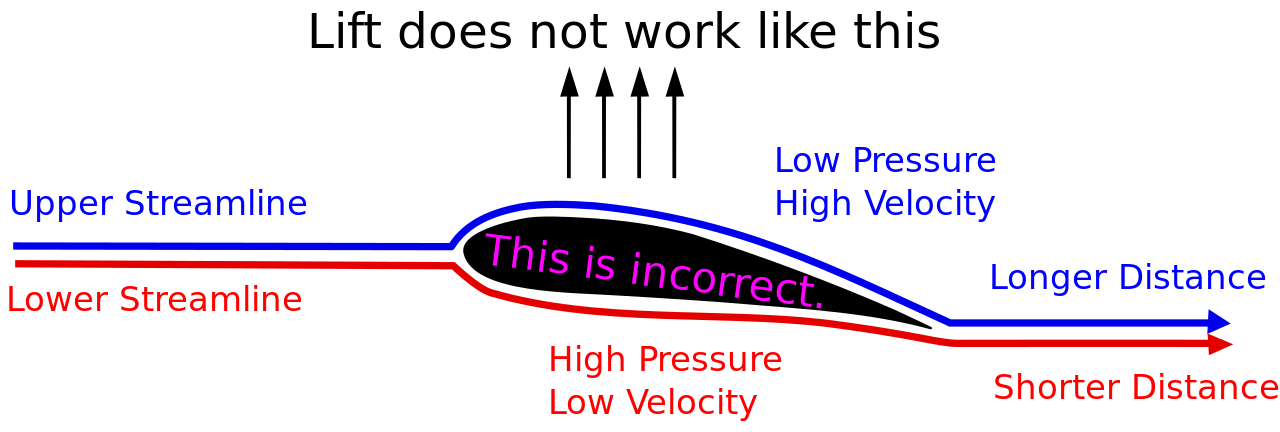
- The lift force is not generated by the air taking the same time to travel above and below an aircraft's wing.[819] This misconception, sometimes called the equal transit-time fallacy, is widespread among textbooks and non-technical reference books, and even appears in pilot training materials. In fact, the air moving over the top of an aerofoil generating lift is always moving much faster than the equal transit theory would imply,[819] as described in the incorrect and correct explanations of lift force.
- Blowing over a curved piece of paper does not demonstrate Bernoulli's principle. Although a common classroom experiment is often explained this way,[820] Bernoulli's principle only applies within a flow field, and the air above and below the paper is in different flow fields.[821] The paper rises because the air follows the curve of the paper and a curved streamline will develop pressure differences perpendicular to the airflow.[822][823]
- The Coriolis effect does not cause water to consistently drain from basins in a clockwise/counter-clockwise direction depending on the hemisphere. The common myth often refers to the draining action of flush toilets and bathtubs. In fact, rotation is determined by whatever minor rotation is initially present at the time the water starts to drain, as the magnitude of the coriolis acceleration is negligibly small compared to the inertial acceleration of flow within a typical basin.[824]
- Neither gyroscopic forces nor geometric trail are required for a rider to balance a bicycle or for it to demonstrate self-stability.[825][826] Although gyroscopic forces and trail can be contributing factors, it has been demonstrated that those factors are neither required nor sufficient by themselves.[825]
- A penny dropped from the Empire State Building would not kill a person or crack the sidewalk. A penny is too light and has too much air resistance to acquire enough speed to do much damage since it reaches terminal velocity after falling about 50 feet. Heavier or more aerodynamic objects could cause significant damage if dropped from that height.[827][828]
- Using a programmable thermostat's setback feature to limit heating or cooling in a temporarily unoccupied building does not waste as much energy as leaving the temperature constant. Using setback saves energy (5–15%) because heat transfer across the surface of the building is roughly proportional to the temperature difference between its inside and the outside.[829][830]
- It is not possible for a person to completely submerge in quicksand, as commonly depicted in fiction,[831] although sand entrapment in the nearshore of a body of water can be a drowning hazard as the tide rises.[832]
- Quantum nonlocality caused by quantum entanglement does not allow faster-than-light communication or imply instant action at a distance, despite its common characterization as "spooky action at a distance". Rather, it means that certain experiments cannot be explained by local realism.[833][834]
- The slipperiness of ice is not due to pressure melting. While it is true that increased pressure, such as that exerted by someone standing on a sheet of ice, will lower the melting point of ice, experiments show that the effect is too weak to account for the lowered friction. Materials scientists still debate whether premelting or the heat of friction is the dominant cause of ice's slipperiness.[835][836]
Psychology and neuroscience
- Cannabis use in pregnancy is not low risk. The THC exposure resulting from cannabis use affects fetal brain development and the male offspring of cannabis users are, as a result, more susceptible to psychotic illness.[837] As of 2022, 70% of American women thought it was safe.[838]
- True photographic memory (the ability to remember endless images, particularly pages or numbers, with such a high degree of precision that the image mimics a photo) has never been demonstrated to exist in any individual,[839] although a small number of young children have eidetic memory, where they can recall an object with high precision for a few minutes after it is no longer present.[840] Many people have claimed to have a photographic memory, but those people have been shown to have high precision memories as a result of mnemonic devices rather than a natural capacity for detailed memory encoding.[841] There are rare cases of individuals with exceptional memory, but none of them have a memory that mimics that of a camera.
- The phase of the Moon does not influence fertility, cause a fluctuation in crime, or affect the stock market. There is no correlation between the lunar cycle and human biology or behavior. However, the increased amount of illumination during the full moon may account for increased epileptic episodes, motorcycle accidents, or sleep disorders.[842]
Mental disorders
- Vaccines do not cause autism. There have been no successful attempts to reproduce fraudulent research by British ex-doctor Andrew Wakefield, where the misconception likely originates. Wakefield's research was ultimately shown to have been manipulated.[843]
- Dyslexia is not defined or diagnosed as mirror writing or reading letters or words backwards.[844][845] Mirror writing and reading letters or words backwards are behaviors seen in many children (dyslexic or not) as they learn to read and write.[844][845] Dyslexia is a neurodevelopmental disorder of people who have at least average intelligence and who have difficulty in reading and writing that is not otherwise explained by low intelligence.[846]
- Self-harm is not generally an attention-seeking behavior. People who engage in self-harm are typically very self-conscious of their wounds and scars and feel guilty about their behavior, leading them to go to great lengths to conceal it from others.[847] They may offer alternative explanations for their injuries, or conceal their scars with clothing.[848][849]
- There is no evidence that a chemical imbalance or neurotransmitter deficiency is the sole factor in depression and other mental disorders, but rather a combination of biological, psychological, and social factors.[850][851]
- Schizophrenia is characterized by continuous or relapsing episodes of psychosis. Major symptoms include hallucinations (typically hearing voices), delusions, paranoia, and disorganized thinking. Other symptoms include social withdrawal, decreased emotional expression, and apathy.[852] The term was coined from the Greek roots schizein and phrēn, "to split" and "mind", in reference to a "splitting of mental functions" seen in schizophrenia, not a splitting of the personality.[853] It does not involve split or multiple personalities—a split or multiple personality is dissociative identity disorder.[854]
Brain
- Broad generalizations are often made in popular psychology about certain brain functions being lateralized, or more predominant in one hemisphere than the other. These claims are often inaccurate or overstated.[855]
- The human brain, particularly the prefrontal cortex, does not reach "full maturity" or "full development" at any particular age (e.g. 16, 18, 21, 25, 30). Changes in structure and myelination of gray matter are recorded to continue with relative consistency all throughout life including until death. Different mental abilities peak earlier or later in life.[856] The myth is believed to have originated from Jay Giedd's work on the adolescent brain funded by the National Campaign to Prevent Teen Pregnancy,[857] though it has also been popularized by Laurence Steinberg in his work with adolescent criminal reform who has considered ages 10–25 to constitute cognitive adolescence, despite denying any connection to the notion of the brain maturing at '25'.[858]
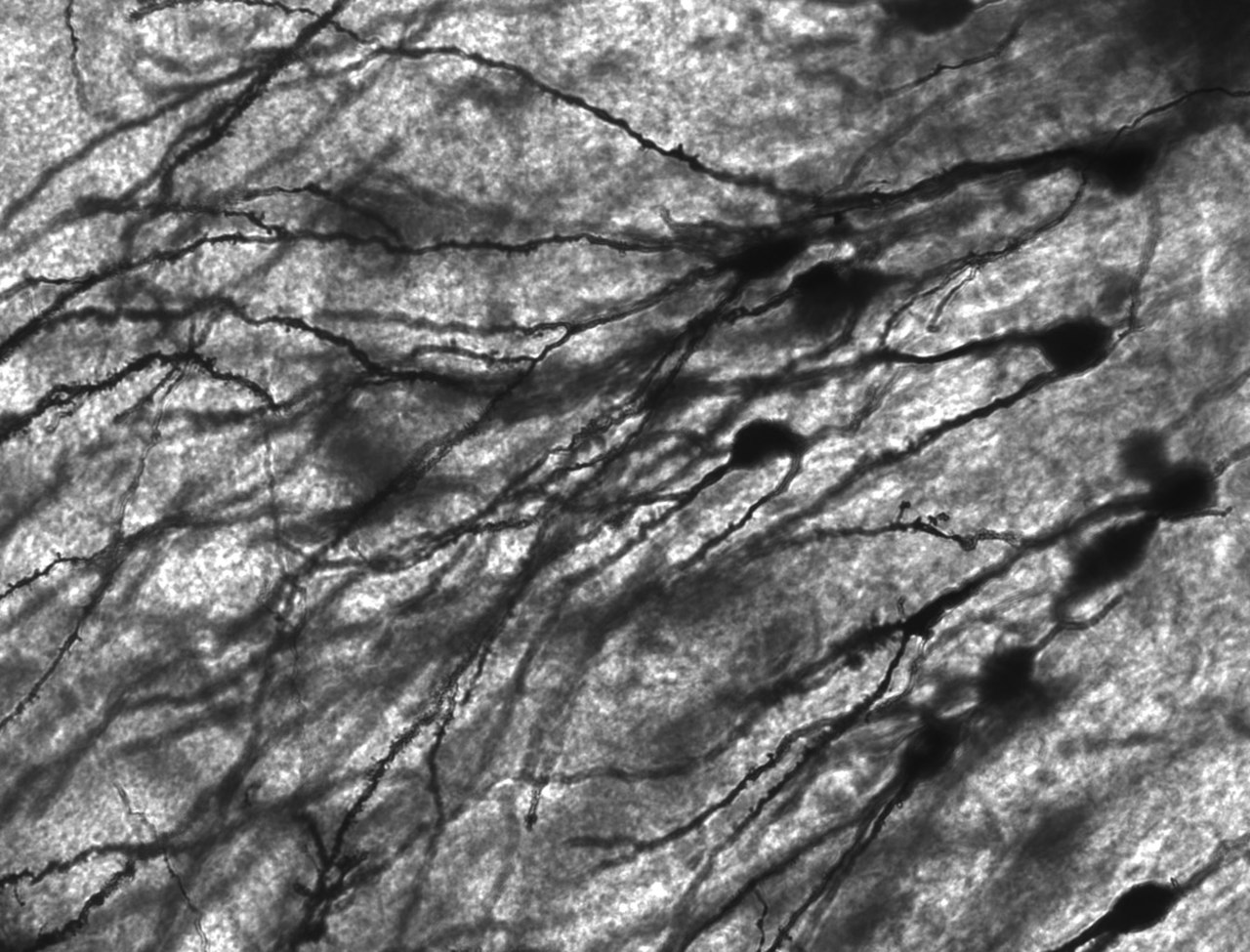
- Humans do not generate all of the brain cells they will ever have by the age of two years. Although this belief was held by medical experts until 1998, it is now understood that new neurons can be created after infancy in some parts of the brain into late adulthood.[859]
- People do not use only 10% of their brains.[860][861] While it is true that a small minority of neurons in the brain are actively firing at any one time, a healthy human will normally use most of their brain over the course of a day, and the inactive neurons are important as well. The idea that activating 100% of the brain would allow someone to achieve their maximum potential and/or gain various psychic abilities is common in folklore and fiction,[861][862][863] but doing so in real life would likely result in a fatal seizure.[864][865] This misconception was attributed to late 19th century leading thinker William James, who apparently used the expression only metaphorically.[862]
- Although Phineas Gage's brain injuries, caused by a several-foot-long tamping rod driven completely through his skull, caused him to become temporarily disabled, many fanciful descriptions of his aberrant behavior in later life are without factual basis or contradicted by known facts.[866]
Senses

- Humans have more than the commonly cited five senses. The number of senses in various categorizations ranges from 5 to more than 20. In addition to sight, smell, taste, touch, and hearing, which were the senses identified by Aristotle, humans can sense balance and acceleration (equilibrioception), pain (nociception), body and limb position (proprioception or kinesthetic sense), and relative temperature (thermoception).[867] Other senses sometimes identified are the sense of time, echolocation, itching, pressure, hunger, thirst, fullness of the stomach, need to urinate, need to defecate, blood carbon dioxide (CO2) levels,[868] and electric field sensation.[869]
- All different tastes can be detected on all parts of the tongue by taste buds,[870] with slightly increased sensitivities in different locations depending on the person; the tongue map showing the contrary is fallacious.[871]
- There are not four primary tastes, but five: in addition to bitter, sour, salty, and sweet, humans have taste receptors for umami, which is a "savory" or "meaty" taste.[872] Fat does interact with specific receptors in taste bud cells, but whether it is a sixth primary taste remains inconclusive.[873]
- The human sense of smell is not weak or underdeveloped. Humans have similar senses of smell to other mammals, and are more sensitive to some odors than rodents and dogs.[874]
Toxicology
- Smokeless tobacco is not a "safe" alternative to conventional tobacco; smokeless tobacco products contain nicotine and are therefore highly addictive.[875] They also can cause various harmful effects such as dental disease, oral cancer, oesophagus cancer, and pancreas cancer, coronary heart disease, as well as negative reproductive effects including stillbirth, premature birth and low birth weight.[875][876]
- Swallowing gasoline does not generally require special emergency treatment, as long as it goes into the stomach and not the lungs; inducing vomiting can make it worse.[877]
- A chloroform-soaked rag cannot instantly incapacitate a person.[878] It takes at least five minutes of inhaling an item soaked in chloroform to render a person unconscious. Most criminal cases involving chloroform also involve another drug being co-administered, such as alcohol or diazepam, or the victim being found to have been complicit in its administration. The misconception that chloroform can be used as an incapacitating agent[879] has been popularized by crime fiction authors.
- Although bananas contain naturally occurring radioactive isotopes, particularly potassium-40 (40K), which emit ionizing radiation when undergoing radioactive decay, the levels of such radiation are far too low to induce radiation poisoning, and bananas are not a radiation hazard. It would not be physically possible to eat enough bananas to cause radiation poisoning, as the radiation dose from bananas is non-cumulative.[880][881][882] (See also: Banana equivalent dose)
- Ingesting Visine, a brand of eye drops, does not cause diarrhea. It is neurotoxic, with consumption causing several serious side-effects. Pranks spiking people with Visine rose after the misconception was popularized by the film Wedding Crashers.[883][884]
Transportation
- The Bermuda Triangle does not have any more shipwrecks or mysterious disappearances than most other waterways.[885]
- Toilet waste is never intentionally jettisoned from an aircraft. All waste is collected in tanks and emptied into toilet waste vehicles.[886] Blue ice is caused by accidental leakage from the waste tank. Passenger train toilets, on the other hand, have indeed historically flushed onto the tracks; modern trains in most developed countries usually have retention tanks on board and therefore do not dispose of waste in such a manner.
- Automotive batteries stored on a concrete floor do not discharge any faster than they would on other surfaces, in spite of a worry that concrete harms batteries.[887] Early batteries with porous, leaky cases may have been susceptible to moisture from floors, but for many years lead–acid car batteries have had impermeable polypropylene cases.[888] While most modern automotive batteries are sealed, and do not leak battery acid when properly stored and maintained,[889] the sulfuric acid in them can leak out and stain, etch, or corrode concrete floors if their cases crack or tip over or their vent-holes are breached by floods.[890]
See also
References
- ^ a. "Legal Tender Status". Resource Center. U.S. Department of the Treasury. January 4, 2011. Archived from the original on January 24, 2017. Retrieved January 27, 2017.
b. "Is it legal for a business in the United States to refuse cash as a form of payment?". Board of Governors of the Federal Reserve System. Federal Reserve System. June 17, 2011. Archived from the original on January 21, 2017. Retrieved January 27, 2017.
c. "What is A "Legal Tender Law"? And, is It a Problem?". Forbes. Archived from the original on June 3, 2018. - ^ VanHooker, Brian (October 27, 2020). "The True Story Behind Adidas' 'All Day I Dream About Sex' (And Other Bogus Brand Acronyms)". MEL Magazine. Archived from the original on April 3, 2023. Retrieved June 28, 2022.
- ^ "Pop Culture Dictionary: Adidas". Dictionary.com. April 23, 2018. Archived from the original on November 29, 2023. Retrieved June 22, 2024.
- ^ Myre, Greg (February 28, 2018). "A Brief History Of The AR-15". NPR. Archived from the original on May 13, 2023. Retrieved July 7, 2024.
- ^ Palma, Bethania (September 9, 2019). "Does 'AR' in AR-15 Stand for 'Assault Rifle'?". Snopes. Retrieved July 7, 2024.
- ^ Mikkelson, Barbara and David (March 19, 2011). "Don't Go Here". Snopes. Archived from the original on June 14, 2019. Retrieved October 3, 2015.
- ^ a. Mikkelson, David (December 18, 2008). "Did Coca-Cola Invent the Modern Image of Santa Claus?". Snopes. Archived from the original on May 24, 2012. Retrieved July 7, 2024.
b. "Coca-Cola's Santa Claus: Not The Real Thing!". BevNET.com. December 18, 2006. Archived from the original on October 26, 2012. Retrieved January 19, 2007.
c. Boissoneault, Lorraine (December 19, 2018). "A Civil War Cartoonist Created the Modern Image of Santa Claus as Union Propaganda". Smithsonian. Retrieved June 21, 2024. - ^ Bayley, Stephen (February 7, 2015). "The art of Coke". The Spectator. Retrieved June 19, 2024.
- ^ Mikkelson, Barbara (May 2, 1999). "Was the Coca-Cola Bottle Design an Accident?". Snopes. Retrieved June 19, 2024.
- ^ a. Rodriguez, Ashley (August 29, 2017). "Netflix was founded 20 years ago today because Reed Hastings was late returning a video". Quartz. Archived from the original on April 4, 2023. Retrieved July 7, 2024.
b. Keating, Gina (September 24, 2013). "Prologue". Netflixed: The Epic Battle for America's Eyeballs. Portfolio. pp. 3–4. ISBN 978-1-59184-659-8.
c. Carey, Alexis (January 18, 2020). "True story behind Netflix's rise – and the downfall of Blockbuster". The New Zealand Herald. Archived from the original on April 4, 2023. Retrieved June 28, 2022.
d. Castillo, Michelle (May 23, 2017). "Reed Hastings' story about the founding of Netflix has changed several times". CNBC. Archived from the original on November 2, 2017. Retrieved July 1, 2022. - ^ Lewis, Flora (May 10, 1989). "Foreign Affairs; Soviets Buy American". The New York Times. Archived from the original on January 5, 2021. Retrieved July 7, 2024.
- ^ Musgrave, Paul (November 27, 2021). "The Doomed Voyage of Pepsi's Soviet Navy". Foreign Policy. Archived from the original on January 18, 2023. Retrieved July 7, 2024.
- ^ Clarke, Kaiyah (May 24, 2022). "Fact Check: NO Pepsi Navy – U.S.-Soviet Deal Did NOT Make Pepsi The '6th Most Powerful Military In The World'". Lead Stories. Archived from the original on March 30, 2023. Retrieved June 24, 2022.
- ^ Ewbank, Anne (January 12, 2018). "When the Soviet Union Paid Pepsi in Warships". Atlas Obscura. Archived from the original on February 7, 2021. Retrieved July 7, 2024.
- ^ a. "Does searing meat really seal in moisture?". Cookthink.com. Archived from the original on December 14, 2013. Retrieved August 29, 2009.
b. McGee, Harold (2004). On Food and Cooking (2nd ed.). Scribner. p. 161. ISBN 978-0-684-80001-1. - ^ "The Truth About Braising". America's Test Kitchen. Archived from the original on December 5, 2022. Retrieved June 24, 2024.
- ^ Lopez-Alt, J Kenji (2015). "Soups, Stews, and the Science of Stock". The Food Lab: Better Home Cooking Through Science. America: W. W. Norton & Company. ISBN 978-0-393-08108-4. Retrieved June 24, 2024.
- ^ Marino, Melissa (June 2007). "Blue Mussels: An Open and Shut Case" (PDF). FISH. Fisheries Research and Development Corporation. Archived (PDF) from the original on June 18, 2024. Retrieved June 19, 2024.
- ^ Kruszelnicki, Karl (October 29, 2008). "Mussel myth an open and shut case". Australian Broadcasting Corporation. Retrieved June 18, 2024.
- ^ Tomky, Naomi (April 2018). "A Guide to Clam Types and What to Do With Them". Serious Eats. Retrieved June 21, 2024.
- ^ Sagon, Candy (April 13, 2005). "Twinkies, 75 Years and Counting". The Washington Post. Archived from the original on June 28, 2011. Retrieved August 30, 2011.
- ^ a. Kelley, Tina (March 23, 2000). "Twinkie Strike Afflicts Fans With Snack Famine". The New York Times. Archived from the original on September 4, 2011. Retrieved February 10, 2012. b. Greenfieldboyce, Nell (October 15, 2020). "A Disturbing Twinkie That Has, So Far, Defied Science". All Things Considered. Archived from the original on October 23, 2020. Retrieved July 7, 2024.
- ^ a. "Food Product Dating". United States Department of Agriculture. Archived from the original on December 1, 2020. Retrieved July 7, 2024. b. Abrahamian, Atossa Araxia (September 19, 2013). "Harvard study finds food expiration labels are misleading". Reuters. Archived from the original on December 13, 2022. Retrieved July 7, 2024.
- ^ Tana, Sara (July 26, 2021). "8 Food Storage Mistakes That Are Costing You Money". Allrecipes.com. Retrieved June 24, 2024.
- ^ Gritzer, Daniel (February 28, 2023). "Does Refrigeration Really Ruin Bread?". Serious Eats. Retrieved June 24, 2024.
- ^ Olaechea, Carlos (June 14, 2023). "Refrigerating Bread Isn't Always Bad". EatingWell. Retrieved July 6, 2024.
- ^ Sertich Velie, Marissa (August 10, 2018). "The Serious Eats Guide to Sugar". Serious Eats. Archived from the original on May 27, 2024. Retrieved June 24, 2024.
- ^ Pearson, Gwen (March 7, 2014). "What Do You Do With Crystallized Honey?". Wired. Archived from the original on June 14, 2023. Retrieved June 24, 2024.
- ^ "New Mexico State University – College of Agriculture and Home Economics (2005)". Archived from the original on May 4, 2007.
- ^ Tandon, G L; Dravid, S V; Siddappa, G S (January 1964). "Oleoresin of Capsicum (Red Chilies)—Some Technological and Chemical Aspects". Journal of Food Science. 29 (1): 2. doi:10.1111/j.1365-2621.1964.tb01683.x. ISSN 0022-1147.
- ^ a b c Vreeman, Rachel C; Carroll, Aaron E (December 20, 2007). "Medical myths". The BMJ. 335 (7633): 1288–9. doi:10.1136/bmj.39420.420370.25. PMC 2151163. PMID 18156231.
- ^ "Caffeine Content of Coffee: Dark Roast vs. Light Roast". America's Test Kitchen. Retrieved June 24, 2024.
- ^ Lipka, Mitch (March 27, 2014). "Your money: Getting the biggest caffeine buzz for your buck". Reuters. Retrieved June 24, 2024.
- ^ Kiniry, Laura (June 13, 2013). "Where Bourbon Really Got Its Name and More Tips on America's Native Spirit". Smithsonian. Archived from the original on February 24, 2024. Retrieved June 24, 2024.
- ^ Minnick, Fred (October 23, 2015). "Is Kentucky the Home of Bourbon?". Whisky Magazine. No. 131. Retrieved June 24, 2024.
- ^ Carroll, James R (May 9, 2024). "Congress resolution marks bourbon's unique status". Courier Journal. Retrieved June 24, 2024.
- ^ Sullivan, Michael (September 12, 2023). "How to Clean and Season Cast-Iron Cookware". Wirecutter. Retrieved June 24, 2024.
- ^ McManus, Lisa (February 15, 2022). "Is It OK to Use Soap on Cast Iron?". America's Test Kitchen. Retrieved June 24, 2024.
- ^ Mikkelson, Barbara (October 5, 2002). "Sushi Definition". Snopes. Retrieved June 19, 2024.
- ^ Francis, Ali (December 1, 2021). "Allspice Is the Berry—Yes, Berry—That Can Do It All". Bon Appetit. Archived from the original on April 8, 2024. Retrieved June 24, 2024.
- ^ Mincey, Rai (February 24, 2021). "What is Allspice?". Allrecipes.com. Retrieved June 24, 2024.
- ^ "Allspice: Etymology". Oxford English Dictionary. Retrieved June 24, 2024.
- ^ Smith, Craig S (April 6, 2005). "The Raw Truth: Don't Blame the Mongols (or Their Horses)". The New York Times. Archived from the original on April 26, 2022. Retrieved July 7, 2024.
- ^ Jack, Albert (September 6, 2011). What Caesar Did for My Salad: The Curious Stories Behind Our Favorite Foods. Penguin. p. 143. ISBN 978-1-101-55114-1.
- ^ Dickie, John (2008). Delizia!: The Epic History of the Italians and Their Food. New York: Free Press. p. 48. ISBN 978-0-7432-7799-0.
- ^ Serventi, Silvano; Sabban, Françoise (2002). Pasta: The Story of a Universal Food [La Pasta: Storia e cultura di un cibo universale]. Translated by Shugaar, Antony. New York: Columbia University Press. p. 10. ISBN 0-231-12442-2.
- ^ a. Freedman, Paul (2012). Claflin, Kyri; Scholliers, Peter (eds.). Writing Food History: A Global Perspective. London: Berg Publishers. p. 24. ISBN 978-1-84788-809-9.
b. Dalby, Andrew (2000). Dangerous Tastes: The Story of Spices. University of California Press. p. 156. ISBN 978-0-520-23674-5.
c. Jotischky, Andrew (2011). A Hermit's Cookbook: Monks, Food and Fasting in the Middle Ages. Bloomsbury. p. 170. ISBN 978-1-4411-5991-5.
d. Krondl, Michael (2007). The Taste of Conquest: The Rise and Fall of the Three Great Cities of Spice. Ballantine Books. p. 6. ISBN 978-0-345-48083-5. - ^ a. Ketcham Wheaton, Barbara (2011). Savoring the Past: The French Kitchen and Table from 1300 to 1789. Atria Publishing Group. pp. 43–51. ISBN 978-1-4391-4373-5. Retrieved July 7, 2024.
b. Mennell, Stephen (1996). All Manners of Food: Eating and Taste in England and France from the Middle Ages to the Present (2nd ed.). University of Illinois Press. pp. 65–66, 69–71. ISBN 978-0-252-06490-6. Retrieved July 7, 2024.
c. Campanini, Antonella (December 18, 2018). The New Gastronome: The Illusive Story Of Catherine de' Medici: A Gastronomic Myth. Archived from the original on December 29, 2020. Retrieved September 19, 2020. Summarizing Campanini, Antonella; Bienassis, Loïc (2018). "La reine à la fourchette et autres histoires. Ce que la table française emprunta à l'Italie: analyse critique d'un mythe". In Quellier, Florent; Briost, Pascal (eds.). La Table de la Renaissance: Le mythe italien. Presses universitaires de Rennes. ISBN 978-2-7535-7406-9. - ^ "Histoire – La chantilly, un dessert de légende". RTBF (in French). July 15, 2021. Archived from the original on January 3, 2024. Retrieved July 7, 2024.
- ^ a. Tebben, Maryann Bates (2014). Sauces: A Global History. London: Reaktion Books. pp. 99–100. ISBN 978-1-78023-413-7. Retrieved July 7, 2024.
b. "Histoire de la Crème Chantilly". Château de Chantilly. Archived from the original on April 16, 2013. Retrieved July 7, 2024. - ^ Foreman, Amanda (December 9, 2021). "The Many Inventors of Champagne". The Wall Street Journal. Retrieved June 26, 2024.
- ^ Kladstrup, Don; Kladstrup, Petie (2005). "Chapter 1: The Monarch and the Monk". Champagne: How the World's Most Glamorous Wine Triumphed Over War and Hard Times. New York: William Morrow and Company. ISBN 978-0-06-073792-4.
- ^ Mikkelson, Barbara (November 10, 2000). "Potato Chip Origin". Snopes. Archived from the original on January 21, 2022. Retrieved July 7, 2024.
- ^ Fox, William S.; Banner, Mae G. (April 1983). "Social and Economic Contexts of Folklore Variants: The Case of Potato Chip Legends". Western Folklore. 42 (2): 114–126. doi:10.2307/1499968. JSTOR 1499968.
- ^ McElwain, Aoife (June 17, 2019). "Did Tayto really invent cheese and onion crisps?". The Irish Times. Archived from the original on June 17, 2019. Retrieved July 7, 2024.
- ^ Burhans, Dirk E (2008). "Creation Myths". Crunch!: A History of the Great American Potato Chip. University of Wisconsin Press. pp. 17–20. ISBN 978-0-299-22770-8.
- ^ a b Krampner, Jon (2013). Creamy and Crunchy: An Informal History of Peanut Butter, the All-American Food. Columbia University Press. p. 42. ISBN 978-0-231-16233-3.
- ^ a b "Who Invented Peanut Butter?". National Peanut Board. Archived from the original on November 25, 2016. Retrieved June 24, 2022.
- ^ Wheeling, Kate (January 2021). "A Brief History of Peanut Butter". Smithsonian. Archived from the original on June 18, 2022. Retrieved July 7, 2024.
- ^ Cannon, William (February 6, 2017). "A True Renaissance Man". American Scientist. Archived from the original on April 3, 2023. Retrieved June 24, 2022.
- ^ Lee, Jennifer 8 (January 16, 2008). "Solving a Riddle Wrapped in a Mystery Inside a Cookie". The New York Times. Archived from the original on April 18, 2012. Retrieved July 7, 2024.
- ^ Mikkelson, Barbara (May 21, 2008). "Origin of Fortune Cookies". Snopes. Retrieved July 7, 2024.
- ^ Birrell, Nicki (July 4, 2024). "Caesar Centenary: What's the story behind the famous salad?". The New Zealand Herald. Retrieved July 10, 2024.
- ^ O'Conner, Patricia T; Kellerman, Stewart (2009). Origins of the Specious: Myths and Misconceptions of the English Language. New York: Random House. p. 75. ISBN 978-1-4000-6660-5.
- ^ LeClair, Catherine (August 5, 2020). "How the Oreo cookie went from unknown knock-off to the world's most popular cookie, as a result of a sibling rivalry between baker brothers". Business Insider. Archived from the original on July 6, 2022. Retrieved July 6, 2022.
- ^ Rhoades, Christopher (January 19, 2008). "The Hydrox Cookie Is Dead, and Fans Won't Get Over It". The Wall Street Journal. Archived from the original on March 12, 2015. Retrieved July 7, 2024.
- ^ Technical Resources International, Inc (November 1994). "Summary of Data For Chemical Selection: Isoamyl Acetate" (PDF). National Toxicology Program. United States Department of Health and Human Services. Archived (PDF) from the original on May 22, 2023. Retrieved April 2, 2023.
- ^ Baraniuk, Chris. "The secrets of fake flavours". BBC. Archived from the original on March 21, 2024. Retrieved July 30, 2022.
- ^ Mayer, Johanna (September 27, 2017). "Why Don't Banana Candies Taste Like Real Bananas?". Science Friday. Archived from the original on February 4, 2024. Retrieved July 7, 2024.
- ^ Soltysiak, Michal; Celuch, Malgorzata; Erle, Ulrich (June 2011). "Measured and simulated frequency spectra of the household microwave oven". 2011 IEEE MTT-S International Microwave Symposium. pp. 1–4. doi:10.1109/MWSYM.2011.5972844. ISBN 978-1-61284-754-2.
- ^ Bloomfield, Louis. "Question 1456". How Everything Works. Archived from the original on October 17, 2013. Retrieved February 9, 2012.
- ^ Baird, Christopher S. (October 15, 2014). "Why are the microwaves in a microwave oven tuned to water". Science Questions with Surprising Answers. Canyon, TX: West Texas A&M University. Retrieved July 7, 2024.
- ^ "Microwave Technology Penetration Depths". pueschner.com. Püschner GMBH + CO KG MicrowavePowerSystems. Archived from the original on March 4, 2023. Retrieved June 1, 2018.
- ^ "Cooking with Microwave Ovens". Food Safety and Inspection Service. U.S. Department of Agriculture. Retrieved July 7, 2024.
- ^ "Resources for You (Radiation-Emitting Products): Microwave Oven Radiation". Food and Drug Administration. FDA Center for Devices and Radiological Health. December 12, 2017. Archived from the original on November 24, 2014. Retrieved July 7, 2024.
- ^ Frei, MR; Jauchem, JR; Dusch, SJ; Merritt, JH; Berger, RE; Stedham, MA (1998). "Chronic, low-level (1.0 W/kg) exposure of mice prone to mammary cancer to 2450 MHz microwaves". Radiation Research. 150 (5): 568–76. Bibcode:1998RadR..150..568F. doi:10.2307/3579874. JSTOR 3579874. PMID 9806599.
- ^ Frei, MR; Berger, RE; Dusch, SJ; Guel, V; Jauchem, JR; Merritt, JH; Stedham, MA (1998). "Chronic exposure of cancer-prone mice to low-level 2450 MHz radiofrequency radiation". Bioelectromagnetics. 19 (1): 20–31. doi:10.1002/(SICI)1521-186X(1998)19:1<20::AID-BEM2>3.0.CO;2-6. PMID 9453703.
- ^ Komaroff, Anthony L (June 12, 2015). "Ask the doctor: Microwave's impact on food". Harvard Health Publishing. Harvard University. Archived from the original on April 14, 2023. Retrieved July 7, 2024.
- ^ Harmetz, Aljean (1992). Round Up the Usual Suspects: The Making of Casablanca – Bogart, Bergman, and World War II. Hyperion. p. 72. ISBN 978-1-56282-761-8.
- ^ a. Sklar, Robert (1992). City Boys: Cagney, Bogart, Garfield. New Jersey: Princeton University Press. p. 135. ISBN 978-0-691-04795-9.
b. Mikkelson, Barbara and David P. (August 17, 2007). "The Blaine Truth". Snopes. Retrieved March 25, 2012. - ^ Maher, John (October 8, 2020). "10 Tragically, Irretrievably Lost Pieces of Animation History". Vulture. Archived from the original on June 22, 2022. Retrieved July 7, 2024.
- ^ Sisterson, Dennis (March 28, 2017). "Magic Wilderness: El Apóstol & Peludópolis". Skwigly. Archived from the original on December 3, 2021. Retrieved June 22, 2022.
- ^ Bendazzi, Giannalberto (2017). "The First Feature Length Animated Film in History". Twice the First: Quirino Cristiani and the Animated Feature Film. CRC Press. p. 36. ISBN 978-1-351-37179-7. Archived from the original on April 3, 2023. Retrieved March 19, 2023.
On the other hand, the movie was not widely successful, and appealed to a small portion of the population. It was strictly for a Buenos Aires audience: nobody in the provinces even saw it because it was not distributed there. And likewise, given the subject, it was not possible to export the film to other nations, not even to a close cousin similar to Uruguay.
- ^ "Snow White colored animation celluloid". National Museum of American History. Retrieved September 23, 2023.
- ^ Higgins, Scott (2000). "Demonstrating Three-Colour Technicolor: "Early Three-Colour Aesthetics and Design"". Film History. 12 (4): 358–383. doi:10.2979/FIL.2000.12.3.358 (inactive September 25, 2024). ISSN 0892-2160. JSTOR 3815345.
{{cite journal}}: CS1 maint: DOI inactive as of September 2024 (link) - ^ "First Color Movie – Everything You Need to Know". Nashville Film Institute. February 28, 2022. Retrieved June 18, 2024.
- ^ Oldfield, Molly; Mitchinson, John (May 5, 2011). "QI: Quite interesting facts about Spain". The Daily Telegraph. Archived from the original on January 11, 2022. Retrieved July 7, 2024.
- ^ Erichsen, Gerald (January 11, 2019). "Did a Royal Edict Give Spaniards a Lisp?". ThoughtCo. Dotdash Meredith. Retrieved May 1, 2020.
- ^ a. Lewis, M. Paul; Simons, Gary F.; Fennig, Charles D., eds. (2013). "Deaf sign language". Ethnologue: Languages of the World (17th ed.). SIL International. Archived from the original on November 26, 2013. Retrieved December 3, 2013.
b. Supalla, Ted; Webb, Rebecca (2013). "The grammar of international sign: A new look at pidgin languages.". In Reilly, Judy Snitzer; Emmorey, Karen (eds.). Language, Gesture, and Space. Psychology Press. pp. 333–52. ISBN 978-1-134-77966-6. Archived from the original on January 21, 2023. Retrieved February 16, 2017.
c. Omar, Hasuria Che (2009). The Sustainability of the Translation Field. ITBM. p. 293. ISBN 978-983-42179-6-9. Archived from the original on January 21, 2023. Retrieved February 21, 2017. - ^ a b Zimmer, Benjamin (March 27, 2007). "Crisis = danger + opportunity: The plot thickens". Language Log. Archived from the original on January 26, 2021. Retrieved January 19, 2009.
- ^ a. Adams, Cecil (November 3, 2000). "Is the Chinese word for "crisis" a combination of "danger" and "opportunity"?". The Straight Dope. Archived from the original on January 22, 2016. Retrieved July 7, 2024.
b. Mair, Victor H. "danger + opportunity ≠ crisis: How a misunderstanding about Chinese characters has led many astray". pinyin.info. Archived from the original on February 2, 2021. Retrieved July 7, 2024. - ^ "Where does the word "Gringo" come from?". The Yucatan Times. April 27, 2018. Archived from the original on March 22, 2022. Retrieved June 11, 2022.
- ^ Sayers, William (May 20, 2009). "An Unnoticed Early Attestation of gringo 'Foreigner': Implications for Its Origin". Bulletin of Spanish Studies. 86 (3): 323–330. doi:10.1080/14753820902937946.
- ^ Ramirez, Aida (August 7, 2013). "Who, Exactly, Is A Gringo?". NPR. Archived from the original on December 22, 2021. Retrieved July 7, 2024.
- ^ "Gringo". American Heritage Dictionary of the English Language. Houghton Mifflin Harcourt. Archived from the original on May 14, 2013. Retrieved July 7, 2024.
- ^ "Is 'Irregardless' a Real Word?". Merriam-Webster. Archived from the original on May 16, 2022. Retrieved June 11, 2022.
- ^ "Definition: irregardless". Merriam-Webster. Archived from the original on May 8, 2014. Retrieved July 7, 2024.
- ^ "Prepositions, Ending a Sentence with". Merriam-Webster. Archived from the original on April 10, 2024. Retrieved May 23, 2024.
- ^ Thompson, Oliver (February 28, 2024). "Why Merriam-Webster says it's OK to end a sentence in a preposition". Canadian Broadcasting Corporation. Archived from the original on March 13, 2024. Retrieved June 16, 2024.
- ^ Fogarty, Mignon (2011). The Ultimate Writing Guide for Students. New York: Henry Holt & Company. pp. 17–18. ISBN 978-0-8050-8944-8.
- ^ a. Jackson, Janice Eurana (1998). Linguistic aspect in African-American English-speaking children: An investigation of aspectual "be" (Dissertation thesis). University of Massachusetts Amherst. ISBN 978-0-591-96032-7. ProQuest 304446674. Archived from the original on July 8, 2024. Retrieved July 7, 2024.
b. "African American English". PBS. Archived from the original on September 30, 2012. Retrieved July 7, 2024. - ^ a b c Mikkelson, Barbara (June 13, 2008). "420". Snopes. Archived from the original on October 19, 2009. Retrieved June 17, 2011.
- ^ "Title 11. Of Crimes Against the Public Peace [403 - 420.1]: 420". leginfo.legislature.ca.gov. Retrieved July 7, 2024.
- ^ a b Harper, Douglas (2010). "Crap". Online Etymology Dictionary. Archived from the original on April 27, 2014. Retrieved July 7, 2024.
- ^ "Crap". American Heritage Dictionary of the English Language. Houghton Mifflin Harcourt. 2001. Archived from the original on January 21, 2013. Retrieved June 17, 2011.
- ^ a b Sheidlower, Jesse (2009). "Introduction". The F-Word (3rd ed.). New York: Oxford University Press. ISBN 978-0-19-539311-8.
- ^ a b c a. Mikkelson, Barbara (July 8, 2007). "What the Fuck?". Snopes. Archived from the original on April 25, 2012. Retrieved June 17, 2011.
b. Mikkelson, Barbara (July 9, 2007). "Pluck Yew". Snopes. Archived from the original on April 25, 2012. Retrieved June 17, 2011. - ^ Sheidlower, Jesse (Autumn 1998). "Revising the F-Word". Verbatim: The Language Quarterly. 23 (4): 18–21.
- ^ a b Kelly, Henry Ansgar (September 1994). "Rule of Thumb and the Folklaw of the Husband's Stick" (PDF). Journal of Legal Education. 44 (3): 341–65. JSTOR 42893341. Archived (PDF) from the original on September 24, 2015. Retrieved May 23, 2024.
- ^ O'Conner & Kellerman 2009, pp. 123–126.
- ^ Mikkelson, David (March 11, 2001). "Why Are Blue Laws Called 'Blue Laws'?". Snopes. Retrieved June 25, 2024.
- ^ Cheung, Iva (May 25, 2015). "Sacré Bleu! Why Is Blue the Most Profane Color?". Slate. Retrieved June 25, 2024.
- ^ Brians, Paul (2011). "Common Errors in English Usage – Ye". Common Errors in English Usage. Washington State University. Archived from the original on May 31, 2013. Retrieved July 7, 2024.
- ^ Harper, Douglas (2001–2010). "Etymology Online". Online Etymology Dictionary. Archived from the original on April 27, 2014. Retrieved June 24, 2011.
- ^ Hill, Will (June 30, 2020). "Chapter 25: Typography and the printed English text" (PDF). The Routledge Handbook of the English Writing System. Taylor & Francis. pp. 6, 15. ISBN 978-0-367-58156-5. Archived from the original (PDF) on July 10, 2022.
- ^ Zimmer, Ben (April 23, 2018). "'Wop' Doesn't Mean What Andrew Cuomo Thinks It Means". The Atlantic. Retrieved June 22, 2024.
- ^ Harper, Douglas (October 25, 2017). "Ingenious Trifling". Online Etymology Dictionary. Retrieved June 16, 2024.
- ^ a b O'Conner & Kellerman 2009, pp. 77, 145.
- ^ "wop". The American Heritage Dictionary of the English Language (5th ed.). HarperCollins.
- ^ Bratcher, Dennis (December 3, 2007). "The Origin of "Xmas"". CRI / Voice, Institute. Archived from the original on May 30, 2013. Retrieved June 10, 2011.
- ^ "X". Oxford English Dictionary (Online ed.). Oxford University Press. 1921. doi:10.1093/OED/9635674512. Retrieved July 7, 2024. (Subscription or participating institution membership required.)
- ^ "Xmas". Oxford English Dictionary (Online ed.). Oxford University Press. 2020. doi:10.1093/OED/7290422930. Retrieved July 7, 2024. (Subscription or participating institution membership required.)
- ^ O'Donnell J (2022). "Men's Rights Activism and the Manosphere". Gamergate and Anti-Feminism in the Digital Age. Palgrave Macmillan. pp. 9–61. doi:10.1007/978-3-031-14057-0_2. ISBN 978-3-031-14056-3.
- ^ a. Benedictus, Leo (March 23, 2015). "Gum control: how Lee Kuan Yew kept chewing gum off Singapore's streets". The Guardian. Archived from the original on February 10, 2023. Retrieved July 9, 2022.
b. Rajah, Jothie (January 1, 2014). "Flogging Gum: Cultural Imaginaries and Postcoloniality in Singapore's Rule of Law". Law Text Culture. 18 (1): 135–165. ISSN 1322-9060. Archived from the original on March 10, 2023. Retrieved July 9, 2022.
c. Brown, Lauren (March 1, 2012). "How To Travel In Singapore Without Getting Caned". Business Insider. Archived from the original on October 21, 2022. Retrieved July 9, 2022. - ^ Gilsinan, Kathy (May 12, 2014). "Interpol at 100: Does the World's Police Force Work?". The Atlantic. Archived from the original on April 16, 2023. Retrieved April 2, 2022.
- ^ Lee, Michael. "Interpol hopes physical border security will solve virtual borders". ZDNet. Archived from the original on January 29, 2023. Retrieved April 7, 2022.
- ^ Brunvand, Jan Harold (January 1, 2012). Encyclopedia of Urban Legends. ABC-CLIO. p. 288. ISBN 978-1-59884-720-8. Archived from the original on January 21, 2023. Retrieved November 10, 2018.
- ^ Boks, Ed (October 6, 2010). "The truth about black cats and Halloween". The Daily Courier. Prescott, Arizona. Archived from the original on March 22, 2012. Retrieved October 10, 2010.
- ^ a. Sparks, Preston; Cox, Timothy (November 17, 2008). "Missing persons usually found". Augusta Chronicle. Archived from the original on December 14, 2013. Retrieved May 21, 2011.
b. "FAQs: Question: Do you need to wait 24 hours before reporting a person missing?". National Missing Persons Coordination Center, Australian Federal Police. Archived from the original on September 23, 2008. Retrieved May 22, 2011.
c. Vongkiatkajorn, Kanyakrit. "NYPD: How The Police Handles Missing Persons Cases". NYCity News Service. Archived from the original on April 4, 2023. Retrieved June 25, 2022. - ^ "Report or find a missing person". Gov.uk. June 3, 2013. Archived from the original on January 22, 2014. Retrieved August 18, 2013.
- ^ "Why the first 72 hours in a missing persons investigation are the most critical, according to criminology experts". ABC News. Archived from the original on March 12, 2023. Retrieved June 11, 2022.
- ^ Gramlich, John (November 20, 2020). "What the data says (and doesn't say) about crime in the United States". Pew Research. Archived from the original on February 18, 2021. Retrieved February 19, 2021.
- ^ "Gun homicides steady after decline in '90s; suicide rate edges up". Pew Research. October 21, 2015. Archived from the original on September 3, 2019. Retrieved September 4, 2019.
- ^ Immigrants are less likely to commit crimes than U.S.-born Americans, studies find MARCH 8, ALL THINGS CONSIDERED Jasmine Garsd https://www.npr.org/2024/03/08/1237103158/immigrants-are-less-likely-to-commit-crimes-than-us-born-americans-studies-find Archived May 16, 2024, at the Wayback Machine
- ^ a b Light, Michael T.; He, Jingying; Robey, Jason P. (2020). "Comparing crime rates between undocumented immigrants, legal immigrants, and native-born US citizens in Texas". Proceedings of the National Academy of Sciences. 117 (51): 32340–32347. Bibcode:2020PNAS..11732340L. doi:10.1073/pnas.2014704117. PMC 7768760. PMID 33288713.
- ^ The mythical tie between immigration and crime Stanford Institute for Economic Policy Research (SIEPR) Krysten Crawford July 21, 2023 https://siepr.stanford.edu/news/mythical-tie-between-immigration-and-crime Archived May 21, 2024, at the Wayback Machine
- ^ Willingham, AJ (September 6, 2018). "The First Amendment doesn't guarantee you the rights you think it does". CNN. Archived from the original on March 1, 2019. Retrieved March 1, 2019.
- ^ McGregor, Jena (August 8, 2017). "The Google memo is a reminder that we generally don't have free speech at work". The Washington Post. Archived from the original on January 25, 2020. Retrieved March 1, 2019.
- ^ Dunn, Christopher (April 28, 2009). "Column: Applying the Constitution to Private Actors (New York Law Journal)". New York Civil Liberties Union. Archived from the original on December 2, 2013. Retrieved January 27, 2017.
- ^ Berman-Gorvine, Martin (May 19, 2014). "Employer Ability to Silence Employee Speech Narrowing in Private Sector, Attorneys Say". Bloomberg BNA. Archived from the original on March 31, 2019. Retrieved March 1, 2019.
- ^ Imwinkelried and Blinka, Criminal Evidentiary Foundations, 2d ed. (Lexis 2007) ISBN 978-1-4224-1741-6 at 620.
- ^ "Can a case be dismissed if a person is not read his/her Miranda rights?". Patrick Barone. September 10, 2021. Archived from the original on July 14, 2022. Retrieved September 10, 2021.
- ^ "Snopes on Entrapment". Snopes.com. March 12, 1998. Retrieved August 29, 2009.
- ^ Larson, Aaron. "What is Entrapment". ExpertLaw. Archived from the original on October 26, 2017. Retrieved June 18, 2024.
- ^ Timm, Trevor (November 2, 2012). "It's Time to Stop Using the 'Fire in a Crowded Theater' Quote". The Atlantic. Archived from the original on August 15, 2023. Retrieved June 20, 2020.
- ^ Volokh, Eugene (May 11, 2015). "Shouting fire in a crowded theater". Washington Post. Archived from the original on March 20, 2023. Retrieved June 20, 2020.
- ^ "5 Military Myths Busted". Military.com. May 8, 2012. Retrieved June 23, 2024.
- ^ a. Powers, Rod (November 24, 2019). "Can a Judge Order Someone to Join the Military or Go to Jail?". The Balance. Archived from the original on December 30, 2017. Retrieved December 30, 2017.
b. Schogol, Jeff (February 3, 2006). "Judge said Army or jail, but military doesn't want him". Stars and Stripes. Archived from the original on December 30, 2017. Retrieved December 30, 2017.
c. Garnett, Benjamin (January 21, 2022). "Guest columnist: Time to join military or go to jail is over". The State Journal (Kentucky). Retrieved June 23, 2024. - ^ Mikkelson, David (October 30, 2014). "Death Row Inmate Asks for a Child As His Last Meal, Texas DOC Plan to Grant Request?". Snopes. Retrieved June 25, 2024.
- ^ Beam, Christopher (November 10, 2009). "I'll Have 24 Tacos and the Filet Mignon". Slate. Retrieved June 25, 2024.
- ^ Paul E. Richardson, "The hot line (is a Hollywood myth)", in: Russian Life, September/October issue 2009, pp. 50–59.
- ^ Clavin, Tom (June 18, 2013). "There Never Was Such a Thing as a Red Phone in the White House". Smithsonian. Archived from the original on November 10, 2017. Retrieved September 21, 2014.
- ^ "Jimi Hendrix cleared of blame for UK parakeet release". BBC. December 13, 2019. Retrieved June 26, 2024.
- ^ Kaplan, Fred (February 11, 2021). "How Close Did the Capitol Rioters Get to the Nuclear "Football"?". Slate. Archived from the original on May 14, 2024. Retrieved June 25, 2024.
- ^ Dobbs, Michael (October 2014). "The Real Story of the "Football" That Follows the President Everywhere". Smithsonian. Retrieved June 25, 2024.
- ^ Craw, Victoria (January 4, 2018). "The nuclear button: Real or fake news?". The New Zealand Herald. Retrieved June 25, 2024.
- ^ Pogash, Carol (November 23, 2003). "Myth of the 'Twinkie defense'". San Francisco Chronicle. p. D-1. Archived from the original on June 11, 2012. Retrieved March 20, 2007.
The "Twinkie defense" is so ingrained in our culture that it appears in law dictionaries, in sociology textbooks, in college exams and in more than 2, 800 references on Google. Only a few of them call it what it is: a myth.
- ^ Mikkelson, David (October 30, 1999). "The Twinkie Defense: Debunking the Myths and Misinformation". Retrieved June 18, 2024.
"Twinkie defense" is now a widespread and commonly-recognized term. It is also a term based on something that never happened.
- ^ Colleen Long (May 5, 2016). "Cops seek killer of man who washed ashore in 'cement shoes'". CBS 3 Philadelphia. Associated Press. Archived from the original on May 18, 2022. Retrieved August 11, 2018.
- ^ "'Cement shoes' found on NYC corpse". BBC News. May 5, 2016. Archived from the original on April 3, 2023. Retrieved August 5, 2021.
- ^ "Après deux ans de polémique, l'État "enterre" le général Bigeard". France 24 (in French). November 20, 2012. Archived from the original on July 6, 2022. Retrieved June 25, 2022.
- ^ Mikkelson, Barbara (June 9, 1999). "Have People Been Buried Alive?". Snopes.
- ^ Slominski, Elena (August 29, 2023). "Life of the death system: shifting regimes, evolving practices, and the rise of eco-funerals". Sustainability: Science, Practice and Policy. 19 (1): 7. Bibcode:2023SSPP...1943779S. doi:10.1080/15487733.2023.2243779.
- ^ Chiappelli, Jeremiah; Chiappelli, Ted (December 2008). "Drinking Grandma: The Problem of Embalming". Journal of Environmental Health. 71 (5): 25–26. JSTOR 26327817. PMID 19115720.
- ^ Knowles, Elizabeth (October 26, 2006). What They Didn't Say: A Book of Misquotations. OUP Oxford. ISBN 978-0-19-150054-1. Archived from the original on May 23, 2024. Retrieved January 26, 2022.
- ^ "200th anniversary of Mary Shelley's Frankenstein". Australian National University. September 12, 2018. Retrieved June 22, 2024.
- ^ Evans, Bergen (1962). Comfortable Words. New York City: Random House.
All dictionaries now recognize "a Frankenstein" as any monstrous creation that threatens to destroy its creator.
- ^ Garner, Bryan A. (1998). A dictionary of modern American usage. New York: Oxford University Press. ISBN 978-0-19-507853-4.
Today this ubiquitous usage must be accepted as standard
- ^ Haglund, David (January 31, 2013). "Did Hemingway Really Write His Famous Six-Word Story?". Slate. Retrieved June 23, 2024.
- ^ Churchwell, Sarah (June 23, 2019). "For sale, baby shoes, never worn — the myth of Ernest Hemingway's short story". The Times. Archived from the original on April 5, 2023. Retrieved April 5, 2023.
- ^ a. Brinkmann, Vinzenz (2008). "The Polychromy of Ancient Greek Sculpture". In Panzanelli, Roberta; Schmidt, Eike D.; Lapatin, Kenneth (eds.). The Color of Life: Polychromy in Sculpture from Antiquity to the Present. Los Angeles: The J. Paul Getty Museum and the Getty Research Institute. pp. 18–39. ISBN 978-0-89236-918-8.
b. Gurewitsch, Matthew (July 2008). "True Colors: Archaeologist Vinzenz Brinkmann insists his eye-popping reproductions of ancient Greek sculptures are right on target". Smithsonian.com. Smithsonian Institution. Archived from the original on July 26, 2020. Retrieved May 15, 2018.
c. Prisco, Jacopo (November 30, 2017). "'Gods in Color' returns antiquities to their original, colorful grandeur". CNN style. Archived from the original on June 17, 2022. Retrieved May 15, 2018. - ^ Talbot, Margaret (October 22, 2018). "The Myth of Whiteness in Classical Sculpture". The New Yorker. Archived from the original on April 11, 2023. Retrieved May 12, 2020.
- ^ Whiddington, Richard (February 20, 2024). "Art Bites: Michelangelo's Poem About How Much It Sucked to Paint the Sistine Chapel". Artnet. Retrieved June 25, 2024.
- ^ "Michelangelo". thesistinechapel.org. Archived from the original on May 9, 2024. Retrieved June 25, 2024.
- ^ Fineman, Mia (June 8, 2005). "The Most Famous Farm Couple in the World: Why American Gothic still fascinates Archived December 6, 2018, at the Wayback Machine". Slate.
- ^ "About This Artwork: American Gothic". The Art Institute of Chicago. Archived from the original on May 28, 2010. Retrieved June 20, 2010.
- ^ Sorensen, Jon (February 10, 2014). "Did the Vatican Outlaw "The Devil In Music?"". Catholic Answers. Archived from the original on July 8, 2022. Retrieved July 8, 2022.
- ^ Smith 1979, pp. 69–70.
- ^ a b Drabkin, William (2001). "Tritone". Grove Music Online. Oxford: Oxford University Press. doi:10.1093/gmo/9781561592630.article.28403. ISBN 978-1-56159-263-0. Archived from the original on May 23, 2024. Retrieved May 23, 2024. (subscription or UK public library membership required)
- ^ Solomon 1995, p. 587.
- ^ "Was Mozart actually poisoned by Salieri?". Classic fm. Archived from the original on April 3, 2023. Retrieved April 12, 2021.
- ^ a. Wolff, Christoph (2001). "Bach. III. 7. Johann Sebastian Bach. Works". In Sadie, Stanley; Tyrrell, John (eds.). The New Grove Dictionary of Music and Musicians (2nd ed.). London: Macmillan Publishers. ISBN 978-1-56159-239-5.
b. Williams, Peter F. (2007). J.S. Bach: A Life in Music. Cambridge University Press. p. 158.
c. Schulenberg, David (2006). The Keyboard Music of J.S. Bach. p. 448.
d. Schulze, Hans-Joachim (1979). "Ein 'Dresdner Menuett' im zweiten Klavierbüchlein der Anna Magdalena Bach. Nebst Hinweisen zur Überlieferung einiger Kammermusikwerke Bachs". Bach-Jahrbuch. 65: 45–64, 54–58, 64. doi:10.13141/bjb.v19791376. - ^ Rauscher, Frances H.; Shaw, Gordon L.; Ky, Catherine N. (1993). "Music and spatial task performance". Nature. 365 (6447): 611. Bibcode:1993Natur.365..611R. doi:10.1038/365611a0. PMID 8413624. S2CID 1385692. Archived from the original on January 23, 2021. Retrieved May 23, 2024.
- ^ William Pryse-Phillips (2003). Companion to Clinical Neurology. Oxford University Press. ISBN 0-19-515938-1., p. 611 defines the term as "Slight and transient improvement in spational[sic] reasoning skills detected in normal subjects as a result of exposure to the music of Mozart, specifically his sonata for two pianos (K448)."
- ^ Bridgett, D.J.; Cuevas, J. (2000). "Effects of listening to Mozart and Bach on the performance of a mathematical test". Perceptual and Motor Skills. 90 (3 Pt 2): 1171–1175. doi:10.2466/pms.2000.90.3c.1171. PMID 10939064. S2CID 35762220.
- ^ Thompson, W.F.; Schellenberg, E.G.; Husain, G. (2001). "Arousal, mood, and the Mozart effect". Psychological Science. 12 (3): 248–251. doi:10.1111/1467-9280.00345. PMID 11437309. S2CID 17641225.
- ^ Jones, Martin H.; West, Stephen D.; Estell, David B. (2006). "The Mozart effect: Arousal, preference, and spatial performance". Psychology of Aesthetics, Creativity, and the Arts. S (1): 26–32. doi:10.1037/1931-3896.S.1.26.
- ^ Steele, Kenneth M. (2000). "Arousal and mood factors in the "Mozart effect"" (PDF). Perceptual and Motor Skills. 91 (1): 188–190. doi:10.2466/pms.2000.91.1.188. PMID 11011888. S2CID 21977655. Archived from the original (PDF) on January 6, 2017. Retrieved November 4, 2015.
- ^ Frédéric Chopin; Joseph Banowetz (2000). Piano works. Alfred Music Publishing. p. 6. ISBN 978-0-7692-9854-2. Retrieved October 2, 2010.
- ^ Maurice Hinson (2004). The Pianist's Dictionary. Indiana University Press. p. 114. ISBN 978-0-253-21682-3. Retrieved October 2, 2010.
This piece bears an erroneous nickname since the story long associated with this nickname presumes the pianist is supposed to play the piece in one minute. The word "minute" means small or little waltz.
- ^ "How Do You Solve a Problem Like Maria?". Archived from the original on April 27, 2014. BBC.
- ^ Vilain, Robert (2010). Words and Music. MHRA. pp. 24, 28. ISBN 978-1-907322-08-2. Archived from the original on January 21, 2023. Retrieved May 14, 2017.
- ^ Krell, David (2020). The New York Mets in Popular Culture: Critical Essays. McFarland. ISBN 978-1-4766-8010-1. Archived from the original on May 23, 2024. Retrieved May 23, 2024.
- ^ "In 1977 Mike Nesmith Fooled the World: When The Monkees Sold More Records Than The Beatles and Rolling Stones Combined". Flashbak. September 18, 2017. Archived from the original on June 20, 2018. Retrieved November 9, 2017.
- ^ Cruickshank, Douglas (January 14, 2002). "Sympathy for the Devil". Salon.com. Archived from the original on March 3, 2016. Retrieved June 25, 2006.
- ^ Burks, John (February 7, 1970). "Rock & Roll's Worst Day". Rolling Stone. Archived from the original on April 22, 2009. Retrieved September 13, 2008.
- ^ a. Elicker, Martina (2001). "Concept Albums: Song Cycles in Popular Music". Word and Music Studies: Essays on the Song Cycle and on Defining the Field. Rodopi. pp. 231–234. ISBN 978-90-420-1565-4. b. McKnight-Trontz, Jennifer (1999). Exotiquarium: Album Art from the Space Age. St. Martin's Press. ISBN 978-0-312-20133-3. c. Welding, Pete. In the Wee Small Hours (Media notes). Capitol Records, 1998 CD release.
- ^ "Mama Cass 'didn't choke to death on a ham sandwich', daughter says". BBC News. May 6, 2024.
- ^ Barton A (May 6, 2024). "Mama Cass 'didn't choke to death' on ham sandwich". The Telegraph.
- ^ Zoladz, Lindsay (May 9, 2024). "Cass Elliot's Death Spawned a Horrible Myth. She Deserves Better". New York Times.
- ^ "Fact Check: In the Air Tonight". Snopes. Archived from the original on December 26, 2021. Retrieved August 8, 2019.
- ^ Butler, Jack (July 7, 2021). "The Myth of the 27 Club". National Review. Retrieved July 4, 2024.
- ^ McKinney, Kelsey (May 23, 2015). "Despite the Huge Myth, Musicians Don't Die at 27 — They Die at 56". Vox. Retrieved July 4, 2024.
- ^ Starkey, Arun (October 4, 2021). "Debunking the Central Myths of the '27 Club'". Far Out Magazine. Retrieved July 4, 2024.
- ^ Peterson, Christopher. "When Did the Buddha Become Fat?". Psychology Today. Archived from the original on May 23, 2024. Retrieved November 1, 2018.
- ^ Bromiley, Geoffrey W. (1995). The International Standard Bible Encyclopedia. Wm. B. Eerdmans Publishing. ISBN 978-0-8028-3781-3. Archived from the original on May 23, 2024. Retrieved May 18, 2011.
- ^ Dunn, James DG (2003). Jesus Remembered. Eerdmans Publishing. p. 324.
- ^ Boyle, Alan (December 19, 2006). "Revisiting the gospel truth". NBC News. Retrieved June 22, 2024.
- ^ Waxman, Olivia (December 29, 2020). "Here's What History Can Tell Us About the Magi". Time. Archived from the original on February 6, 2024. Retrieved June 22, 2024.
- ^ Mikkelson, David (November 7, 2000). "Fact Check: Three Wise Men". Snopes. Retrieved June 22, 2024.
- ^ Schiller, G. (1971). Iconography of Christian Art (English translation from German). Vol. I. Lund Humphries. p. 96. ISBN 978-0-85331-270-3.
- ^ Calvin, John. Calvin's Commentaries, Vol. 31: Matthew, Mark and Luke, Part I, tr. by John King. Archived from the original on September 6, 2008. Retrieved May 15, 2010. Quote from Commentary on Matthew 2:1–6
- ^ Ashby, Chad. "Magi, Wise Men, or Kings? It's Complicated Archived May 23, 2024, at the Wayback Machine." Christianity Today, December 16, 2016.
- ^ a b Ehrman, Bart D. (2006). Peter, Paul, and Mary Magdalene: The Followers of Jesus in History and Legend. Oxford, England: Oxford University Press. pp. 189–90. ISBN 978-0-19-530013-0. Archived from the original on January 19, 2023. Retrieved October 18, 2020.
- ^ a b Spong, John Shelby (March 14, 2006). The Sins of Scripture: Exposing the Bible's Texts of Hate to Reveal the God of Love. HarperOne. p. 108. ISBN 978-0-06-077840-8.
- ^ a. Marrow, Stanley B. (1986). Paul: His Letters and His Theology: an Introduction to Paul's Epistles. Paulist Press. pp. 5, 7. ISBN 978-0-8091-2744-3. Archived from the original on August 1, 2023. Retrieved June 3, 2016.
b. "Why did God change Saul's name to Paul?". Catholic Answers. Archived from the original on October 30, 2012. Retrieved August 31, 2014. - ^ "Religion & Ethics – Beliefs: The Immaculate Conception". BBC. 2009. Archived from the original on January 24, 2012. Retrieved January 5, 2011.
- ^ "Hopko, Thomas. The Winter Pascha Chapter 9, Antiochian Orthodox Christian Archdiocese of North America". Archived from the original on March 2, 2021. Retrieved May 23, 2024.
- ^ "Papal Infallibility". Catholic Answers. Archived from the original on June 6, 2009. Retrieved June 23, 2024.
- ^ MacDonald, David; Bonocore, Mark. "Is the Pope Sinless?". The Pope, Bishop of Rome Catholic and Orthodox relations. CatholicBridge.com. Archived from the original on June 15, 2011. Retrieved June 17, 2011.
- ^ "Catholic Encyclopedia: Beatification and Canonization". www.newadvent.org. Archived from the original on July 24, 2018. Retrieved August 22, 2016.
- ^ a. "Utah Local News – Salt Lake City News, Sports, Archive". The Salt Lake Tribune. Archived from the original on October 6, 2014. Retrieved October 1, 2014.
b. "Religions – Mormon: Polygamy". BBC. Archived from the original on November 13, 2014. Retrieved October 1, 2014.
c. "Mormon church explains polygamy in early days". The Big Story. Archived from the original on October 6, 2014. Retrieved October 1, 2014.
d. "Mormon Polygamy Misconceptions about Mormon Polygamy". Mormon Polygamy. Archived from the original on January 13, 2013. Retrieved October 1, 2014. - ^ The Church of Jesus Christ of Latter-Day Saints. "Do Mormons practice polygamy?". mormon.org. Archived from the original on October 6, 2014. Retrieved October 1, 2014.
- ^ a. "Current practice of polygamy in the Mormon movement". Archived from the original on June 29, 2009. Retrieved October 1, 2014.
b. "Modern Polygamy: Arizona Mormon Fundamentalists Seek to Shed Stereotypes". ABC News. March 14, 2014. Archived from the original on October 6, 2014. Retrieved October 1, 2014. - ^ Roos, Dave (February 24, 2020). "Who Decided Which Books to Include in the Bible?". HowStuffWorks. InfoSpace Holdings. Archived from the original on August 29, 2022. Retrieved August 29, 2022.
- ^ Cross, F. L.; Livingstone, E. A., eds. (January 1, 2005). "canon of Scripture". The Oxford Dictionary of the Christian Church (3rd ed.). Oxford University Press. p. 282. doi:10.1093/acref/9780192802903.001.0001. ISBN 978-0-19-280290-3. Archived from the original on October 1, 2012. Retrieved September 5, 2022.
- ^ "Rome's Conversion to Christianity and its Lasting Legacy | Rhodes Sites". Archived from the original on May 5, 2024. Retrieved May 23, 2024.
- ^ The Cambridge History of Christianity – Cambridge University Press "Christianity did not become the official religion of the empire under Constantine, as is often mistakenly claimed..." https://www.cambridge.org/core/books/abs/cambridge-history-of-christianity/constantine-and-the-peace-of-the-church/1D6492CD5ECB96174AAE1221F48DC56F Archived May 5, 2024, at the Wayback Machine
- ^ "The Seven Deadly Sins". Catholic Answers. Retrieved September 30, 2023.
- ^ "For pride is the root of all evil, of which it is said, as Scripture bears witness; Pride is the beginning of all sin. [Ecclus. 10, 1] But seven principal vices, as its first progeny, spring doubtless from this poisonous root, namely, vain glory, envy, anger, melancholy, avarice, gluttony, lust." Gregory the Great, Moralia in Iob, book XXXI
- ^ Vyver, James (March 7, 2014). "Explainer: Why do Muslim women wear a burka, niqab or hijab?". Australian Broadcasting Corporation. Retrieved June 17, 2024.
- ^ "U.S. Muslims Concerned About Their Place in Society, But Continue to Belief in the American Dream". Pew Research Center. July 26, 2017. Retrieved June 17, 2024.
- ^ a. Isbister, William H. (November 23, 2002). "A "good" fatwa". British Medical Journal. 325 (7374): 1227. doi:10.1136/bmj.325.7374.1227. PMC 1124693.
b. Vultee, Fred (October 2006). "Fatwa on the Bunny". Journal of Communication Inquiry. 30 (4): 319–336. doi:10.1177/0196859906290919. S2CID 143612009. - ^ "In Depth: Islam, Fatwa FAQ". CBC News Online. June 15, 2006. Archived from the original on July 14, 2011. Retrieved April 8, 2009.
- ^ a. Buckles, Luke (2004). The Complete Idiot's Guide to World Religions (3rd ed.). Alpha. p. 157. ISBN 978-1-59257-222-9. Archived from the original on November 1, 2023. Retrieved September 21, 2016.
b. "Western definition of "jihad" must be corrected – Italian expert". Kuwait News Agency (KUNA). March 29, 2007. Archived from the original on October 15, 2011. - ^ Safi, Louay M. (2003). Peace and the Limits of War: Transcending the Classical Conception of Jihad. International Institute of Islamic Thought. p. preface. ISBN 978-1-56564-402-1. Archived from the original on January 21, 2023. Retrieved September 21, 2016.
- ^ Hoque, M.; Jaim, M. S.; Mohamed, Y. (March 30, 2023). "The concept of jihad for education". International Journal of Language and Education. 2 (1): 83–95. doi:10.33102/alazkiyaa43. Archived from the original on May 23, 2024. Retrieved January 21, 2024.
- ^ al-Jalalayn. "Tafsir Ar-Rahman". Tafsir al-Jalalayn. Archived from the original on March 8, 2021. Retrieved April 30, 2020.
- ^ a b Warraq, Ibn (January 12, 2002). "Virgins? What virgins?". The Guardian. London. Archived from the original on June 22, 2013.
- ^ Anjali Nirmal (2009). Urban Terrorism: Myths and Realities. Pointer Publishers. p. 33. ISBN 978-81-7132-598-6.
- ^ Salahuddin Yusuf, Riyadhus Salihin, commentary on Nawawi, Chapter 372, Dar-us-Salam Publications (1999), ISBN 978-1-59144-053-6
- ^ a b Szpek, Heidi (2002). Voices from the University: The Legacy of the Hebrew Bible. iUniverse. p. 92. ISBN 978-0-595-25619-8.
- ^ a. Babylonian Talmud, Berakhot, 40a
b. Adams, Cecil (November 24, 2006). "Was the forbidden fruit in the Garden of Eden an apple?". The Straight Dope. Archived from the original on April 1, 2014. Retrieved February 9, 2012. - ^ Levine, Rabbi Menachem (October 7, 2018). "Judaism and Tattoos". aish.com. Archived from the original on October 7, 2018. Retrieved December 12, 2018.
- ^ Jastifer JR, McNitt AS, Mack CD, Kent RW, McCullough KA, Coughlin MJ, Anderson RB (2019). "Synthetic Turf: History, Design, Maintenance, and Athlete Safety". Sports Health (Review). 11 (1): 84–90. doi:10.1177/1941738118793378. PMC 6299344. PMID 30096021.
- ^ a b Mikkelson, Barbara (May 18, 2010). "Golf: Gentlemen Only, Ladies Forbidden?". Snopes. Archived from the original on June 23, 2022. Retrieved June 23, 2022.
- ^ a b Jerris, Rand. "FAQ – Golf History Questions". United States Golf Association. Archived from the original on September 4, 2022. Retrieved June 23, 2022.
- ^ a. Cole, Diane (October 4, 1990). "Contrary to myth, baseball may have had no single inventor". U.S. News & World Report. Archived from the original on December 14, 2013. Retrieved August 6, 2009.
b. Fox, Butterfield (October 4, 1990). "Cooperstown? Hoboken? Try New York City". The New York Times. Archived from the original on January 9, 2011. Retrieved April 3, 2009. - ^ VanBlaricum, Michael (August 29, 2010). "Black Belt Realities". USADojo.com. Retrieved June 24, 2024.
- ^ 柔道帯の最高位は、何と紅!? "紅帯"所持者に投げられてきた! (in Japanese). R25.jp. May 15, 2008. Archived from the original on May 19, 2008. Retrieved November 11, 2008.
- ^ Williams, Jack (February 17, 2017). "You Can Tell an F.A. Cup Champion by Its Corner Flags. Or Not". The New York Times. Archived from the original on January 25, 2020. Retrieved April 8, 2018.
- ^ Adhikari, Somak (June 6, 2018). "No, India Did Not Withdraw From The 1950 FIFA World Cup Because They Did Not Want To Wear Shoes". The Times of India. The Times Group. Archived from the original on January 25, 2020. Retrieved December 2, 2019.
- ^ "Violent video games found not to be associated with adolescent aggression". University of Oxford. February 13, 2019. Archived from the original on June 25, 2022. Retrieved June 25, 2022.
- ^ Etchells, Pete (April 6, 2019). "Five damaging myths about video games – let's shoot 'em up". The Guardian. Retrieved December 23, 2020.
- ^ Henry, Jenkins. "Reality Bytes: Eight Myths About Video Games Debunked". PBS. Archived from the original on August 26, 2004. Retrieved December 23, 2020.
- ^ "Misconceptions – Video Game Dissection". Pennsylvania State University. Retrieved December 23, 2020.
- ^ Markey, Patrick M.; Ferguson, Christopher J. (October 1, 2017). "Teaching Us to Fear: The Violent Video Game Moral Panic and the Politics of Game Research" (PDF). American Journal of Play: 99–115. Archived from the original (PDF) on June 29, 2021. Retrieved December 23, 2020.
- ^ Draper, Kevin (August 5, 2019). "Video Games Aren't Why Shootings Happen. Politicians Still Blame Them". The New York Times. Archived from the original on April 26, 2020. Retrieved August 22, 2019.
- ^ Plunkett, Luke (February 3, 2016). "Why Gandhi Is Such An Asshole In Civilization". Kotaku. Archived from the original on September 18, 2020. Retrieved June 22, 2022.
- ^ a b Meier, Sid (2020). "Funny Business". Sid Meier's Memoir!: A Life in Computer Games. W. W. Norton. pp. 261–266. ISBN 978-1-324-00587-2.
- ^ Артемий Леонов (September 5, 2019). Почему история о баге с «ядерным Ганди» в Civilization, скорее всего, выдумана [Why the story about the "Nuclear Gandhi" bug in Civilization is likely fictional]. DTF.ru (in Russian). Archived from the original on September 26, 2020. Retrieved June 22, 2022.
- ^ Jackson, Gina (August 11, 2016). "Gandhi Is Still An Asshole In Civilization VI". Kotaku. Archived from the original on September 18, 2020. Retrieved June 22, 2022.
- ^ Joe, Skrebels (April 22, 2020). "How Dragon Quest Spawned an Urban Legend". IGN. Archived from the original on April 14, 2022. Retrieved June 26, 2022.
- ^ a b Fox, Mark (2012). "Space Invaders targets coins". World Coin News. 39 (2). Krause Publications: 35–37. Archived from the original on February 26, 2023. Retrieved June 26, 2022.
- ^ a b Paradis, Charles (March 2014). "Insert Coin to Play: Space Invaders and the 100-Yen Myth". The Numismatist. American Numismatic Association: 46–48. Archived from the original on October 21, 2022. Retrieved June 26, 2022.
- ^ Parkin, Simon (October 17, 2013). "The Space Invader". The New Yorker. Archived from the original on May 19, 2022. Retrieved June 26, 2022.
- ^ a. Shaw, Johnathan (July–August 2003). "Who Built the Pyramids?". Harvard Magazine. Archived from the original on March 19, 2023. Retrieved August 14, 2022.
b. "Egypt tombs suggest pyramids not built by slaves". Reuters. January 10, 2010. Archived from the original on December 20, 2022. Retrieved August 14, 2022.
c. Weiss, Daniel (July–August 2022). "Journeys of the Pyramid Builders". Archaeology. Archaeological Institute of America. Archived from the original on March 14, 2023. Retrieved August 14, 2022.Based on the contents of the papyri, Tallet believes that at least some workers in the time of Khufu were highly skilled and well rewarded for their labor, contradicting the popular notion that the Great Pyramid was built by masses of oppressed slaves.
- ^ a b Watterson, Barbara (1997). "The Era of Pyramid-builders". The Egyptians. Blackwell. p. 63.
Herodotus claimed that the Great Pyramid at Giza was built with the labour of 100,000 slaves working in three-monthly shifts, a charge that cannot be substantiated. Much of the non-skilled labour on the pyramids was undertaken by peasants working during the Inundation season when they could not farm their lands. In return for their services they were given rations of food, a welcome addition to the family diet.
- ^ Kratovac, Katarina (January 12, 2010). "Egypt: New Find Shows Slaves Didn't Build Pyramids". U.S. News. Archived from the original on May 12, 2019. Retrieved August 14, 2022.
- ^ Casson, Lionel (1966). "Galley Slaves". Transactions and Proceedings of the American Philological Association. 97: 35–36. doi:10.2307/2936000. JSTOR 2936000.
- ^ Sargent, Rachel L (July 1927). "The Use of Slaves by the Athenians in Warfare II. In Warfare by Sea" (PDF). Classical Philology. 22 (3): 264–279. doi:10.1086/360910. JSTOR 262754 – via JSTOR.
- ^ Unger, Richard (1980). The ship in the medieval economy, 600-1600. London: Croom Helm. p. 37. ISBN 0-85664-949-X.
- ^ a. James Hamilton-Paterson, Carol Andrews, Mummies: Death and Life in Ancient Egypt, p. 191, Collins for British Museum Publications, 1978, ISBN 978-0-00-195532-5
b. Charlotte Booth, The Boy Behind the Mask, p. xvi, Oneword, 2007, ISBN 978-1-85168-544-8
c. Richard Cavendish, "Tutankhamun's Curse?", History Today 64:3 (3 March 2014 Archived April 3, 2023, at the Wayback Machine) - ^ a. Neer, Richard (2012). Art and Archaeology of the Greek World. Thames and Hudson. p. 37. ISBN 978-0-500-05166-5.
"...popular associations of the eruption with a legend of Atlantis should be dismissed...nor is there good evidence to suggest that the eruption...brought about the collapse of Minoan Crete
b. Manning, Stuart (2012). "Eruption of Thera/Santorini". In Cline, Eric (ed.). The Oxford Handbook of the Bronze Age Aegean. Oxford University Press. pp. 457–454. doi:10.1093/oxfordhb/9780199873609.013.0034. ISBN 978-0-19-987360-9.Marinatos (1939) famously suggested that the eruption might even have caused the destruction of Minoan Crete (also Page 1970). Although this simple hypothesis has been negated by the findings of excavation and other research since the late 1960s... which demonstrate that the eruption occurred late in the Late Minoan IA ceramic period, whereas the destructions of the Cretan palaces and so on are some time subsequent (late in the following Late Minoan IB ceramic period)
- ^ Sparkes A.W. (1988). "Idiots, Ancient and Modern". Australian Journal of Political Science. 23: 101–102. doi:10.1080/00323268808402051.
- ^ Oxford English Dictionary, s.v. Archived August 8, 2024, at the Wayback Machine
- ^ Winkler, Martin M. (2009). The Roman Salute: Cinema, History, Ideology. Columbus: Ohio State University Press. ISBN 978-0-8142-0864-9. p. 55
- ^ a b McKeown, J.C. (2010). A Cabinet of Roman Curiosities: Strange Tales and Surprising Facts from the World's Greatest Empire. Oxford University Press. pp. 153–54. ISBN 978-0-19-539375-0.
- ^ Fass, Patrick (1994). Around the Roman Table. University of Chicago Press. pp. 66–67. ISBN 978-0-226-23347-5. Archived from the original on January 21, 2023. Retrieved September 21, 2016.
- ^ a. Ridley, R.T. (1986). "To Be Taken with a Pinch of Salt: The Destruction of Carthage". Classical Philology. 81 (2): 140–146. doi:10.1086/366973. JSTOR 269786. S2CID 161696751.: "a tradition in Roman history well known to most students"
b. Stevens, Susan T. (1988). "A Legend of the Destruction of Carthage". Classical Philology. 83 (1): 39–41. doi:10.1086/367078. JSTOR 269635. S2CID 161764925.
c. Visona, Paolo (1988). "Passing the Salt: On the Destruction of Carthage Again". Classical Philology. 83 (1): 41–42. doi:10.1086/367079. JSTOR 269636. S2CID 162289604.: "this story... had already gained widespread currency"
d. Warmington, B.H. (1988). "The Destruction of Carthage: A Retractatio". Classical Philology. 83 (4): 308–10. doi:10.1086/367123. JSTOR 269510. S2CID 162850949.: "the frequently repeated story" - ^ "[A mother in the 1st century AD] could not survive the trauma of a Caesarean" Oxford Classical Dictionary, Third Edition, "Childbirth"
- ^ Wanjek, Christopher (April 7, 2003). Bad Medicine: Misconceptions and Misuses Revealed, from Distance Healing to Vitamin O. John Wiley & Sons. p. 5. ISBN 978-0-471-46315-3.
- ^ a. Lindberg, David C. (2003). "The Medieval Church Encounters the Classical Tradition: Saint Augustine, Roger Bacon, and the Handmaiden Metaphor". In Lindberg, David C.; Numbers, Ronald L. (eds.). When Science & Christianity Meet. Chicago: University of Chicago Press. p. 8.
b. Grant, Edward (2001). God and Reason in the Middle Ages. Cambridge. p. 9.
c. Peters, Ted (2005). "Science and Religion". In Jones, Lindsay (ed.). Encyclopedia of Religion (2nd ed.). Thomson Gale. p. 8182.
d. Snyder, Christopher A. (1998). An Age of Tyrants: Britain and the Britons A.D. 400–600. University Park: Pennsylvania State University Press. pp. xiii–xiv. ISBN 978-0-271-01780-8. - ^ Bitel LM (October 24, 2002). Women in Early Medieval Europe, 400-1100. Cambridge University Press. ISBN 978-0-521-59773-9.
- ^ "World Population Prospects 2019" (PDF). Population Division. U.N. Department of Economic and Social Affairs.
- ^ a b Wanjek, Christopher (2002). Bad Medicine: Misconceptions and Misuses Revealed, from Distance Healing to Vitamin O. Wiley. pp. 70–71. ISBN 978-0-471-43499-3.
- ^ ""Expectations of Life" by H.O. Lancaster as per". Archived from the original on September 4, 2012.
- ^ Scott, Robert A. (October 4, 2011). Miracle Cures: Saints, Pilgrimage, and the Healing Powers of Belief (1st ed.). Berkeley: University of California Press. pp. 10–11. ISBN 978-0-520-27134-0.
- ^ Kahn, Charles (2005). World History: Societies of the Past. Portage & Main Press. p. 9. ISBN 978-1-55379-045-7.
- ^ "Viking helmets". National Museum of Denmark.
In a battle situation, horns on a helmet would get in the way.
- ^ E. W. Gordon, Introduction to Old Norse (2nd edition, Oxford 1962) pp. lxix–lxx.
- ^ Evans, Andrew (June 2016). "Is Iceland Really Green and Greenland Really Icy?". National Geographic. Archived from the original on June 30, 2016.
- ^ a. Eirik the Red's Saga. Gutenberg.org. March 8, 2006. Archived from the original on May 11, 2011. Retrieved September 6, 2010.
b. "How Greenland Got Its Name". The Ancient Standard. December 17, 2010. Archived from the original on March 19, 2012. Retrieved January 24, 2020..
c. Grove, Jonathan (2009). "The place of Greenland in medieval Icelandic saga narrative". Journal of the North Atlantic. 2: 30–51. doi:10.3721/037.002.s206. S2CID 163032041. Archived from the original on April 11, 2012. - ^ "Is King Canute misunderstood?". BBC. May 26, 2011. Archived from the original on April 20, 2014.
- ^ Schild, Wolfgang (2000). Die eiserne Jungfrau. Dichtung und Wahrheit (Schriftenreihe des Mittelalterlichen Kriminalmuseums Rothenburg o. d. Tauber Nr. 3). Rothenburg ob der Tauber: Mittelalterl. Kriminalmuseum.
- ^ Guy, Neil (2011–2012). "The Rise of the Anticlockwise Newel Stair" (PDF). The Castle Studies Group Journal. 25: 114, 163. Archived (PDF) from the original on August 7, 2020. Retrieved May 12, 2020.
- ^ Wright, James (October 9, 2019). Guest Post: Busting Mediaeval Building Myths: Part One. History... the interesting bits!. Archived from the original on January 8, 2020. Retrieved February 24, 2020.
- ^ Ryder, Charles (2011). The spiral stair or vice: its origins, role and meaning in medieval stone castles (PhD). University of Liverpool. p. 294. Archived from the original on February 23, 2020. Retrieved May 12, 2020.
- ^ Breiding, Dirk. "Department of Arms and Armor, The Metropolitan Museum of Art". metmuseum.org. Archived from the original on April 26, 2014. Retrieved February 23, 2012.
- ^ "Cranes hoisting armored knights". Archived from the original on October 29, 2013. Retrieved October 23, 2013.
- ^ Keyser, Linda Migl (2008). "The Medieval Chastity Belt Unbuckled". In Harris, Stephen J.; Grigsby, Bryon L. (eds.). Misconceptions About the Middle Ages. Routledge.
- ^ a b "Busting a myth about Columbus and a flat Earth". Washington Post. Archived from the original on February 20, 2022. Retrieved September 29, 2018.
- ^ a. Meyer, Robinson (December 12, 2013). "No Old Maps Actually Say 'Here Be Dragons'". The Atlantic. Archived from the original on February 1, 2023. Retrieved June 24, 2022.
b. Van Duzer, Chet (June 4, 2014). "Bring on the Monsters and Marvels: Non-Ptolemaic Legends on Manuscript Maps of Ptolemy's Geography". Viator. 45 (2): 303–334. doi:10.1484/J.VIATOR.1.103923. ISSN 0083-5897.
c. Kim, Meeri (August 19, 2013). "Oldest globe to depict the New World may have been discovered". The Washington Post. Archived from the original on September 30, 2021. Retrieved July 2, 2022.The only other map or globe on which this specific phrase appears is what can arguably be called the egg's twin: the copper Hunt-Lenox Globe, dated around 1510 and housed by the Rare Book Division of the New York Public Library.
- ^ Louise M. Bishop (2010). "The Myth of the Flat Earth". In Stephen Harris; Bryon L. Grigsby (eds.). Misconceptions about the Middle Ages. Routledge. ISBN 978-1-135-98666-7. Archived from the original on August 8, 2024. Retrieved January 26, 2014.
- ^ "Columbus's Geographical Miscalculations". IEEE Spectrum: Technology, Engineering, and Science News. October 9, 2012. Archived from the original on October 3, 2018. Retrieved October 3, 2018.
- ^ a. Eviatar Zerubavel (2003). Terra cognita: the mental discovery of America. Transaction Publishers. pp. 90–91. ISBN 978-0-7658-0987-2. Archived from the original on January 21, 2023. Retrieved September 21, 2016.
b. Sale, Kirkpatrick (1991). The Conquest of Paradise: Christopher Columbus and the Columbian Legacy. Plume. pp. 204–09. ISBN 978-1-84511-154-0 – via Google Books. - ^ Wills, Matthew (January 17, 2020). The Mexica Didn't Believe the Conquistadors Were Gods Archived April 3, 2023, at the Wayback Machine. JSTOR. Retrieved January 19, 2020.
- ^ Pound, Cath (March 14, 2018). "When the Old Masters Were the P.R. Agents of the Rich and Powerful". The New York Times. Archived from the original on March 14, 2018. Retrieved June 26, 2024.
- ^ Higgins, Charlotte (June 22, 2007). "The old black". The Guardian. Retrieved June 26, 2024.
- ^ "Plymouth Colony Clothing". Web.ccsd.k12.wy.us. Archived from the original on October 22, 2013. Retrieved February 9, 2012.
- ^ a. Schenone, Laura (2004). A Thousand Years Over A Hot Stove: A History Of American Women Told Through Food, Recipes, And Remembrances. New York: W. W. Norton & Company. p. 118. ISBN 978-0-393-32627-7.
b. Wilson, Susan (2000). Literary Trail of Greater Boston. Boston: Houghton Mifflin Company. p. 23. ISBN 978-0-618-05013-0. Archived from the original on May 23, 2024. Retrieved April 18, 2021 – via Google Books. - ^ Brooks, Rebecca Beatrice (July 22, 2018). "What Did the Pilgrims Wear?". History of Massachusetts Blog. Rebecca Beatrice Brooks. Archived from the original on November 10, 2019. Retrieved November 10, 2019.
- ^ Mehta, Archit (December 24, 2021). "Fact-check: Did Shah Jahan chop off the hands of Taj Mahal workers?". Alt News. Archived from the original on August 12, 2022. Retrieved January 24, 2024.
- ^ Beg, M. Saleem (March 8, 2022). "Debunking an urban myth about Taj Mahal". The Hindu. ISSN 0971-751X. Archived from the original on July 9, 2023. Retrieved January 24, 2024.
- ^ S. Sharma, Manimugdha (October 22, 2017). "Busting the Taj fake news". The Times of India. ISSN 0971-8257. Archived from the original on October 4, 2023. Retrieved January 24, 2024.
- ^ "Newton's apple: The real story". New Scientist. January 18, 2010. Archived from the original on January 21, 2010. Retrieved May 10, 2010.
- ^ a. Rosenthal, Bernard (1995). Salem Story: Reading the Witch Trials of 1692. Cambridge University Press. p. 209. ISBN 978-0-521-55820-4. Archived from the original on January 21, 2023. Retrieved September 21, 2016.
b. Adams, Gretchen (2010). The Specter of Salem: Remembering the Witch Trials in Nineteenth-Century America. ReadHowYouWant.com. p. xxii. ISBN 978-1-4596-0582-4. Archived from the original on January 21, 2023. Retrieved September 21, 2016 – via Google Books.
c. Kruse, Colton (March 22, 2018). "Salem Never Burned Any Witches At The Stake". Ripley's Believe It or Not!. Archived from the original on December 3, 2022. Retrieved July 18, 2022. - ^ "Top 5 Marie Antoinette Scandals". history.howstuffworks.com. September 2, 2008. Archived from the original on September 4, 2012. Retrieved January 13, 2023.
- ^ "Washington's False Teeth Not Wooden". NBC News. January 27, 2005. Archived from the original on February 11, 2013. Retrieved August 29, 2009.
- ^ a b Etter, William M. "George Washington's Teeth Myth". www.mountvernon.org. Mount Vernon Ladies' Association. Archived from the original on January 10, 2024. Retrieved March 24, 2019.
- ^ Thompson, Mary V. "The Private Life of George Washington's Slaves". PBS. Archived from the original on June 25, 2014. Retrieved June 16, 2014.
- ^ "Teeth". George Washington's Mount Vernon. Archived from the original on December 5, 2023. Retrieved December 2, 2022.
- ^ "Declaration of Independence – A History". archives.gov. U.S. National Archives and Records Administration. Archived from the original on January 26, 2010. Retrieved April 4, 2011.
- ^ Crabtree, Steve (July 6, 1999). "New Poll Gauges Americans' General Knowledge Levels". Gallup News Service. Archived from the original on March 27, 2014. Retrieved January 13, 2011.
- ^ a. Lund, Nicholas (November 21, 2013). "Did Benjamin Franklin Really Say the National Symbol Should Be the Turkey?". Slate. Archived from the original on April 27, 2014. Retrieved November 22, 2013.
b. McMillan, Joseph (May 18, 2007). "The Arms of the United States: Benjamin Franklin and the Turkey". American Heraldry Society. Archived from the original on April 27, 2014. Retrieved November 24, 2013. - ^ a. Sick, Bastian (2004). Der Dativ ist dem Genetiv sein Tod (in German). Kiepenheuer & Witsch. pp. 131–135. ISBN 978-3-462-03448-6 – via Internet Archive.
b. "Willi Paul Adams: The German Americans. Chapter 7: German or English". Archived from the original on June 24, 2010.
c. "The German Vote". Snopes. July 9, 2007. Archived from the original on December 16, 2008. Retrieved August 31, 2013. - ^ a. Owen Connelly (2006). Blundering to Glory: Napoleon's Military Campaigns. Rowman & Littlefield. p. 7. ISBN 978-0-7425-5318-7.
b. Evans, Rod L. (2010). Sorry, Wrong Answer: Trivia Questions That Even Know-It-Alls Get Wrong. Penguin Books. ISBN 978-0-399-53586-4. Archived from the original on January 21, 2023. Retrieved December 31, 2011.
c. "Forget Napoleon – Height Rules". CBS News. February 11, 2009. Archived from the original on July 2, 2013. Retrieved December 31, 2011. - ^ a. "Fondation Napoléon". Napoleon.org. Archived from the original on April 17, 2014. Retrieved August 29, 2009.
b. "La taille de Napoléon" (in French). Archived from the original on September 12, 2009. Retrieved July 22, 2010. - ^ "Napoleon's Imperial Guard". Archived from the original on April 27, 2014.
- ^ a. "The nose of the Great Sphinx". britannica.com. Archived from the original on February 27, 2023. Retrieved November 27, 2022.
b. Feder, Kenneth L. (October 11, 2010). Encyclopedia of Dubious Archaeology: From Atlantis to the Walam Olum: From Atlantis to the Walam Olum. ABC-CLIO. ISBN 978-0-313-37919-2. Archived from the original on April 3, 2023. Retrieved December 18, 2022.
c. Zivie-Coche, Christiane (2002). Sphinx: History of a Monument. Cornell University Press. p. 16. ISBN 978-0-8014-3962-9. - ^ a. Lovgren, Stefan (May 5, 2006). "Cinco de Mayo, From Mexican Fiesta to Popular U.S. Holiday". National Geographic News. Archived from the original on July 9, 2007.
b. Lauren Effron (May 5, 2010). "Cinco de Mayo: NOT Mexico's Independence Day". Discovery Channel. Archived from the original on March 21, 2012. Retrieved May 5, 2011. - ^ a. "Hysteria". Welcome Collection. August 12, 2015. Archived from the original on August 8, 2018. Retrieved September 25, 2018.
b. King, Helen (2011). "Galen and the widow. Towards a history of therapeutic masturbation in ancient gynaecology". Eugesta, Journal of Gender Studies in Antiquity: 227–31.
c. "Victorian-Era Orgasms and the Crisis of Peer Review". The Atlantic. September 6, 2018. Archived from the original on September 20, 2018. Retrieved September 25, 2018.
d. "Why the Movie "Hysteria" Gets Its Vibrator History Wrong". Dildographer. May 4, 2012. Archived from the original on April 15, 2019. Retrieved September 25, 2018.
e. King, Helen (2011). "Galen and the widow. Towards a history of therapeutic masturbation in ancient gynaecology". Eugesta, Journal of Gender Studies in Antiquity: 206–08.
f. "Buzzkill: Vibrators and the Victorians (NSFW)". The Whores of Yore. Archived from the original on August 9, 2018. Retrieved September 25, 2018.
g. Riddell, Fern (November 10, 2014). "No, no, no! Victorians didn't invent the vibrator". The Guardian. Archived from the original on April 15, 2019. Retrieved September 25, 2018. - ^ a. Isaacson, Walter (April 5, 2007). "Making the Grade". Time. Archived from the original on March 29, 2014. Retrieved December 31, 2013.
- ^ Kruszelnicki, Karl (June 22, 2004). "Einstein Failed School". Australian Broadcasting Corporation. Archived from the original on April 27, 2014. Retrieved July 12, 2012.
- ^ a. López-Ortiz, Alex (February 20, 1998). "Why is there no Nobel in mathematics?". University of Waterloo. Archived from the original on February 17, 2023. Retrieved June 28, 2022.
b. Mikkelson, David (October 4, 2013). "No Nobel Prize for Math". Snopes. Archived from the original on November 12, 2021. Retrieved June 28, 2022.
c. Firaque, Kabir (October 16, 2019). "Explained: Why is there no mathematics Nobel? The theories, the facts, the myths". The Indian Express. Archived from the original on March 24, 2023. Retrieved June 28, 2022. - ^ Harris, Carolyn (December 27, 2016). "The Murder of Rasputin, 100 Years Later". Smithsonian Magazine. Archived from the original on October 15, 2023. Retrieved October 16, 2023.
- ^ "How was Russian mystic Rasputin murdered?". BBC. December 31, 2016. Archived from the original on October 31, 2023. Retrieved October 16, 2023.
- ^ Smith, Douglas (2016). "A Cowardly Crime". Rasputin: Faith, Power, and the Twilight of the Romanovs. Farrar, Straus and Giroux. pp. 590–592. ISBN 978-0-374-71123-8.
- ^ Cathcart, Brian (April 3, 1994). "Rear Window: Making Italy work: Did Mussolini really get the trains running on time". The Independent. London. Archived from the original on January 24, 2012. Retrieved September 3, 2010.
- ^ a. Ankerstjerne, Christian. "The myth of Polish cavalry charges". Panzerworld. Archived from the original on August 4, 2012. Retrieved April 5, 2011.
b. "The Mythical Polish Cavalry Charge". Polish American Journal. Polamjournal.com. July 2008. Archived from the original on September 24, 2012. Retrieved February 9, 2012. - ^ Nazi. In: Friedrich Kluge, Elmar Seebold: Etymologisches Wörterbuch der deutschen Sprache. 24. Auflage, Walter de Gruyter, Berlin/New York 2002, ISBN 3-11-017473-1 (Online Etymology Dictionary: Nazi Archived October 6, 2014, at the Wayback Machine).
- ^ a. Vilhjálmur Örn Vilhjálmsson. "The King and the Star – Myths created during the Occupation of Denmark" (PDF). Danish institute for international studies. Archived from the original (PDF) on July 16, 2011. Retrieved April 5, 2011.
b. "Some Essential Definitions & Myths Associated with the Holocaust". Center for Holocaust and Genocide Studies – University of Minnesota. Archived from the original on May 15, 2011. Retrieved April 5, 2011.
c. "King Christian and the Star of David". The National Museum of Denmark. Archived from the original on September 28, 2011. Retrieved February 21, 2017. - ^ a. Craig, Laura; Young, Kevin (2008). "Beyond White Pride: Identity, Meaning and Contradiction in the Canadian Skinhead Subculture*". Canadian Review of Sociology/Revue Canadienne de Sociologie. 34 (2): 175–206. doi:10.1111/j.1755-618x.1997.tb00206.x. Retrieved July 2, 2022.
b. Borgeson, Kevin; Valeri, Robin (Fall 2005). "Examining Differences in Skinhead Ideology and Culture Through an Analysis of Skinhead Websites". Michigan Sociological Review. 19: 45–62. JSTOR 40969104.
c. Lambert, Chris (November 12, 2017). "'Black Skinhead': The politics of New Kanye". Daily Dot. Retrieved July 2, 2022."Skinhead" was a term originally used to describe a 1960s British working-class subculture that revolved around fashion and music and that would heavily inspire the punk rock scene. While it has harmless roots, the skinhead movement fell into polemic politics. Nowadays, it's popularly associated with neo-Nazis, despite having split demographics of far-right, far-left, and apolitical.
- ^ Brown, Timothy S. (January 1, 2004). "Subcultures, Pop Music and Politics: Skinheads and "Nazi Rock" in England and Germany". Journal of Social History. 38 (1): 157–178. doi:10.1353/jsh.2004.0079. JSTOR 3790031. S2CID 42029805.
- ^ Cotter, John M. (1999). "Sounds of hate: White power rock and roll and the neo-nazi skinhead subculture". Terrorism and Political Violence. 11 (2): 111–140. doi:10.1080/09546559908427509. ISSN 0954-6553.
- ^ Shaffer, Ryan (2013). "The soundtrack of neo-fascism: youth and music in the National Front". Patterns of Prejudice. 47 (4–5): 458–482. doi:10.1080/0031322X.2013.842289. ISSN 0031-322X. S2CID 144461518.
- ^ Marc Leepson, "Five myths about the American flag" Archived 2017-07-15 at the Wayback Machine, The Washington Post, June 12, 2011, p. B2.
- ^ "The Lincoln Presidency: Last Full Measure of Devotion". rmc.library.cornell.edu.
- ^ Green, Joey (2005). Contrary to Popular Belief: More than 250 False Facts Revealed. Broadway. ISBN 978-0-7679-1992-0.
- ^ a b Stewart, Alicia W. (January 1, 2013). "150 years later, myths persist about the Emancipation Proclamation". CNN. Retrieved July 29, 2024.
- ^ a b Berlin, Ira; Fields, Barbara J.; Glymph, Thavolia; Reidy, Joseph P.; Rowland, Leslie S., eds. (1985). Freedom: A Documentary History of Emancipation, 1861-1867: Series 1, Volume 1: The Destruction of Slavery. Cambridge University Press. p. 69. ISBN 978-0-521-22979-1.
- ^ Foner, Eric (2010). The fiery trial: Abraham Lincoln and American slavery. New York: W. W. Norton. pp. 241–242. ISBN 978-0-393-06618-0. OCLC 601096674.
- ^ a. Haycox, Stephen (1990). "Haycox, Stephen. "Truth and Expectation: Myth in Alaska History". Northern Review. 6. Retrieved August 31, 2015.
b. Welch, Richard E. Jr. (1958). "American Public Opinion and the Purchase of Russian America". American Slavic and East European Review. 17 (4): 481–94. doi:10.2307/3001132. JSTOR 3001132.
c. Howard I. Kushner, "'Seward's Folly'?: American Commerce in Russian America and the Alaska Purchase". California Historical Quarterly (1975): 4–26. JSTOR 25157541.
d. "Biographer calls Seward's Folly a myth". The Seward Phoenix LOG. April 3, 2014. Archived from the original on June 22, 2017. Retrieved August 31, 2015.
e. Professor Preston Jones (Featured Speaker) (July 9, 2015). Founding of Anchorage, Alaska (Adobe Flash). C-SPAN. Retrieved December 22, 2017. - ^ Cook, Mary Alice (Spring 2011). "Manifest Opportunity: The Alaska Purchase as a Bridge Between United States Expansion and Imperialism" (PDF). Alaska History. 26 (1): 1–10.
- ^ "The Hat That Won the West". Retrieved February 10, 2010.
- ^ Snyder, Jeffrey B. (1997) Stetson Hats and the John B. Stetson Company 1865–1970. p. 50 ISBN 978-0-7643-0211-4
- ^ "The O'Leary Legend". Chicago History Museum. Archived from the original on January 10, 2011. Retrieved March 18, 2007.
- ^ a. Campbell, W. Joseph (2010). Getting it Wrong: Ten of the Greatest Misreported Stories in American Journalism. Berkeley: University of California Press. pp. 9–25. ISBN 978-0-520-26209-6 – via Internet Archive.
b. Campbell, W. Joseph (2003). Yellow Journalism: Puncturing the Myths, Defining the Legacies. Praeger. p. 72. ISBN 978-0-275-98113-6. - ^ "Did Edison really electrocute Topsy the Elephant". The Edison Papers. October 28, 2016. Archived from the original on November 13, 2013 – via Rutgers University.
- ^ Foss, Katherine (April 24, 2020). "#TyphoidMary – now a hashtag – was a maligned immigrant who got a bum rap". The Conversation.
- ^ "Why Your Family Name Was Not Changed at Ellis Island (and One That Was)". Archived from the original on December 8, 2015.
- ^ "Prohibition | Definition, History, Eighteenth Amendment, & Repeal". britannica.com. Retrieved October 24, 2022.
- ^ "Market Crash Eexacts a Toll in Suicides". Retrieved August 24, 2024.
- ^ a. Pooley, Jefferson; Socolow, Michael (October 28, 2013). "The Myth of the War of the Worlds Panic". Slate. Archived from the original on May 9, 2014. Retrieved November 24, 2013.
b. Campbell, W. Joseph (2010). Getting it wrong: ten of the greatest misreported stories in American Journalism. Berkeley: University of California Press. pp. 26–44. ISBN 978-0-520-26209-6 – via Google Books. - ^ Garber, Megan (June 15, 2014). "The Man Who Introduced the World to Flying Saucers". The Atlantic. Retrieved June 24, 2022.
- ^ Lacitis, Eric (June 24, 2017). "'Flying saucers' became a thing 70 years ago Saturday with sighting near Mount Rainier". The Seattle Times. Retrieved June 24, 2022.
- ^ Arnold, Kenneth (June 26, 1947). "12:15 news" (Radio). Interviewed by Smith, Ted. Pendleton, Oregon: KWRC.
- ^ {{#invokecite news ||last1=Meyer |first1=Dave |title=64th anniversary of flying saucers at Mt. Rainier |url=https://www.knkx.org/other-news/2011-06-24/64th-anniversary-of-flying-saucers-at-mt-rainier |access-date=18 July 2024 |work=KNKX Public Radio |date=24 June 2011 |language=en |quote=Arnold described the shiny objects as 'something like a pie plate that was cut in half with a sort of a convex triangle in the rear' and that they flew 'like a saucer if you skipped it across the water.' The term 'flying saucer' made it into a newspaper headline and the rest, as they say, is history.}}
- ^ a. "Florida: Anything Goes". Time. April 17, 1950. Archived from the original on June 24, 2013. Retrieved May 3, 2010.
b. Nohlgren, Stephen (November 29, 2003). "A born winner, if not a native Floridian". St. Petersburg Times. Archived from the original on October 5, 2012. Retrieved October 8, 2011. - ^ "Interstate Highway System - The Myths". Federal Highway Administration. Archived from the original on April 29, 2024. Retrieved June 24, 2024.
- ^ Laskow, Sarah (August 24, 2015). "Eisenhower and History's Worst Cross-Country Road Trip". Slate. Retrieved June 24, 2024.
- ^ "An Act of Courage, The Arrest Records of Rosa Parks". National Archives. August 15, 2015. Retrieved December 1, 2020.
- ^ a b Bass, Amy (2009). Those about Him Remained Silent: The Battle Over W.E.B. Du Bois. University of Minnesota Press. p. 155. ISBN 978-0-8166-4495-7.
- ^ a. "Renouncing citizenship is usually all about the Benjamins, say experts". Fox News. May 11, 2012. Retrieved May 18, 2015.
b. "Celebrities Who Renounced Their Citizenship". Huffington Post. February 1, 2012. Retrieved May 18, 2015.
c. Aberjhani, Sandra L. West (2003). Encyclopedia of the Harlem Renaissance. Infobase Publishing. p. 89. ISBN 978-1-4381-3017-0. - ^ Lewis, David (2009). W.E.B. Du Bois: A Biography. MacMillan. p. 841. ISBN 978-0-8050-8805-2.
- ^ a. Daum, Andreas W. (2007). Kennedy in Berlin. Cambridge University Press. pp. 148–49. ISBN 978-3-506-71991-1. Archived from the original on January 21, 2023. Retrieved May 13, 2018.
b. "Gebrauch des unbestimmten Artikels (German, "Use of the indefinite article")". Canoo Engineering AG. Archived from the original on March 28, 2014. Retrieved July 5, 2010. - ^ a. Ryan, Halford Ross (1995). U.S. presidents as orators: a bio-critical sourcebook. Greenwood. pp. 219–20. ISBN 978-0-313-29059-6. Archived from the original on May 23, 2024. Retrieved May 23, 2024.
b. "Ich bin ein Pfannkuchen. Oder ein Berliner?" [I am a jelly doughnut. Or a Berliner?] (in German). Stadtkind. August 22, 2005. Archived from the original on June 19, 2008. Retrieved June 26, 2013. - ^ Rüther, Tobias (March 5, 2019). "Essen und Sprechen Geben Sie mir ein Semmelbrötchen!". Faz.net. Archived from the original on October 20, 2021. Retrieved May 23, 2024.
- ^ Gansberg, Martin (March 27, 1964). "37 Who Saw Murder Didn't Call the Police" (PDF). The New York Times. Archived from the original (PDF) on August 7, 2015.
- ^ Bregman, Rutger (2020). "9". Humankind: A Hopeful History. Bloomsbury Publishing. ISBN 978-1-4088-9896-3.
- ^ Rasenberger, Jim (October 2006). "Nightmare on Austin Street". American Heritage. Retrieved May 18, 2015.
- ^ Cendón, Sara Fernández (February 3, 2012). "Pruitt-Igoe 40 Years Later". American Institute of Architects. Archived from the original on March 14, 2014. Retrieved December 31, 2014.
For example, Pruitt-Igoe is often cited as an AIA-award recipient, but the project never won any architectural awards.
- ^ Bristol, Katharine (May 1991). "The Pruitt–Igoe Myth" (PDF). Journal of Architectural Education. 44 (3): 168. doi:10.1111/j.1531-314X.2010.01093.x. ISSN 1531-314X. S2CID 219542179. Archived from the original (PDF) on September 24, 2015. Retrieved December 31, 2014.
Though it is commonly accorded the epithet 'award-winning,"' Pruitt-Igoe never won any kind of architectural prize. An earlier St. Louis housing project by the same team of architects, the John Cochran Garden Apartments, did win two architectural awards. At some point this prize seems to have been incorrectly attributed to Pruitt-Igoe
- ^ Jerry Lembcke, The Spitting Image: Myth, Memory and the Legacy of Vietnam, 1998, ISBN 978-0-8147-5147-3
- ^ Greene, Bob (1989). Homecoming: When the Soldier Returned from Vietnam. G. P. Putnam's Sons. ISBN 978-0-399-13386-2.
- ^ Vlieg, Heather (September 2019). "Were They Spat On? Understanding The Homecoming Experience of Vietnam Veterans". The Grand Valley Journal of History. 7 (1).
- ^ "100 Women: The truth behind the 'bra-burning' feminists". BBC News. September 6, 2018.
- ^ Novak, Matt (May 15, 2012). "How Space-Age Nostalgia Hobbles Our Future". Slate. Retrieved June 26, 2024.
- ^ Saripalli, Srikanth (September 19, 2013). "To Boldly Go Nowhere, for Now". Slate. Retrieved June 26, 2024.
- ^ Strauss, Mark (April 14, 2011). "Ten Enduring Myths About the U.S. Space Program". Smithsonian. Retrieved June 26, 2024.
- ^ "Kool Aid/Flavor Aid: Inaccuracies vs. Facts Part 7". Alternative Considerations of Jonestown & Peoples Temple. Archived from the original on July 13, 2020. Retrieved June 20, 2022.
- ^ Higgins, Chris (November 8, 2012). "Stop Saying 'Drink the Kool-Aid'". The Atlantic. Retrieved June 20, 2022.
- ^ Krause, Charles A. (December 17, 1978). "Jonestown Is an Eerie Ghost Town Now". Washington Post. Retrieved June 20, 2022.
A pair of woman's eyelasses, a towel, a pair of shorts, packets of unopened Flavor-Aid lie scattered about waiting for the final cleanup that may one day return Jonestown to the tidy, if overcrowded, little community it once was.
- ^ Kihn, Martin (March 2005). "Don't Drink the Grape-Flavored Sugar Water..." Fast Company. Archived from the original on April 7, 2005. Retrieved June 20, 2022.
- ^ Jeffrey Bennett; Megan Donohue; Nicholas Schneider; Mark Voit (2007). The cosmic perspective (4th ed.). San Francisco, CA: Pearson/Addison-Wesley. pp. 82–84. ISBN 978-0-8053-9283-8.
- ^ Carlson, Shawn (1985). "A double-blind test of astrology" (PDF). Nature. 318 (6045): 419–425. Bibcode:1985Natur.318..419C. doi:10.1038/318419a0. S2CID 5135208.
- ^ Zarka, Philippe (2011). "Astronomy and astrology". Proceedings of the International Astronomical Union. 5 (S260): 420–425. Bibcode:2011IAUS..260..420Z. doi:10.1017/S1743921311002602.
- ^ "freefall". December 11, 2023.
An astronaut orbiting Earth in a spacecraft experiences a condition of weightlessness because both the spacecraft and the astronaut are in free fall.
- ^ Oberg, James (May 1993). "Space myths and misconceptions". Omni. 15 (7). Archived from the original on September 27, 2007. Retrieved May 2, 2007.
- ^ Cowen, Ron (May 31, 2012). "Andromeda on collision course with the Milky Way". Nature. doi:10.1038/nature.2012.10765. S2CID 124815138.
- ^ Chandler, David (May 1991). "Weightlessness and Microgravity" (PDF). The Physics Teacher. 29 (5): 312–13. Bibcode:1991PhTea..29..312C. doi:10.1119/1.2343327.
- ^ a. Sigurdsson, Steinn (June 9, 2014). "The Dark Side of the Moon: a Short History". Retrieved September 16, 2017.
b. Messer, A'ndrea Elyse (June 9, 2014). "55-year-old dark side of the moon mystery solved". Penn State News. Retrieved September 16, 2017.
c. Falin, Lee (January 5, 2015). "What's on the Dark Side of the Moon?". Archived from the original on November 30, 2018. Retrieved September 16, 2017. - ^ Wolfson, Richard (2002). Simply Einstein: relativity demystified. W.W. Norton & Co. p. 261. ISBN 978-0-393-05154-4.
- ^ "Frontiers And Controversies In Astrophysics Lecture 9". Yale University. Retrieved April 26, 2011.
- ^ Phillips, Tony (July 4, 2003). "The Distant Sun". NASA. Archived from the original on December 5, 2022. Retrieved April 21, 2021.
- ^ "Sun-Earth Connection". Adler Planetarium. Archived from the original on December 16, 2007. Retrieved May 8, 2009.
- ^ "Ten Things You Thought You Knew about Sun-Earth Science". NASA. Archived from the original on February 21, 2013. Retrieved May 8, 2009.
- ^ "NASA – Spacecraft Design". Archived from the original on July 9, 2009. Retrieved January 7, 2013.
- ^ "More booming fireballs". March 30, 2009. Archived from the original on December 15, 2013. Retrieved January 7, 2013.
- ^ Phil Plait (December 14, 2008). "Meteor propter hoc". Bad Astronomy. Discover. Archived from the original on February 3, 2014. Retrieved January 19, 2014.
- ^ "Infernal Egguinox". Snopes. March 6, 2012. Retrieved January 29, 2014.
- ^ Schmid, Randolph (September 20, 1987). "Equinox Returns and Eggs Keep Balancing". Associated Press News. Archived from the original on April 27, 2014. Retrieved January 29, 2014.
- ^ "Fisher Space Pen – Our story" Retrieved on February 4, 2019
- ^ "NASA – The Fisher Space Pen" Archived January 11, 2022, at the Wayback Machine Retrieved on February 4, 2019
- ^ Curtin, Ciara. "Fact or Fiction?: NASA Spent Millions to Develop a Pen that Would Write in Space, whereas the Soviet Cosmonauts Used a Pencil". Scientific American. Retrieved May 18, 2022.
- ^ "Spinoff Frequently Asked Questions". NASA.gov. Retrieved February 28, 2021.
- ^ Courter, Barry (May 13, 2007). "Boomers collect artifacts, memories of NASA's heyday". Times Free Press. Archived from the original on September 30, 2011.
- ^ Scherrer, Deborah; et al. "What Color do YOU think the Sun is?". Stanford SOLAR Center. Retrieved June 1, 2021.
- ^ Lou Mayo. "What Color is the Sun?". NASA Eclipse2017. Retrieved January 24, 2024.
- ^ "Great Wall". NASA. April 2, 2009. Retrieved July 5, 2024.
- ^ "Space Station Astrophotography". NASA. March 24, 2003. Archived from the original on April 4, 2014. Retrieved January 13, 2011.
- ^ "Brief Answers to Cosmic Questions". Universe Forum. Cambridge, MA: Harvard–Smithsonian Center for Astrophysics. Archived from the original on April 13, 2016. Retrieved December 18, 2019. Archival site: "The Universe Forum's role as part of NASA's Education Support Network concluded in September, 2009."
- ^ a. Spanney, Laura (January 28, 1995). "Not many people know that". New Scientist. Archived from the original on March 25, 2008. Retrieved June 16, 2024.
b. "Are elephants afraid of mice? Facts and myths about the African savanna elephant". December 6, 2023. Retrieved June 25, 2024.Mythbusting: Popular myths about the African elephant... Myth: Elephants go to elephant graveyards to die
- ^ a. Smith II, Larry (2007). "Longhorn_Information – handling". International Texas Longhorn Association. Archived from the original on May 11, 2010. Retrieved June 23, 2010.
b. Dario, A. (September 12, 2003). "Cattle – Basic Care" (PDF). IACUC, University of Tennessee. Archived from the original (PDF) on June 25, 2008. Retrieved June 23, 2010.
c. Grandin, Temple (2007). "Behavioral Principles of Handling Cattle and Other Grazing Animals under Extensive Conditions". In Moberg, Gary; Mench, Joy A. (eds.). The Biology of Animal Stress. CABI. p. 45. ISBN 978-1-84593-219-0. - ^ Udell, Monique; Delgado, Mikel; Ekenstedt, Kari; Shoveller, Anna Kate; Croney, Candace (2023). "CATastrophic myths part 2: Common misconceptions about the environmental, nutritional, and genetic management of domestic cats and their welfare implications". The Veterinary Journal. 300–302: 106029. doi:10.1016/j.tvjl.2023.106029. PMID 37683762.
- ^ a b Mikkelson, Barbara and David P. (August 19, 2007). "White Wilderness Lemmings Suicide". Snopes. Retrieved August 29, 2009.
- ^ Smith, Nadine (March 13, 2020). "How Disney Tricked the World Into Believing Lemmings Commit Mass Suicide". Hyperallergic. Retrieved August 23, 2022.
- ^ Scott, W. (November 1891). "The Monthly chronicle of North-country lore and legend: v. 1–5; Mar. 1887–Dec. 1891". The Monthly Chronicle of North-country Lore and Legend. 5: 523.
- ^ Cara, Ed (November 26, 2023). "The Unhealthiest Dog Breeds". Gizmodo Australia. Retrieved August 23, 2024.
- ^ a. Spadafori, Gina (1996). Dogs for Dummies. IDG Books. ISBN 978-1-56884-861-7
b. Siegal, Mordecai (Ed.; 1995). UC Davis School of Veterinary Medicine Book of the Dogs; Chapter 5, "Geriatrics", by Aldrich, Janet. Harper Collins. ISBN 978-0-06-270136-7.
c. Wang, Tina; Ma, Jianzhu; Hogan, Andrew N.; Fong, Samson; Licon, Katherine; Tsui, Brian; Kreisberg, Jason F.; Adams, Peter D.; Carvunis, Anne-Ruxandra; Bannasch, Danika L.; Ostrander, Elaine A. (July 2, 2020). "Quantitative Translation of Dog-to-Human Aging by Conserved Remodeling of the DNA Methylome". Cell Systems. 11 (2): 176–185.e6. doi:10.1016/j.cels.2020.06.006. ISSN 2405-4712. PMC 7484147. PMID 32619550. - ^ Busch, R. H. (2007). Wolf Almanac, New and Revised: A Celebration Of Wolves And Their World (3rd ed.). Rowman & Littlefield. ISBN 978-1-59921-069-8., p. 59
- ^ Lopez, Barry H. (1978). Of Wolves and Men. J. M. Dent and Sons Limited. ISBN 978-0-7432-4936-2., p. 38
- ^ "Dominance and Dog Training". Archived from the original on February 2, 2017. Retrieved January 30, 2017.
- ^ Davis, Lauren. "Why everything you know about wolf packs is wrong". io9. Retrieved October 13, 2017.
- ^ a. Di Silvestro, Roger (February 1, 2003). "The Truth About Animal Clichés". National Wildlife Federation. Retrieved October 31, 2011.
b. "Blind as a Bat?". Geneva, New York: Hobart and William Smith Colleges. June 12, 2003. Archived from the original (Press release) on June 7, 2008. Retrieved April 7, 2009. - ^ Is it true that tomato sauce will get rid of the smell of a skunk?. Scienceline. Retrieved on April 5, 2012.
- ^ "De-skunking your dog". The Humane Society of the United States. Archived from the original on December 10, 2016. Retrieved August 8, 2019.
- ^ Encyclopædia Britannica: Or, A Dictionary of Arts, Sciences, and Miscellaneous Literature, Enlarged and Improved. Archibald Constable. 1823. pp. 501–.
- ^ Shepard, Thomas Goodwin (1865). The natural history of secession. Derby & Miller. pp. 78–.
- ^ "Porcupines". Texas Parks & Wildlife. n.d. Retrieved October 14, 2022.
- ^ "Do mice really love cheese?". HowStuffWorks. April 15, 2015. Retrieved February 27, 2020.
- ^ "FACT CHECK: Is Hippopotamus Milk Pink?". Snopes. January 6, 2016. Retrieved February 16, 2022.
- ^ Bittel, Jason (September 22, 2019). "Think you know what bunnies and bears eat? Their diets may surprise you". Washington Post. Archived from the original on September 26, 2019.
In the wild, rabbits aren't in the habit of digging up root vegetables such as carrots, potatoes and beets. They much prefer wild greens, such as grasses and clover. In fact, carrots may actually be bad for rabbits, because although the vegetables are high in good nutrients, including beta carotene, they are also relatively high in sugar. This means that feeding a rabbit lots of carrots could lead to tooth decay or other health issues.
- ^ George, Amber E.; Schatz, J.L., eds. (2016). "Chapter 5: Would Bugs Bunny Have Diabetes? The Realistic Consequences of Cartoons for Non-Human Animals". Screening the Nonhuman: Representations of Animal Others in the Media. Lexington Books. pp. 63–67. ISBN 978-1-4985-1375-3.
- ^ Mikkelson, Barbara (August 26, 2001). "Fact Check: Will Baby Birds Be Rejected by Their Mother If You Handle Them?". Snopes.
- ^ Boyd, Robynne (July 26, 2007). "Fact or Fiction?: Birds (and Other Critters) Abandon Their Young at the Slightest Human Touch". Scientific American.
- ^ a b Mikkelson, Barbara (May 14, 2000). "Is Throwing Rice at Weddings Bad for Birds?". Snopes. Retrieved July 29, 2024.
- ^ Mikkelson, David (May 10, 2020). "Duck Eats Yeast, Quacks, Explodes; Man Loses Eye". Snopes. Retrieved December 6, 2023.
- ^ "Does Wedding Rice Make Birds Explode?". Live Science. June 4, 2010. Retrieved April 17, 2021.
- ^ Fader, Carole (October 19, 2016). "Fact Check: Birds really can eat rice safely". The Florida Times-Union.
- ^ Jessica Robinson, "Bald Eagle: A Mighty Symbol, With A Not-So-Mighty Voice"; NPR, July 2, 2012; accessed 2019.08.23.
- ^ Ferguson-Lees, J.; Christie, D. (2001). Raptors of the World. London: Christopher Helm. pp. 717–19. ISBN 978-0-7136-8026-3.
- ^ Kruszelnicki, Karl S. (November 2, 2006). "Ostrich head in sand". Australian Broadcasting Corporation. Archived from the original on April 27, 2014. Retrieved October 7, 2011.
- ^ Smith, Rex (May 8, 2011). "Maybe ostriches are smarter". Albany Times-Union. Archived from the original on April 27, 2014. Retrieved October 7, 2011.
- ^ "Alcatraz Escape: Does a Duck's Quack Echo?". Archived from the original on October 3, 2012. (Season 1, Episode 8). MythBusters. Discovery Channel. December 12, 2003.
- ^ "A Duck's Quack Doesn't Echo, and no-one knows the reason why?". Acoustics.salford.ac.uk. University of Salford Acoustics. Archived from the original on October 11, 2013. Retrieved January 13, 2010.
- ^ Fugate, Lauren; Miller, John MacNeill (November 1, 2021). "Shakespeare's Starlings: Literary History and the Fictions of Invasiveness". Environmental Humanities. 13 (2): 301–322. doi:10.1215/22011919-9320167. ISSN 2201-1919. S2CID 243468840. Retrieved November 26, 2021.
- ^ Strycker, Noah (2014). The Thing with Feathers. Penguin Group. p. 42. ISBN 978-1-59448-635-7.
- ^ "Next Time, What Say We Boil a Consultant". Fast Company Issue 01. October 1995. Retrieved February 29, 2016.
- ^ Hipsley, Anna (February 19, 2008). "Goldfish three-second memory myth busted (Australian Broadcasting Corporation)". Australia: ABC. Archived from the original on June 25, 2011. Retrieved August 29, 2009.
- ^ "Sinking Titanic: Goldfish Memory". Archived from the original on February 25, 2011.. 2004 season, Episode 12. MythBusters. Discovery.com. February 22, 2004.
- ^ Ostrander, G. K.; Cheng, KC; Wolf, JC; Wolfe, MJ (2004). "Shark Cartilage, Cancer and the Growing Threat of Pseudoscience". Cancer Research. 64 (23): 8485–91. doi:10.1158/0008-5472.CAN-04-2260. PMID 15574750.
- ^ Jennifer Hile (January 23, 2004). "Great White Shark Attacks: Defanging the Myths". nationalgeographic.com. Archived from the original on January 25, 2004.
- ^ MacDonald, James (June 26, 2019). "How Snakes Swallow". JSTOR Daily.
- ^ Binns, Corey (September 11, 2012). "How Do Snakes Swallow Large Animals?". Live Science.
- ^ Brulliard, Karin (October 14, 2016). "Why French pigs say groin, Japanese bees say boon and American frogs say ribbit". Washington Post. Archived from the original on April 27, 2019. Retrieved June 25, 2022.
Only American frogs are said to go "ribbit," and that's believed to be because early Hollywood producers used the ribbiting sound of the Pacific tree frog during night scenes.
- ^ "Have You Heard the Calls from Cook County's 12 Frog and Toad Species?". Forest Preserves of Cook County. May 25, 2022. Retrieved June 25, 2022.
- ^ Gudger, E.W. (January 1930). "On the alleged penetration of the human urethra by an Amazonian catfish called candiru with a review of the allied habits of other members of the family pygidiidae". The American Journal of Surgery (Print). 8 (1). Elsevier Inc.: 170–188. doi:10.1016/S0002-9610(30)90912-9. ISSN 0002-9610.
- ^ Gray, Melissa (August 16, 2013). "Warning over testicle-biting fish in Denmark? It's all wet". CNN. Retrieved September 8, 2013.
- ^ Than, Ker (August 13, 2013). "Fears of 'Testicle-Eating' Fish Overblown". National Geographic. Archived from the original on November 4, 2021. Retrieved June 13, 2022.
- ^ "Killer Piranhas: Myth or Fact?". Explorersweb. April 7, 2020. Retrieved June 26, 2021.
- ^ a b Stuart-Fox, Devi; Moussalli, Adnan (January 2008). "Selection for Social Signalling Drives the Evolution of Chameleon Colour Change". PLOS Biology. 6 (1): e25. doi:10.1371/journal.pbio.0060025. ISSN 1544-9173. PMC 2214820. PMID 18232740.
- ^ a b Clark, Laura (March 11, 2015). "We Finally Know How Chameleons Change Their Color". Smithsonian Magazine. Retrieved July 29, 2024.
- ^ Bates, Mary. "How Do Chameleons Change Colors?". Wired. Wired Magazine. April 11, 2014.
- ^ Moment, Gairdner B. (1942). "Simultaneous anterior and posterior regeneration and other growth phenomena in Maldanid polychaetes". Journal of Experimental Zoology. 117: 1–13. doi:10.1002/jez.1401170102.
- ^ "The Housefly". Forest Preserve District of Cook County (Illinois). April 15, 1972. Archived from the original on March 1, 2013. Retrieved January 16, 2011.
- ^ Sweeney, Bernard W.; Vannote, Robin L. (1982). "Population Synchrony in Mayflies: A Predator Satiation Hypothesis". Evolution. 36 (4): 810–22. doi:10.2307/2407894. JSTOR 2407894. PMID 28568232.
- ^ "Buried in Concrete: Daddy Long Legs". Archived from the original on February 25, 2011.. (2004 Season, Episode 13). MythBusters. Discovery Channel. February 25, 2004.
- ^ "UCR Spider Site – Daddy Long Legs Myth". University of California Riverside. Archived from the original on November 4, 2013. Retrieved September 18, 2008.
- ^ "Spider Myths – If it could only bite". Burke Museum of Natural History & Culture, University of Washington. 2003. Archived from the original on July 14, 2007. Retrieved July 22, 2008.
- ^ "Myth: You unknowingly swallow an average of four live spiders in your sleep each year". Burke Museum. 2010. Retrieved February 5, 2020.
- ^ Sneed, Annie (April 15, 2014). "Fact or Fiction? People Swallow 8 Spiders a Year While They Sleep". Scientific American. Retrieved June 7, 2015.
- ^ Burchell, Helen (August 6, 2023). "Do people really swallow spiders in their sleep?". BBC News. Hertfordshire. Retrieved August 6, 2023.
- ^ "Do Female Praying Mantises Always Eat the Males?". EntomologyToday. December 22, 2013.
- ^ a. Chatfield, Matthew (January 4, 2008). "Some scientist once proved that bees can't fly...?".. naturenet.net. The Ranger's Blog.
b. Ivars Peterson (September 13, 2004). "Flight of the Bumblebee". Ivars Peterson's MathTrek. Mathematical Association of America. Retrieved November 18, 2011.
c. Dickinson, Michael (June 2001). "Solving the Mystery of Insect Flight". Scientific American. 284 (6): 48–50, 53–57. Bibcode:2001SciAm.284f..48D. doi:10.1038/scientificamerican0601-48. JSTOR 26059248. PMID 11396342.a 1934 book by entomologist Antoine Magnan... refers to a calculation by his assistant André Sainte-Laguë, who was an engineer. The conclusion was presumably based on the fact that the maximum possible lift produced by aircraft wings as small as a bumblebee's wings and traveling as slowly as a bee in flight would be much less than the weight of a bee.
- ^ Lindsay Dodgson (December 27, 2017). "This myth about bees is scientifically incorrect — here's why". Business Insider. Retrieved January 23, 2024.
- ^ "The Strange Myth That Bees Shouldn't Be Able To Fly According To Physics". IFLScience. May 26, 2023. Retrieved January 23, 2024.
- ^ Shilton, AC (March 2, 2017). "What Would Happen if All the Bees Died Tomorrow?". Vice Media. Archived from the original on July 6, 2017. Retrieved June 16, 2024.
- ^ Palmer, Brian (May 2, 2022). "A World Without Bees? Here's What Happens If Bees Go Extinct". Natural Resources Defense Council. Retrieved June 16, 2024.
- ^ a b Food and Agriculture Organization of the United Nations, Statistics Division (2017). "FAOstats Food Supply - Crops Primary Equivalent".
- ^ FAO 2015. FAO Statistical Pocketbook 2015, ISBN 978-92-5-108802-9, p. 28
- ^ Maguire, Sarah (July 9, 2018). "Do all bees die after they sting humans?". The Jersey Biodiversity Centre. Retrieved June 20, 2024.
- ^ Dorey, James; Gilpin, Amy-Marie; Gloag, Rosalyn (April 26, 2024). "Most bees don't die after stinging - and other surprising bee facts". University of Wollongong. Retrieved June 20, 2024.
- ^ a b van Loon, Mariëtte H; Dunlosky, John; van Gog, Tamara; van Merriënboer, Jeroen JG; de Bruin, Anique BH (April 14, 2015). "Refutations in science texts lead to hypercorrection of misconceptions held with high confidence". Contemporary Educational Psychology. 42: 39, 47. doi:10.1016/j.cedpsych.2015.04.003 – via Elsevier Science Direct.
- ^ Fisher, JR (1986). "Earwig in the ear". Western Journal of Medicine. 145 (2): 245. PMC 1306897. PMID 3765607.
- ^ Costa, J.T. (2006). The Other Insect Societies. Cambridge, MA: Harvard University Press.
- ^ "Dermaptera: earwigs". Insects and their Allies. CSIRO. Retrieved November 16, 2015.
- ^ Roberts, Catherine (June 2, 2018). "4 Common Myths About Ticks Debunked". Consumer Reports. Retrieved June 7, 2021.
- ^ "Host seeking". CVBD: Companion Vector-Borne Diseases. Retrieved December 8, 2016.
- ^ "Termite". Merriam-Webster.com. August 27, 2023.
- ^ Cleveland, L.R.; Hall, S.K.; Sanders, E.P.; Collier, J. (1934). "The Wood-Feeding Roach Cryptocercus, its protozoa, and the symbiosis between protozoa and roach". Memoirs of the American Academy of Arts and Sciences. 17 (2): 185–382. doi:10.1093/aesa/28.2.216.
- ^ McKittrick, F.A. (1965). "A contribution to the understanding of cockroach-termite affinities". Annals of the Entomological Society of America. 58 (1): 18–22. doi:10.1093/aesa/58.1.18. PMID 5834489.
- ^ "Cockroaches are not radiation-proof and most are not pests". BBC Earth. Retrieved June 1, 2018.
- ^ Riley, Daniel (July 8, 2008). "Will cockroaches really be the last survivors on Earth?". Slate Magazine. Retrieved August 28, 2022.
- ^ a b "Does Urine Help a Jellyfish Sting?". UAMS Health. March 8, 2019.
- ^ a b Curtin, Ciara (January 4, 2007). "Fact or Fiction?: Urinating on a Jellyfish Sting is an Effective Treatment". Scientific American.
- ^ a b "Should You Pee on a Jellyfish Sting?". Cleveland Clinic. May 20, 2024. Retrieved July 10, 2024.
- ^ "Carnivorous Plants | Encyclopedia.com". www.encyclopedia.com. Retrieved May 25, 2021.
It is known that carnivorous plants can survive without catching prey.
- ^ Bender, Steve, ed. (2004). "Euphorbia". The Southern Living Garden Book (2nd ed.). Birmingham, AL: Oxmoor House. p. 306. ISBN 978-0-376-03910-1.
- ^ a. "Are Poinsettia Plants Poisonous? Fact or Fiction?". MedicineNet. Archived from the original on May 9, 2013. Retrieved December 21, 2007.
b. Krenzelok E.P.; Jacobsen T.D.; Aronis J. M. (November 1996). "Poinsettia exposures have good outcomes...just as we thought". Am J Emerg Med. 14 (7): 671–74. doi:10.1016/S0735-6757(96)90086-8. PMID 8906768.
c. "Ask the Expert: Poison Control > Poinsettia". ASPCA. Archived from the original on January 10, 2011. - ^ a. Gerard, John (1597). "Herball, or Generall Historie of Plantes". John Norton. pp. 612–14. Archived from the original on April 27, 2014. Retrieved January 7, 2021. Popular botany book in 17th century England.
b. Hangarter, Roger P. "Solar tracking: sunflower plants". Plants-In-Motion website. Indiana University. Archived from the original on October 19, 2013. Retrieved August 22, 2012.
c. Polikarpov, G.G. (1978). "Sunflower's blooming floscule is a compass". Nature. 272 (5649): 122. Bibcode:1978Natur.272..122P. doi:10.1038/272122c0.
d. Lang, A.R.G.; Begg, J.E. (1979). "Movements of Helianthus annuus Leaves and Heads". Journal of Applied Ecology. 16 (1): 299–305. Bibcode:1979JApEc..16..299L. doi:10.2307/2402749. JSTOR 2402749. Archived from the original on May 23, 2013. Retrieved December 10, 2016.Dinural E-W oscillations of the heads occurred initially but ceased as the flowers opened and anthesis commenced, leaving the heads facing east
- ^ "When the plant is in the bud stage, it tends to track the movement of the sun across the horizon. Once the flower opens into the radiance of yellow petals, it faces east". National Sunflower Association. Archived from the original on November 3, 2013.
- ^ Shalchian-Tabrizi K, Minge MA, Espelund M, et al. (May 7, 2008). Aramayo R (ed.). "Multigene phylogeny of choanozoa and the origin of animals". PLOS ONE. 3 (5): e2098. Bibcode:2008PLoSO...3.2098S. doi:10.1371/journal.pone.0002098. PMC 2346548. PMID 18461162.
- ^ "Fifth-Grade Elementary School Students' Conceptions and Misconceptions about the Fungus Kingdom". Retrieved October 5, 2022.
- ^ "Evolutionary Science and Society: Educating a New Generation (TOC)" (PDF). Revised Proceedings of the BSCS, AIBS Symposium. MSU.edu. November 2004. pp. 11–12. Retrieved January 13, 2011.
- ^ "It Is Not Just a Theory... It Is a Theory!". Chandra Chronicles. Harvard-Smithsonian Center for Astrophysics. July 7, 2008. Archived from the original on December 14, 2013. Retrieved April 8, 2009.
- ^ Kuhn, Thomas S. (1996). The Structure of Scientific Revolutions (3rd ed.). Chicago: University of Chicago Press. p. 7. ISBN 978-0-226-45808-3.
- ^ "Misconceptions about the Nature of Science". UMT.edu. University of Montana, Div. Biological Sciences. Archived from the original on October 17, 2011. Retrieved April 8, 2009.
- ^ "Misconceptions about evolution". Evolution.berkeley.edu. Archived from the original on October 27, 2013. Retrieved February 9, 2012.
- ^ "Five Major Misconceptions about Evolution". TalkOrigins. October 1, 2003. Archived from the original on October 3, 2013. Retrieved February 9, 2012.
- ^ "Evolution and Natural Selection". University of Michigan. October 10, 2010. Retrieved November 9, 2016.
- ^ Moran, Nancy A. (2002). "Microbial MinimalismGenome Reduction in Bacterial Pathogens". Cell. 108 (5): 583–86. doi:10.1016/S0092-8674(02)00665-7. PMID 11893328. S2CID 18688744.
- ^ Brian K. Hall (1984), "Developmental mechanisms underlying the atavisms", Biological Reviews, 59 (1): 89–124, doi:10.1111/j.1469-185x.1984.tb00402.x, PMID 6367843, S2CID 29258934
- ^ "Darwin's precursors and influences: Glossary". Retrieved January 18, 2010.
- ^ "Is the human race evolving or devolving?". Scientific American. July 20, 1998. Archived from the original on October 10, 2012. see also biological devolution.
- ^ Colby, Chris (1996–1997), Introduction to Evolutionary Biology, TalkOrigins Archive, retrieved February 22, 2009
- ^ Hartl, D. L. (1981) A Primer of Population Genetics ISBN 978-0-87893-271-9
- ^ Haldane, J. B. S. (November 1992). "The Cost of Natural Selection". Current Science. 63 (9/10): 612–625.
- ^ "Misconceptions about natural selection and adaptation: Natural selection involves organisms 'trying' to adapt.". Misconceptions about evolution. University of California Museum of Paleontology. Archived from the original on October 27, 2013.
- ^ "Misconceptions about natural selection and adaptation: Natural selection gives organisms what they 'need.' ". Misconceptions about evolution. University of California Museum of Paleontology. Archived from the original on October 27, 2013.
- ^ Hanke, David (2004). "Teleology: The explanation that bedevils biology". In John Cornwell (ed.). Explanations: Styles of explanation in science. Oxford & New York: Oxford University Press. pp. 143–55. ISBN 978-0-19-860778-6.
- ^ Zelenitsky DK; Therrien F; Erickson GM; DeBuhr CL; Kobayashi Y; Eberth DA; Hadfield F (October 25, 2012). "Scientist: "Dinosaurs may have evolved feathers for courtship"". Science. 338 (6106): 510–14. Bibcode:2012Sci...338..510Z. doi:10.1126/science.1225376. PMID 23112330. S2CID 2057698. Archived from the original on December 14, 2013. Retrieved August 18, 2013.
- ^ Hartelt, Tim; Martens, Helge (2024). "Influence of self-assessment and conditional metaconceptual knowledge on students' self-regulation of intuitive and scientific conceptions of evolution". Journal of Research in Science Teaching. 61 (5): 1134–1180. Bibcode:2024JRScT..61.1134H. doi:10.1002/tea.21938. ISSN 0022-4308.
- ^ "Study challenges evolutionary theory that DNA mutations are random". U.C. Davis. Retrieved February 12, 2022.
- ^ Monroe, J. Grey; Srikant, Thanvi; Carbonell-Bejerano, Pablo; Becker, Claude; Lensink, Mariele; Exposito-Alonso, Moises; Klein, Marie; Hildebrandt, Julia; Neumann, Manuela; Kliebenstein, Daniel; Weng, Mao-Lun; Imbert, Eric; Ågren, Jon; Rutter, Matthew T.; Fenster, Charles B.; Weigel, Detlef (February 2022). "Mutation bias reflects natural selection in Arabidopsis thaliana". Nature. 602 (7895): 101–105. Bibcode:2022Natur.602..101M. doi:10.1038/s41586-021-04269-6. ISSN 1476-4687. PMC 8810380. PMID 35022609.
- ^ Bundell, Shamini; Thompson, Benjamin (January 19, 2022). "Why mutation is not as random as we thought". Nature. doi:10.1038/d41586-022-00142-2. PMID 35046581. S2CID 263483178.
- ^ Benton, M. J. (1990). "Scientific methodologies in collision: the history of the study of the extinction of the dinosaurs". Evolutionary Biology. 24. Archived from the original on July 23, 2019. Retrieved January 14, 2017.
- ^ a b Lucas, Spencer G. (2000). "Dinosaurs in the public eye". Dinosaurs: The Textbook (3rd ed.). Boston: McGraw-Hill. pp. 247–260. ISBN 978-0-07-303642-7.
- ^ MacLeod, N; Rawson, PF; et al. (1997). "The Cretaceous–Tertiary biotic transition". Journal of the Geological Society. 154 (2): 265–292. Bibcode:1997JGSoc.154..265M. doi:10.1144/gsjgs.154.2.0265. S2CID 129654916.
- ^ "dinosaur". Dictionary.com. Lexico Publishing Group, LLC. Retrieved August 6, 2008.
- ^ Padian K.; Chiappe L. M. (1997). "Bird Origins". In Currie PJ; Padian K (eds.). Encyclopedia of Dinosaurs. San Diego: Academic Press. pp. 41–96.
- ^ Wilford, John Noble (March 28, 2016). "'Dinosaurs Among Us' Retraces an Evolutionary Path". The New York Times. Retrieved March 28, 2016.
- ^ Chiappe, Luis M. (2009). "Downsized Dinosaurs: The Evolutionary Transition to Modern Birds". Evolution: Education and Outreach. 2 (2): 248–256. doi:10.1007/s12052-009-0133-4.
- ^ Lambert, David; the Diagram Group (1990). The Dinosaur Data Book. New York: Avon Books. pp. 290–301. ISBN 978-0-380-75896-8.
- ^ Angielczyk, K. D. (2009). "Dimetrodon is Not a Dinosaur: Using Tree Thinking to Understand the Ancient Relatives of Mammals and their Evolution". Evolution: Education and Outreach. 2 (2): 257–271. doi:10.1007/s12052-009-0117-4.
- ^ Black, Riley. "The Dimetrodon in Your Family Tree". Smithsonian Magazine. Retrieved December 5, 2021.
- ^ Benton, Michael J. (2004). "Origin and relationships of Dinosauria". In Weishampel, David B.; Dodson, Peter; Osmólska, Halszka (eds.). The Dinosauria (2nd ed.). Berkeley: University of California Press. pp. 7–19. ISBN 978-0-520-24209-8.
- ^ "American Adults Flunk Basic Science". Science Daily. March 13, 2009. Archived from the original on April 2, 2014.
- ^ "Why Did the Woolly Mammoth Die Out?". National Geographic. March 26, 2011. Archived from the original on May 29, 2016. Retrieved August 2, 2016.
- ^ Strauss, Bob (August 15, 2019). "Does Oil Really Come From Dinosaurs?". ThoughtCo. Retrieved September 4, 2019.
- ^ "Coal Explained". Energy Explained. US Energy Information Administration. April 21, 2017. Archived from the original on December 8, 2017. Retrieved November 13, 2017.
- ^ Romer, A. S. (1970) [1949]. The Vertebrate Body (4th ed.). W.B. Saunders.
- ^ Cowen, R. (2000). History of Life. Oxford, UK: Blackwell Science. p. 154. ISBN 978-0-632-04444-3.
- ^ "Diapsida". ucmp.berkeley.edu.
- ^ Jones, Marc EH; Anderson, Cajsa Lisa; Hipsley, Christy A; Müller, Johannes; Evans, Susan E; Schoch, Rainer R (September 25, 2013). "Integration of molecules and new fossils supports a Triassic origin for Lepidosauria (lizards, snakes, and tuatara)". BMC Evolutionary Biology. 13 (1): 208. Bibcode:2013BMCEE..13..208J. doi:10.1186/1471-2148-13-208. PMC 4016551. PMID 24063680.
- ^ Richard J. Butler; Stephen L. Brusatte; Mike Reich; Sterling J. Nesbitt; Rainer R. Schoch; Jahn J. Hornung (2011). "The sail-backed reptile Ctenosauriscus from the latest Early Triassic of Germany and the timing and biogeography of the early archosaur radiation". PLOS ONE. 6 (10): e25693. Bibcode:2011PLoSO...625693B. doi:10.1371/journal.pone.0025693. PMC 3194824. PMID 22022431.
- ^ Romer, A.S. & Parsons, T.S. (1977). The Vertebrate Body. 5th ed. Saunders, Philadelphia. (6th ed. 1985)
- ^ a b Seiffert Erik R. (January 2006). "Revised age estimates for the later Paleogene mammal faunas of Egypt and Oman". Proceedings of the National Academy of Sciences of the United States of America. 103 (13): 5000–5005. Bibcode:2006PNAS..103.5000S. doi:10.1073/pnas.0600689103. PMC 1458784. PMID 16549773.
- ^ a. Perez, S.I.; Tejedor, M.F.; et al. (June 2013). "Divergence times and the evolutionary radiation of New World monkeys (Platyrrhini, Primates): an analysis of fossil and molecular data". PLOS ONE. 8 (6): e68029. Bibcode:2013PLoSO...868029P. doi:10.1371/journal.pone.0068029. PMC 3694915. PMID 23826358.
b. Romer, A. S. (1970) [1949]. The Vertebrate Body (4th ed.). W.B. Saunders.
c. Terry, M. W. (1977). "Use of common and scientific nomenclature to designate laboratory primates". In Schrier, A. M. (ed.). Behavioral Primatology: Advances in Research and Theory. Vol. 1. Hillsdale, N.J., USA: Lawrence Erlbaum. pp. 3–4.
d. Li, Jing; Han, Kyudong; Xing, Jinchuan; Kim, Heui-Soo; Rogers, Jeffrey; Ryder, Oliver A.; Disotell, Todd; Yue, Bisong; Batzer, Mark A. (2009). "Phylogeny of the macaques (Cercopithecidae: Macaca) based on Alu elements". Gene. 448 (2): 242–249. doi:10.1016/j.gene.2009.05.013. PMC 2783879. PMID 19497354.
e. Hodges, J. K.; Cortes, J. (2006). The Barbary macaque: biology, management and conservation. Nottingham, UK: Nottingham University Press. - ^ a. "Early Primate Evolution: The First Primates". anthro.palomar.edu. Archived from the original on December 25, 2015. Retrieved August 12, 2017.
b. Benton, Michael J. (2005). "Chapter 3: Primate evolution". Vertebrate palaeontology. Wiley-Blackwell. pp. 378–380. ISBN 978-0-632-05637-8. Retrieved July 10, 2011.
c. Osman Hill, W. C. (1953). Primates Comparative Anatomy and Taxonomy I—Strepsirhini. Edinburgh Univ Pubs Science & Maths, No 3. Edinburgh University Press. p. 53. OCLC 500576914.
d. Martin, W. C. L. (1841). A General Introduction to the Natural History of Mammiferous Animals, With a Particular View of the Physical History of man, and the More Closely Allied Genera of the Order Quadrumana, or Monkeys. London: Wright and Co. printers. pp. 340, 361.
e. Geoffroy Saint-Hilaire, M. É. (1812). "Tableau des quadrumanes, ou des animaux composant le premier ordre de la classe des Mammifères". Annales du Muséum d'Histoire Naturelle. 19. Paris: 85–122.
f. Bugge, J. (1974). "Chapter 4". Cells Tissues Organs. 87 (Suppl. 62): 32–43. doi:10.1159/000144209. ISSN 1422-6405. - ^ "Letter, Carl Linnaeus to Johann Georg Gmelin. Uppsala, Sweden, 25 February 1747". Swedish Linnaean Society.
- ^ Johnson, N. A.; Smith, J. J.; Pobiner, B.; Schrein, C. (February 2012). "Why Are Chimps Still Chimps?". The American Biology Teacher. 74 (2): 74–80. doi:10.1525/abt.2012.74.2.3. JSTOR 3738744. S2CID 86832904.
- ^ De Waal, Frans B. M (2002). Tree of Origin: What Primate Behavior Can Tell Us About Human Social Evolution. Harvard University Press. pp. 124–26. ISBN 978-0-674-01004-8.
- ^ William H. Calvin, 2002. "A Brain for All Seasons: Human Evolution and Abrupt Climate Change." University of Chicago Press. Chicago.
- ^ "Evolution: Frequently Asked Questions". PBS.org. Archived from the original on December 14, 2013. Retrieved August 29, 2009.
- ^ Fuss, Jochen; Spassov, Nikolai; Begun, David R.; Böhme, Madelaine (2017). "Potential hominin affinities of Graecopithecus from the Late Miocene of Europe". PLOS ONE. 12 (5): e0177127. Bibcode:2017PLoSO..1277127F. doi:10.1371/journal.pone.0177127. PMC 5439669. PMID 28531170.
- ^ Daver, G.; Guy, F.; Mackaye, H. T.; Likius, A.; Boisserie, J. -R.; Moussa, A.; Pallas, L.; Vignaud, P.; Clarisse, N. D. (August 24, 2022). "Postcranial evidence of late Miocene hominin bipedalism in Chad" (PDF). Nature. 609 (7925). Springer Science and Business Media LLC: 94–100. Bibcode:2022Natur.609...94D. doi:10.1038/s41586-022-04901-z. ISSN 0028-0836. PMID 36002567. S2CID 234630242.
- ^ "Thesaurus results for HUMAN". www.merriam-webster.com. Retrieved May 21, 2022.
- ^ "Misconceptions about evolution – Understanding Evolution". September 19, 2021. Retrieved May 21, 2022.
- ^ "The 'balance of nature' is an enduring concept. But it's wrong, says modern ecological science". National Geographic Society. July 29, 2019. Archived from the original on July 29, 2019. Retrieved September 5, 2024.
- ^ Wu, Jianguo; Loucks, Orie L. (1995). "From Balance of Nature to Hierarchical Patch Dynamics: A Paradigm Shift in Ecology". The Quarterly Review of Biology. 70 (4): 439–466. doi:10.1086/419172. ISSN 0033-5770.
- ^ Vala DR, Azam MS (2024). "Salt and Cardiovascular Disease". Indian Journal of Clinical Cardiology. 5 (2): 160–166. doi:10.1177/26324636241259583. ISSN 2632-4636.
- ^ Curtin, Ciara (February 2007). "Fact or Fiction?: Glass Is a (Supercooled) Liquid". Scientific American. Archived from the original on December 14, 2013.
- ^ a b c Halem, Henry (May 30, 1998). "Does Glass Flow". Glassnotes.com. Archived from the original on October 22, 2013. Retrieved August 29, 2009.
- ^ a b c Chang, Kenneth (July 29, 2008). "The Nature of Glass Remains Anything but Clear". The New York Times. Retrieved April 4, 2010.
- ^ Zanotto, E.D. (May 1998). "Do cathedral glasses flow?". American Journal of Physics. 66 (5): 392. Bibcode:1998AmJPh..66..392Z. doi:10.1119/1.19026.
- ^ a. King, Hobart (2012). "How do diamonds form? They don't form from coal!". geology.com. Archived from the original on October 30, 2013. Retrieved June 29, 2012.
b. Amelia Pak-Harvey (October 31, 2013). "10 common scientific misconceptions". Christian Science Monitor. - ^ Hertzberg, Ruth; Greene, Janet; Vaughan, Beatrice (2010). Putting Food By: Fifth Edition. Penguin. ISBN 978-1-101-53990-3. Archived from the original on February 6, 2018.
- ^ "Why Don't We Use Tin Foil Anymore?".
- ^ https://krcgtv.com/features/beyond-the-trivia/beyond-the-trivia-the-tin-can "Are today's so-called "tin cans" actually made with tin? No... The modern metal can is made of steel or aluminum."
- ^ "FACT CHECK: Does a Urine-Revealing Pool Chemical Exist?". December 14, 2000.
- ^ a. "Have pencils ever contained lead?". BBC Science Focus Magazine. Retrieved August 27, 2020.
b. Bennett, Howard J. (26 November 2014). "Ever wondered about the lead in pencils?". The Washington Post. ISSN 0190-8286. Archived from the original on 6 November 2015. Retrieved 5 October 2015.
c. "Pencil swallowing: MedlinePlus Medical Encyclopedia". www.nlm.nih.gov. Archived from the original on 6 October 2015. Retrieved 5 October 2015.
d. "Lead Facts – Uses, Properties, Element Pb, Plumbing, Pipes, Weights". www.sciencekids.co.nz. Archived from the original on October 30, 2016. Retrieved October 29, 2016.
e. Oxford English Dictionary, 3rd ed., s.v. 'lead' 3 and 'black lead' 2a - ^ a. Broersma, Matthew (June 24, 2004). "Mac OS X Security Myth Exposed". TechWorld. Archived from the original on May 26, 2011. Retrieved August 12, 2011.
b. Foresman, Chris (May 2, 2011). "Fake "MAC Defender" antivirus app scams users for money, CC numbers". Ars Technica. Archived from the original on May 26, 2011.
c. "Myth Busting: Is Linux Immune to Viruses?". Linux.com. Archived from the original on April 30, 2014. - ^ a. Mookhey, K. K.; et al. (2005). Linux: Security, Audit and Control Features. ISACA. p. 128. ISBN 978-1-893209-78-7. Archived from the original on December 1, 2016.
b. Toxen, Bob (2003). Real World Linux Security: Intrusion Prevention, Detection, and Recovery. Prentice Hall Professional. p. 365. ISBN 978-0-13-046456-9. Archived from the original on December 1, 2016.
c. Noyes, Katherine (August 3, 2010). "Why Linux Is More Secure Than Windows". PCWorld. Archived from the original on September 1, 2013.
d. Wallen, Jack (February 9, 2010). "Myth Busting: Is Linux Immune to Viruses?". Linux.com. Retrieved April 9, 2022.
e. "Do I need anti-virus software?". help.ubuntu.com. Retrieved April 9, 2022.
f. Hoffman, Chris (September 21, 2016). "Why You Don't Need an Antivirus On Linux (Usually)". How-To Geek. Retrieved April 9, 2022. - ^ a. Greenberg, Andy. "Hacker Lexicon: What Is the Dark Web?". Wired.
b. Callaghan, Greg (March 9, 2018). "The dark web: uncovering monsters (and myths) in the Net's 'evil twin'". The Sydney Morning Herald. Retrieved August 8, 2022.
c. Cox, Joseph (June 18, 2015). "The Dark Web as You Know It Is a Myth". Wired. Retrieved August 8, 2022.
d. Beckett, Andy (November 25, 2009). "The dark side of the internet". The Guardian. Retrieved August 8, 2022. - ^ Grothaus, Michael (April 12, 2019). "Incognito mode won't keep your browsing private. Do this instead". Fast Company. Retrieved August 14, 2019.
- ^ B, Anirudh. "Incognito mode while browsing – Myths Busted". Archived from the original on May 16, 2020. Retrieved September 6, 2019.
- ^ Wu, Yuxi; Gupta, Panya; Wei, Miranda; Acar, Yasemin; Fahl, Sascha; Ur, Blase (April 23, 2018). Proceedings of the 2018 World Wide Web Conference: Your Secrets Are Safe: How Browsers' Explanations Impact Misconceptions About Private Browsing Mode. WWW '18. Republic and Canton of Geneva, CHE in Lyon, France: International World Wide Web Conferences Steering Committee. pp. 217–226. doi:10.1145/3178876.3186088. ISBN 978-1-4503-5639-8. S2CID 4881375.
- ^ Zelenko, Michael (September 14, 2015). "Putting your wet phone in rice probably won't save it. But do it anyway". The Verge. Retrieved March 18, 2022.
- ^ Chugh, Ritesh (April 8, 2021). "Phone wet and won't turn on? Here's how to deal with water damage (hint: soaking it in rice won't work)". The Conversation. Retrieved March 18, 2022.
- ^ Aguilar, Nelson (April 30, 2014). "Myth Debunked: Uncooked Rice Isn't the Best Way to Save Your Water-Damaged Phone « Smartphones :: Gadget Hacks". Smartphones.gadgethacks.com. Retrieved May 16, 2022.
- ^ "Total population living in extreme poverty, by world region". Our World in Data. Retrieved March 7, 2020.
- ^ * Roser, Max; Ortiz-Ospina, Esteban (May 25, 2013). "Global Extreme Poverty". Our World in Data.
- ^ "Could you live on $1.90 a day? That's the international poverty line". the Guardian. November 1, 2015. Retrieved December 6, 2022.
- ^ Edward, Peter (August 8, 2006). "The ethical poverty line: a moral quantification of absolute poverty". Third World Quarterly. 27 (2): 377–393. doi:10.1080/01436590500432739. ISSN 0143-6597. S2CID 154522588.
- ^ Scudellari, Megan (December 1, 2015). "The science myths that will not die". Nature. 528 (7582): 322–325. Bibcode:2015Natur.528..322S. doi:10.1038/528322a. ISSN 1476-4687. PMID 26672537. S2CID 1414926.
- ^ "Human Overpopulation: Still an Issue of Concern?". Scientific American. Retrieved October 21, 2021.
- ^ Piper, Kelsey (August 20, 2019). "We've worried about overpopulation for centuries. And we've always been wrong". Vox. Retrieved October 21, 2021.
- ^ a. "Economics A-Z terms beginning with L". The Economist. Retrieved December 21, 2016.
b. Bishop, Matthew (2004). "Lump of labour fallacy". Essential Economics: An A to Z Guide. Bloomberg Press. ISBN 978-1-86197-580-5.One of the best-known fallacies in ECONOMICS is the notion that there is a fixed amount of work to be done – a lump of LABOUR – which can be shared out in different ways to create fewer or more jobs...
- ^ Garcia, Mireya (July 15, 2019). "Consumer Watch: Many Americans think income affects credit score". KOKH.
- ^ DiJulio, Bianca; Norton, Mira; Brodie, Mollyann (January 20, 2016). "Americans' Views on the U.S. Role in Global Health". Kaiser Family Foundation. Retrieved January 12, 2021.
- ^ "4 Common Misconceptions About Taxes, Debunked". Inc. Magazine. March 25, 2019.
- ^ "Addressing Benefits Cliffs". National Conference of State Legislatures. August 20, 2019. Retrieved September 15, 2021.
- ^ "Understanding How Marginal Taxes Work: It's all Party (Yet Again) | YouGov".
- ^ Nall, Clayton; Elmendorf, Christopher; Oklobdzija, Stan (November 15, 2022). "Folk Economics and the Persistence of Political Opposition to New Housing". SSRN 4266459.
- ^ Levitz, Eric (August 4, 2023). "Rent Growth Is Slowing (Where Housing Got Built)". Intelligencer. Retrieved August 4, 2023.
- ^ Neukom, Raphael; Barboza, Luis A.; Erb, Michael P.; Shi, Feng; Emile-Geay, Julien; Evans, Michael N.; Franke, Jörg; Kaufman, Darrell S.; Lücke, Lucie; Rehfeld, Kira; Schurer, Andrew (2019). "Consistent multidecadal variability in global temperature reconstructions and simulations over the Common Era". Nature Geoscience. 12 (8): 643–649. Bibcode:2019NatGe..12..643P. doi:10.1038/s41561-019-0400-0. ISSN 1752-0908. PMC 6675609. PMID 31372180.
- ^ "Global Annual Mean Surface Air Temperature Change". NASA. Retrieved February 23, 2020.
- ^ Powell, James (November 20, 2019). "Scientists Reach 100% Consensus on Anthropogenic Global Warming". Bulletin of Science, Technology & Society. 37 (4): 183–184. doi:10.1177/0270467619886266. S2CID 213454806.
- ^ Lynas, Mark; Houlton, Benjamin Z.; Perry, Simon (2021). "Greater than 99% consensus on human caused climate change in the peer-reviewed scientific literature". Environmental Research Letters. 16 (11). 114005. Bibcode:2021ERL....16k4005L. doi:10.1088/1748-9326/ac2966. ISSN 1748-9326. S2CID 239032360.
- ^ "Public and Scientists' Views on Science and Society". Pew Research Center. January 29, 2015.
- ^ Lydia Saad (October 5, 2021). "Are Americans Concerned About Global Warming?". Gallup.
- ^ Begley, Sharon (August 13, 2007). "The Truth About Denial". Newsweek. Archived from the original on October 21, 2007. (MSNBC single page version, archived 20 August 2007)
- ^ a. Understanding and responding to climate change: Highlights of National Academies Reports, 2008 edition (PDF) (Report). National Academy of Sciences. 2008. p. 2. Archived from the original (PDF) on October 11, 2017. Retrieved November 9, 2010.
b. Oreskes, Naomi (2007). "The scientific consensus on climate change: How do we know we're not wrong?". In DiMento, Joseph F. C.; Doughman, Pamela M. (eds.). Climate Change: What It Means for Us, Our Children, and Our Grandchildren. The MIT Press. p. 68. ISBN 978-0-262-54193-0.
c. Gleick, Peter (January 7, 2017). "Statements on Climate Change from Major Scientific Academies, Societies, and Associations (January 2017 update)". ScienceBlogs. Retrieved April 2, 2020. - ^ "Climate Change". United Nations.
- ^ Jacob, Daniel J. Introduction to Atmospheric Chemistry. pp. 177–87. Princeton: Princeton University Press, 1999.
- ^ "Chlorofluorocarbons". Greenhouse Gases. NOAA National Centers for Environmental Information. Archived from the original on August 30, 2015. Retrieved October 21, 2018.
- ^ "CFCS – What on Earth". February 24, 2010.
- ^ "The enhanced greenhouse effect and global warming – Physical and human causes of climate change – Higher Geography Revision". BBC Bitesize. January 1, 1970. Retrieved February 9, 2022.
- ^ "2019 Ozone Hole is the Smallest on Record Since Its Discovery – NASA". October 21, 2019. Retrieved April 14, 2024.
- ^ Ansari, Talal. "Ozone Hole Above Antarctica Shrinks to Smallest Size on Record". WSJ. Retrieved April 14, 2024.
- ^ "Myth of cooling towers is symptomatic of global warming information shortage". Royal Society of Chemistry. February 15, 2007. Retrieved March 2, 2022.
- ^ "Why do we blame climate change on carbon dioxide, when water vapor is a much more common greenhouse gas? | MIT Climate Portal".
- ^ Energy, Duke. "Common Myths About Nuclear Energy". Duke Energy | Nuclear Information Center. Retrieved April 23, 2023.
- ^ "10 myths about nuclear energy | Argonne National Laboratory". www.anl.gov. September 9, 2013. Retrieved April 23, 2023.
- ^ "What are the safest sources of energy?". Our World in Data. Retrieved May 27, 2020.
- ^ Frank N. von Hippel (September–October 2011). "The radiological and psychological consequences of the Fukushima Daiichi accident". Bulletin of the Atomic Scientists. 67 (5): 27–36. Bibcode:2011BuAtS..67e..27V. doi:10.1177/0096340211421588. S2CID 218769799.
- ^ "USGS Earthquake Magnitude Policy (implemented on January 18, 2002)". April 28, 2016. Archived from the original on April 28, 2016. Retrieved November 8, 2023.
- ^ "British Geological Survey Seismology Monitoring Page". www.earthquakes.bgs.ac.uk. Retrieved November 8, 2023.
- ^ "Explained: Measuring earthquakes". MIT News | Massachusetts Institute of Technology. May 10, 2011. Retrieved November 8, 2023.
- ^ Reich, Kenneth (February 29, 1988). "Science / Medicine: The Richter Scale: Caltech Seismologists Say Temblor Rating Has a Magnitude of Problems". Los Angeles Times. Retrieved November 8, 2023.
- ^ "What are the faultlines with the Richter scale?". euronews. May 15, 2015. Retrieved November 8, 2023.
- ^ a. "Lightning Myths and Facts". National Weather Service.
Fact: Lightning often strikes the same place repeatedly, especially if it's a tall, pointy, isolated object. The Empire State Building is hit an average of 23 times a year
b. "Lightning Often Strikes Twice". NASA Spinoff. Office of the Chief Technologist, NASA. Archived from the original on March 25, 2012. Retrieved June 23, 2010.
c. WeatherBug Meteorologists (May 17, 2010). "The Myths and Facts of Lightning". WeatherBug. Earth Works. Archived from the original on July 11, 2010. Retrieved June 23, 2010.
d. Tristan Simpson (April 29, 2022). "Can lightning strike the same place twice?". The Weather Network. - ^ "What Is Heat Lightning?". Weather.com.
- ^ "Five Things Most People Get Wrong About the Yellowstone Volcano (2015)". Yellowstone Volcano Observatory (USGS). May 8, 2015. Retrieved April 2, 2022.
- ^ "Modeling the Ash Distribution of a Yellowstone Supereruption (2014) | U.S. Geological Survey". www.usgs.gov. Retrieved November 27, 2023.
- ^ "Questions About Future Volcanic Activity at Yellowstone | U.S. Geological Survey". www.usgs.gov. Retrieved November 27, 2023.
- ^ "Could a large Yellowstone eruption significantly change the climate? | U.S. Geological Survey". www.usgs.gov. Retrieved November 27, 2023.
- ^ Gupta, H.K. (2011). Encyclopedia of Solid Earth Geophysics. Springer Dordrecht. p. 1539. ISBN 978-90-481-8701-0.
- ^ Robertson, E.C. "The Interior of the Earth". USGS. Retrieved July 8, 2022.
- ^ Hata, M.; Uyeshima, M. (March 31, 2015). "Temperature and melt fraction distributions in a mantle wedge determined from the electrical conductivity structure: Application to one nonvolcanic and two volcanic regions in the Kyushu subduction zone, Japan". Geophysical Research Letters. 42 (8): 2709–2717. Bibcode:2015GeoRL..42.2709H. doi:10.1002/2015GL063308. S2CID 128585826.
- ^ Clement, B.M.; Holzheid, A.; Tilgner, A. (October 25, 1997). "Core geophysics". PNAS. 94 (24): 12742–12743. Bibcode:1997PNAS...9412742C. doi:10.1073/pnas.94.24.12742. PMC 34384. PMID 9370529.
- ^ Katarina, Zimmer (August 28, 2019). "Why the Amazon doesn't really produce 20% of the world's oxygen". National Geographic. Archived from the original on February 18, 2021. Retrieved October 8, 2021.
- ^ LLC, AirPano. "Cape of Good Hope, South Africa. The Most South-Western Point of The African Continent". AirPano.
- ^ "Journey through a stunning diversity of cultures and sounds in the Sahara Desert". Australian Broadcasting Corporation. June 19, 2024. Archived from the original on June 19, 2024. Retrieved June 20, 2024.
- ^ Kamiar, Mohammad (May 23, 2008). "More Than a Few Northerly Running Rivers in the World". The Florida Geographer. 39.
- ^ a b Rosenberg, Matt (April 5, 2020). "Major Rivers That Flow North". ThoughtCo. Retrieved November 8, 2022.
- ^ "Rivers That Flow North". May 6, 2021.
- ^ "Can eating burnt foods cause cancer?". Cancer Research UK. October 15, 2021.
- ^ "Metal Toxicity". Dictionary of Toxicology. Springer. 2024. doi:10.1007/978-981-99-9283-6_1678.
- ^ "Why Do Koreans Think Electric Fans Will Kill Them?". Esquire. January 22, 2009. Retrieved August 2, 2016.
- ^ Shapiro, Ari (August 9, 2015). "South Korea's Quirky Notions About Electric Fans". NPR. Retrieved June 15, 2024.
- ^ Paolucci, Paul (July 18, 2019). "Acquiring Modernity: An Investigation into the Rise, Structure, and Future of the Modern World". Acquiring Modernity. Studies in Critical Social Sciences, Volume: 136. Leiden, The Netherlands: Brill Publishers. p. 9. ISBN 978-90-04-39395-0.
- ^ van Kerrebroeck P, Hashim H, Holm-Larsen T, Robinson D, Stanley N (May 2010). "Thinking beyond the bladder: antidiuretic treatment of nocturia". Int J Clin Pract. 64 (6): 807–16. doi:10.1111/j.1742-1241.2010.02336.x. PMID 20337753.
- ^ {{#invoke cite web ||url= |publisher=Cleveland Clinic |title=Nocturia|access-date=Aug 1, 2024 }}
- ^ a. Mersch, John. "Sleepwalking: Causes, Symptoms, and Treatments". MedicineNet, Inc. Archived from the original on October 26, 2013. Retrieved May 10, 2009.
b. "Sleepwalking". National Sleep Foundation. Archived from the original on December 29, 2013. Retrieved May 10, 2009. - ^ Tarulli A (2021). "Seizures and Epilepsy". Neurology. Springer. pp. 289–315. doi:10.1007/978-3-030-55598-6_20. ISBN 978-3-030-55597-9.
- ^ Rossi, Kyle C.; Baumgartner, Alexander J.; Goldenholz, Shira R.; Goldenholz, Daniel M. (December 2020). "Recognizing and refuting the myth of tongue swallowing during a seizure". Seizure. 83: 32–37. doi:10.1016/j.seizure.2020.09.023. ISSN 1532-2688. PMID 33080482. S2CID 222137755.
- ^ "Seizure First Aid | Epilepsy | CDC". www.cdc.gov. January 3, 2022. Retrieved November 10, 2023.
- ^ a b Vittone, Mario. "It Doesn't Look Like They're Drowning" (PDF). On Scene: The Journal of U.S. Coast Guard Search and Rescue: 14.
- ^ Pia, Frank (1999). "Chapter 14: Reflections on Lifeguard surveillance programs". In Fletemeyer, John R.; Freas, Samuel J. (eds.). Drowning: new perspectives on intervention and prevention. Vol. 1998. Taylor & Francis. p. 234. ISBN 978-1-57444-223-6.
- ^ Kumar P, Nandave M, Kumar A, Nandave D (2024). "Herbovigilance". In Nandave M, Kumar A (eds.). Pharmacovigilance Essentials. Springer. pp. 243–267. doi:10.1007/978-981-99-8949-2_12. ISBN 978-981-99-8948-5.
- ^ a. Kienle, Alwin; Lilge, Lothar; Vitkin, I.Alex; Patterson, Michael S.; Wilson, Brian C.; Hibst, Raimund; Steiner, Rudolf (March 1, 1996). "Why do veins appear blue? A new look at an old question" (PDF). Applied Optics. 35 (7): 1151–60. Bibcode:1996ApOpt..35.1151K. doi:10.1364/AO.35.001151. PMID 21085227. Archived from the original (PDF) on February 10, 2012. Retrieved April 30, 2012.
- ^ a. "Ask an Astrophysicist: How would the unprotected human body react to the vacuum of outer space?". NASA. Archived from the original on June 4, 2012.
b. "Exploding Body in Vacuum". ABC Science. April 6, 2005. Archived from the original on June 4, 2012. - ^ a. Cheung, K; Hume, P; Maxwell, L (2003). "Delayed onset muscle soreness: treatment strategies and performance factors". Sports Medicine. 33 (2): 145–64. doi:10.2165/00007256-200333020-00005. PMID 12617692. S2CID 26525519.
b.McHugh, Malachy P. (2003). "Recent advances in the understanding of the repeated bout effect: the protective effect against muscle damage from a single bout of eccentric exercise". Scandinavian Journal of Medicine & Science in Sports. 13 (2): 88–97. doi:10.1034/j.1600-0838.2003.02477.x. ISSN 0905-7188. PMID 12641640. S2CID 6697478. - ^ Henschke, Nicholas; Lin, C. Christine (December 1, 2011). "Stretching before or after exercise does not reduce delayed-onset muscle soreness". Br J Sports Med. 45 (15): 1249–50. doi:10.1136/bjsports-2011-090599. ISSN 0306-3674. PMID 22006932. S2CID 32498886. Retrieved September 11, 2018.
- ^ a b Engelhaupt, Erika (May 22, 2014). "Urine is not sterile, and neither is the rest of you". Science News. Archived from the original on June 22, 2018. Retrieved July 31, 2020.
- ^ Tipton, M. J.; Collier, N.; Massey, H.; Corbett, J.; Harper, M. (November 1, 2017). "Cold water immersion: kill or cure?: Cold water immersion: kill or cure?". Experimental Physiology. 102 (11): 1335–55. doi:10.1113/EP086283. PMID 28833689.
- ^ Green, Jennifer; Green, Michael (2006). Dealing With Death: Practices and Procedures. Jessica Kingsley Publishers. p. 112. ISBN 978-1-84310-381-3.
- ^ Prange, Henry D. (2003). "Laplace's Law and the Alveolus: A Misconception of Anatomy and a Misapplication of Physics". Advances in Physiology Education. 27 (1): 34–40. doi:10.1152/advan.00024.2002. PMID 12594072. S2CID 7791096.
- ^ Sessler DI, Moayeri A, Støen R, Glosten B, Hynson J, McGuire J (1990). "Thermoregulatory vasoconstriction decreases cutaneous heat loss". Anesthesiology. 73 (4): 656–60. doi:10.1097/00000542-199010000-00011. PMID 2221434.
- ^ a b Gammon, Katharine (February 1, 2013). "Do We Really Lose Half our Body Heat From our Heads?". Live Science. Retrieved January 18, 2022.
- ^ Hammond, Claudia. "Do you lose most heat from your head?". www.bbc.com. Retrieved January 18, 2022.
- ^ a b Sample, Ian (December 17, 2008). "Scientists debunk the myth that you lose most heat through your head". The Guardian. Retrieved July 29, 2024.
- ^ Adams, Josie (April 7, 2020). "The truth about adrenochrome". The Spinoff. Retrieved June 28, 2020.
- ^ Friedberg, Brian. "The Dark Virality of a Hollywood Blood-Harvesting Conspiracy". Wired. Retrieved February 21, 2021.
- ^ Dresden, Danielle (March 12, 2020). "How many ribs do humans have? Men, women, and anatomy". Medical News Today. Retrieved June 5, 2022.
Although many people might think that males have fewer ribs than females — most likely sparked by the biblical story of Adam and Eve — there is no factual evidence.
- ^ a. Moser, Rod (November 13, 2006), Q-Tips – Weapons of Ear Destruction?, WebMD
b. Stein, Joel (March 26, 2001), "Something Evil in the Ear Canal", Time
c. American Academy of Family Physicians (May 2007). "Information from Your Family Doctor—Earwax: What You Should Know". American Family Physician. 75 (10): 1530. PMID 17555145.
d. "Why You Really, Truly Should Not Put Q-Tips Into Your Ears". commonhealth. Archived from the original on March 3, 2016. Retrieved March 6, 2016. - ^ a. Konigsberg, Ruth Davis (January 29, 2011). "New Ways to Think About Grief". Archived from the original on January 31, 2011. Retrieved November 27, 2016 – via www.time.com.
b. Corr CA (October 23, 2018). "The 'five stages' in coping with dying and bereavement: strengths, weaknesses and some alternatives". Mortality. 24 (4): 405–417. doi:10.1080/13576275.2018.1527826. S2CID 149545381.
c. Shermer, Michael (November 1, 2008). "Five Fallacies of Grief: Debunking Psychological Stages". www.scientificamerican.com. Scientific American. Archived from the original on May 11, 2020. Retrieved December 29, 2016.
d. Wortman CB, Silver RC (June 1989). "The myths of coping with loss". Journal of Consulting and Clinical Psychology. 57 (3): 349–357. doi:10.1037/0022-006x.57.3.349. PMID 2661609. - ^ Wunderlich, Carl Reinhold August (1868). Das Verhalten der Eigenwärme in Krankheiten [The behavior of the self-warmth in diseases]. Leipzig: O. Wigand.; its 1871 2nd edition translated into English and published with the title On the temperature in diseases: a manual of medical thermometry.
- ^ Weintraub, Karen (April 2020). "Are Human Body Temperatures Cooling Down?". Scientific American. Retrieved March 10, 2022.
- ^ MacKowiak PA, Wasserman SS, Levine MM (1992). "A critical appraisal of 98.6 degrees F, the upper limit of the normal body temperature, and other legacies of Carl Reinhold August Wunderlich". JAMA. 268 (12): 1578–1580. doi:10.1001/jama.1992.03490120092034. PMID 1302471.
- ^ "The Average Body Temperature is Not 98.6 | RealClearScience". August 26, 2015.
- ^ a. Abbott, Alison (2016). "Scientists bust myth that our bodies have more bacteria than human cells". Nature. doi:10.1038/nature.2016.19136.
b. Engelhaupt, Erika; Morrow-Cribbs, Briony (2020). Gory details: adventures from the dark side of science. Washington: National geographic partners. ISBN 978-1-4262-2097-5.
c. "Body's bacteria don't outnumber human cells so much after all". January 8, 2016. - ^ Kamboj A, Lause M, Kamboj K (2023). "The Problem of Tuberculosis: Myths, Stigma, and Mimics". In Rezaei N (ed.). Tuberculosis. Integrated Science. Vol. 11. Springer. pp. 1046–1062. doi:10.1007/978-3-031-15955-8_50. ISBN 978-3-031-15954-1.
- ^ Grimes DR, O'Riordan E (November 2023). "Starving cancer and other dangerous dietary misconceptions". Lancet Oncol. 24 (11): 1177–1178. doi:10.1016/S1470-2045(23)00483-7. PMID 37922928.
- ^ Foxman, E. F.; Storer, J. A.; Fitzgerald, M. E.; Wasik, B. R.; Hou, L.; Zhao, H.; Turner, P. E.; Pyle, A. M.; Iwasaki, A. (2015). "Temperature-dependent innate defense against the common cold virus limits viral replication at warm temperature in mouse airway cells". Proceedings of the National Academy of Sciences of the United States of America. 112 (3): 827–832. Bibcode:2015PNAS..112..827F. doi:10.1073/pnas.1411030112. PMC 4311828. PMID 25561542.
- ^ Mourtzoukou EG, Falagas ME (September 2007). "Exposure to cold and respiratory tract infections". The International Journal of Tuberculosis and Lung Disease. 11 (9): 938–43. PMID 17705968.
- ^ a. Sigelman, Carol K. (2012). "Age and Ethnic Differences in Cold Weather and Contagion Theories of Colds and Flu". Health Education & Behavior. 39 (1): 67–76. doi:10.1177/1090198111407187. PMID 21586668. S2CID 206684728.
b. Snow LF (1983). "Traditional health beliefs and practices among lower class black Americans". West J Med. 139 (6): 820–28. PMC 1011011. PMID 6364570.
c. Snow LF (1983). "Traditional health beliefs and practices among lower class black Americans". West J Med. 139 (6): 820–28. PMC 1011011. PMID 6364570.
d. Thomas, Merlin (July 25, 2011). "Monday's medical myth: you can catch a cold by getting cold". The Conversation.
e. "Feeling cold causing colds? – Scientific Scribbles".
f. Parker-Pope, Tara (June 29, 2009). "11 Health Myths That May Surprise You". Archived from the original on April 18, 2019.
g. "Winter Illness Guide". www.hopkinsmedicine.org. December 6, 2021. Retrieved June 21, 2022.
h. Acharya, B.; Thapa, K. (January 2016). "Indoor Staying During Winter Season Makes People More Susceptible to Flu". Journal of Nepal Health Research Council. 14 (32): 69–70. ISSN 1999-6217. PMID 27426715. - ^ "Suffering from a cold?". October 6, 2021.
- ^ "WARNING: Antibiotics don't work for viruses like colds and the flu". FDA. November 3, 2018.
- ^ Arroll, B; Kenealy, T (October 21, 2002). "Antibiotics for the common cold and acute purulent rhinitis". The Cochrane Database of Systematic Reviews (3): CD000247. doi:10.1002/14651858.CD000247. PMID 12137610.
- ^ Lee, Myeong Soo; Choi, Jiae Choi (2012). "Aromatherapy for health care: an overview of systematic reviews". Maturitas. 3 (71): 257–260. doi:10.1016/j.maturitas.2011.12.018. PMID 22285469.
- ^ "Do Essential Oils Work? Here's What Science Says". Scientific American. March 7, 2020.
- ^ a. Eccles, Ronald; Weber, Olaf, eds. (2009). Common cold. Basel: Birkhäuser. p. 7. ISBN 978-3-7643-9894-1.
b. Rutter, Paul (2009). Community pharmacy: symptoms, diagnosis and treatment (2nd ed.). Edinburgh: Elsevier/Churchill Livingstone. p. 7. ISBN 978-0-7020-2995-0. - ^ Davis, Daniel M. (November 5, 2021). "Immunology meets the masses". Science. 374 (6568): 697. Bibcode:2021Sci...374..697D. doi:10.1126/science.abm0134. ISSN 0036-8075. PMID 34735237. S2CID 243761609.
- ^ a. "Vitamin C for the Common Cold". WebMD. Archived from the original on October 24, 2010. Retrieved September 27, 2013.
b. Harri Hemilä; Elizabeth Chalker (January 2013). "Vitamin C for preventing and treating the common cold". The Cochrane Database of Systematic Reviews. 1 (1): CD000980. doi:10.1002/14651858.CD000980.pub4. PMC 1160577. PMID 23440782. - ^ a. "Warts: 10 Answers to Common Questions".
b. "Putting an End to Warts". Londondrugs.com. Archived from the original on June 9, 2012. Retrieved August 29, 2009. - ^ "Pink Book (Human Papillomavirus)" (PDF). Centers for Disease Control and Prevention. Archived (PDF) from the original on March 21, 2017. Retrieved April 18, 2017.
- ^ Rizvi, Asad; Loukas, Marios; Oskouian, Rod J.; Tubbs, R. Shane (August 2018). "Let's get a hand on this: Review of the clinical anatomy of "knuckle cracking"". Clinical Anatomy. 31 (6): 942–945. doi:10.1002/ca.23243. ISSN 0897-3806. PMID 30080300. S2CID 51920825.
- ^ a. Bosomworth NJ (September 2009). "Exercise and knee osteoarthritis: benefit or hazard?". Can Fam Physician. 55 (9): 871–78. PMC 2743580. PMID 19752252.
b. Deweber, K; Olszewski, M; Ortolano, R (March–April 2011). "Knuckle cracking and hand osteoarthritis". Journal of the American Board of Family Medicine. 24 (2): 169–74. doi:10.3122/jabfm.2011.02.100156. PMID 21383216. - ^ Eichenfield LF, Tom WL, Berger TG, Krol A, Paller AS, Schwarzenberger K, et al. (2014). "Guidelines of care for the management of atopic dermatitis: section 2. Management and treatment of atopic dermatitis with topical therapies". J Am Acad Dermatol. 71 (1): 116–32. doi:10.1016/j.jaad.2014.03.023. PMC 4326095. PMID 24813302.
- ^ Mikkelson, Barbara (March 24, 2012). "Keeping Tabs". Snopes. Retrieved March 30, 2014.
- ^ "NKF Dispels Pull Tabs for Dialysis Time Rumor". National Kidney Foundation. June 1, 1998. Archived from the original on April 7, 2014. Retrieved March 30, 2014.
- ^ Kamyar Kalantar-Zadeh (November 7, 2019). "High-protein diet is bad for kidney health: unleashing the taboo". Oxford Academic. Retrieved May 5, 2022.
- ^ Kamal Patel (November 2, 2020). "Can eating too much protein be bad for you?". Examine.com. Retrieved May 5, 2022.
- ^ Bensky, Dan; Clavey, Steven; Stoger, Erich and Gamble, Andrew (2004) Chinese Herbal Medicine: Materia Medica, 3rd Edition. Eastland Press. ISBN 978-0-939616-42-8
- ^ a b Solnit, Rebecca (June 12, 2013). "The Separating Sickness". Harper's Magazine. Retrieved July 29, 2024.
- ^ "Leprosy – Infections". Merck Manuals Consumer Version.
- ^ a. Grzybowski, Andrzej; Nita, Małgorzata (2016). "Leprosy in the Bible". Clinics in Dermatology. 34 (1): 3–7. doi:10.1016/j.clindermatol.2015.10.003. ISSN 0738-081X. PMID 26773616.
b. Yehuda Liv Binyamin Ben Israel, Katznelson (1928). HaTalmud V'Chachmas HaRefuah. Berlin: JALKUT G.m.b.H. p. 323. Title at hebrewbooks.org, pp. 339-340. - ^ "Tetanus – Can a Rusty Nail Cause Tetanus?". Environmental Safety and Health Online. Retrieved November 9, 2015.
- ^ Jacqueline Howard (April 17, 2019). "Doctors develop 'cure' for babies with 'bubble boy' disease". CNN.
- ^ Sylte, Alison (March 4, 2020). "The 1918 Spanish flu killed 8,000 people in Colorado, but Gunnison only had 2 cases. Here's why". KUSA. Retrieved September 11, 2020.
- ^ Mühlbauer, Viktoria; Prinz, Roman; Mühlhauser, Ingrid; Wegwarth, Odette (September 13, 2018). "Alternative package leaflets improve people's understanding of drug side effects – A randomized controlled exploratory survey". PLOS ONE. 13 (9): e0203800. Bibcode:2018PLoSO..1303800M. doi:10.1371/journal.pone.0203800. ISSN 1932-6203. PMC 6136776. PMID 30212555.
- ^ "Can Dogs Help Humans Heal? | Psychology Today Australia". www.psychologytoday.com.
- ^ "Live Science". Live Science. June 23, 2017. Retrieved July 29, 2018.
- ^ Spellman, Frank R; Price-Bayer, Joni. (2010). In Defense of Science: Why Scientific Literacy Matters. The Scarecrow Press. p. 81. ISBN 978-1-60590-735-2 "There is no scientific evidence that crystal healing has any effect. It has been called a pseudoscience. Pleasant feelings or the apparent successes of crystal healing can be attributed to the placebo effect or cognitive bias—a believer wanting it to be true."
- ^ Regal, Brian. (2009). Pseudoscience: A Critical Encyclopedia. Greenwood. p. 51. ISBN 978-0-313-35507-3
- ^ a.
Nicolia, Alessandro; Manzo, Alberto; Veronesi, Fabio; Rosellini, Daniele (March 2014). "An overview of the last 10 years of genetically engineered crop safety research". Critical Reviews in Biotechnology. 34 (1): 84. doi:10.3109/07388551.2013.823595. PMID 24041244.
b. Ronald, Pamela (May 1, 2011). "Plant Genetics, Sustainable Agriculture and Global Food Security". Genetics. 188 (1): 12. doi:10.1534/genetics.111.128553. PMC 3120150. PMID 21546547. - ^ Domingo, José L; Bordonaba, Jordi Giné (2011). "A literature review on the safety assessment of genetically modified plants" (PDF). Environment International. 37 (4): 741. Bibcode:2011EnInt..37..734D. doi:10.1016/j.envint.2011.01.003. PMID 21296423.
- ^ Freedman, David H (September 1, 2013). "The Truth about Genetically Modified Food". Scientific American. Retrieved July 6, 2024.
- ^ a. "Statement by the AAAS Board of Directors On Labeling of Genetically Modified Foods" (PDF). American Association for the Advancement of Science. October 20, 2012. Retrieved July 7, 2024.
b. European Commission. Directorate-General for Research (2010). A decade of EU-funded GMO research (2001–2010) (PDF). Directorate-General for Research and Innovation. Biotechnologies, Agriculture, Food. European Commission, European Union. doi:10.2777/97784. ISBN 978-92-79-16344-9. Retrieved August 30, 2019. c. Report 2 of the Council on Science and Public Health (A-12): Labeling of Bioengineered Foods (PDF) (Report). American Medical Association. 2012. Archived from the original (PDF) on September 7, 2012. Retrieved July 7, 2024. d. Restrictions on Genetically Modified Organisms: United States (Report). March 2014. Archived from the original on February 6, 2016. Retrieved July 7, 2024. - ^ Almutairi, Nawaf; Kundart, James; Muthuramalingam, Naganathan; Hayes, John; Citek, Karl; Aljohani, Saad (2017). "Assessment of EnChroma Filter for Correcting Color Vision Deficiency" (PDF). Pacific University. Retrieved November 24, 2018.
- ^ a b Compare: Zeratsky, Katherine (April 21, 2012). "Do detox diets offer any health benefits?". Mayo Clinic. Archived from the original on December 16, 2019. Retrieved May 9, 2015.
[...T]here's little evidence that detox diets actually remove toxins from the body. Indeed, the kidneys and liver are generally quite effective at filtering and eliminating most ingested toxins.
- ^ a. Barrett, Stephen (June 8, 2011). ""Detoxification" schemes and scams". Quackwatch. Retrieved June 18, 2014.
b. "Detox Diets: Cleansing the Body". WebMD. Retrieved June 23, 2010. - ^ a. Pinnock, CB; Graham, NM; Mylvaganam, A; Douglas, RM (1990). "Relationship between milk intake and mucus production in adult volunteers challenged with rhinovirus-2". The American Review of Respiratory Disease. 141 (2): 352–56. doi:10.1164/ajrccm/141.2.352. PMID 2154152.
b. Patricia Queen Samour; Kathy King Helm (2005). Handbook of pediatric nutrition. Jones & Bartlett Learning. ISBN 978-0-7637-8356-3. - ^ "Cold symptoms: Does drinking milk increase phlegm?". Mayo Clinic. Retrieved July 31, 2022.
- ^ a b a. Valtin, Heinz (2002). ""Drink at least eight glasses of water a day." Really? Is there scientific evidence for "8 × 8"?". American Journal of Physiology. Regulatory, Integrative and Comparative Physiology. 283 (5): R993–R1004. doi:10.1152/ajpregu.00365.2002. PMID 12376390.
b. "Über den Durst" (in German). Die Zeit. Retrieved April 7, 2012.
c. "Muss ich wirklich 3 Liter Wasser am Tag trinken" (in German). Archived from the original on September 3, 2012. Retrieved April 7, 2012. - ^ a b "Busting 5 common myths about water and hydration: Life Kit". NPR.
- ^ a. Sophie C. Killer; Andrew K. Blannin; Asker E. Jeukendrup (January 2014). "No Evidence of Dehydration with Moderate Daily Coffee Intake: A Counterbalanced Cross-Over Study in a Free-Living Population". PLOS ONE. 9 (1): e84154. Bibcode:2014PLoSO...984154K. doi:10.1371/journal.pone.0084154. PMC 3886980. PMID 24416202. S2CID 18643248.
b. Erickson, Alexa (May 11, 2017). "Science Just Debunked a Coffee Myth That's Been Around Since 1928". Reader's Digest.
c. Maughan, Ronald J.; Watson, Phillip; Cordery, Philip A.A.; Walsh, Neil P.; Oliver, Samuel J.; Dolci, Alberto; Rodriguez-Sanchez, Nidia; Galloway, Stuart (December 23, 2015). "A randomized trial to assess the potential of different beverages to affect hydration status: development of a beverage hydration index". The American Journal of Clinical Nutrition. 103 (3): 717–23. doi:10.3945/ajcn.115.114769. hdl:1893/22892. PMID 26702122. S2CID 378245. - ^ El Hayek R, Sfeir M, AlMutairi MS, Alqadheeb B, El Hayek S (2024). "Chapter 16: Myths about diet and mental health". In Mohamed W, Kobeissy F (eds.). Nutrition and Psychiatric Disorders. Springer. pp. 347–372. doi:10.1007/978-981-97-2681-3_16.
- ^ Raphael Rubin; David S. Strayer; Emanuel Rubin; Gonzalo Aponte, eds. (2012). Rubin's pathology: clinicopathologic foundations of medicine (6th ed.). Philadelphia, PA: Wolters Kluwer Health/Lippincott Williams & Wilkins. p. 623. ISBN 978-1-60547-968-2.
- ^
a. Vreeman R. C.; Carroll A.E. (2008). "Festive medical myths". BMJ. 337: a2769. doi:10.1136/bmj.a2769. PMID 19091758. S2CID 29006871.
b. "Medical Myths". University of Arkansas for Medical Sciences. Archived from the original on January 9, 2014. Retrieved February 10, 2011. - ^ Fullerton-Smith, Jill (2007). The Truth About Food. Bloomsbury. pp. 115–17. ISBN 978-0-7475-8685-2.
Most parents assume that children plus sugary foods equals raucous and uncontrollable behaviour. ... according to nutrition experts, the belief that children experience a 'sugar high' is a myth.
- ^ Mantantzis, Konstantinos; Schlaghecken, Friederike; Sünram-Lea, Sandra I.; Maylor, Elizabeth A. (June 1, 2019). "Sugar rush or sugar crash? A meta-analysis of carbohydrate effects on mood" (PDF). Neuroscience and Biobehavioral Reviews. 101: 45–67. doi:10.1016/j.neubiorev.2019.03.016. PMID 30951762. S2CID 92575160.
- ^ Atkins, William. "Diverticulitis isn't anti-nut any more". Archived from the original on April 4, 2012. Retrieved July 1, 2011.
- ^ Weisberger, L; Jamieson, B (July 2009). "Clinical inquiries: How can you help prevent a recurrence of diverticulitis?". The Journal of Family Practice. 58 (7): 381–82. PMID 19607778.
- ^ O'Connor, Anahad (June 28, 2005). "The Claim: Never Swim After Eating". The New York Times. Retrieved January 16, 2011.; "Hour Missed Brooks". Snopes. January 3, 2005. Retrieved January 16, 2011.
- ^ a b a. Webb, Densie (September 2010). "Defending Vegan Diets – RDs Aim to Clear Up Common Misconceptions About Vegan Diets". Today's Dietician: 20. Archived from the original on December 14, 2013. Retrieved March 9, 2011.
b. Matthews, Jessica (November 4, 2009). "Are vegetarian diets safe?". Ask the Expert. American Council on Exercise. Archived from the original on January 6, 2013. Retrieved March 9, 2011. - ^ Messina, Virginia; Reed Mangles; Mark Messina (2004). The dietitian's guide to vegetarian diets. Sudbury, MA: Jones and Bartlett Publishers. ISBN 978-0-7637-3241-7.
- ^ Craig, W. J.; Mangels, A. R.; American Dietetic Association (2009). "Position of the American Dietetic Association: vegetarian diets". Journal of the American Dietetic Association. 109 (7): 1266–1282. doi:10.1016/j.jada.2009.05.027. PMID 19562864. S2CID 7906168.
- ^ Woo, Kam; Kwok, Timothy; Celermajer, David (August 19, 2014). "Vegan Diet, Subnormal Vitamin B-12 Status and Cardiovascular Health". Nutrients. 6 (8): 3259–3273. doi:10.3390/nu6083259. PMC 4145307. PMID 25195560.
- ^ Zampelas A, Magriplis E (February 2020). "Dietary patterns and risk of cardiovascular diseases: a review of the evidence". Proc Nutr Soc (Review). 79 (1): 68–75. doi:10.1017/S0029665119000946. PMID 31250769. S2CID 195757764.
Few studies have reported the health benefits of vegan diets and therefore no conclusive evidence can be proposed
- ^ Eveleigh, Elizabeth R.; Coneyworth, Lisa J.; Avery, Amanda; Welham, Simon J. M. (May 29, 2020). "Vegans, Vegetarians, and Omnivores: How Does Dietary Choice Influence Iodine Intake? A Systematic Review". Nutrients. 12 (6): E1606. doi:10.3390/nu12061606. ISSN 2072-6643. PMC 7352501. PMID 32486114.
- ^ Iguacel, Isabel; Miguel-Berges, María L; Gómez-Bruton, Alejandro; Moreno, Luis A; Julián, Cristina (January 2019). "Veganism, vegetarianism, bone mineral density, and fracture risk: a systematic review and meta-analysis". Nutrition Reviews. 77 (1): 1–18. doi:10.1093/nutrit/nuy045. PMID 30376075. S2CID 53111636.
- ^ a. Matson, John (October 11, 2007). "Fact or Fiction?: Chewing Gum Takes Seven Years to Digest". Scientific American. Archived from the original on January 9, 2014. Retrieved February 4, 2011.
b. Claim: Chewing gum takes seven years to pass through the digestive system; FALSE - ^ a. Zanfirescu, A. (May 2019). "A Review of the Alleged Health Hazards of Monosodium Glutamate". Comprehensive Reviews in Food Science and Food Safety. 18 (4): 1111–34. doi:10.1111/1541-4337.12448. PMID 31920467.Tarasoff, L. (December 1993). "Monosodium L-glutamate: A double-blind study and review". Food and Chemical Toxicology. 31 (12): 1019–35. doi:10.1016/0278-6915(93)90012-N. PMID 8282275.
b. Freeman, M. (October 2006). "Reconsidering the effects of monosodium glutamate: A literature review". Journal of the American Academy of Nurse Practitioners. 18 (10): 482–86. doi:10.1111/j.1745-7599.2006.00160.x. PMID 16999713. S2CID 21084909."Is MSG (Monosodium Glutamate) bad for your health?". Examine.com. February 23, 2022. - ^ "Fact sheet for health professionals: Vitamin A". Office of Dietary Supplements, National Institutes of Health. June 3, 2013. Archived from the original on May 17, 2008. Retrieved December 29, 2016.
- ^ Maron DF (June 23, 2014). "Fact or Fiction?: Carrots Improve Your Vision". Scientific American. Retrieved December 29, 2016.
- ^ Dunkin, Mary Anne. "Top Iron-Rich Foods List". WebMD. Retrieved October 21, 2022.
- ^ "High Iron Content of Spinach – More Than a Myth?". www.healwithfood.org. Retrieved October 21, 2022.
- ^ Mielewczik, M.; Moll, J. (2016). "Spinach in Blunderland: How the myth that spinach is rich in iron became an urban academic legend". Annals of the History and Philosophy of Biology. 21: 61–142. doi:10.17875/gup2018-1125.
- ^ a. "Does metabolism vary between two people?". Examine.com. January 28, 2013.
b. Hall, Kevin D.; Heymsfield, Steven B.; Kemnitz, Joseph W.; Klein, Samuel; Schoeller, Dale A.; Speakman, John R. (April 1, 2012). "Energy balance and its components: implications for body weight regulation". The American Journal of Clinical Nutrition. 95 (4): 989–94. doi:10.3945/ajcn.112.036350. ISSN 1938-3207. PMC 3302369. PMID 22434603.
c. "The truth about slow metabolism". Mayo Clinic.
d. Crowe, Tim. "Monday's medical myth: 'my slow metabolism makes me fat'". The Conversation.
e. Wang, Catharine; Coups, Elliot J. (March 3, 2010). "Causal beliefs about obesity and associated health behaviors: results from a population-based survey". International Journal of Behavioral Nutrition and Physical Activity. 7: 19. doi:10.1186/1479-5868-7-19. ISSN 1479-5868. PMC 2842229. PMID 20199677.
f. Barry, Colleen L.; Brescoll, Victoria L.; Brownell, Kelly D.; Schlesinger, Mark (2009). "Obesity Metaphors: How Beliefs about the Causes of Obesity Affect Support for Public Policy". The Milbank Quarterly. 87 (1): 7–47. CiteSeerX 10.1.1.175.4460. doi:10.1111/j.1468-0009.2009.00546.x. PMC 2879183. PMID 19298414.
g. Oliver, J. Eric; Lee, Taeku (October 1, 2005). "Public Opinion and the Politics of Obesity in America". Journal of Health Politics, Policy and Law. 30 (5): 923–954. doi:10.1215/03616878-30-5-923. ISSN 0361-6878. PMID 16477792.
h. Hankey, C. R.; Eley, S.; Leslie, W. S.; Hunter, C. M.; Lean, M. E. J. (2004). "Eating habits, beliefs, attitudes and knowledge among health professionals regarding the links between obesity, nutrition and health". Public Health Nutrition. 7 (2): 337–43. doi:10.1079/PHN2003526. ISSN 1368-9800. PMID 15003142.
i. "How can I speed up my metabolism?". nhs.uk. April 26, 2018. Retrieved August 16, 2019. - ^ a. Oliveira, Rosane (June 9, 2015). "The Startling Truth About Soy". Archived from the original on March 31, 2019. Retrieved February 28, 2019.
b. "The truth about what soya does to men's bodies". The Independent. June 12, 2018.
c. Stanczyk, Frank Z.; Bhavnani, Bhagu R. (March 1, 2012). "Misconception and Concerns about Bioidentical Hormones Used for Custom-Compounded Hormone Therapy". The Journal of Clinical Endocrinology & Metabolism. 97 (3): 756–59. doi:10.1210/jc.2011-2492. PMID 22205711.
d. "Soy" (PDF). www.huhs.edu.
e. Bowles, Nellie (July 25, 2018). "The Dawning of Sperm Awareness". The New York Times – via NYTimes.com. - ^ a. Brandstadt, William G. (December 19, 1967). "Popular Misconceptions Regarding Intoxication". Middlesboro Daily News. Retrieved January 13, 2011.
b. Pierson, Rebecca (December 9, 2004). "Hypothermia main outdoors threat". Elizabethton Star. Retrieved January 13, 2011.
c. Seixas, Judy (April 15, 1977). "Writer Tells Of Alcohol Dangers, Misconceptions". The Virgin Islands Daily News. Retrieved January 13, 2011. - ^ "Study finds alcohol doesn't kill off brain cells | News.com.au". July 10, 2007. Archived from the original on November 29, 2016. Retrieved March 10, 2019.
- ^ Lovinger, D. M. (1993). "Excitotoxicity and Alcohol-Related Brain Damage". Alcoholism: Clinical and Experimental Research. 17 (1): 19–27. doi:10.1111/j.1530-0277.1993.tb00720.x. PMID 8383925.
- ^ Kopelman M. D.; Thomson A.D.; Guerrini I.; Marshall E.J. (2009). "The Korsakoff syndrome: clinical aspects, psychology and treatment". Alcohol and Alcoholism. 44 (2): 148–54. doi:10.1093/alcalc/agn118. PMID 19151162.
- ^ Köchling, Jöran; Geis, Berit; Wirth, Stefan; Hensel, Kai O. (February 1, 2019). "Grape or grain but never the twain? A randomized controlled multiarm matched-triplet crossover trial of beer and wine". The American Journal of Clinical Nutrition. 109 (2): 345–52. doi:10.1093/ajcn/nqy309. PMC 6410559. PMID 30753321.
- ^ Padosch, Stephan A; Lachenmeier, Dirk W; Kröner, Lars U (2006). "Absinthism: a fictitious 19th century syndrome with present impact". Substance Abuse Treatment, Prevention, and Policy. 1: 14. doi:10.1186/1747-597X-1-14. PMC 1475830. PMID 16722551.
- ^ "Class Mag May/June 2009 La Fee". Lafeeabsinthe.com. Archived from the original on December 2, 2016. Retrieved December 2, 2016.
- ^ Steckenrider J (March 2023). "Sexual activity of older adults: let's talk about it". Lancet Healthy Longev. 4 (3): e96–e97. doi:10.1016/S2666-7568(23)00003-X. PMID 36739874.
- ^ Kopa Z, Scafa R, Graziani A, Goulis DG, Ferlin A (July 29, 2024). "Male contraception: Focus on behavioral and barrier methods". Andrology (Review). 12 (7): 1535–1540. doi:10.1111/andr.13722. ISSN 2047-2919. PMID 39075932.
- ^ a. Mikkelson, David (July 12, 2009). "Sperm in Swimming Pool". Snopes. Retrieved July 23, 2022.
b. Andelane, Lana (February 26, 2020). "Family Planning debunks claim women can get pregnant 'without penetration' in pools". Newshub. Retrieved July 23, 2022.
c. Taylor, Magdalene (June 13, 2020). "Fact-Checking the Urban Legends About Getting Pregnant in Swimming Pools". MEL Magazine. Retrieved July 23, 2022.
d. Ewe, Koh (February 24, 2020). "Indonesian Government Official Sitti Hikmawatty Thinks Women Can Get Pregnant From Swimming in Pools With Men". Vice. Retrieved July 23, 2022. - ^ Perlman, Sally E.; Nakajyma, Steven T.; Hertweck, S. Paige (2004). Clinical protocols in pediatric and adolescent gynecology. Parthenon. p. 131. ISBN 978-1-84214-199-1.
- ^ Green, Hank (December 14, 2019). "The Hymen Doesn't Tell You Anything About a Person". SciShow.
- ^ Mishori, R.; Ferdowsian, H.; Naimer, K.; Volpellier, M.; McHale, T. (June 3, 2019). "The little tissue that couldn't – dispelling myths about the Hymen's role in determining sexual history and assault". Reproductive Health. 16 (1): 74. doi:10.1186/s12978-019-0731-8. PMC 6547601. PMID 31159818.
- ^ Perlman, Sally E.; Nakajyma, Steven T.; Hertweck, S. Paige (2004). Clinical protocols in pediatric and adolescent gynecology. Parthenon. p. 131. ISBN 978-1-84214-199-1.
- ^ "United Nations agencies call for ban on virginity testing". World Health Organization. October 17, 2018. Retrieved October 22, 2018.
- ^ A National Protocol for Sexual Assault Medical Forensic Examinations Archived July 8, 2011, at the Wayback Machine National Criminal Justice Reference Service (NCJRS). September 2004
- ^ Christensen, Jen. "Trump: Do small hands equal small penis, or a myth?". CNN.
- ^ Shah, J.; Christopher, N. (2002). "Can shoe size predict penile length?". BJU International. 90 (6): 586–587. doi:10.1046/j.1464-410X.2002.02974.x. ISSN 1464-410X. PMID 12230622. S2CID 20887458. Retrieved January 28, 2022.
- ^ Maugh II, Thomas H. (July 4, 2011). "Judging penis size by comparing index, ring fingers". Los Angeles Times.
- ^ a b Kershaw, Sarah (November 26, 2009). "Shaking Off the Shame". The New York Times.
- ^ a b Bennett, Robin L.; Motulsky, Arno G.; Bittles, Alan; Hudgins, Louanne; Uhrich, Stefanie; Doyle, Debra Lochner; Silvey, Kerry; Scott, C. Ronald; Cheng, Edith; McGillivray, Barbara; Steiner, Robert D.; Olson, Debra (2002). "Genetic Counseling and Screening of Consanguineous Couples and Their Offspring". Journal of Genetic Counseling. 11 (2): 97–119. doi:10.1023/A:1014593404915. PMID 26141656. S2CID 23922750.
- ^ a. Ober, C; Hyslop, T; Hauck, WW (January 1999). "Inbreeding effects on fertility in humans: evidence for reproductive compensation". Am. J. Hum. Genet. 64 (1): 225–31. doi:10.1086/302198. PMC 1377721. PMID 9915962.
b. Robert, Alexandre; Toupance, Bruno; Tremblay, Marc; Heyer, Evelyne (2009). "Impact of inbreeding on fertility in a pre-industrial population". European Journal of Human Genetics. 17 (5): 673–81. doi:10.1038/ejhg.2008.237. PMC 2986271. PMID 19092776. - ^ Ainsworth Claire (June 9, 2006). "Sex before the big game?". Nature. doi:10.1038/news060605-16. S2CID 179920555. Archived from the original on November 4, 2012. Retrieved January 16, 2011.
- ^ "Sex and Sports: Should Athletes Abstain Before Big Events?". National Geographic. February 22, 2006. Archived from the original on March 1, 2014. Retrieved January 16, 2011.
- ^ a. Balon, Richard; Segraves, Robert Taylor (2009). Clinical Manual of Sexual Disorders. American Psychiatric Publishing. p. 258. ISBN 978-1-58562-905-3. Retrieved January 24, 2014.
b. Greenberg, Jerrold S.; Bruess, Clint E.; Oswalt, Sara B. (2014). Exploring the Dimensions of Human Sexuality. Jones & Bartlett Publishers. pp. 102–04. ISBN 978-1-4496-4851-0. Retrieved October 30, 2014.
c. Hines T (August 2001). "The G-Spot: A modern gynecologic myth". Am J Obstet Gynecol. 185 (2): 359–62. doi:10.1067/mob.2001.115995. PMID 11518892. S2CID 32381437.
d. Kilchevsky, A; Vardi, Y; Lowenstein, L; Gruenwald, I (January 2012). "Is the Female G-Spot Truly a Distinct Anatomic Entity?". The Journal of Sexual Medicine. 9 (3): 719–26. doi:10.1111/j.1743-6109.2011.02623.x. PMID 22240236.
e. Lay summary in: "G-Spot Does Not Exist, 'Without A Doubt,' Say Researchers". Huffington Post. January 19, 2012.
f. Vincenzo Puppo (June 6, 2012). "Does the G-spot exist? A review of the current literature". International Urogynecology Journal. 23 (12): 1665–1669. doi:10.1007/s00192-012-1831-y. PMID 22669428. S2CID 1861061.All published scientific data point to the fact that the G-spot does not exist...
- ^ Adams HE, Wright Jr LW, Lohr BA (1996). "Is homophobia associated with homosexual arousal?" (PDF). Journal of Abnormal Psychology. 105 (3): 440–45. doi:10.1037/0021-843X.105.3.440. PMID 8772014. Archived from the original (PDF) on July 3, 2017. Retrieved June 14, 2021.
- ^ MacInnis, Cara C.; Hodson, Gordon (November 2013). "Is Homophobia Associated with an Implicit Same-Sex Attraction?". Journal of Sex Research. 50 (8): 777–785. doi:10.1080/00224499.2012.690111. PMID 22989040. S2CID 205442892.
- ^ Gosline, Anna (December 7, 2007). "Do Women Who Live Together Menstruate Together?". Scientific American. Retrieved January 2, 2012.
- ^ Harris, Amy L.; Vitzthum, Virginia J. (2013). "Darwin's Legacy: An Evolutionary View of Women's Reproductive and Sexual Functioning". Journal of Sex Research. 50 (3–4): 207–46. doi:10.1080/00224499.2012.763085. PMID 23480070. S2CID 30229421.
- ^ Botcharova, Maria (January 10, 2013). "A gripping tale: scientists claim to have discovered why skin wrinkles in water". The Guardian. Retrieved January 28, 2013.
- ^ a. Changizi, Mark; Weber, Romann; Kotecha, Ritesh; Palazzo, Joseph (2011). "Are Wet-Induced Wrinkled Fingers Primate Rain Treads?". Brain Behav. Evol. 77 (4): 286–90. doi:10.1159/000328223. PMID 21701145.
b. Kareklas, Kyriacos; Nettle, Daniel; Smulders, Tom V. (April 23, 2013). "Water-induced finger wrinkles improve handling of wet objects". Biol. Lett. 9 (2): 20120999. doi:10.1098/rsbl.2012.0999. PMC 3639753. PMID 23302867. - ^ Graham-Brown, Robin; Tony Burns (2007). Lecture Notes on Dermatology. Blackwell. p. 6. ISBN 978-1-4051-3977-9.
- ^ a. "Shaved Hair Grows Darker". Snopes. October 2, 2003. Archived from the original on January 1, 2014. Retrieved August 29, 2009.
b. "Does shaving make hair grow back thicker?". Mayo Clinic. October 26, 2011. Archived from the original on January 1, 2014. Retrieved February 9, 2012.
c. "Shaving Tips for Teen Girls". WebMD. Archived from the original on January 1, 2014. Retrieved February 9, 2012. - ^ Silverman, Jacob (September 9, 2007). "Are redheads going extinct?". HowStuffWorks. Archived from the original on December 3, 2012. Retrieved July 15, 2011.
- ^ "Acne". Mayo Clinic. Retrieved August 20, 2021.
- ^ a. "How to treat dandruff". American Academy of Dermatology. Retrieved July 2, 2022.
Many people believe that dandruff is caused by poor hygiene, but this is not true.
b. Rosenblum, Katie (September 25, 2019). "Dandruff: What It Is and What to Do About It". Cedars-Sinai. Retrieved July 2, 2022.It's often associated with poor hygiene, but that's a misconception—no one's really sure what causes it.
c. "Dandruff". NHS. October 18, 2017. Retrieved July 2, 2022.Dandruff is not caused by poor hygiene, although it may be more obvious if you do not wash your hair regularly.
- ^ a. Rolt, L. T. C. (1962). James Watt. Batsford. p. 10. ISBN 978-1-163-47052-7.
b. Carroll, John Millar (1991). Designing interaction: psychology at the human-computer interface. Cambridge University Press. p. 76. ISBN 978-0-521-40056-5.
c. Green, Joey (2005). Contrary to Popular Belief: More Than 250 False Facts Revealed. Broadway Books. p. 20. ISBN 978-0-7679-1992-0.
d. "Invention – Myth and Reality". Physics World. 1990. - ^ Miller, David Philip (2004). "True Myths: James Watt's Kettle, His Condenser, and His Chemistry". History of Science. 42 (3): 333–60. Bibcode:2004HisSc..42..333M. doi:10.1177/007327530404200304. S2CID 161722497.
- ^ "An Evolutionary Framework for Experimental Innovation" (PDF). Australian Government Department of Defence Defence Science and Technology Organisation. Archived from the original (PDF) on August 15, 2011. Retrieved May 1, 2011.
- ^ "Origins of the Guillotine". Snopes. September 4, 2011. Retrieved June 5, 2020.
- ^ "Thomas Crapper". Snopes. February 22, 2007. Retrieved December 13, 2008.
- ^ Kinghorn, Jonathan (1986). "A Privvie in Perfection: Sir John Harrington's Water Closet". Bath History. 1: 173–88. ISBN 978-0-86299-294-1
- ^ "From Charles Mackintosh's waterproof to Dolly the sheep: 43 innovations Scotland has given the world". The independent. December 30, 2016.
- ^ "Thomas Crapper: Myth & Reality". Plumbing & Mechanical Magazine. BNP Media. June 1, 1993.
- ^ Robert, Friedel; Paul Israel (1987). Edison's Electric Light: Biography of an Invention. New Brunswick, NJ: Rutgers University Press. pp. 115–17. ISBN 978-0-8135-1118-4.
- ^ a. Hounshell, David A. (1984), From the American System to Mass Production, 1800–1932: The Development of Manufacturing Technology in the United States, Baltimore, Maryland: Johns Hopkins University Press, ISBN 978-0-8018-2975-8, LCCN 83016269, OCLC 1104810110, pp. 15–47.
b. Sorensen, Charles E.; Williamson, Samuel T. (1956). My Forty Years with Ford. New York: Norton. p. 128. ISBN 978-0-8143-3279-5. LCCN 56010854. - ^ Stein, Ralph (1967). The Automobile Book. Paul Hamlyn Ltd.
- ^ "Al Gore on the invention of the internet". Snopes. May 5, 2005. Retrieved August 29, 2009.
- ^ a b Kessler, Glenn (November 4, 2013). "A cautionary tale for politicians: Al Gore and the 'invention' of the Internet". Washington Post.
- ^ "The Mother of Gore's Invention". Wired. October 17, 2000.
- ^ Joost-Gaugier, Christiane L. (2006), Measuring Heaven: Pythagoras and his Influence on Thought and Art in Antiquity and the Middle Ages, Ithaca, New York: Cornell University Press, p. 143, ISBN 978-0-8014-7409-5
- ^ Burkert, Walter (June 1, 1972), Lore and Science in Ancient Pythagoreanism, Cambridge, Massachusetts: Harvard University Press, pp. 428–33, ISBN 978-0-674-53918-1
- ^ Kahn 2001, pp. 2–3.
- ^ Burkert 1972, pp. 429, 462.
- ^ Riedweg, Christoph (2005) [2002], Pythagoras: His Life, Teachings, and Influence, Ithaca, New York: Cornell University Press, p. 27, ISBN 978-0-8014-7452-1
- ^ a b Kahn 2001, p. 32.
- ^ Ferguson, Kitty (2008), The Music of Pythagoras: How an Ancient Brotherhood Cracked the Code of the Universe and Lit the Path from Antiquity to Outer Space, New York City, New York: Walker & Company, pp. 6–7, ISBN 978-0-8027-1631-6
- ^ Burkert 1972, p. 429.
- ^ a. Jesse Galef (August 29, 2011). "Lies and Debunked Legends about the Golden Ratio". Archived from the original on April 27, 2014. Retrieved April 10, 2013.
b. "Two other beliefs about [the golden ratio] are often mentioned in magazines and books: that the ancient Greeks believed it was the proportion of the rectangle the eye finds most pleasing and that they accordingly incorporated the rectangle in many of their buildings, including the famous Parthenon. These two equally persistent beliefs are likewise assuredly false and, in any case, are completely without any evidence." Devlin, Keith (2008). The Unfinished Game: Pascal, Fermat, and the Seventeenth-Century Letter that Made the World Modern. Basic Books. p. 35. - ^ a. Donald E. Simanek. "Fibonacci Flim-Flam". Archived from the original on February 1, 2010. Retrieved April 9, 2013.
b. Devlin, Keith (May 2007). "The Myth That Will Not Go Away". Archived from the original on July 1, 2013. Retrieved April 10, 2013.Part of the process of becoming a mathematics writer is, it appears, learning that you cannot refer to the golden ratio without following the first mention by a phrase that goes something like 'which the ancient Greeks and others believed to have divine and mystical properties.' Almost as compulsive is the urge to add a second factoid along the lines of 'Leonardo Da Vinci believed that the human form displays the golden ratio.' There is not a shred of evidence to back up either claim, and every reason to assume they are both false. Yet both claims, along with various others in a similar vein, live on.
- ^ a. Stillwell, John (1994). Elements of algebra: geometry, numbers, equations. Springer. p. 42.
b. Bunch, Bryan H. (1982). Mathematical fallacies and paradoxes. Van Nostrand Reinhold. p. 119. ISBN 978-0-442-24905-2.
c. Tall, David; Schwarzenberger, R. L. E. (1978). "Conflicts in the Learning of Real Numbers and Limits" (PDF). Mathematics Teaching. 82: 6, 44–49. Archived from the original (PDF) on May 30, 2009. Retrieved May 3, 2009. - ^ a b Wasserstein RL, Lazar NA (2016). "The ASA's statement on p-values: context, process, and purpose" (PDF). The American Statistician. 70 (2): 129–33. doi:10.1080/00031305.2016.1154108. S2CID 124084622.
- ^ Sterne JA, Davey Smith G (January 2001). "Sifting the evidence-what's wrong with significance tests?". BMJ. 322 (7280): 226–31. doi:10.1136/bmj.322.7280.226. PMC 1119478. PMID 11159626.
- ^ a. J. Michael Shaughnessy (1977). "Misconceptions of probability: An experiment with a small-group, activity-based, model building approach to introductory probability at the college level". Educational Studies in Mathematics. 8 (3): 295–316. doi:10.1007/BF00385927. S2CID 120555285.
b. Henk Tijms (2007). Understanding Probability: Chance Rules in Everyday Life. Cambridge University Press. p. 79. ISBN 978-0-521-70172-3.
c. Maxwell, Nicholas (2004). Data Matters: Conceptual Statistics for a Random World. Key College. p. 63. ISBN 1-930190-89-1.
d. W. Edward Craighead, Charles B. Nemeroff, ed. (2000). The Corsini Encyclopedia of Psychology and Behavioral Science. Vol. 2. Wiley. p. 617. ISBN 0-471-24097-4.
e. Oppenheimer, D.M., & Monin, B. (2009). The retrospective gambler's fallacy: Unlikely events, constructing the past, and multiple universes. Judgment and Decision Making, vol. 4, no. 5, pp. 326-334
f. "Why we gamble like monkeys". BBC.com. January 2, 2015.
g. Rogers, Paul (1998). "The cognitive psychology of lottery gambling: A theoretical review". Journal of Gambling Studies. 14 (2): 111–134. doi:10.1023/A:1023042708217. ISSN 1050-5350. PMID 12766438. S2CID 21141130. - ^ a b "Incorrect Lift Theory". grc.nasa.gov. NASA Glenn Research Center. July 28, 2008. Archived from the original on April 27, 2014. Retrieved January 13, 2011. (Java applet).
- ^ a. "This occurs because of Bernoulli's principle – fast-moving air has lower pressure than non-moving air". Make Magazine. Archived from the original on January 3, 2013. Retrieved September 5, 2012.
b. "Paper Lift". Physics Force. University of Minnesota. Archived from the original on November 12, 2020. Retrieved January 7, 2021..
c. "Educational Packet" (PDF). Tall Ships Festival: Channel Islands Harbor. Archived from the original (PDF) on December 3, 2013. Retrieved June 25, 2012.Bernoulli's Principle states that faster moving air has lower pressure... You can demonstrate Bernoulli's Principle by blowing over a piece of paper held horizontally across your lips."
- ^ a. Craig, Gale M. "Physical Principles of Winged Flight" (PDF). Archived from the original (PDF) on March 7, 2021. Retrieved September 5, 2012.
If the lift in figure A were caused by "Bernoulli principle," then the paper in figure B should droop further when air is blown beneath it. However, as shown, it raises when the upward pressure gradient in downward-curving flow adds to atmospheric pressure at the paper lower surface.
b. Babinsky, Holger (2003). "How Do Wings Work". Physics Education. 38 (6): 497–502. Bibcode:2003PhyEd..38..497B. doi:10.1088/0031-9120/38/6/001. S2CID 1657792. Retrieved January 7, 2021.
c. Eastwell, Peter (2007). "Bernoulli? Perhaps, but What About Viscosity?" (PDF). The Science Education Review. 6. Archived from the original (PDF) on March 18, 2018. Retrieved September 10, 2023....air does not have a reduced lateral pressure (or static pressure...) simply because it is caused to move, the static pressure of free air does not decrease as the speed of the air increases, it misunderstanding Bernoulli's principle to suggest that this is what it tells us, and the behavior of the curved paper is explained by other reasoning than Bernoulli's principle. ... An explanation based on Bernoulli's principle is not applicable to this situation, because this principle has nothing to say about the interaction of air masses having different speeds... Also, while Bernoulli's principle allows us to compare fluid speeds and pressures along a single streamline and... along two different streamlines that originate under identical fluid conditions, using Bernoulli's principle to compare the air above and below the curved paper in Figure 1 is nonsensical; in this case, there aren't any streamlines at all below the paper!
d. Raskin, Jef. "Coanda Effect: Understanding Why Wings Work".
e. Auerbach, David (2000). "Why Aircraft Fly". European Journal of Physics. 21 (4): 292, 295. Bibcode:2000EJPh...21..289A. doi:10.1088/0143-0807/21/4/302. S2CID 250821727.
f. Smith, Norman F. (November 1972). "Bernoulli and Newton in Fluid Mechanics". The Physics Teacher. 10 (8): 451–455. Bibcode:1972PhTea..10..451S. doi:10.1119/1.2352317. - ^ a. Babinsky, Holger (2003). "How Do Wings Work". Physics Education. 38 (6): 497–503. Bibcode:2003PhyEd..38..497B. doi:10.1088/0031-9120/38/6/001. S2CID 1657792. Retrieved January 7, 2021.
...if a streamline is curved, there must be a pressure gradient across the streamline, with the pressure increasing in the direction away from the centre of curvature.
b. Smith, Norman F. (April 1973). "Bernoulli, Newton, and Dynamic Lift Part II*: Bernoulli or Newton?". School Science and Mathematics. 73 (4): 327–335. doi:10.1111/j.1949-8594.1973.tb09040.x.The curved paper turns the stream of air downward, and this action produces the lift reaction that lifts the paper.
c. "AERONAUTICS: An Educator's Guide with Activities in Science, Mathematics, and Technology Education" (PDF). NASA. p. 26. Retrieved January 7, 2021.The curved surface of the tongue creates unequal air pressure and a lifting action. ... Lift is caused by air moving over a curved surface.
- ^ a. Anderson, David F.; Eberhardt, Scott (2000). Understanding Flight. McGraw Hill Professional. p. 229. ISBN 978-0-07-138666-1 – via Google Books.
Demonstrations" of Bernoulli's principle are often given as demonstrations of the physics of lift. They are truly demonstrations of lift, but certainly not of Bernoulli's principle.
b. Feil, Max. The Aeronautics File.As an example, take the misleading experiment most often used to "demonstrate" Bernoulli's principle. Hold a piece of paper so that it curves over your finger, then blow across the top. The paper will rise. However most people do not realize that the paper would NOT rise if it was flat, even though you are blowing air across the top of it at a furious rate. Bernoulli's principle does not apply directly in this case. This is because the air on the two sides of the paper did not start out from the same source. The air on the bottom is ambient air from the room, but the air on the top came from your mouth where you actually increased its speed without decreasing its pressure by forcing it out of your mouth. As a result the air on both sides of the flat paper actually has the same pressure, even though the air on the top is moving faster. The reason that a curved piece of paper does rise is that the air from your mouth speeds up even more as it follows the curve of the paper, which in turn lowers the pressure according to Bernoulli.
- ^ a. "Bad Coriolis". www.ems.psu.edu. Retrieved December 21, 2016.
b. "Flush Bosh". Snopes. April 28, 2003. Retrieved December 21, 2016.
c. "Does the rotation of the Earth affect toilets and baseball games?". July 20, 2009. Retrieved December 21, 2016.
d. "Can somebody finally settle this question: Does water flowing down a drain spin in different directions depending on which hemisphere you're in? And if so, why?". www.scientificamerican.com. Retrieved December 21, 2016.
e. Larry D. Kirkpatrick; Gregory E. Francis (2006). Physics: A World View. Cengage Learning. pp. 168–9. ISBN 978-0-495-01088-3.
f. Y. A. Stepanyants; G. H. Yeoh (2008). "Stationary bathtub vortices and a critical regime of liquid discharge" (PDF). Journal of Fluid Mechanics. 604 (1): 77–98. Bibcode:2008JFM...604...77S. doi:10.1017/S0022112008001080. S2CID 53071268. Archived from the original (PDF) on July 23, 2022. Retrieved July 23, 2022.
g. Creative Media Applications (2004). A Student's Guide to Earth Science: Words and terms. Greenwood Publishing Group. p. 22. ISBN 978-0-313-32902-9. - ^ a b J. D. G. Kooijman; J. P. Meijaard; J. M. Papadopoulos; A. Ruina; A. L. Schwab (April 15, 2011). "A bicycle can be self-stable without gyroscopic or caster effects" (PDF). Science. 332 (6027): 339–342. Bibcode:2011Sci...332..339K. doi:10.1126/science.1201959. PMID 21493856. S2CID 12296078. Retrieved January 22, 2013.
- ^ a. Whitt, Frank R.; Wilson, David G. (1982). Bicycling Science (2nd ed.). Massachusetts Institute of Technology. pp. 198–233. ISBN 978-0-262-23111-4.
b. Klein, Richard E.; et al. "Bicycle Science". LoseTheTrainingWheels.org. Archived from the original on October 10, 2006. Retrieved August 4, 2006.
c. Jones, David E. H. (1970). "The Stability of the Bicycle" (PDF). Physics Today. 23 (4): 34–40. Bibcode:1970PhT....23d..34J. doi:10.1063/1.3022064. - ^ "Could a Penny Dropped off a Skyscraper Actually Kill You?". Scientific American.
- ^ "What would happen if you were hit by a penny falling from a skyscraper?". USA Today.
- ^ "Thermostats". Energy.gov.
- ^ "Programmable thermostat myths: Know the facts and boost your profits". www.achrnews.com.
- ^ Patricia Reaney (September 29, 2005). "Quicksand myth exposed". www.abc.net.au. Reuters. Retrieved April 8, 2020.
- ^ Hammond, Claudia. "Can quicksand really suck you to your death?". www.bbc.com. Retrieved April 8, 2020.
- ^ Aspect, Alain; Dalibard, Jean; Roger, Gérard (December 1982). "Experimental Test of Bell's Inequalities Using Time- Varying Analyzers". Physical Review Letters. 49 (25): 1804–1807. Bibcode:1982PhRvL..49.1804A. doi:10.1103/PhysRevLett.49.1804.
- ^ Bohr, N. (October 13, 1935). "Can Quantum-Mechanical Description of Physical Reality be Considered Complete?" (PDF). Physical Review. 48 (8): 696–702. Bibcode:1935PhRv...48..696B. doi:10.1103/PhysRev.48.696.
- ^ a. Colbeck SC (1995). "Pressure melting and ice skating". American Journal of Physics. 63 (10): 888. Bibcode:1995AmJPh..63..888C. doi:10.1119/1.18028.
Pressure melting cannot be responsible for the low friction of ice. The pressure needed to reach the melting temperature is above the compressive failure stress..."
b. Kenneth Chang (February 21, 2006). "Explaining Ice: The Answers Are Slippery". The New York Times.According to the frequently cited — if incorrect — explanation of why ice is slippery under an ice skate, the pressure exerted along the blade lowers the melting temperature of the top layer of ice, the ice melts and the blade glides on a thin layer of water that refreezes to ice as soon as the blade passes... But the explanation fails... because the pressure-melting effect is small.
c. Robert Rosenberg (December 2005). "Why is Ice slippery?" (PDF). Physics Today: 50–55. - ^ Bluhm, H.; T. Inoue; M. Salmeron (2000). "Friction of ice measured using lateral force microscopy". Phys. Rev. B. 61 (11): 7760. Bibcode:2000PhRvB..61.7760B. doi:10.1103/PhysRevB.61.7760.
- ^ Frau R, Melis M (February 2023). "Sex-specific susceptibility to psychotic-like states provoked by prenatal THC exposure: Reversal by pregnenolone". J Neuroendocrinol (Review). 35 (2): e13240. doi:10.1111/jne.13240. hdl:11584/360819. PMID 36810840.
- ^ Lo JO, Hedges JC, Girardi G (October 2022). "Impact of cannabinoids on pregnancy, reproductive health, and offspring outcomes". Am J Obstet Gynecol (Review). 227 (4): 571–581. doi:10.1016/j.ajog.2022.05.056. PMC 9530020. PMID 35662548.
- ^ "Photographic Memory". indianapublicmedia.org. Archived from the original on April 27, 2014.
- ^ Anthony Simola (2015). The Roving Mind: A Modern Approach to Cognitive Enhancement. ST Press. p. 117. ISBN 978-0-692-40905-3. Retrieved May 10, 2016.
- ^ Foer, Joshua (April 27, 2006). "Kaavya Syndrome: The accused Harvard plagiarist doesn't have a photographic memory. No one does". Slate. Archived from the original on September 24, 2011. Retrieved January 20, 2013.
- ^ a. Martens, R.; Kelly, I. W.; Saklofske, D. H. (December 1988). "Lunar Phase and Birthrate: A 50-Year Critical Review". Psychological Reports. 63 (3): 923–934. doi:10.2466/pr0.1988.63.3.923. PMID 3070616. S2CID 34184527.
b. Rotton, James; Kelly, I. W. (1985). "Much ado about the full moon: A meta-analysis of lunar-lunacy research". Psychological Bulletin. 97 (2): 286–306. doi:10.1037/0033-2909.97.2.286. PMID 3885282.
c. Kelly, Ivan; Rotton, James; Culver, Roger (1986), "The Moon Was Full and Nothing Happened: A Review of Studies on the Moon and Human Behavior", Skeptical Inquirer, 10 (2): 129–43. Reprinted in The Hundredth Monkey – and other paradigms of the paranormal, edited by Kendrick Frazier, Prometheus Books. Revised and updated in The Outer Edge: Classic Investigations of the Paranormal, edited by Joe Nickell, Barry Karr, and Tom Genoni, 1996, CSICOP.
d. Foster, Russell G.; Roenneberg, Till (2008). "Human Responses to the Geophysical Daily, Annual and Lunar Cycles". Current Biology. 18 (17): R784–R794. Bibcode:2008CBio...18.R784F. doi:10.1016/j.cub.2008.07.003. PMID 18786384. S2CID 15429616. - ^ Godlee, F.; Smith, J.; Marcovitch, H. (2011). "British Medical Journal: Wakefield's article linking MMR vaccine and autism was fraudulent". BMJ. 342: c7452. doi:10.1136/bmj.c7452. PMID 21209060. S2CID 43640126. Archived from the original on November 11, 2013. Retrieved January 5, 2011.
- ^ a b Lilienfeld, Scott O.; Lynn, Steven Jay; Ruscio, John; Beyerstein, Barry L. (September 15, 2011). 50 Great Myths of Popular Psychology: Shattering Widespread Misconceptions about Human Behavior. John Wiley & Sons. pp. 88–91. ISBN 978-1-4443-6074-5. Archived from the original on January 9, 2017. Retrieved May 19, 2016.
- ^ a b Handler, Sheryl M; Fierson, Walter M (March 1, 2011). "Learning disabilities, dyslexia, and vision". Pediatrics. 127 (3). American Academy of Pediatrics: e820. doi:10.1542/peds.2010-3670. PMID 21357342.
- ^ Dinelli, Beth. "Common Misconceptions about Dyslexia". Commonwealth Learning Center. Retrieved August 2, 2019.
- ^ Truth Hurts Report. Mental Health Foundation. 2006. ISBN 978-1-903645-81-9. Retrieved June 11, 2008.
- ^ Helen Spandler (1996). Who's Hurting Who? Young people, self-harm and suicide. Manchester: 42nd Street. ISBN 978-1-900782-00-5.
- ^ Pembroke, L. R., ed. (1994). Self-harm – Perspectives from personal experience. Chipmunka/Survivors Speak Out. ISBN 978-1-904697-04-6.
- ^ Stahl, S. M. (2021). Stahl's essential psychopharmacology: Neuroscientific basis and practical applications (5th ed.). Cambridge University Press. p. 264. ISBN 978-1-108-98585-7.
- ^ "The Myth of the Chemical Imbalance | Ronald Pies". Return. March 17, 2022. Archived from the original on December 1, 2022. Retrieved June 1, 2022.
- ^ Diagnostic and Statistical Manual 5th edition.
- ^ Baucum, Don (2006). Psychology (2nd ed.). Hauppauge, NY: Barron's. p. 182. ISBN 978-0-7641-3421-0.
- ^ a. "Schizophrenia". National Alliance on Mental Illness. Archived from the original on May 4, 2012.
b. "10 Myths About Mental Illness". Mental Health Association. Archived from the original on May 19, 2011. - ^ Goswami, U (2006). "Neuroscience and education: from research to practice?". Nature Reviews. Neuroscience. 7 (5): 406–11. doi:10.1038/nrn1907. PMID 16607400. S2CID 3113512.
- ^ a. More modern research suggests that the prefrontal cortex region of the brain is changing in structure even well past the age of 30.Hartshorne, Joshua K.; Germine, Laura T. (April 2015). "When Does Cognitive Functioning Peak? The Asynchronous Rise and Fall of Different Cognitive Abilities Across the Life Span". Psychological Science. 26 (4): 433–443. doi:10.1177/0956797614567339. PMC 4441622. PMID 25770099.
Some abilities peak and begin to decline around high school graduation; some abilities plateau in early adulthood, beginning to decline in subjects' 30s; and still others do not peak until subjects reach their 40s or later. These findings motivate a nuanced theory of maturation and age-related decline, in which multiple, dissociable factors differentially affect different domains of cognition.
b. Matthews, MEelissa (March 19, 2019). "People's Brains Don't Reach Adulthood Until Age 30, Study Finds". Men's Health.What we're really saying is that to have a definition of when you move from childhood to adulthood looks increasingly absurd... It's a much more nuanced transition that takes place over three decades.
c. "Scientists think you are not a proper adult until you enter your 30s". Independent.co.uk. March 18, 2019.
d. "Brain only fully 'matures' in middle age, claims neuroscientist". December 16, 2010.
e. Petanjek, Zdravko; Judaš, Miloš; Šimić, Goran; Rašin, Mladen Roko; Uylings, Harry B. M.; Rakic, Pasko; Kostović, Ivica (2011). "Extraordinary neoteny of synaptic spines in the human prefrontal cortex". Proceedings of the National Academy of Sciences. 108 (32): 13281–13286. Bibcode:2011PNAS..10813281P. doi:10.1073/pnas.1105108108. PMC 3156171. PMID 21788513.
f. Juzwiak, Stoya; Rich Juzwiak (January 9, 2020). "My Progressive Friends Say It's Immoral to Have Sex With Anyone Under 25". Slate.
g. Henig, Robin Marantz (August 18, 2010). "What Is It About 20-Somethings?". The New York Times.
h. Cockcroft, Kate (September 4, 2015). "The role of working memory in childhood education: Five questions and answers". South African Journal of Childhood Education. 5 (1): 18. doi:10.4102/sajce.v5i1.347. ProQuest 1898641293.
i. Hartshorne, Joshua K.; Germine, Laura T. (April 2015). "When Does Cognitive Functioning Peak? The Asynchronous Rise and Fall of Different Cognitive Abilities Across the Life Span". Psychological Science. 26 (4): 433–443. doi:10.1177/0956797614567339. PMC 4441622. PMID 25770099.
j. Hu, Jane C. (November 28, 2022). "A Powerful Idea About Our Brains Stormed Pop Culture and Captured Minds. It's Mostly Bunk". Slate Magazine. Retrieved November 28, 2022. - ^ "Does the Brain Really Mature at the Age of 25?". May 19, 2023.
- ^ "Why we need to treat adolescents in a radical new way". The Globe and Mail. September 25, 2014.
- ^ Gross C. G. (2000). "Neurogenesis in the adult brain: death of a dogma". Nat Rev Neurosci. 1 (1): 67–73. doi:10.1038/35036235. PMID 11252770. S2CID 2347812.
- ^ "Snopes on brains". Snopes. February 8, 2000. Retrieved August 29, 2009.
- ^ a b Radford, Benjamin (March–April 1999). "The Ten-Percent Myth". Skeptical Inquirer. ISSN 0194-6730. Archived from the original on October 30, 2013. Retrieved April 15, 2009.
It's the old myth heard time and again about how people use only ten percent of their brains
- ^ a b Beyerstein, Barry L. (1999). "Whence Cometh the Myth that We Only Use 10% of our Brains?". In Sergio Della Sala (ed.). Mind Myths: Exploring Popular Assumptions About the Mind and Brain. Wiley. pp. 3–24. ISBN 978-0-471-98303-3.
- ^ Bahn, Christopher. "'Limitless' brainpower plot isn't all that crazy". Archived from the original on March 13, 2011. Retrieved March 31, 2011.
- ^ Fisher RS, Acevedo C, Arzimanoglou A, Bogacz A, Cross JH, Elger CE, Engel J, Forsgren L, French JA, Glynn M, Hesdorffer DC, Lee BI, Mathern GW, Moshé SL, Perucca E, Scheffer IE, Tomson T, Watanabe M, Wiebe S (April 2014). "ILAE official report: a practical clinical definition of epilepsy". Epilepsia. 55 (4): 475–482. doi:10.1111/epi.12550. PMID 24730690. S2CID 35958237.
- ^ "The Life and Times of the 10% Neuromyth – Knowing Neurons". Knowing Neurons. February 13, 2018. Archived from the original on March 15, 2018. Retrieved February 24, 2018.
- ^ Barker, F. G. II (1995). "Phineas among the phrenologists: the American crowbar case and nineteenth-century theories of cerebral localization" (PDF). Journal of Neurosurgery. 82 (4): 672–82. doi:10.3171/jns.1995.82.4.0672. PMID 7897537. Archived from the original (PDF) on October 6, 2014.
- ^ Cerretani, Jessica (Spring 2010). "Extra Sensory Perceptions". Harvard Medicine. Harvard College. Archived from the original on February 11, 2012. Retrieved January 13, 2011.
- ^ "How many senses does a human being have?". Discovery Health. Discovery Communications Inc. April 2000. Archived from the original on November 6, 2011. Retrieved January 13, 2011.
- ^ Odagiri-Shimizu, H; Shimizu, K (November 1999). "Experimental analysis of the human perception threshold of a DC electric field". Medical * Biological Engineering & Computing. 37 (6): 727–732. doi:10.1007/BF02513374. PMID 10723879.
- ^ Huang AL, Chen X, Hoon MA, Chandrashekar J, Guo W, Tränkner D, Ryba NJ, Zuker CS (August 2006). "The cells and logic for mammalian sour taste detection". Nature. 442 (7105): 934–938. Bibcode:2006Natur.442..934H. doi:10.1038/nature05084. PMC 1571047. PMID 16929298.
- ^ "Beyond the Tongue Map". Asha.org. October 22, 2002. Archived from the original on December 14, 2013. Retrieved August 29, 2009.
- ^ a. Campbell-Platt, Geoffrey (2009). Food Science and Technology. Wiley. p. 31. ISBN 978-0-632-06421-2.
b. "Senses Notes" (PDF). Archived from the original (PDF) on July 20, 2011. Retrieved January 13, 2011.
c. Krulwich, Robert (November 5, 2007). "Sweet, Sour, Salty, Bitter ... and Umami". Krulwich Wonders, an NPR Science Blog. NPR. Retrieved January 13, 2011.
d. "Probing Question: What is umami? | Penn State University". www.psu.edu. Retrieved July 23, 2024. - ^ Besnard, P (December 2015). "Taste of Fat: A Sixth Taste Modality?". Physiological Reviews. 96 (1): 151–176. doi:10.1152/physrev.00002.2015. PMID 26631596.
- ^ McGann, John P. (May 12, 2017). "Poor human olfaction is a 19th-century myth". Science. 356 (6338): eaam7263. doi:10.1126/science.aam7263. ISSN 0036-8075. PMC 5512720. PMID 28495701.
- ^ a b Vidyasagaran, A. L.; Siddiqi, K.; Kanaan, M. (2016). "Use of smokeless tobacco and risk of cardiovascular disease: A systematic review and meta-analysis" (PDF). European Journal of Preventive Cardiology. 23 (18): 1970–1981. doi:10.1177/2047487316654026. ISSN 2047-4873. PMID 27256827. S2CID 206820997.
- ^ Gupta, Ruchika; Gupta, Sanjay; Sharma, Shashi; Sinha, Dhirendra N; Mehrotra, Ravi (January 1, 2019). "Risk of Coronary Heart Disease Among Smokeless Tobacco Users: Results of Systematic Review and Meta-Analysis of Global Data". Nicotine & Tobacco Research. 21 (1): 25–31. doi:10.1093/ntr/nty002. ISSN 1469-994X. PMC 6941711. PMID 29325111.
- ^ a. University of Utah Poison Control Center (June 24, 2014). "Dos and Don'ts in Case of Gasoline Poisoning". University of Utah.
b. Agency for Toxic Substances and Disease Registry (October 21, 2014). "Medical Management Guidelines for Gasoline (Mixture) CAS# 86290-81-5 and 8006-61-9". Centers for Disease Control and Prevention. - ^ Payne, J. P. (July 1998). "The criminal use of chloroform". Anaesthesia. 53 (7): 685–690. doi:10.1046/j.1365-2044.1998.528-az0572.x. PMID 9771177. S2CID 1718276.
- ^ "Medical Annotation: Chloroform amongst Thieves". The Lancet. 2 (2200): 490–491. 1865. doi:10.1016/s0140-6736(02)58434-8.
- ^ "The Most Common Medical Radiation Myths Dispelled". AdventHealth University. May 21, 2018. Retrieved November 5, 2022.
- ^ Loughran, Sarah (November 3, 2022). "Are bananas really 'radioactive'? An expert clears up common misunderstandings about radiation". The Conversation. Retrieved November 6, 2022.
- ^ a. Eisenbud, Merril; Gesell, Thomas F. (1997). Environmental radioactivity: from natural, industrial, and military sources. Academic Press. pp. 171–172. ISBN 978-0-12-235154-9.
It is important to recognize that the potassium content of the body is under strict homeostatic control and is not influenced by variations in environmental levels. For this reason, the dose from 40K in the body is constant.
b. U. S. Environmental Protection Agency (1999), Federal Guidance Report 13, page 16: "For example, the ingestion coefficient risk for 40K would not be appropriate for an application to ingestion of 40K in conjunction with an elevated intake of natural potassium. This is because the biokinetic model for potassium used in this document represents the relatively slow removal of potassium (biological half-time 30 days) that is estimated to occur for typical intakes of potassium, whereas an elevated intake of potassium would result in excretion of a nearly equal mass of natural potassium, and hence of 40K, over a short period."
c. Maggie Koerth-Baker (August 27, 2010). "Bananas are radioactive—But they aren't a good way to explain radiation exposure". Retrieved May 25, 2011.. Attributes the title statement to Geoff Meggitt, former UK Atomic Energy Authority. - ^ "Nothing funny about so-called 'Visine prank,' says pharmacist". Waterloo Region Record. July 24, 2013.
- ^ Blum, Deborah (March 25, 2013). "Just an (Eye) Drop of Poison". Wired.
- ^ a. "Study finds shipwrecks threaten precious seas". BBC News/science. June 7, 2013. Retrieved June 7, 2013.
b. "Bermuda Triangle doesn't make the cut on list of world's most dangerous oceans". The Christian Science Monitor. June 10, 2013. Retrieved March 22, 2016.
c. Kusche, Lawrence David (1975). The Bermuda Triangle Mystery Solved. Buffalo, NY: Prometheus Books. ISBN 978-0-87975-971-1. - ^ Philips, Matt (November 19, 2008). "On World Toilet Day, Let Us Praise the Airline Lav". The Middle Seat Terminal (Wall Street Journal). Archived from the original on December 14, 2013. Retrieved April 2, 2009.
- ^ "Battery Parked". Snopes. February 8, 2011. Retrieved June 2, 2013.
- ^ Magliozzi, Tom; Magliozzi, Ray (November 4, 1999). "No End to Battery Storage Debate". The Vindicator. p. 37.
- ^ a. Magliozzi, Tom; Magliozzi, Ray (2008). Ask Click and Clack: Answers from Car Talk. Chronicle Books. pp. 68–69. ISBN 978-0-8118-6477-0. Retrieved June 2, 2013.
b. "Car Care Auto Clinic". Popular Mechanics. Vol. 177, no. 11. November 2000. p. 136. ISSN 0032-4558. Retrieved June 2, 2013. - ^ a. Youso, Karen (October 4, 2008). "Use care in cleaning battery-acid stain". The Seattle Times. Retrieved May 9, 2018.
b. "Managing Used Lead-Acid Batteries" (PDF). Georgia Environmental Compliance Assistance Program. Georgia Tech Research Institute. July 2002. Archived from the original (PDF) on October 28, 2020. Retrieved May 9, 2018.
Sources
- Lisi, Clemente Angelo (2007). A history of the World Cup: 1930–2006. Lanham: Scarecrow Press. ISBN 978-0-8108-5905-0.
- Kahn, Charles H. (2001), Pythagoras and the Pythagoreans: A Brief History, Indianapolis, Indiana and Cambridge, England: Hackett Publishing Company, ISBN 978-0-87220-575-8
- O'Conner, Patricia T.; Kellerman, Stewart (2009). Origins of the Specious: Myths and Misconceptions of the English Language. New York: Random House. ISBN 978-1-4000-6660-5.
- Smith, F. J. (January 1, 1979). "Some aspects of the tritone and the semitritone in the Speculum Musicae: the non-emergence of the diabolus in musica". Journal of Musicological Research. 3 (1–2): 63–74. doi:10.1080/01411897908574507. ISSN 0141-1896.
- Solomon, Maynard (1995). Mozart: A Life (1st ed.). New York: HarperCollins. ISBN 978-0-06-019046-0. OCLC 31435799.
- Varasdi, J. Allen (1996). Myth Information: More Than 590 Popular Misconceptions, Fallacies, and Misbeliefs Explained!. Ballantine Books. ISBN 978-0-345-41049-8.
Further reading
- Diefendorf, David (2007). Amazing... But False!: Hundreds of "Facts" You Thought Were True, But Aren't. Sterling. ISBN 978-1-4027-3791-6.
- Green, Joey (2005). Contrary to Popular Belief: More than 250 False Facts Revealed. Broadway. ISBN 978-0-7679-1992-0.
- Johnsen, Ferris (1994). La enciclopedia de conceptos erróneos populares: la guía definitiva para desmitificar falacias ampliamente aceptadas. Carol Publishing Group. ISBN 978-0-8065-1556-4.
- Kruszelnicki, Karl; Adam Yazxhi (2006). Grandes mitos y concepciones: la ciencia detrás de los mitos . Andrews McMeel Publishing. ISBN 978-0-7407-5364-0.
- Lloyd, John; John Mitchinson (2006). El libro de la ignorancia general. Harmony Books. ISBN 978-0-307-39491-0.
- Lloyd, John; John Mitchinson (2010). El segundo libro de la ignorancia general . Faber y Faber. ISBN 978-0-571-26965-5.
- Scudellari, Megan (17 de diciembre de 2015). «Los mitos científicos que no morirán». Nature . 528 (7582): 322–25. Bibcode :2015Natur.528..322S. doi : 10.1038/528322a . PMID 26672537.
- Tuleja, Tad (1999). Falacias fabulosas: más de 300 creencias populares que no son ciertas . Galahad Books. ISBN 978-1-57866-065-0.
Enlaces externos
- Lista de conceptos erróneos de los niños sobre la ciencia
- Conceptos erróneos que enseñan los libros de texto de ciencias
- Mala ciencia


