 Hispanopedia Wiki
El Instituto Tecnológico de Massachusetts ( MIT ) es una universidad privada de investigación concesionaria situada en Cambridge, Massachusetts . Fundado en 1861, el MIT ha desempeñado un papel importante en el desarrollo de muchas áreas de la ciencia y la tecnología modernas .
Fundado en respuesta a la creciente industrialización de los Estados Unidos , el MIT adoptó un modelo de universidad politécnica europea y enfatizó la instrucción de laboratorio en ciencias aplicadas e ingeniería . El MIT es una de las tres universidades privadas concesionarias de tierras en los Estados Unidos, las otras son la Universidad de Cornell y la Universidad de Tuskegee . El instituto tiene un campus urbano que se extiende más de una milla (1,6 km) a lo largo del río Charles , y abarca una serie de importantes instalaciones fuera del campus, como el Laboratorio Lincoln del MIT , el Centro Bates y el Observatorio Haystack , así como laboratorios afiliados como los Institutos Broad y Whitehead .
En octubre de 2023 [update], 101 premios Nobel , [10] 26 ganadores del premio Turing y 8 medallistas Fields han estado afiliados al MIT como exalumnos, miembros de la facultad o investigadores. [11] Además, 58 destinatarios de la Medalla Nacional de Ciencias , 29 destinatarios de la Medalla Nacional de Tecnología e Innovación , 50 becarios MacArthur , [12] 83 becarios Marshall , [13] 41 astronautas , [14] 16 científicos jefes de la Fuerza Aérea de EE. UU. y 1 jefe de estado extranjero han estado afiliados al MIT. El instituto también tiene una fuerte cultura empresarial y los exalumnos del MIT han fundado o cofundado muchas empresas notables. [15] [16] El MIT es miembro de la Asociación de Universidades Estadounidenses . [17]
Historia
Fundación y visión
[...] una escuela de ciencias industriales que ayuda al avance, desarrollo y aplicación práctica de la ciencia en conexión con las artes, la agricultura, las manufacturas y el comercio [...]
Ley de Incorporación del Instituto Tecnológico de Massachusetts,
Leyes de 1861, Capítulo 183 [18]
.jpg/1280px-MIT_Boston_19th_c_byEdward_L_Allen_BPL_2351553844_(cropped).jpg)

En 1859, se presentó una propuesta a la Corte General de Massachusetts para utilizar tierras recién rellenadas en Back Bay , Boston, para un " Conservatorio de Arte y Ciencia ", pero la propuesta fracasó. [19] [20] Una carta para la incorporación del Instituto Tecnológico de Massachusetts, propuesta por William Barton Rogers , fue firmada por John Albion Andrew , el gobernador de Massachusetts , el 10 de abril de 1861. [21]
Rogers, que se formó en el College of William & Mary y más tarde ocupó cátedras tanto en William & Mary como en la Universidad de Virginia , [22] quería establecer una institución para abordar los rápidos avances científicos y tecnológicos. [23] [24] No deseaba fundar una escuela profesional , sino una combinación de elementos de educación profesional y liberal , [25] proponiendo que:
El verdadero y único objeto practicable de una escuela politécnica es, como yo lo concibo, la enseñanza, no de los minuciosos detalles y manipulaciones de las artes, que sólo pueden hacerse en el taller, sino la inculcación de aquellos principios científicos que forman la base y explicación de ellas, y junto con esto, una revisión completa y metódica de todos sus procesos y operaciones principales en conexión con las leyes físicas. [26]
El Plan Rogers reflejó el modelo de universidad de investigación alemana , haciendo hincapié en una facultad independiente dedicada a la investigación, así como en una instrucción orientada en torno a seminarios y laboratorios. [27] [28]
Primeros desarrollos

_(cropped).tiff/lossless-page1-1280px-Massachusetts_Institute_of_Technology,_Boston,_Mass_(NYPL_b12647398-74365)_(cropped).tiff.png)
Dos días después de que el MIT fuera fundado, estalló la primera batalla de la Guerra Civil . Después de un largo retraso durante los años de guerra, las primeras clases del MIT se llevaron a cabo en el Mercantile Building en Boston en 1865. [29] El nuevo instituto fue fundado como parte de la Ley de Universidades de Concesión de Tierras Morrill para financiar instituciones "para promover la educación liberal y práctica de las clases industriales" y era una escuela de concesión de tierras. [30] [31] En 1863, bajo la misma ley, la Mancomunidad de Massachusetts fundó el Massachusetts Agricultural College , que se desarrolló como la Universidad de Massachusetts Amherst . En 1866, las ganancias de las ventas de tierras se destinaron a nuevos edificios en Back Bay. [32]
El MIT se llamaba informalmente "Boston Tech". [32] El instituto adoptó el modelo de universidad politécnica europea y enfatizó la instrucción de laboratorio desde una fecha temprana. [27] A pesar de los problemas financieros crónicos, el instituto vio crecimiento en las últimas dos décadas del siglo XIX bajo el presidente Francis Amasa Walker . [33] Se introdujeron programas en ingeniería eléctrica, química, marina y sanitaria, [34] [35] se construyeron nuevos edificios y el tamaño del cuerpo estudiantil aumentó a más de mil. [33]
El plan de estudios se desplazó hacia un énfasis vocacional, con menos enfoque en la ciencia teórica. [36] La incipiente escuela todavía sufría de escasez financiera crónica que desvió la atención de la dirección del MIT. Durante estos años de "Boston Tech", la facultad y los ex alumnos del MIT rechazaron los repetidos intentos del presidente de la Universidad de Harvard (y ex profesor del MIT) Charles W. Eliot de fusionar el MIT con la Escuela Científica Lawrence del Harvard College . [37] Habría al menos seis intentos de absorber el MIT en Harvard. [38] En su estrecha ubicación de Back Bay, el MIT no podía permitirse expandir sus instalaciones superpobladas, lo que impulsó una búsqueda desesperada de un nuevo campus y financiación. Finalmente, la Corporación MIT aprobó un acuerdo formal para fusionarse con Harvard y mudarse a Allston, a pesar de las vehementes objeciones de la facultad, los estudiantes y los ex alumnos del MIT. [38] El plan de fusión colapsó en 1905 cuando la Corte Suprema Judicial de Massachusetts dictaminó que el MIT no podía vender su terreno en Back Bay. [39]
.jpg/1280px-George_Eastman_plaque_in_Eastman_Laboratories_building_(MIT_Building_6).jpg)
En 1912, el MIT adquirió su campus actual comprando un terreno de una milla (1,6 km) de terrenos rellenos a lo largo del lado de Cambridge del río Charles. [40] [41] El campus neoclásico de "Nueva Tecnología" fue diseñado por William W. Bosworth [42] y había sido financiado en gran parte por donaciones anónimas de un misterioso "Sr. Smith", a partir de 1912. En enero de 1920, se reveló que el donante era el industrial George Eastman , inventor de métodos de producción de películas y fundador de Eastman Kodak . Entre 1912 y 1920, Eastman donó $ 20 millones ($ 304,2 millones en dólares de 2024) en efectivo y acciones de Kodak al MIT. [43] En 1916, con los primeros edificios académicos completos, la administración del MIT y la carta del MIT cruzaron el río Charles en la barcaza ceremonial que Bucentaur construyó para la ocasión. [44] [45]
Reformas curriculares
En la década de 1930, el presidente Karl Taylor Compton y el vicepresidente (efectivamente rector ) Vannevar Bush enfatizaron la importancia de las ciencias puras como la física y la química y redujeron la práctica vocacional requerida en talleres y estudios de dibujo. [46] Las reformas de Compton "renovaron la confianza en la capacidad del Instituto para desarrollar liderazgo en ciencia así como en ingeniería". [47] A diferencia de las escuelas de la Ivy League , el MIT atendía más a las familias de clase media y dependía más de la matrícula que de donaciones o subvenciones para su financiación. [48] La escuela fue elegida para la Asociación de Universidades Estadounidenses en 1934. [49]
Aun así, en 1949, el Comité Lewis lamentaba en su informe sobre el estado de la educación en el MIT que "el Instituto está ampliamente concebido básicamente como una escuela vocacional", una percepción "parcialmente injustificada" que el comité trató de cambiar. El informe revisó exhaustivamente el plan de estudios de pregrado, recomendó ofrecer una educación más amplia y advirtió contra permitir que la ingeniería y la investigación patrocinada por el gobierno resten valor a las ciencias y las humanidades. [50] [51] La Escuela de Humanidades, Artes y Ciencias Sociales y la Escuela de Administración Sloan del MIT se formaron en 1950 para competir con las poderosas Escuelas de Ciencias e Ingeniería . Las facultades previamente marginadas en las áreas de economía, administración, ciencia política y lingüística emergieron como departamentos cohesivos y asertivos al atraer a profesores respetados y lanzar programas de posgrado competitivos. [52] [53] La Escuela de Humanidades, Artes y Ciencias Sociales continuó desarrollándose bajo los sucesivos mandatos de los presidentes de orientación más humanística Howard W. Johnson y Jerome Wiesner entre 1966 y 1980. [54]
Investigación de defensa

La participación del MIT en la ciencia militar aumentó durante la Segunda Guerra Mundial . En 1941, Vannevar Bush fue nombrado director de la Oficina federal de Investigación y Desarrollo Científico y dirigió la financiación solo a un grupo selecto de universidades, incluido el MIT. [55] Ingenieros y científicos de todo el país se reunieron en el Laboratorio de Radiación del MIT , establecido en 1940 para ayudar al ejército británico a desarrollar el radar de microondas . El trabajo realizado allí afectó significativamente tanto a la guerra como a la investigación posterior en el área. [56] Otros proyectos de defensa incluyeron sistemas de control complejos basados en giroscopios y otros para miras de armas , miras de bombardeo y navegación inercial bajo el Laboratorio de Instrumentación de Charles Stark Draper ; [57] [58] el desarrollo de una computadora digital para simulaciones de vuelo bajo el Proyecto Whirlwind ; [59] y fotografía de alta velocidad y gran altitud bajo Harold Edgerton . [60] [61] Al final de la guerra, el MIT se convirtió en el mayor contratista de I+D en tiempos de guerra del país (lo que atrajo algunas críticas de Bush), [55] empleando a casi 4000 personas solo en el Laboratorio de Radiación [56] y recibiendo más de 100 millones de dólares (1200 millones de dólares en dólares de 2015) antes de 1946. [47] El trabajo en proyectos de defensa continuó incluso después de eso. La investigación patrocinada por el gobierno de posguerra en el MIT incluyó SAGE y sistemas de guía para misiles balísticos y el Proyecto Apolo . [62]
... un tipo especial de institución educativa que puede definirse como una universidad centrada en la ciencia, la ingeniería y las artes. Podríamos decir que es una universidad limitada en sus objetivos pero ilimitada en la amplitud y la minuciosidad con que persigue esos objetivos.
—James Rhyne Killian , presidente del MIT
Estas actividades afectaron profundamente al MIT. Un informe de 1949 señaló la falta de "ninguna gran relajación en el ritmo de vida del Instituto" para igualar el regreso a los tiempos de paz, recordando la "tranquilidad académica de los años anteriores a la guerra", aunque reconociendo las contribuciones significativas de la investigación militar al mayor énfasis en la educación de posgrado y el rápido crecimiento del personal y las instalaciones. [64] El cuerpo docente se duplicó y el cuerpo de estudiantes de posgrado se quintuplicó durante los mandatos de Karl Taylor Compton , presidente del MIT entre 1930 y 1948; James Rhyne Killian , presidente de 1948 a 1957; y Julius Adams Stratton , rector de 1952 a 1957, cuyas estrategias de construcción institucional dieron forma a la universidad en expansión. En la década de 1950, el MIT ya no solo beneficiaba a las industrias con las que había trabajado durante tres décadas, y había desarrollado relaciones de trabajo más estrechas con nuevos patrocinadores, fundaciones filantrópicas y el gobierno federal. [65]
A finales de los años 1960 y principios de los años 1970, los activistas estudiantiles y docentes protestaron contra la Guerra de Vietnam y la investigación de defensa del MIT. [66] [67] En este período, los diversos departamentos del MIT estaban investigando helicópteros, bombas inteligentes y técnicas de contrainsurgencia para la guerra en Vietnam, así como sistemas de guía para misiles nucleares. [68] La Unión de Científicos Preocupados se fundó el 4 de marzo de 1969 durante una reunión de profesores y estudiantes que buscaban cambiar el énfasis en la investigación militar hacia problemas ambientales y sociales. [69] El MIT finalmente se deshizo del Laboratorio de Instrumentación y trasladó toda la investigación clasificada fuera del campus a las instalaciones del Laboratorio Lincoln del MIT en 1973 en respuesta a las protestas. [70] [71] El cuerpo estudiantil, el profesorado y la administración permanecieron comparativamente no polarizados durante lo que fue una época tumultuosa para muchas otras universidades. [66] Se consideró que Johnson tuvo mucho éxito al llevar a su institución a "mayor fuerza y unidad" después de estos tiempos de agitación. [72] Sin embargo, seis estudiantes del MIT fueron sentenciados a prisión en este momento y algunos ex líderes estudiantiles, como Michael Albert y George Katsiaficas , todavía están indignados por el papel del MIT en la investigación militar y su represión de estas protestas. [73] ( La película de Richard Leacock , November Actions , registra algunos de estos tumultuosos eventos. [74] )
En la década de 1980, hubo más controversia en el MIT sobre su participación en la investigación de SDI (armamento espacial) y CBW (guerra química y biológica). [75] Más recientemente, la investigación del MIT para el ejército ha incluido trabajos sobre robots, drones y "trajes de batalla". [76]
Historia reciente
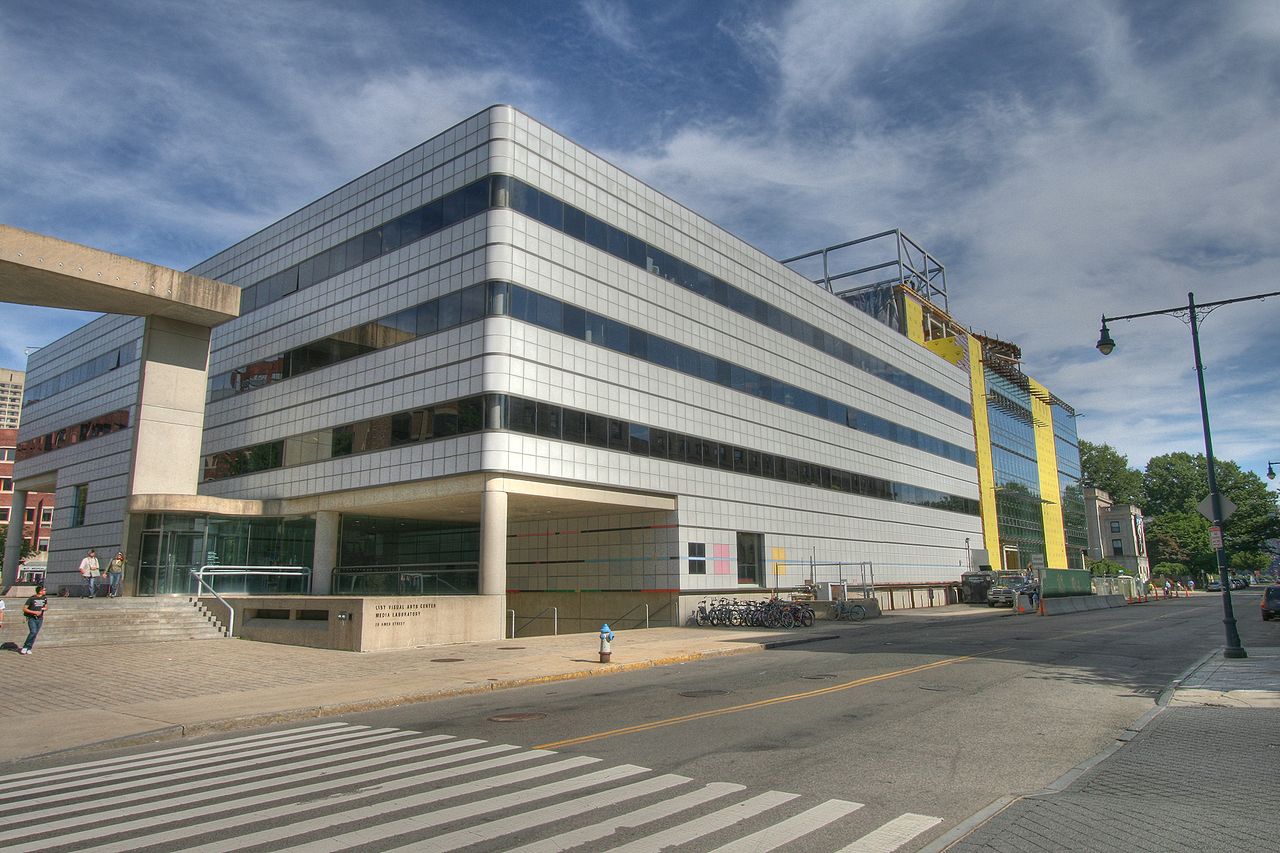
El MIT ha seguido el ritmo y ha ayudado a avanzar en la era digital. Además de desarrollar los predecesores de las tecnologías de redes y computación modernas, [77] [78] los estudiantes, el personal y los miembros de la facultad del Proyecto MAC , el Laboratorio de Inteligencia Artificial y el Tech Model Railroad Club escribieron algunos de los primeros videojuegos interactivos para computadora como Spacewar! y crearon gran parte de la jerga y la cultura hacker modernas . [79] Varias organizaciones importantes relacionadas con la informática se han originado en el MIT desde la década de 1980: el Proyecto GNU de Richard Stallman y la posterior Free Software Foundation se fundaron a mediados de la década de 1980 en el Laboratorio de IA; el MIT Media Lab fue fundado en 1985 por Nicholas Negroponte y Jerome Wiesner para promover la investigación en nuevos usos de la tecnología informática; [80] la organización de estándares del Consorcio World Wide Web fue fundada en el Laboratorio de Ciencias de la Computación en 1994 por Tim Berners-Lee ; [81] El proyecto OpenCourseWare ha puesto a disposición en línea, de forma gratuita, materiales de cursos para más de 2.000 clases del MIT desde 2002; [82] y en 2005 se lanzó la iniciativa One Laptop per Child para ampliar la educación informática y la conectividad a niños de todo el mundo. [83]
El MIT fue nombrado colegio subvencionado por el mar en 1976 para apoyar sus programas en oceanografía y ciencias marinas y fue nombrado colegio subvencionado por el espacio en 1989 para apoyar sus programas de aeronáutica y astronáutica. [84] [85] A pesar de la disminución del apoyo financiero del gobierno durante el último cuarto de siglo, el MIT lanzó varias campañas de desarrollo exitosas para expandir significativamente el campus: nuevos dormitorios y edificios de atletismo en el campus oeste; el Centro Tang para la Educación en Gestión ; varios edificios en la esquina noreste del campus que apoyan la investigación en biología , ciencias cerebrales y cognitivas , genómica , biotecnología e investigación del cáncer ; y una serie de nuevos edificios "backlot" en Vassar Street, incluido el Stata Center . [86] La construcción en el campus en la década de 2000 incluyó expansiones del Media Lab, el campus oriental de la Escuela Sloan y residencias de posgrado en el noroeste. [87] [88] En 2006, el presidente Hockfield lanzó el Consejo de Investigación Energética del MIT para investigar los desafíos interdisciplinarios que plantea el aumento del consumo energético global . [89]
En 2001, inspirado por los movimientos de código abierto y acceso abierto , [90] el MIT lanzó OpenCourseWare para hacer que las notas de clase, los conjuntos de problemas , los programas de estudio, los exámenes y las conferencias de la gran mayoría de sus cursos estuvieran disponibles en línea sin cargo, aunque sin ninguna acreditación formal para el trabajo del curso completado. [91] Si bien el costo de apoyar y alojar el proyecto es alto, [92] OCW se expandió en 2005 para incluir otras universidades como parte del Consorcio OpenCourseWare, que actualmente incluye más de 250 instituciones académicas con contenido disponible en al menos seis idiomas. [93] En 2011, el MIT anunció que ofrecería certificación formal (pero no créditos o títulos) a los participantes en línea que completaran el trabajo del curso en su programa "MITx", por una tarifa modesta. [94] La plataforma en línea " edX " que respalda a MITx se desarrolló inicialmente en asociación con Harvard y su iniciativa análoga "Harvardx". La plataforma de cursos es de código abierto y otras universidades ya se han unido y han añadido su propio contenido de cursos. [95] En marzo de 2009, la facultad del MIT adoptó una política de acceso abierto para hacer que sus investigaciones fueran accesibles al público en línea. [96]
El MIT tiene su propia fuerza policial. Tres días después del atentado con bombas en la maratón de Boston de abril de 2013, el oficial de patrulla de la policía del MIT Sean Collier fue asesinado a tiros por los sospechosos Dzhokhar y Tamerlan Tsarnaev , lo que desencadenó una violenta persecución que cerró el campus y gran parte del área metropolitana de Boston durante un día. [97] Una semana después, al servicio conmemorativo de Collier asistieron más de 10 000 personas, en una ceremonia organizada por la comunidad del MIT con miles de oficiales de policía de la región de Nueva Inglaterra y Canadá. [98] [99] [100] El 25 de noviembre de 2013, el MIT anunció la creación de la Medalla Collier, que se otorgaría anualmente a "un individuo o grupo que encarne el carácter y las cualidades que el oficial Collier exhibió como miembro de la comunidad del MIT y en todos los aspectos de su vida". El anuncio también afirmaba que "entre los futuros destinatarios del premio se incluirán aquellos cuyas contribuciones excedan los límites de su profesión, aquellos que hayan contribuido a construir puentes a través de la comunidad y aquellos que realicen actos de bondad de manera constante y desinteresada". [101] [102] [103]
En septiembre de 2017, la escuela anunció la creación de un laboratorio de investigación de inteligencia artificial llamado MIT-IBM Watson AI Lab. IBM gastará 240 millones de dólares durante la próxima década, y el laboratorio estará formado por científicos del MIT y de IBM. [104] En octubre de 2018, el MIT anunció que abriría un nuevo Schwarzman College of Computing dedicado al estudio de la inteligencia artificial, llamado así en honor al donante principal y director ejecutivo de The Blackstone Group, Stephen Schwarzman . El nuevo colegio se centra en estudiar no solo la IA, sino también la educación interdisciplinaria en IA y cómo se puede utilizar la IA en campos tan diversos como la historia y la biología. Se espera que el coste de los edificios y el nuevo profesorado del nuevo colegio sea de 1.000 millones de dólares una vez finalizado. [105]
El Observatorio de Ondas Gravitacionales por Interferometría Láser (LIGO) fue diseñado y construido por un equipo de científicos del Instituto Tecnológico de California , el MIT y contratistas industriales, y financiado por la Fundación Nacional de la Ciencia . Fue diseñado para abrir el campo de la astronomía de ondas gravitacionales a través de la detección de ondas gravitacionales predichas por la relatividad general . [106] Las ondas gravitacionales fueron detectadas por primera vez por el detector LIGO en 2015. Por sus contribuciones al detector LIGO y la observación de ondas gravitacionales, dos físicos de Caltech, Kip Thorne y Barry Barish , y el físico del MIT Rainer Weiss ganaron el Premio Nobel de Física en 2017. [107] Weiss, quien también es un graduado del MIT, diseñó la técnica de interferometría láser, que sirvió como modelo esencial para el LIGO. [108]
En abril de 2024, los estudiantes del MIT se unieron a otros campus de los Estados Unidos en protestas y establecieron campamentos contra la guerra entre Israel y Hamás . [109] [110] [111] [112] Los estudiantes compararon sus acciones con las protestas históricas contra la invasión estadounidense de Vietnam y las inversiones del MIT en el apartheid sudafricano ; [113] pidieron poner fin a los vínculos con el Ministerio de Defensa israelí . [114] El final del año académico vio a la administración introducir nuevas reglas para restringir la libertad de expresión en un intento de detener las protestas. [115]
Campus
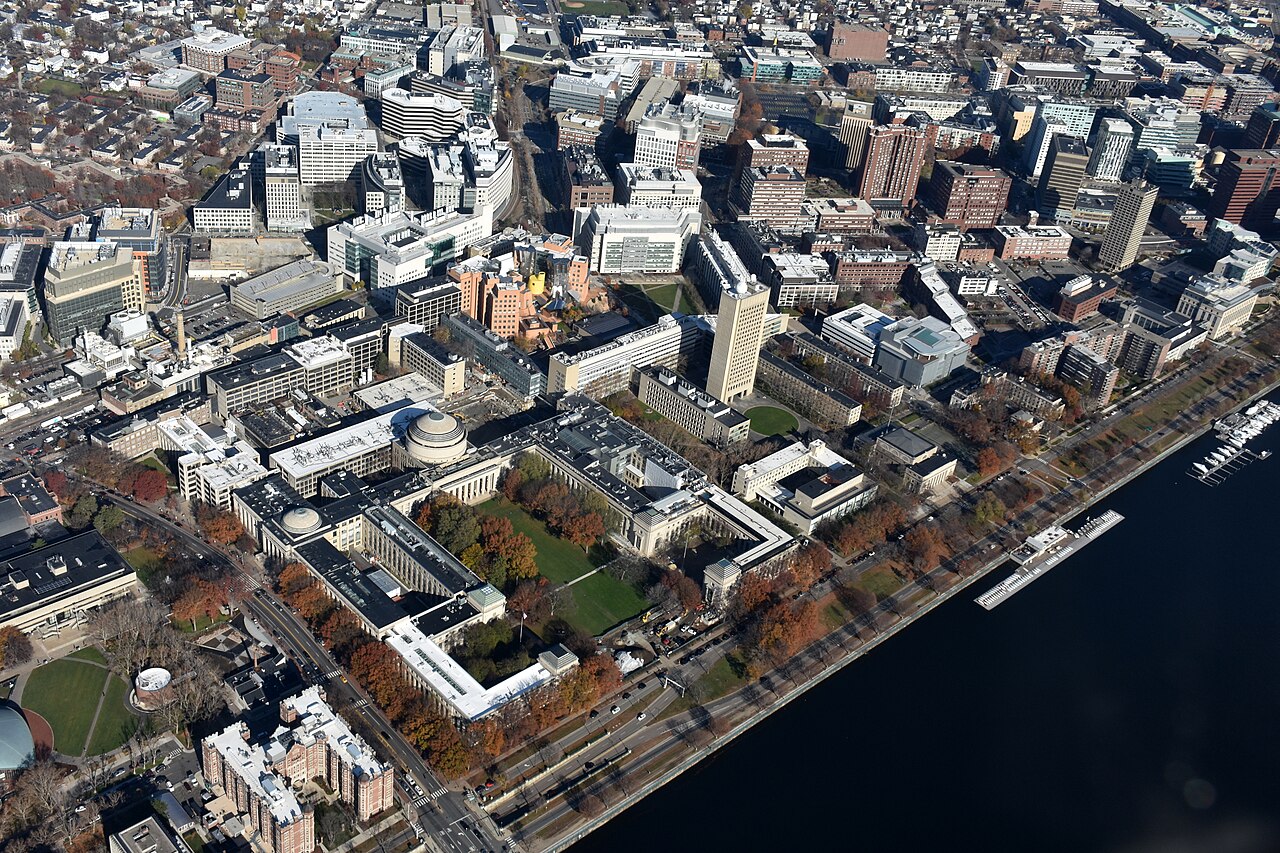

El campus de 166 acres (67,2 ha) del MIT en la ciudad de Cambridge se extiende aproximadamente una milla a lo largo del lado norte de la cuenca del río Charles . [6] El campus está dividido aproximadamente a la mitad por Massachusetts Avenue , con la mayoría de los dormitorios e instalaciones para la vida estudiantil al oeste y la mayoría de los edificios académicos al este. El puente más cercano al MIT es el puente de Harvard , que es conocido por estar marcado en una unidad de longitud no estándar : el smoot . [116] [117]
La estación Kendall/MIT de la línea roja del MBTA está ubicada en el extremo noreste del campus, en Kendall Square . Los barrios de Cambridge que rodean al MIT son una mezcla de empresas de alta tecnología que ocupan tanto edificios de oficinas modernos como edificios industriales rehabilitados, así como barrios residenciales socioeconómicamente diversos. [118] [119] A principios de 2016, el MIT presentó su Iniciativa Kendall Square actualizada a la ciudad de Cambridge, con planes para un espacio de uso mixto educativo, minorista, residencial, de incubación de empresas emergentes y de oficinas en un plan de desarrollo denso de gran altura orientado al tránsito . El Museo del MIT se ha mudado inmediatamente adyacente a una entrada de metro de Kendall Square, uniéndose al Centro de Artes Visuales List en el extremo este del campus. [120]
Cada edificio del MIT tiene un número (posiblemente precedido por una designación W , N , E o NW ) y la mayoría también tiene un nombre. Por lo general, los edificios académicos y de oficinas se conocen principalmente por su número, mientras que las residencias universitarias se conocen por su nombre. La organización de los números de los edificios corresponde aproximadamente al orden en el que se construyeron los edificios y su ubicación relativa (norte, oeste y este) al grupo central original de edificios Maclaurin. [121] Muchos de los edificios están conectados por encima del suelo, así como a través de una extensa red de túneles, lo que proporciona protección contra el clima de Cambridge, así como un lugar para hackear techos y túneles . [122] [123]
El reactor nuclear del campus del MIT [124] es uno de los reactores nucleares universitarios más potentes de los Estados Unidos. La prominencia del edificio de contención del reactor en una zona densamente poblada ha sido controvertida [125] , pero el MIT sostiene que está bien protegido. [126]
MIT Nano, también conocido como Building 12, es una instalación interdisciplinaria para la investigación a nanoescala. Su sala limpia y espacio de investigación de 100.000 pies cuadrados (9.300 m2), visible a través de amplias fachadas de vidrio, es la instalación de investigación más grande de su tipo en la nación. [ 127 ] Con un costo de US$400 millones, también es uno de los edificios más costosos del campus. La instalación también proporciona capacidades de nanoimágenes de última generación con salas de imágenes y metrología con amortiguación de vibraciones ubicadas sobre una losa de hormigón subterránea de 5 × 10 6 lb (2.300.000 kg). [128]^
Otras instalaciones notables del campus incluyen un túnel de viento presurizado para probar la investigación aerodinámica , un tanque de remolque para probar diseños de estructuras de barcos y océanos, y anteriormente Alcator C-Mod , que fue el dispositivo de fusión más grande operado por cualquier universidad. [129] [130] La red inalámbrica de todo el campus del MIT se completó en el otoño de 2005 y consta de casi 3000 puntos de acceso que cubren 9,4 × 10 6 pies cuadrados (870 000 m 2 ) del campus. [131]^
La principal fuente de energía del campus es el gas natural. En relación con las campañas de capital para ampliar el campus, el Instituto también ha renovado ampliamente los edificios existentes para mejorar su eficiencia energética. El MIT también ha tomado medidas para reducir su impacto ambiental mediante la puesta en funcionamiento de lanzaderas de combustible alternativo en el campus, la subvención de pases de transporte público , la construcción de compensaciones de energía solar y la construcción de una planta de cogeneración para abastecer las necesidades de electricidad, calefacción y refrigeración del campus. [132] [133]
El MIT posee importantes propiedades inmobiliarias comerciales en Cambridge sobre las que paga impuestos sobre la propiedad , además de un pago voluntario adicional en lugar de impuestos (PILOT) sobre los edificios académicos que están legalmente exentos de impuestos. A partir de 2017 [update], es el mayor contribuyente de la ciudad, contribuyendo aproximadamente con el 14% de los ingresos anuales de la ciudad. [134] Las propiedades incluyen Technology Square , partes de Kendall Square , University Park y muchas propiedades en Cambridgeport y Area 4 vecinas al campus principal. [135] El terreno se conserva con fines de inversión y posible expansión a largo plazo. [136]
Arquitectura
.jpg/1280px-Stata_Center_(05689p).jpg)
La Escuela de Arquitectura del MIT , fundada en 1865 [137] y ahora llamada Escuela de Arquitectura y Planificación, fue el primer programa formal de arquitectura en los Estados Unidos, [138] y tiene un historial de encargo de edificios progresistas. [139] [140] Los primeros edificios construidos en el campus de Cambridge, completados en 1916, a veces se denominan "edificios Maclaurin" en honor al presidente del Instituto, Richard Maclaurin , quien supervisó su construcción. Diseñados por William Welles Bosworth , estos imponentes edificios fueron construidos con hormigón armado , una novedad para un edificio no industrial, y mucho menos universitario, en los EE. UU. [141] El diseño de Bosworth estuvo influenciado por el Movimiento City Beautiful de principios de la década de 1900 [141] y presenta la Gran Cúpula estilo Panteón que alberga la Biblioteca de Ingeniería Barker. La Gran Cúpula domina Killian Court, donde se celebran ceremonias de graduación cada año. Los frisos de los edificios revestidos de piedra caliza alrededor de Killian Court están grabados con los nombres de científicos y filósofos importantes. [a] El espacioso atrio del Edificio 7 en 77 Massachusetts Avenue se considera la entrada al Corredor Infinito y al resto del campus. [119]
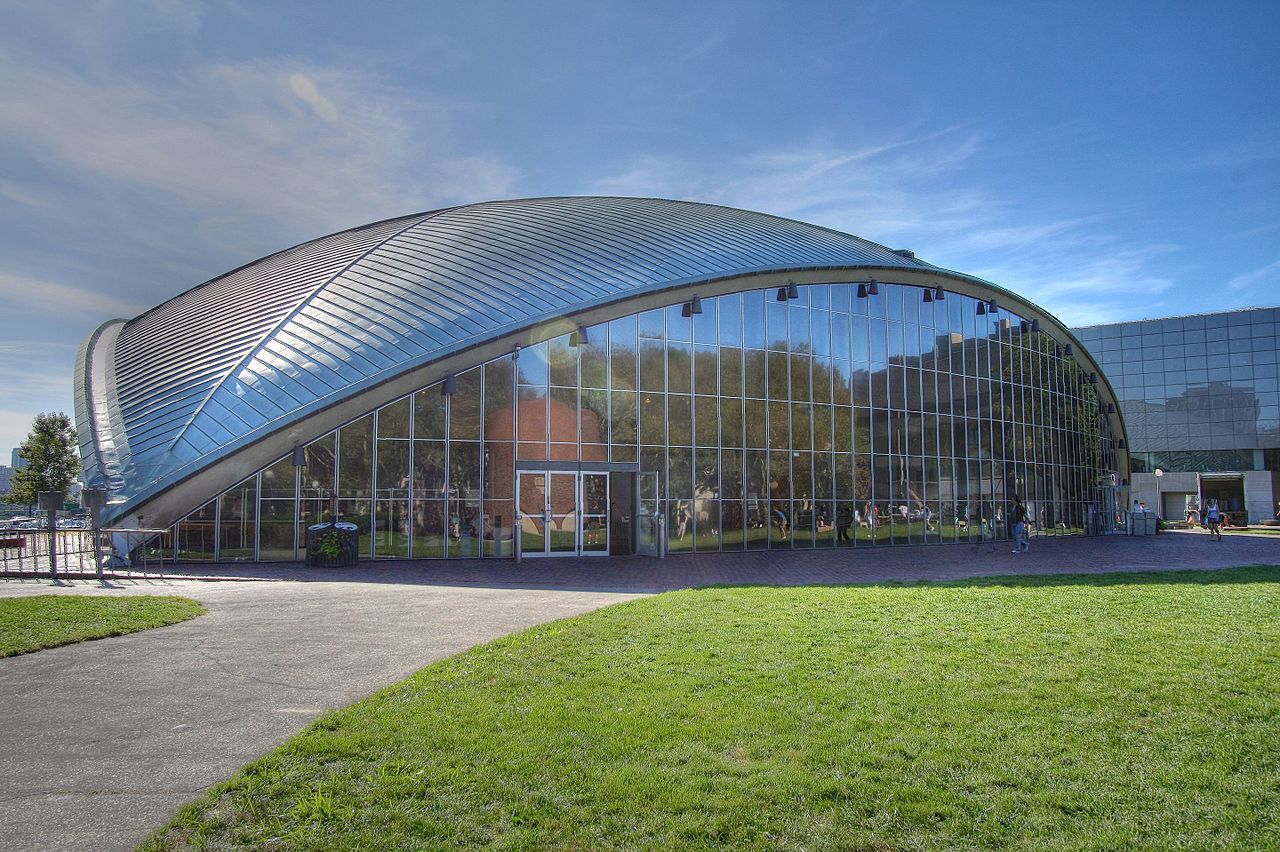
La Baker House de Alvar Aalto (1947), la Capilla del MIT y el Auditorio Kresge de Eero Saarinen (1955), y los edificios Green , Dreyfus, Landau y Wiesner de IM Pei representan formas elevadas de arquitectura modernista de posguerra . [144] [145] [146] Edificios más recientes como el Stata Center de Frank Gehry (2004), el Simmons Hall de Steven Holl (2002), el Edificio 46 de Charles Correa (2005) y la Extensión del Media Lab de Fumihiko Maki (2009) se destacan entre la arquitectura clásica del área de Boston y sirven como ejemplos de la " arquitectura estrella " del campus contemporáneo. [139] [147] Estos edificios no siempre han sido bien recibidos; [148] [149] en 2010, The Princeton Review incluyó al MIT en una lista de veinte escuelas cuyos campus son "pequeños, feos o ambas cosas". [150]
Alojamiento

Los estudiantes universitarios tienen garantizada una vivienda de cuatro años en una de las 11 residencias universitarias del MIT. [151] Aquellos que viven en el campus pueden recibir apoyo y tutoría de tutores de posgrado residentes, asesores residentes y directores de residencia de la facultad. [152] Debido a que las asignaciones de alojamiento se realizan en función de las preferencias de los propios estudiantes, se pueden mantener diversos ambientes sociales en diferentes grupos de convivencia; por ejemplo, según The Insider's Guide to the Colleges, 2010 , del personal del Yale Daily News , "La división entre el Campus Este y el Campus Oeste es una característica significativa del MIT. El Campus Este se ha ganado la reputación de ser una contracultura próspera". [153] El MIT también tiene 5 residencias para estudiantes de posgrado solteros y 2 edificios de apartamentos en el campus para familias de estudiantes casados. [154]
El MIT tiene un sistema activo de viviendas griegas y cooperativas , que incluye treinta y seis fraternidades , hermandades y grupos de vida independiente ( FSILG ). [155] En 2015 [update], el 98% de todos los estudiantes universitarios vivían en viviendas afiliadas al MIT; el 54% de los hombres participaban en fraternidades y el 20% de las mujeres participaban en hermandades. [156] La mayoría de los FSILG están ubicados al otro lado del río en Back Bay, cerca de donde se fundó el MIT, y también hay un grupo de fraternidades en el Campus Oeste del MIT que miran hacia la cuenca del río Charles. [157] Después de la muerte relacionada con el alcohol en 1997 de Scott Krueger, un nuevo miembro de la fraternidad Phi Gamma Delta , el MIT requirió que todos los estudiantes de primer año vivieran en el sistema de dormitorios a partir de 2002. [158] Debido a que los FSILG habían alojado previamente a 300 estudiantes de primer año fuera del campus, la nueva política no pudo implementarse hasta que Simmons Hall abrió en ese año. [159]
En 2013-2014, el MIT cerró abruptamente y luego demolió la residencia de estudiantes Bexley Hall, alegando que los extensos daños causados por el agua hacían inviables las reparaciones. En 2017, el MIT cerró Senior House después de un siglo de servicio como residencia de estudiantes. Ese año, los administradores del MIT publicaron datos que mostraban que solo el 60% de los residentes de Senior House se habían graduado en cuatro años. En todo el campus, la tasa de graduación de cuatro años es del 84% (la tasa de graduación acumulada es significativamente más alta). [160]
Organización y administración

El MIT es una corporación sin fines de lucro con estatuto público gobernada por una junta designada de forma privada conocida como la Corporación MIT. [161] Una junta grande desde la fundación del MIT, [161] la Corporación tiene entre 60 y 80 miembros en cualquier momento, algunos con mandatos fijos, otros con nombramientos vitalicios y ocho que sirven ex officio . [162] [163] [164] La Corporación aprueba el presupuesto, los nuevos programas, los títulos y los nombramientos de profesores, y elige a un presidente para gestionar la universidad y presidir el profesorado del Instituto. [119] [161] La actual presidenta es Sally Kornbluth , bióloga celular y ex rectora de la Universidad de Duke , que se convirtió en la decimoctava presidenta del MIT en enero de 2023. [165]
El MIT tiene cinco escuelas ( Ciencias , Ingeniería , Arquitectura y Planificación , Administración y Humanidades, Artes y Ciencias Sociales ) y una facultad ( Schwarzman College of Computing ), pero no hay escuelas de derecho o medicina. [166] [b] [168] Si bien los comités de la facultad afirman un control sustancial sobre muchas áreas del currículo, la investigación, la vida estudiantil y los asuntos administrativos del MIT, [169] el presidente de cada uno de los 32 departamentos académicos del MIT informa al decano de la escuela de ese departamento, quien a su vez informa al Rector bajo el Presidente. [170] Los departamentos académicos también son evaluados por "Comités Visitadores", organismos especializados de miembros de la Corporación y expertos externos que revisan el desempeño, las actividades y las necesidades de cada departamento.
La dotación , los bienes raíces y otros activos financieros del MIT son administrados por la MIT Investment Management Company (MITIMCo), una subsidiaria de la MIT Corporation creada en 2004. [171] Una fuente de ingresos menor durante gran parte de la historia del Instituto, el papel de la dotación en las operaciones del MIT ha crecido debido a los fuertes retornos de inversión desde la década de 1990, lo que la convierte en una de las dotaciones más grandes en manos de universidades estadounidenses . [172] Entre sus tenencias se encuentran la mayoría de las acciones del fabricante de equipos de audio Bose Corporation . [173]
Académica
El MIT es una universidad de investigación grande y altamente residencial con una mayoría de inscripciones en programas de posgrado y profesionales. [176] La universidad ha sido acreditada por la Asociación de Escuelas y Universidades de Nueva Inglaterra desde 1929. [177] El MIT opera con un calendario académico 4–1–4 con el semestre de otoño comenzando después del Día del Trabajo y terminando a mediados de diciembre, un "Período de Actividades Independientes" de 4 semanas en el mes de enero y el semestre de primavera comenzando a principios de febrero y terminando a fines de mayo. [178]
Los estudiantes del MIT se refieren tanto a sus carreras como a sus clases utilizando únicamente números o acrónimos. [179] Los departamentos y sus carreras correspondientes se numeran en el orden aproximado de su base; por ejemplo, Ingeniería civil y ambiental es el curso 1 , mientras que Lingüística y filosofía es el curso 24. [ 180] Los estudiantes que se especializan en Ingeniería eléctrica y Ciencias de la computación (EECS), el departamento más popular, se identifican colectivamente como "Curso 6". Los estudiantes del MIT utilizan una combinación del número de curso del departamento y el número asignado a la clase para identificar sus materias; por ejemplo, el curso introductorio de mecánica clásica basado en cálculo es simplemente "8.01" (pronunciado ocho-cero-uno ) en el MIT. [181] [c]
Programa de pregrado
El programa de pregrado de cuatro años a tiempo completo mantiene un equilibrio entre las especialidades profesionales y las de artes y ciencias. En 2010, US News lo denominó "el más selectivo" , [188] admitiendo pocos estudiantes transferidos [176] y el 4,1% de sus solicitantes en el ciclo de admisiones 2020-2021. [189] Es ciego a las necesidades de los solicitantes nacionales e internacionales. [190] El MIT ofrece 44 títulos de pregrado en sus cinco escuelas. [191] En el año académico 2017-2018, se otorgaron 1045 títulos de Licenciatura en Ciencias (abreviado " SB "), el único tipo de título de pregrado que otorga el MIT ahora. [ necesita actualización ] [192] [193] En el semestre de otoño de 2011, entre los estudiantes que habían designado una especialidad, la Escuela de Ingeniería fue la división más popular, con un 63% de estudiantes matriculados en sus 19 programas de grado, seguida por la Escuela de Ciencias (29%), la Escuela de Humanidades, Artes y Ciencias Sociales (3,7%), la Escuela de Administración Sloan (3,3%) y la Escuela de Arquitectura y Planificación (2%). [ necesita actualización ] Los programas de grado de pregrado más grandes fueron Ingeniería Eléctrica y Ciencias de la Computación ( Curso 6-2 ), Ciencias de la Computación e Ingeniería ( Curso 6-3 ), Ingeniería Mecánica ( Curso 2 ), Física ( Curso 8 ) y Matemáticas ( Curso 18 ). [182]

All undergraduates are required to complete a core curriculum called the General Institute Requirements (GIRs).[194] The Science Requirement, generally completed during freshman year as prerequisites for classes in science and engineering majors, comprises two semesters of physics, two semesters of calculus, one semester of chemistry, and one semester of biology. There is a Laboratory Requirement, usually satisfied by an appropriate class in a course major. The Humanities, Arts, and Social Sciences (HASS) Requirement consists of eight semesters of classes in the humanities, arts, and social sciences, including at least one semester from each division as well as the courses required for a designated concentration in a HASS division. Under the Communication Requirement, two of the HASS classes, plus two of the classes taken in the designated major must be "communication-intensive",[195] including "substantial instruction and practice in oral presentation".[196] Finally, all students are required to complete a swimming test;[197] non-varsity athletes must also take four quarters of physical education classes.[194]
Most classes rely on a combination of lectures, recitations led by associate professors or graduate students, weekly problem sets ("p-sets"), and periodic quizzes or tests. While the pace and difficulty of MIT coursework has been compared to "drinking from a fire hose",[198][199][200] the freshmen retention rate at MIT is similar to other research universities.[188] The "pass/no-record" grading system relieves some pressure for first-year undergraduates. For each class taken in the fall term, freshmen transcripts will either report only that the class was passed, or otherwise not have any record of it. In the spring term, passing grades (A, B, C) appear on the transcript while non-passing grades are again not recorded.[201] (Grading had previously been "pass/no record" all freshman year, but was amended for the Class of 2006 to prevent students from gaming the system by completing required major classes in their freshman year.[202]) Also, freshmen may choose to join alternative learning communities, such as Experimental Study Group, Concourse, or Terrascope.[201]
In 1969, Margaret MacVicar founded the Undergraduate Research Opportunities Program (UROP) to enable undergraduates to collaborate directly with faculty members and researchers. Students join or initiate research projects ("UROPs") for academic credit, pay, or on a volunteer basis through postings on the UROP website or by contacting faculty members directly.[203] A substantial majority of undergraduates participate.[204][205] Students often become published, file patent applications, and/or launch start-up companies based upon their experience in UROPs.[206][207]
In 1970, the then-Dean of Institute Relations, Benson R. Snyder, published The Hidden Curriculum, arguing that education at MIT was often slighted in favor of following a set of unwritten expectations and that graduating with good grades was more often the product of figuring out the system rather than a solid education. The successful student, according to Snyder, was the one who was able to discern which of the formal requirements were to be ignored in favor of which unstated norms. For example, organized student groups had compiled "course bibles"—collections of problem-set and examination questions and answers for later students to use as references. This sort of gamesmanship, Snyder argued, hindered development of a creative intellect and contributed to student discontent and unrest.[208][209]
Graduate program
MIT's graduate program has high coexistence with the undergraduate program, and many courses are taken by qualified students at both levels. MIT offers a comprehensive doctoral program with degrees in the humanities, social sciences, and STEM fields as well as professional degrees, including the Master of Business Administration (MBA).[176] The Institute offers graduate programs leading to academic degrees such as the Master of Science (which is abbreviated as MS at MIT), various Engineer's Degrees, Doctor of Philosophy (PhD), and Doctor of Science (DSc) and interdisciplinary graduate programs such as the MD-PhD (with Harvard Medical School) and a joint program in oceanography with Woods Hole Oceanographic Institution.[210][211][212][213]
Admission to graduate programs is decentralized; applicants apply directly to the department or degree program. More than 90% of doctoral students are supported by fellowships, research assistantships (RAs), or teaching assistantships (TAs).[214]
MIT Bootcamps
MIT Bootcamps are "intense week-long innovation and leadership programs".[215] MIT Bootcamp instructors include Eric von Hippel, Sanjay Sarma, Erdin Beshimov, and Bill Aulet.[216] MIT Bootcamps were founded by Erdin Beshimov.[217][218][219]
Rankings
MIT places among the top five in many overall rankings of universities (see table right) and rankings based on students' revealed preferences.[228][229][230] For several years, U.S. News & World Report, the QS World University Rankings, and the Academic Ranking of World Universities have ranked MIT's School of Engineering first, as did the 1995 National Research Council report.[231] In the same lists, MIT's strongest showings apart from in engineering are in computer science, the natural sciences, business, architecture, economics, linguistics, mathematics, and, to a lesser extent, political science and philosophy.[232]
Times Higher Education has recognized MIT as one of the world's "six super brands" on its World Reputation Rankings, along with Berkeley, Cambridge, Harvard, Oxford, and Stanford.[233] In 2019, it was ranked #3 among the universities around the world by SCImago Institutions Rankings.[234] In 2017, the Times Higher Education World University Rankings also rated MIT the #2 university for arts and humanities.[235][236] MIT was ranked #7 in 2015 and #6 in 2017 of the Nature Index Annual Tables, which measure the largest contributors to papers published in 82 leading journals.[237][238][239] Georgetown University researchers ranked MIT #3 in the US for 20-year return on investment.[240]
Collaborations
The university historically pioneered research and training collaborations between academia, industry and government.[241][242] In 1946, President Compton, Harvard Business School professor Georges Doriot, and Massachusetts Investor Trust chairman Merrill Grisswold founded American Research and Development Corporation, the first American venture-capital firm.[243][244] In 1948, Compton established the MIT Industrial Liaison Program.[245] Throughout the late 1980s and early 1990s, American politicians and business leaders accused MIT and other universities of contributing to a declining economy by transferring taxpayer-funded research and technology to international – especially Japanese – firms that were competing with struggling American businesses.[246][247] On the other hand, MIT's extensive collaboration with the federal government on research projects has led to several MIT leaders serving as presidential scientific advisers since 1940.[d] MIT established a Washington Office in 1991 to continue effective lobbying for research funding and national science policy.[249][250]
The US Justice Department began an investigation in 1989, and in 1991 filed an antitrust suit against MIT, the eight Ivy League colleges, and eleven other institutions for allegedly engaging in price-fixing during their annual "Overlap Meetings", which were held to prevent bidding wars over promising prospective students from consuming funds for need-based scholarships.[251][252] While the Ivy League institutions settled,[253] MIT contested the charges, arguing that the practice was not anti-competitive because it ensured the availability of aid for the greatest number of students.[254][255] MIT ultimately prevailed when the Justice Department dropped the case in 1994.[256][257]


MIT's proximity[e] to Harvard University ("the other school up the river") has led to a substantial number of research collaborations such as the Harvard-MIT Division of Health Sciences and Technology and the Broad Institute.[258] In addition, students at the two schools can cross-register for credits toward their own school's degrees without any additional fees.[258] A cross-registration program between MIT and Wellesley College has also existed since 1969, and in 2002 the Cambridge–MIT Institute launched an undergraduate exchange program between MIT and the University of Cambridge.[258] MIT also has a long-term partnership with Imperial College London, for both student exchanges and research collaboration.[259][260] More modest cross-registration programs have been established with Boston University, Brandeis University, Tufts University, Massachusetts College of Art, and the School of the Museum of Fine Arts, Boston.[258]
MIT maintains substantial research and faculty ties with independent research organizations in the Boston area, such as the Charles Stark Draper Laboratory, the Whitehead Institute for Biomedical Research, and the Woods Hole Oceanographic Institution.[213] Ongoing international research and educational collaborations include the Amsterdam Institute for Advanced Metropolitan Solutions (AMS Institute),[261] Singapore-MIT Alliance, MIT-Politecnico di Milano,[258][262] MIT-Zaragoza International Logistics Program, and projects in other countries through the MIT International Science and Technology Initiatives (MISTI) program.[258][263]
The mass-market magazine Technology Review is published by MIT through a subsidiary company, as is a special edition that also serves as an alumni magazine.[264][265] The MIT Press is a major university press, publishing over 200 books and 30 journals annually, emphasizing science and technology as well as arts, architecture, new media, current events, and social issues.[266]
MIT Microphotonics Center and PhotonDelta founded the global roadmap for integrated photonics: Integrated Photonics Systems Roadmap – International (IPSR-I). The first edition has been published in 2020. The roadmap is an amalgamation of two previously independent roadmaps: the IPSR roadmap of MIT Microphotonics Center and AIM Photonics in the United States, and the WTMF (World Technology Mapping Forum) of PhotonDelta in Europe.[267] In 2022, Open Philanthropy donated $13,277,348 to MIT to study potential risks from AI.[268]
Libraries, collections, and museums
The MIT library system consists of five subject libraries: Barker (Engineering), Dewey (Economics), Hayden (Humanities and Science), Lewis (Music), and Rotch (Arts and Architecture). There are also various specialized libraries and archives. The libraries contain more than 2.9 million printed volumes, 2.4 million microforms, 49,000 print or electronic journal subscriptions, and 670 reference databases. The past decade has seen a trend of increased focus on digital over print resources in the libraries.[269] Notable collections include the Lewis Music Library with an emphasis on 20th and 21st-century music and electronic music,[270] the List Visual Arts Center's rotating exhibitions of contemporary art,[271] and the Compton Gallery's cross-disciplinary exhibitions.[272] MIT allocates a percentage of the budget for all new construction and renovation to commission and support its extensive public art and outdoor sculpture collection.[273][274]
The MIT Museum was founded in 1971 and collects, preserves, and exhibits artifacts significant to the culture and history of MIT. The museum now engages in significant educational outreach programs for the general public, including the annual Cambridge Science Festival, the first celebration of this kind in the United States. Since 2005, its official mission has been, "to engage the wider community with MIT's science, technology and other areas of scholarship in ways that will best serve the nation and the world in the 21st century".[275]
Research
MIT was elected to the Association of American Universities in 1934 and is classified among "R1: Doctoral Universities – Very high research activity";[49][176] research expenditures totaled $952 million in 2017.[276] The federal government was the largest source of sponsored research, with the Department of Health and Human Services granting $255.9 million, Department of Defense $97.5 million, Department of Energy $65.8 million, National Science Foundation $61.4 million, and NASA $27.4 million.[277] MIT employs approximately 1300 researchers in addition to faculty.[278] In 2011, MIT faculty and researchers disclosed 632 inventions, were issued 153 patents, earned $85.4 million in cash income, and received $69.6 million in royalties.[279] Through programs like the Deshpande Center, MIT faculty leverage their research and discoveries into multi-million-dollar commercial ventures.[280]
In electronics, magnetic-core memory, radar, single-electron transistors, and inertial guidance controls were invented or substantially developed by MIT researchers.[281][282] Harold Eugene Edgerton was a pioneer in high-speed photography and sonar.[283][284] Claude E. Shannon developed much of modern information theory and discovered the application of Boolean logic to digital circuit design theory.[285] In the domain of computer science, MIT faculty and researchers made fundamental contributions to cybernetics, artificial intelligence, computer languages, machine learning, robotics, and cryptography.[282][286] At least nine Turing Award laureates and seven recipients of the Draper Prize in engineering have been or are currently associated with MIT.[287][288]
Current and previous physics faculty have won eight Nobel Prizes,[289] four ICTP Dirac Medals,[290] and three Wolf Prizes predominantly for their contributions to subatomic and quantum theory.[291] Members of the chemistry department have been awarded three Nobel Prizes and one Wolf Prize for the discovery of novel syntheses and methods.[289] MIT biologists have been awarded six Nobel Prizes for their contributions to genetics, immunology, oncology, and molecular biology.[289] Professor Eric Lander was one of the principal leaders of the Human Genome Project.[292][293] Positronium atoms,[294] synthetic penicillin,[295] synthetic self-replicating molecules,[296] and the genetic bases for Amyotrophic lateral sclerosis (also known as ALS or Lou Gehrig's disease) and Huntington's disease were first discovered at MIT.[297] Jerome Lettvin transformed the study of cognitive science with his paper "What the frog's eye tells the frog's brain".[298] Researchers developed a system to convert MRI scans into 3D printed physical models.[299]
In the domain of humanities, arts, and social sciences, as of October 2019 MIT economists have been awarded seven Nobel Prizes and nine John Bates Clark Medals.[289][300] Linguists Noam Chomsky and Morris Halle authored seminal texts on generative grammar and phonology.[301][302] The MIT Media Lab, founded in 1985 within the School of Architecture and Planning and known for its unconventional research,[303][304] has been home to influential researchers such as constructivist educator and Logo creator Seymour Papert.[305]
Spanning many of the above fields, MacArthur Fellowships (the so-called "Genius Grants") have been awarded to 50 people associated with MIT.[306] Five Pulitzer Prize–winning writers currently work at or have retired from MIT.[307] Four current or former faculty are members of the American Academy of Arts and Letters.[308]
Allegations of research misconduct or improprieties have received substantial press coverage. Professor David Baltimore, a Nobel Laureate, became embroiled in a misconduct investigation starting in 1986 that led to Congressional hearings in 1991.[309][310] Professor Ted Postol has accused the MIT administration since 2000 of attempting to whitewash potential research misconduct at the Lincoln Lab facility involving a ballistic missile defense test, though a final investigation into the matter has not been completed.[311][312] Associate Professor Luk Van Parijs was dismissed in 2005 following allegations of scientific misconduct and found guilty of the same by the United States Office of Research Integrity in 2009.[313][314]
In 2019, Clarivate Analytics named 54 members of MIT's faculty to its list of "Highly Cited Researchers". That number places MIT eighth among the world's universities.[315]
Discoveries and innovation
Natural sciences
- Oncogene – Robert Weinberg discovered genetic basis of human cancer.[316]
- Reverse transcription – David Baltimore independently isolated, in 1970 at MIT, two RNA tumor viruses: R-MLV and again RSV.[317]
- Thermal death time – Samuel Cate Prescott and William Lyman Underwood from 1895 to 1898. Done for canning of food. Applications later found useful in medical devices, pharmaceuticals, and cosmetics.[318]
- Electroweak interaction – Steven Weinberg proposed the electroweak unification theory, which gave rise to the modern formulation of the Standard Model, in 1967 at MIT.[319]
Computer and applied sciences
- Akamai Technologies – Daniel Lewin and Tom Leighton developed a faster content delivery network, now one of the world's largest distributed computing platforms, responsible for serving between 15 and 30 percent of all web traffic.[320]
- Cryptography – MIT researchers Ron Rivest, Adi Shamir and Leonard Adleman developed one of the first practical public-key cryptosystems, the RSA cryptosystem, and started a company, RSA Security.[321]
- Digital circuits – Claude Shannon, while a master's degree student at MIT, developed the digital circuit design theory which paved the way for modern computers.[322]
- Electronic ink – developed by Joseph Jacobson at MIT Media Lab.[323]
- Emacs (text editor) – development began during the 1970s at the MIT AI Lab.[324]
- Flight recorder (black box) – Charles Stark Draper developed the black box at MIT's Instrumentation Laboratory. That lab later made the Apollo Moon landings possible through the Apollo Guidance Computer it designed for NASA.[325]
- GNU Project – Richard Stallman formally founded the free software movement in 1983 by launching the GNU Project at MIT.[326][327][328]
- Julia (programming language) – Development was started in 2009, by Jeff Bezanson, Stefan Karpinski, Viral B. Shah, and Alan Edelman, all at MIT at that time, and continued with the contribution of a dedicated MIT Julia Lab[329]
- Lisp (programming language) – John McCarthy invented Lisp at MIT in 1958.[330]
- Lithium-ion battery efficiencies – Yet-Ming Chiang and his group at MIT showed a substantial improvement in the performance of lithium batteries by boosting the material's conductivity by doping it[331] with aluminium, niobium and zirconium.[332][333]
- Macsyma, one of the oldest general-purpose computer algebra systems; the GPL-licensed version Maxima remains in wide use.[334]
- MIT OpenCourseWare – the OpenCourseWare movement started in 1999 when the University of Tübingen in Germany published videos of lectures online for its timms initiative (Tübinger Internet Multimedia Server).[335] The OCW movement only took off, however, with the launch of MIT OpenCourseWare and the Open Learning Initiative at Carnegie Mellon University[336] in October 2002. The movement was soon reinforced by the launch of similar projects at Yale, Utah State University, the University of Michigan and the University of California Berkeley.[337]
- Perdix micro-drone – autonomous drone that uses artificial intelligence to swarm with many other Perdix drones.[338]
- Project MAC – groundbreaking research in operating systems, artificial intelligence, and the theory of computation. DARPA funded project.[339]
- Radar – developed at MIT's Radiation Laboratory during World War II.[340]
- SKETCHPAD – invented by Ivan Sutherland at MIT (presented in his PhD thesis). It pioneered the way for human–computer interaction (HCI).[341] Sketchpad is considered to be the ancestor of modern computer-aided design (CAD) programs as well as a major breakthrough in the development of computer graphics in general.[342]
- VisiCalc – first spreadsheet computer program for personal computers, originally released for the Apple II by VisiCorp. MIT alumni Dan Bricklin and Bob Frankston rented time sharing at night on an MIT mainframe computer (that cost $1/hr for use).[343]
- World Wide Web Consortium – founded in 1994 by Tim Berners-Lee, (W3C) is the main international standards organization for the World Wide Web[344]
- X Window System – pioneering architecture-independent system for graphical user interfaces that has been widely used for Unix and Linux systems.[345]
Companies and entrepreneurship
MIT alumni and faculty have founded numerous companies, some of which are shown below:[346][347]
- Analog Devices, 1965, co-founders Ray Stata, (SB, SM) and Matthew Lorber (SB)
- BlackRock, 1988, co-founder Bennett Golub, (SB, SM, PhD)
- Bose Corporation, 1964, founder Amar Bose (SB, PhD)
- Buzzfeed, 2006, co-founder Jonah Peretti (SM)
- Dropbox, 2007, founders Drew Houston (SB) and Arash Ferdowsi (drop-out)
- Hewlett-Packard, 1939, co-founder William R. Hewlett (SM)
- HuffPost, 2005, co-founder Jonah Peretti (SM)
- Intel, 1968, co-founder Robert Noyce (PhD)
- Khan Academy, 2008, founder Salman Khan (SB, SM)[348]
- Koch Industries, 1940, founder Fred C. Koch (SB), sons William (SB, PhD), David (SB)
- Qualcomm, 1985, co-founders Irwin M. Jacobs (SM, PhD) and Andrew Viterbi (SB, SM)
- Raytheon, 1922, co-founder Vannevar Bush (DEng, Professor)
- Renaissance Technologies, 1982, founder James Simons (SB)
- Texas Instruments, 1930, founder Cecil Howard Green (SB, SM)
- TSMC, 1987, founder Morris Chang (SB, SM)
- VMware, 1998, co-founder Diane Greene (SM)
Traditions and student activities
The faculty and student body place a high value on meritocracy and on technical proficiency.[349][350] MIT has never awarded an honorary degree,[351] nor does it award athletic scholarships,[352] ad eundem degrees,[citation needed] or Latin honors[353] upon graduation. However, MIT has twice awarded honorary professorships: to Winston Churchill in 1949 and Salman Rushdie in 1993.[354]
Many upperclass students and alumni wear a large, heavy, distinctive class ring known as the "Brass Rat".[355][356] Originally created in 1929, the ring's official name is the "Standard Technology Ring".[357] The undergraduate ring design (a separate graduate student version exists as well) varies slightly from year to year to reflect the unique character of the MIT experience for that class, but always features a three-piece design, with the MIT seal and the class year each appearing on a separate face, flanking a large rectangular bezel bearing an image of a beaver.[355] The initialism IHTFP, representing the informal school motto "I Hate This Fucking Place" and jocularly euphemized as "I Have Truly Found Paradise", "Institute Has The Finest Professors", "Institute of Hacks, TomFoolery and Pranks", "It's Hard to Fondle Penguins", and other variations, has occasionally been featured on the ring given its historical prominence in student culture.[358]
Caltech Rivalry
MIT also shares a well-known rivalry with the California Institute of Technology (Caltech), stemming from both institutions' reputations as two of the highest ranked and most highly recognized science and engineering schools in the world.[359] The rivalry is an unusual college rivalry given its focus on academics and pranks instead of sports, and due to the geographic distance between the two (their campuses are separated by about 2580 miles and are on opposite coasts of the United States). In 2005, Caltech students pranked MIT's Campus Preview Weekend by distributing t-shirts that read "MIT" on the front, and "...because not everyone can go to Caltech" on the back.[360][361][362] Additionally, the word Massachusetts in the "Massachusetts Institute of Technology" engraving on the exterior of the Lobby 7 dome was covered with a banner so that it read "That Other Institute of Technology". In 2006, MIT retaliated by posing as contractors and stealing the 1.7-ton, 130-year-old Fleming cannon, a Caltech landmark. The cannon was relocated to Cambridge, where it was displayed in front of the Green Building during the 2006 Campus Preview Weekend.[363][364] In September 2010, MIT students unsuccessfully tried to place a life-sized model of the TARDIS time machine from the Doctor Who (1963–present) television series on top of Baxter Hall at Caltech. A few months later, Caltech students collaborated to help MIT students place the TARDIS on top of their originally planned destination.[365] The rivalry has continued, most recently in 2014, when a group of Caltech students gave out mugs sporting the MIT logo on the front and the words "The Institute of Technology" on the back. When heated, the mugs turned orange and read, "Caltech, The Hotter Institute of Technology".[366]
Activities

MIT has over 500 recognized student activity groups,[367] including a campus radio station, The Tech student newspaper, an annual entrepreneurship competition, a crime club, and weekly screenings of popular films by the Lecture Series Committee. Less traditional activities include the "world's largest open-shelf collection of science fiction" in English, a model railroad club, and a vibrant folk dance scene. Students, faculty, and staff are involved in over 50 educational outreach and public service programs through the MIT Museum, Edgerton Center, and MIT Public Service Center.[368]
Fraternities and sororities provide a base of activities in addition to housing. Approximately 1,000 undergrads, 48% of men and 30% of women, participate in one of several dozen Greek Life men's, women's and co-ed chapters on the campus.[369]
The Independent Activities Period is a four-week-long "term" offering hundreds of optional classes, lectures, demonstrations, and other activities throughout the month of January between the Fall and Spring semesters. Some of the most popular recurring IAP activities are Autonomous Robot Design (course 6.270), Robocraft Programming (6.370), and MasLab competitions,[370] the annual "mystery hunt",[371] and Charm School.[372][373] More than 250 students pursue externships annually at companies in the US and abroad.[374][375]
Many MIT students also engage in "hacking", which encompasses both the physical exploration of areas that are generally off-limits (such as rooftops and steam tunnels), as well as elaborate practical jokes.[376][377] Examples of high-profile hacks have included the abduction of Caltech's cannon,[378] reconstructing a Wright Flyer atop the Great Dome,[379] and adorning the John Harvard statue with the Master Chief's Mjölnir Helmet.[380]
Athletics

MIT sponsors 31 varsity sports and has one of the three broadest NCAA Division III athletic programs.[381][382] MIT participates in the NCAA's Division III, the New England Women's and Men's Athletic Conference, the New England Football Conference, NCAA's Division I Patriot League for women's crew, and the Collegiate Water Polo Association (CWPA) for Men's Water Polo. Men's crew competes outside the NCAA in the Eastern Association of Rowing Colleges (EARC). The intercollegiate sports teams, called the MIT Engineers won 22 Team National Championships, 42 Individual National Championships. MIT is the all-time Division III leader in producing Academic All-Americas (302) and rank second across all NCAA Divisions only behind the University of Nebraska.[383] MIT Athletes won 13 Elite 90 awards and ranks first among NCAA Division III programs, and third among all divisions.[384] In April 2009, budget cuts led to MIT eliminating eight of its 41 sports, including the mixed men's and women's teams in alpine skiing and pistol; separate teams for men and women in ice hockey and gymnastics; and men's programs in golf and wrestling.[385][386]
People
Students
MIT enrolled 4,602 undergraduates and 6,972 graduate students in 2018–2019.[388] Undergraduate and graduate students came from all 50 US states as well as from 115 foreign countries.[389]
MIT received 33,240 applications for admission to the undergraduate Class of 2025: it admitted 1,365 (4.1 percent).[390] In 2019, 29,114 applications were received for graduate and advanced degree programs across all departments; 3,670 were admitted (12.6 percent) and 2,312 enrolled (63 percent).[391] In August 2024, after the U.S. Supreme Court overruled race-based affirmative action in Students for Fair Admissions v. Harvard (2023), the university reported that for the class of 2028, Black and Latino student enrollment decreased from previous averages to 5 and 11 percent, respectively, while Asian American enrollment increased to 47 percent.[392][393]
Undergraduate tuition and fees for 2019–2020 was $53,790 for nine months. 59% of students were awarded a need-based MIT scholarship. Graduate tuition and fees for 2019–2020 was also $53,790 for nine months, and summer tuition was $17,800. Financial support for graduate students are provided in large part by individual departments. They include fellowships, traineeships, teaching and research assistantships, and loans.[394] The annual increase in expenses had led to a student tradition (dating back to the 1960s) of tongue-in-cheek "tuition riots".[395]
MIT has been nominally co-educational since admitting Ellen Swallow Richards in 1870. Richards also became the first female member of MIT's faculty, specializing in sanitary chemistry.[396][397] Female students remained a small minority prior to the completion of the first wing of a women's dormitory, McCormick Hall, in 1963.[398][399][400] Between 1993 and 2009 the proportion of women rose from 34 percent to 45 percent of undergraduates and from 20 percent to 31 percent of graduate students.[182][401] As of 2009[update], women outnumbered men in Biology, Brain & Cognitive Sciences, Architecture, Urban Planning, and Biological Engineering.[182][402]
Faculty and staff

As of 2021[update], MIT had 1,069 faculty members.[4] Faculty are responsible for lecturing classes, for advising both graduate and undergraduate students, and for sitting on academic committees, as well as for conducting original research. Between 1964 and 2009 a total of seventeen faculty and staff members affiliated with MIT won Nobel Prizes (thirteen of them in the latter 25 years).[403] As of October 2020, 37 MIT faculty members, past or present, have won Nobel Prizes, the majority in Economics or Physics.[404]
As of October 2013[update], current faculty and teaching staff included 67 Guggenheim Fellows, 6 Fulbright Scholars, and 22 MacArthur Fellows.[4] Faculty members who have made extraordinary contributions to their research field as well as the MIT community are granted appointments as Institute Professors for the remainder of their tenures. Susan Hockfield, a molecular neurobiologist, served as MIT's president from 2004 to 2012. She was the first woman to hold the post.[405]
MIT faculty members have often been recruited to lead other colleges and universities. Founding faculty-member Charles W. Eliot became president of Harvard University in 1869, a post he would hold for 40 years, during which he wielded considerable influence both on American higher education and on secondary education. MIT alumnus and faculty member George Ellery Hale played a central role in the development of the California Institute of Technology (Caltech), and other faculty members have been key founders of Franklin W. Olin College of Engineering in nearby Needham, Massachusetts.
As of 2014[update] former provost Robert A. Brown served as president of Boston University; former provost Mark Wrighton is chancellor of Washington University in St. Louis; former associate provost Alice Gast is president of Lehigh University; and former professor Suh Nam-pyo is president of KAIST. Former dean of the School of Science Robert J. Birgeneau was the chancellor of the University of California, Berkeley (2004–2013); former professor John Maeda was president of Rhode Island School of Design (RISD, 2008–2013); former professor David Baltimore was president of Caltech (1997–2006); and MIT alumnus and former assistant professor Hans Mark served as chancellor of the University of Texas system (1984–1992).
In addition, faculty members have been recruited to lead governmental agencies; for example, former professor Marcia McNutt is president of the National Academy of Sciences,[406] urban studies professor Xavier de Souza Briggs served as the associate director of the White House Office of Management and Budget,[407] and biology professor Eric Lander was a co-chair of the President's Council of Advisors on Science and Technology.[408] In 2013, faculty member Ernest Moniz was nominated by President Obama and later confirmed as United States Secretary of Energy.[409][410] Former professor Hans Mark served as Secretary of the Air Force from 1979 to 1981. Alumna and Institute Professor Sheila Widnall served as Secretary of the Air Force between 1993 and 1997, making her the first female Secretary of the Air Force and first woman to lead an entire branch of the US military in the Department of Defense. A 1999 report, met by promises of change by President Charles Vest, found that senior female faculty in the School of Science were often marginalized, and in return for equal professional accomplishments received reduced "salary, space, awards, resources, and response to outside offers".[411]
As of 2017[update], MIT was the second-largest employer in the city of Cambridge.[134] Based on feedback from employees, MIT was ranked No. 7 as a place to work, among US colleges and universities as of March 2013[update].[412] Surveys cited a "smart", "creative", "friendly" environment, noting that the work-life balance tilts towards a "strong work ethic" but complaining about "low pay" compared to an industry position.[413]
Notable alumni
Many of MIT's over 120,000 alumni have achieved considerable success in scientific research, public service, education, and business. As of October 2020[update], 41 MIT alumni have won Nobel Prizes, 48 have been selected as Rhodes Scholars,[414] 61 have been selected as Marshall Scholars,[415] and 3 have been selected as Mitchell Scholars.[416]
Alumni in United States politics and public service include former Chairman of the Federal Reserve Ben Bernanke, former MA-1 Representative John Olver, former CA-13 Representative Pete Stark, KY-4 Representative Thomas Massie, California Senator Alex Padilla, former National Economic Council chairman Lawrence H. Summers,[417] and former Council of Economic Advisers chairman Christina Romer. MIT alumni in international politics include Foreign Affairs Minister of Iran Ali Akbar Salehi, Education Minister of Nepal Sumana Shrestha, President of Colombia Virgilio Barco Vargas, President of the European Central Bank Mario Draghi,[418] former Governor of the Reserve Bank of India Raghuram Rajan, former British Foreign Minister David Miliband, former Greek Prime Minister Lucas Papademos, former UN Secretary General Kofi Annan, former Iraqi Deputy Prime Minister Ahmed Chalabi, former Minister of Education and Culture of The Republic of Indonesia Yahya Muhaimin, former Jordanian Minister of Education, Higher Education and Scientific Research and former Jordanian Minister of Energy and Mineral Resources Khaled Toukan.
Alumni in sports have included Olympic fencing champion Johan Harmenberg.
MIT alumni founded or co-founded many notable companies, such as Intel, McDonnell Douglas, Texas Instruments, 3Com, Qualcomm, Bose, Raytheon, Apotex, Koch Industries, Rockwell International, Genentech, Dropbox, and Campbell Soup. According to the British newspaper The Guardian, "a survey of living MIT alumni found that they have formed 25,800 companies, employing more than three million people including about a quarter of the workforce of Silicon Valley. Those firms collectively generate global revenues of about $1.9 trillion (£1.2 trillion) a year". If the companies founded by MIT alumni were a country, they would have the 11th-highest GDP of any country in the world.[419][420][421]
MIT alumni have led prominent institutions of higher education, including the University of California system, Harvard University, the New York Institute of Technology, Johns Hopkins University, Carnegie Mellon University, Tufts University, Rochester Institute of Technology, Rhode Island School of Design (RISD), UC Berkeley College of Environmental Design, the New Jersey Institute of Technology, Northeastern University, Tel Aviv University, Lahore University of Management Sciences, Rensselaer Polytechnic Institute, Tecnológico de Monterrey, Purdue University, Virginia Polytechnic Institute, Korea Advanced Institute of Science and Technology, and Quaid-e-Azam University. Berklee College of Music, the largest independent college of contemporary music in the world, was founded and led by MIT alumnus Lawrence Berk for more than three decades.
More than one third of the United States' crewed spaceflights have included MIT-educated astronauts, a contribution exceeding that of any university excluding the United States service academies.[422] Of the 12 people who have set foot on the Moon as of 2019[update], four graduated from MIT (among them Apollo 11 Lunar Module Pilot Buzz Aldrin). Alumnus and former faculty member Qian Xuesen led the Chinese nuclear-weapons program and became instrumental in Chinese rocket-program.[423]
MIT alumni played a significant role in the creation of the Atomic Energy Commission and Department of Energy. Carroll Wilson (a student and professor at MIT) served as the first General Manager of the Atomic Energy Commission. John Deutch served as Under Secretary of Energy for President Carter; William F. Martin served as Deputy Secretary of Energy for Ronald Reagan and Ernest Moniz served as Secretary of Energy for President Obama. Indeed, modern post World War II history has been influenced by MIT and its alumni in the fields of nuclear energy and high energy physics.
Noted alumni in non-scientific fields include author Hugh Lofting,[424] sculptor Daniel Chester French, guitarist Tom Scholz of the band Boston, the British BBC and ITN correspondent and political advisor David Walter, The New York Times columnist and Nobel Prize-winning economist Paul Krugman, The Bell Curve author Charles Murray, United States Supreme Court building architect Cass Gilbert,[425] Pritzker Prize-winning architects I.M. Pei and Gordon Bunshaft.
-
 Apollo 11 astronaut Buzz Aldrin, ScD 1963 (MIT Department of Aeronautics and Astronautics)
 -
 Former UN Secretary-General Kofi Annan, SM 1972 (MIT Sloan School of Management)
 -
 President of Colombia (1986–1990) Virgilio Barco Vargas, SB 1943 (MIT Civil and Environmental Engineering)
 -
 Former Federal Reserve Bank chairman and 2022 Nobel Laureate Ben Bernanke, PhD 1979 (MIT Department of Economics)
 -
![Economics Nobel laureate Esther Duflo, PhD 1999 (MIT Department of Economics), also an MIT professor[426]](https://images.hispanopedia.wiki/wikipedia/commons/thumb/c/c7/Esther_Duflo_-_Pop%21Tech_2009_-_001_%28cropped%29.jpg/500px-Esther_Duflo_-_Pop%21Tech_2009_-_001_%28cropped%29.jpg) Economics Nobel laureate Esther Duflo, PhD 1999 (MIT Department of Economics), also an MIT professor[426]
Economics Nobel laureate Esther Duflo, PhD 1999 (MIT Department of Economics), also an MIT professor[426] -
![Physicist and Nobel laureate Richard Feynman, SB 1939 (MIT Department of Physics)[427]](https://images.hispanopedia.wiki/wikipedia/en/thumb/4/42/Richard_Feynman_Nobel.jpg/500px-Richard_Feynman_Nobel.jpg) Physicist and Nobel laureate Richard Feynman, SB 1939 (MIT Department of Physics)[427]
Physicist and Nobel laureate Richard Feynman, SB 1939 (MIT Department of Physics)[427] -
 Astronaut and USAF Colonel Michael Fincke, SB 1989 (MIT Department of Aeronautics and Astronautics), SB 1989 (MIT Department of Earth, Atmospheric and Planetary Sciences)
 -
 Sculptor Daniel Chester French, Did not graduate
 -
 Economics Nobel laureate Paul Krugman, PhD 1977 (MIT Department of Economics)
 -
 Space Shuttle Challenger astronaut and physicist Ronald McNair, PhD 1976 (MIT Department of Physics)
 -
 Israeli Prime Minister Benjamin Netanyahu, SB 1975 (MIT Architecture), SM 1976 (MIT Sloan School of Management)
 -
 Architect I. M. Pei, BArch 1940 (MIT Architecture)
 -
 Claude Shannon, PhD 1940 (MIT Department of Electrical Engineering and Computer Science)
 -
 CEO of General Motors Alfred P. Sloan, SB 1895 (MIT Department of Electrical Engineering and Computer Science)
 -
 "Boston" guitarist Tom Scholz, SB 1969, SM 1970 (MIT Department of Mechanical Engineering)
 -
 Astronaut and engineer Mike Massimino, PhD 1992 (MIT Department of Mechanical Engineering)
 -
![Chemist and Nobel laureate Robert Burns Woodward, SB 1936, PhD 1937[428]](https://images.hispanopedia.wiki/wikipedia/en/thumb/b/bf/Robert_Woodward_Nobel.jpg/500px-Robert_Woodward_Nobel.jpg) Chemist and Nobel laureate Robert Burns Woodward, SB 1936, PhD 1937[428]
Chemist and Nobel laureate Robert Burns Woodward, SB 1936, PhD 1937[428]


![Economics Nobel laureate Esther Duflo, PhD 1999 (MIT Department of Economics), also an MIT professor[426]](http://upload.wikimedia.org/wikipedia/commons/thumb/c/c7/Esther_Duflo_-_Pop!Tech_2009_-_001_(cropped).jpg/1280px-Esther_Duflo_-_Pop!Tech_2009_-_001_(cropped).jpg)
![Physicist and Nobel laureate Richard Feynman, SB 1939 (MIT Department of Physics)[427]](http://upload.wikimedia.org/wikipedia/en/thumb/4/42/Richard_Feynman_Nobel.jpg/1280px-Richard_Feynman_Nobel.jpg)


![Chemist and Nobel laureate Robert Burns Woodward, SB 1936, PhD 1937[428]](http://upload.wikimedia.org/wikipedia/en/thumb/b/bf/Robert_Woodward_Nobel.jpg/1280px-Robert_Woodward_Nobel.jpg)
See also
- Massachusetts Institute of Technology School of Engineering
- Whitehead Institute
- Eli and Edythe L. Broad Institute of MIT and Harvard
- Koch Institute for Integrative Cancer Research
- The Coop, campus bookstore
Notes
- ^ The friezes of the marble-clad buildings surrounding Killian Court are carved in large Roman letters with the names of Aristotle, Newton, Pasteur, Lavoisier, Faraday, Archimedes, da Vinci, Darwin, and Copernicus; each of these names is surmounted by a cluster of appropriately related names in smaller letters. Lavoisier, for example, is placed in the company of Boyle, Cavendish, Priestley, Dalton, Gay Lussac, Berzelius, Woehler, Liebig, Bunsen, Mendelejeff [sic], Perkin, and van't Hoff.[142][143]
- ^ The Harvard-MIT Division of Health Sciences and Technology (HST) offers joint MD, MD-PhD, or Medical Engineering degrees in collaboration with Harvard Medical School.[167]
- ^ Course numbers are sometimes presented in Roman numerals, e.g. "Course XVIII" for mathematics.[182] At least one MIT style guide now discourages this usage.[183] Also, some Course numbers have been re-assigned over time, so that the subject area of a degree may depend on the year it was awarded.[180]
- ^ Vannevar Bush was the director of the Office of Scientific Research and Development and general advisor to Franklin D. Roosevelt and Harry Truman, James Rhyne Killian was Special Assistant for Science and Technology for Dwight D. Eisenhower, and Jerome Wiesner advised John F. Kennedy and Lyndon Johnson.[248]
- ^ MIT's Building 7 and Harvard's Johnston Gate, the traditional entrances to each school, are 1.72 mi (2.77 km) apart along Massachusetts Avenue.
- ^ Other consists of Multiracial Americans & those who prefer to not say.
- ^ The percentage of students who received an income-based federal Pell Grant intended for low-income students.
- ^ The percentage of students who are a part of the American middle class at the bare minimum.
References
- ^ "Symbols: Seal". MIT Graphic Identity. MIT. Retrieved 2010-09-08.
- ^ "NAICU – Membership". Archived from the original on 2015-11-09.
- ^ As of 30 June 2023[update], "Report of the Treasurer" (PDF). MIT. Retrieved 2023-10-08.
- ^ a b c "Faculty and Staff". MIT Facts. MIT. Retrieved 2022-09-19.
- ^ a b c "Enrollment Statistics by Year". MIT Registrar's Office. Retrieved 2024-05-31.
- ^ a b "The Campus". MIT Facts 2018. Retrieved 2018-11-11.
- ^ "College Navigator – Massachusetts Institute of Technology". nces.ed.gov.
- ^ "Colors - MIT Graphic Identity". Retrieved 2016-05-25.
- ^ "History of Tim". TimBeaver100.MIT.edu. Retrieved 2020-04-14.
- ^ "How many Nobel Prize Laureates are affiliated with MIT?". MIT Admissions. Retrieved 2022-03-19.
- ^ "Notable Awards". MIT CSAIL. Retrieved 2019-10-18.
- ^ "MIT Facts 2018: Faculty and Staff". web.mit.edu. Retrieved 2019-03-07.
- ^ "Statistics". www.marshallscholarship.org. Retrieved 2019-03-08.
- ^ "NASA Chooses Three MIT Alumni to be Astronauts". alum.mit.edu. 2017-06-22. Retrieved 2019-03-07.
- ^ "MIT Facts 2018: Entrepreneurship and Innovation". web.mit.edu. Retrieved 2018-04-15.
- ^ "Entrepreneurship and Innovation at MIT (December 2015)" (PDF). MIT.
- ^ "Massachusetts Institute of Technology | Association of American Universities". www.aau.edu. Retrieved 2018-08-17.
- ^ "Charter of the MIT Corporation". Retrieved 2007-03-22.
- ^ Kneeland, Samuel (March 1859). "Committee Report: Conservatory of Art and Science" (PDF). Massachusetts House of Representatives, House No. 260. Archived from the original (PDF) on 2010-06-12. Retrieved 2008-06-07.
- ^ "MIT Timeline". MIT History. MIT Institute Archives. Archived from the original on 2013-02-19. Retrieved 2015-04-01.
- ^ "Acts and Resolves of the General Court Relating to the Massachusetts Institute of Technology" (PDF). MIT History. MIT Institute Archives. Archived from the original (PDF) on 2015-07-01. Retrieved 2012-05-29.
- ^ "Collection: William Barton Rogers papers | MIT ArchivesSpace". MIT Libraries ArchiveSpace. Retrieved 2023-01-09.
- ^ "MIT Facts 2012: Origins and Leadership". MIT Facts. MIT. Retrieved 2012-05-29.
- ^ Rogers, William (1861). "Objects and Plan of an Institute of Technology: including a Society of Arts, a Museum of Arts, and a School of Industrial Science; proposed to be established in Boston" (PDF). The Committee of Associated Institutions of Science and Arts. Archived from the original (PDF) on 2010-06-12. Retrieved 2008-06-07.
- ^ Lewis 1949, p. 8.
- ^ "Letter from William Barton Rogers to His Brother Henry". Institute Archives, MIT. 1846-03-13. Archived from the original on 2016-03-04. Retrieved 2010-10-02.
- ^ a b Angulo, A.J. (2009-01-26). William Barton Rogers and the Idea of MIT. The Johns Hopkins University Press. pp. 155–156. ISBN 978-0-8018-9033-8.
- ^ Angulo, A.J. "The Initial Reception of MIT, 1860s–1880s". In Geiger, Roger L. (ed.). Perspectives on the History of Higher Education. pp. 1–28.
- ^ Andrews, Elizabeth; Murphy, Nora; Rosko, Tom (2000). "William Barton Rogers: MIT's Visionary Founder". MIT. Archived from the original on 2008-05-12. Retrieved 2006-03-08.
- ^ Stratton, Julius Adams; Mannix, Loretta H. (2005). "The Land-Grant Act of 1862". Mind and Hand: The Birth of MIT. MIT Press. pp. 251–276. ISBN 0-262-19524-0.
- ^ "Morrill Act:Primary Documents of American History". Library of Congress. 2016. Retrieved 2016-02-10.
- ^ a b Prescott, Samuel C (1954). When MIT Was "Boston Tech", 1861–1916. MIT Press.
- ^ a b Dunbar, Charles F. (July 1897). "The Career of Francis Amasa Walker". Quarterly Journal of Economics. 11 (4): 446–447. doi:10.2307/1880719. ISSN 0033-5533. JSTOR 1880719.
- ^ "Explore campus, visit Boston, and find out if MIT fits you to a tea". 2006-12-16. Retrieved 2006-12-16.
- ^ Munroe, James P. (1923). A Life of Francis Amasa Walker. New York: Henry Holt & Company. pp. 233, 382.
- ^ Lewis 1949, p. 12.
- ^ "Alumni Petition Opposing MIT-Harvard Merger, 1904–05". Institute Archives, MIT. Archived from the original on 2010-07-22. Retrieved 2010-10-01.
- ^ a b Alexander, Philip N. "MIT-Harvard Rivalry Timeline". MIT Music and Theater Arts News. Massachusetts Institute of Technology. Archived from the original on 2014-07-14. Retrieved 2014-07-07.
- ^ Budari, Robert (2022-06-29). "How MIT ended up on Memorial Drive". MIT Tech Review. Retrieved 2024-09-28.
- ^ "Souvenir Program, Dedication of Cambridge Campus, 1916". Object of the Month. MIT Institute Archives & Special Collections. Archived from the original on 2012-05-10. Retrieved 2012-05-29.
- ^ Middlesex Canal (Massachusetts) map, 1852 (Map). J. B. Shields. 1852. Retrieved 2010-09-17.
- ^ "Freeman's 1912 Design for the "New Technology"". Object of the Month. MIT Institute Archives & Special Collections. Archived from the original on 2012-05-27. Retrieved 2012-05-29.
- ^ Lindsay, David (2000). "Eastman Becomes a Mystery Donor to MIT". PBS-WGBH.
- ^ "MIT150 Exhibition Nomination". museum.mit.edu. Archived from the original on 2016-03-05. Retrieved 2016-01-03.
- ^ "MIT Museum". webmuseum.mit.edu.
- ^ Lecuyer, Christophe (1992). "The making of a science based technological university: Karl Compton, James Killian, and the reform of MIT, 1930–1957". Historical Studies in the Physical and Biological Sciences. 23 (1): 153–180. doi:10.2307/27757693. JSTOR 27757693.
- ^ a b Lewis 1949, p. 13.
- ^ Geiger, Roger L. (2004). To advance knowledge: the growth of American research universities, 1900–1940. Oxford University Press. pp. 13–15, 179–9. ISBN 0-19-503803-7.
- ^ a b "Member Institutions and Years of Admission". Association of American Universities. Archived from the original on 2012-10-28. Retrieved 2012-06-26.
- ^ Lewis 1949, p. 113.
- ^ Bourzac, Katherine, "Rethinking an MIT Education: The faculty reconsiders the General Institute Requirements", Technology Review, Monday, March 12, 2007
- ^ "History: School of Humanities, Arts, and Social Sciences". MIT Archives. Archived from the original on 2010-03-11. Retrieved 2008-07-25.
- ^ "History: Sloan School of Management". MIT Archives. Archived from the original on 2010-06-21. Retrieved 2008-07-25.
- ^ Johnson, Howard Wesley (2001). Holding the Center: Memoirs of a Life in Higher Education. MIT Press. ISBN 0-262-60044-7.
- ^ a b Zachary, Gregg (1997). Endless Frontier: Vannevar Bush, Engineer of the American Century. Free Press. pp. 248–249. ISBN 0-684-82821-9.
- ^ a b "MIT's Rad Lab". IEEE Global History Network. Archived from the original on 2010-07-07. Retrieved 2008-07-25.
- ^ "Doc Draper & His Lab". History. The Charles Stark Draper Laboratory, Inc. Archived from the original on 2012-05-27. Retrieved 2012-05-30.
- ^ "Charles Draper: Gyroscopic Apparatus". Inventor of the Week. MIT School of Engineering. Archived from the original on 2012-04-18. Retrieved 2012-05-30.
- ^ "Project Whirlwind". Object of the Month. MIT Institute Archives & Special Collections. Archived from the original on 2012-05-30. Retrieved 2012-05-30.
- ^ "Wartime Strobe: 1939–1945 – Harold "Doc" Edgerton (Doc's Life)". Archived from the original on 2010-02-10. Retrieved 2009-11-28.
- ^ Bedi, Joyce (May 2010). "MIT and World War II: Ingredients for a Hot Spot of Invention" (PDF). Prototype. Archived from the original (PDF) on 2012-05-24. Retrieved 2012-05-30.
- ^ Leslie, Stuart (1993). The Cold War and American Science: The Military-Industrial-Academic Complex at MIT and Stanford. Columbia University Press. ISBN 0-231-07959-1.
- ^ Killian, James Rhyne (1949-04-02). "The Obligations and Ideals of an Institute of Technology". The Inaugural Address. Massachusetts Institute of Technology. Archived from the original on 2014-10-03. Retrieved 2013-08-10.
- ^ Lewis 1949, p. 49.
- ^ Lecuyer, 1992
- ^ a b Todd, Richard (1969-05-18). "The 'Ins' and 'Outs' at MIT". The New York Times.
- ^ "A Policy of Protest". Time. 1969-02-28. Archived from the original on 2008-12-14. Retrieved 2008-08-13.
- ^ MIT Review Panel on Special Laboratories Final Report; S.Leslie, The Cold War and American Science. The military-industrial complex at MITand Stanford; M.Albert, Remembering Tomorrow, pp. 97–99; 'MIT may be dangerous to the world' Archived 2017-01-17 at the Wayback Machine, The Tech, 28/4/72, p. 5; 'Why Smash MIT?' in I. Wallerstein, University Crisis Reader, vol. 2, pp. 240–3; The Technology Review, December 1969.
- ^ "Founding Document: 1968 MIT Faculty Statement". Union of Concerned Scientists, USA. Archived from the original on 2008-01-15. Retrieved 2008-08-12.
- ^ Hechinger, Fred (1969-11-09). "Tension Over Issue of Defense Research". The New York Times.
- ^ Stevens, William (1969-05-05). "MIT Curb on Secret Projects Reflects Growing Antimilitary Feeling Among Universities' Researchers". The New York Times.
- ^ Warsh, David (1999-06-01). "A tribute to MIT's Howard Johnson". The Boston Globe. Retrieved 2007-04-04.
At a critical time in the late 1960s, Johnson stood up to the forces of campus rebellion at MIT. Many university presidents were destroyed by the troubles. Only Edward Levi, University of Chicago president, had comparable success guiding his institution to a position of greater strength and unity after the turmoil.
- ^ 'Battering Ram: The occupation of the president's office', The Tech, 14/12/71 p. 4 Archived 2022-03-21 at the Wayback Machine and The Tech, 4/8/72 Archived 2023-03-23 at the Wayback Machine; M.Albert, Remembering Tomorrow pp. 9, 97–99; 'Michael Albert interview', 17/4/07; G.Katsiaficas, 'Review of Howard Johnson's Holding the Center Archived 2017-01-17 at the Wayback Machine; S.Shalom, 'A flawed political biography' Archived August 8, 2016, at the Wayback Machine, New Politics, Issue 23.
- ^ November Actions YouTube extract. See also: MIT Museum photos of student activism, 1960s/1970s.
- ^ The Tech, May 27, 1988, pp. 2, 11 and February 24, 1989, p. 5 and March 7, 1989, 2, 16; The Thistle, Vol. 9 No. 7; Science for the People, Vol. 20 January/February 1988, pp. 17–25, 41–2 and March/April 1988, p. 6.
- ^ MIT News, 'MIT cheetah robot lands the running jump' (2015) and 'Driving drones can be a drag' (2012); 'Department of Defense Announces Successful Micro-Drone Demonstration' (2017); MIT Technology Review, March 20, 2002.
- ^ Lee, J.A.N.; McCarthy, J.; Licklider, J.C.R. (1992). "The beginnings at MIT". IEEE Annals of the History of Computing. 14 (1): 18–54. doi:10.1109/85.145317. S2CID 30631012.
- ^ "Internet History". Computer History Museum. Retrieved 2008-08-13.
- ^ Raymond, Eric S. "A Brief History of Hackerdom". Archived from the original on 2008-10-10. Retrieved 2008-08-11.
- ^ "The Media Lab – Retrospective". MIT Media Lab. Archived from the original on 2009-04-17. Retrieved 2008-08-12.
- ^ "About W3C: History". World Wide Web Consortium. Retrieved 2008-08-11.
- ^ "MIT OpenCourseWare". MIT. Retrieved 2008-06-12.
- ^ "Mission – One Laptop Per Child". One Laptop Per Child. Archived from the original on 2008-08-13. Retrieved 2008-08-11.
- ^ "Massachusetts Space Grant Consortium". Massachusetts Space Grant Consortium. Retrieved 2008-08-26.
- ^ "MIT Sea Grant College Program". MIT Sea Grant College Program. Archived from the original on 2009-04-04. Retrieved 2008-08-26.
- ^ Simha., O. R. (2003). MIT campus planning 1960–2000: An annotated chronology. MIT Press. pp. 120–149. ISBN 978-0-262-69294-6.
- ^ "MIT Facilities: In Development & Construction". MIT. Archived from the original on 2009-03-12. Retrieved 2008-07-22.
- ^ Bombardieri, Marcella (2006-09-14). "MIT will accelerate its building boom: $750m expansion to add 4 facilities". The Boston Globe. Retrieved 2008-08-13.
- ^ "About MITEI". MIT Energy Initiative. Retrieved 2012-05-31.
- ^ Attwood, Rebecca (2009-09-24). "Get it out in the open". Times Higher Education.
- ^ Goldberg, Carey (2001-04-04). "Auditing Classes at M.I.T., on the Web and Free". The New York Times.
- ^ Hafner, Katie (2010-04-16). "An Open Mind". The New York Times.
- ^ Guttenplan, D.D. (2010-11-01). "For Exposure, Universities Put Courses on the Web". The New York Times.
- ^ Lewin, Tamar (2011-12-19). "M.I.T. Expands Its Free Online Courses". The New York Times.
- ^ "What is edX?". MIT News Office. 2012-05-02.
- ^ "Massachusetts Institute of Technology". ROARMAP: Registry of Open Access Repository Mandates and Policies. UK: University of Southampton. 2014-12-15. Retrieved 2018-07-24.
- ^ Ruderman, Wendy; Kovaleski, Serge; Cooper, Michael (2013-04-24). "Officer's Killing Spurred Pursuit in Boston Attack". The New York Times.
- ^ Bidgood, Jess (2013-04-24). "On a Field at M.I.T., 10,000 Remember an Officer Who Was Killed". The New York Times. Retrieved 2014-01-30.
- ^ Faviero, Bruno B. F. (2013-04-26). "Thousands attend Sean Collier memorial service". The Tech. Vol. 133, no. 21. Archived from the original on 2014-02-19. Retrieved 2014-01-30.
- ^ "Thousands attend slain MIT officer's memorial service". CBS News. 2013-04-24.
- ^ "Letter regarding the establishment of the Collier Medal". MIT News. 2013-11-25. Retrieved 2013-11-26.
- ^ "Collier Medal". MIT Police. MIT. Retrieved 2013-11-26.
- ^ Rocheleau, Matt (2013-11-26). "MIT to establish a Sean Collier award". The Boston Globe. Retrieved 2013-11-26.
- ^ "IBM and MIT partner on artificial intelligence research". ABC News. Associated Press. September 7, 2017. Archived from the original on September 7, 2017. Retrieved September 7, 2017.
- ^ Gershgorn, Dave (2018-10-15). "MIT is building a billion-dollar college dedicated to AI". Quartz. Retrieved 2018-10-16.
- ^ "About LIGO". MIT. Retrieved 2020-09-08.
- ^ "Rainer Weiss – Facts". Nobel Foundation. Retrieved 2020-09-08.
- ^ "MIT physicist Rainer Weiss shares Nobel Prize in physics". MIT News. 2017-10-03. Retrieved 2020-09-08.
- ^ "Major Gaza protests at US universities". 2024-04-26. Retrieved 2024-09-13.
- ^ "Carefully planned and partly improvised: inside the Columbia protest that fueled a national movement". AP News. 2024-04-25. Retrieved 2024-09-13.
- ^ Reports • •, Staff (2024-04-26). "Pro-Palestinian protests continue on college campuses across Boston". NBC Boston. Retrieved 2024-09-13.
- ^ "MSN". www.msn.com. Retrieved 2024-09-13.
- ^ "After police clear MIT encampment, a day of arrests, rage and protest". GBH. 2024-05-10. Retrieved 2024-09-13.
- ^ "Pro-Palestinian protesters break through barricades to retake MIT encampment". AP News. 2024-05-06. Retrieved 2024-09-13.
- ^ "U.S. colleges revise rules on free speech in hopes of containing anti-war demonstrations". NBC News. 2024-08-16. Retrieved 2024-09-13.
- ^ Durant, Elizabeth. "Smoot's Legacy: 50th anniversary of famous feat nears". Technology Review. Archived from the original on 2012-01-11. Retrieved 2008-08-13.
- ^ Fahrenthold, David (2005-12-08). "The Measure of This Man Is in the Smoot; MIT's Human Yardstick Honored for Work". The Washington Post.
- ^ "Cambridge: Just the Facts (City Facts Brochure)". City of Cambridge. Retrieved 2012-05-31.
- ^ a b c "MIT Course Catalogue: Overview". MIT. Retrieved 2024-08-19.
- ^ "New MIT Museum Invites Exploration and Discussion". spectrum.mit.edu. MIT. Retrieved 2023-03-13.
- ^ "Building History and Numbering System". Mind and Hand Book, MIT. Archived from the original on 2010-12-22. Retrieved 2008-08-13.
- ^ "MIT Campus Subterranean Map" (PDF). MIT Department of Facilities. Archived from the original (PDF) on 2010-07-31. Retrieved 2008-08-13.
- ^ Abel, David (2000-03-30). "'Hackers' Skirt Security in Late-Night MIT Treks". The Boston Globe.
- ^ "MIT Course Catalogue". MIT. Archived from the original on 2009-01-04. Retrieved 2008-07-14.
- ^ "Loose Nukes: A Special Report". ABC News. Retrieved 2007-04-14.
- ^ "MIT Assures Community of Research Reactor Safety". MIT News Office. 2005-10-13. Retrieved 2006-10-05.
- ^ "Research Capabilities | MIT.nano". mitnano.mit.edu.
- ^ Chandler, David (2018-09-23). "A big new home for the ultrasmall". MIT News.
- ^ "Supersonic Tunnel Open; Naval Laboratory for Aircraft Dedicated at M.I.T.". The New York Times. 1949-12-02.
- ^ "Ship Test Tank for M.I.T.; Dr. Killian Announces Plant to Cost $500,000". The New York Times. 1949-02-06.
- ^ "MIT maps wireless users across campus". MIT. 2005-11-04. Archived from the original on 2006-09-05. Retrieved 2007-03-03.
- ^ "The Environment at MIT: Conservation". MIT. Archived from the original on 2009-01-04. Retrieved 2008-08-11.
- ^ Carrington, Don (2017-04-26). "Mass. entities claim solar power on N.C. grid will offset carbon use". Carolina Journal. Retrieved 2024-08-20.
- ^ a b "MIT Facts 2017: MIT and the Community". web.mit.edu. Retrieved 2017-03-24.
- ^ "Institutional Ownership Map – Cambridge Massachusetts" (PDF). Archived from the original (PDF) on 2015-10-22. Retrieved 2016-09-08.
- ^ Yadav, Sudhanshu (2022-06-22). "Discover – MITIMCo".
- ^ Allaback, Sarah (2008). The first American women architects. Urbana, Ill.: University of Illinois Press. p. 24. ISBN 978-0-252-03321-6.
- ^ "MIT Architecture: Welcome". MIT Department of Architecture. Archived from the original on 2007-03-23. Retrieved 2007-04-04.
- ^ a b Dillon, David (2004-02-22). "Starchitecture on Campus". The Boston Globe. Retrieved 2006-10-24.
- ^ Flint, Anthony (2002-10-13). "At MIT, Going Boldly Where No Architect Has Gone Before". The Boston Globe.
- ^ a b Jarzombek, Mark (2004). Designing MIT: Bosworth's New Tech. Boston: Northeastern University Press. pp. 50–51. ISBN 978-1-55553-619-0.
- ^ "Names of MIT Buildings". MIT Archives. Archived from the original on 2010-05-19. Retrieved 2007-04-10.
- ^ "Names on Institute Buildings Lend Inspiration to Future Scientists". The Tech. Vol. XLII, no. 70. 1922-12-22. Archived from the original on 2016-03-05. Retrieved 2012-05-30.
- ^ Campbell, Robert (1986-03-02). "Colleges: More Than Ivy-Covered Halls". The Boston Globe.
- ^ "Challenge to the Rectangle". Time Magazine. 1953-06-29. Archived from the original on 2008-12-22. Retrieved 2008-08-13.
- ^ "Flagpole in the Square". Time Magazine. 1960-08-22. Archived from the original on 2009-01-14. Retrieved 2008-08-13.
- ^ Campbell, Robert (2001-05-20). "Architecture's Brand Names Come to Town". The Boston Globe.
- ^ Paul, James (1989-04-09). "The Campuses of Cambridge, A City Unto Themselves". The Washington Post.
- ^ Lewis, Roger K. (2007-11-24). "The Hubris of a Great Artist Can Be a Gift or a Curse". The Washington Post. Retrieved 2008-08-13.
- ^ "2010 361 Best College Rankings: Quality of Life: Campus Is Tiny, Unsightly, or Both". Princeton Review. 2010. Retrieved 2010-07-06.
- ^ MIT Housing Office. "Undergraduate Residence Halls". Retrieved 2010-10-01.
- ^ "Residential Life Live-in Staff". MIT. Archived from the original on 2012-03-20. Retrieved 2012-06-01.
- ^ Yale Daily News Staff (2009). The Insider's Guide to the Colleges, 2010. St. Martin's Griffin. pp. 377–380. ISBN 978-0-312-57029-3.
- ^ MIT Housing Office. "Graduate residences for singles & families". MIT. Archived from the original on 2010-06-20. Retrieved 2010-10-01.
- ^ "MIT Facts: Housing". 2010. Retrieved 2010-10-01.
- ^ "Common Data Set". Institutional Research, Office of the Provost, MIT. 2012.
- ^ "Undergraduate and Graduate Residence Halls, Fraternities, Sororities, and Independent Living Groups @ MIT" (PDF). MIT Residential Life. Archived from the original (PDF) on 2012-05-08. Retrieved 2012-06-01.
- ^ Zernike, Kate (1998-08-27). "MIT rules freshmen to reside on campus". The Boston Globe. p. B1.
- ^ Russell, Jenna (2002-08-25). "For First Time, MIT Assigns Freshmen to Campus Dorms". The Boston Globe.
- ^ Glatter, Hayley. "Why Residents of MIT's Counter-Culture Dorm Have to Move Out". The Atlantic. Retrieved 2017-11-07.
- ^ a b c Mead, Dana G. (May 2006). "A Brief History and Workings of the MIT Corporation". MIT Faculty Newsletter. Retrieved 2024-08-19.
- ^ Life members end their terms at 75 years old. Ex officio members are the Corporation's elected officers—its Chair, President, Treasurer, and Secretary—and the president of the MIT Alumni Association, the Governor of Massachusetts, the Chief Justice of the Massachusetts Supreme Judicial Court, and the Massachusetts Secretary of Education.
- ^ "Bylaws of the MIT Corporation – Section 2: Members". The MIT Corporation. Retrieved 2024-08-19.
- ^ "The MIT Corporation: All Members". The MIT Corporation. Retrieved 2024-08-19.
- ^ Bradt, Steve (2022-10-20). "Sally Kornbluth is named as MIT's 18th president".
- ^ "MIT Facts: Academic Schools and Departments, Divisions & Sections". 2010. Retrieved 2010-10-01.
- ^ "Harvard-MIT HST Academics Overview". Archived from the original on 2003-01-05. Retrieved 2007-08-05.
- ^ "FAQ on the newly established MIT Stephen A. Schwarzman College of Computing". MIT News. Retrieved 2018-10-24.
- ^ Bras, Rafael L. (2004–2005). "Reports to the President, Report of the Chair of the Faculty" (PDF). MIT. Retrieved 2006-12-01.
- ^ "Reporting List". MIT. Retrieved 2010-09-07.
- ^ Humphreys, Joshua. Educational Endowments and the Financial Crisis: Social Costs and Systemic Risks in the Shadow Banking System (PDF) (Report). Center for Social Philanthropy. pp. 47–48. Retrieved 2024-08-19.
- ^ "The MIT Endowment" (PDF). March 2024. Retrieved 2024-08-19.
- ^ Gelles, David (2011-05-01). "Bose founder donates lion's share to MIT". Financial Times. Retrieved 2024-08-19.
- ^ a b "Common Data Set 2022-23". Massachusetts Institute of Technology. Archived from the original on 2023-09-30. Retrieved 2023-10-07.
- ^ a b "Common Data Set 2017-18". Massachusetts Institute of Technology. Archived from the original on 2023-06-01. Retrieved 2023-10-07.
- ^ a b c d "Massachusetts Institute of Technology". Carnegie Foundation for the Advancement of Teaching. Retrieved 2012-06-22.
- ^ "Massachusetts Institute of Technology". Roster of Institutions. New England Association of Schools and Colleges Commission on Institutions of Higher Education. Retrieved 2018-08-03.
- ^ "Academic Calendar". Officer of the Registrar, MIT. Retrieved 2010-09-06.
- ^ "Majors & Minors". MIT Admissions Office. Retrieved 2008-08-13.
MIT is organized into academic departments, or Courses, which you will often hear referred to by their Course number or acronym.
- ^ a b Butcher, Ev. "Course Code Designation Key". MIT Club of San Diego. Archived from the original on 2011-07-25.
- ^ "MIT Course Catalogue: Degree Programs". MIT. Retrieved 2008-07-16.
- ^ a b c d "Enrollment Statistics". MIT Office of the Registrar. Retrieved 2012-06-26.
- ^ "Style Sheet | Report Preparation Guidelines". MIT. Retrieved 2012-06-06.
- ^ "Common Data Set 2018-19". Massachusetts Institute of Technology. Archived from the original on 2023-08-29. Retrieved 2023-10-07.
- ^ "Common Data Set 2019-20". Massachusetts Institute of Technology. Archived from the original on 2023-06-01. Retrieved 2023-10-07.
- ^ "Common Data Set 2020-21". Massachusetts Institute of Technology. Archived from the original on 2023-09-07. Retrieved 2023-10-07.
- ^ "Common Data Set 2021-22". Massachusetts Institute of Technology. Archived from the original on 2023-06-01. Retrieved 2023-10-07.
- ^ a b "Average Freshmen Retention Rates: National Universities". U.S. News & World Report. Retrieved 2010-09-06.
- ^ "Admissions statistics". mitadmissions.org. Retrieved 2019-04-12.
- ^ "What is need-blind admissions?". MIT Admissions. Archived from the original on 2019-11-21. Retrieved 2019-11-25.
- ^ "MIT Course Catalog: Degree Charts". Officer of the Registrar, MIT. Retrieved 2010-09-06.
- ^ "MIT Degrees Awarded". Institutional Research, Office of the Provost. Retrieved 2012-06-26.
- ^ "MIT Course Catalog: Academic Programs". Officer of the Registrar, MIT. Retrieved 2010-09-06.
- ^ a b "MIT Course Catalog: Undergraduate General Institute Requirements". Officer of the Registrar, MIT. Retrieved 2010-09-06.
- ^ "About the Requirement". Undergraduate Communication Requirement. MIT. Retrieved 2012-05-30.
- ^ "Faculty and Instructors". Undergraduate Communication Requirement. MIT. Retrieved 2012-05-30.
- ^ Morell, Nicole (2014-12-18). "MIT's Wettest Test". Archived from the original on 2018-11-09.
- ^ "The Boston Globe". 1959-02-01. p. 51.
'Getting an education at MIT is like drinking from a fire hose' is generally attributed to former President Jerome Wiesner. However, in the 1 February 1959 (p. 51) issue of the Boston Globe, there is the following, "Quoting an MIT student Dr. [Julius] Stratton cited the quickening pace of science and said: 'Getting a technical education today is like getting a drink from a firehose.'"
- ^ Schön, Donald A. (1986). "Leadership as Reflection-in-Action". In Thomas J. Sergiovanni; John Edward Corbally (eds.). Leadership and Organizational Culture: New Perspectives on Administrative Theory and Practice. University of Illinois Press. p. 59. ISBN 0-252-01347-6. Retrieved 2008-08-13.
[In the sixties] Students spoke of their undergraduate experience as "drinking from a fire hose."
- ^ Mattuck, Arthur (2009). The Torch or the Firehose. MIT OpenCourseWare. p. 1.
- ^ a b "MIT Course Catalog: Freshman Year". Officer of the Registrar, MIT. Retrieved 2010-09-06.
- ^ Keuss, Nancy (2000-10-17). "The Evolution of MIT's Pass/No Record System". The Tech. Vol. 120, no. 50. Archived from the original on 2011-05-16. Retrieved 2010-09-06.
- ^ "MIT UROP: Basic Information". MIT. Retrieved 2012-06-21.
- ^ "MIT Research and Teaching Firsts". MIT News Office. Archived from the original on 2006-09-15. Retrieved 2006-10-06.
- ^ "Undergraduate Research Opportunities Program". MIT Admissions. Retrieved 2012-06-21.
- ^ Maeroff, Gene I. (1976-01-11). "Use of Undergraduates in Research Is Hailed by M.I.T.; Inventions by Students". The New York Times.
- ^ Palmer, Matthew (1999-10-05). "An MIT Original, the Oft Replicated UROP Program Reaches 30 Years". The Tech. Vol. 119, no. 47. Archived from the original on 2011-05-16. Retrieved 2009-05-08.
- ^ Benson, Snyder (1970). The Hidden Curriculum. MIT Press. ISBN 0-262-69043-8. Archived from the original on 2006-09-22.
- ^ Mahoney, Matt (May 2012). "Unwritten Rules". Technology Review. Retrieved 2012-06-21.
- ^ "MIT Course Catalog: Graduate Education: General Degree Requirements". Officer of the Registrar, MIT. Retrieved 2010-09-06.
- ^ "Interdisciplinary Graduate Programs". Officer of the Registrar, MIT. Retrieved 2010-09-06.
- ^ "Degrees Offered". MIT Facts 2017. Massachusetts Institute of Technology. Retrieved 2017-09-13.
- ^ a b "MIT-WHOI Joint Program". Retrieved 2019-11-10.
- ^ "Graduate Education". MIT Facts 2012. MIT. Retrieved 2012-06-25.
- ^ "MIT Bootcamps". MIT Innovation Initiative. 2016-03-31.
- ^ "MIT Bootcamps | MIT Innovation Leadership Bootcamp". bootcamps.mit.edu.
- ^ "MIT Bootcamps | MIT Innovation Leadership Bootcamp". bootcamps.mit.edu.
- ^ "Virtual bootcamps recruit from a wider world". MIT News | Massachusetts Institute of Technology. 2021-03-03.
- ^ "Starting a Business in Boston, MA: What Makes This City Perfect for Entrepreneurs | Incfile". www.incfile.com.
- ^ a b "2024 Academic Ranking of World Universities". ShanghaiRanking Consultancy. 2024-08-15. Retrieved 2024-08-21.
- ^ "America's Top Colleges 2024". Forbes. 2024-09-06. Retrieved 2024-09-10.
- ^ "2023-2024 Best National Universities Rankings". U.S. News & World Report. 2023-09-18. Retrieved 2024-08-09.
- ^ "2024 National University Rankings". Washington Monthly. 2024-08-25. Retrieved 2024-08-29.
- ^ "2025 Best Colleges in the U.S." The Wall Street Journal/College Pulse. 2024-09-04. Retrieved 2024-09-06.
- ^ "QS World University Rankings 2025". Quacquarelli Symonds. 2024-06-04. Retrieved 2024-08-09.
- ^ "World University Rankings 2024". Times Higher Education. 2023-09-27. Retrieved 2024-08-09.
- ^ "2024-2025 Best Global Universities Rankings". U.S. News & World Report. 2024-06-24. Retrieved 2024-08-09.
- ^ Avery, Christopher; Glickman, Mark E.; Hoxby, Caroline M; Metrick, Andrew (December 2005). "A Revealed Preference Ranking of U.S. Colleges and Universities". NBER Working Paper No. W10803. National Bureau of Economic Research. SSRN 601105.
- ^ "2012 Parchment Top Choice College Rankings: All Colleges". Parchment Inc. Retrieved 2012-06-05.
- ^ Coughlan, Sean (2014-09-15). "What makes a global top 10 university?". BBC News.
It's the third year in a row that [MIT] ... has been top of the QS World University Rankings. The biggest single factor in the QS rankings is academic reputation ... calculated by surveying more than 60,000 academics ... Universities with an established name and a strong brand are likely to do better.
- ^ "NRC Rankings". Archived from the original on 2008-09-26. Retrieved 2008-10-09.
- ^ "MIT undergraduate engineering again ranked No. 1". MIT News Office. 2010-08-17.
- ^ Morgan, John (January 1990). "Top Six Universities Dominate THE World Reputation Rankings".
"The rankings suggest that the top six- ... Stanford University and the University of Oxford – form a group of globally recognized "super brands".
- ^ "SCImago Institutions Rankings – Higher Education – All Regions and Countries – 2019 – Overall Rank". www.scimagoir.com.
- ^ "Stanford and MIT lead THE arts and humanities ranking". Times Higher Education (THE) World University Rankings. Times Higher Education (THE). 2017-09-13. Retrieved 2018-01-26.
- ^ "MIT SHASS: MIT named No. 2 university worldwide for the Arts and Humanities". shass.mit.edu. Retrieved 2018-01-26.
- ^ "Ten institutions that dominated science in 2015". Archived from the original on 2016-04-24. Retrieved 2019-05-28.
- ^ "10 institutions that dominated science in 2017". 2018-06-12. Retrieved 2019-05-28.
- ^ "Introduction to the Nature Index". Retrieved 2019-05-28.
- ^ Center on Education and the Workforce. "Ranking 4,500 Colleges by ROI (2022)". Georgetown University.
- ^ "A Survey of New England: A Concentration of Talent". The Economist. 1987-08-08.
MIT for a long time ... stood virtually alone as a university that embraced rather than shunned industry.
- ^ Roberts, Edward B. (1991). "An Environment for Entrepreneurs". MIT: Shaping the Future. Cambridge, Massachusetts: MIT Press. ISBN 0262631415.
The war made necessary the formation of new working coalitions ... between these technologists and government officials. These changes were especially noteworthy at MIT.
- ^ Shlaes, Amity (2008-05-14). "From the Ponderosa to the Googleplex: How Americans match money to ideas". State Department Press Release. U.S. Department of State.
Griswold, [MIT president] Compton, and various politicians handpicked Doriot to head American Research & Development, a new firm that would invest in [the] small, innovative companies that had been underserved by traditional capital markets.
- ^ Simon, Jane (1985-07-01). "Route 128: How it developed, and why it's not likely to be duplicated". New England Business. Boston. p. 15.
Compton co-founded in 1946 what is believed to be the nation's first venture capital company. ... [He] and a group led by a Harvard professor [Doriot] founded one of the first venture capital companies, American Research & Development Corp.
- ^ "Industrial Liaison Program: About Us". MIT. 2011. Archived from the original on 2015-10-16. Retrieved 2012-11-25.
Established in 1948, the ILP continues ... making industrial connections for MIT.
- ^ Kolata, Gina (1990-12-19). "MIT Deal with Japan Stirs Fear on Competition". The New York Times. Retrieved 2008-06-09.
- ^ Booth, William (1989-06-14). "MIT Criticized for Selling Research to Japanese Firms". The Washington Post.
- ^ "Nearly half of all US Presidential science advisers have had ties to the Institute". MIT News Office. 2001-05-02. Retrieved 2007-03-18.
- ^ "MIT Washington Office". MIT Washington Office. Archived from the original on 2007-02-07. Retrieved 2007-03-18.
- ^ "Hunt Intense for Federal Research Funds: Universities Station Lobbyists in Washington". 2001-02-11.
- ^ Johnston, David (1989-08-10). "Price-Fixing Inquiry at 20 Elite Colleges". The New York Times. Retrieved 2008-12-16.
- ^ Chira, Susan (1991-03-13). "23 College Won't Pool Discal Data". The New York Times. Retrieved 2008-12-16.
- ^ DePalma, Anthony (1991-05-23). "Ivy Universities Deny Price-Fixing But Agree to Avoid It in the Future". The New York Times. Retrieved 2008-12-16.
- ^ DePalma, Anthony (1992-09-02). "MIT Ruled Guilty in Anti-Trust Case". The New York Times. Retrieved 2008-07-16.
- ^ DePalma, Anthony (1992-06-26). "Price-Fixing or Charity? Trial of M.I.T. Begins". The New York Times. Retrieved 2008-08-13.
- ^ "Settlement allows cooperation on awarding financial-aid". MIT Tech Talk. 1994. Retrieved 2007-03-03.
- ^ Honan, William (1993-12-21). "MIT Suit Over Aid May Be Settled". The New York Times. Retrieved 2008-07-16.
- ^ a b c d e f "MIT Facts: Educational Partnerships". 2010. Archived from the original on 2009-01-04. Retrieved 2010-09-07.
- ^ "MIT and Imperial launch 'unparalleled' student exchange | Imperial News | Imperial College London". Imperial News. Retrieved 2018-03-21.
- ^ "MIT expands partnership with Imperial College London". MIT News. Retrieved 2018-03-21.
- ^ "AMSI". Archived from the original on 2017-05-11. Retrieved 2024-07-13.
- ^ "Roberto Rocca Project". MIT. Retrieved 2009-11-19.
- ^ "MIT International Science and Technology Initiatives". MIT. Archived from the original on 2007-02-10. Retrieved 2007-03-17.
- ^ "About Us". Technology Review. MIT. Retrieved 2012-06-05.
- ^ "Alumni Benefits". MIT Alumni Association. Retrieved 2012-06-05.
- ^ "History – The MIT Press". MIT. Archived from the original on April 15, 2007. Retrieved March 18, 2007.
- ^ "About IPSR-I". Photonicsmanufacturing.org. Retrieved 2022-12-29.
- ^ "Massachusetts Institute of Technology — AI Trends and Impacts Research (2022)". Open Philanthropy. Retrieved 2024-04-25.
- ^ Geraci, Diane. "Information Resources" (PDF). MIT Reports to the President 2009–2010. MIT Reference Publications Office. Retrieved 2012-06-26.
- ^ "Lewis Music Library". MIT. Archived from the original on 2010-07-07. Retrieved 2010-10-10.
- ^ "MIT List Visual Arts Center". MIT. Retrieved 2010-10-01.
- ^ "Compton Gallery". MIT Museum. Archived from the original on 2010-08-06. Retrieved 2010-10-01.
- ^ "MIT Percent-for-Art Program". MIT. Retrieved 2010-10-01.
- ^ "MIT Public Art Collection". MIT. Archived from the original on 2009-07-18. Retrieved 2010-10-01.
- ^ "MIT Museum: Mission and History". MIT. Retrieved 2013-05-15.
- ^ "Rankings by total R&D expenditures". ncsesdata.nsf.gov. National Science Foundation. Retrieved 2020-07-19.
- ^ "Research at MIT". MIT Facts. MIT. Archived from the original on 2010-08-02. Retrieved 2012-07-01.
- ^ Office of the Provost. "MIT Faculty and Staff". MIT. Retrieved 2011-04-17.
- ^ "TLO Statistics for Fiscal Year 2011". MIT. Archived from the original on 2012-05-21. Retrieved 2012-07-01.
- ^ Bishop, Matthew; Michael Green (Spring 2012). "Innovation for the Real World". Philanthropy. Retrieved 2012-06-05.
- ^ "IEEE History Center: MIT Radiation Laboratory". IEEE. Retrieved 2008-06-09.
- ^ a b "Research Laboratory of Electronics at MIT: History". MIT. Archived from the original on 2008-05-15. Retrieved 2008-06-09.
- ^ Edgerton, Harold "Doc" (2009-11-28). "High Speed Camera". Archived from the original on 2010-02-07. Retrieved 2009-11-28.
- ^ The Edgerton Digital Collections Project "When a strobe would not do the trick in murky waters, Edgerton began working on sonar techniques to "see" with sound."
- ^ "MIT Professor Claude Shannon dies; was founder of digital communications". MIT News Office. 2001-02-27. Retrieved 2010-10-04.
- ^ Guttag, John (2003). The Electron and the Bit, Electrical Engineering and Computer Science at MIT, 1902–2002.
- ^ Office of the Provost. "A. M. Turing Award". MIT. Retrieved 2011-04-17.
- ^ Robert N. Noyce, Robert Langer, Bradford W. Parkinson, Ivan A. Getting, Butler W. Lampson, Timothy J. Berners-Lee, Rudolph Kalman
- ^ a b c d "Nobel Prize". Office of Institutional Research, MIT. Retrieved 2008-12-31.
- ^ "Dirac Medal". Office of Institutional Research, MIT. Retrieved 2008-12-31.
- ^ "Prize in Physics". Wolf Foundation. Archived from the original on 2024-05-25. Retrieved 2010-10-04.
- ^ Lander, Eric; Linton, LM; Birren, B; Nusbaum, C; Zody, MC; Baldwin, J; Devon, K; Dewar, K; et al. (2001). "Initial sequencing and analysis of the human genome" (PDF). Nature. 409 (6822): 860–921. Bibcode:2001Natur.409..860L. doi:10.1038/35057062. PMID 11237011.
- ^ "Eric S. Lander". Broad Institute. Retrieved 2008-06-09.
- ^ "Martin Deutsch, MIT physicist who discovered positronium, dies at 85". 2002-08-20. Retrieved 2008-06-12.
- ^ "Professor John C. Sheehan Dies at 76". MIT News Office. 1992-04-01. Retrieved 2008-06-12.
- ^ "Self-Reproducing Molecules Reported by MIT Researchers". MIT News Office. 1990-05-09. Archived from the original on 2008-05-16. Retrieved 2008-06-12.
- ^ "MIT Research and Teaching Firsts". MIT. Archived from the original on 2008-05-31. Retrieved 2008-06-12.
- ^ Hilts, Philip J. (1998-03-31). "Last Rites for a 'Plywood Palace' That Was a Rock of Science". The New York Times. Retrieved 2010-10-04.
- ^ Hardesty, Larry (2015-09-17). "Personalized Heart model". Retrieved 2015-09-21.
- ^ "John Bates Clark Medal". Office of Institutional Research, MIT. Retrieved 2008-12-31.
- ^ Fox, Margalit (1998-12-05). "A Changed Noam Chomsky Simplifies". The New York Times.
- ^ Jaggi, Maya (2001-01-20). "Conscience of a nation". The Guardian. London. Retrieved 2008-08-12.
- ^ Herper, Matthew (2002-01-08). "MIT Media Lab Tightens Its Belt". Forbes. Retrieved 2008-08-12.
- ^ Guernsey, Lisa (2009-04-07). "M.I.T. Media Lab at 15: Big Ideas, Big Money". The New York Times.
- ^ Matchan, Linda (2008-07-12). "In Search of A Beautiful Mind". The Boston Globe. Retrieved 2008-08-12.
- ^ Office of the Provost. "MacArthur Fellows". MIT. Retrieved 2011-04-17.
- ^ Office of the Provost. "Pulitzer Prize". MIT. Retrieved 2011-04-17.
- ^ Office of the Provost. "American Academy of Arts and Letters". MIT. Retrieved 2011-04-17.
- ^ Saltus, Richard (1990-09-28). "Journal Cites New Evidence ex-MIT Scientist Faked Data". The Boston Globe.
- ^ Boffey, Philip (1988-04-12). "Nobel Winner Is Caught Up in a Dispute Over Study". The New York Times.
- ^ Abel, David (2002-11-29). "MIT Faces Charges of Fraud, Cover-up on Missile Test Study". The Boston Globe.
- ^ Pierce, Charles P. (2005-10-23). "Going Postol". The Boston Globe. Retrieved 2008-01-27.
- ^ "Case Summary – Luk Van Parijs". Office of Research Integrity, U.S. Department of Health & Human Services. 2009-01-23. Archived from the original on 2009-06-11. Retrieved 2009-12-02.
- ^ Reich, Eugenie (2009-02-03). "Former MIT biologist penalized for falsifying data". Nature News.
- ^ Analytics, Clarivate. "Global Highly Cited Researchers 2019 list reveals top talent in the sciences and social sciences". www.prnewswire.com (Press release). Retrieved 2020-04-12.
- ^ Shih, C.; Weinberg, R. A. (1982). "Isolation of a transforming sequence from a human bladder carcinoma cell line". Cell. 29 (1): 161–9. doi:10.1016/0092-8674(82)90100-3. PMID 6286138. S2CID 12046552.
- ^ Baltimore D. (June 1970). "RNA-dependent DNA polymerase in virions of RNA tumour viruses". Nature. 226 (5252): 1209–11. Bibcode:1970Natur.226.1209B. doi:10.1038/2261209a0. PMID 4316300. S2CID 4222378.
- ^ Goldblith, S.A. (1993). Pioneers in Food Science, Volume 1: Samuel Cate Prescott – M.I.T. Dean and Pioneer Food Technologist. Trumball, CT: Food & Nutrition Press.
- ^ Weinberg, S (1967). "A Model of Leptons" (PDF). Phys. Rev. Lett. 19 (21): 1264–66. Bibcode:1967PhRvL..19.1264W. doi:10.1103/PhysRevLett.19.1264. Archived from the original (PDF) on 2012-01-12.
- ^ "Strong dollar hurts Akamai's profit forecast, shares fall". Reuters. 2015-04-28.
- ^ Bristol, University of. "Dr Clifford Cocks CB". www.bristol.ac.uk. Retrieved 2022-04-14.
- ^ Poundstone, William (2005). Fortune's Formula: The Untold Story of the Scientific Betting System That Beat the Casinos and Wall Street. Hill & Wang. ISBN 978-0-8090-4599-0.
- ^ "Innovators under 35". MIT Technology Review. 1999. Archived from the original on 2016-03-15. Retrieved 2013-01-26.
- ^ Singh, Sunil K. (2021-08-31). Linux Yourself: Concept and Programming. CRC Press. ISBN 978-0-429-82051-9.
- ^ Hall, Eldon C. (1996). Journey to the Moon: The History of the Apollo Guidance Computer. AIAA. ISBN 978-1-56347-185-8.
- ^ "Initial Announcement – GNU Project – Free Software Foundation".
- ^ "MIT 150: The Top 50". Boston.com.
- ^ "50 Things (That MIT Made) – MIT Admissions". MIT Admissions. 2011-05-27.
- ^ Nazarathy, Yoni; Klok, Hayden (2021-09-04). Statistics with Julia: Fundamentals for Data Science, Machine Learning and Artificial Intelligence. Springer Nature. ISBN 978-3-030-70901-3.
- ^ John McCarthy. "Recursive Functions of Symbolic Expressions and Their Computation by Machine, Part I". Archived from the original on October 4, 2013. Retrieved October 13, 2006.
- ^ Chung, S. Y.; Bloking, J. T.; Chiang, Y. M. (2002). "Electronically conductive phospho-olivines as lithium storage electrodes". Nature Materials. 1 (2): 123–128. Bibcode:2002NatMa...1..123C. doi:10.1038/nmat732. PMID 12618828. S2CID 2741069.
- ^ Boesenberg, Ulrike; Henriksen, Christian; Rasmussen, Kaare Lund; Chiang, Yet-Ming; Garrevoet, Jan; Ravnsbæk, Dorthe B. (2022-04-25). "State of LiFePO 4 Li-Ion Battery Electrodes after 6533 Deep-Discharge Cycles Characterized by Combined Micro-XRF and Micro-XRD". ACS Applied Energy Materials. 5 (4): 4358–4368. doi:10.1021/acsaem.1c03966. ISSN 2574-0962. S2CID 248249666.
- ^ Qiao, H.; Wei, Q. (2012-01-01), Wei, Qufu (ed.), "10 - Functional nanofibers in lithium-ion batteries", Functional Nanofibers and their Applications, Woodhead Publishing Series in Textiles, Woodhead Publishing, pp. 197–208, doi:10.1533/9780857095640.2.197, ISBN 978-0-85709-069-0, retrieved 2022-05-04
- ^ Moses, Joel (May 2008). "Macsyma: A Personal History" (PDF). Milestones in Computer Algebra.. See also Joel Moses (2012), "Macsyma: A personal history", Journal of Symbolic Computation, 47 (2): 123–130, doi:10.1016/j.jsc.2010.08.018
- ^ "Tübinger Internet Multimedia Server". Archived from the original on 2009-09-30.
- ^ "Learn More About OLI". cmu.edu.
- ^ Jacobs, Lynn F.; Hyman, Jeremy S. (2013-04-10). The Secrets of College Success. John Wiley & Sons. ISBN 978-1-118-57515-4.
- ^ "Department of Defense Announces Successful Micro-Drone Demonstration". U.S. Department of Defense.
- ^ Bonvillian, William B.; Singer, Peter L. (2018-01-12). Advanced Manufacturing: The New American Innovation Policies. MIT Press. ISBN 978-0-262-34340-4.
- ^ "MIT Radiation Laboratory | MIT Lincoln Laboratory". www.ll.mit.edu. Retrieved 2021-10-15.
- ^ Sears, Andrew; Jacko, Julie A. (2007-09-19). The Human-Computer Interaction Handbook: Fundamentals, Evolving Technologies and Emerging Applications, Second Edition. CRC Press. p. 5. ISBN 978-1-4106-1586-2. Retrieved 2013-03-01.
- ^ Ko, Joy; Steinfeld, Kyle (2018-02-15). Geometric Computation: Foundations for Design. Routledge. ISBN 978-1-317-65907-5.
- ^ "Boston Globe Highlights 150 MIT Ideas, Innovators". MIT Sloan Management Review. 2011-05-17.
- ^ "World Wide Web Consortium (W3C) About the Consortium". W3C. September 2009. Retrieved 2009-09-08.
- ^ Noite.pl. The X Window System: Linux Services. AL3-123 (in Polish). NOITE S.C.
- ^ "MIT Facts 2017: Entrepreneurship and Innovation". web.mit.edu. Retrieved 2017-11-18.
- ^ "17 Companies You Didn't Know Were Founded By MIT Grads". Business Insider. Retrieved 2017-11-18.
- ^ "What is the history of Khan Academy?". Khan Academy Help Center. Retrieved 2024-01-24.
- ^ Jones, Marilee. "MIT freshman application & financial aid information" (PDF). MIT Admissions Office. Archived from the original (PDF) on 2006-11-07. Retrieved 2007-01-02.
We are a meritocracy. We judge each other by our ideas, our creativity and our accomplishments, not by who our families are.
- ^ Bernanke, Ben S. (2006-06-09). "2006 Commencement Speech at MIT". Archived from the original on 2006-10-07. Retrieved 2007-01-02.
Mathematical approaches to economics have at times been criticized as lacking in practical value. Yet the MIT Economics Department has trained many economists who have played leading roles in government and in the private sector, including the current heads of four central banks: those of Chile, Israel, Italy, and, I might add, the United States.
- ^ "No honorary degrees is an MIT tradition going back to ... Thomas Jefferson". MIT News Office. 2001-06-08. Retrieved 2006-05-07.
MIT's founder, William Barton Rogers, regarded the practice of giving honorary degrees as 'literary almsgiving ... of spurious merit and noisy popularity ... '
- ^ "Does MIT provide any academic or athletic scholarships?". MIT Admissions. Retrieved 2023-02-25.
MIT provides financial aid on the basis of financial need only. We don't award money based on any measure of merit—academic, athletic, artistic, or anything else.
- ^ B., Mollie (2006-07-16). "Standing out". MIT Admissions. Retrieved 2023-02-25.
MIT doesn't rank, and nobody graduates with Latin honors or anything foofy like that.
- ^ Stevenson, Daniel C. "Rushdie Stuns Audience 26–100". The Tech. Vol. 113, no. 61. Archived from the original on 2010-07-25. Retrieved 2009-05-08.
- ^ a b Gellerman, Bruce; Erik Sherman (2004). Massachusetts Curiosities: Quirky Characters, Roadside Oddities, & Other Offbeat Stuff. Globe Pequot. pp. 65–66. ISBN 0-7627-3070-6.
- ^ Pourian, Jessica J. (2011-02-15). "2013's Brass Rat unveiled". The Tech. Vol. 131, no. 5. Archived from the original on 2011-10-26. Retrieved 2011-06-12.
- ^ "Ring History ('93 class webpage)". Archived from the original on 2006-12-14. Retrieved 2006-12-26.
- ^ Bauer, M.J. "IHTFP". Retrieved 2005-11-23.
- ^ "World University Rankings". Times Higher Education (THE). 2021-08-25. Retrieved 2022-02-27.
- ^ "Caltech vs MIT". Archived from the original on 2006-03-08. Retrieved 2012-07-16.
- ^ Seigel, Alex (2005-04-11). "Tales from the Snow-Covered Trenches: A Techer's Account of Card-Readers, Campus Cops, and Courage". The California Tech. p. 2. Retrieved 2014-06-11.
- ^ Wang, Hanhan (2005-04-12). "Caltech Pranks CPW; MIT Hackers Reply" (PDF). The Tech. p. 1. Archived from the original (PDF) on 2010-07-12. Retrieved 2012-09-23.
- ^ "Caltech Pranked by MIT Today". California Institute of Technology. 2006-04-06. Archived from the original on 2012-09-19. Retrieved 2012-09-23.
- ^ McNamara, John (2006-04-10). "MIT Students and Prefrosh Discover the Cannon". The California Tech. p. 1. Retrieved 2014-06-11.
- ^ Marzen, Sarah (2010-09-27). "Caltech Security Halts MIT Prank". The California Tech. p. 1. Retrieved 2014-06-11.
- ^ Lawler, Liz (2014-04-14). "Caltech Prank Club pranks MIT Campus Preview Weekend". The California Tech. p. 1. Retrieved 2014-06-11.
- ^ "Student Group List". MIT. Retrieved 2015-11-25.
- ^ "MIT Outreach Database". MIT. Archived from the original on 2011-05-11. Retrieved 2010-09-07.
- ^ Current statistics from the 2020 FSILG office annual report Archived 2020-06-21 at the Wayback Machine, accessed 22 Jun 2020.
- ^ Dowling, Claudia Glenn (2005-06-05). "MIT Nerds". Discover Magazine. Retrieved 2007-08-17.
- ^ Bridges, Mary (2005-01-23). "Her Mystery achievement: to boldly scavenge at MIT". The Boston Globe. Retrieved 2007-01-16.
- ^ "Charm School". MIT Student Activities Office. MIT Division of Student Life. Archived from the original on 2011-04-26. Retrieved 2011-07-03.
- ^ Chang, Kenneth (2001-02-06). "What, Geeks at M.I.T.? Not With This Class". The New York Times. Retrieved 2008-08-12.
- ^ Kirkpatrick, J. (2011). "Students head off to varied externships". The Tech. Vol. 131, no. 59. Archived from the original on 2015-10-16. Retrieved 2012-07-05.
- ^ Kirkpatrick, J. (2011). "Record 294 participate in MIT Externship Program". The Tech. Vol. 131, no. 57. Archived from the original on 2015-10-16. Retrieved 2012-07-05.
- ^ Peterson, T.F. (2003). Nightwork: A History of Hacks and Pranks at MIT. MIT Press. ISBN 978-0-262-66137-9.
- ^ Biskup, Agnieska (2003-04-01). "These Are Not Your Ordinary College Pranks". The Boston Globe.
- ^ "Howe & Ser Moving Co". Retrieved 2007-04-04.
- ^ Bombadieri, Marcella (2003-12-18). "MIT Pranksters Wing It For Wright Celebration". The Boston Globe.
- ^ "MIT Hackers & Halo 3". The Tech. Archived from the original on 2010-04-29. Retrieved 2007-09-25.
- ^ Kathryn Krtnick, Asst. Dir. of Communications (2012-11-28). "Re: NCAA Media Inquiry" (PDF). Natl. Collegiate Athletic Assn.
List of institutions that sponsor the most sports: Bowdoin College and Williams College – 32; MIT – 31.
- ^ Dept. of Athletics (August 2012). "2012–13 Quick Facts" (PDF). MIT.
Intercollegiate Athletics: 33 varsity sports.
- ^ "CoSIDA Academic All-America All-Time Recipients". MIT. Archived from the original on 2019-03-08. Retrieved 2019-03-07.
- ^ "NCAA Elite 90 Award All-Time Recipients". MIT. Archived from the original on 2019-03-08. Retrieved 2019-03-07.
- ^ Cohen, Rachel (2010-05-18). "MIT the No. 1 jock school? You're kidding, right?". Associated Press. Archived from the original on 2011-09-12. Retrieved 2011-06-25.
- ^ Powers, John (2009-04-24). "MIT forced to cut 8 varsity sports". The Boston Globe.
- ^ "College Scorecard: Massachusetts Institute of Technology". United States Department of Education. Retrieved 2024-08-22.
- ^ "Enrollment statistics | MIT Registrar". registrar.mit.edu. Retrieved 2018-11-02.
- ^ "Geographic Distribution of Students". Office of the Registrar, MIT. 2009–2010. Retrieved 2010-10-01.
- ^ "MIT Admission Statistics". MIT Admissions. Retrieved 2020-11-18.
- ^ "MIT facts: Admission to MIT". MIT Bulletin. 144 (4). January 2019.
- ^ Hartocollis, Anemona; Saul, Stephanie (2024-08-21). "At M.I.T., Black and Latino Enrollment Drops Sharply After Affirmative Action Ban". The New York Times. ISSN 0362-4331. Retrieved 2024-08-22.
- ^ Maglione, Francesca; Lorin, Janet (2024-08-21). "MIT's Drop in Black Students Shows Fallout From Top Court Ruling". Bloomberg News. Retrieved 2024-08-22.
- ^ "Tuition and financial aid". MIT. Retrieved 2020-09-15.
- ^ Bolotin, Mark (1966-01-14). "Tuition hike provokes student riot" (PDF). The Tech. Vol. 85, no. 32. Archived from the original (PDF) on 2012-09-25. Retrieved 2010-08-26.
- ^ Bowden, Mary Ellen (1997). Chemical achievers: the human face of the chemical sciences. Philadelphia, PA: Chemical Heritage Foundation. pp. 156–158. ISBN 9780941901123.
- ^ "Ellen H. Swallow Richards". Science History Institute. June 2016. Retrieved 2016-11-18.
- ^ "McCormick Fact Sheet" (PDF). Archived from the original (PDF) on 2015-02-20. Retrieved 2015-02-19.
- ^ Simha, O. R. (2003). MIT campus planning 1960–2000: An annotated chronology. MIT Press. pp. 32–33. ISBN 978-0-262-69294-6.
In 1959, 158 women were enrolled at MIT.
- ^ Stratton, J. A. (1960). The president's report 1960 (PDF). p. 49. Archived from the original (PDF) on 2016-03-04. Retrieved 2009-11-12.
Registration: In 1959–60 ... [o]ne hundred and fifty-five women were enrolled, [2.5 percent of student body]. ...
- ^ EECS Women Undergraduate Enrollment Committee (1995-01-03). "Chapter 1: Male/Female enrollment patterns in EECS at MIT and other schools". Women Undergraduate Enrollment in Electrical Engineering and Computer Science at MIT. Retrieved 2006-12-08.
- ^ MIT, Office of the Registrar. (2009-10-09). Enrollment statistics: Women students, Fall term 2009–2010.
- ^ Nobel Foundation (2009). Nobel laureates and universities. Retrieved 2015-04-01.
- ^ "Awards and Honors". Institutional Research, Office of the Provost. Retrieved 2011-10-18.
- ^ "Susan Hockfield, President, Massachusetts Institute of Technology – Biography". MIT. Retrieved 2008-09-19.
- ^ "Marcia McNutt Elected 22nd NAS President; New Treasurer, Council Members Chosen" (Press release). National Academy of Sciences. February 16, 2016. Archived from the original on February 21, 2016. Retrieved February 23, 2016.
- ^ "DUSP's Briggs joins Obama administration". MIT News Office. 2009-01-20. Archived from the original on 2013-11-06.
- ^ "Lander named to Obama's science team". MIT News Office. 2008-12-22. Archived from the original on 2013-11-06.
- ^ Calmes, Jackie; Broder, John (2013-03-04). "Obama Announces 3 Cabinet Nominations". The New York Times. Retrieved 2013-03-04.
- ^ Rampton, Roberta (2013-02-06). "Exclusive: Obama considering MIT physicist Moniz for energy secretary – sources". Chicago Tribune. Retrieved 2013-02-24.
- ^ First and Second Committees on Women Faculty in the School of Science (March 1999). "A Study on the Status of Women Faculty in Science at MIT". The MIT Faculty Newsletter. 11 (4). MIT. Archived from the original on 1999-05-08.
- ^ "Glassdoor's Top 25 Universities To Work For". Glassdoor. Glassdoor, Inc. 2013-09-20. Retrieved 2014-03-11.
- ^ "MIT Reviews". Glassdoor. Glassdoor, Inc. Retrieved 2014-03-11.
- ^ "Rhodes Scholarships: Number of Winners by Institution, U.S. Rhodes Scholars (1904–2019)" (PDF). The Rhodes Trust. Archived from the original (PDF) on 2019-02-15.
- ^ MIT Office of Institutional Research. "Awards and Honors". Retrieved 2014-03-11.
- ^ Mongo, Julia (2020-11-24). "Meghan Davis named 2022 Mitchell Scholar". MIT News. Retrieved 2020-11-26.
- ^ "Curriculum Vitae (Lawrence H. Summers)" (PDF). Harvard University. Retrieved 2020-09-08.
- ^ "MIT Professional education Italia" (in Italian). Retrieved 2022-12-23.
- ^ Ericka Chickowski (2010-09-20). "Gurus and Grads". Entrepreneur.
- ^ "Kauffman Foundation study finds MIT alumni companies generate billions for regional economies". MIT News Office. 2009-02-17. Retrieved 2009-02-25.
- ^ Pilkington, Ed (2011-05-18). "The MIT factor: celebrating 150 years of maverick genius". The Guardian. Retrieved 2011-05-25.
- ^ "Notable Alumni". Archived from the original on 2006-11-27. Retrieved 2006-11-04.
- ^ (in Chinese) 钱学森:历尽险阻报效祖国 火箭之王淡泊名誉 Archived 2016-03-03 at the Wayback Machine,人民网,2009年10月31日.Accessed October 31, 2009; (in Chinese) 美国航空周刊2008年度人物:钱学森.网易探索(广州)(2009年10月31日. Accessed November 11, 2009.
- ^ Silvey, Anita (1995). Children's Books and Their Creators. Houghton Mifflin. p. 415. ISBN 0-395-65380-0.
- ^ "Study for Woolworth Building, New York". World Digital Library. 1910-12-10. Retrieved 2013-07-25.
- ^ "Curriculum Vitae (Esther Duflo)". MIT. Archived from the original on 2018-08-09. Retrieved 2020-10-13.
- ^ "Richard P. Feynman – Biographical". Nobel Foundation. Retrieved 2020-09-12.
- ^ "Robert B. Woodward – Biographical". Nobel Foundation. Retrieved 2020-10-04.
Sources
- Also see the bibliography Archived 2012-02-22 at the Wayback Machine maintained by MIT's Institute Archives & Special Collections and Written Works in MIT in popular culture.
- Abelmann, Walter H. (2004). The Harvard-MIT Division of Health Sciences and Technology: The First 25 Years, 1970–1995. Cambridge, Massachusetts: Harvard-MIT Division of Health Sciences and Technology. ISBN 9780674014589.
- Angulo, A. J. (2007). "The Initial Reception of MIT, 1860s–1880s". History of Higher Education Annual. 26: 1–28.
- Bridger, Sarah (2015). Scientists at War, The Ethics of Cold War Weapons Research. Cambridge, Massachusetts: Harvard University Press. ISBN 9780674736825.
- Etzkowitz, Henry (2006). MIT and the Rise of Entrepreneurial Science. London: Routledge. ISBN 9780415435055.
- Hapgood, Fred (1992). Up the Infinite Corridor: MIT and the Technical Imagination. Reading, Mass.: Addison-Wesley. ISBN 9780201082937.
- Jarzombek, Mark (2004). Designing MIT: Bosworth's New Tech. Boston, Mass.: Northeastern University Press. ISBN 9781555536190.
- Keyser, Samuel Jay (2011). Mens et Mania: The MIT Nobody Knows. Cambridge, Massachusetts: MIT Press. ISBN 9780262015943.
- Lecuyer, Christophe (1992). "The Making of a Science Based Technological University: Karl Compton, James Killian, and the Reform of MIT, 1930–1957". Historical Studies in the Physical and Biological Sciences. 23 (1): 153–180. doi:10.2307/27757693. JSTOR 27757693.
- Leslie, Stuart W. (1993). The Cold War and American Science: The Military-Industrial-Academic Complex at MIT and Stanford. New York: Columbia University Press. ISBN 9780231079587.
- Lewis, Warren K.; Robnett, Ronald H.; Soderberg, C. Richard; Stratton, Julius A.; Loofbourow, John R. (1949). Report of the Committee on Educational Survey (Lewis Report) (PDF). Cambridge, Massachusetts: MIT Press. Archived from the original (PDF) on 2012-05-07. Retrieved 2012-05-28.
- Mitchell, William J. (2007). Imagining MIT: Designing a Campus for the Twenty-first Century. Cambridge, Massachusetts: MIT Press. ISBN 9780262134798.
- Nelkin, Dorothy. (1972). The University and Military Research: Moral politics at MIT (science, technology and society). New York: Cornell University Press. ISBN 0-8014-0711-7.
- Peterson, T. F. (2003). Nightwork: A History of Hacks and Pranks at MIT. Cambridge, Massachusetts: MIT Press. ISBN 9780262661379.
- Prescott, Samuel C. (1954). When MIT was "Boston Tech", 1861–1916 (Reprint. ed.). MIT Press. ISBN 9780262661393.
- Postle, Denis. (1965). How to be First. BBC documentary on MIT available at reidplaza.com
- Renehan, Colm. (2007). Peace Activism at the Massachusetts Institute of Technology from 1975 to 2001: A case study, PhD thesis, Boston: Boston College.
- Servos, John W. (December 1980). "The Industrial Relations of Science: Chemical Engineering at MIT, 1900–1939". Isis. 71 (4). The University of Chicago Press on behalf of The History of Science Society: 531–549. doi:10.1086/352591. JSTOR 230499. S2CID 145327416.
- Shrock, Robert Rakes (1982). Geology at MIT 1865–1965: A History of the First Hundred Years of Geology at Massachusetts Institute of Technology. Cambridge, Massachusetts: MIT Press. ISBN 9780262192118.
- Simha, O. Robert (2003). MIT Campus Planning, 1960–2000: An Annotated Chronology. Cambridge, Massachusetts: MIT Press. ISBN 9780262692946.
- Snyder, Benson R. (1971). The Hidden Curriculum. Cambridge, Massachusetts: MIT Press. ISBN 9780262690430.
- Stratton, Julius A. (2005). Mind and Hand: The Birth of MIT. Cambridge, Massachusetts: MIT Press. ISBN 9780262195249.
- Vest, Charles M. (2004). Pursuing the Endless Frontier: Essays on MIT and the Role of Research Universities. Cambridge, Massachusetts: MIT Press. ISBN 9780262220729.
- Wildes, Karl L.; Lindgren, Nilo A. (1985). A Century of Electrical Engineering and Computer Science at MIT, 1882–1982. Cambridge, Massachusetts: MIT Press. ISBN 9780262231190.
External links


- Official website
 Texts on Wikisource:
- "Massachusetts Institute of Technology". Collier's New Encyclopedia. 1921.
- "Massachusetts Institute of Technology, The". Encyclopedia Americana. 1920.
- "Massachusetts Institute of Technology". The New Student's Reference Work. 1914.
- "Massachusetts Institute of Technology". New International Encyclopedia. 1905.
- Swain, George Fillmore (July 1900). "Technical Education at the Massachusetts Institute of Technology". Popular Science Monthly. Vol. 57.
