 Hispanopedia Wiki
Los hispanos, iberoamericanos y latinoamericanos ( en español : Estadounidenses hispanos y latinos ; en portugués : Estadunidenses hispânicos e latinos ) son estadounidenses de origen, cultura u familia total o parcialmente español y/o latinoamericano . [3] [4] [5] [6] Estos datos demográficos incluyen a todos los estadounidenses que se identifican como hispanos o latinos independientemente de su raza. [7] [8] [9] [10] [11] [12] En 2020, la Oficina del Censo estimó que había casi 65,3 millones de hispanos y latinos viviendo en los Estados Unidos y sus territorios .
"Origen" puede ser visto como la ascendencia, grupo de nacionalidad, linaje o país de nacimiento de la persona o los padres o antepasados de la persona antes de su llegada a los Estados Unidos de América. Las personas que se identifican como hispanas o latinas pueden ser de cualquier raza, porque de manera similar a lo que ocurrió durante la colonización y la post-independencia de los Estados Unidos, los países latinoamericanos tenían sus poblaciones compuestas por descendientes de colonizadores europeos blancos (en este caso portugueses y españoles), pueblos nativos de las Américas , descendientes de esclavos africanos , inmigrantes post-independencia provenientes de Europa , Medio Oriente y Asia Oriental , así como descendientes de uniones multirraciales entre estos diferentes grupos étnicos. [13] [14] [15] [16] Como una de las dos únicas categorías específicamente designadas de etnicidad en los Estados Unidos , los hispanos y latinos forman una pan-etnicidad que incorpora una diversidad de herencias culturales y lingüísticas interrelacionadas, siendo el uso de los idiomas español y portugués el más importante de todos. La mayoría de los hispanoamericanos y latinoamericanos son de origen mexicano , puertorriqueño , cubano , salvadoreño , dominicano , colombiano , guatemalteco , hondureño , ecuatoriano , peruano , venezolano o nicaragüense . El origen predominante de las poblaciones hispanas y latinas regionales varía ampliamente en diferentes lugares del país. [14] [17] [18] [19] [20] En 2012, los hispanoamericanos fueron el segundo grupo étnico de más rápido crecimiento por crecimiento porcentual en los Estados Unidos después de los asiáticoamericanos . [21]
Los hispanos multirraciales ( mestizos ) de ascendencia indígena y española son los segundos grupos étnicos más antiguos (después de los nativos americanos ) que habitan gran parte de lo que hoy es Estados Unidos. [22] [23] [24] [25] España colonizó grandes áreas de lo que hoy es el suroeste y la costa oeste de Estados Unidos , así como Florida. Sus posesiones incluían las actuales California, Texas, Nuevo México, Nevada, Utah, Arizona y Florida, todas las cuales formaban parte del Virreinato de Nueva España , con sede en la Ciudad de México . Más tarde, este vasto territorio pasó a formar parte de México después de su independencia de España en 1821 y hasta el final de la guerra entre México y Estados Unidos en 1848. Los inmigrantes hispanos en el área metropolitana de Nueva York / Nueva Jersey proceden de un amplio espectro de países hispanos. [26]
Terminología

Los términos " hispano " y " latino " se refieren a una etnia . "Hispano" comenzó a usarse popularmente para referirse a individuos con orígenes en países de habla hispana después de que la Oficina de Administración y Presupuesto creó la clasificación en 1977, según lo propuesto por un subcomité compuesto por tres empleados del gobierno, un cubano, un mexicano y un puertorriqueño estadounidense. [27] La Oficina del Censo de los Estados Unidos define ser hispano como ser miembro de una etnia, en lugar de ser miembro de una raza en particular y, por lo tanto, las personas que son miembros de este grupo también pueden ser miembros de cualquier raza. [14] [28] [29] En una encuesta nacional de 2015 de hispanos autoidentificados, el 56% dijo que ser hispano es parte de su origen racial y étnico, mientras que un número menor lo consideró parte de su origen étnico solamente (19%) o solo de su origen racial (11%). [28] Los hispanos pueden ser de cualquier origen lingüístico; En una encuesta de 2015, el 71% de los hispanos estadounidenses estuvo de acuerdo en que "no es necesario que una persona hable español para ser considerada hispana/latina". [30] Las personas hispanas y latinas pueden compartir algunas similitudes en su idioma, cultura, historia y herencia. Según el Instituto Smithsoniano , el término "latino" incluye a las personas con raíces portuguesas, como los brasileños , así como a las de origen hispano. [31] [32] La diferencia entre los términos hispano y latino es ambigua para algunas personas. [33] La Oficina del Censo de los EE. UU. equipara los dos términos y los define como una referencia a cualquier persona de España o de los países de habla hispana o portuguesa de las Américas. Después de que concluyó la guerra mexicano-estadounidense en 1848, el término hispano o hispanoamericano se utilizó principalmente para describir a los hispanos de Nuevo México en el suroeste de Estados Unidos . El censo de los Estados Unidos de 1970 amplió de manera controvertida la definición a "una persona de origen mexicano, puertorriqueño, cubano, dominicano, sudamericano o centroamericano u otro origen o cultura española, independientemente de la raza". Esta es ahora la definición formal y coloquial común del término dentro de los Estados Unidos, fuera de Nuevo México. [34] [35] Esta definición es coherente con el uso del siglo XXI por parte de la Oficina del Censo de los Estados Unidos y la OMB , ya que las dos agencias usan ambos términos hispano y latino indistintamente. El Pew Research Centercree que el término "hispano" está estrictamente limitado a España , Puerto Rico y todos los países donde el español es el único idioma oficial, mientras que "latino" incluye a todos los países de América Latina (incluso Brasil independientemente del hecho de que el portugués es su único idioma oficial), pero no incluye a España y Portugal. [3]

Los términos latino y latina son palabras prestadas de Italia y, en última instancia, de la antigua Roma . En inglés, el término latino es una forma condensada de "latinoamericano" , el término español para un latinoamericano o alguien que viene de América Latina. El término latino ha desarrollado varias definiciones. Esta definición, como "habitante latinoamericano masculino de los Estados Unidos", [36] es la definición más antigua que se usa en los Estados Unidos, se usó por primera vez en 1946. [36] Según esta definición, un mexicano-estadounidense o un puertorriqueño , por ejemplo, es tanto hispano como latino. Un brasileño-estadounidense también es latino según esta definición, que incluye a aquellos de origen de habla portuguesa de América Latina. [37] [38] [39 ] [40] [41] [42] En inglés, los italoamericanos no se consideran "latinos", ya que en su mayoría descienden de inmigrantes de Europa en lugar de América Latina, a menos que hayan tenido una historia reciente en un país latinoamericano.
La preferencia de uso de los términos entre los hispanos en los Estados Unidos a menudo depende de dónde residen los usuarios de los respectivos términos. Aquellos en el este de los Estados Unidos tienden a preferir el término hispano , mientras que aquellos en el oeste tienden a preferir latino . [13]
La designación étnica estadounidense latino se abstrae de la forma más larga latinoamericano . [43] El elemento latino- es en realidad una forma compositiva indeclinable en -o (es decir, un elemento compositivo ) que se emplea para acuñar formaciones compuestas (similar a franco o- en franc o canadiense 'francocanadiense', o ibero- en iberorrománico , [44] etc.).

El término Latinx (y el neologismo similar Xicanx ) han ganado cierto uso. [46] [47] La adopción de la X estaría "reflejando una nueva conciencia inspirada en el trabajo más reciente de los movimientos LGBTQI y feministas, algunos activistas hispanohablantes están usando cada vez más una "x" aún más inclusiva para reemplazar la "a" y la "o", en una ruptura total con el binario de género . [48] Entre los defensores del término LatinX , una de las quejas más frecuentemente citadas sobre sesgo de género en el idioma español es que un grupo de género mixto o desconocido sería denominado latinos , mientras que latinas se refiere a un grupo de mujeres únicamente (pero esto se cambia inmediatamente a latinos , si incluso un solo hombre se une a este grupo femenino). [49] Una encuesta del Pew Research Center de 2020 encontró que alrededor del 3% de los hispanos usan el término (en su mayoría mujeres), y solo alrededor del 23% ha oído hablar del término. De ellos, el 65% dijo que no debería usarse para describir su grupo étnico. [50]
Algunos han señalado que el término “hispano” se refiere a una identidad panétnica, que abarca una gama de razas, orígenes nacionales y antecedentes lingüísticos. “Términos como hispano y latino no reflejan plenamente cómo nos vemos a nosotros mismos”, dice Geraldo Cadava, profesor asociado de historia y estudios hispánicos en la Universidad Northwestern . [51]
Según datos de la Encuesta sobre la Comunidad Estadounidense de 2017 , una pequeña minoría de inmigrantes de Brasil (2%), Portugal (2%) y Filipinas (1%) se autoidentificaron como hispanos. [11]
Historia
Siglos XVI y XVII

Los exploradores españoles fueron pioneros en el territorio de los actuales Estados Unidos. El primer desembarco europeo confirmado en los Estados Unidos continentales fue el de Juan Ponce de León , quien desembarcó en 1513 en una exuberante costa que bautizó como La Florida . En las siguientes tres décadas, los españoles se convirtieron en los primeros europeos en llegar a los Apalaches , el río Misisipi , el Gran Cañón y las Grandes Llanuras . Los barcos españoles navegaron a lo largo de la costa atlántica , penetrando hasta la actual Bangor, Maine , y subiendo por la costa del Pacífico hasta Oregón . De 1528 a 1536, Álvar Núñez Cabeza de Vaca y tres compañeros (incluido un africano llamado Estevanico ), de una expedición española que naufragó, viajaron desde Florida hasta el golfo de California . En 1540, Hernando de Soto emprendió una extensa exploración de los actuales Estados Unidos.

También en 1540, Francisco Vásquez de Coronado lideró a 2.000 españoles y nativos mexicanos a través de la actual frontera entre Arizona y México y viajó hasta el centro de Kansas , cerca del centro geográfico exacto de lo que ahora es Estados Unidos continental. Otros exploradores españoles del territorio estadounidense incluyen, entre otros: Alonso Álvarez de Pineda , Lucas Vázquez de Ayllón , Pánfilo de Narváez , Sebastián Vizcaíno , Gaspar de Portolà , Pedro Menéndez de Avilés , Álvar Núñez Cabeza de Vaca , Tristán de Luna y Arellano y Juan de Oñate , y exploradores no españoles que trabajaban para la Corona española, como Juan Rodríguez Cabrillo . En 1565, los españoles crearon el primer asentamiento europeo permanente en los Estados Unidos continentales, en San Agustín, Florida . Los misioneros y colonos españoles fundaron asentamientos en las actuales Santa Fe, Nuevo México , El Paso , San Antonio , Tucson , Albuquerque , San Diego , Los Ángeles y San Francisco . [52]
Los asentamientos españoles en América formaban parte de una red más amplia de rutas comerciales que conectaban Europa, África y las Américas. Los españoles establecieron conexiones comerciales con los pueblos indígenas, intercambiando bienes como pieles , cueros , productos agrícolas y productos manufacturados. Estas redes comerciales contribuyeron al desarrollo económico de las colonias españolas y facilitaron el intercambio cultural entre diferentes grupos.
Siglos XVIII y XIX

Tan tarde como en 1783, al final de la Guerra de la Independencia de los Estados Unidos (un conflicto en el que España ayudó y luchó junto a los rebeldes), España tenía derecho a aproximadamente la mitad del territorio de los Estados Unidos continentales actuales. De 1819 a 1848, los Estados Unidos aumentaron su área en aproximadamente un tercio a expensas de España y México, adquiriendo los actuales estados estadounidenses de California , Texas , Nevada , Utah , la mayor parte de Colorado , Nuevo México y Arizona , y partes de Oklahoma , Kansas y Wyoming a través del Tratado de Guadalupe Hidalgo después de la Guerra México-Estadounidense , [53] así como Florida a través del tratado Adams-Onís , [54] y el territorio estadounidense de Puerto Rico a través de la Guerra Hispano-Estadounidense en 1898. [55] Muchos latinos que residían en esas regiones durante ese período obtuvieron la ciudadanía estadounidense. No obstante, muchos residentes latinos establecidos desde hacía mucho tiempo enfrentaron dificultades significativas después de la ciudadanía. Con la llegada de los angloamericanos a estas áreas recién incorporadas, los habitantes latinos lucharon por mantener sus propiedades territoriales, su influencia política y sus tradiciones culturales. [56] [57]
El descubrimiento de oro en California en 1848 atrajo a personas de diversos orígenes, incluidos mineros, comerciantes y colonos hispanos y latinos. La fiebre del oro provocó un auge demográfico y un rápido crecimiento económico en California, transformando el panorama social y político de la región.
Muchos nativos hispanos vivían en las zonas que Estados Unidos adquirió, y una nueva ola de inmigrantes mexicanos, centroamericanos, caribeños y sudamericanos se había mudado a Estados Unidos en busca de nuevas oportunidades. Este fue el comienzo de un grupo demográfico que aumentaría drásticamente con el paso de los años. [58]
Siglos XX y XXI

Durante los siglos XX y XXI, la inmigración hispana a los Estados Unidos aumentó notablemente tras los cambios en la ley de inmigración en 1965. [61] Durante las guerras mundiales, los hispanoamericanos y los inmigrantes habían ayudado a estabilizar la economía estadounidense para que no cayera debido al auge industrial en el Medio Oeste en estados como Michigan, Ohio, Indiana, Illinois, Iowa, Wisconsin y Minnesota. Si bien un porcentaje de estadounidenses había huido de sus trabajos debido a la guerra, los hispanos habían ocupado sus puestos de trabajo en el mundo industrial. Esto puede explicar por qué hay una concentración tan alta de hispanoamericanos en áreas metropolitanas como las de Chicago-Elgin-Naperville, Detroit-Warren-Dearborn y Cleveland-Elyria. [58]
Los hispanos y latinoamericanos participaron activamente en el movimiento de derechos civiles del siglo XX, en defensa de la igualdad de derechos, la justicia social y el fin de la discriminación y la segregación. Organizaciones como la Liga de Ciudadanos Latinoamericanos Unidos (LULAC) y los Trabajadores Agrícolas Unidos (UFW) lucharon por los derechos de los trabajadores y las comunidades hispanas y latinas.
Las contribuciones hispanas en el pasado histórico y presente de los Estados Unidos se abordan con más detalle a continuación (ver Personas notables y sus contribuciones). Para reconocer las contribuciones actuales e históricas de los hispanoamericanos, el 17 de septiembre de 1968, el presidente Lyndon B. Johnson designó una semana a mediados de septiembre como Semana Nacional de la Herencia Hispana, con la autorización del Congreso . En 1988, el presidente Ronald Reagan extendió la celebración a un mes, designado Mes Nacional de la Herencia Hispana . [62] [63] Los hispanoamericanos se convirtieron en el grupo minoritario más grande en 2004. [64]
Durante el siglo XX, los hispanos y latinoamericanos buscaron cada vez más representación y empoderamiento político. La elección de personas como Edward Roybal , Henry B. González y Dennis Chávez para el Congreso marcó hitos importantes en la representación política hispana. Además, el nombramiento de personas como Lauro Cavazos y Bill Richardson para puestos en el gabinete destacó la creciente influencia de los líderes hispanos y latinos en el gobierno.
Los hispanos y latinoamericanos se convirtieron en el grupo minoritario más grande de los Estados Unidos, contribuyendo significativamente al crecimiento demográfico del país. Los esfuerzos por preservar y promover la cultura y el patrimonio hispanos y latinos continuaron en el siglo XXI, incluidas iniciativas para apoyar la educación bilingüe, celebrar las tradiciones y los festivales culturales y reconocer las contribuciones de los individuos y las comunidades hispanas y latinas a la sociedad estadounidense.
Demografía


En 2020, los hispanos representaban entre el 19% y el 20% de la población de Estados Unidos, o entre 62 y 65 millones de personas. [65] La Oficina del Censo de Estados Unidos estimó posteriormente que los hispanos estaban subcontados en un 5,0% o 3,3 millones de personas en el censo de Estados Unidos, lo que explica el rango de 3 millones en la cifra anterior. En cambio, los blancos estaban sobrecontados en unos 3 millones. [66] La tasa de crecimiento hispano durante el período del 1 de abril de 2000 al 1 de julio de 2007 fue del 28,7%, aproximadamente cuatro veces la tasa de crecimiento de la población total del país (7,2%). [67] La tasa de crecimiento del 1 de julio de 2005 al 1 de julio de 2006 por sí sola fue del 3,4% [68] , aproximadamente tres veces y media la tasa de crecimiento de la población total del país (1,0%). [67] Según el censo de 2010, los hispanos son ahora el grupo minoritario más grande en 191 de las 366 áreas metropolitanas de los Estados Unidos. [69] La población hispana proyectada de los Estados Unidos para el 1 de julio de 2050 es de 132,8 millones de personas, o el 30,2% de la población total proyectada del país en esa fecha. [70]
Distribución geográfica
- Distribución de la población hispana y latinoamericana a lo largo del tiempo
-
 1980
1980 -
 1990
1990 -
 2000
2000 -
 2010
2010 -
 2020
2020


Áreas estadísticas metropolitanas de Estados Unidos con más de un millón de hispanos (2014) [71]
Estados y territorios con mayor proporción de hispanos (2021) [72]
Del total de la población hispana del país, el 49% (21,5 millones) vive en California o Texas . [73] En 2022, la ciudad de Nueva York y Washington, DC comenzaron a recibir cantidades significativas de inmigrantes latinos del estado de Texas, en su mayoría originarios de Venezuela , Ecuador , Colombia y Honduras . [74]
Más de la mitad de la población hispana se concentra en la región suroeste , compuesta principalmente por mexicanos estadounidenses. California y Texas tienen algunas de las mayores poblaciones de mexicanos e hispanos centroamericanos en los Estados Unidos. La región noreste está dominada por dominicanos estadounidenses y puertorriqueños , con las mayores concentraciones de ambos en el país. En la región del Atlántico Medio, centrada en el área metropolitana de DC , los salvadoreños estadounidenses son el grupo hispano más grande. Florida está dominada por cubanoamericanos y puertorriqueños. Tanto en los estados de los Grandes Lagos como en los estados del Atlántico Sur , dominan los mexicanos y los puertorriqueños. Los mexicanos dominan en el resto del país, incluidos los estados del Oeste , Centro Sur y Grandes Llanuras .
Origen nacional
En 2022, aproximadamente el 60,1% de la población hispana del país era de origen mexicano (véase la tabla). Otro 9,6% era de origen puertorriqueño , y aproximadamente el 3,9% de origen cubano y salvadoreño y aproximadamente el 3,7% de origen dominicano . [75] El resto era de otro origen centroamericano o sudamericano, o de origen directamente español. En 2017, dos tercios de todos los hispanoamericanos nacieron en los Estados Unidos. [77]
Hay pocos inmigrantes directamente de España, ya que los españoles han emigrado históricamente a Hispanoamérica en lugar de a países de habla inglesa. Debido a esto, la mayoría de los hispanos que se identifican como españoles también se identifican con el origen nacional hispanoamericano. En la estimación del censo de 2017, aproximadamente 1,76 millones de estadounidenses declararon alguna forma de " español " como su ascendencia, ya sea directamente de España o no. [75]
En el norte de Nuevo México y el sur de Colorado , hay una gran parte de hispanos que rastrean su ascendencia a los colonos de Nueva España (México), y a veces de la propia España , a fines del siglo XVI hasta el siglo XVII. Las personas de este origen a menudo se identifican como "hispanos", "españoles" o "hispanos". Muchos de estos colonos también se casaron con nativos americanos locales, creando una población mestiza . [78] Asimismo, el sur de Luisiana es el hogar de comunidades de personas de ascendencia de las Islas Canarias , conocidas como isleños , además de otras personas de ascendencia española. Los californios , nuevomexicanos y tejanos son estadounidenses de ascendencia española y/o mexicana , con subgrupos que a veces se llaman a sí mismos chicanos . Los nuevomexicanos y tejanos son culturas hispanas del suroeste distintas con sus propias cocinas, dialectos y tradiciones musicales.
Los nuyoricans son estadounidenses de ascendencia puertorriqueña del área de la ciudad de Nueva York . Hay cerca de dos millones de nuyoricans en los Estados Unidos. Entre los nuyoricans más destacados se encuentran la congresista Alexandria Ocasio-Cortez , la jueza de la Corte Suprema de los Estados Unidos Sonia Sotomayor y la cantante Jennifer Lopez .
Raza y etnicidad
Los hispanos provienen de países multirraciales y multiétnicos con diversidad de orígenes; por lo tanto, un hispano puede ser de cualquier raza o mezcla de razas. Las ascendencias más comunes son: nativos americanos, europeos y africanos. Muchos también tienen ascendencia judía sefardí cristiana nueva de la era colonial . [79] Como resultado de su diversidad racial, los hispanos forman una etnia que comparte un idioma ( español ) y una herencia cultural, en lugar de una raza .
El origen hispano es independiente de la raza y la Oficina del Censo de los Estados Unidos lo denomina "etnicidad" .
En el censo de Estados Unidos de 2020 , el 20,3 % de los hispanos seleccionó "blanca" como su raza. Esto marcó una gran caída en comparación con el censo de Estados Unidos de 2010 en el que el 53,0 % de los hispanos se identificaron como "blancos". [80] Estos hispanos representan 12 579 626 personas o el 3,8 % de la población.
Más del 42% de los hispanoamericanos se identifican como " de alguna otra raza ". [81] De todos los estadounidenses que marcaron la casilla "de alguna otra raza", el 97 por ciento eran hispanos. [82] Estos hispanos representan 26.225.882 personas o el 42,2% de la población hispana.
Más de la mitad de los encuestados de " dos o más razas " eran hispanos. [83] Estos hispanos representan 20.299.960 personas o el 32,7% de la población hispana.
La mayor cantidad de hispanos negros provienen de las islas del Caribe español, incluidas las comunidades cubana, dominicana , panameña y puertorriqueña.
En Puerto Rico, la gente tiene cierta ascendencia indígena americana nativa, así como ascendencia europea y de las islas Canarias. También hay una población de ascendencia predominantemente africana, así como poblaciones de ascendencia nativa americana, así como aquellas con ascendencias mezcladas. Los cubanos son en su mayoría de ascendencia ibérica y canaria, con algo de herencia de los indígenas nativos del Caribe. También hay poblaciones de ascendencia negra subsahariana y personas multirraciales. [84] [85] [86] La raza y la cultura de cada país hispano y su diáspora en los Estados Unidos difieren según la historia y la geografía.
Welch y Sigelman encontraron, a partir del año 2000, una menor interacción entre latinos de diferentes nacionalidades (como entre cubanos y mexicanos) que entre latinos y no latinos. [87] Esto es un recordatorio de que, si bien a menudo se los trata como tales, los latinos en los Estados Unidos no son un monolito y a menudo ven su propia identidad étnica o nacional como muy diferente de la de otros latinos. [87]
Genética
Un estudio de ADN automosal publicado en 2019, centrado específicamente en la ascendencia nativa americana en diferentes grupos étnicos/raciales dentro de los EE. UU., encontró que los estadounidenses hispanos autoidentificados tenían una cantidad promedio más alta de ascendencia nativa americana en comparación con los estadounidenses negros y blancos no hispanos . En promedio, se encontró que los estadounidenses hispanos eran un poco más de la mitad europeos, alrededor del 38% nativos americanos y menos del 10% africanos. [93] [94] Sin embargo, estos resultados, al ser un promedio de toda la población hispana, varían marcadamente entre individuos y entre regiones. Los participantes hispanos de las regiones de la Costa Oeste y el Centro Sur Oeste , donde la población hispana es predominantemente mexicano-americana , [95] tenían un promedio de 43% de ascendencia nativa americana. [94] Por otro lado, aquellos de la región del Atlántico Medio , donde la población hispana es predominantemente de ascendencia puertorriqueña o dominicana , [96] tenían un promedio de solo 11% de ascendencia nativa americana. [94]
Edad
En 2014, un tercio, o 17,9 millones, de la población hispana tenía menos de 18 años y una cuarta parte, 14,6 millones, eran millennials . Esto los convierte en más de la mitad de la población hispana en los Estados Unidos. [97]
Educación
Educación hispana desde preescolar hasta el 12.º grado

Con el aumento de la población hispana en los Estados Unidos, los hispanos han tenido un impacto considerable en el sistema K-12. En 2011-12, los hispanos representaban el 24% de todas las inscripciones en los Estados Unidos, incluido el 52% y el 51% de la matrícula en California y Texas, respectivamente. [98] Investigaciones posteriores muestran que la población hispana seguirá creciendo en los Estados Unidos, lo que implica que más hispanos poblarán las escuelas estadounidenses.

El estado de la educación hispana muestra algunas señales de esperanza. En primer lugar, los estudiantes hispanos que asisten a preescolar o jardín de infantes tienen más probabilidades de asistir a programas de día completo. [98] En segundo lugar, los hispanos en educación primaria son el segundo grupo más representado en los programas para superdotados y talentosos. [98] En tercer lugar, las puntuaciones promedio de los hispanos en NAEP en matemáticas y lectura han aumentado de manera constante durante los últimos 10 años. [98] Por último, los hispanos tienen más probabilidades que otros grupos, incluidos los blancos, de ir a la universidad. [98]
Sin embargo, sus logros académicos en la educación infantil, primaria y secundaria están por detrás de los de otros grupos. [98] Por ejemplo, sus puntajes promedio de NAEP en matemáticas y lectura fueron más bajos que los de todos los demás grupos, excepto los afroamericanos, y tienen la tasa de deserción escolar más alta de todos los grupos, 13% a pesar de haber disminuido del 24%. [98]
Para explicar estas disparidades, algunos académicos han sugerido que existe una "crisis educativa" hispana debido a políticas escolares y sociales fallidas. [99] Con este fin, los académicos han ofrecido además varias razones potenciales, incluidas las barreras lingüísticas, la pobreza y el estatus de inmigrante/nacimiento que dan como resultado que los hispanos no tengan un buen desempeño académico. [100] [101]
Estudiantes de inglés

En la actualidad, los estudiantes hispanos representan el 80% de los estudiantes de inglés en los Estados Unidos. [102] En 2008-2009, 5,3 millones de estudiantes fueron clasificados como estudiantes de inglés (ELL) desde preescolar hasta el 12º grado. [103] Esto es el resultado de que muchos estudiantes ingresan al sistema educativo a diferentes edades, aunque la mayoría de los ELL no nacieron en el extranjero. [103] Para proporcionar instrucción en inglés a los estudiantes hispanos ha habido una multitud de programas de idioma inglés. Las escuelas hacen exigencias en lo que respecta a la fluidez en inglés. Hay requisitos de prueba para certificar a los estudiantes que no son hablantes nativos de inglés en escritura, habla, lectura y comprensión auditiva, por ejemplo. Toman una prueba ELPAC, que evalúa su eficiencia en inglés. Esta evaluación determina si se consideran estudiantes ELL o no. Para los estudiantes hispanos, ser un estudiante ELL tendrá un gran impacto porque es una presión adicional para aprobar un examen adicional aparte de sus propias clases originales. Además, si el examen no se aprueba antes de que comiencen a asistir a la escuela secundaria, el estudiante se quedará atrás en sus cursos debido a los cursos ELD adicionales en lugar de tomar sus clases normales en ese año. [104] Sin embargo, la gran mayoría de estos programas son de inmersión en inglés, lo que posiblemente socave la cultura y el conocimiento de los estudiantes de su lengua materna. [101] Como tal, sigue habiendo un gran debate dentro de las escuelas sobre qué programa puede abordar estas disparidades lingüísticas.
Estatus migratorio
Hay más de cinco millones de ELL de todo el mundo que asisten a escuelas públicas en los Estados Unidos y hablan al menos 460 idiomas diferentes . [104] Los inmigrantes indocumentados no siempre han tenido acceso a la educación obligatoria en los Estados Unidos. Sin embargo, desde el caso histórico de la Corte Suprema Plyler v. Doe en 1982, los inmigrantes han recibido acceso a la educación K-12. Esto impactó significativamente a todos los grupos de inmigrantes, incluidos los hispanos. Sin embargo, su logro académico depende de varios factores que incluyen, entre otros, el momento de llegada y la escolarización en el país de origen. [105] Cuando los hablantes no nativos llegan a los Estados Unidos, el estudiante no solo ingresa a un nuevo país, idioma o cultura, sino que también ingresa a una cultura de pruebas para determinar todo, desde sus colocaciones hasta el avance al siguiente nivel de grado en su educación. [104] Además, el estado de inmigración/natividad de los hispanos juega un papel importante con respecto a su logro académico. Por ejemplo, los hispanos de primera y segunda generación superan a sus contrapartes de generaciones posteriores. [106] Además, sus aspiraciones también parecen disminuir. [107] Esto tiene implicaciones importantes para su futuro postsecundario.
Bilingüismo simultáneo
Existe un término “bilingües simultáneos” que surge de la investigación de Guadalupe Valdez [108], quien afirma que lo utilizan los individuos que adquieren dos idiomas como “primero”; que la mayoría de los bilingües circunstanciales estadounidenses adquieren primero su lengua étnica o de inmigrante y luego adquieren el inglés. El período de adquisición de la segunda lengua se conoce como bilingüismo incipiente.
Educación superior hispana

El porcentaje de venezolanos con título universitario o superior es del 50%, mientras que el de ecuatorianos de 25 años o más es del 18%. Entre los grupos hispanos más numerosos, el porcentaje de cubanos con título universitario o superior es del 25%, el de puertorriqueños es del 16%, el de dominicanos es del 15% y el de mexicanos es del 11%. Más del 21% de los dominicanos de segunda generación tienen título universitario, porcentaje ligeramente inferior al promedio nacional (28%) pero significativamente superior al de los mexicanos nacidos en Estados Unidos (13%) y los puertorriqueños nacidos en Estados Unidos (12%). [110]
Los hispanos constituyen el segundo o tercer grupo étnico más numeroso en las universidades de la Ivy League , consideradas las más prestigiosas de los Estados Unidos. La matrícula hispana en las universidades de la Ivy League ha aumentado gradualmente a lo largo de los años. Hoy en día, los hispanos representan entre el 8% de los estudiantes de la Universidad de Yale y el 15% de la Universidad de Columbia . [111] Por ejemplo, el 18% de los estudiantes de la promoción de 2018 de la Universidad de Harvard son hispanos. [112]
Los hispanos tienen una matrícula significativa en muchas otras universidades importantes, como la Universidad de Texas en El Paso (70% de los estudiantes), la Universidad Internacional de Florida (63%), la Universidad de Miami (27%) y el MIT , la UCLA y la UC-Berkeley con un 15% cada una. En la Universidad de Stanford , los hispanos son el tercer grupo étnico más grande detrás de los blancos no hispanos y los asiáticos, con un 18% de la población estudiantil. [113]
Matrículas universitarias hispanas
Mientras los hispanos estudian en colegios y universidades de todo el país, algunos optan por asistir a instituciones designadas por el gobierno federal para servir a los hispanos , instituciones que están acreditadas, otorgan títulos, son instituciones de educación superior públicas o privadas sin fines de lucro con un 25 por ciento o más de matrícula total de estudiantes hispanos de pregrado equivalentes a tiempo completo (FTE). Hay más de 270 instituciones de educación superior que han sido designadas como HSI. [115]
Salud
Longevidad

En 2016, la esperanza de vida de los hispanoamericanos era de 81,8 años, superior a la de los blancos (78,6 años). [130] La investigación sobre la " paradoja hispana " (la aparente ventaja de mortalidad bien establecida de los hispanoamericanos en comparación con los blancos, a pesar del estatus socioeconómico más aventajado de estos últimos) se ha explicado principalmente por "(1) la migración relacionada con la salud hacia y desde los EE. UU.; y (2) los mecanismos de protección social y cultural, como el mantenimiento de estilos de vida y comportamientos saludables adoptados en los países de origen, y la disponibilidad de amplias redes sociales en los EE. UU." [131] La hipótesis del "sesgo del salmón", que sugiere que la ventaja de salud de los hispanos es atribuible a tasas más altas de migración de retorno entre los migrantes menos saludables, ha recibido cierto apoyo en la literatura académica. [132] Un estudio de 2019, que examinó la salud comparativamente mejor de los hispanoamericanos nacidos en el extranjero, cuestionó la hipótesis de que una orientación más fuerte hacia la familia ( familismo ) contribuía a esta ventaja. [133] Algunos investigadores han sugerido que es probable que la ventaja de mortalidad hispana desaparezca debido a las mayores tasas de obesidad y diabetes entre los hispanos en relación con los blancos, aunque las menores tasas de tabaquismo (y, por lo tanto, de mortalidad atribuible al tabaquismo ) entre los hispanos pueden contrarrestar esto hasta cierto punto. [131]
Cuidado de la salud
En 2017, aproximadamente el 19% de los hispanoamericanos carecía de cobertura de seguro médico , lo que representa la tasa más alta de todos los grupos étnicos, excepto los indígenas estadounidenses y los nativos de Alaska. [134] En términos de extensión de la cobertura de salud, los hispanos fueron los más beneficiados entre los grupos étnicos de EE. UU. por la Ley de Atención Médica Asequible (ACA); entre los hispanos no ancianos, la tasa de personas sin seguro disminuyó del 26,7% en 2013 al 14,2% en 2017. [134] Entre la población hispana no anciana sin seguro en 2017, aproximadamente el 53% eran no ciudadanos, aproximadamente el 39% eran ciudadanos nacidos en EE. UU. y aproximadamente el 9% eran ciudadanos naturalizados. [134] (La ACA no ayuda a los inmigrantes indocumentados o inmigrantes legales con menos de cinco años de residencia en los Estados Unidos a obtener cobertura). [134]
Según un estudio de 2013, las mujeres mexicanas tienen la tasa más alta de personas sin seguro (54,6%) en comparación con otros inmigrantes (26,2%), negros (22,5%) y blancos (13,9%). [135] Según el estudio, las mujeres mexicanas son el grupo femenino inmigrante más grande en los Estados Unidos y también son las que tienen mayor riesgo de desarrollar enfermedades prevenibles. [135] Múltiples factores como el acceso limitado a la atención médica, el estatus legal y los ingresos aumentan el riesgo de desarrollar enfermedades prevenibles porque muchos inmigrantes indocumentados posponen las visitas de rutina al médico hasta que enferman gravemente.
Salud mental
Separación familiar

Algunas familias que están en proceso de cruzar fronteras ilegalmente pueden sufrir el riesgo de ser atrapadas y separadas por agentes de patrulla fronteriza. Los migrantes también corren el peligro de ser separados si no traen suficientes recursos, como agua, para que todos sus miembros puedan seguir cruzando. Una vez que los inmigrantes ilegales han llegado al nuevo país, pueden temer redadas en sus lugares de trabajo donde son detenidos y deportados.
La separación familiar pone a los niños nacidos en Estados Unidos, a los niños indocumentados y a sus padres inmigrantes ilegales en riesgo de depresión y síndrome de mala adaptación familiar. Los efectos suelen ser a largo plazo y el impacto se extiende al nivel comunitario. Los niños pueden experimentar traumas emocionales y cambios de comportamiento a largo plazo. Además, cuando los padres son retirados a la fuerza, los niños suelen desarrollar sentimientos de abandono y pueden culparse a sí mismos por lo que le ha sucedido a su familia. Algunos niños que son víctimas de cruces fronterizos ilegales que resultan en la separación familiar creen en la posibilidad de no volver a ver a sus padres. Estos efectos pueden causar un apego negativo entre padres e hijos. La reunificación puede ser difícil debido a las leyes de inmigración y las restricciones de reingreso que afectan aún más la salud mental de los niños y los padres. [136] Los padres que abandonan su país de origen también experimentan experiencias negativas de salud mental. Según un estudio publicado en 2013, el 46% de los hombres migrantes mexicanos que participaron en el estudio informaron niveles elevados de síntomas depresivos. [137] En los últimos años, la duración de la estancia de los migrantes ha aumentado, de 3 años a casi una década. [137] Los migrantes que se separaron de sus familias, ya sea que estuvieran casados o solteros, experimentaron una mayor depresión que los hombres casados acompañados de sus esposas. [137] Además, el estudio también reveló que los hombres que están separados de sus familias son más propensos a vivir en condiciones más duras, como el hacinamiento en las viviendas, y están bajo una mayor presión para enviar remesas para ayudar a sus familias. Estas condiciones generan un estrés adicional en los migrantes y a menudo empeoran su depresión. Las familias que emigraron juntas experimentan mejores condiciones de vida, reciben aliento emocional y motivación mutua y comparten un sentido de solidaridad. También tienen más probabilidades de desenvolverse con éxito en los sistemas de empleo y atención médica en el nuevo país y no se ven presionadas para enviar remesas a sus hogares.
Vulnerabilidades

La Ley de Reforma de la Inmigración Ilegal y Responsabilidad de los Inmigrantes de 1996 cambió significativamente la forma en que Estados Unidos lidiaba con la inmigración. Bajo esta nueva ley, los inmigrantes que permanecieran más tiempo del permitido por sus visas o que se encontraran en Estados Unidos ilegalmente estaban sujetos a ser detenidos y/o deportados sin representación legal. Los inmigrantes que violaran estas leyes podrían no ser autorizados a regresar al país. De manera similar, esta ley dificultó la entrada a Estados Unidos u obtener un estatus legal a otros inmigrantes. Estas leyes también ampliaron los tipos de delitos que pueden considerarse dignos de deportación para inmigrantes documentados. [136] Las políticas promulgadas por futuros presidentes limitan aún más el número de inmigrantes que ingresan al país y su expulsión acelerada.
Muchas familias de inmigrantes ilegales no pueden disfrutar de sus actividades cotidianas sin tener cuidado porque temen encontrarse con agentes de inmigración, lo que limita su participación en eventos comunitarios. Las familias indocumentadas tampoco confían en las instituciones y servicios gubernamentales. Debido a su miedo a encontrarse con agentes de inmigración, los inmigrantes ilegales a menudo se sienten excluidos y aislados, lo que puede conducir al desarrollo de problemas de salud mental como depresión y ansiedad. [136] Los efectos nocivos de ser excluido del resto de la sociedad no se limitan solo a los inmigrantes indocumentados, sino que afectan a toda la familia, incluso si algunos de los miembros tienen un estatus legal. Los niños a menudo informan haber sido víctimas de acoso escolar por parte de sus compañeros de clase porque sus padres son indocumentados. [138] Esto puede hacer que se sientan aislados y desarrollen un sentimiento de inferioridad que puede afectar negativamente a su rendimiento académico.
Estrés

A pesar de las dificultades que enfrentan las familias hispanas, han encontrado formas de mantenerse motivadas. Muchos inmigrantes usan la religión como fuente de motivación. Los inmigrantes mexicanos creían que las dificultades que enfrentan son parte del plan más grande de Dios y creen que su vida mejorará al final. Mantuvieron su fe fuerte y oraron todos los días, esperando que Dios mantuviera a sus familias a salvo. [138] Los inmigrantes participan en los servicios religiosos y se relacionan con otros inmigrantes que comparten las mismas experiencias. [136] Los hispanos indocumentados también encuentran apoyo de amigos, familiares y la comunidad que sirven como mecanismos de afrontamiento. Algunos hispanos afirman que sus hijos son la razón por la que tienen la fuerza para seguir adelante. Quieren que sus hijos tengan un futuro y les dan cosas que ellos mismos no pueden tener. [138] La comunidad puede proporcionar ciertos recursos que las familias inmigrantes necesitan, como tutoría para sus hijos, asistencia financiera y servicios de asesoramiento. [136] Algunos identificaron que mantener una actitud mental positiva los ayudó a enfrentar el estrés que experimentan. Muchos inmigrantes se niegan a vivir una vida con un miedo constante que los lleve a la depresión, con el fin de disfrutar de la vida en los Estados Unidos. [138] Dado que muchos inmigrantes tienen fuentes de ingresos inestables, muchos planifican con anticipación para evitar futuros problemas financieros. Reservan dinero y encuentran formas de ahorrarlo en lugar de gastarlo, como aprender a reparar electrodomésticos por sí mismos. [138]
Pobreza

Muchas familias hispanas emigran en busca de mejores oportunidades económicas para poder enviar remesas a sus hogares. La indocumentación limita las posibilidades de empleo que los inmigrantes aceptan y muchos tienen dificultades para encontrar un trabajo estable. Muchos hispanos denuncian que las empresas los rechazan porque no tienen un número de Seguro Social. Si logran conseguir un trabajo, los inmigrantes corren el riesgo de perderlo si su empleador descubre que no pueden proporcionar pruebas de residencia o ciudadanía. Muchos recurren a agencias que no piden identificación, pero esos trabajos a menudo no son fiables. Para evitar ser detenidos y deportados, muchos tienen que trabajar bajo explotación. En un estudio, un participante informó: "Si alguien sabe que no tienes los papeles... esa persona es un peligro. Mucha gente los estafa... si saben que no tienes los papeles, con todo lo que dicen es 'oye, voy a llamar a inmigración'". [138] Estas condiciones reducen los ingresos que las familias hispanas aportan a su hogar y para algunos resulta muy difícil vivir cada día. Cuando un padre indocumentado es deportado o detenido, los ingresos se reducen significativamente si el otro padre también mantiene económicamente a la familia. El padre que queda tiene que cuidar de la familia y puede resultarle difícil trabajar junto con otras responsabilidades. Incluso si las familias no están separadas, los hispanos viven constantemente con el temor de perder su equilibrio económico.
La vida en la pobreza se ha relacionado con la depresión, la baja autoestima, la soledad, las actividades delictivas y el uso frecuente de drogas entre los jóvenes. [136] Las familias con bajos ingresos no pueden permitirse una vivienda adecuada y algunas de ellas son desalojadas. El entorno en el que crecen los hijos de inmigrantes indocumentados suele estar compuesto por una mala calidad del aire, ruido y toxinas que impiden un desarrollo saludable. [136] Además, estos barrios son propensos a la violencia y las actividades de pandillas, lo que obliga a las familias a vivir con un miedo constante que puede contribuir al desarrollo del trastorno de estrés postraumático, la agresión y la depresión.
Perspectivas económicas
Ingreso medio
En 2017, el censo de Estados Unidos informó que el ingreso familiar promedio de los hispanoamericanos era de $50,486. Este es el tercer aumento anual consecutivo del ingreso familiar promedio de los hogares de origen hispano. [90]
Pobreza
Según el censo de EE. UU., la tasa de pobreza de los hispanos fue del 18,3 por ciento en 2017, una reducción respecto del 19,4 por ciento en 2016. Los hispanos representaban 10,8 millones de personas en situación de pobreza. [90] En comparación, la tasa de pobreza promedio en 2017 para los estadounidenses blancos no hispanos fue del 8,7 por ciento con 17 millones de personas en situación de pobreza, la de los estadounidenses asiáticos fue del 10,0 por ciento con 2 millones de personas en situación de pobreza, y la de los afroamericanos fue del 21,2 por ciento con 9 millones de personas en situación de pobreza. [90]
Entre los grupos hispanos más numerosos durante 2015 se encontraban: hondureños estadounidenses y dominicanos estadounidenses (27%), guatemaltecos estadounidenses (26%), puertorriqueños (24%), mexicanos estadounidenses (23%), salvadoreños estadounidenses (20%), cubanos estadounidenses y venezolanos estadounidenses (17%), ecuatorianos estadounidenses (15%), nicaragüenses estadounidenses (14%), colombianos estadounidenses (13%), argentinos estadounidenses (11%) y peruanos estadounidenses (10%). [140]
La pobreza afecta a muchos estudiantes subrepresentados, ya que las minorías raciales y étnicas tienden a permanecer aisladas en grupos de comunidades de bajos ingresos. Esto da lugar a varias desigualdades, como "la oferta escolar, la calidad de los docentes, el plan de estudios, la orientación y todo tipo de cosas que mantienen a los estudiantes interesados en la escuela y los preparan para graduarse". [141] En el caso de los hispanos, la tasa de pobreza de los niños hispanos en 2004 era del 28,6 por ciento. [102] Además, con esta falta de recursos, las escuelas reproducen estas desigualdades para las generaciones futuras. Para aliviar la pobreza, muchas familias hispanas pueden recurrir a los servicios sociales y comunitarios como recursos.
Asuntos culturales

La diversidad geográfica, política, social, económica y racial de los hispanoamericanos hace que todos los hispanos sean muy diferentes según su herencia familiar y/o su origen nacional. Muchas veces, existen muchas similitudes culturales entre los hispanos de países vecinos y los de países más distantes, es decir, del Caribe español, del Cono Sur, de América Central, etc. Sin embargo, varias características tienden a unir a los hispanos de estos diversos orígenes.
Idioma
Español

Como uno de los factores de unión más importantes de los hispanoamericanos, el español es una parte importante de la cultura hispana. Enseñar español a los niños es a menudo una de las habilidades más valoradas que se enseñan entre las familias hispanas. El español no solo está estrechamente vinculado con la familia, la herencia y la cultura general de la persona, sino que también se valora por sus mayores oportunidades en los negocios y en la futura carrera profesional. Una encuesta de Pew Research de 2013 mostró que el 95% de los adultos hispanos dijeron que "es importante que las futuras generaciones de hispanos hablen español". [142] [143] Dada la proximidad de los Estados Unidos a otros países de habla hispana , el español se está transmitiendo a las futuras generaciones estadounidenses. Entre los hispanos de segunda generación, el 80% habla español con fluidez, y entre los hispanos de tercera generación, el 40% habla español con fluidez. [144] El español también es el idioma más popular que se enseña en los Estados Unidos. [145] [146]

Los hispanos han revivido el idioma español en los Estados Unidos , traído por primera vez a América del Norte durante el período colonial español en el siglo XVI. El español es el idioma europeo más antiguo de los Estados Unidos, hablado ininterrumpidamente durante cuatro siglos y medio, desde la fundación de San Agustín, Florida en 1565. [147] [148] [149] [150] Hoy, el 90% de todos los hispanos hablan inglés, y al menos el 78% habla español con fluidez. [151] Además, 2,8 millones de estadounidenses no hispanos también hablan español en casa para un total de 41,1 millones. [92]
Dado que el 40% de los hispanoamericanos son inmigrantes [152] y que muchos de los 60% nacidos en Estados Unidos son hijos o nietos de inmigrantes, el bilingüismo es la norma en la comunidad en general. En el hogar, al menos el 69% de todos los hispanos mayores de cinco años son bilingües en inglés y español, mientras que hasta el 22% son monolingües de habla inglesa y el 9% son monolingües de habla hispana. Otro 0,4% habla un idioma distinto del inglés y el español en el hogar. [151]
Dialectos del español americano
Los dialectos del español hablados en los Estados Unidos difieren dependiendo del país de origen de la persona o de la herencia familiar de la persona. Sin embargo, generalmente, el español hablado en el suroeste es el español mexicano o el español chicano . Una variedad del español nativo del suroeste hablado por los descendientes de los primeros colonos españoles en Nuevo México y Colorado se conoce como español tradicional de Nuevo México . Una de las principales distinciones del español tradicional de Nuevo México es su uso de vocabulario y formas gramaticales distintas que hacen que el español de Nuevo México sea único entre los dialectos españoles. El español hablado en la costa este es generalmente el español caribeño y está fuertemente influenciado por el español de Cuba , la República Dominicana y Puerto Rico . El español isleño , descendiente del español canario , es el dialecto español histórico hablado por los descendientes de los primeros colonos españoles a partir del siglo XVIII en Luisiana . El español hablado en otras partes del país varía, aunque generalmente es el español mexicano . [92] [156]
Los hablantes de herencia española tienden a hablar español con una fonología cercana a la nativa, pero con un dominio más limitado de la morfosintaxis. [157] Los hispanos que hablan español como segunda lengua a menudo hablan con acento inglés.
Spanglish y dialectos ingleses

Los hispanos han influido en la forma de hablar de los estadounidenses con la introducción de muchas palabras españolas en el idioma inglés. Entre las generaciones más jóvenes de hispanos, el spanglish , un término para cualquier mezcla de español e inglés, es común en el habla. Como hablan con fluidez ambos idiomas, los hablantes a menudo alternan entre el español y el inglés a lo largo de la conversación. El spanglish es particularmente común en ciudades y comunidades de mayoría hispana como Miami , Hialeah , San Antonio , Los Ángeles y partes de la ciudad de Nueva York . [158]
Los hispanos también han influido en la forma en que se habla inglés en los Estados Unidos. En Miami, por ejemplo, el dialecto de Miami ha evolucionado hasta convertirse en la forma más común de inglés hablado y escuchado en Miami hoy en día. Este es un dialecto nativo del inglés, y se desarrolló entre la segunda y tercera generación de cubanoamericanos en Miami. Hoy en día, se escucha comúnmente en todas partes de la ciudad. Gloria Estefan y Enrique Iglesias son ejemplos de personas que hablan con el dialecto de Miami. Otro dialecto inglés importante, es hablado por chicanos y tejanos en el suroeste de los Estados Unidos , llamado inglés chicano . George López y Selena son ejemplos de hablantes de inglés chicano. [159] Un dialecto inglés hablado por puertorriqueños y otros grupos hispanos se llama inglés latino de Nueva York ; Jennifer López y Cardi B son ejemplos de personas que hablan con el dialecto latino de Nueva York.
Al hablar en inglés, los hispanoamericanos a menudo insertan etiquetas y elementos de relleno en español como tú sabes , este y órale en las oraciones como un marcador de identidad étnica y solidaridad. Lo mismo ocurre a menudo con palabras gramaticales como pero . [160]
Religión

Según un estudio del Pew Center que se realizó en 2019, la mayoría de los hispanoamericanos son cristianos (72%), [161] Entre los hispanos estadounidenses, en 2018-19, el 47% son católicos , el 24% son protestantes , el 1% son mormones , menos del 1% son cristianos ortodoxos , el 3% son miembros de religiones no cristianas y el 23% no están afiliados . [161] La proporción de hispanos que son católicos ha disminuido desde 2009 (cuando era del 57%), mientras que la proporción de hispanos no afiliados ha aumentado desde 2009 (cuando era del 15%). [161] Entre la comunidad protestante hispana, la mayoría son evangélicos , pero algunos pertenecen a denominaciones principales . [162] En comparación con los hispanos católicos, no afiliados y protestantes principales; Los hispanos protestantes evangélicos tienen una probabilidad sustancialmente mayor de asistir a los servicios semanales, orar diariamente y adherirse al liberalismo bíblico . [162] En 2014, alrededor del 67% de los protestantes hispanos y alrededor del 52% de los católicos hispanos eran renovacionistas, lo que significa que se describían a sí mismos como cristianos pentecos o carismáticos (en la tradición católica, llamada renovación carismática católica ). [163]
La afiliación católica es mucho mayor entre los inmigrantes hispanos de primera generación que entre los inmigrantes hispanos de segunda y tercera generación, quienes muestran una tasa bastante alta de conversión al protestantismo o al bando no afiliado. [164] Según Andrew Greeley , hasta 600.000 hispanos estadounidenses abandonan el catolicismo por las iglesias protestantes cada año, y esta cifra es mucho mayor en Texas y Florida . [165] Los católicos hispanos están desarrollando programas juveniles y sociales para retener a los miembros. [166]
Los hispanos representan una proporción sustancial (casi el 40%) de los católicos en los Estados Unidos , [167] aunque el número de sacerdotes hispanos estadounidenses es bajo en relación con la membresía hispana en la iglesia. [168] En 2019, José Horacio Gómez , arzobispo de Los Ángeles y ciudadano estadounidense naturalizado nacido en México, fue elegido presidente de la Conferencia de Obispos Católicos de los Estados Unidos . [167]
Medios de comunicación

En Estados Unidos existen miles de medios de comunicación en español, que varían en tamaño desde gigantescas cadenas de radiodifusión comerciales y algunas no comerciales , pasando por importantes revistas con tiradas de millones de ejemplares, hasta emisoras de radio AM de baja potencia con cientos de oyentes. Existen cientos de medios de comunicación en Internet dirigidos a los consumidores hispanos de Estados Unidos. Algunos de estos medios son versiones en línea de sus contrapartes impresas y otros son exclusivamente en línea.
Según los datos de una encuesta, el uso creciente de los medios de comunicación en español conduce a mayores niveles de conciencia de grupo. Las diferencias en las actitudes se deben a los objetivos divergentes de los medios de comunicación en español y en inglés. El efecto del uso de los medios de comunicación en español sirve para promover un sentido de conciencia de grupo entre los hispanos al reforzar las raíces en el mundo hispano y los puntos en común entre los hispanos de diversos orígenes nacionales. [170] [171]
El primer estudio cinematográfico importante de propiedad hispana en los Estados Unidos tiene su sede en Atlanta, Georgia . En 2017, Ozzie y Will Areu compraron el antiguo estudio de Tyler Perry para establecer Areu Bros. Studios. [172] [173]
Radio
La radio en español es el medio de difusión más grande en lenguas no inglesas. [174] Mientras que la radiodifusión en otros idiomas extranjeros disminuyó de manera constante, la radiodifusión en español creció de manera constante desde la década de 1920 hasta la de 1970. La década de 1930 fue un año de auge. [175] El éxito inicial dependió de la audiencia geográfica concentrada en Texas y el suroeste. [176] Las estaciones estadounidenses estaban cerca de México, lo que permitió un flujo circular constante de artistas, ejecutivos y técnicos, y estimuló las iniciativas creativas de los ejecutivos de radio hispanos, corredores y anunciantes. La propiedad se concentró cada vez más en las décadas de 1960 y 1970. La industria patrocinó la publicación comercial ahora desaparecida Sponsor desde fines de la década de 1940 hasta 1968. [177] La radio en español ha influido en el discurso estadounidense e hispano sobre temas clave de actualidad como la ciudadanía y la inmigración. [178]
Redes
Entre los medios de comunicación hispanos más destacados se incluyen:
- CNN en Español , una cadena de noticias en español con sede en Atlanta, Georgia ;
- ESPN Deportes y Fox Deportes , dos cadenas de televisión deportiva en español.
- Telemundo , la segunda cadena de televisión en español más grande de los Estados Unidos, con afiliadas en casi todos los mercados principales de EE. UU. y numerosas afiliadas a nivel internacional;
- Univisión , la cadena de televisión en español más grande de los Estados Unidos, con filiales en casi todos los mercados importantes de ese país y numerosas filiales a nivel internacional. Es la cuarta cadena más grande del país en general; [179]
- UniMás , una cadena de televisión estadounidense de señal abierta en español, propiedad de Univision Communications.
- Fusion TV , un canal de televisión en inglés dirigido al público hispano con programación de noticias y sátira;
- Galavisión , un canal de televisión en español dirigido al público hispano con programación de entretenimiento general;
- Estrella TV , una cadena de televisión estadounidense en español propiedad de Estrella Media.
- V-me , una cadena de televisión en español;
- Primo TV , un canal de cable en idioma inglés dirigido a la juventud hispana.
- Azteca América , una cadena de televisión en español en los Estados Unidos, con filiales en casi todos los mercados principales de ese país y numerosas filiales a nivel internacional;
- Fuse , un antiguo canal de música que se fusionó con NuvoTV, de orientación hispana, en 2015.
- FM , un canal centrado en la música que reemplazó a NuvoTV luego de la fusión de este último con Fuse en 2015.
- 3ABN Latino, una cadena de televisión cristiana en español con sede en West Frankfort, Illinois ;
- TBN Enlace USA , una cadena de televisión cristiana en español con sede en Tustin, California ;
Imprimir
- La Opinión , un diario en español publicado en Los Ángeles, California y distribuido en los seis condados del sur de California . Es el periódico en español más grande de los Estados Unidos.
- El Nuevo Herald y Diario Las Américas , diarios en español que prestan servicios en el mercado del gran Miami, Florida .
- El Tiempo Latino es un periódico semanal de libre circulación en español publicado en Washington, DC.
- Latina , una revista paramujeres hispanas bilingües y biculturales
- People en Español , una revista en español contraparte de People
- Vida Latina , una revista de entretenimiento en español distribuida en todo el sur de los Estados Unidos.
Deportes y música
Debido a las diferentes culturas que existen en el mundo hispano, existen diversas formas de música en los países hispanos, con diferentes sonidos y orígenes. El reggaetón y el hip hop son los géneros más populares entre la juventud hispana en los Estados Unidos. Recientemente, el trap latino , los trap corridos y el dembow dominicano han ganado popularidad. [180] [181] [182]
El fútbol es un deporte común para los hispanos de fuera de la región del Caribe, en particular los inmigrantes. El béisbol es un deporte común entre los hispanos del Caribe. Otros deportes populares son el boxeo , el fútbol americano y el baloncesto .
Cocina

La comida hispana, en particular la comida mexicana, ha influido en la cocina y los hábitos alimenticios estadounidenses. La cocina mexicana se ha convertido en una corriente principal en la cultura estadounidense. En todo Estados Unidos, las tortillas y la salsa se están volviendo tan comunes como los panecillos de hamburguesa y el kétchup . Las tortillas fritas han superado a las patatas fritas en ventas anuales, y las chips de plátano, populares en las cocinas caribeñas , han seguido aumentando sus ventas. [183] El aguacate ha sido descrito como "la nueva fruta favorita de Estados Unidos"; su mercado más grande dentro de los EE. UU. está entre los hispanoamericanos. [184]
Debido a la gran población mexicano-estadounidense en el suroeste de los Estados Unidos y su proximidad a México , se cree que la comida mexicana allí es una de las mejores de los Estados Unidos. Los cubanos trajeron la cocina cubana a Miami y hoy, los cortaditos , los pastelitos de guayaba y las empanadas son bocadillos comunes del mediodía en la ciudad. La cultura cubana ha cambiado los hábitos de consumo de café de Miami, y hoy en día es común tomar un café con leche o un cortadito en una de las numerosas cafeterías de la ciudad. [185] El sándwich cubano , desarrollado en Miami, es ahora un alimento básico e ícono de la cocina y la cultura de la ciudad. [186]
Situaciones familiares
Vida familiar y valores
.jpg/1280px-Quincea%C3%B1era._Santa_Fe_(14369403262).jpg)
La cultura hispana valora mucho la familia y, por lo general, se enseña a los niños hispanos que es uno de los valores más importantes de la vida. Según las estadísticas, las familias hispanas tienden a ser más numerosas y más unidas que el promedio estadounidense. Las familias hispanas tienden a preferir vivir cerca de otros miembros de la familia. Esto puede significar que tres o, a veces, cuatro generaciones pueden vivir en el mismo hogar o cerca unas de otras, aunque cuatro generaciones es poco común en los Estados Unidos. Se cree que el papel de los abuelos es muy importante en la crianza de los niños. [187]
Los hispanos tienden a estar muy orientados al grupo y se pone énfasis en el bienestar de la familia por encima del individual. La familia extensa juega un papel importante en muchas familias hispanas y las reuniones sociales familiares frecuentes son comunes. Los ritos de paso tradicionales, en particular los sacramentos católicos romanos : como los bautismos , los cumpleaños, las primeras comuniones , las quinceañeras , las confirmaciones , las graduaciones y las bodas son momentos populares de reuniones y celebraciones familiares en las familias hispanas. [188] [189]
La educación es otra prioridad importante para las familias hispanas. Se considera que la educación es la clave para una movilidad ascendente continua en los Estados Unidos entre las familias hispanas. Un estudio de 2010 de Associated Press mostró que los hispanos dan más importancia a la educación que el estadounidense promedio. Los hispanos esperan que sus hijos se gradúen de la universidad. [190] [191]
Los jóvenes hispanos de hoy permanecen en casa de sus padres más tiempo que antes. Esto se debe a que pasan más años estudiando y a la dificultad de encontrar un trabajo remunerado que satisfaga sus aspiraciones. [192]
Matrimonio mixto


Los hispanoamericanos, como muchos grupos de inmigrantes antes que ellos, se casan con alguien de otra etnia a un ritmo elevado. En 2008, los matrimonios con alguien de otra etnia representaban el 17,4% de todos los matrimonios hispanos existentes. [197] La tasa era más alta para los recién casados (que excluye a los inmigrantes que ya están casados): entre todos los recién casados en 2010, el 25,7% de todos los hispanos se casaron con alguien no hispano (esto se compara con las tasas de matrimonios con alguien de otra etnia del 9,4% de los blancos, el 17,1% de los negros y el 27,7% de los asiáticos). La tasa era mayor para los hispanos nacidos en el país, ya que el 36,2% de los hispanos nacidos en el país (tanto hombres como mujeres) se casaban con alguien de otra etnia, en comparación con el 14,2% de los hispanos nacidos en el extranjero. [198] La diferencia se atribuye a que los inmigrantes recientes tienden a casarse dentro de su comunidad inmigrante inmediata debido a la similitud del idioma, la proximidad, las conexiones familiares y la familiaridad. [197]

En 2008, el 81% de los hispanos que se casaron fuera del matrimonio se casaron con personas blancas no hispanas, el 9% se casó con personas negras no hispanas, el 5% con asiáticos no hispanos y el resto se casó con parejas multirraciales no hispanas. [197]
De los aproximadamente 275.500 nuevos matrimonios interraciales o interétnicos en 2010, el 43,3% fueron entre blancos e hispanos (en comparación con el 14,4% entre blancos y asiáticos, el 11,9% entre blancos y negros y el 30,4% entre otras combinaciones; las "otras combinaciones" consisten en emparejamientos entre diferentes grupos minoritarios y personas multirraciales). [198] A diferencia de los matrimonios con personas negras y asiáticas, las tasas de matrimonios mixtos entre hispanos y blancos no varían según el género. Los ingresos medios combinados de las parejas blancas/hispanas son inferiores a los de las parejas blancas/blancas, pero superiores a los de las parejas hispanas/hispanas. El 23% de los hombres hispanos que se casaron con mujeres blancas tienen un título universitario, en comparación con solo el 10% de los hombres hispanos que se casaron con una mujer hispana. El 33% de las mujeres hispanas que se casaron con un marido blanco tienen estudios universitarios, en comparación con el 13% de las mujeres hispanas que se casaron con un hombre hispano. [198]
Las actitudes entre los no hispanos hacia el matrimonio mixto con hispanos son mayoritariamente favorables: el 81% de los blancos, el 76% de los asiáticos y el 73% de los negros "no tienen ningún problema" con que un miembro de su familia se case con un hispano, y un 13% adicional de los blancos, el 19% de los asiáticos y el 16% de los negros "se sienten molestos pero aceptan el matrimonio". Solo el 2% de los blancos, el 4% de los asiáticos y el 5% de los negros no aceptarían el matrimonio de un miembro de su familia con un hispano. [197]
Las actitudes de los hispanos hacia los matrimonios mixtos con no hispanos también son favorables: el 81% de los hispanos “no tiene ningún problema” con los matrimonios con personas blancas y el 73% “no tiene ningún problema” con los matrimonios con personas negras. Otro 13% admitió que “le molesta pero acepta” el matrimonio de un miembro de su familia con una persona blanca y el 22% admitió que “le molesta pero acepta” el matrimonio de un miembro de su familia con una persona negra. Sólo el 5% de los hispanos se opuso directamente al matrimonio de un miembro de su familia con una persona negra no hispana y el 2% con una persona blanca no hispana. [197]
A diferencia de los matrimonios mixtos con otros grupos raciales, los matrimonios mixtos con personas negras no hispanas varían según la nacionalidad de origen. Los puertorriqueños tienen, con diferencia, las tasas más altas de matrimonios mixtos con personas negras de todos los principales grupos nacionales hispanos, que también tienen la tasa general más alta de matrimonios mixtos entre los hispanos. [190] [200] [201] [202] [ 203] [204] [205] [206] [207] [208] [ citas excesivas ] Los cubanos tienen la tasa más alta de matrimonios mixtos con personas blancas no hispanas de todos los principales grupos nacionales hispanos, y son los más asimilados a la cultura blanca estadounidense. [209] [210]
Ajuste cultural

A medida que los inmigrantes hispanos se convierten en la norma en los Estados Unidos, los efectos de esta migración en la identidad de estos inmigrantes y sus parientes se hacen más evidentes en las generaciones más jóvenes. Cruzar las fronteras cambia las identidades tanto de los jóvenes como de sus familias. A menudo "hay que prestar especial atención al papel que desempeña la cultura expresiva como entretenimiento y como un lugar en el que se expresa, fortalece y reforma la identidad", porque "a veces se opone a las normas y prácticas dominantes y a veces va en conjunción con ellas". [211] El intercambio de su cultura de origen con la cultura estadounidense crea una dicotomía dentro de los valores que los jóvenes consideran importantes, cambiando así lo que significa ser hispano en la esfera global.
Transnacionalismo
Junto con la sensación de que no son ni del país de su origen étnico ni de los Estados Unidos, se forma una nueva identidad dentro de los Estados Unidos llamada latinidad . Esto se ve especialmente en entornos sociales cosmopolitas como la ciudad de Nueva York, Chicago, Houston, Los Ángeles y San Francisco. "La interrelación de diferentes subpoblaciones latinas ha sentado las bases para el surgimiento y la evolución continua de un fuerte sentido de latinidad" que establece un "sentido de afinidad e identidad cultural profundamente arraigado en lo que muchos hispanos perciben como una herencia histórica, espiritual, estética y lingüística compartida, y un creciente sentido de afinidad y solidaridad cultural en el contexto social de los Estados Unidos". [211] Esto une a los hispanos como uno solo, creando un parentesco cultural con otras etnias hispanas.
Roles de género
En un estudio realizado en 1998 entre mexicanos y estadounidenses se encontró que los hombres eran más propensos a respaldar la idea de que los hombres deberían ser los únicos sustentadores de la familia, mientras que las mujeres mexicano-estadounidenses no respaldaban esta noción. [212]

Antes del movimiento contracultural de los años 1960 , los hombres mexicanos a menudo sentían una necesidad exagerada de ser el único sustentador de sus familias. [213] Hay dos caras del machismo: el hombre que tiene una fuerte ética de trabajo y está a la altura de sus responsabilidades, o el hombre que bebe mucho y, por lo tanto, muestra actos de comportamiento desagradable hacia su familia. [212]

Los roles tradicionales de las mujeres en una comunidad hispana son el de ama de casa y madre, el papel de la mujer es cocinar, limpiar y cuidar de sus hijos y su marido, poniéndose a sí misma y a sus necesidades en último lugar. [214] La estructura típica de una familia hispana obliga a las mujeres a delegar la autoridad a su marido, permitiéndole tomar las decisiones importantes que tanto la mujer como los niños deben respetar. [215] En los hogares hispanos tradicionales, las mujeres y las niñas son hogareñas o muchachas de la casa , lo que demuestra que se rigen por "las normas culturales... [de] respetabilidad, castidad y honor familiar [tal como] las valora la comunidad [hispana]". [216]
La migración a los Estados Unidos puede cambiar la identidad de los jóvenes hispanos de varias maneras, incluyendo la forma en que llevan sus identidades de género. [217] Sin embargo, cuando las mujeres hispanas llegan a los Estados Unidos, tienden a adaptarse a las normas sociales percibidas de este nuevo país y su ubicación social cambia a medida que se vuelven más independientes y capaces de vivir sin el apoyo financiero de sus familias o parejas. [217] La comunidad no asimilada ve a estas mujeres que se adaptan como de la calle ("de [o de] la calle"), transgresoras y sexualmente promiscuas. [217] El motivo de una mujer para perseguir una educación o una carrera es demostrar que puede cuidar y hacer alguien de sí misma, rompiendo el rol de género tradicional de que una mujer hispana solo puede servir como madre o ama de casa, cambiando así el papel de la mujer en la sociedad. [218] Algunas familias hispanas en los Estados Unidos "se enfrentan al hecho de que las mujeres jóvenes no se adhieren a estas normas culturalmente prescritas de comportamiento adecuado en función del género de diversas maneras, entre ellas enviándolas a vivir en... [el país de origen] con miembros de la familia, independientemente de si... [las mujeres jóvenes] son sexualmente activas o no". [219] Ahora ha habido un aumento en la comunidad hispana en la que se sabe que tanto los hombres como las mujeres trabajan y se dividen las tareas del hogar entre ellos; se anima a las mujeres a obtener una educación, un título y seguir una carrera. [220]
Sexualidad

Según datos de encuestas publicados en 2022, el 11% de los adultos hispanoamericanos se identifican como homosexuales, lesbianas, bisexuales o transgénero. Esta tasa es más del doble de la de los estadounidenses blancos o afroamericanos . Más del 20% de los hispanos millennials y de la generación Z afirmaron tener una identidad LGBT . [221] El crecimiento de la población hispana joven está impulsando un aumento de la comunidad LGBT en los Estados Unidos. [222] Los estudios han demostrado que los hispanoamericanos están sobrerrepresentados entre las personas transgénero en los Estados Unidos. [223] [224]
Según Gattamorta, et al. (2018), la noción socialmente construida de machismo refuerza los roles de género masculino en la cultura hispana, lo que puede conducir a la homofobia internalizada en los hombres homosexuales hispanos y aumentar los problemas de salud mental y la ideación suicida. [225] Sin embargo, según Reyes Salinas, investigaciones más recientes muestran que ha habido un crecimiento explosivo de la autoidentificación LGBT entre los jóvenes hispanoamericanos, lo que puede indicar que las actitudes hispanas hacia LGBT se han derrumbado. [221] Según Marina Franco, las encuestas realizadas en 2022 sugieren que la comunidad hispana en Estados Unidos acepta en gran medida a las personas LGBT y el matrimonio homosexual, lo que es significativo a la luz del rápido crecimiento de la autoidentificación LGBT entre los hispanos. [226]
Relaciones con otros grupos minoritarios
.jpg/1280px-Sunny_Hostin_(49469995906).jpg)
Como resultado del rápido crecimiento de la población hispana, ha habido cierta tensión con otras poblaciones minoritarias, especialmente la población afroamericana , ya que los hispanos se han mudado cada vez más a áreas que antes eran exclusivamente negras. [227] [228] También ha habido una creciente cooperación entre los grupos minoritarios para trabajar juntos para lograr influencia política. [229] [230]
- Un estudio de la UCLA de 2007 reveló que el 51% de los negros sentían que los hispanos les estaban quitando puestos de trabajo y poder político, y el 44% de los hispanos dijeron que temían a los afroamericanos, identificándolos (a los afroamericanos) con altas tasas de criminalidad. Dicho esto, una gran mayoría de hispanos atribuyó a los negros estadounidenses y al movimiento por los derechos civiles el haberles hecho la vida más fácil en los Estados Unidos. [231] [232]
- Una encuesta del Pew Research Center de 2006 mostró que la mayoría de los negros pensaba que los inmigrantes hispanos eran muy trabajadores (78%) y tenían fuertes valores familiares (81%); el 34% creía que los inmigrantes les quitaban el trabajo a los estadounidenses, el 22% de los negros creía que habían perdido directamente un trabajo a manos de un inmigrante y el 34% de los negros quería que se restringiera la inmigración. El informe también encuestó a tres ciudades: Chicago (con su comunidad hispana bien establecida); Washington, DC (con una comunidad hispana menos establecida pero en rápido crecimiento); y Raleigh-Durham (con una comunidad hispana muy nueva pero en rápido crecimiento). Los resultados mostraron que una proporción significativa de los negros en esas ciudades quería que se restringiera la inmigración: Chicago (46%), Raleigh-Durham (57%) y Washington, DC (48%). [233]
- Per a 2008 University of California, Berkeley Law School research brief, a recurring theme to Black/Hispanic tensions is the growth in "contingent, flexible, or contractor labor", which is increasingly replacing long term steady employment for jobs on the lower-rung of the pay scale (which had been disproportionately filled by Black people). The transition to this employment arrangement corresponds directly with the growth in the Hispanic immigrant population. The perception is that this new labor arrangement has driven down wages, removed benefits, and rendered temporary, jobs that once were stable (but also benefiting consumers who receive lower-cost services) while passing the costs of labor (healthcare and indirectly education) onto the community at large.[234]
- A 2008 Gallup poll indicated that 60% of Hispanics and 67% of Black people believe that good relations exist between US Black people and Hispanics[235] while only 29% of Black people, 36% of Hispanics and 43% of White people, say Black–Hispanic relations are bad.[235]
- In 2009, in Los Angeles County, Hispanics committed 30% of the hate crimes against Black victims and Black people committed 70% of the hate crimes against Hispanics.[236]
Politics


Political affiliations


Hispanics differ on their political views depending on their location and background. The majority (57%)[237] either identify as or support the Democrats, and 23% identify as Republicans.[237] This 34-point gap as of December 2007 was an increase from the gap of 21 points 16 months earlier. While traditionally a key Democratic Party constituency at-large,[238] beginning in the early 2010s, Hispanics have begun to split[239] between the Democrats and the Republican Party.[240][241][242] In a 2022 study, it was found that 64% of Latinos surveyed had positive attitudes towards President Obama's executive actions on immigration, which was notably four percentage points lower than that of non-Hispanic Black respondents. It was also noted that support for undocumented immigrants was lowest among Latinos living in developing 'bedroom communities' or newly built suburbs designed for commuters. This was also the case for Latinos of affluent income levels, however they were still most likely to display a positive attitude towards undocumented immigrants, especially when compared to their non-Hispanic White counterparts.[243]
Cuban Americans, Colombian Americans, Chilean Americans, and Venezuelan Americans tend to favor conservative political ideologies and support the Republicans. Mexican Americans, Puerto Ricans, and Dominican Americans tend to favor progressive political ideologies and support the Democrats. However, because the latter groups are far more numerous—as, again, Mexican Americans alone are 64% of Hispanics—the Democratic Party is considered to be in a far stronger position with the ethnic group overall.
Some political organizations associated with Hispanic Americans are League of United Latin American Citizens (LULAC), the National Council of La Raza (NCLR), the United Farm Workers, the Cuban American National Foundation and the National Institute for Latino Policy.
Political impact

The United States has a population of over 60 million of Hispanic Americans, of whom 27 million are citizens eligible to vote (13% of total eligible voters); therefore, Hispanics have a very important effect on presidential elections since the vote difference between two main parties is usually around 4%.[244][245][246][247]
Elections of 1986–1996
During the 1986 midterm elections, Hispanic voter turnout was increasing, although it remained lower compared to other demographic groups. The political concerns of Hispanic communities during this period included immigration reform and civil rights, with modest gains for Latino candidates at state and local levels. In the 1988 presidential election, George H.W. Bush (Republican) and Michael Dukakis (Democrat) were the main contenders, and although Hispanic voters were becoming more engaged, their influence was still emerging. The 1990 Census highlighted the substantial growth of Hispanic populations in the United States, leading to greater attention from political parties to Hispanic issues and concerns.
The 1992 presidential election marked a significant shift as Bill Clinton (Democrat) engaged actively with Hispanic voters, resulting in increased Latino support and signaling a broader Democratic outreach. Clinton's administration would further stimulate Hispanic political activity. The 1994 midterm elections saw Republican gains and were significantly impacted by debates over immigration and welfare reform, including California's Proposition 187, which sought to limit public services for undocumented immigrants and mobilized many Latino voters.
By the 1996 presidential election, Bill Clinton's successful re-election campaign reflected the growing influence of Hispanic voters. Key issues for the Latino community during this time included immigration, education, and healthcare. The period also witnessed an increase in Latino representation in Congress with figures such as Bob Menendez and Luis Gutiérrez emerging as prominent leaders. Overall, the period from 1986 to 1996 marked a critical phase in the evolving political influence and representation of Hispanic and Latino Americans in the United States.
Elections of 1996–2006

In the 1996 presidential election, 72% of Hispanics backed President Bill Clinton. In 2000, the Democratic total fell to 62%, and went down again in 2004, with Democrat John Kerry winning Hispanics 54–44 against Bush.[248] Hispanics in the West, especially in California, were much stronger for the Democratic Party than in Texas and Florida. California Hispanics voted 63–32 for Kerry in 2004, and both Arizona and New Mexico Hispanics by a smaller 56–43 margin. Texas Hispanics were split nearly evenly, favoring Kerry 50–49 over their favorite son candidate and Florida Hispanics (who are mostly Cuban American) backed Bush, by a 54–45 margin.
In 1998, California Proposition 227, which sought to eliminate bilingual education in public schools, was passed. This initiative highlighted the political mobilization of Latino communities and their influence on educational policy in California.

The 2000 presidential election was notably close, with George W. Bush winning the presidency over Al Gore. Bush's outreach to Hispanic voters, particularly in battleground states such as Florida, was a significant factor in his narrow victory. Despite the growing visibility of Hispanic candidates, their representation at the national level remained limited. By the 2002 midterm elections, there was a notable increase in Hispanic representation in Congress, with more Latino candidates successfully winning seats in the House of Representatives. This trend continued to grow, reflecting the expanding political engagement of Hispanic Americans. In the 2004 presidential election, George W. Bush was re-elected, with a notable increase in Hispanic support attributed to his campaign's targeted outreach efforts. Prominent Latino figures, including New Mexico Governor Bill Richardson and U.S. Senators Ken Salazar, gained national recognition during this period.
In the 2006 midterm election, however, due to the unpopularity of the Iraq War, the heated debate concerning illegal Hispanic immigration and Republican-related Congressional scandals, Hispanics went as strongly Democratic as they have since the Clinton years. Exit polls showed the group voting for Democrats by a lopsided 69–30 margin, with Florida Hispanics for the first time split evenly.
The runoff election in Texas' 23rd congressional district was seen as a bellwether of Hispanic politics. Democrat Ciro Rodriguez's unexpected (and unexpectedly decisive) defeat of Republican incumbent Henry Bonilla was seen as proof of a leftward lurch among Hispanic voters; majority-Hispanic counties overwhelmingly backed Rodriguez and majority European-American counties overwhelmingly backed Bonilla.
Elections 2008–2012

In the 2008 Presidential election's Democratic primary, Hispanics participated in larger numbers than before, with Hillary Clinton receiving most of the group's support.[249] Pundits discussed whether Hispanics would not vote for Barack Obama because he was African-American.[229] Hispanics voted 2 to 1 for Mrs. Clinton, even among the younger demographic. In other groups, younger voters went overwhelmingly for Obama.[250] Among Hispanics, 28% said race was involved in their decision, as opposed to 13% for (non-Hispanic) White people.[250] Obama defeated Clinton.
In the matchup between Obama and Republican candidate John McCain, Hispanics supported Obama with 59% to McCain's 29% in the June 30 Gallup tracking poll.[251] This was higher than expected, since McCain had been a leader of the comprehensive immigration reform effort (John McCain was born in Panama to parents who were serving in the US Navy, but raised in the United States).[252] However, McCain had retreated from reform during the Republican primary, damaging his standing among Hispanics.[253][better source needed] Obama took advantage of the situation by running ads in Spanish highlighting McCain's reversal.[254][better source needed]

In the general election, 67% of Hispanics voted for Obama.[255][256] with a relatively strong turnout in states such as Colorado, New Mexico, Nevada and Virginia, helping Obama carry those formerly Republican states. Obama won 70% of non-Cuban Hispanics and 35% of the traditionally Republican Cuban Americans who have a strong presence in Florida. The relative growth of non-Cuban vs Cuban Hispanics also contributed to his carrying Florida's Hispanics with 57% of the vote.[255][257]
While employment and the economy were top concerns for Hispanics, almost 90% of Hispanic voters rated immigration as "somewhat important" or "very important" in a poll taken after the election.[258] Republican opposition to the Comprehensive Immigration Reform Act of 2007 had damaged the party's appeal to Hispanics, especially in swing states such as Florida, Nevada and New Mexico.[258] In a Gallup poll of Hispanic voters taken in the final days of June 2008, only 18% of participants identified as Republicans.[251] The 2010 midterm elections highlighted the growing influence of Hispanic Americans in U.S. politics. Marco Rubio, a Republican from Florida, won a Senate seat, enhancing the visibility of Latino politicians in national politics.
Hispanics voted even more heavily for Democrats in the 2012 election with the Democratic incumbent Barack Obama receiving 71% and the Republican challenger Mitt Romney receiving about 27% of the vote.[259][260] Some Hispanic leaders were offended by remarks Romney made during a fundraiser, when he suggested that cultural differences[261] and "the hand of providence"[262][263] help explain why Israelis are more economically successful than Palestinians, and why similar economic disparities exist between other neighbors, such as the United States and Mexico, or Chile and Ecuador.[264] A senior aide to Palestinian Authority President Mahmoud Abbas called the remarks racist,[263][265] as did American political scientist Angelo Falcón, president of the National Institute of Latino Policy.[266] Mitt Romney's father was born to American parents in a Mormon colony in Chihuahua, Mexico. The Hispanic vote was crucial to Obama's re-election, particularly in swing states such as Florida, Colorado, and Nevada. The Obama campaign's focus on issues important to Latino voters, including immigration reform and healthcare, helped secure substantial support from the Hispanic community.
Elections 2014–2022
"More convincing data" from the 2016 United States presidential election[267] from the polling firm Latino Decisions indicates that Clinton received a higher share of the Hispanic vote, and Trump a lower share, than the Edison exit polls showed. Using wider, more geographically and linguistically representative sampling, Latino Decisions concluded that Clinton won 79% of Hispanic voters (also an improvement over Obama's share in 2008 and 2012), while Trump won only 18% (lower than previous Republicans such as Romney and McCain).[268] Additionally, the 2016 Cooperative Congressional Election Study found that Clinton's share of the Hispanic vote was one percentage point higher than Obama's in 2012, while Trump's was seven percentage points lower than Romney's.[269] Trump's campaign was marked by controversial statements and policies regarding immigration, which galvanized Latino voters.
On June 26, 2018, Alexandria Ocasio-Cortez, a millennial, won the Democratic primary in New York's 14th congressional district covering parts of The Bronx and Queens in New York City, defeating the incumbent, Democratic Caucus Chair Joe Crowley, in what has been described as the biggest upset victory in the 2018 midterm election season and at the age of 29 years, became the youngest woman ever elected to Congress.[270][271] She is a member of the Democratic Socialists of America and has been endorsed by various politically progressive organizations and individuals.[272] According to a Pew Research Center report, the 2020 election will be the first one when Hispanics are the largest racial or ethnic minority group in the electorate. A record 32 million Hispanics were projected to be eligible to vote in the presidential election, many of them first-time voters. On September 15, 2020, President Donald J. Trump announced his intent to nominate and appoint Eduardo Verastegui, to be a member of the President's Advisory Commission on Hispanic Prosperity if re-elected after days of the Democratic convention.[273]
Hispanic communities across the United States were long held as a single voting bloc, but economic, geographic and cultural differences show stark divides in how Hispanic Americans have cast their ballots in 2020. Hispanics helped deliver Florida to Donald Trump in part because of Cuban Americans and Venezuelan Americans (along with smaller populations such as Nicaraguan Americans and Chilean Americans); President Trump's reelection campaign ran pushing a strong anti-socialism message as a strategy in Florida, to their success. However the perceived anti-immigrant rhetoric resonated with Mexican Americans in Arizona and the COVID-19 pandemic (Arizona being one of the states hardest hit by the COVID-19 pandemic in the United States).[274] Many Latino voters in Nevada are members of the Culinary Union Local 226 and supported Biden based on Right-to-work standards.[275] The takeaway may be this may be the last election cycle that the "Hispanic vote" as a whole is more talked about instead of particular communities within it, such as Cubans, Puerto Ricans, Mexican Americans and so on. In Texas like in Arizona and Nevada, the Hispanic community mainly being Mexican American; one in three Texan voters is now Hispanic. Biden did win the Hispanic vote in those states. But in Texas, 41 percent to 47 percent of Hispanic voters backed Trump in several heavily Hispanic border counties in the Rio Grande Valley region, a Democratic stronghold. In Florida, Trump won 45 percent of the Hispanic vote, an 11-point improvement from his 2016 performance reported NBC News.[276] Recognizing Hispanics as a population that can not only make a difference in swing states like Arizona, Nevada, Texas or Florida, but also really across the country, even in places like Georgia, North Carolina, Wisconsin, Michigan and Pennsylvania, the number of Hispanic eligible voters may be the reason for the thin margins. In 1984, 37 percent of Hispanics voted for Ronald Reagan and 40 percent voted for George W. Bush in 2004.
In Florida, even though Trump won Florida and gained Hispanic voters, Biden kept 53% of the Hispanic vote and Trump 45%. According to NBC News exit polls, 55% of Cuban Americans, 30% of Puerto Ricans and 48% of other Hispanics voted for Trump.[277]
Subsections of Hispanic voters have a range of historical influences vying to affect their votes. Cuban American voters, mostly concentrated in South Florida, tend to vote Republican in part because of their anathema for socialism, the party of Fidel Castro's government that many of their families fled. Mexican Americans, however, have no such historical relationship with either party. Puerto Rican voters who have left the island might be influenced by the territory's move towards statehood, as a referendum for Trump's relief effort after Hurricane Maria, or regarding how it is taxed.[51] The 2020 presidential election was a major event, with Joe Biden defeating incumbent President Donald Trump. Biden's campaign focused on issues such as immigration reform, healthcare, and economic recovery, which resonated with many Latino voters. Despite Biden's win, Trump made significant inroads with Hispanic voters compared to 2016, particularly in Florida and Texas. This election highlighted the diverse political preferences within the Latino community and the growing complexity of its electoral impact.
Nationwide, Hispanics cast 16.6 million votes in 2020, an increase of 30.9% over the 2016 presidential election.[278]
After representative Filemon Vela Jr. resigned, Mayra Flores won a special election to succeed him, she won the election to the United States House of Representatives in June 2022.[279][280] She was the first Mexican-born woman to serve in the House, but would go on to lose in the 2022 General election to Democrat Vicente Gonzalez.[280][281][282]
Notable contributions

Hispanic Americans have made distinguished contributions to the United States in all major fields, such as politics, the military, music, film, literature, sports, business and finance, and science.[283]
Arts and entertainment
In 1995, the American Latino Media Arts Award, or ALMA Award was created. It is a distinction given to Hispanic performers (actors, film and television directors and musicians) by the National Council of La Raza. The number of Latin nominees at the Grammy Awards lag behind. Talking to People magazine ahead of music's biggest night in 2021, Grammy nominees J Balvin and Ricky Martin reflected on what it is mean to continue to represent Hispanics at awards shows like the Grammys. Martin, who served as a pioneer for the "Latin crossover" in the '90s told "When you get nominated, it's the industry telling you, 'Hey Rick, you did a good job this year, congratulations.' Yes, I need that", the 49-year-old says. "When you walk into the studio, you say, 'This got a Grammy potential.' You hear the songs that do and the ones that don't. It's inevitable." Like Selena Gomez tapping into her roots, the influence Hispanics and reggaetón are having on the mainstream is undeniable.[284]
Music
There are many Hispanic American musicians that have made a significant impact on the music industry and achieved fame within the United States and internationally, such as Christopher Rios better known by his stage name Big Pun, Jennifer Lopez, Joan Baez, Selena Gomez, Demi Lovato, Fergie, Pitbull, Victoria Justice, Linda Ronstadt, Zack de la Rocha, Gloria Estefan, Héctor Lavoe, Celia Cruz, Tito Puente, Kat DeLuna, Selena, Ricky Martin, Marc Anthony, Miguel, Carlos Santana, Christina Aguilera, Bruno Mars, Mariah Carey, Jerry García, Dave Navarro, Santaye, Elvis Crespo, Romeo Santos, Tom Araya, Sonny Sandoval, The Mars Volta, Los Lobos, Villano Antillano, South Park Mexican, Cuco, Malo, OhGeesy, Malu Trevejo, Ice Spice, Young M.A, Lloyd Banks, Exposé, Sweet Sensation, Jellybean, Immortal Technique, Brujeria, Fuerza Regida, Xavi, Aventura, Lunay, Myke Towers, Jay Wheeler, J.I., Amara La Negra, Joseline Hernandez, Lele Pons, Snow Tha Product, The Marías, Ángela Aguilar, Tego Calderón, Prince Royce, Don Omar, Eddie Palmieri, Wisin & Yandel, Melanie Martinez, Mariah Angeliq, That Mexican OT, MC Magic, TKA, La India, George Lamond, Sa-Fire, Cynthia, Lisa Lisa, Julieta Venegas, Intocable, Marisela, Pepe Aguilar, Jon Secada, Chayanne, DannyLux, Eslabon Armado, Iván Cornejo, Grupo Frontera, Yahritza y su Esencia, Herencia de Patrones, Omar Apollo, Eladio Carrión, Kid Frost, Cypress Hill, N.O.R.E., Fat Joe, Mellow Man Ace, Chicano Batman, Delinquent Habits, Lil Rob, Ritchie Valens, Ozomatli, BIA, Plan B, Chencho Corleone, Maye, Kap G, Tha Mexakinz, Brownside, Psycho Realm, A Lighter Shade of Brown, Gilberto Santa Rosa, Noriel, Baby Rasta, Brytiago, Farruko, J Álvarez, Darell, Ñengo Flow, Luis Fonsi, José Feliciano, Daddy Yankee, Lil Suzy, Judy Torres, Nayobe, Willie Colón, Jenni Rivera, Baby Bash, Frankie J, Larry Hernandez, Arcángel, De la Ghetto, Giselle Bellas, Juan Luis Guerra, Residente, Anuel AA, Ozuna, Lil Pump, 6ix9ine, Becky G, Ivy Queen, Cardi B, Kali Uchis, Bad Bunny, Rauw Alejandro, all of the members of all-female band Go Betty Go, Camila Cabello, two members of girl group Fifth Harmony: Lauren Jauregui and Ally Brooke, and two members of the nu metal band Nonpoint.
Hispanic music imported from Cuba (chachachá, mambo, and rhumba) and Mexico (ranchera and mariachi) had brief periods of popularity during the 1950s. Examples of artists include Celia Cruz, who was a Cuban American singer and the most popular Latin artist of the 20th century, gaining twenty-three gold albums during her career. Bill Clinton awarded her the National Medal of Arts in 1994.
Among the Hispanic American musicians who were pioneers in the early stages of rock and roll were Ritchie Valens, who scored several hits, most notably "La Bamba" and Herman Santiago, who wrote the lyrics to the iconic rock and roll song "Why Do Fools Fall in Love". Songs that became popular in the United States and are heard during the holiday/Christmas season include "¿Dónde Está Santa Claus?", a novelty Christmas song with 12-year-old Augie Ríos which was a hit record in 1959 and featured the Mark Jeffrey Orchestra, "Feliz Navidad" by José Feliciano; and Mariah Carey’s 1994 song "All I Want for Christmas Is You", which is the best-selling holiday song by a female artist. Miguel del Aguila wrote 116 works and has three Latin Grammy nominations.
In 1986, Billboard magazine introduced the Hot Latin Songs chart which ranks the best-performing songs on Spanish-language radio stations in the United States. Seven years later, Billboard initiated the Top Latin Albums which ranks top-selling Latin albums in the United States.[285] Similarly, the Recording Industry Association of America incorporated "Los Premios de Oro y Platino" (The Gold and Platinum Awards) to certify Latin recordings which contains at least 50% of its content recorded in Spanish.[286]
In 1989, Univision established the Lo Nuestro Awards which became the first award ceremony to recognize the most talented performers of Spanish-language music and was considered to be the "Hispanic Grammys".[287][288] In 2000, the Latin Academy of Recording Arts & Sciences (LARAS) established the Latin Grammy Awards to recognize musicians who perform in Spanish and Portuguese.[289] Unlike The Recording Academy, LARAS extends its membership internationally to Hispanophone and Lusophone communities worldwide beyond the Americas, particularly the Iberian Peninsula.[290] Becky G won favorite female Latin artist, a brand new category at the AMAs in 2020.[291] For the 63rd Annual Grammy Awards, the academy announced several changes for different categories and rules: the category Latin Pop Album has been renamed Best Latin Pop or Urban Album, while Latin Rock, Urban or Alternative Album has been renamed Best Latin Rock or Alternative Album.
Film, radio, television, and theatre
American cinema has often reflected and propagated negative stereotypes towards foreign nationals and ethnic minorities.[292] For example, Hispanics are largely depicted as sexualized figures such as the Hispanic macho or the Hispanic vixen, gang members, (illegal) immigrants, or entertainers.[293] However representation in Hollywood has enhanced in latter times of which it gained noticeable momentum in the 1990s and does not emphasize oppression, exploitation, or resistance as central themes. According to Ramírez Berg, third wave films "do not accentuate Chicano oppression or resistance; ethnicity in these films exists as one fact of several that shape characters' lives and stamps their personalities".[294] Filmmakers like Edward James Olmos and Robert Rodriguez were able to represent the Hispanic American experience like none had on screen before, and actors like Hilary Swank, Michael Peña, Jordana Brewster, Ana de Armas, Jessica Alba, Natalie Martinez and Jenna Ortega have become successful. In the last decade, minority filmmakers like Chris Weitz, Alfonso Gomez-Rejon and Patricia Riggen have been given applier narratives. Portrayal in films of them include La Bamba (1987), Selena (1997), The Mask of Zorro (1998), Nothing like the Holidays (2008), Dora and the Lost City of Gold (2019), Being the Ricardos (2001), Father of the Bride (2022) and Josefina López's Real Women Have Curves, originally a play which premiered in 1990 and was later released as a film in 2002.[294]
Hispanics have also contributed some prominent actors and others to the film industry. Of Puerto Rican origin: José Ferrer (the first Hispanic actor to win an acting Academy Award for his role in Cyrano de Bergerac), Auliʻi Cravalho, Rita Moreno, Chita Rivera, Raul Julia, Rosie Perez, Rosario Dawson, Esai Morales, Aubrey Plaza, Jennifer Lopez, Joaquin Phoenix and Benicio del Toro. Of Mexican origin: Emile Kuri (the first Hispanic to win an Academy Award – for Best Production Design – in 1949), Ramon Novarro, Dolores del Río, Lupe Vélez, Anthony Quinn, Ricardo Montalbán, Katy Jurado, Adrian Grenier, Jay Hernandez, Salma Hayek, Danny Trejo, Jessica Alba, Tessa Thompson, and Kate del Castillo. Of Cuban origin: Cesar Romero, Mel Ferrer, Andy García, Cameron Diaz, María Conchita Alonso, William Levy, and Eva Mendes. Of Dominican origin: Maria Montez and Zoe Saldana. Of partial Spanish origin: Rita Hayworth, Martin Sheen. Other outstanding figures are: Anita Page (of Salvadoran origin), Fernando Lamas, Carlos Thompson, Alejandro Rey and Linda Cristal (of Argentine origin), Raquel Welch (of Bolivian origin), John Leguizamo (of Colombian origin), Oscar Isaac (of Guatemalan origin), John Gavin and Pedro Pascal (both of Chilean origin).
In stand-up comedy, Cristela Alonzo, Anjelah Johnson, Paul Rodríguez, Greg Giraldo, Cheech Marin, George Lopez, Freddie Prinze, Jade Esteban Estrada, Carlos Mencia, John Mendoza, Gabriel Iglesias and others are prominent.

Some of the Hispanic actors who achieved notable success in U.S. television include Desi Arnaz, Lynda Carter, Jimmy Smits, Charo, Jencarlos Canela, Christian Serratos, Carlos Pena Jr., Eva Longoria, Sofía Vergara, Ricardo Antonio Chavira, Jacob Vargas, America Ferrera, Benjamin Bratt, Ricardo Montalbán, Hector Elizondo, Mario Lopez, America Ferrera, Karla Souza, Diego Boneta, Erik Estrada, Cote de Pablo, Freddie Prinze, Lauren Vélez, Isabella Gomez, Justina Machado, Tony Plana Stacey Dash, and Charlie Sheen. Kenny Ortega is an Emmy Award-winning producer, director and choreographer who has choreographed many major television events such as Super Bowl XXX, the 72nd Academy Awards and Michael Jackson's memorial service.
Hispanics are underrepresented in U.S. television, radio, and film. This is combatted by organizations such as the Hispanic Organization of Latin Actors (HOLA), founded in 1975; and National Hispanic Media Coalition (NHMC), founded in 1986.[295] Together with numerous Hispanic civil rights organizations, the NHMC led a "brownout" of the national television networks in 1999, after discovering that there were no Hispanic on any of their new prime time series that year.[296] This resulted in the signing of historic diversity agreements with ABC, CBS, Fox and NBC that have since increased the hiring of Hispanic talent and other staff in all of the networks.
Latino Public Broadcasting (LPB) funds programs of educational and cultural significance to Hispanic Americans. These programs are distributed to various public television stations throughout the United States.
The 72nd Primetime Emmy Awards was criticized by Hispanics; there were no major nominations for Hispanic performers, despite the Academy of Television Arts & Sciences publicizing their improved diversity in 2020. While there was a record number of Black nominees, there was only one individual Hispanic nomination. Hispanic representation groups said the greater diversity referred only to more African American nominees.[297][298] When the Los Angeles Times reported the criticism using the term "Black", it was itself criticized for erasing Afro-Hispanics, a discussion that then prompted more investigation into this under-represented minority ethnic group in Hollywood.[299] John Leguizamo boycotted the Emmys because of its lack of Hispanic nominees.[300]
Fashion
In the world of fashion, notable Hispanic designers include Oscar de la Renta, Carolina Herrera, Narciso Rodriguez, Manuel Cuevas, Maria Cornejo,[301] among others. Christy Turlington, Lais Ribeiro, Adriana Lima, Gisele Bündchen and Lea T achieved international fame as models.
Artists

Notable Hispanic artists include Jean-Michel Basquiat, Judith Baca, Carmen Herrera, Patssi Valdez, Gronk, Luis Jiménez, Félix González-Torres, Ana Mendieta, Ester Hernandez, Joe Shannon, Richard Serra, Abelardo Morell, Bill Melendez, María Magdalena Campos Pons, Sandra Ramos, Myrna Báez, Soraida Martinez and Yolanda Gonzalez.
Business and finance

The total number of Hispanic-owned businesses in 2002 was 1.6 million, having grown at triple the national rate for the preceding five years.[62]
Hispanic business leaders include Cuban immigrant Roberto Goizueta, who rose to head of The Coca-Cola Company.[302] Advertising Mexican-American magnate Arte Moreno became the first Hispanic to own a major league team in the United States when he purchased the Los Angeles Angels baseball club.[303] Also a major sports team owner is Mexican-American Linda G. Alvarado, president and CEO of Alvarado Construction, Inc. and co-owner of the Colorado Rockies baseball team.
There are several Hispanics on the Forbes 400 list of richest Americans. Alejandro Santo Domingo and his brother Andres Santo Domingo inherited their fathers stake in SABMiller, now merged with Anheuser-Busch InBev. The brothers are ranked No. 132 and are each worth $4.8bn.[304] Jorge Perez founded and runs The Related Group. He built his career developing and operating low-income multifamily apartments across Miami.[305][306] He is ranked No. 264 and is worth $3bn.[304]
The largest Hispanic-owned food company in the United States is Goya Foods, because of World War II hero Joseph A. Unanue, the son of the company's founders.[307] Angel Ramos was the founder of Telemundo, Puerto Rico's first television station[308] and now the second largest Spanish-language television network in the United States, with an average viewership over one million in primetime. Samuel A. Ramirez Sr. made Wall Street history by becoming the first Hispanic to launch a successful investment banking firm, Ramirez & Co.[309][310] Nina Tassler is president of CBS Entertainment since September 2004. She is the highest-profile Hispanic in network television and one of the few executives who has the power to approve the airing or renewal of series.
Since 2021, magazine Hispanic Executive has released a list of 30 under 30 executives in the United States.[311] Members include financial analyst Stephanie Nuesi, fashion entrepreneur Zino Haro, and Obama scholar Josue de Paz.[312]
Government and politics
As of 2007, there were more than five thousand elected officeholders in the United States who were of Hispanic origin.[313]
In the House of Representatives, Hispanic representatives have included Ladislas Lazaro, Antonio M. Fernández, Henry B. Gonzalez, Kika de la Garza, Herman Badillo, Romualdo Pacheco and Manuel Lujan Jr., out of almost two dozen former representatives. Current representatives include Ileana Ros-Lehtinen, Jose E. Serrano, Luis Gutiérrez, Nydia Velázquez, Xavier Becerra, Lucille Roybal-Allard, Loretta Sanchez, Rubén Hinojosa, Mario Díaz-Balart, Raul Grijalva, Ben R. Lujan, Jaime Herrera Beutler, Raul Labrador and Alex Mooney—in all, they number thirty. Former senators are Octaviano Ambrosio Larrazolo, Mel Martinez, Dennis Chavez, Joseph Montoya and Ken Salazar. As of January 2011, the U.S. Senate includes Hispanic members Bob Menendez, a Democrat and Republicans Ted Cruz and Marco Rubio, all Cuban Americans.[314]
Numerous Hispanics hold elective and appointed office in state and local government throughout the United States.[315] Current Hispanic Governors include Republican Nevada Governor Brian Sandoval and Republican New Mexico Governor Susana Martinez; upon taking office in 2011, Martinez became the first Hispanic woman governor in the history of the United States.[316] Former Hispanic governors include Democrats Jerry Apodaca, Raul Hector Castro, and Bill Richardson, as well as Republicans Octaviano Ambrosio Larrazolo, Romualdo Pacheco and Bob Martinez.

Since 1988,[317] when Ronald Reagan appointed Lauro Cavazos the Secretary of Education, the first Hispanic United States Cabinet member, Hispanic Americans have had an increasing presence in presidential administrations. Hispanics serving in subsequent cabinets include Ken Salazar, current Secretary of the Interior; Hilda Solis, current United States Secretary of Labor; Alberto Gonzales, former United States Attorney General; Carlos Gutierrez, Secretary of Commerce; Federico Peña, former Secretary of Energy; Henry Cisneros, former Secretary of Housing and Urban Development; Manuel Lujan Jr., former Secretary of the Interior; and Bill Richardson, former Secretary of Energy and Ambassador to the United Nations. Rosa Rios is the current US Treasurer, including the latest three, were Hispanic women.
In 2009, Sonia Sotomayor became the first Supreme Court Associate Justice of Hispanic origin.
In 2022, Robert Santos became the first Director of the U.S. Census Bureau of Hispanic origin (Mexican American).[318]
The Congressional Hispanic Caucus (CHC), founded in December 1976, and the Congressional Hispanic Conference (CHC), founded on March 19, 2003, are two organizations that promote policy of importance to Americans of Hispanic descent. They are divided into the two major American political parties: The Congressional Hispanic Caucus is composed entirely of Democratic representatives, whereas the Congressional Hispanic Conference is composed entirely of Republican representatives.
Groups like the United States Hispanic Leadership Institute (USHLI) work to achieve the promises and principles of the United States by "promoting education, research, and leadership development, and empowering Hispanics and similarly disenfranchised groups by maximizing their civic awareness, engagement, and participation".[319]
Literature and journalism


Writers and their works
- Julia Álvarez (How the García Girls Lost Their Accents)
- Rudolfo Anaya (Bless Me, Ultima and Heart of Aztlan)
- Marie Arana (American Chica, Bolívar: American Liberator, and Silver, Sword, and Stone
- Sandra Cisneros (The House on Mango Street and Woman Hollering Creek and Other Stories)
- Junot Díaz (The Brief Wondrous Life of Oscar Wao)
- Cecilia Domeyko (Sacrifice on the Border)
- Ernest Fenollosa (art historian, Masters of Ukiyoe)
- Rigoberto González (Butterfly Boy: Memories of a Chicano Mariposa)
- Oscar Hijuelos (The Mambo Kings Play Songs of Love)
- Jorge Majfud (Crisis and La frontera salvaje[320]).
- Micol Ostow (Mind Your Manners, Dick and Jane and Emily Goldberg Learns to Salsa)[321]
- Benito Pastoriza Iyodo (A Matter of Men and September Elegies)
- Alberto Alvaro Rios (Capirotada, Elk Heads on the Wall, and The Iguana Killer)
- Tomas Rivera (...And the Earth did Not Devour Him)
- Richard Rodríguez (Hunger of Memory)
- George Santayana (novelist and philosopher: "Those who cannot remember the past are condemned to repeat it")
- Sergio Troncoso (From This Wicked Patch of Dust and The Last Tortilla and Other Stories)
- Alisa Valdes-Rodriguez (Haters)
- Victor Villaseñor (Rain of Gold)
- Oscar Zeta Acosta (The Revolt of the Cockroach People)
Journalists
- Cecilia Vega American journalist, currently serving as chief White House correspondent for ABC News.
- Jorge Ramos has won eight Emmy Awards and the Maria Moors Cabot Award for excellence in journalism. In 2015, Ramos was one of five selected as Time magazine's World's Most Influential People.
- José Díaz-Balart is currently the anchor for Noticias Telemundo, as well as anchor of NBC Nightly News on Saturdays.
- Paola Ramos, correspondent for Vice and is a contributor to Telemundo and MSNBC.
- Ana Cabrera currently works as a television news anchor for CNN in Manhattan.
- Natalie Morales is the Today Show West Coast anchor and appears on other programs including Dateline NBC and NBC Nightly News.
- María Elena Salinas CBS News contributor called the "Voice of Hispanic America" by The New York Times
- Morgan Radford, reporter employed by NBC News and MSNBC, was a production assistant for ESPN.
- Geraldo Rivera has won a Peabody Award and appears regularly on Fox News programs such as The Five.
- John Quiñones, co-anchor of the ABC News program, Primetime and now hosts What Would You Do?
- Rubén Salazar, reporter for the Los Angeles Times and news director for KMEX, which was a Spanish language station.
- Maria Elvira Salazar, journalist and broadcast television anchor who worked for Telemundo, CNN en Español and Noticiero Univision.
- Michele Ruiz, former Los Angeles news anchor for KNBC-TV.
- Giselle Fernández, reporting and guest anchoring for CBS Early Show, CBS Evening News, NBC Today, NBC Nightly News; regular host for Access Hollywood.
- Elizabeth Pérez, television journalist for CNN en Español.
Political strategists
- Mercedes Schlapp, American lobbyist and columnist for Fox News, including U.S. News & World Report and The Washington Times.
- Geovanny Vicente, political strategist, international consultant and columnist who writes for CNN.
Military

Hispanics have participated in the military of the United States and in every major military conflict from the American Revolution onward.[322][323][324] 11% to 13% military personnel now are Hispanics and they have been deployed in the Iraq War, the Afghanistan War, and U.S. military missions and bases elsewhere.[325] Hispanics have not only distinguished themselves in the battlefields but also reached the high echelons of the military, serving their country in sensitive leadership positions on domestic and foreign posts. Up to now, 43 Hispanics have been awarded the nation's highest military distinction, the Medal of Honor (also known as the Congressional Medal of Honor). The following is a list of some notable Hispanics in the military:
American Revolution
- Bernardo de Gálvez (1746–1786) – Spanish military leader and colonial administrator who aided the American Thirteen Colonies in their quest for independence and led Spanish forces against Britain in the Revolutionary War; since 2014, a posthumous honorary citizen of the United States.
- Lieutenant Jorge Farragut Mesquida (1755–1817) – participated in the American Revolution as a lieutenant in the South Carolina Navy.
American Civil War

HstMilitOccNM.jpg/1280px-DiegoArchuleta(Gen)HstMilitOccNM.jpg)
- Admiral David Farragut – promoted to vice admiral on December 21, 1864, and to full admiral on July 25, 1866, after the war, thereby becoming the first person to be named full admiral in the Navy's history.[326][327]
- Rear Admiral Cipriano Andrade – Mexican Navy rear admiral who fought for the Union. He was buried at Arlington National Cemetery.
- Colonel Ambrosio José Gonzales – Cuban officer active during the bombardment of Fort Sumter; because of his actions, was appointed Colonel of artillery and assigned to duty as Chief of Artillery in the department of South Carolina, Georgia and Florida.
- Brigadier General Diego Archuleta (1814–1884) – member of the Mexican Army who fought against the United States in the Mexican–American War. During the American Civil War, he joined the Union Army (US Army) and became the first Hispanic to reach the military rank of brigadier general. He commanded The First New Mexico Volunteer Infantry in the Battle of Valverde. He was later appointed an Indian (Native Americans) Agent by Abraham Lincoln.[328]
- Colonel Carlos de la Mesa – grandfather of Major General Terry de la Mesa Allen Sr. commanding general of the 1st Infantry Division in North Africa and Sicily, and later the commander of the 104th Infantry Division during World War II. Colonel Carlos de la Mesa was a Spanish national who fought at Gettysburg for the Union Army in the Spanish Company of the "Garibaldi Guard" of the 39th New York State Volunteers.[329]
- Colonel Federico Fernández Cavada – commanded the 114th Pennsylvania Volunteer infantry regiment when it took the field in the Peach Orchard at Gettysburg.[330]
- Colonel Miguel E. Pino – commanded the 2nd Regiment of New Mexico Volunteers, which fought at the Battle of Valverde in February and the Battle of Glorieta Pass and helped defeat the attempted invasion of New Mexico by the Confederate Army.[331]
- Colonel Santos Benavides – commanded his own regiment, the "Benavides Regiment"; highest ranking Mexican-American in the Confederate Army.[330]
- Major Salvador Vallejo – officer in one of the California units that served with the Union Army in the West.[331]
- Captain Adolfo Fernández Cavada – served in the 114th Pennsylvania Volunteers at Gettysburg with his brother, Colonel Federico Fernandez Cavada; served with distinction in the Army of the Potomac from Fredericksburg to Gettysburg; "special aide-de-camp" to General Andrew A. Humphreys.[330][332]
- Captain Rafael Chacón – Mexican American leader of the Union New Mexico Volunteers.[333]
- Captain Roman Anthony Baca – member of the Union forces in the New Mexico Volunteers; spy for the Union Army in Texas.[331]
- Lieutenant Augusto Rodriguez – Puerto Rican native; officer in the 15th Connecticut Volunteer Infantry, of the Union Army; served in the defenses of Washington, D.C., and led his men in the Battles of Fredericksburg and Wyse Fork.[334]
- Lola Sánchez – Cuban-born woman who became a Confederate spy; helped the Confederates obtain a victory against the Union forces in the "Battle of Horse Landing".
- Loreta Janeta Velázquez, also known as "Lieutenant Harry Buford" – Cuban woman who donned Confederate garb and served as a Confederate officer and spy during the American Civil War.
World War I
- Major General Luis R. Esteves, United States Army – in 1915, became the first Hispanic to graduate from the United States Military Academy ("West Point"); organized the Puerto Rican National Guard.
- Private Marcelino Serna – undocumented Mexican immigrant who joined the United States Army and became the most decorated soldier from Texas in World War I; first Hispanic to be awarded the Distinguished Service Cross.
World War II


- Lieutenant General Pedro del Valle – first Hispanic to reach the rank of lieutenant general; played an instrumental role in the seizure of Guadalcanal and Okinawa as commanding general of the U.S. 1st Marine Division during World War II.
- Lieutenant General Elwood R. Quesada (1904–1993) – commanding general of the 9th Fighter Command, where he established advanced headquarters on the Normandy beachhead on D-Day plus one, and directed his planes in aerial cover and air support for the Allied invasion of the European continent during World War II. He was the foremost proponent of "the inherent flexibility of air power", a principle he helped prove during the war.
- Major General Terry de la Mesa Allen Sr. (1888–1969) – commanding general of the 1st Infantry Division in North Africa and Sicily during World War II; commander of the 104th Infantry Division.
- Colonel Virgil R. Miller – regimental commander of the 442d Regimental Combat Team, a unit composed of "Nisei" (second generation Americans of Japanese descent), during World War II; led the 442nd in its rescue of the Lost Texas Battalion of the 36th Infantry Division, in the forests of the Vosges Mountains in northeastern France.[335][336]
- Captain Marion Frederic Ramírez de Arellano (1913–1980) – served in World War II; first Hispanic submarine commander.
- First Lieutenant Oscar Francis Perdomo – of the 464th Fighter Squadron, 507th Fighter Group; the last "Ace in a Day" for the United States in World War II.
- CWO2 Joseph B. Aviles Sr. – member of the United States Coast Guard; first Hispanic American to be promoted to chief petty officer; received a wartime promotion to chief warrant officer (November 27, 1944), thus becoming the first Hispanic American to reach that level as well.[337]
- Sergeant First Class Agustín Ramos Calero – most decorated Hispanic soldier in the European Theatre of World War II.
- PFC Guy Gabaldon, United States Marine Corps – captured over a thousand prisoners during the World War II Battle of Saipan.
- Tech4 Carmen Contreras-Bozak – first Hispanic woman to serve in the United States Women's Army Corps, where she served as an interpreter and in numerous administrative positions.[338]
Korean War

- Major General Salvador E. Felices, United States Air Force – flew in 19 combat missions over North Korea during the Korean War in 1953. In 1957, he participated in "Operation Power Flite", a historic project that was given to the Fifteenth Air Force by the Strategic Air Command headquarters. Operation Power Flite was the first around the world non-stop flight by an all-jet aircraft.
- First Lieutenant Baldomero Lopez – the only Hispanic graduate of the United States Naval Academy ("Annapolis") to be awarded the Medal of Honor.
- Sergeant First Class Modesto Cartagena – member of the 65th Infantry Regiment, an all-Puerto Rican regiment also known as "The Borinqueneers", during World War II and the Korean War; most decorated Puerto Rican soldier in history.[339]
Cuban Missile Crisis
- Admiral Horacio Rivero, Jr. – second Hispanic four-star admiral; commander of the American fleet sent by President John F. Kennedy to set up a quarantine (blockade) of the Soviet ships during the Cuban Missile Crisis.
Vietnam War
- Sergeant First Class Jorge Otero Barreto a.k.a. "The Puerto Rican Rambo"– the most decorated Hispanic American soldier in the Vietnam War.[340]
After the Vietnam War


- Lieutenant General Ricardo Sanchez – top commander of the Coalition forces during the first year of the occupation of Iraq, 2003–2004, during the Iraq War.
- Lieutenant General Edward D. Baca – in 1994, became the first Hispanic Chief of the National Guard Bureau.
- Vice Admiral Antonia Novello, M.D., Public Health Service Commissioned Corps – in 1990, became the first Hispanic (and first female) U.S. Surgeon General.
- Vice Admiral Richard Carmona, M.D., Public Health Service Commissioned Corps – served as the 17th Surgeon General of the United States, under President George W. Bush
- Brigadier General Joseph V. Medina, USMC – made history by becoming the first Marine Corps officer to take command of a naval flotilla.
- Rear Admiral Ronald J. Rábago – first person of Hispanic descent to be promoted to rear admiral (lower half) in the United States Coast Guard.[341]
- Captain Linda Garcia Cubero, United States Air Force – in 1980, became the first Hispanic woman graduate of the United States Air Force.
- Major General Erneido Oliva – deputy commanding general of the D.C. National Guard.
- Brigadier General Carmelita Vigil-Schimmenti, United States Air Force – in 1985 became the first Hispanic female to attain the rank of brigadier general in the Air Force.[342][343]
- Brigadier General Angela Salinas – on August 2, 2006, became the first Hispanic female to obtain a general rank in the Marines.[344]
- Chief Master Sergeant Ramón Colón-López – pararescueman; in 2007, was the only Hispanic among the first six airmen to be awarded the newly created Air Force Combat Action Medal.
- Specialist Hilda Clayton (1991–2013) – combat photographer with 55th Signal Company who captured the explosion that killed her and four Afghan soldiers.[345]
Medal of Honor
The following 43 Hispanics were awarded the Medal of Honor: Philip Bazaar, Joseph H. De Castro, John Ortega, France Silva, David B. Barkley, Lucian Adams, Rudolph B. Davila, Marcario Garcia, Harold Gonsalves, David M. Gonzales, Silvestre S. Herrera, Jose M. Lopez, Joe P. Martinez, Manuel Perez Jr., Cleto L. Rodriguez, Alejandro R. Ruiz, Jose F. Valdez, Ysmael R. Villegas, Fernando Luis García, Edward Gomez, Ambrosio Guillen, Rodolfo P. Hernandez, Baldomero Lopez, Benito Martinez, Eugene Arnold Obregon, Joseph C. Rodriguez, John P. Baca, Roy P. Benavidez, Emilio A. De La Garza, Ralph E. Dias, Daniel Fernandez, Alfredo Cantu "Freddy" Gonzalez, Jose Francisco Jimenez, Miguel Keith, Carlos James Lozada, Alfred V. Rascon, Louis R. Rocco, Euripides Rubio, Hector Santiago-Colon, Elmelindo Rodrigues Smith, Jay R. Vargas, Humbert Roque Versace and Maximo Yabes.
National intelligence
- In the spy arena, José Rodríguez, a native of Puerto Rico, was the deputy director of operations and subsequently Director of the National Clandestine Service (D/NCS), two senior positions in the Central Intelligence Agency (CIA), between 2004 and 2007.[346]
- Lieutenant Colonel Mercedes O. Cubria (1903–1980), a.k.a. La Tía (The Aunt), was the first Cuban-born female officer in the United States Army. She served in the Women's Army Corps during World War II and in the United States Army during the Korean War, and was recalled into service during the Cuban Missile Crisis. In 1988, she was posthumously inducted into the Military Intelligence Hall of Fame.[347]
Science and technology
Among Hispanic Americans who have excelled in science are Luis Walter Álvarez, Nobel Prize–winning physicist of Spanish descent, and his son Walter Alvarez, a geologist. They first proposed that an asteroid impact on the Yucatán Peninsula caused the extinction of the dinosaurs. Mario J. Molina won the Nobel Prize in chemistry and currently works in the chemistry department at the University of California, San Diego. Dr. Victor Manuel Blanco is an astronomer who in 1959 discovered "Blanco 1", a galactic cluster.[348] F. J. Duarte is a laser physicist and author; he received the Engineering Excellence Award from the prestigious Optical Society of America for the invention of the N-slit laser interferometer.[349] Alfredo Quiñones-Hinojosa is the director of the Pituitary Surgery Program at Johns Hopkins Hospital and the director of the Brain Tumor Stem Cell Laboratory at Johns Hopkins School of Medicine. Physicist Albert Baez made important contributions to the early development of X-ray microscopes and later X-ray telescopes. His nephew John Carlos Baez is also a noted mathematical physicist. Francisco J. Ayala is a biologist and philosopher, former president of the American Association for the Advancement of Science, and has been awarded the National Medal of Science and the Templeton Prize. Peruvian-American biophysicist Carlos Bustamante has been named a Searle Scholar and Alfred P. Sloan Foundation Fellow. Luis von Ahn is one of the pioneers of crowdsourcing and the founder of the companies reCAPTCHA and Duolingo. Colombian-American Ana Maria Rey received a MacArthur Fellowship for her work in atomic physics in 2013.
Dr. Fernando E. Rodríguez Vargas discovered the bacteria that cause dental cavity. Dr. Gualberto Ruaño is a biotechnology pioneer in the field of personalized medicine and the inventor of molecular diagnostic systems, Coupled Amplification and Sequencing (CAS) System, used worldwide for the management of viral diseases.[350] Fermín Tangüis was an agriculturist and scientist who developed the Tangüis Cotton in Peru and saved that nation's cotton industry.[351] Severo Ochoa, born in Spain, was a co-winner of the 1959 Nobel Prize in Physiology or Medicine. Dr. Sarah Stewart, a Mexican-American microbiologist, is credited with the discovery of the Polyomavirus and successfully demonstrating that cancer causing viruses could be transmitted from animal to animal. Mexican-American psychiatrist Dr. Nora Volkow, whose brain imaging studies helped characterize the mechanisms of drug addiction, is the current director of the National Institute on Drug Abuse. Dr. Helen Rodríguez Trías, an early advocate for women's reproductive rights, helped drive and draft U.S. federal sterilization guidelines in 1979. She was awarded the Presidential Citizens Medal by President Bill Clinton, and was the first Hispanic president of the American Public Health Association.

Some Hispanics have made their names in astronautics, including several NASA astronauts:[352] Franklin Chang-Diaz, the first Hispanic NASA astronaut, is co-recordholder for the most flights in outer space, and is the leading researcher on the plasma engine for rockets; France A. Córdova, former NASA chief scientist; Juan R. Cruz, NASA aerospace engineer; Lieutenant Carlos I. Noriega, NASA mission specialist and computer scientist; Dr. Orlando Figueroa, mechanical engineer and director of Mars exploration in NASA; Amri Hernández-Pellerano, engineer who designs, builds and tests the electronics that will regulate the solar array power in order to charge the spacecraft battery and distribute power to the different loads or users inside various spacecraft at NASA's Goddard Space Flight Center.
Olga D. González-Sanabria won an R&D 100 Award for her role in the development of the "Long Cycle-Life Nickel-Hydrogen Batteries" which help enable the International Space Station power system. Mercedes Reaves, research engineer and scientist who is responsible for the design of a viable full-scale solar sail and the development and testing of a scale model solar sail at NASA Langley Research Center. Dr. Pedro Rodríguez, inventor and mechanical engineer who is the director of a test laboratory at NASA and of a portable, battery-operated lift seat for people suffering from knee arthritis. Dr. Felix Soto Toro, electrical engineer and astronaut applicant who developed the Advanced Payload Transfer Measurement System (ASPTMS) (Electronic 3D measuring system); Ellen Ochoa, a pioneer of spacecraft technology and astronaut; Joseph Acaba, Fernando Caldeiro, Sidney Gutierrez, José M. Hernández, Michael López-Alegría, John Olivas and George Zamka, who are current or former astronauts.
Sports
Hispanic and Latino American women in sports

Hispanic and Latino American women have left an indelible mark on sports in the US, showcasing exceptional talent, resilience, and cultural diversity. Some notable figures include Monica Puig, tennis player hailing from Puerto Rico, Monica Puig achieved historic success by winning the gold medal in women's singles at the 2016 Rio Olympics, marking Puerto Rico's first-ever Olympic gold medal in any sport. Laurie Hernandez, gymnastics athlete also of Puerto Rican descent, Laurie Hernandez secured a gold medal with the US gymnastics team at the 2016 Rio Olympics and added a silver medal on the balance beam, captivating audiences with her grace and skill. Jessica Mendoza, softball/baseball] of Mexican heritage, is celebrated as a former professional softball player and Olympic gold medalist (2004). She continues to inspire as a groundbreaking baseball analyst for ESPN, breaking barriers in sports broadcasting. Giselle Juarez, softball player of Mexican descent, emerged as a standout pitcher, leading the University of Oklahoma to victory in the 2021 NCAA Women's College World Series championship, showcasing her dominance on the mound. Linda Alvarado, made history as the first Hispanic woman to co-own a Major League Baseball team, the Colorado Rockies, breaking barriers and paving the way for diversity in professional sports ownership. Brenda Villa, water polo of Mexican descent, is a trailblazer in women's water polo, earning four Olympic medals (gold in 2012, silver in 2000 and 2008, bronze in 2004) and inspiring a generation with her leadership and achievements. Nancy Lopez, golf a Hall of Fame golfer of Mexican heritage, amassed an impressive 48 LPGA Tour victories, including three major championships, during her illustrious career, solidifying her legacy as one of golf's all-time greats. Sofia Huerta, player of Mexican and American descent, has excelled in professional soccer, showcasing her versatility and skill as a midfielder and forward in the NWSL and internationally with Mexico's national team, inspiring young athletes with her talent and determination.
Hispanic and Latino American men in sports
Football

There have been far fewer football and basketball players, let alone star players, but Tom Flores was the first Hispanic head coach and the first Hispanic quarterback in American professional football, and won Super Bowls as a player, as assistant coach and as head coach for the Oakland Raiders. Anthony Múñoz is enshrined in the Pro Football Hall of Fame, ranked No. 17 on Sporting News's 1999 list of the 100 greatest football players, and was the highest-ranked offensive lineman. Jim Plunkett won the Heisman Trophy and was inducted into the College Football Hall of Fame, and Joe Kapp is inducted into the Canadian Football Hall of Fame and College Football Hall of Fame. Steve Van Buren, Martin Gramatica, Victor Cruz, Tony Gonzalez, Ted Hendricks, Marc Bulger, Tony Romo and Mark Sanchez can also be cited among successful Hispanics in the National Football League (NFL).
Baseball

Hispanics have played in the Major Leagues since the very beginning of organized baseball, with Cuban player Esteban Bellán being the first (1873).[353][354] The large number of Hispanic American stars in Major League Baseball (MLB) includes players like Ted Williams (considered by many to be the greatest hitter of all time), Sammy Sosa, Alex Rodriguez, Alex Rios, Miguel Cabrera, Lefty Gómez, Adolfo Luque, Iván Rodríguez, Carlos González, Roberto Clemente, Adrián González, Jose Fernandez, David Ortiz, Juan Marichal, Fernando Valenzuela, Nomar Garciaparra, Albert Pujols, Omar Vizquel, managers Miguel Angel Gonzalez (the first Hispanic Major League manager),[355][356] Al López, Ozzie Guillén and Felipe Alou, and General Manager Omar Minaya. Hispanics in the MLB Hall of Fame include Roberto Alomar, Luis Aparicio, Rod Carew, Orlando Cepeda, Juan Marichal, Pedro Martínez, Tony Pérez, Iván Rodríguez, Ted Williams, Reggie Jackson, Mariano Rivera, Edgar Martinez and Roberto Clemente. Afro-Hispanic players Martin Dihigo, Jose Mendez and Cristóbal Torriente are Hispanic Hall of Famers who played in the Negro leagues.[357]
Basketball

Trevor Ariza, Mark Aguirre, Carmelo Anthony, Manu Ginóbili, Carlos Arroyo, Gilbert Arenas, Rolando Blackman, Pau Gasol, Jose Calderon, José Juan Barea and Charlie Villanueva can be cited in the National Basketball Association (NBA). Dick Versace made history when he became the first person of Hispanic heritage to coach an NBA team. Rebecca Lobo was a major star and champion of collegiate (National Collegiate Athletic Association (NCAA)) and Olympic basketball and played professionally in the Women's National Basketball Association (WNBA). Diana Taurasi became just the seventh player ever to win an NCAA title, a WNBA title and as well an Olympic gold medal. Orlando Antigua became in 1995 the first Hispanic and the first non-Black in 52 years to play for the Harlem Globetrotters.
Tennis
Notable Hispanic and Latino American tennis players include legendary player Pancho Gonzales, as well as Olympic tennis champions Mary Joe Fernández and Gigi Fernández. Monica Puig, a Puerto Rican-born player, achieved significant recognition by winning the gold medal in women's singles at the 2016 Rio Olympics.[358]
Soccer
.jpg/1280px-Carlos_Bocanegra_(2010).jpg)
Hispanics have made significant contributions to all major American sports and leagues, with a particularly notable impact on the growth of soccer in the United States. Soccer, being the most popular sport in the Spanish-speaking world, has been profoundly influenced by Hispanic heritage. This influence is evident in Major League Soccer (MLS), where teams such as LA Galaxy, Los Angeles FC, Houston Dynamo and Columbus Crew have substantial fan bases comprising primarily Mexican Americans.[359][360][361] Notable Hispanic players in MLS include Tab Ramos, Claudio Reyna, Omar Gonzalez, Marcelo Balboa, Roger Espinoza, and Carlos Bocanegra.
Swimming
Swimmers Ryan Lochte (the second-most decorated swimmer in Olympic history measured by total number of medals)[362] and Dara Torres (one of three women with the most Olympic women's swimming medals), both of Cuban ancestry,[363] have won multiple medals at various Olympic Games over the years. Torres is also the first American swimmer to appear in five Olympic Games.[364] Maya DiRado, of Argentine ancestry, won four medals at the 2016 games, including two gold medals.[358]
Other sports

Boxing's first Hispanic American world champion was Solly Smith. Some other champions include Oscar De La Hoya, Miguel Cotto, Bobby Chacon, Brandon Ríos, Michael Carbajal, John Ruiz, Andy Ruiz Jr. and Mikey Garcia.

Ricco Rodriguez, Tito Ortiz, Diego Sanchez, Nick Diaz, Nate Diaz, Dominick Cruz, Frank Shamrock, Gilbert Melendez, Roger Huerta, Carlos Condit, Tony Ferguson, Jorge Masvidal, Kelvin Gastelum, Henry Cejudo and UFC Heavy Weight Champion Cain Velasquez have been competitors in the Ultimate Fighting Championship (UFC) of mixed martial arts.
In 1991, Bill Guerin whose mother is Nicaraguan became the first Hispanic player in the National Hockey League (NHL). He was also selected to four NHL All-Star Games. In 1999, Scott Gomez won the NHL Rookie of the Year Award.[365]
Figure skater Rudy Galindo; golfers Chi Chi Rodríguez, Nancy López and Lee Trevino; softball player Lisa Fernández; and Paul Rodríguez Jr., X Games professional skateboarder, are all Hispanic Americans who have distinguished themselves in their sports.
In gymnastics, Laurie Hernandez, who is of Puerto Rican ancestry, was a gold medalist at the 2016 Games.[358]
In sports entertainment we find the professional wrestlers Hulk Hogan, Alberto Del Rio, Rey Mysterio, Eddie Guerrero, Tyler Black and Melina Pérez and executive Vickie Guerrero.
Anti-Latino sentiment
.jpg/1280px-President_Trump_and_the_First_Lady_in_El_Paso,_Texas_(48485174852).jpg)
In countries where the majority of the population is descended from immigrants, such as the United States, opposition to immigration sometimes takes the forms of nativism, racism, religious intolerance and xenophobia.[366] Throughout US history, anti-Latino sentiment has existed to varying degrees at different times, and it was largely based on ethnicity, race, culture, Anti-Catholicism (see Anti-Catholicism in the United States), xenophobia (see Xenophobia in the United States), economic and social conditions in Hispanic America, and opposition to the use of the Spanish language.[367][368][369][370] In 2006, Time magazine reported that the number of hate groups in the United States increased by 33 percent since 2000, primarily as a result of anti-illegal immigrant and anti-Mexican sentiment.[371] According to Federal Bureau of Investigation (FBI) statistics, the number of anti-Hispanic hate crimes increased by 35 percent since 2003 (albeit from a low level). In California, the state with the largest Hispanic population, the number of hate crimes which were committed against Hispanics almost doubled.[372]
In 2009, the FBI reported that 4,622 of the 6,604 hate crimes which were recorded in the United States were anti-Hispanic, comprising 70.3% of all recorded hate crimes, the highest percentage of all of the hate crimes which were recorded in 2009. This percentage is contrasted by the fact that 34.6% of all of the hate crimes which were recorded in 2009 were anti-Black, 17.9% of them were anti-homosexual, 14.1% of them were anti-Jewish, and 8.3% of them were anti-White.[373]
Discrimination

It is reported that 31% of Hispanics have reported personal experiences with discrimination whilst 82% of Hispanics believe that discrimination plays a crucial role in whether or not they will find success while they are living in the United States.[136] The current legislation on immigration policies also plays a crucial role in creating a hostile and discriminatory environment for immigrants. In order to measure the discrimination which immigrants are being subjected to, researchers must take into account the immigrants' perception that they are being targeted for discrimination and they must also be aware that instances of discrimination can also vary based on: personal experiences, social attitudes and ethnic group barriers. The immigrant experience is associated with lower self-esteem, internalized symptoms and behavioral problems amongst Mexican youth. It is also known that more time which is spent living in the United States is associated with increased feelings of distress, depression and anxiety.[136] Like many other Hispanic groups that migrate to the United States, these groups are often stigmatized. An example of this stigmatization occurred after 9/11, when people who were considered threats to national security were frequently described with terms like migrant and the "Hispanic Other" along with other terms like refugee and asylum seeker.[374]
Immigration reform
1965: Immigration and Nationality Act (Hart-Celler Act)
The Immigration and Nationality Act (INA), enacted in 1952, serves as a foundational piece of US immigration law by consolidating and reorganizing various provisions into a unified framework. Since its enactment, the INA has undergone numerous amendments, reflecting its evolving role in immigration policy. It is codified in Title 8 of the United States Code (USC), which is the comprehensive collection of US laws. Title 8 specifically addresses "Aliens and Nationality," and the INA's sections are aligned with corresponding US Code sections for clarity. For accuracy, the official U.S. Code is provided by the Office of the Law Revision Counsel of the US House of Representatives, with links available through USCIS.[375]
1986: Immigration Reform and Control Act (IRCA)
The Immigration Reform and Control Act of 1986 (IRCA), detailed in House Report 99-1000, introduced significant changes to US immigration law. Title I of the Act focused on controlling illegal immigration by making it unlawful for employers to hire or continue employing unauthorized aliens without verifying their work status.[376] It established an employment verification system requiring employers to attest to and maintain records of employees' work eligibility. The Act also set up procedures for monitoring the verification system and addressing violations, while explicitly prohibiting the use of such verification for national identity purposes. Additionally, Title I outlined employer sanctions, including a public education period and a phased enforcement approach. Title II of the Act provided a legalization program for certain undocumented aliens who met specific criteria, including continuous residence in the U.S. since January 1, 1982.[376] It authorized adjustment from temporary to permanent resident status under certain conditions and required the Attorney General to manage and disseminate information about the program. Title III addressed the reform of legal immigration, including provisions for temporary agricultural workers and adjustments to visa programs. The Act also established various commissions and reports to assess and improve immigration policies and enforcement measures.
1996: Illegal Immigration Reform and Immigrant Responsibility Act (IIRIRA)
The Illegal Immigration Reform and Immigrant Responsibility Act of 1996 expanded the definition of "qualified alien" under section 431 of the Personal Responsibility and Work Opportunity Act of 1996 (8 USC 1641) to include certain categories of battered aliens. The new provisions added to 8 USC 1641 recognize battered aliens.[377] Those who have experienced battery or extreme cruelty by a spouse or parent, or by a member of their family residing with them. As eligible for benefits if there is a substantial connection between the abuse and the need for assistance. This includes aliens with pending petitions for various statuses under the Immigration and Nationality Act, such as spousal or child status of a US citizen or applications for suspension of deportation. The act extends protections to aliens whose children have been subjected to similar abuse, provided there is no active participation by the alien in the abuse. It also includes alien children who reside with a parent who has been abused. These provisions do not apply if the abuser resides in the same household as the victim. The Attorney General is tasked with issuing guidance on the interpretation of "battery" and "extreme cruelty" and establishing standards for determining the connection between such abuse and the need for benefits.[377]
2012: Deferred Action for Childhood Arrivals (DACA)
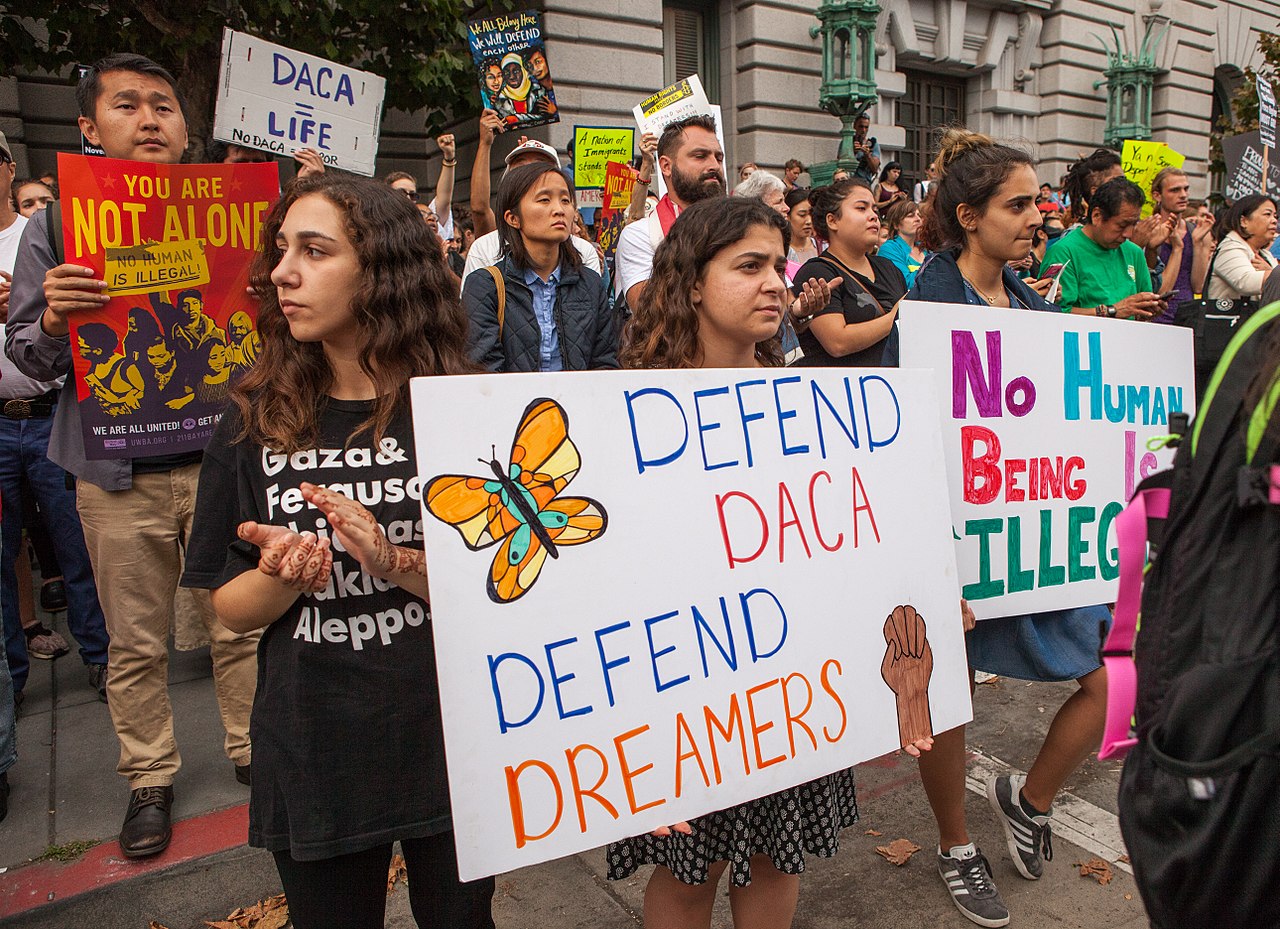
Deferred Action for Childhood Arrivals (DACA) is a policy established on June 15, 2012, by Janet Napolitano, then Secretary of Homeland Security, under the Obama administration. The policy provides temporary relief from deportation and work authorization to certain young undocumented immigrants who meet specific criteria. DACA does not offer a pathway to permanent legal status. Instead, it grants temporary protection that requires renewal every two years. To be eligible, applicants must have arrived in the United States before the age of 16, be currently under the age of 31, and have continuously resided in the US since June 15, 2007. They must also be enrolled in school, have graduated from high school, or have been honorably discharged from the US Armed Forces or Coast Guard. Upon its implementation, DACA initially benefited approximately 832,881 individuals. The policy has been associated with various socioeconomic improvements among its recipients. According to a 2019 survey, DACA recipients experienced an 86 percent increase in their average hourly wage. This rise in wages has contributed to enhanced financial independence and increased consumer spending, which in turn has had positive economic effects. Recipients also reported improved job conditions and expanded educational opportunities, reflecting the broader impact of the policy on their quality of life. Overall, DACA has been a significant, though temporary, measure aimed at addressing the status of undocumented young immigrants and has had notable effects on their economic and educational outcomes.[378]
DACA's future has faced legal challenges, including a 2020 Supreme Court ruling that blocked the Trump administration's attempt to end it and a 2021 decision declaring DACA unlawful, though it did not immediately affect current recipients. The Biden administration has since reaffirmed its support and proposed regulatory changes to secure the program's future.
See also

Places of settlement in United States:
- List of U.S. communities with Hispanic- or Latino-majority in the 2010 census
- List of U.S. cities with large Hispanic and Latino populations
- List of U.S. cities by Spanish-speaking population
- Hispanics and Latinos in New Jersey
- Hispanics and Latinos in Massachusetts
- Hispanics and Latinos in Washington, D.C.
- Hispanics and Latinos in California
- Hispanics and Latinos in Arizona
- Hispanics and Latinos in New Mexico
- Hispanics and Latinos in Texas
- Hispanics and Latinos in Nevada
- Hispanics and Latinos in Florida
- Hispanics and Latinos in New York
Diaspora:
Individuals:
- List of Hispanic and Latino Americans
- Hispanics and Latinos in the American Civil War
- Hispanic and Latino Americans in World War II
- Hispanics and Latinos in the United States Air Force
- Hispanics and Latinos in the United States Coast Guard
- Hispanics and Latinos in the United States Marine Corps
- Hispanics and Latinos in the United States Navy
Other Hispanic and Latino Americans topics:
- Black Hispanic Americans
- Hispanic and Latino American Muslims
- Latin America–United States relations
- List of Latin American Jews
- National Alliance for Hispanic Health
- Portugal–United States relations
- Spain–United States relations
- White Hispanic Americans
- List of U.S. place names of Spanish origin
- Latino National Survey, 2006
- Latino literature
- Chicano movement
- Territories of the United States
- Puerto Rico statehood movement
General:
- Race and ethnicity in the United States census
- Demographics of the United States
- Historical racial and ethnic demographics of the United States
Notes
- ^ Includes Asian Americans.
- ^ a b c The 1970, 1980, and 1990 US censuses did not allow for the selection of multiple races.
- ^ As a U.S. Supreme Court Justice, Sotomayor was nominated by Barack Obama and confirmed by the U.S. Senate, not elected.
- ^ After the election of California senator Kamala Harris as vice president, Padilla was appointed senator by California Governor Gavin Newsom to fill the seat vacancy.
References
- ^ a b "Racial and Ethnic Diversity in the United States: 2010 Census and 2020 Census". U.S. Census Bureau. August 12, 2021. Retrieved August 12, 2021.
- ^ Krogstad, Jens M.; Alvarado, Joshua & Mohamed, Besheer (April 13, 2023). "Among U.S. Latinos, Catholicism Continues to Decline But Is Still the Largest Faith". Pew Research Center. Retrieved August 14, 2023.
- ^ a b c Krogstad, Jens M.; Passel, Jeffrey S.; Lopez, Mark H. (September 23, 2021). "Who is Hispanic?". Pew Research Center. Washington, D.C. Archived from the original on September 29, 2021. Retrieved October 1, 2021.
- ^ Fraga, Luis & Garcia, John A. (2010). Latino Lives in America: Making It Home. Temple University Press. p. 145. ISBN 978-1-4399-0050-5.
- ^ Fisher, Nancy L. (1996). Cultural and Ethnic Diversity: A Guide for Genetics Professionals. Johns Hopkins University Press. p. 19. ISBN 978-0-8018-5346-3.
- ^ Holden, Robert H. & Villars, Rina (2012). Contemporary Latin America: 1970 to the Present. John Wiley & Sons. p. 18. ISBN 978-1-118-27487-3.
- ^ "49 CFR Part 26". Federal Highway Administration. Retrieved October 22, 2012.
'Hispanic Americans,' which includes persons of Mexican, Puerto Rican, Cuban, Dominican, Central or South American, or other Spanish or Portuguese culture or origin, regardless of race.
- ^ "US Small Business Administration 8(a) Program Standard Operating Procedure" (PDF). Archived from the original (PDF) on September 25, 2006. Retrieved October 22, 2012.
SBA has defined 'Hispanic American' as an individual whose ancestry and culture are rooted in South America, Central America, Cuba, Puerto Rico, the Dominican Republic and Mexico.
- ^ Humes, Karen R.; Jones, Nicholas A.; Ramirez, Roberto R. "Overview of Race and Hispanic Origin: 2010" (PDF). U.S. Census Bureau. Archived from the original (PDF) on April 29, 2011. Retrieved March 28, 2011.
"Hispanic or Latino" refers to a person of Cuban, Mexican, Puerto Rican, South or Central American, or other Spanish culture or origin regardless of race.
- ^ "American FactFinder Help: Hispanic or Latino origin". United States Census Bureau. Archived from the original on February 13, 2020. Retrieved October 5, 2008.
- ^ a b Lopez, Mark Hugo; Krogstad, Jens M. & Passel, Jeffrey S. (November 11, 2019). "Who Is Hispanic?". Pew Research Center.
- ^ Tello, Yvette (January 8, 2024). "Hispanic with a Non-Spanish Last Name". La Prensa Texas. Retrieved June 8, 2024.
- ^ a b Office of Management and Budget. "Revisions to the Standards for the Classification of Federal Data on Race and Ethnicity. Federal Register Notice October 30, 1997". White House Archives. Archived from the original on January 21, 2017. Retrieved June 1, 2012 – via National Archives.
- ^ a b c Grieco, Elizabeth M. & Cassidy, Rachel C. "Overview of Race and Hispanic Origin: 2000" (PDF). U.S. Census Bureau. Retrieved April 27, 2008.
- ^ "B03001. Hispanic or Latino origin by specific origin". 2009 American Community Survey 1-Year Estimates. U.S. Census Bureau. Retrieved October 17, 2010.
- ^ "CIA World Factbook – Field Listing: Ethnic groups". Archived from the original on June 13, 2007. Retrieved November 18, 2010.
- ^ "T4-2007. Hispanic or Latino By Race". 2007 Population Estimates. United States Census Bureau.
- ^ "B03002. Hispanic or Latino origin by race". 2007 American Community Survey 1-Year Estimates. U.S. Census Bureau.
- ^ Tafoya, Sonya (December 6, 2004). "Shades of Belonging" (PDF). Pew Hispanic Center. Archived from the original (PDF) on March 3, 2016. Retrieved May 7, 2008.
- ^ Maciel, David (February 26, 2000). The Contested Homeland: A Chicano History of New Mexico. UNM Press. ISBN 978-0-826321992 – via Google Books.
- ^ "Hispanics Were Not The Fastest-Growing Minority Group Last Year". MarketingCharts. July 23, 2013. Retrieved March 5, 2015.
- ^ "Oldest U.S. City". Infoplease.com. Retrieved November 21, 2008.
- ^ The Encyclopedia Americana. Encyclopedia Americana Corp. 1919. p. 151.
- ^ "Chronology of Mexican American History". University of Houston. Archived from the original on January 21, 2012. Retrieved June 11, 2008.
- ^ "Cuartocentennial of Colonization of New Mexico". New Mexico State University. Archived from the original on November 15, 2011. Retrieved June 11, 2008.
- ^ "Supplemental Table 2. Persons Obtaining Lawful Permanent Resident Status by Leading Core Based Statistical Areas (CBSAs) of Residence and Region and Country of Birth: Fiscal Year 2014". U.S. Department of Homeland Security. Archived from the original on March 22, 2017. Retrieved July 3, 2017.
- ^ Bernstein, David E. (2022). Classified: The Untold Story of Racial Classification in America. New York City: Bombardier Books. ISBN 978-1-637581735.
- ^ a b Gonzales-Barrera, Ana & Lopez, Mark Hugo (June 15, 2015). "Is being Hispanic a matter of race, ethnicity or both?". Pew Research Center.
- ^ "U.S. Census Bureau Guidance on the Presentation and Comparison of Race and Hispanic Origin Data". Census.gov. Retrieved March 18, 2007.
Race and Hispanic origin are two separate concepts in the federal statistical system. People who are Hispanic may also be members of any race. People in each racial group may either be Hispanic or they may not be Hispanic. Each person has two attributes, their race (or races) and whether or not they are Hispanic/Latino.
- ^ Lopez, Mark Hugo (February 19, 2016). "Is speaking Spanish necessary to be Hispanic? Most Hispanics say no". Pew Research Center.
- ^ "Mexican America: Glossary". Smithsonian Institution. Archived from the original on June 21, 2008.
Note: It defines "Hispanic" as meaning those with Spanish-speaking roots in the Americas and Spain, and "Latino" as meaning those from both Spanish- and Portuguese-speaking cultures in Latin America.
- ^ Ramirez, Deborah A. (1993). "Excluded Voices: The Disenfranchisement of Ethnic Groups From Jury Service". Wisconsin Law Review: 761.
[T]he term 'Latino' ... may be more inclusive than the term 'Hispanic.'
- ^ Austin, Grace (August 17, 2012). "Hispanic or Latino: Which is Correct?". Profiles in Diversity. Retrieved September 30, 2020.
- ^ Cobos, Rubén (2003). "Introduction". A Dictionary of New Mexico & Southern Colorado Spanish (2nd ed.). Santa Fe: Museum of New Mexico Press. p. ix. ISBN 0-89013-452-9.
- ^ Office of Management and Budget (October 30, 1997). "Revisions to the Standards for the Classification of Federal Data on Race and Ethnicity. Federal Register Notice". The White House. Archived from the original on February 8, 2004. Retrieved June 1, 2012.
- ^ a b "Latino". Online Etymology Dictionary. Retrieved March 5, 2015.
- ^ Ready, Timothy (1991). Latino Immigrant Youth: Passages from Adolescence to Adulthood. Taylor & Francis. p. 14. ISBN 978-0-8153-0057-1.
- ^ Thurman, Christie (September 21, 2010). The Effects of Multicultural Dance on Self-Determination of Adults with Intellectual Disabilities (MA). California State University, Chico. Retrieved January 16, 2018.
- ^ Anderson, Kevin (October 18, 2008). "The complexity of race in New Mexico". The Guardian. London.
- ^ "AP Stylebook Twitter". Retrieved April 6, 2012.
- ^ "Herald Style Guide". Archived from the original on May 24, 2017. Retrieved April 6, 2012.
- ^ "Newsroom 101: Recent Changes to AP Style". Newsroom 101. Archived from the original on April 18, 2012. Retrieved April 6, 2012.
- ^ "latinoamericano, na". Diccionario de la lengua española (in Spanish). RAE/ASALE. Retrieved July 24, 2019.
- ^ "iberorrománico, ca". Diccionario de la lengua española (in Spanish). RAE/ASALE. Retrieved July 24, 2019.
- ^ "Who are we?/ Quienes Somos?". Our Lady of Guadalupe Church in New York City.
- ^ Ramirez, Tanisha Love; Blay, Zeba (July 5, 2016). "Why People Are Using The Term 'Latinx'". HuffPost. Retrieved July 24, 2019.
- ^ Luna, Jennie; Estrada, Gabriel S. (2020). "Trans*lating the Genderqueer -X through Caxcan, Nahua, and Xicanx Indígena Knowledge". In Aldama, Arturo J.; Luis Aldama, Frederick (eds.). Decolonizing Latinx Masculinities. University of Arizona Press. pp. 251–268. ISBN 978-0-816541836.
- ^ Blackwell; McCaughan, ibid., p. 9
- ^ Pero Like (October 14, 2017). "What's The Deal With "Latinx"?". YouTube. Archived from the original on October 29, 2021. Retrieved July 24, 2019.
- ^ Noe-Bustamante, Luis; Mora, Lauren & Lopez, Mark Hugo (August 11, 2020). "About One-in-Four U.S. Hispanics Have Heard of Latinx, but Just 3% Use It". Pew Research Center's Hispanic Trends Project. Retrieved September 30, 2020.
- ^ a b "The US election proves there's no such thing as "the Latino vote"". Quartz.com. November 6, 2020. Retrieved November 6, 2020.
- ^ Weber, David J. (1992). Spanish Frontier in North America. Yale University Press. pp. 30–91.
- ^ "The Treaty of Guadalupe Hidalgo". National Archives. August 15, 2016. Retrieved January 30, 2024.
- ^ "Milestones: 1801–1829". Office of the Historian. Retrieved January 30, 2024.
- ^ "The Spanish-American War, 1898 - 1866–1898 - Milestones - Office of the Historian". January 14, 2016. Archived from the original on January 14, 2016. Retrieved June 18, 2024.
- ^ "World Book Encyclopedia | Atlas | Homework Help". April 21, 2009. Archived from the original on April 21, 2009. Retrieved June 23, 2024.
- ^ "Justice Delayed: Mexican-Americans Win Stolen Oil Rights". October 8, 2012. Archived from the original on October 8, 2012. Retrieved June 23, 2024.
- ^ a b Gutiérrez, David G. (July 10, 2020). "An Historic Overview of Latino Immigration and the Demographic Transformation of the United States". National Park Service.
- ^ "Meet the 20 MAKERS Inducted Into the National Women's Hall of Fame". Makers. October 5, 2015. Archived from the original on March 26, 2017. Retrieved May 31, 2017.
- ^ "Dolores Huerta". The Adelante Movement. Archived from the original on March 20, 2018. Retrieved May 31, 2017.
- ^ "Modern Immigration Wave Brings 58 Million to U.S." Pew Research Center's Hispanic Trends Project. September 28, 2015. Retrieved February 17, 2021.
- ^ a b "Press Release: Hispanic Heritage Month 2009: Sept. 15 – Oct. 15". U.S. Census Bureau. Archived from the original on February 23, 2010. Retrieved January 26, 2010.
- ^ Alemany, Jacqueline (May 7, 2020). "Power Up: Black and Hispanic Americans are getting laid off at higher rates than white workers". The Washington Post. Retrieved May 7, 2020.
- ^ The American Community—Hispanics: 2004 (Report). U.S. Census Bureau. February 1, 2007. Retrieved September 5, 2020.
- ^ "Census QuickFacts: Population Estimates, July 1, 2022, (V2022)". U.S. Census Bureau. Retrieved July 2, 2022.
- ^ Cohn, D'vera; Passel, Jeffrey S. (June 8, 2022). "Key facts about the quality of the 2020 census". Pew Research Center. Retrieved July 2, 2022.
- ^ a b "T1. Population Estimates; Data Set: 2007 Population Estimates". United States Census Bureau. Retrieved April 30, 2008.
- ^ "Facts for features: Hispanic Heritage Month 2007, Sept. 15–Oct. 15". U.S. Census Bureau. July 16, 2008. Archived from the original on September 14, 2007. Retrieved April 30, 2008.
- ^ "Census: Hispanics surpass black people in most U.S. metros". USA Today. April 14, 2011.
- ^ "Table 4. Projections of the Population by Sex, Race, and Hispanic Origin for the United States: 2010 to 2050". U.S. Census Bureau. Archived from the original (XLS) on March 27, 2010. Retrieved October 24, 2010.
- ^ "Hispanic Population and Origin in Select U.S. Metropolitan Areas, 2014". Pew Research Center: Hispanic Trends. September 6, 2016.
- ^ "Selection Population Profiles – Hispanic or Latino (of any race)". U.S. Census Bureau. Retrieved July 5, 2022.
- ^ "Hispanic Population by State: 2006" (PDF). Pew Hispanic Center. Archived from the original (PDF) on May 5, 2008. Retrieved May 7, 2008.
- ^ Shaw, Adam (August 10, 2022). "Abbott's campaign hits back after NYC Mayor Adams threatens to bus New Yorkers to Texas". Fox News. Retrieved August 11, 2022.
- ^ a b c "Hispanic or Latino Origin by Specific Origin: 2022 American Community Survey 1-Year Estimates". U.S. Census Bureau. 2022.
- ^ Includes people who identify as Spaniard, Spanish, or Spanish American
- ^ "Place of Birth (Hispanic or Latino) in the United States: Hispanic or Latino population in the United States 2017 American Community Survey 1-Year Estimates". U.S. Census Bureau. 2017. Archived from the original on February 14, 2020. Retrieved September 18, 2018.
- ^ López, Antonio (April 24, 1998). "A Spanish View of History: Spain's Legacy is not an Issue of Race". New Mexico CultureNet. Archived from the original on October 6, 2007. Retrieved May 13, 2008.
- ^ Chacón-Duque, Juan-Camilo; Adhikari, Kaustubh; Fuentes-Guajardo, Macarena; Mendoza-Revilla, Javier; Acuña-Alonzo, Victor; Barquera, Rodrigo; Quinto-Sánchez, Mirsha; Gómez-Valdés, Jorge; Everardo Martínez, Paola; Villamil-Ramírez, Hugo; Hünemeier, Tábita (December 19, 2018). "Latin Americans show wide-spread Converso ancestry and imprint of local Native ancestry on physical appearance". Nature Communications. 9 (1): 5388. Bibcode:2018NatCo...9.5388C. doi:10.1038/s41467-018-07748-z. ISSN 2041-1723. PMC 6300600. PMID 30568240.
- ^ Pastor, Manuel; Hondagneu-Sotelo, Pierrette (September 9, 2021). "Op-Ed: Why did so few Latinos identify themselves as white in the 2020 census?". Los Angeles Times. Retrieved August 13, 2023.
- ^ "Hispanic or Latino Origin by Race". U.S. Census Bureau. 2017. Archived from the original on February 14, 2020. Retrieved September 18, 2018.
- ^ Schmitt, Eric (March 13, 2001). "For 7 Million People in Census, One Race Category Isn't Enough". The New York Times. ISSN 0362-4331. Retrieved February 17, 2021.
- ^ Aske, Jon. "Hispanics and Race". Salem State University.
- ^ Loveman, Mara & Muniz, Jeronimo (2006). "How Puerto Rico Became White" (PDF). Center for Demography and Ecology, University of Wisconsin. Archived from the original (PDF) on February 7, 2012.
- ^ Marcheco-Teruel, Beatriz; Parra, Esteban J; Fuentes-Smith, Evelyn; Salas, Antonio; Buttenschøn, Henriette N; Demontis, Ditte; Torres-Español, María; Marín-Padrón, Lilia C; Gómez-Cabezas, Enrique J; Álvarez-Iglesias, Vanesa; Mosquera-Miguel, Ana; Martínez-Fuentes, Antonio; Carracedo, Ángel; Børglum, Anders D; Mors, Ole (2014). "Cuba: Exploring the History of Admixture and the Genetic Basis of Pigmentation Using Autosomal and Uniparental Markers". PLOS Genetics. 10 (7): e1004488. doi:10.1371/journal.pgen.1004488. PMC 4109857. PMID 25058410.
- ^ "Republic of Cuba – Country Profile". Nations Online. Retrieved January 10, 2016.
- ^ a b Welch, Susan & Sigelman, Lee (2000). "Getting to Know You? Latino-Anglo Social Contact". Social Science Quarterly. 1 (81): 67–83. JSTOR 42864368. Retrieved September 30, 2022.
- ^ "1970 Census of Population, Subject Reports: Persons of Spanish Origin". U.S. Census Bureau.
- ^ 1980: Census of Population (PDF). Bureau of the Census. August 1982.
- ^ a b c d Fontenot, Kayla; Semega, Jessica; Kollar, Melissa (2018). "Current Population Reports, P60-263, Income and Poverty in the United States: 2017" (PDF). Census.gov. Washington, DC.
- ^ "Overview of Race and Hispanic Origin: 2010" (PDF). U.S Census Bureau. March 2011. Archived from the original (PDF) on April 29, 2011. Retrieved January 9, 2016.
- ^ a b c "Spanish is the most spoken non-English language in U.S. homes, even among non-Hispanics". Pew Research Center. August 13, 2013. Retrieved March 5, 2015.
- ^ Jordan, I. King; Rishishwar, Lavanya; Conley, Andrew B. (September 23, 2019). "Native American admixture recapitulates population-specific migration and settlement of the continental United States". PLOS Genetics. 15 (9): e1008225. doi:10.1371/journal.pgen.1008225. ISSN 1553-7404. PMC 6756731. PMID 31545791.
- ^ a b c Jordan, I. King; Rishishwar, Lavanya; Conley, Andrew B. (September 23, 2019). "Native American admixture recapitulates population-specific migration and settlement of the continental United States". PLOS Genetics. 15 (9): e1008225. doi:10.1371/journal.pgen.1008225. ISSN 1553-7404. PMC 6756731. PMID 31545791.
- ^ "Grid View: Table B03001 - Census Reporter". censusreporter.org. Retrieved August 5, 2024.
- ^ "Census profile: Middle Atlantic Division". Census Reporter. Retrieved August 5, 2024.
- ^ Patten, Eileen (April 20, 2016). "The Nation's Latino Population Is Defined by Its Youth". Pew Research Center's Hispanic Trends Project. Retrieved May 17, 2017.
- ^ a b c d e f g Santiago, Deborah A.; Galdeano, Emily Calderón & Taylor, Morgan (January 2015). The Condition of Latinos in Education: 2015 Factbook (PDF). Washington, DC: Excelencia in Education.
- ^ Gandara, Patricia C. & Contreras, Frances (2009). The Latino Education Crisis: The Consequences of Failed Social Policies. Harvard University Press. ISBN 978-0-674-03127-2. Retrieved January 10, 2016.
- ^ Fergus, E (2009). "Understanding Latino Students' Schooling Experiences: The Relevance of Skin Color Among Mexican and Puerto Rican High School Students". Teachers College Record. 111 (2): 339–375. doi:10.1177/016146810911100209. S2CID 6630196.
- ^ a b Gándara, P (2015). "With the future on the line: Why studying Latino education is so important". American Journal of Education. 121 (3): 451–463. doi:10.1086/680411. S2CID 144901107.
- ^ a b "Hispanics: Education Issues". National Education Association. Archived from the original on November 19, 2015. Retrieved November 18, 2015.
- ^ a b Becerra, D. (2012). "Perceptions of educational barriers affecting the academic achievement of Latino K-12 students". Children and Schools. 34 (3): 167–177. doi:10.1093/cs/cds001.
- ^ a b c Menken, Kate (December 31, 2008). English Learners Left Behind. doi:10.21832/9781853599996. ISBN 978-1-85359-999-6.
- ^ "By the Numbers: ACE Report Identifies Educational Barriers for Hispanics". American Council on Education. 2011. Archived from the original on April 4, 2018.
- ^ Valenzuela, Angela (October 21, 1999). Subtractive Schooling: U.S. – Mexican Youth and the Politics of Caring. SUNY Press. ISBN 978-0-791443224. Retrieved January 16, 2018 – via Google Books.
- ^ Wojtkiewicz, R. A.; Donato, K. M. (1995). "Hispanic Educational Attainment: The Effects of Family Background and Nativity". Social Forces. 74 (2): 559–574. doi:10.1093/sf/74.2.559.
- ^ ValdéS, Guadalupe (January 1992). "Bilingual Minorities and Language Issues in Writing: Toward Professionwide Responses to a New Challenge". Written Communication. 9 (1): 85–136. doi:10.1177/0741088392009001003. ISSN 0741-0883.
- ^ "UTEP Ranked #1 Engineering School for Hispanics for 3rd Consecutive Year". University of Texas at El Paso.
- ^ Castro, Max J. (2002). The Dominican Diaspora Revisited, Dominicans and Dominican-Americans in a New Century.
- ^ a b "Ivy League Schools Don't Reflect U.S. Minority Ratios". National Journal. Archived from the original on March 18, 2015. Retrieved March 5, 2015.
- ^ Delwiche, Theodore R. (May 9, 2014). "Record Number of African Americans, Latinos Matriculate as Yield Increases". The Crimson. Retrieved March 5, 2015.
- ^ "Stanford University: Common Data Set 2013–2014". Ucomm.stanford.edu. Retrieved March 5, 2015.
- ^ "Top 100 Colleges and Universities Hispanics". Hispanic Outlook On Education Magazine. Retrieved October 23, 2021.
- ^ "HACU Lists of Hispanic-Serving Institutions (HSIs) and Emerging HSIs 2017–2018". Hispanic Association of Colleges and Universities. Archived from the original on April 3, 2019. Retrieved April 3, 2019.
- ^ "HO Top 100 Rankings: Colleges & Universities Granting" (PDF). Hispanic Outlook. May 13, 2013. Archived from the original (PDF) on November 2, 2013. Retrieved January 9, 2016.
- ^ "California Community Colleges Chancellor's Office". Data Mart. Retrieved March 5, 2015.
- ^ Malhotra, Monica. "CSU – AS – Enrollment by Ethnic Group – Fall 2013". California State University. Archived from the original on March 16, 2015. Retrieved March 5, 2015.
- ^ "The Fact Book: Report for the Florida College System 2014" (PDF). Florida Department of Education Division of Accountability, Research, and Measurement. 2014. Archived from the original (PDF) on March 4, 2016. Retrieved January 9, 2016.
- ^ "Facts 2013" (PDF). The University of Texas System. 2013. Archived from the original (PDF) on March 4, 2016. Retrieved January 9, 2016.
- ^ "Board of Governors : Resources". State University System of Florida. Archived from the original on February 22, 2015. Retrieved March 5, 2015.
- ^ "A Profile of Undergraduates at CUNY Senior and Community Colleges: Fall 2013" (PDF). CUNY Office of Institutional Research and Assessment. May 14, 2014. Archived from the original (PDF) on February 10, 2016. Retrieved January 9, 2016.
- ^ "Fast Facts – SUNY". State University of New York. Retrieved March 5, 2015.
- ^ "Texas Higher Education Coordinating Board Institutional Targets for Closing the Gaps in Participation, Targets One – Four" (PDF). Texas Higher Education Coordinating Board. February 24, 2014. Retrieved January 9, 2016.
- ^ "The Texas A&M University System Facts 2013" (PDF). Texas A&M University. 2013. Archived from the original (PDF) on February 10, 2016. Retrieved January 9, 2016.
- ^ "Nevada System Of Higher Education: Diversity: Minority Status" (PDF). NSHE. [dead link]
- ^ Godoy, Maria (May 30, 2020). "What Do Coronavirus Racial Disparities Look Like State By State?". NPR.
- ^ Karson, Kendall; Scanlan, Quinn (May 22, 2020). "Black Americans and Latinos nearly 3 times as likely to know someone who died of COVID-19: POLL". ABC News.
- ^ "States tracking COVID-19 race and ethnicity data". American Medical Association. July 28, 2020. Retrieved July 31, 2020.
- ^ Arias, Elizabeth; Xu, Jiaquan & Kochanek, Kenneth D. (May 7, 2019). "United States Life Tables, 2016". National Vital Statistics Reports. 68 (4): 1–66. PMID 31112121.
- ^ a b Goldman, N. (2016). "Will the Latino Mortality Advantage Endure?". Research on Aging. 38 (3): 263–282. doi:10.1177/0164027515620242. PMC 4955825. PMID 26966251.
- ^ Diaz, C. J.; Koning, S. M.; Martinez-Donate, A. P. (2016). "Moving Beyond Salmon Bias: Mexican Return Migration and Health Selection". Demography. 53 (6): 2005–2030. doi:10.1007/s13524-016-0526-2. PMC 5735845. PMID 27848222.
- ^ Diaz, Christina J.; Niño, Michael (2019). "Familism and the Hispanic Health Advantage: The Role of Immigrant Status". Journal of Health and Social Behavior. 60 (3): 274–290. doi:10.1177/0022146519869027. PMID 31526018. S2CID 202674498.
- ^ a b c d Artiga, Samantha; Orgera, Kendal & Damico, Anthony (February 13, 2019). "Changes in Health Coverage by Race and Ethnicity since Implementation of the ACA, 2013–2017". Kaiser Family Foundation.
- ^ a b De Leon Siantz, Mary Lou; Castaneda, Xochitl; Benavente, Viola; Peart, Tasha; Felt, Emily (2013). "The Health Status of Latino Immigrant Women in the united States and Future Health Policy Implications of the Affordable Care Act". Global Advances in Health and Medicine. 2 (5): 70–74. doi:10.7453/gahmj.2013.066. PMC 3833563. PMID 24416697.
- ^ a b c d e f g h i Torres, S. A.; Santiago, C. D.; Walts, K. K. & Richards, M. H. (2018). "Immigration policy, practices and procedures: the impact on the mental health of Mexican and central American youth and families". American Psychologist. 73 (7): 843–854. doi:10.1037/amp0000184. PMID 29504782. S2CID 3692176.
- ^ a b c Letiecq, B. L.; Grzywacz, J. G.; Gray, K. M. & Eudave, Y. M. (2014). "Depression among Mexican men on the migration frontier: the role of family separation and other structural and situational stressors". Journal of Immigrant and Minority Health. 16 (6): 1193–1200. doi:10.1007/s10903-013-9918-1. PMID 24142396. S2CID 762954.
- ^ a b c d e f Hinojos, Belinda (July 2013). Stressors and Coping Strategies of Undocumented Latinos in Therapy (DPhil). University of Nebraska-Lincoln.
- ^ López, Gustavo (September 15, 2015). "The Impact of Slowing Immigration: Foreign-Born Share Falls Among 14 Largest U.S. Hispanic Origin Groups". Pew Research Center. Retrieved September 15, 2015.
- ^ Flores, Antonio (September 18, 2017). "How the U.S. Hispanic population is changing". Pew Research Center.
- ^ Gándara, P. (2015). "With the future on the line: Why studying Latino education is so important". American Journal of Education. 121 (3): 454. doi:10.1086/680411. S2CID 144901107.
- ^ a b "What is the future of Spanish in the United States?". Pew Research Center. September 5, 2013. Retrieved March 5, 2015.
- ^ Rodriguez, Cindy Y. (September 20, 2013). "Fewer Latinos will speak Spanish, more non-Latinos will, report says". CNN. Retrieved March 5, 2015.
- ^ "IV. Language Use". Pew Research Center's Hispanic Trends Project. December 11, 2009. Retrieved March 5, 2015.
- ^ "Languages Spoken and Learned in the United States". Vistawide.com. Retrieved March 5, 2015.
- ^ "Most Studied Foreign Languages in the U.S." Infoplease.com. Retrieved March 5, 2015.
- ^ Small, Lawrence M (August 1, 2002). "Latino Legacies". Smithsonian. Smithsonian Institution. Retrieved April 28, 2008.
There was a Hispanic presence on the continent for more than 200 years before 13 colonies on the eastern coast declared their independence from England. ... By 1607, when the British established their first successful settlement, at Jamestown, Virginia, writes historian Bernard Bailyn, "Spain's American dominion extended nearly 8,000 miles, from Southern California to the Straits of Magellan"
- ^ "A Brief History of St. Augustine". City of St. Augustine. Archived from the original on September 7, 2016. Retrieved April 28, 2008.
Founded in 1565, St. Augustine is the oldest continuously occupied settlement of European origin in the United States. Forty-two years before the English colonized Jamestown and fifty-five years before the Pilgrims landed at Plymouth Rock, the Spanish established at St. Augustine this nation's first enduring settlement.
- ^ "A Spanish Expedition Established St. Augustine in Florida". America's Library. Library of Congress. Archived from the original on May 24, 2008. Retrieved April 28, 2008.
On September 8, 1565, Pedro Menéndez de Avilés landed on the shore of what is now called Matanzas Bay and began the founding of the Presidio of San Agustin. Later the settlement would be called St. Augustine, Florida. Built on the site of an ancient Native American village, and near the place where Ponce de León, the European discoverer of Florida, landed in 1513 in search of the legendary Fountain of Youth, it has been continually inhabited since its founding.
- ^ Francisco Lopez de Mendoza Grajales. "The Founding of St. Augustine, 1565". Modern History Sourcebook. Fordham University. Archived from the original on September 26, 2010. Retrieved April 28, 2008.
- ^ a b "B16006. Language spoken at home by ability to speak English for the population 5 years and over (Hispanic or Latino)". 2006 American Community Survey. U.S. Census Bureau. Retrieved June 12, 2008. [There were 39.5 million Hispanic and Latino Americans aged 5 or more in 2006. 8.5 million of them, or 22%, spoke only English at home, and another 156,000, or 0.4%, spoke neither English nor Spanish at home. The other 30.8 million, or 78%, spoke Spanish at home. Of these, 3.7 million spoke no English, while the overwhelming majority, 27.2 million, did, at these levels: 15.5 million "very well", 5.8 million "well", and 5.9 million "not well". These 27.2 million bilingual speakers represented 69% of all (39.5 million) Hispanic and Latino Americans aged five or over in 2006, while the 3.7 million monolingual Spanish-speakers represented 9%.]
- ^ "United States – Selected Population Profile in the United States (Hispanic or Latino (of any race))". 2006 American Community Survey. U.S. Census Bureau. Archived from the original on September 2, 2010. Retrieved June 11, 2008.
- ^ Shin, Hyon B. & Bruno, Rosalind (October 2003). "Language Use and English-Speaking Ability: 2000" (PDF). U.S. Census Bureau. Retrieved January 9, 2016.
- ^ "The Future of Spanish in the United States". Languagepolicy.net. Retrieved March 5, 2015.
- ^ Data Access and Dissemination Systems (DADS). "American FactFinder – Results". Census.gov. Archived from the original on February 12, 2020. Retrieved March 5, 2015.
- ^ "8 Reasons Spanish Isn't A Foreign Language In The U.S. (SLIDESHOW)". The Huffington Post. June 12, 2013. Retrieved March 5, 2015.
- ^ Benmamoun, Elabbas; Montrul, Silvina & Polinsky, Maria (2010). "Prologmena to Heritage Linguistics". Harvard University.
- ^ Suarez, Ray & Stavans, Ilan. "Do You Speak American?: Spanglish". PBS. Retrieved March 5, 2015.
- ^ Haggin, Patience (August 27, 2013). "Miami Accents: Why Locals Embrace That Heavy "L" Or Not". WLRN. Retrieved March 5, 2015.
- ^ Lipski, John M. (2005). "Code-switching or Borrowing? No sé so no puedo decir, you know" (PDF). Selected Proceedings of the Second Workshop on Spanish Sociolinguistics. Somerville, MA: Cascadilla Proceedings Project.
- ^ a b c "In U.S., Decline of Christianity Continues at Rapid Pace". Pew Research Center. October 17, 2019.
- ^ a b "The Shifting Religious Identity of Latinos in the United States". Pew Research Center. May 7, 2014.
- ^ "Chapter 7: Renewalism and Hispanic Christianity". The Shifting Religious Identity of Latinos in the United States (Report). Pew Research Center. May 7, 2014.
- ^ "Select-a-Faith: Latinos are quitting the Catholic church". The Economist. May 17, 2014.
- ^ "Faith: Pick and mix". The Economist. March 14, 2015. Retrieved March 28, 2015.
- ^ Espinosa, Gastón (2008). "Latinos, Religion, and the American Presidency". In Espinosa, Gastón (ed.). Religion, Race, and the American Presidency. Lanham, MD: Rowman & Littlefield. pp. 242–244. ISBN 978-0-742563216.
- ^ a b Dias, Elizabeth (November 12, 2019). "U.S. Catholic Bishops Elect Hispanic Immigrant as Leader". The New York Times.
- ^ Long-García, J.D. (May 4, 2018). "The Hispanic Catholic Church in the U.S. is growing, survey confirms". America.
- ^ Nadeem, Reem (April 13, 2023). "Among U.S. Latinos, Catholicism Continues to Decline But Is Still the Largest Faith". Pew Research Center. Retrieved April 25, 2023.
- ^ Kerevel, Yann P. (June 2011). "The Influence of Spanish-Language Media on Latino Public Opinion and Group Consciousness" (PDF). Social Science Quarterly. 92 (2): 509–534. Archived from the original (PDF) on April 12, 2019.
- ^ Subervi-Velez, Federico A. (January 1986). "The Mass Media and Ethnic Assimilation and Pluralism: A Review and Research Proposal with Special Focus on Hispanics". Communication Research. 13 (1): 71–96. doi:10.1177/009365028601300105. S2CID 146739567.
- ^ Polley, Leonor Ayala & Morales, Natalie (February 24, 2020). "Ozzie Areu, the first Latino to own a major studio, has a Hollywood story himself". NBC News.
- ^ Murry, Kenny (December 5, 2019). "Atlanta's Areu Bros. Open First Latinx-Owned Studios In US". Georgia Public Broadcasting.
- ^ Chambers, Todd (2006). "The state of Spanish-language radio". Journal of Radio Studies. 13 (1): 34–50. doi:10.1207/s15506843jrs1301_3. S2CID 167640657.
- ^ Schement, Jorge Reina & Flores, Ricardo (1977). "The Origins of Spanish-Language Radio: The Case of San Antonio, Texas". Journalism History. 4 (2): 56–61. doi:10.1080/00947679.1977.12066845.
- ^ Gutiérrez, Félix F. & Schement, Jorge Reina (1979). Spanish-Language Radio in the Southwestern United States. Austin, TX: UT Center for Mexican American Studies.
- ^ Paxman, Andrew (2018). "The Rise of US Spanish-Language Radio From 'Dead Airtime' to Consolidated Ownership (1920s–1970s)". Journalism History. 44 (3): 174–186. doi:10.1080/00947679.2018.12059208. S2CID 181477533.
- ^ Casillas, Dolores Inés (October 2014). Sounds of Belonging: US Spanish-language radio and public advocacy. New York City: NYU Press. ISBN 978-0-814770658.
- ^ Levine, D.M. (January 19, 2012). "As Hispanic Television Market Grows, Univision Reshuffles Executives". AdWeek. Retrieved March 5, 2015.
- ^ "How Latin trap defied the odds and launched the hottest artists of 2018 - The Washington Post". The Washington Post. February 28, 2019. Archived from the original on February 28, 2019. Retrieved May 13, 2024.
- ^ Thompson-Hernández, Walter (January 28, 2024). "Where Mexican Folk Ballads Meet Trap Music - The New York Times". The New York Times. Archived from the original on January 28, 2024. Retrieved May 13, 2024.
- ^ "From Reggaeton to Dominican Dembow. A Timeline to the Hottest Music Genre Around - HipLatina". February 13, 2024. Archived from the original on February 13, 2024. Retrieved May 13, 2024.
- ^ Chumley, Cheryl K. (October 17, 2013). "Hispanic influence: Tortillas take over burger buns as fast-food fave". The Washington Times. Retrieved March 5, 2015.
- ^ Ferdman, Roberto A. (November 25, 2021). "The rise of the avocado, America's new favorite fruit". The Washington Post.
- ^ "Latino, other ethnic influences changing America's food choices". NBC Latino. Archived from the original on April 2, 2015. Retrieved March 5, 2015.
- ^ "Food in United States: Latino Americans". Food by Country. Retrieved March 5, 2015.
- ^ Adcox, Susan. "Grandparents Important in Hispanic Family Structure". About.com Parenting. Archived from the original on January 10, 2017. Retrieved March 5, 2015.
- ^ "Hispanic Priorities: Marriage, Family and Youth". Barna Group. Archived from the original on March 1, 2015. Retrieved March 5, 2015.
- ^ "Cultural Values of Latino Patients and Families". Dimensions of Culture.com. Retrieved March 5, 2015.
- ^ a b Landale, Nancy S.; Oropesa, R. Salvador & Bradatan, Christina. "Hispanic Families in the United States: Family Structure and Process in an Era of Family Change". National Center for Biotechnology Information. Retrieved March 5, 2015.
- ^ "Hispanics Place Higher Emphasis On Education, Poll Reports". The Huffington Post. July 20, 2010. Retrieved March 5, 2015.
- ^ Brown, B. Bradford; Larson, Reed W. & Saraswathi, Tharakad Subramanium, eds. (2002). The World's Youth: Adolescence in Eight Regions of the Globe. Cambridge University Press. ISBN 978-0-521809108.
- ^ Ford, Rebecca (February 18, 2016). "'The Witch' Breakout Anya Taylor-Joy Goes From Ballet to Studio Thrillers". The Hollywood Reporter. Archived from the original on February 7, 2017. Retrieved February 12, 2017.
- ^ Florsheim, Lane (November 6, 2020). "Anya Taylor-Joy on 'The Queen's Gambit' and Dancing at the End of the Pandemic". The Wall Street Journal. ISSN 0099-9660. Archived from the original on November 15, 2020. Retrieved November 15, 2020.
- ^ Fishwick, Samuel (January 19, 2017). "Anya Taylor-Joy: meet the actress on the cusp of Hollywood superstardom". Evening Standard. Archived from the original on April 9, 2017. Retrieved March 9, 2017.
- ^ "The Spanish family of Anya, the actress of Gambito de Dama: her grandmother's shop in Zaragoza". The Canadian News. March 7, 2021. Archived from the original on March 8, 2021. Retrieved March 7, 2021.
- ^ a b c d e "Pew Social Trends: "Marrying Out"" (PDF). Pew Research Center. June 15, 2010. Archived from the original (PDF) on June 11, 2016.
- ^ a b c Wang, Wendy (February 16, 2012). "The Rise of Intermarriage". Pew Research Center.
- ^ "Rosa Salazar: From "Abbreviated" 'Bird Box' Role to James Cameron's 'Alita'". The Hollywood Reporter. January 11, 2019. Archived from the original on January 14, 2019. Retrieved January 15, 2019.
- ^ Lee, Sharon M. & Edmonston, Barry (June 2005). "New Marriages, New Families: U.S. Racial and Hispanic Intermarriage" (PDF). Population Reference Bureau Population Bulletin. 6 (2). ISSN 0032-468X. Archived from the original (PDF) on March 3, 2016. Retrieved January 9, 2016.
- ^ Jeffrey S. Passel; Wendy Wang; Paul Taylor (June 4, 2010). "Marrying Out: One-in-Seven New U.S. Marriages is Interracial or Interethnic" (PDF). Pew Research Center. Archived from the original (PDF) on January 31, 2016. Retrieved January 9, 2016.
- ^ Glazer, Nathan (1998). We are All Multiculturalists Now. Harvard University Press. p. 129. ISBN 978-0-674948365. Retrieved March 5, 2015.
- ^ "Multiracial population grows in Orlando". Orlando Sentinel. Archived from the original on June 25, 2011. Retrieved March 5, 2015.
- ^ "How interracial relationships shape the Latino community". Being Latino. Archived from the original on November 2, 2014. Retrieved March 5, 2015.
- ^ "Explorations in Black and Tan". Imdiversity.com. Retrieved March 5, 2015.
- ^ Szot, Hilary S. (February 26, 2014). "Black History Month: New Generation Of Afro-Latinos Tackles Race And Identity". Fox News Latino. Retrieved March 5, 2015.
- ^ Alex-Assensoh, Yvette Marie; Hanks, Lawrence J. (November 2000). Black and Multiracial Politics in America. NYU Press. p. 97. ISBN 9780814706633. Retrieved March 5, 2015.
- ^ Torres, Andrés (1995). Between Melting Pot and Mosaic. Temple University Press. p. 4. ISBN 978-1-566392808. Retrieved March 5, 2015.
- ^ "The case of the white Cubans". Gene Expression. Archived from the original on April 6, 2015. Retrieved March 5, 2015.
- ^ "'Whitening' the children: a desire of many Cuban families". Iván's File Cabinet. February 25, 2012. Retrieved March 5, 2015.
- ^ a b Hondagneu-Sotelo, Pierrette (2004). "Gender and the Latino experience in Late-Twentieth-Century America". In Gutiérrez, D.G. (ed.). The Columbia History of Latinos in the United States since 1960. New York City: Columbia University Press. ISBN 978-0-231118088.
- ^ a b Gowan, Mary; Trevino, Melanie (June 1, 1998). "An Examination of Gender Differences in Mexican-American Attitudes Toward Family and Career Roles". Sex Roles. 38 (11): 1079–1093. doi:10.1023/A:1018886912223. ISSN 1573-2762. S2CID 141119013.
- ^ Peñalosa, Fernando (1968). "Mexican Family Roles". Journal of Marriage and Family. 30 (4): 680–689. doi:10.2307/349517. ISSN 0022-2445. JSTOR 349517.
- ^ Galanti, Geri-Ann (July 2003). "The Hispanic Family and Male-Female Relationships: An Overview". Journal of Transcultural Nursing. 14 (3): 180–185. doi:10.1177/1043659603014003004. ISSN 1043-6596. PMID 12861920. S2CID 2397695.
- ^ Cromwell, Ronald E.; Ruiz, Rene A. (December 1979). "The Myth of Macho Dominance in Decision Making Within Mexican and Chicano Families". Hispanic Journal of Behavioral Sciences. 1 (4): 355–373. doi:10.1177/073998637900100404. ISSN 0739-9863. PMID 12340208. S2CID 11319203.
- ^ Souza, Caridad (2002). "The Sexual Identities of Young Puerto Rican Mothers". Diálogo. 6 (1).
- ^ a b c Foner, Nancy; Deaux, Kay; Donato, Katharine M. (2018). "Introduction: Immigration and Changing Identities". RSF: The Russell Sage Foundation Journal of the Social Sciences. 4 (5): 1–25. doi:10.7758/rsf.2018.4.5.01. ISSN 2377-8253. JSTOR 10.7758/rsf.2018.4.5.01. S2CID 158508992.
- ^ Espin, Oliva M.; Warner, Beth (September 1982). "Attitudes Towards the Role of Women in Cuban Women Attending a Community College". International Journal of Social Psychiatry. 28 (3): 233–239. doi:10.1177/002076408202800310. ISSN 0020-7640. PMID 7118462. S2CID 45670975.
- ^ Pérez, Gina (2003). "'Puertorriqueñas Rencorosas y Mejicanas Sufridas': Gendered Ethnic Identity Formation in Chicago's Latino Communities". Journal of Latin American Anthropology. 8 (2): 96–124. doi:10.1525/jlca.2003.8.2.96.
- ^ Tharp, Roland G.; Meadow, Arnold; Lennhoff, Susan G.; Satterfield, Donna (1968). "Changes in Marriage Roles Accompanying the Acculturation of the Mexican-American Wife". Journal of Marriage and Family. 30 (3): 404–412. doi:10.2307/349908. ISSN 0022-2445. JSTOR 349908.
- ^ a b Bojórquez, Kim (June 1, 2022). "More Latinos are identifying as LGBTQ. Here's how some in Utah have found acceptance and community". The Salt Lake Tribune.
The poll found 11% of U.S. Latino adults said they identified as LGBTQ, nearly twice the rate of 6.2% of non-Hispanic white adults and 6.6% of Black adults who said they were queer. The percentage of queer Latino adults was even higher among Gen Zers — the cohort born between 1997 and 2012 — where more than 1 in 5 said they were LGBTQ, the report found.
- ^ Kupemba, Danai Nesta (June 12, 2022). "More young, Hispanic Americans identify as LGBTQ+ than ever before". PinkNews.
New data has confirmed that young Hispanic Americans are driving an increase in the LGBTQ+ population.
- ^ Nolan, Ian T.; Kuhner, Christopher J.; Dy, Geolani W. (2019). "Demographic and temporal trends in transgender identities and gender confirming surgery". Translational Andrology and Urology. 8 (3). AME Publishing Company: 184–190. doi:10.21037/tau.2019.04.09. ISSN 2223-4683. PMC 6626314. PMID 31380225.
Studies evaluating racial and ethnic demographic trends suggest that non-white groups are overrepresented in TGNB populations. Flores et al. estimate transgender prevalence among non-Hispanic whites at approximately 480 per 100,000, lower than the 770 per 100,000 for non-Hispanic blacks, 840 per 100,000 for "Hispanic/Latino" and 640 per 100,000 for "other non-Hispanic" categories.
- ^ Flores, Andrew (2016). Race And Ethnicity Of Adults Who Identify As Transgender In The United States (PDF). Los Angeles, California: The Williams Institute (UCLA). p. 3.
Based on these estimates, we find that adults who identify as transgender are less likely to be White and more likely to be African-American or Black and Hispanic or Latino than the U.S. general population.
- ^ Gattamorta, Karina; Quidley-Rodriguez, Narciso (2018). "Coming Out Experiences of Hispanic Sexual Minority Young Adults in South Florida". Journal of Homosexuality. 65 (6): 741–765. doi:10.1080/00918369.2017.1364111. ISSN 0091-8369. PMC 5797510. PMID 28771094.
Machismo, a socially constructed set of behaviors that reinforces male gender roles in Hispanic culture, may impact identity development and behavior (Arciniega, Anderson, Tovar-Blank, & Tracey, 2008; Basham, 1976; De La Cancela, 1986). Hirai, Winkel, and Popan (2014) reported that higher levels of machismo was positively correlated with prejudice toward lesbians and gay men. In addition, machismo has been correlated with internalized homophobia (Estrada, Rigali-Oiler, Arciniega, & Tracey, 2011), and this, in turn, has been linked to mental health issues and suicidal ideation (Cochran, Sullivan, & Mays, 2003; Hatzenbuehler, McLaughlin, & Nolen-Hoeksema, 2008; Newcomb & Mustanski, 2010; Williamson, 2000).
- ^ Franco, Marina (March 24, 2022). "Poll: Latinos are highly accepting of members of LGBTQ community". Axios.
- ^ "Where black and brown collide: The struggle for political dominance". The Economist. August 2, 2007.
- ^ Chideya, Farai & del Barco, Mandalit (May 16, 2005). "Racial Tension at Los Angeles High School". National Public Radio.
- ^ a b Nagourney, Adam & Steinhauer, Jennifer (January 15, 2008). "In Obama's Pursuit of Latinos, Race Plays Role". The New York Times.
- ^ Broder, John M. (April 24, 2005). "A Black-Latino Coalition Emerges in Los Angeles". The New York Times.
- ^ Preston, Julia (December 13, 2007). "Survey Points to Tensions Among Chief Minorities". The New York Times.
- ^ Senteno, Christine (December 13, 2007). "Poll Explores Racial Tensions Among Minority Groups". UCLA Center for Communications & Community. Archived from the original on July 12, 2010.
- ^ Rosentiel, Tom (April 26, 2006). "Attitudes Toward Immigration: In Black and White". Pew Research Center.
- ^ Saucedo, Leticia M. (July 2008). "African American–immigrant Tensions: Myths, Realities And Policy Implications" (PDF). University of Berkeley Law School.
- ^ a b Saad, Lydia (July 17, 2008). "White people May Exaggerate Black-Hispanic Tensions". Gallup.
- ^ Faturechi, Robert (December 21, 2010). "Hate crimes in L.A. County down overall, but anti-Jewish vandalism rises". Los Angeles Times. Archived from the original on February 7, 2011.
- ^ a b Levenson, Michael (December 10, 2007). "GOP hopefuls beckon Hispanics in debate". The Boston Globe. Retrieved June 8, 2008.
- ^ Munoz, Carlos Jr. (November 2, 2000). "The Latino challenge". BBC News. Retrieved May 16, 2008.
- ^ Medina, Jennifer (March 1, 2022). "How Immigration Politics Drives Some Hispanic Voters to the G.O.P. in Texas". The New York Times. Retrieved May 2, 2022.
- ^ Cadava, Geraldo (January 18, 2022). "Latino Voters Are Key to 2024, and They're Not Always Buying What Democrats Are Selling". The New York Times. Retrieved May 2, 2022.
- ^ Concha, Joe (April 17, 2022). "Hispanics are abandoning Biden in droves. Here's why". The Hill. Retrieved May 2, 2022.
- ^ McDaniel, Ronna (April 29, 2022). "Minorities are finding a new political home with the Republican Party". The Hill. Retrieved May 2, 2022.
- ^ Frasure-Yokley, L. & Wilcox-Archuleta, B. (2019). "Geographic Identity and Attitudes toward Undocumented Immigrants". Political Research Quarterly. 4 (72): 944–959. doi:10.1177/1065912919843349. JSTOR 45223013. S2CID 182586898. Retrieved September 30, 2022.
- ^ "1. Looking Forward to 2016: The Changing Latino Electorate". Pew Research Center. January 19, 2016.
- ^ "Millennials Make Up Almost Half of Latino Eligible Voters in 2016". Pew Research Center. January 19, 2016.
- ^ "2016 electorate will be the most diverse in U.S. history". Pew Research Center. February 3, 2016.
- ^ Valdes, Marcela (September 14, 2016). "27 Million Potential Hispanic Votes. But What Will They Really Add Up To?". The New York Times Magazine.
- ^ "The Hispanic Vote in Presidential Elections, 1980–2012" (PDF). Pew Research Center. Archived from the original (PDF) on April 23, 2013. Retrieved May 11, 2013.
- ^ Ndiaye, Ahmad (March 22, 2008). "Obama gets another ally". Afrik-News. Archived from the original on June 10, 2008. Retrieved June 8, 2008.
- ^ a b Minushkin, Susan & Lopez, Mark Hugo (February 21, 2008). "The Hispanic Vote in the 2008 Democratic Presidential Primaries" (PDF). Pew Hispanic Center. Archived from the original (PDF) on May 1, 2009.
- ^ a b "Obama dominates McCain among Hispanics: poll". AFP. July 2, 2008. Archived from the original on November 18, 2010. Retrieved April 9, 2009.
- ^ "McCain Lost Ground with Hispanics, Despite Immigration Stance". HispanicTips. September 1, 2010. Archived from the original on September 1, 2010. Retrieved August 30, 2016.
- ^ Costantini, Peter (November 12, 2008). "Why John McCain Lost the Latino Vote". AlterNet. Retrieved March 5, 2015.
- ^ Video on YouTube
- ^ a b Lawrence, Jill (November 6, 2008). "Hispanic vote grows, shifts to Democrats". USA Today. Retrieved April 11, 2009.
- ^ "Local Exit Polls – Election Center 2008". CNN. Retrieved May 4, 2010.
- ^ Carroll, Susan (November 6, 2008). "In record turnout, Hispanic voters flip red states to blue". Houston Chronicle. Retrieved April 11, 2009.
- ^ a b Ewers, Justin (January 30, 2009). "Republicans and Latino Voters: Has the GOP Shifted on Immigration Reform?". U.S. News & World Report. Retrieved April 8, 2009. Page 1
- ^ "[OPINION] The Latino Vote In 2012 and the Depth Of The GOP Problem". NJ Today.net. Archived from the original on April 2, 2015. Retrieved March 5, 2015.
- ^ "Are Republican immigration reform opponents losing clout?". CBS News.com. November 23, 2012. Retrieved March 5, 2015.
- ^ Romney, Mitt (July 31, 2012). "Culture does matter". National Review Online.
- ^ Bloomfield, Adrian; Day, Matthew; Swaine, Jon (July 30, 2012). "Mitt Romney: Israelis richer than Palestinians because of 'hand of providence'". The Daily Telegraph. London. Archived from the original on January 11, 2022.
- ^ a b Sherwood, Harriet (July 30, 2012). "Mitt Romney 'providence' comments in Israel outrage Palestinians". The Guardian. London. Retrieved August 3, 2012.
- ^ "Text of Romney's Remarks About Culture and Israel". ABC News. Associated Press. August 1, 2012. Retrieved August 1, 2012.
- ^ "Mitt Romney creates fresh divisions on Israel tour with 'racist' economic remarks". National Post. July 30, 2012. Retrieved August 2, 2012.
- ^ "Embajada de México rechaza comentarios de Romney". El Universal (in Spanish). August 1, 2012. Archived from the original on July 8, 2013. Retrieved August 2, 2012.
- ^ Sabato, Larry J. (2017). "The 2016 Election that Broke All, or At Least Most, of the Rules". In Sabato, Larry; Kondik, Kyle & Skelley, Geoffrey (eds.). Trumped: The 2016 Election That Broke All the Rules. Lanham, MD: Rowman & Littlefield. p. 10. ISBN 978-1-442279407.
- ^ Barreto, Matt; Schaller, Thomas; Segura, Gary (2017). "Latinos and the 2016 Election". In Sabato, Larry; Kondik, Kyle; Skelley, Geoffrey (eds.). Trumped: The 2016 Election That Broke All the Rules. Lanham, Maryland: Rowman & Littlefield. pp. 123–35. ISBN 978-1-442279407.
- ^ Skelley, Geoffrey (March 23, 2017). "Another Look Back at 2016: Comparing the exit poll and the Cooperative Congressional Election Study". Sabato's Crystal Ball. Retrieved March 8, 2018.
- ^ Remnick, David (July 23, 2018). "Alexandria Ocasio-Cortez's Historic Win and the Future of the Democratic Party". The New Yorker.
- ^ Seitz-Wald, Alex (June 26, 2018). "High-ranking Democrat ousted in stunning primary loss to newcomer Alexandria Ocasio-Cortez". NBC News. Retrieved June 27, 2018.
- ^ "Bernie Sanders weighs in on Ocasio-Cortez's victory". MSNBC. June 27, 2018. Retrieved August 10, 2018.
- ^ "President Donald J. Trump Announces Intent to Nominate and Appoint Individuals to Key Administration Posts". whitehouse.gov. Retrieved September 17, 2020 – via National Archives.
- ^ "Election 2020: How Latino voters turned Arizona blue". AJ+. Retrieved July 10, 2024.
- ^ "Culinary Union delivered Nevada for Biden/Harris, drove unprecedented turnout with the largest political team statewide". Culinary Union Local 226. November 7, 2020. Retrieved July 10, 2024.
- ^ "Trump's gains among Latino voters shouldn't come as a surprise. Here's why". NBC News. November 5, 2020. Retrieved November 6, 2020.
- ^ "2 Hispanic congressmen from Arizona among 'potential candidates' for Biden's cabinet". 12news NBC News. November 19, 2020. Retrieved November 19, 2020.
- ^ "Latino voters were decisive in 2020 presidential election". UCLA. January 6, 2021. Retrieved July 13, 2021.
- ^ Svitek, Patrick (March 24, 2022). "U.S. Rep. Filemon Vela's resignation announcement sparks a sudden special-election scramble in hotly contested South Texas". Texas Tribune. Archived from the original on March 24, 2022. Retrieved March 24, 2022.
- ^ a b Harris, Cayla (April 11, 2022) [April 7, 2022]. "Texas Republican Mayra Flores gets a boost in quest to be first U.S. congresswoman born in Mexico". San Antonio Express-News. Archived from the original on June 17, 2022. Retrieved May 30, 2022.
- ^ Svitek, Patrick (June 14, 2022). "Republicans flip U.S. House seat in South Texas, historically a Democratic stronghold". Texas Tribune. Archived from the original on June 15, 2022.
- ^ Svitek, Patrick (July 6, 2023). "National GOP recruiting Mayra Flores, ousted from her South Texas seat, to run again for Congress". The Texas Tribune. Retrieved January 16, 2024.
- ^ Oboler, Suzanne & González, Deena J., eds. (2006). The Oxford Encyclopedia of Latinos & Latinas In The United States. Oxford University Press. ISBN 978-0-195156003.
- ^ Mier, Tomás (March 14, 2021). "'We've Got the Whole World Listening': J Balvin and Ricky Martin Talk Repping Latinos at Grammys". People. Retrieved April 11, 2021.
- ^ "Billboard's Latin Charts Switch To SoundScan". Billboard. July 10, 1993. pp. 4, 71. Retrieved January 19, 2013.
- ^ "RIAA Launches "Los Premios de Oro y De Platino" to Recognize Top Latin Artists". Recording Industry Association of America. Archived from the original on October 29, 2013. Retrieved January 18, 2013.
- ^ "Historia: Premios Lo Nuestro". Terra (in Spanish). Terra Networks, Inc. February 6, 2006. Retrieved June 10, 2013.
- ^ "Univision Announces the Nominees for Spanish-language Music's Highest Honors Premio Lo Nuestro a la Musica Latina". Univision. March 27, 1996. Archived from the original on December 15, 2013. Retrieved June 11, 2013.
- ^ Valdes-Rodriguez, Alisa (September 12, 2000). "One Little Word, Yet It Means So Much". Los Angeles Times. Retrieved December 25, 2013.
- ^ Garza, Agustin (May 18, 2002). "Latin Grammys Struggle With Loss of Momentum". Los Angeles Times. Retrieved December 25, 2013.
- ^ Melas, Chloe (November 23, 2020). "American Music Awards 2020: See who won". CNN. Retrieved November 23, 2020.
- ^ Lee, Kevin (January 2008). ""The Little State Department": Hollywood and the MPAA's Influence on U.S. Trade Relations". Northwestern Journal of International Law & Business. 28 (2).
- ^ Davison, Heather K.; Burke, Michael J. (2000). "Sex Discrimination in Simulated Employment Contexts: A Meta-analytic Investigation". Journal of Vocational Behavior. 56 (2): 225–248. doi:10.1006/jvbe.1999.1711.
- ^ a b Enrique Pérez, Daniel (2009). Rethinking Chicana/o and Latina/o Popular Culture. Palgrave Macmillan. pp. 93–95. ISBN 978-0-230616066.
- ^ "About Us". National Hispanic Media Coalition. Retrieved June 12, 2008.
- ^ Noriega, Chon. "Politics and Culture: Making a Difference". Connecticut College. Archived from the original on December 10, 2008. Retrieved June 12, 2008.
- ^ "2020 Emmy Nominations Criticized by Hispanic Caucus for 'Erasure' of Latino Actors". People. Retrieved September 21, 2020.
- ^ "Emmys 2020 nominees are more diverse, but Latino representation still abysmal". Los Angeles Times. July 28, 2020. Retrieved September 21, 2020.
- ^ "The Afro-Latino Actors Fighting Erasure in Hollywood". Time. Retrieved September 21, 2020.
- ^ "John Leguizamo will boycott the Emmys: 'If you don't have Latin people, there's no reason for me to see it'". The Independent. September 18, 2020. Retrieved September 21, 2020.
- ^ Samaha, Barry; Betancourt, Bianca (October 13, 2021). "14 Latinx Designers on How Their Culture Informs Their Work". Harper's Bazaar. Retrieved April 27, 2022.
- ^ "I'd Like The World To Buy A Coke". Businessweek. April 13, 1998. Archived from the original on May 17, 2008. Retrieved December 13, 2008.
- ^ Gregory, Sean (August 13, 2005). "Arturo Moreno: The Major League Player". Time. Archived from the original on September 8, 2005. Retrieved December 13, 2008.
- ^ a b "Forbes 400". Forbes. November 14, 2017.
- ^ Piore, Adam (May 1, 2013). "Related's Jorge Pérez puts his stamp on the skyline". The Real Deal. Retrieved January 15, 2017.
- ^ Levin, Jordan (April 15, 2016). "Jorge Pérez – building a cultural legacy". Miami Herald. Retrieved October 1, 2017.
- ^ "Joseph Unanue". Smithsonian Institution. Archived from the original on January 22, 2009. Retrieved December 13, 2008.
- ^ "Biografía de Ángel Ramos Torres". Manati.info (in Spanish). Archived from the original on October 24, 2007. Retrieved April 16, 2009.
- ^ "Samuel A. Ramirez & Company, Inc. Introduces The Ramirez Hispanic Index Equally-Weighted Portfolio". Archived from the original on October 12, 2008. Retrieved April 16, 2009.
- ^ "Making Wall Street History" (PDF). Archived from the original (PDF) on March 2, 2006. Retrieved April 16, 2009. (Scan of cover story in Hispanic Trends, issue of December 2005 – January 2006.)
- ^ "30 Under 30". Hispanic Executive.
- ^ "First Tech Fund CEO, Josue De Paz Selected as Class of 2022-2023 Obama Foundation Scholar". First Tech Fund. August 30, 2022.
- ^ "Directory of Latino Elected Officials", NALEO, archived from the original on May 31, 2009, retrieved January 27, 2010
- ^ "Latino clout in Congress appears to stay consistent". Houston Chronicle. January 8, 2011. Retrieved March 5, 2015.
- ^ "History". NALEO. Archived from the original on December 14, 2009. Retrieved January 27, 2010.
- ^ "First Latina Governor's Historic Inauguration Gets Little National News Coverage". Fox News. January 11, 2011.
- ^ "Lauro F. Cavazos: An Inventory of His Papers 1943–1991 and undated, at the Southwest Collection/Special Collections Library". University of Texas. Retrieved March 5, 2015.
- ^ Wang, Hansi Lo (November 4, 2021). "The Senate has confirmed the 1st Latino to lead the U.S. census, Robert Santos". NPR. Retrieved October 25, 2023.
- ^ "Mission and History". USHLI. August 30, 2018.
- ^ ""The Wild Frontier' by Jorge Majfud Shares Tales From The Remarkable Past"". Pro News Report. June 2, 2021.
- ^ "Princeton's Children's Book Festival". Princeton Library. September 15, 2007. Archived from the original on February 26, 2010.
- ^ "Operation Tribute to Freedom: Hispanic Heritage Month". U.S. Army. March 25, 2007. Archived from the original on March 25, 2007. Retrieved January 16, 2018.
- ^ "Senator Mark Pryor Press Releases". U.S. Senate. March 8, 2007. Archived from the original on March 8, 2007. Retrieved January 16, 2018.
- ^ "The Hispanic Experience – Contributions to America's Defense". Houston Culture.org. Retrieved January 16, 2018.
- ^ "U.S. military, a growing Latino army". NBC Latino.com. January 1, 2013. Archived from the original on January 25, 2018. Retrieved January 16, 2018.
- ^ Farragut, Loyall (1879). The life of David Glasgow Farragut, first admiral of the United States navy: embodying his journal and letters. New York City: D. Appleton & Company. p. 3.
- ^ Hickman, Kennedy. "Admiral David G. Farragut: Hero of the Union Navy". About.com. p. 216. Archived from the original on September 27, 2011. Retrieved November 11, 2010.
- ^ Kanellos, Nicolás (1997). Hispanic Firsts: 500 Years of Extraordinary Achievement. Canton, Michigan: Visible Ink Press. pp. 210–211. ISBN 0-7876-0519-0.
- ^ "Prominent Figures in Hispanic History". Arlington Cemetery. Archived from the original on June 19, 2010. Retrieved March 5, 2015.
- ^ a b c Hernandez, Roger E. (2008). The Civil War, 1840s–1890s. New York: Marshall Cavendish. ISBN 978-0-7614-2939-5.
- ^ a b c "Hispanics in America's Defense" (PDF). Office of the Deputy Assistant Secretary of Defense for Military Manpower and Personnel Policy. Retrieved January 10, 2016.
- ^ "Civil War Stories – Immigrants". Archived from the original on April 13, 2014. Retrieved March 5, 2015.
- ^ Hannigan, Isabel. "'Overrun All This Country...' Two New Mexican Lives Through the Nineteenth Century". Oberlin College. Archived from the original on October 9, 2020. Retrieved September 3, 2020.
- ^ Whalen, Carmen Teresa & Vázquez-Hernandez, Víctor (2008). The Puerto Rican Diaspora: Historical Perspectives. Philadelphia: Temple University Press. p. 176. ISBN 978-1-59213-413-7.
- ^ "Virgil Rasmuss Miller" (PDF). Assembly. Vol. XXVIII, no. 2. Association of Graduates, U.S. Military Academy. Summer 1969. pp. 132–133. Archived from the original (PDF) on January 16, 2014.
- ^ "Patriots under Fire: Japanese Americans in World War II". Retrieved June 1, 2016. [dead link]
- ^ "Hispanic-Americans and the U.S. Coast Guard: A Historical Chronology". U.S. Coast Guard. Archived from the original on August 5, 2012. Retrieved March 5, 2015.
- ^ Kennon, Katie (February 17, 1996). "US Latinos and Latinas and WWII: Young woman's life defined by service in Women's Army Corp". University of Texas. Archived from the original on February 17, 2006.
- ^ "The 65th Infantry Regiment on Kelly in September 1952". mervino.com. Retrieved October 10, 2006.
- ^ "Sargento Jorge Otero Barreto". Univision.com (in Spanish). Archived from the original on June 6, 2011. Retrieved March 5, 2015.
- ^ "Hispanic Americans in the U.S. Coast Guard". U.S. Coast Guard.
- ^ "Hispanic Military History". U.S Air Force. Archived from the original on May 11, 2011. Retrieved March 5, 2015.
- ^ "Notable Hispanics". City of Albuquerque. Archived from the original on October 9, 2014. Retrieved March 5, 2015.
- ^ "Enlisted Commissioning Program (ECP)". United States Marine Corps. Archived from the original on July 4, 2007. Retrieved August 5, 2006.
- ^ Martin, David (May 3, 2017). "Army combat photographer's last picture is of her own death". CBS News.
- ^ "HPSCI Chairman Reyes Honors D/NCS Jose Rodriguez". Central Intelligence Agency. Archived from the original on January 9, 2008. Retrieved March 9, 2010.
- ^ "Diversity, the MI Tradition" (PDF). Fort Huachuca, United States Army. Archived from the original (PDF) on April 25, 2012. Retrieved October 27, 2011.
- ^ "Exótico Cielo Profundo". SurAstronomico.com (in Spanish). Retrieved March 5, 2015.
- ^ "News". Optics & Photonics News. 6 (10): 12. October 1995.
- ^ Seay, Gregory (November 30, 2009). "Genetic Roadmap Targets Drug Therapies". Hartford Business Review. Archived from the original on September 1, 2010.
- ^ "Un Modelo de Vida" [A role model in his lifetime]. Colegio Fermín Tangüis (in Spanish). Archived from the original on May 12, 2008.
- ^ "Hispanic Astronauts/Astronautas Hispanos". NASA. Archived from the original on July 11, 2001. Retrieved February 14, 2010.
- ^ "Latinos in Baseball - Early Years". University of Michigan. Retrieved June 16, 2020.
- ^ "Latin Americans in Major League Baseball Through the First Years of the 21st Century". Encyclopedia Britannica. Retrieved June 16, 2020.
- ^ "The Latin-born managers in Major League Baseball history". PennLive. April 4, 2016. Retrieved June 16, 2020.
- ^ "Mike González Managerial Record". Baseball-Reference.com. Retrieved June 16, 2020.
- ^ "MLB to celebrate Latin American-born Hall of Famers in All-Star pregame ceremony". MLB.com. Retrieved June 25, 2020.
- ^ a b c "Which Latinos Won Gold at the Rio Olympics? Here's Our Handy List". NBC News. August 22, 2016. Retrieved June 25, 2020.
- ^ "Hispanic Influence in U.S. Soccer". US Soccer.com. September 20, 2013. Archived from the original on March 23, 2015.
- ^ "Research Study: The Hispanic Influence On American Culture". Reuters. PR Newswire. November 28, 2012. Archived from the original on July 14, 2014.
- ^ "Latino Influence Shapes Action Sports". UCF Today. September 30, 2009. Retrieved March 5, 2015.
- ^ "Ryan Lochte Becomes 2nd Most Decorated Male Olympic Swimmer In History". SwimSwam. August 10, 2016. Retrieved June 16, 2020.
- ^ "Cuban-American Swimmer Ryan Lochte Aims for Another 2016 Olympic Gold". NBC News. August 11, 2016. Retrieved June 25, 2020.
- ^ "Dara Torres battles doping rumors, says she's up for the challenge". Orange County Register. July 20, 2008. Retrieved June 16, 2020.
- ^ "Trophies: Calder". NHL.com. Archived from the original on April 23, 2006. Retrieved April 6, 2009.
- ^ Higham, John (1963). Strangers in the Land: Patterns of American nativism, 1860–1925. New York: Atheneum. OCLC 421752.
- ^ "Mexican Migrant Workers and Lynch Culture". University of Colorado Boulder. 2004. Archived from the original on January 14, 2008.
- ^ Williams, Rudi (December 8, 2006). "Hispanics Lose Staunchest Trumpeter for Fairness, Equality". Hispanic America USA. American Forces Press Service. Archived from the original on December 8, 2006. Retrieved August 30, 2016.
- ^ Wilson, Steven H. (2003). "Brown over "Other White": Mexican Americans' Legal Arguments and Litigation Strategy in School Desegregation Lawsuits". History Cooperative. Archived from the original on September 30, 2012. Retrieved March 5, 2015.
- ^ "The Zoot Suit Riots". Digital History. August 22, 2003. Archived from the original on August 22, 2003. Retrieved August 30, 2016.
- ^ Ressner, Jeffrey (May 29, 2006). "How Immigration is Rousing the Zealots". Time. Archived from the original on June 16, 2006. Retrieved March 5, 2015.
- ^ Goodman, Amy (December 5, 2007). "FBI Statistics Show Anti-Latino Hate Crimes on the Rise". Democracy Now!.
- ^ "Table 1: Hate Crime Statistics, 2009". U.S. Department of Justice/Federal Bureau of Investigation. Retrieved March 5, 2015.
- ^ Quayson, Ato & Daswani, Girish (2013). A Companion to Diaspora and Transnationalism. Hoboken, NJ: Wiley-Blackwell Publishing.
- ^ "Immigration and Nationality Act | USCIS". www.uscis.gov. July 10, 2019. Retrieved July 27, 2024.
- ^ a b "S.1200 - Immigration Reform and Control Act of 1986". congress.gov.
- ^ a b "The Illegal Immigration Reform and Immigrant Responsibility Act of 1996" (PDF).
- ^ "Deferred Action for Childhood Arrivals (DACA): An Overview". American Immigration Council. February 5, 2021. Retrieved July 27, 2024.
Further reading
Surveys and historiography
- Bean, Frank D. & Marta Tienda. The Hispanic Population of the United States (1987), statistical analysis of demography and social structure
- David E. Bernstein, Classified: The Untold Story of Racial Classification in America. (2022). (especially chapter 2)
- Gómez, Laura E. (September 6, 2022). Inventing Latinos. ISBN 978-1-62097-761-3. OCLC 1140710454.
- Jr., Robert Eli Sanchez (August 26, 2019). Sanchez, Robert Eli (ed.). Latin American and Latinx Philosophy. New York London: Routledge, Taylor & Francis Group. doi:10.4324/9781315100401. ISBN 9781138295865. OCLC 1112422733.
- Geraldo Cadava. The Hispanic Republican, The Shaping of an American Political Identity, from Nixon to Trump. (2021).online
- Miguel A. De La Torre. Encyclopedia on Hispanic American Religious Culture (2 vol. ABC-CLIO Publishers, 2009).
- De Leon, Arnoldo, & Richard Griswold Del Castillo. North to Aztlan: A History of Mexican Americans in the United States (2006)
- Garcia, Maria Cristina. "Hispanics in the United States". Encyclopedia of Latin American History and Culture, edited by Jay Kinsbruner & Erick D. Langer, (2nd ed.) vol. 3, Charles Scribner's Sons, 2008), pp. 696–728. online
- Garcia, Richard A. "Changing Chicano Historiography", Reviews in American History 34.4 (2006) 521–528 online
- Gomez-Quiñones, Juan. Mexican American Labor, 1790–1990. (1994).
- Gutiérrez, David G. (ed.) The Columbia History of Latinos in the United States Since 1960 (2004) 512pp excerpt and text search
- Gutiérrez, David G. "Migration, Emergent Ethnicity, and the 'Third Space'": The Shifting Politics of Nationalism in Greater Mexico" Journal of American History 1999 86(2): 481–517. in JSTOR covers 1800 to the 1980s
- Leonard, David J. Latino History and Culture: An Encyclopedia (Sharpe Reference 2009)
- Oboler, Suzanne & Deena J. González, (eds.) The Oxford Encyclopedia Of Latinos & Latinas In The United States (4 vol. 2006) excerpt and text search
- Ortiz, Paul (2018). An African American and Latinx History of the United States. Beacon Press. ISBN 978-0807005934.
- Rochín, Refugio I. & Denis N. Valdés, (eds.) Voices of a New Chicana/o History. (2000). 307 pp.
- Ruiz, Vicki L. "Nuestra América: Latino History as United States History", Journal of American History, 93 (2006), 655–72. in JSTOR
- Ruiz, Vicki L. From Out of the Shadows: Mexican Women in Twentieth-Century America (1998)
Pre-1965
- Bogardus, Emory S. The Mexican in the United States (1934), sociological
- Gamio, Manuel. The Life Story of the Mexican Immigrant (1931)
- Gamio, Manuel. Mexican Immigration to the United States (1939)
- García, Mario T. Mexican Americans: Leadership, Ideology and Identity, 1930–1960 (1989)
- García, Mario T. Desert Immigrants. The Mexicans of El Paso, 1880–1920 (1982) 348 pp; excerpt and text search
- Gomez-Quinones, Juan. Roots of Chicano Politics, 1600–1940 (1994)
- Grebler, Leo, Joan Moore, & Ralph Guzmán. The Mexican American People: The Nation's Second Largest Minority (1970), emphasis on census data and statistics
- Rivas-Rodríguez, Maggie (ed.) Mexican Americans and World War II (2005)
- Sanchez, George J. Becoming Mexican American: Ethnicity, Culture, and Identity in Chicano Los Angeles, 1900–1945 (1995) excerpt and text search
Culture and politics, post-1965
- Abrajano, Marisa A. & R. Michael Alvarez, (eds.) New Faces, New Voices: The Hispanic Electorate in America (Princeton University Press; 2010) 219 pages. Documents the generational and other diversity of the Hispanic electorate and challenges myths about voter behavior.
- Aranda, José, Jr. When We Arrive: A New Literary History of Mexican America. U. of Arizona Press, 2003. 256 pp.
- Arreola, Daniel D. (ed.) Hispanic Spaces, Latino Places: Community and Cultural Diversity in Contemporary America. 2004. 334 pp.
- Badillo, David A. Latinos and the New Immigrant Church. 2006. 275 pp. excerpt and text search
- Berg, Charles Ramírez. Latino Images in Film: Stereotypes, Subversion, and Resistance, 2002. 314 pp.
- Branton, Regina. "Latino Attitudes toward Various Areas of Public Policy: The Importance of Acculturation", Political Research Quarterly, Vol. 60, No. 2, 293–303 (2007) Abstract Archived November 9, 2009, at the Wayback Machine
- Cepeda, Raquel. Bird of Paradise: How I Became Latina Atria Books. 2013. ISBN 978-1-4516-3586-7. A personal exploration of Dominican American identity via family interviews, travel and genetic genealogy. Synopsis and Excerpt
- DeGenova, Nicholas & Ramos-Zayas, Ana Y. Latino Crossings: Mexicans, Puerto Ricans, and the Politics of Race and Citizenship. 2003. 257 pp.
- Dolan, Jay P., and Gilberto M. Hinojosa, eds. Mexican Americans and the Catholic Church, 1900-1965 (Volume 1, "Notre Dame History of Hispanic Catholics in the U.S." series), (University of Notre Dame Press, 1994).
- Dolan, Jay P., and Jaime R. Vidal, eds. Puerto Rican and Cuban Catholics in the U.S., 1900-1965 (Volume 2, "Notre Dame History of Hispanic Catholics in the U.S." series), (University of Notre Dame Press, 1994).
- Dolan, Jay P., and Allan Figueroa, eds. Hispanic Catholic Culture in the U.S.: Issues and Concerns (Volume 3, "Notre Dame History of Hispanic Catholics in the U.S." series), (University of Notre Dame Press, 1994).
- Fregoso, Rosa Linda. The Bronze Screen: Chicana and Chicano Film Culture. (1993) excerpt and text search
- García, Mario T. Mexican Americans: Leadership, Ideology and Identity, 1930–1960 (1989)
- García, María Cristina. Seeking Refuge: Central American Migration to Mexico, The United States, and Canada. (2006) 290pp
- Gomez-Quinones, Juan. Chicano Politics: Reality and Promise, 1940–1990 (1990)
- Gutiérrez, David G. Walls and Mirrors: Mexican Americans, Mexican Immigrants, and the Politics of Ethnicity in the Southwest, 1910–1986 1995. excerpt and text search
- Hammerback, John C., Richard J. Jensen, & Jose Angel Gutierrez. A War of Words: Chicano Protest in the 1960s and 1970s 1985.
- Herrera-Sobek, Maria. Celebrating Latino Folklore: An Encyclopedia of Cultural Traditions (3 vol., 2012) excerpt and text search
- Kanellos, Nicolás, (ed.) The Greenwood Encyclopedia of Latino Literature (3 vol. 2008) excerpt and text search
- Thananopavarn, Susan (March 19, 2018). LatinAsian Cartographies: History, Writing, and the National Imaginary. Latinidad: Transnational Cultures in the United States. Rutgers University Press. ISBN 9780813589848.
- Kenski, Kate & Tisinger, Russell. "Hispanic Voters in the 2000 and 2004 Presidential General Elections". Presidential Studies Quarterly 2006 36(2): 189–202. ISSN 0360-4918
- López-Calvo, Ignacio. Latino Los Angeles in Film and Fiction: The Cultural Production of Social Anxiety. University of Arizona Press, 2011. ISBN 0-8165-2926-4
- Martinez, Juan Francisco. Sea La Luz: The Making of Mexican Protestantism in the American Southwest, 1829–1900 (2006)
- Matovina, Timothy. Guadalupe and Her Faithful: Latino Catholics in San Antonio, from Colonial Origins to the Present. 2005. 232 pp. excerpt and text search
- Meier, Matt S., & Margo Gutierrez, (eds.) Encyclopedia of the Mexican American Civil Rights Movement (2000) excerpt and text search
- Nuno, S. A. "Latino Mobilization and Vote Choice in the 2000 Presidential Election" American Politics Research, (2007); 35(2): 273–293. Abstract Archived January 2, 2010, at the Wayback Machine
- Saldívar-Hull, Sonia. Feminism on the Border: Chicana Gender Politics and Literature 2000. excerpt and text search
- Wegner, Kyle David, "Children of Aztlán: Mexican American Popular Culture and the Post-Chicano Aesthetic" (PhD dissertation State University of New York, Buffalo, 2006). Order No. DA3213898.
Women
- Martinez, Elizabeth. 500 Years of Chicana Women's History/500 anos de la mujer Chicana, Rutgers University Press (Bilingual Edition) 2008.
Regional and local
- Overmyer-Velazquez, Mark. Latino America: A State-by-State Encyclopedia (2 vol. 2008) excerpt and text search
California
- Hubert Howe Bancroft. The Works of Hubert Howe Bancroft
- Bedolla, Lisa García. Fluid Borders: Latino Power, Identity, and Politics in Los Angeles. 2005. 279 pp.
- Burt, Kenneth C. The Search for a Civic Voice: California Latino Politics (2007) excerpt and text search
- Camarillo, Albert. Chicanos in a Changing Society: From Mexican Pueblos to American Barrios in Santa Barbara and Southern California, 1848–1930 (1979)
- Camarillo, Albert M., "Cities of Color: The New Racial Frontier in California's Minority-Majority Cities", Pacific Historical Review, 76 (February 2007), 1–28; looks at cities of Compton, East Palo Alto, and Seaside
- Daniel, Cletus E. Bitter Harvest: A History of California Farmworkers, 1870–1941 1981.
- García, Matt. A World of Its Own: Race, Labor, and Citrus in the Making of Greater Los Angeles, 1900–1970 (2001),
- Hayes-Bautista, David E. La Nueva California: Latinos in the Golden State. U. of California Press, 2004. 263 pp. excerpt and text search
- Hughes, Charles. "The Decline of the Californios: The Case of San Diego, 1846–1856" The Journal of San Diego History Summer 1975, Volume 21, Number 3 online at [1]
- McWilliams, Carey. North from Mexico. (1949), farm workers in California
- Pitt, Leonard. The Decline of the Californios: A Social History of the Spanish speaking Californians, 1846–1890 (ISBN 0-520-01637-8)
- Sánchez, George J. Becoming Mexican American: Ethnicity, Culture, and Identity in Chicano Los Angeles, 1900–1945 (1993) excerpt and text search
- Valle, Victor M. & Torres, Rodolfo D. Latino Metropolis. 2000. 249 pp. on Los Angeles
Texas and Southwest
- Alonzo, Armando C. Tejano Legacy: Rancheros and Settlers in South Texas, 1734–1900 (1998)
- Bancroft, Hubert Howe The Works of Hubert Howe Bancroft
- Vol. 15: History of the North Mexican States and Texas, Volume 1: 1531 – 1800
- Vol. 16: History of the North Mexican States and Texas, Volume 2: 1801 – 1889
- Vol. 17: History of Arizona and New Mexico (1530–1888) (1889)
- Blackwelder, Julia Kirk. Women of the Depression: Caste and Culture in San Antonio 1984. excerpt and text search
- Buitron Jr., Richard A. The Quest for Tejano Identity in San Antonio, Texas, 1913–2000 (2004) excerpt and text search
- Chávez, John R. The Lost Land: The Chicano Image of the Southwest (Albuquerque, 1984)
- Chávez-García, Miroslava. Negotiating Conquest: Gender and Power in California, 1770s to 1880s (2004).
- De León, Arnoldo. They Called Them Greasers: Anglo Attitudes toward Mexicans in Texas, 1821–1900 (Austin, 1983)
- De León, Arnoldo. Mexican Americans in Texas: A Brief History, 2nd ed. (1999)
- Deutsch, Sarah No Separate Refuge: Culture, Class, and Gender on the Anglo-Hispanic Frontier in the American Southwest, 1880–1940 1987
- Dysart, Jane. "Mexican Women in San Antonio, 1830–1860: The Assimilation Process" Western Historical Quarterly 7 (October 1976): 365–375. in JSTOR
- Echeverría, Darius V., "Aztlán Arizona: Abuses, Awareness, Animosity, and Activism amid Mexican-Americans, 1968–1978" PhD dissertation (Temple University, 2006). Order No. DA3211867.
- Fregoso, Rosa Linda. Mexicana Encounters: The Making of Social Identities on the Borderlands (2003)
- Garcia, Ignacio M. Viva Kennedy: Mexican Americans in Search of Camelot, Texas A&M University Press, 2000. 227pp and online search from Amazon.com.
- García, Richard A. Rise of the Mexican American Middle Class: San Antonio, 1929–1941 (1991)
- Garcia, Richard A. "Changing Chicano Historiography", Reviews in American History 34.4 (2006) 521–528 in Project MUSE
- Getz, Lynne Marie. Schools of Their Own: The Education of Hispanos in New Mexico, 1850–1940 (1997)
- Gómez-Quiñones, Juan. Roots of Chicano Politics, 1600–1940 (1994)
- Gonzales-Berry, Erlinda, David R. Maciel, editors, The Contested Homeland: A Chicano History of New Mexico, 314 pages (2000), ISBN 0-8263-2199-2
- González, Nancie L. The Spanish-Americans of New Mexico: A Heritage of Pride (1969)
- Guglielmo, Thomas A. "Fighting for Caucasian Rights: Mexicans, Mexican Americans, and the Transnational Struggle for Civil Rights in World War II Texas", Journal of American History, 92 (March 2006) in History Cooperative
- Gutiérrez, Ramón A. When Jesus Came, the Corn Mothers Went Away: Marriage, Sexuality, and Power in New Mexico, 1500–1846 (1991)
- Márquez, Benjamin. LULAC: The Evolution of a Mexican American Political Organization (1993)
- Matovina, Timothy M. Tejano Religion and Ethnicity, San Antonio, 1821–1860 (1995)
- Montejano, David. Anglos and Mexicans in the Making of Texas, 1836–1986 (1987)
- Muñoz, Laura K., "Desert Dreams: Mexican American Education in Arizona, 1870–1930" (PhD dissertation Arizona State University, 2006). Order No. DA3210182.
- Quintanilla, Linda J., "Chicana Activists of Austin and Houston, Texas: A Historical Analysis" (University of Houston, 2005). Order No. DA3195964.
- Sánchez, George I. Forgotten People: A Study of New Mexicans (1940; reprint 1996) on New Mexico
- Taylor, Paul S. Mexican Labor in the United States. 2 vols. 1930–1932, on Texas
- Stewart, Kenneth L., & Arnoldo De León. Not Room Enough: Mexicans, Anglos, and Socioeconomic Change in Texas, 1850–1900 (1993)
- de la Teja, Jesús F. San Antonio de Béxar: A Community on New Spain's Northern Frontier (1995).
- Tijerina, Andrés. Tejanos and Texas under the Mexican Flag, 1821–1836 (1994),
- Tijerina, Andrés. Tejano Empire: Life on the South Texas Ranchos (1998).
- Timmons, W. H. El Paso: A Borderlands History (1990).
- Trevino, Roberto R. The Church in the Barrio: Mexican American Ethno-Catholicism in Houston. (2006). 308pp.
- Weber, David J. The Mexican Frontier, 1821–1846: The American Southwest under Mexico (1982)
Other regions
- West, Lorane A. (2004). Color: Latino Voices in the Pacific Northwest. Washington State University Press. ISBN 978-0-87422-274-6.
- Bullock, Charles S., & M. V. Hood, "A Mile‐Wide Gap: The Evolution of Hispanic Political Emergence in the Deep South". Social Science Quarterly 87.5 (2006): 1117–1135. Online[dead link]
- García, María Cristina. Havana, USA: Cuban Exiles and Cuban Americans in South Florida, 1959–1994 (1996); excerpt and text search
- Korrol, Virginia Sánchez. From Colonia to Community: The History of Puerto Ricans in New York City, 1917–1948 (1994)
- Fernandez, Lilia. Brown in the Windy City: Mexicans and Puerto Ricans in Postwar Chicago (University of Chicago Press, 2012)
- Millard, Ann V. & Chapa, Jorge. Apple Pie and Enchiladas: Latino Newcomers in the Rural Midwest. 2004. 276 pp. excerpt and text search
- Murphy, Arthur D., Colleen Blanchard, & Jennifer A. Hill, (eds.) Latino Workers in the Contemporary South. 2001. 224 pp.
- Padilla, Felix M. Puerto Rican Chicago. (1987). 277 pp.
- Sãnchez Korrol, Virginia E. From Colonia to Community: The History of Puerto Ricans in New York City. (1994) complete text online free in California; excerpt and text search
- Vargas, Zaragosa. Proletarians of the North: A History of Mexican Industrial Workers in Detroit and the Midwest, 1917–1933 (1993) complete text online free in California; excerpt and text search
- Whalen, Carmen Teresa, & Victor Vásquez-Hernández, (eds.) The Puerto Rican Diaspora: Historical Perspectives (2005)
Primary sources
- Ellis, Richard, (ed.) New Mexico Past and Present: A Historical Reader. 1971.
- Weber, David J. Foreigners in Their Native Land: Historical Roots of the Mexican Americans (1973), primary sources to 1912
External links
- 2000 Census
- Hispanic Americans in Congress – Library of Congress
- Hispanic Americans in the U.S. Army
- Latino-Americans Become Unofficial Face of Politics Abroad by Josh Miller, PBS, April 27, 2007
- Latino in America – CNN