 Hispanopedia Wiki
La Agencia de Seguridad Nacional ( NSA ) es una agencia de inteligencia del Departamento de Defensa de los Estados Unidos , bajo la autoridad del Director de Inteligencia Nacional (DNI). La NSA es responsable de la vigilancia global, la recopilación y el procesamiento de información y datos para fines de inteligencia y contrainteligencia extranjera , especializándose en una disciplina conocida como inteligencia de señales (SIGINT). La NSA también se encarga de la protección de las redes de comunicaciones y los sistemas de información de los Estados Unidos . [8] [9] La NSA se basa en una variedad de medidas para cumplir su misión, la mayoría de las cuales son clandestinas . [10] La NSA tiene aproximadamente 32.000 empleados. [11]
Originariamente como una unidad para descifrar comunicaciones codificadas en la Segunda Guerra Mundial , fue formada oficialmente como la NSA por el presidente Harry S. Truman en 1952. Entre entonces y el final de la Guerra Fría, se convirtió en la mayor de las organizaciones de inteligencia de Estados Unidos en términos de personal y presupuesto, pero la información disponible a partir de 2013 indica que la Agencia Central de Inteligencia (CIA) se adelantó en este sentido, con un presupuesto de $ 14.7 mil millones. [6] [12] La NSA actualmente lleva a cabo una recopilación masiva de datos en todo el mundo y se sabe que ha instalado micrófonos físicos en sistemas electrónicos como un método para este fin. [13] También se alega que la NSA ha estado detrás de software de ataque como Stuxnet , que dañó gravemente el programa nuclear de Irán . [14] [15] La NSA, junto con la CIA, mantiene una presencia física en muchos países de todo el mundo; el Servicio de Recopilación Especial conjunto CIA/NSA (un equipo de inteligencia altamente clasificado) inserta dispositivos de escucha en objetivos de alto valor (como palacios presidenciales o embajadas). Las tácticas de recolección de datos de la SCS supuestamente incluyen "vigilancia estrecha, robo, escuchas telefónicas y allanamiento de morada". [16]
A diferencia de la CIA y la Agencia de Inteligencia de Defensa (DIA), ambas especializadas principalmente en espionaje humano extranjero , la NSA no realiza públicamente la recopilación de inteligencia humana . La NSA está encargada de proporcionar asistencia y la coordinación de los elementos SIGINT para otras organizaciones gubernamentales, a las que la Orden Ejecutiva les impide participar en tales actividades por su cuenta. [17] Como parte de estas responsabilidades, la agencia tiene una organización ubicada en el mismo lugar llamada el Servicio Central de Seguridad (CSS), que facilita la cooperación entre la NSA y otros componentes de criptoanálisis de defensa de los EE. UU . Para garantizar aún más la comunicación optimizada entre las divisiones de la comunidad de inteligencia de señales, el Director de la NSA sirve simultáneamente como Comandante del Comando Cibernético de los Estados Unidos y como Jefe del Servicio Central de Seguridad.
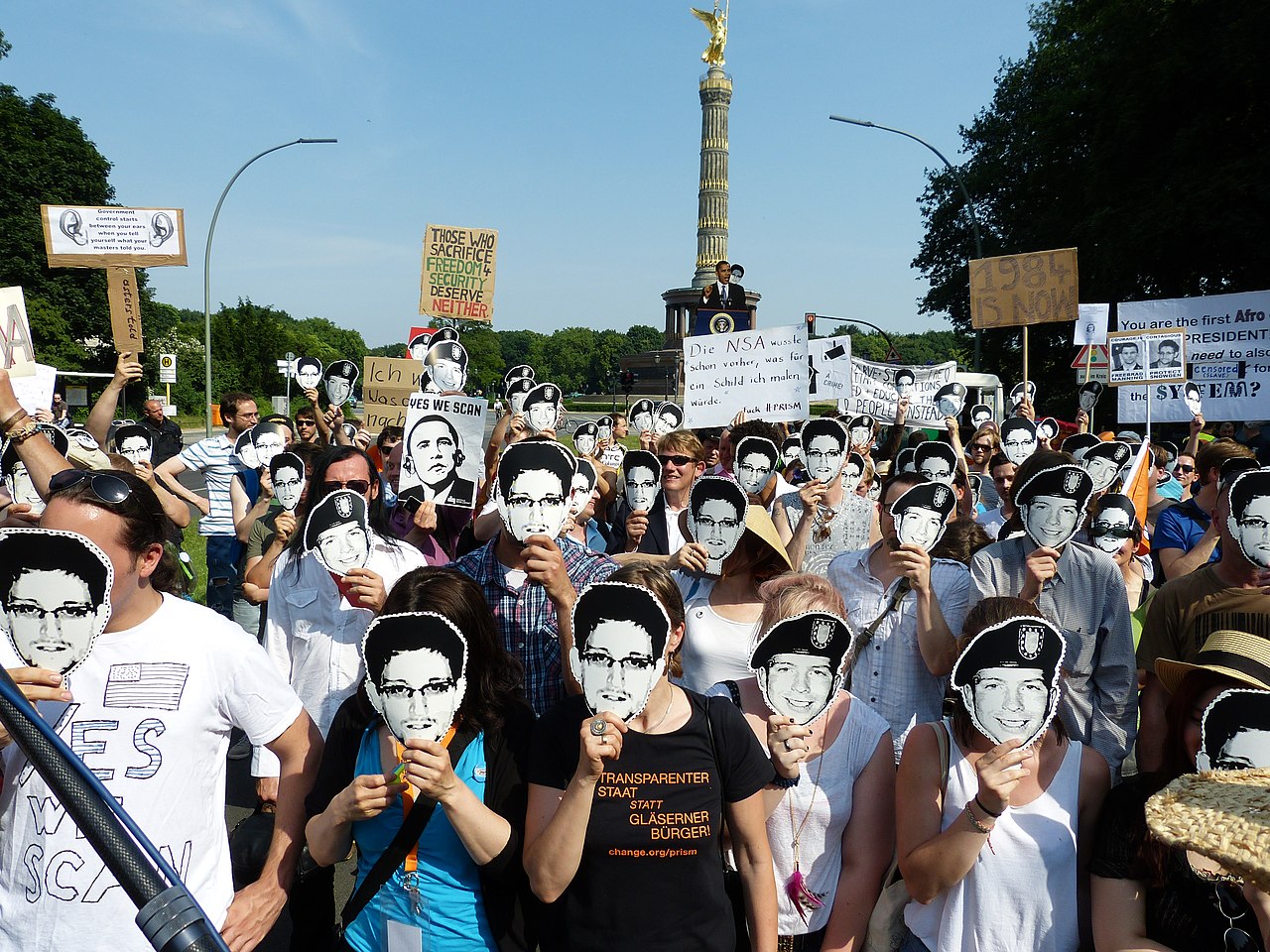
Las acciones de la NSA han sido motivo de controversia política en varias ocasiones, incluyendo su espionaje a los líderes que se oponían a la guerra de Vietnam y la participación de la agencia en el espionaje económico . En 2013, Edward Snowden , un ex contratista de la NSA, reveló al público muchos de sus programas secretos de vigilancia . Según los documentos filtrados, la NSA intercepta y almacena las comunicaciones de más de mil millones de personas en todo el mundo, incluidos ciudadanos de los Estados Unidos. Los documentos también revelaron que la NSA rastrea los movimientos de cientos de millones de personas utilizando metadatos de teléfonos celulares . A nivel internacional, la investigación ha señalado la capacidad de la NSA para vigilar el tráfico de Internet interno de países extranjeros a través del " enrutamiento bumerán ". [18]
Historia
Formación
Los orígenes de la Agencia de Seguridad Nacional se remontan al 28 de abril de 1917, tres semanas después de que el Congreso de los Estados Unidos declarara la guerra a Alemania en la Primera Guerra Mundial . Se estableció una unidad de descifrado de códigos y cifras llamada Sección de Cable y Telégrafo, que también se conocía como Oficina de Cifrado. [19] Tenía su sede en Washington, DC, y era parte del esfuerzo de guerra bajo el poder ejecutivo sin autorización directa del Congreso. Durante el curso de la guerra, fue reubicada en el organigrama del ejército varias veces. El 5 de julio de 1917, Herbert O. Yardley fue asignado para dirigir la unidad. En ese momento, la unidad estaba compuesta por Yardley y dos empleados civiles . Absorbió las funciones de criptoanálisis de la Armada en julio de 1918. La Primera Guerra Mundial terminó el 11 de noviembre de 1918 , y la sección criptográfica del ejército de Inteligencia Militar (MI-8) se trasladó a la ciudad de Nueva York el 20 de mayo de 1919, donde continuó las actividades de inteligencia como la Compañía de Compilación de Códigos bajo la dirección de Yardley. [20] [21]
La cámara negra

Después de la disolución de la sección criptográfica del ejército estadounidense de inteligencia militar conocida como MI-8, el gobierno estadounidense creó la Oficina de Cifrado, también conocida como Cámara Negra , en 1919. La Cámara Negra fue la primera organización criptoanalítica en tiempos de paz de los Estados Unidos. [22] Financiada conjuntamente por el ejército y el Departamento de Estado, la Oficina de Cifrado se disfrazó como una empresa de códigos comerciales de la ciudad de Nueva York ; en realidad produjo y vendió dichos códigos para uso comercial. Sin embargo, su verdadera misión era romper las comunicaciones (principalmente diplomáticas) de otras naciones. En la Conferencia Naval de Washington , ayudó a los negociadores estadounidenses proporcionándoles el tráfico descifrado de muchas de las delegaciones de la conferencia, incluida la japonesa . La Cámara Negra persuadió con éxito a Western Union , la compañía de telegramas estadounidense más grande en ese momento, así como a varias otras compañías de comunicaciones, para que le dieran acceso ilegal a la Cámara Negra al tráfico de cables de embajadas y consulados extranjeros. [23] Pronto, estas empresas interrumpieron públicamente su colaboración.
A pesar de los éxitos iniciales de la Cámara, fue clausurada en 1929 por el Secretario de Estado de los EE. UU. Henry L. Stimson , quien defendió su decisión afirmando: "Los caballeros no leen el correo de los demás". [24]
La Segunda Guerra Mundial y sus consecuencias
Durante la Segunda Guerra Mundial , se creó el Servicio de Inteligencia de Señales (SIS) para interceptar y descifrar las comunicaciones de las potencias del Eje . [25] Cuando terminó la guerra, el SIS se reorganizó como la Agencia de Seguridad del Ejército (ASA), y quedó bajo el liderazgo del Director de Inteligencia Militar. [25]
El 20 de mayo de 1949, todas las actividades criptológicas se centralizaron bajo una organización nacional llamada Agencia de Seguridad de las Fuerzas Armadas (AFSA). [25] Esta organización se estableció originalmente dentro del Departamento de Defensa de los EE. UU. bajo el mando del Estado Mayor Conjunto . [26] La AFSA tenía la tarea de dirigir las comunicaciones del Departamento de Defensa y las actividades de inteligencia electrónica, excepto las de las unidades de inteligencia militar de los EE. UU . [26] Sin embargo, la AFSA no pudo centralizar la inteligencia de las comunicaciones y no logró coordinarse con las agencias civiles que compartían sus intereses, como el Departamento de Estado , la Agencia Central de Inteligencia (CIA) y el Buró Federal de Investigaciones (FBI). [26] En diciembre de 1951, el presidente Harry S. Truman ordenó a un panel que investigara cómo la AFSA no había logrado sus objetivos. Los resultados de la investigación llevaron a mejoras y a su redesignación como Agencia de Seguridad Nacional. [27]
El Consejo de Seguridad Nacional emitió un memorando el 24 de octubre de 1952 que revisaba la Directiva de Inteligencia del Consejo de Seguridad Nacional (NSCID) 9 . El mismo día, Truman emitió un segundo memorando que exigía la creación de la NSA. [28] La creación real de la NSA se realizó mediante un memorando del 4 de noviembre de Robert A. Lovett , el Secretario de Defensa , cambiando el nombre de la AFSA a NSA y haciendo que la nueva agencia fuera responsable de toda la inteligencia de las comunicaciones. [29] Dado que el memorando del presidente Truman era un documento clasificado , [28] la existencia de la NSA no era conocida por el público en ese momento. Debido a su ultrasecreto, la comunidad de inteligencia estadounidense se refirió a la NSA como "No Such Agency" (No existe tal agencia). [30]
Guerra de Vietnam
En la década de 1960, la NSA jugó un papel clave en la expansión del compromiso de Estados Unidos con la Guerra de Vietnam al proporcionar evidencia de un ataque norvietnamita al destructor estadounidense USS Maddox durante el incidente del Golfo de Tonkín . [31]
La NSA organizó una operación secreta, cuyo nombre en código era « MINARET », para vigilar las comunicaciones telefónicas de los senadores Frank Church y Howard Baker , así como de los principales líderes del movimiento por los derechos civiles , incluido Martin Luther King Jr. , y destacados periodistas y deportistas estadounidenses que criticaron la guerra de Vietnam . [32] Sin embargo, el proyecto resultó ser controvertido y una revisión interna de la NSA concluyó que su programa Minaret era «deshonroso, si no directamente ilegal». [32]
La NSA realizó un gran esfuerzo para asegurar las comunicaciones tácticas entre las fuerzas estadounidenses durante la guerra, con resultados dispares. La familia NESTOR de sistemas de voz seguros compatibles que desarrolló se implementó ampliamente durante la guerra de Vietnam , con aproximadamente 30.000 equipos NESTOR producidos. Sin embargo, una variedad de problemas técnicos y operativos limitaron su uso, lo que permitió a los norvietnamitas explotar e interceptar las comunicaciones estadounidenses. [33] : Vol I, p.79
Audiencias del Comité de la Iglesia
A raíz del escándalo Watergate , una audiencia del Congreso en 1975 dirigida por el senador Frank Church [34] reveló que la NSA, en colaboración con la agencia de inteligencia SIGINT de Gran Bretaña, Government Communications Headquarters (GCHQ), había interceptado rutinariamente las comunicaciones internacionales de destacados líderes anti-guerra de Vietnam como Jane Fonda y el Dr. Benjamin Spock . [35] La NSA rastreó a estos individuos en un sistema de archivo secreto que fue destruido en 1974. [36] Después de la renuncia del presidente Richard Nixon , hubo varias investigaciones sobre presunto mal uso de las instalaciones del FBI, la CIA y la NSA. [37] El senador Frank Church descubrió actividad previamente desconocida, [37] como un complot de la CIA (ordenado por la administración del presidente John F. Kennedy ) para asesinar a Fidel Castro . [38] La investigación también descubrió las escuchas telefónicas de la NSA a ciudadanos estadounidenses seleccionados. [39]
Después de las audiencias del Comité Church, se aprobó la Ley de Vigilancia de Inteligencia Extranjera de 1978, diseñada para limitar la práctica de la vigilancia masiva en los Estados Unidos . [37]
De los años 1980 a los años 1990
En 1986, la NSA interceptó las comunicaciones del gobierno libio inmediatamente después del atentado en la discoteca de Berlín . La Casa Blanca afirmó que la interceptación de la NSA había proporcionado pruebas "irrefutables" de que Libia estaba detrás del atentado, lo que el presidente estadounidense Ronald Reagan citó como justificación del bombardeo estadounidense de Libia en 1986. [ 40] [41]
En 1999, una investigación de varios años del Parlamento Europeo destacó el papel de la NSA en el espionaje económico en un informe titulado 'Desarrollo de la tecnología de vigilancia y riesgo de abuso de la información económica'. [42] Ese año, la NSA fundó el Salón de Honor de la NSA , un monumento en el Museo Criptológico Nacional en Fort Meade, Maryland. [43] El monumento es un "tributo a los pioneros y héroes que han hecho contribuciones significativas y duraderas a la criptología estadounidense". [43] Los empleados de la NSA deben estar jubilados durante más de quince años para calificar para el monumento. [43]
La infraestructura de la NSA se deterioró en los años 90, ya que los recortes del presupuesto de defensa dieron lugar a aplazamientos de tareas de mantenimiento. El 24 de enero de 2000, la sede de la NSA sufrió una interrupción total de la red durante tres días debido a una sobrecarga de la misma. El tráfico entrante se almacenaba con éxito en los servidores de la agencia, pero no se podía dirigir ni procesar. La agencia llevó a cabo reparaciones de emergencia con un coste de 3 millones de dólares para que el sistema volviera a funcionar (algo del tráfico entrante también se dirigía al GCHQ británico por el momento). El director Michael Hayden calificó la interrupción como una "llamada de atención" sobre la necesidad de invertir en la infraestructura de la agencia. [44]
En la década de 1990, el brazo defensivo de la NSA, la Dirección de Seguridad de la Información (IAD), comenzó a trabajar de manera más abierta; la primera charla técnica pública de un científico de la NSA en una conferencia importante sobre criptografía fue la presentación de J. Solinas sobre algoritmos eficientes de criptografía de curva elíptica en Crypto 1997. [45] El enfoque cooperativo de la IAD con la academia y la industria culminó en su apoyo a un proceso transparente para reemplazar el obsoleto Estándar de cifrado de datos (DES) por un Estándar de cifrado avanzado (AES). La experta en políticas de ciberseguridad Susan Landau atribuye la colaboración armoniosa de la NSA con la industria y la academia en la selección del AES en 2000, y el apoyo de la Agencia a la elección de un algoritmo de cifrado fuerte diseñado por europeos en lugar de estadounidenses, a Brian Snow , quien era el Director Técnico de la IAD y representó a la NSA como copresidente del Grupo de Trabajo Técnico para la competencia AES, y a Michael Jacobs, quien dirigió la IAD en ese momento. [46] : 75
Después de los ataques terroristas del 11 de septiembre de 2001 , la NSA creyó que tenía apoyo público para una expansión dramática de sus actividades de vigilancia. [47] Según Neal Koblitz y Alfred Menezes , el período en el que la NSA era un socio de confianza de la academia y la industria en el desarrollo de estándares criptográficos comenzó a llegar a su fin cuando, como parte del cambio en la NSA en la era posterior al 11 de septiembre, Snow fue reemplazado como Director Técnico, Jacobs se retiró y la IAD ya no pudo oponerse eficazmente a las acciones propuestas por el brazo ofensivo de la NSA. [48]
Guerra contra el terrorismo
Tras los ataques del 11 de septiembre , la NSA creó nuevos sistemas informáticos para hacer frente a la avalancha de información procedente de nuevas tecnologías, como Internet y los teléfonos móviles. ThinThread contenía capacidades avanzadas de extracción de datos . También tenía un "mecanismo de privacidad"; la vigilancia se almacenaba cifrada; para descifrarla se necesitaba una orden judicial. La investigación realizada en el marco de este programa puede haber contribuido a la tecnología utilizada en sistemas posteriores. ThinThread se canceló cuando Michael Hayden eligió Trailblazer , que no incluía el sistema de privacidad de ThinThread. [49]
El proyecto Trailblazer se puso en marcha en 2002 y en él trabajaron Science Applications International Corporation (SAIC), Boeing , Computer Sciences Corporation , IBM y Litton Industries . Algunos denunciantes de la NSA se quejaron internamente de los grandes problemas que rodeaban a Trailblazer. Esto dio lugar a investigaciones por parte del Congreso y de los inspectores generales de la NSA y del Departamento de Defensa . El proyecto se canceló a principios de 2004.
Turbulence comenzó en 2005. Se desarrolló en pequeñas y económicas piezas de "prueba", en lugar de un gran plan como Trailblazer. También incluía capacidades ofensivas de guerra cibernética, como la inyección de malware en computadoras remotas. El Congreso criticó a Turbulence en 2007 por tener problemas burocráticos similares a los de Trailblazer. [50] Se suponía que sería la realización de un procesamiento de información a mayor velocidad en el ciberespacio. [51]
Divulgaciones sobre vigilancia global
El enorme alcance del espionaje de la NSA, tanto en el extranjero como en el país, se reveló al público en una serie de divulgaciones detalladas de documentos internos de la NSA a partir de junio de 2013. La mayoría de las revelaciones fueron filtradas por el ex contratista de la NSA Edward Snowden . El 4 de septiembre de 2020, el programa de vigilancia de la NSA fue declarado ilegal por el Tribunal de Apelaciones de Estados Unidos . El tribunal también añadió que los líderes de inteligencia estadounidenses, que lo defendieron públicamente, no estaban diciendo la verdad. [52]
Misión
La misión de espionaje de la NSA incluye transmisiones de radio, tanto de organizaciones como de individuos, Internet, llamadas telefónicas y otras formas de comunicación interceptadas. Su misión de comunicaciones seguras incluye comunicaciones militares, diplomáticas y todas las demás comunicaciones gubernamentales sensibles, confidenciales o secretas. [53]
Según un artículo de 2010 publicado en The Washington Post , "cada día, los sistemas de recopilación de datos de la Agencia de Seguridad Nacional interceptan y almacenan 1.700 millones de correos electrónicos, llamadas telefónicas y otros tipos de comunicaciones. La NSA clasifica una fracción de ellos en 70 bases de datos independientes". [54]
Debido a su tarea de escucha, la NSA/CSS ha estado muy involucrada en la investigación criptoanalítica , continuando el trabajo de agencias predecesoras que habían descifrado muchos códigos y cifras de la Segunda Guerra Mundial (ver, por ejemplo, Purple , el proyecto Venona y JN-25 ).
En 2004, el Servicio de Seguridad Central de la NSA y la División Nacional de Seguridad Cibernética del Departamento de Seguridad Nacional (DHS) acordaron ampliar el Programa de Educación en Seguridad de la Información de los Centros de Excelencia Académica de la NSA. [55]
Como parte de la Directiva Presidencial de Seguridad Nacional 54/Directiva Presidencial de Seguridad Nacional 23 (NSPD 54), firmada el 8 de enero de 2008 por el Presidente Bush, la NSA se convirtió en la agencia líder para monitorear y proteger todas las redes informáticas del gobierno federal del ciberterrorismo . [9]
Una parte de la misión de la NSA es servir como agencia de apoyo de combate para el Departamento de Defensa. [56]
Operaciones
Las operaciones de la Agencia de Seguridad Nacional se pueden dividir en tres tipos:
- Recolección en el extranjero, que está bajo la responsabilidad de la división Global Access Operations (GAO).
- Recolección doméstica, que es responsabilidad de la división de Operaciones de Fuentes Especiales (SSO).
- Operaciones de piratería, que son responsabilidad de la división Tailored Access Operations (TAO).
Recogida en el extranjero
Escalón
"Echelon" fue creado en la incubadora de la Guerra Fría . [57] Hoy es un sistema heredado , y varias estaciones de la NSA están cerrando. [58]
Se informó que la NSA/CSS, en combinación con las agencias equivalentes en el Reino Unido ( Government Communications Headquarters ), Canadá ( Communications Security Establishment ), Australia ( Australian Signals Directorate ) y Nueva Zelanda ( Government Communications Security Bureau ), también conocida como el grupo UKUSA , [59] estaba al mando de la operación del llamado sistema ECHELON . Se sospechaba que sus capacidades incluían la capacidad de monitorear una gran proporción del tráfico de teléfono, fax y datos civiles transmitidos en el mundo. [60]
A principios de los años 1970, se instaló en Menwith Hill la primera de las más de ocho grandes antenas parabólicas de comunicaciones. [61] El periodista de investigación Duncan Campbell informó en 1988 sobre el programa de vigilancia " ECHELON ", una extensión del Acuerdo UKUSA sobre inteligencia de señales globales (SIGINT) , y detalló cómo funcionaban las operaciones de espionaje. [62] El 3 de noviembre de 1999, la BBC informó que tenían confirmación del Gobierno australiano de la existencia de una poderosa "red de espionaje global" con el nombre en código Echelon, que podía "espiar cada llamada telefónica, fax o correo electrónico, en cualquier lugar del planeta" con Gran Bretaña y Estados Unidos como principales protagonistas. Confirmaron que Menwith Hill estaba "vinculado directamente a la sede de la Agencia de Seguridad Nacional de Estados Unidos (NSA) en Fort Meade en Maryland". [63]
La Directiva de Inteligencia de Señales de los Estados Unidos 18 (USSID 18) de la NSA prohibía estrictamente la interceptación o recopilación de información sobre "... personas , entidades, corporaciones u organizaciones estadounidenses..." sin el permiso legal explícito por escrito del Fiscal General de los Estados Unidos cuando el sujeto se encuentra en el extranjero, o del Tribunal de Vigilancia de Inteligencia Extranjera cuando se encuentra dentro de las fronteras de los Estados Unidos. Las supuestas actividades relacionadas con Echelon, incluido su uso por motivos distintos a la seguridad nacional, incluido el espionaje político e industrial , recibieron críticas de países fuera de la alianza UKUSA. [64]
Otras operaciones SIGINT en el extranjero
La NSA también participó en la planificación de chantajear a personas con " SEXINT ", información obtenida sobre la actividad y preferencias sexuales de un objetivo potencial. Los objetivos no habían cometido ningún delito aparente ni estaban acusados de ninguno. [65]
Para apoyar su programa de reconocimiento facial , la NSA está interceptando "millones de imágenes por día". [66]
El Real Time Regional Gateway es un programa de recopilación de datos introducido en 2005 en Irak por la NSA durante la guerra de Irak que consistía en reunir todas las comunicaciones electrónicas, almacenarlas, buscarlas y analizarlas. Fue eficaz para proporcionar información sobre los insurgentes iraquíes que habían eludido técnicas menos exhaustivas. [67] Glenn Greenwald de The Guardian cree que esta estrategia de "recopilarlo todo" introducida por el director de la NSA, Keith B. Alexander , es el modelo para el archivo masivo y exhaustivo de comunicaciones a nivel mundial en el que participa la NSA desde 2013. [68]
Una unidad especializada de la NSA localiza objetivos para la CIA con fines de asesinato extrajudicial en Oriente Medio. [69] La NSA también ha espiado ampliamente a la Unión Europea, las Naciones Unidas y numerosos gobiernos, incluidos aliados y socios comerciales en Europa, Sudamérica y Asia. [70] [71]
En junio de 2015, WikiLeaks publicó documentos que mostraban que la NSA espiaba a empresas francesas . [72]
En julio de 2015, WikiLeaks publicó documentos que mostraban que la NSA había espiado a los ministerios federales alemanes desde los años 1990. [73] [74] Incluso los teléfonos móviles de la canciller alemana, Angela Merkel, y los de sus predecesores habían sido interceptados. [75]
Informante sin límites
Edward Snowden reveló en junio de 2013 que entre el 8 de febrero y el 8 de marzo de 2013, la NSA recopiló alrededor de 124.800 millones de elementos de datos telefónicos y 97.100 millones de elementos de datos informáticos en todo el mundo, como se muestra en los gráficos de una herramienta interna de la NSA con el nombre en código Boundless Informant . Inicialmente, se informó de que algunos de estos datos reflejaban escuchas clandestinas a ciudadanos de países como Alemania, España y Francia, [76] pero más tarde, quedó claro que esos datos fueron recopilados por agencias europeas durante misiones militares en el extranjero y posteriormente fueron compartidos con la NSA.
Evitar el cifrado
En 2013, los periodistas descubrieron un memorando secreto que afirma que la NSA creó e impulsó la adopción del estándar de cifrado Dual EC DRBG que contenía vulnerabilidades integradas en 2006 ante el Instituto Nacional de Estándares y Tecnología de los Estados Unidos (NIST) y la Organización Internacional de Normalización (también conocida como ISO). [77] [78] Este memorando parece dar crédito a especulaciones previas de los criptógrafos de Microsoft Research . [79] Edward Snowden afirma que la NSA a menudo elude el cifrado por completo al levantar información antes de que se cifre o después de que se descifre. [78]
Las reglas de XKeyscore (como se especifica en un archivo xkeyscorerules100.txt, obtenido por las estaciones de televisión alemanas NDR y WDR , que afirman tener extractos de su código fuente) revelan que la NSA rastrea a los usuarios de herramientas de software que mejoran la privacidad, incluido Tor ; un servicio de correo electrónico anónimo proporcionado por el Laboratorio de Ciencias de la Computación e Inteligencia Artificial del MIT (CSAIL) en Cambridge, Massachusetts; y los lectores del Linux Journal . [80] [81]
Puertas traseras de software
Linus Torvalds , el fundador del kernel de Linux , bromeó durante una conferencia de LinuxCon el 18 de septiembre de 2013, diciendo que la NSA, que es la fundadora de SELinux , quería una puerta trasera en el kernel. [82] Sin embargo, más tarde, el padre de Linus, un miembro del Parlamento Europeo (MEP), reveló que la NSA en realidad hizo esto. [83]
Cuando a mi hijo mayor le hicieron la misma pregunta: "¿La NSA se ha puesto en contacto con él para hablar de puertas traseras?", dijo "No", pero al mismo tiempo asintió. Entonces se encontró en una especie de libertad legal. Había dado la respuesta correcta, todo el mundo comprendió que la NSA se había puesto en contacto con él.
— Nils Torvalds , Comisión de Investigación de la LIBE sobre vigilancia electrónica masiva de ciudadanos de la UE – 11.ª audiencia, 11 de noviembre de 2013 [84]
IBM Notes fue el primer producto de software ampliamente adoptado que utiliza criptografía de clave pública para la autenticación cliente-servidor y servidor-servidor y para el cifrado de datos. Hasta que las leyes estadounidenses que regulaban el cifrado se cambiaron en 2000, IBM y Lotus tenían prohibido exportar versiones de Notes que admitieran claves de cifrado simétrico de más de 40 bits. En 1997, Lotus negoció un acuerdo con la NSA que permitía la exportación de una versión que admitiera claves más fuertes con 64 bits, pero 24 de los bits estaban cifrados con una clave especial e incluidos en el mensaje para proporcionar un "factor de reducción de carga de trabajo" para la NSA. Esto reforzó la protección de los usuarios de Notes fuera de los EE. UU. contra el espionaje industrial del sector privado , pero no contra el espionaje del gobierno estadounidense. [85] [86]
Enrutamiento de Boomerang
Aunque se supone que las transmisiones extranjeras que terminan en los EE. UU. (como un ciudadano no estadounidense que accede a un sitio web estadounidense) someten a los ciudadanos no estadounidenses a la vigilancia de la NSA, investigaciones recientes sobre el enrutamiento boomerang han suscitado nuevas preocupaciones sobre la capacidad de la NSA para vigilar el tráfico de Internet interno de países extranjeros. [18] El enrutamiento boomerang se produce cuando una transmisión de Internet que se origina y termina en un solo país transita por otro. Las investigaciones de la Universidad de Toronto han sugerido que aproximadamente el 25% del tráfico interno canadiense puede estar sujeto a actividades de vigilancia de la NSA como resultado del enrutamiento boomerang de los proveedores de servicios de Internet canadienses . [18]
Implantación de hardware
Un documento incluido en los archivos de la NSA publicados con el libro No Place to Hide de Glenn Greenwald detalla cómo las Operaciones de Acceso a Medida (TAO, por sus siglas en inglés) de la agencia y otras unidades de la NSA obtienen acceso al hardware. Interceptan enrutadores , servidores y otro hardware de red que se envía a organizaciones que son objeto de vigilancia e instalan en ellos un firmware de implante encubierto antes de que se entreguen. Esto fue descrito por un gerente de la NSA como "una de las operaciones más productivas en TAO porque preposicionan puntos de acceso en redes de objetivos difíciles en todo el mundo". [87]
Los ordenadores que la NSA incauta para fines de interceptación suelen estar modificados con un dispositivo físico conocido como Cottonmouth. [88] Cottonmouth es un dispositivo que se puede insertar en el puerto USB de un ordenador para establecer acceso remoto al equipo en cuestión. Según el catálogo de implantes del grupo Tailored Access Operations (TAO) de la NSA, después de implantar Cottonmouth, la NSA puede establecer un puente de red "que le permite cargar software de explotación en ordenadores modificados, así como transmitir comandos y datos entre implantes de hardware y software". [89]
Colección nacional
La misión de la NSA, tal como se establece en la Orden Ejecutiva 12333 de 1981, es recopilar información que constituya "inteligencia o contrainteligencia extranjera", pero no "obtener información sobre las actividades internas de personas de los Estados Unidos ". La NSA ha declarado que confía en el FBI para recopilar información sobre actividades de inteligencia extranjera dentro de las fronteras de los Estados Unidos, mientras que limita sus propias actividades dentro de los Estados Unidos a las embajadas y misiones de naciones extranjeras. [90]
La aparición de una "Dirección de Vigilancia Nacional" de la NSA pronto fue expuesta como un engaño en 2013. [91] [92]
Las actividades de vigilancia interna de la NSA están limitadas por los requisitos impuestos por la Cuarta Enmienda de la Constitución de los Estados Unidos . Por ejemplo, el Tribunal de Vigilancia de Inteligencia Extranjera sostuvo en octubre de 2011, citando múltiples precedentes de la Corte Suprema, que las prohibiciones de la Cuarta Enmienda contra registros e incautaciones irrazonables se aplican al contenido de todas las comunicaciones, cualquiera sea el medio, porque "las comunicaciones privadas de una persona son similares a los documentos personales". [93] Sin embargo, estas protecciones no se aplican a las personas no estadounidenses ubicadas fuera de las fronteras de los Estados Unidos, por lo que las iniciativas de vigilancia extranjera de la NSA están sujetas a muchas menos limitaciones bajo la ley estadounidense. [94] Los requisitos específicos para las operaciones de vigilancia interna están contenidos en la Ley de Vigilancia de Inteligencia Extranjera de 1978 (FISA), que no extiende la protección a los ciudadanos no estadounidenses ubicados fuera del territorio estadounidense . [94]
Programa de vigilancia del presidente
George W. Bush , presidente durante los ataques terroristas del 11 de septiembre , aprobó la Ley Patriota poco después de los ataques para tomar medidas de seguridad antiterroristas. Los títulos 1 , 2 y 9 autorizaban específicamente las medidas que tomaría la NSA. Estos títulos otorgaban una mayor seguridad interna contra el terrorismo, procedimientos de vigilancia y una mejor inteligencia, respectivamente. El 10 de marzo de 2004, hubo un debate entre el presidente Bush y el abogado de la Casa Blanca Alberto Gonzales , el fiscal general John Ashcroft y el fiscal general interino James Comey . Los fiscales generales no estaban seguros de si los programas de la NSA podían considerarse constitucionales. Amenazaron con dimitir por el asunto, pero finalmente los programas de la NSA continuaron. [95] El 11 de marzo de 2004, el presidente Bush firmó una nueva autorización para la vigilancia masiva de registros de Internet, además de la vigilancia de registros telefónicos. Esto permitió al presidente poder anular leyes como la Ley de Vigilancia de Inteligencia Extranjera , que protegía a los civiles de la vigilancia masiva. Además de esto, el Presidente Bush también firmó que las medidas de vigilancia masiva también entrarían en vigor de forma retroactiva. [96] [97]
Uno de esos programas de vigilancia, autorizado por la Directiva de Inteligencia de Señales de los Estados Unidos 18 del presidente George Bush, fue el Proyecto Highlander llevado a cabo para la Agencia de Seguridad Nacional por la 513.ª Brigada de Inteligencia Militar del Ejército de los Estados Unidos . La NSA transmitió conversaciones telefónicas (incluso de teléfonos celulares) obtenidas desde estaciones de monitoreo terrestres, aéreas y satelitales a varios Oficiales de Inteligencia de Señales del Ejército de los Estados Unidos, incluido el 201.º Batallón de Inteligencia Militar . Se interceptaron conversaciones de ciudadanos de los Estados Unidos, junto con las de otras naciones. [98]
Los defensores del programa de vigilancia sostienen que el Presidente tiene autoridad ejecutiva para ordenar tales acciones [ cita requerida ] , argumentando que leyes como la FISA quedan anuladas por los poderes constitucionales del Presidente. Además, algunos argumentaron que la FISA fue implícitamente anulada por una ley posterior, la Autorización para el Uso de la Fuerza Militar , aunque el fallo de la Corte Suprema en Hamdan v. Rumsfeld desaprueba esta opinión. [99]
El programa PRISM

En el marco del programa PRISM , que comenzó en 2007, [100] [101] la NSA recopila comunicaciones de Internet de objetivos extranjeros de nueve importantes proveedores de servicios de comunicación basados en Internet de Estados Unidos: Microsoft , [102] Yahoo , Google , Facebook , PalTalk , AOL , Skype , YouTube y Apple . Los datos recopilados incluyen correo electrónico, vídeos, fotos, chats de VoIP como Skype y transferencias de archivos.
El ex director de la NSA, el general Keith Alexander, afirmó que en septiembre de 2009 la NSA impidió que Najibullah Zazi y sus amigos llevaran a cabo un ataque terrorista. [103] Sin embargo, no se ha presentado ninguna prueba que demuestre que la NSA haya contribuido alguna vez a prevenir un ataque terrorista. [104] [105] [106] [107]
La base de datos FASCIA
FASCIA es una base de datos creada y utilizada por la Agencia de Seguridad Nacional de los Estados Unidos que contiene billones de registros de ubicación de dispositivos que se recopilan de una variedad de fuentes. [108] Su existencia fue revelada durante la divulgación de vigilancia global de 2013 por Edward Snowden . [109]
La base de datos FASCIA almacena varios tipos de información, incluidos códigos de área de ubicación (LAC), identificadores de torres de telefonía celular (CeLLID), registros de ubicación de visitantes (VLR), identidad de equipo de estación móvil internacional (IMEI) y MSISDN (números de red digital de servicios integrados de abonado móvil). [108] [109]
Durante un período de aproximadamente siete meses, se recopilaron y almacenaron en la base de datos más de 27 terabytes de datos de ubicación. [110]
Operaciones de piratería
Además de las formas más tradicionales de espionaje para recopilar señales de inteligencia, la NSA también participa en el pirateo de ordenadores, teléfonos inteligentes y sus redes. Una división que lleva a cabo este tipo de operaciones es la división Tailored Access Operations (TAO), que lleva activa al menos desde 1998. [111]
Según la revista Foreign Policy , "... la Oficina de Operaciones de Acceso Personalizado, u OAT, ha penetrado con éxito los sistemas informáticos y de telecomunicaciones chinos durante casi 15 años, generando parte de la mejor y más fiable información de inteligencia sobre lo que está sucediendo dentro de la República Popular China". [112] [113]
En una entrevista con la revista Wired , Edward Snowden dijo que la división Tailored Access Operations causó accidentalmente el apagón de Internet en Siria en 2012. [114]
Estructura organizacional

La NSA está dirigida por el Director de la Agencia de Seguridad Nacional (DIRNSA), que también se desempeña como Jefe del Servicio Central de Seguridad (CHCSS) y Comandante del Comando Cibernético de los Estados Unidos (USCYBERCOM) y es el oficial militar de mayor rango de estas organizaciones. Cuenta con la asistencia de un Director Adjunto , que es el civil de mayor rango dentro de la NSA/CSS.
La NSA también tiene un Inspector General , jefe de la Oficina del Inspector General (OIG); [115] un Asesor General , jefe de la Oficina del Asesor General (OGC); y un Director de Cumplimiento, jefe de la Oficina del Director de Cumplimiento (ODOC). [116]
A diferencia de otras organizaciones de inteligencia como la CIA o la DIA , la NSA siempre ha sido particularmente reticente respecto de su estructura organizativa interna. [ cita requerida ]
A mediados de la década de 1990, la Agencia de Seguridad Nacional estaba organizada en cinco Direcciones:
- La Dirección de Operaciones, que era responsable de la recopilación y procesamiento de SIGINT.
- La Dirección de Tecnología y Sistemas, que desarrolla nuevas tecnologías para la recolección y procesamiento de SIGINT.
- La Dirección de Seguridad de los Sistemas de Información, responsable de las misiones de seguridad de la información y las comunicaciones de la NSA .
- La Dirección de Planes, Políticas y Programas, que proporcionó apoyo de personal y dirección general a la Agencia.
- La Dirección de Servicios de Apoyo, que prestaba actividades de apoyo logístico y administrativo. [117]
Cada una de estas direcciones estaba formada por varios grupos o elementos, designados con una letra. Por ejemplo, existía el Grupo A, que era responsable de todas las operaciones SIGINT contra la Unión Soviética y Europa del Este, y el Grupo G, que era responsable de la SIGINT relacionada con todos los países no comunistas. Estos grupos se dividían en unidades designadas con un número adicional, como la unidad A5 para descifrar códigos soviéticos, y la G6, que era la oficina para Oriente Medio, el norte de África, Cuba, América Central y del Sur. [118] [119]
Direcciones
A partir de 2013 [update], la NSA tiene alrededor de una docena de direcciones, que se designan mediante una carta, aunque no todas son conocidas públicamente. [120]
In the year 2000, a leadership team was formed consisting of the director, the deputy director and the directors of the Signals Intelligence (SID), the Information Assurance (IAD) and the Technical Directorate (TD). The chiefs of other main NSA divisions became associate directors of the senior leadership team.[121]
After president George W. Bush initiated the President's Surveillance Program (PSP) in 2001, the NSA created a 24-hour Metadata Analysis Center (MAC), followed in 2004 by the Advanced Analysis Division (AAD), with the mission of analyzing content, Internet metadata and telephone metadata. Both units were part of the Signals Intelligence Directorate.[122]
A 2016 proposal would combine the Signals Intelligence Directorate with the Information Assurance Directorate into a Directorate of Operations.[123]
NSANet

NSANet stands for National Security Agency Network and is the official NSA intranet.[124] It is a classified network,[125] for information up to the level of TS/SCI[126] to support the use and sharing of intelligence data between NSA and the signals intelligence agencies of the four other nations of the Five Eyes partnership. The management of NSANet has been delegated to the Central Security Service Texas (CSSTEXAS).[127]
NSANet is a highly secured computer network consisting of fiber-optic and satellite communication channels which are almost completely separated from the public Internet. The network allows NSA personnel and civilian and military intelligence analysts anywhere in the world to have access to the agency's systems and databases. This access is tightly controlled and monitored. For example, every keystroke is logged, activities are audited at random and downloading and printing of documents from NSANet are recorded.[128]
In 1998, NSANet, along with NIPRNet and SIPRNet, had "significant problems with poor search capabilities, unorganized data and old information".[129] In 2004, the network was reported to have used over twenty commercial off-the-shelf operating systems.[130] Some universities that do highly sensitive research are allowed to connect to it.[131]
The thousands of Top Secret internal NSA documents that were taken by Edward Snowden in 2013 were stored in "a file-sharing location on the NSA's intranet site"; so, they could easily be read online by NSA personnel. Everyone with a TS/SCI-clearance had access to these documents. As a system administrator, Snowden was responsible for moving accidentally misplaced highly sensitive documents to safer storage locations.[132]
Watch centers
The NSA maintains at least two watch centers:
- National Security Operations Center (NSOC), which is the NSA's current operations center and focal point for time-sensitive SIGINT reporting for the United States SIGINT System (USSS). This center was established in 1968 as the National SIGINT Watch Center (NSWC) and renamed into National SIGINT Operations Center (NSOC) in 1973. This "nerve center of the NSA" got its current name in 1996.[citation needed]
- NSA/CSS Threat Operations Center (NTOC), which is the primary NSA/CSS partner for Department of Homeland Security response to cyber incidents. The NTOC establishes real-time network awareness and threat characterization capabilities to forecast, alert, and attribute malicious activity and enable the coordination of Computer Network Operations. The NTOC was established in 2004 as a joint Information Assurance and Signals Intelligence project.[133]
NSA Police
The NSA has its own police force, known as NSA Police (and formerly as NSA Security Protective Force) which provides law enforcement services, emergency response and physical security to the NSA's people and property.[134]
NSA Police are armed federal officers. NSA Police has a K9 division, which generally conducts explosive detection screening of mail, vehicles and cargo entering NSA grounds.[135]
NSA Police use marked vehicles to carry out patrols.[136]
Employees
The number of NSA employees is officially classified[4] but there are several sources providing estimates. In 1961, NSA had 59,000 military and civilian employees, which grew to 93,067 in 1969, of which 19,300 worked at the headquarters at Fort Meade. In the early 1980s, NSA had roughly 50,000 military and civilian personnel. By 1989 this number had grown again to 75,000, of which 25,000 worked at the NSA headquarters. Between 1990 and 1995 the NSA's budget and workforce were cut by one third, which led to a substantial loss of experience.[137]
In 2012, the NSA said more than 30,000 employees worked at Fort Meade and other facilities.[2] In 2012, John C. Inglis, the deputy director, said that the total number of NSA employees is "somewhere between 37,000 and one billion" as a joke,[4] and stated that the agency is "probably the biggest employer of introverts."[4] In 2013 Der Spiegel stated that the NSA had 40,000 employees.[5] More widely, it has been described as the world's largest single employer of mathematicians.[138] Some NSA employees form part of the workforce of the National Reconnaissance Office (NRO), the agency that provides the NSA with satellite signals intelligence.
As of 2013 about 1,000 system administrators work for the NSA.[139]
Personnel security
The NSA received criticism early on in 1960 after two agents had defected to the Soviet Union. Investigations by the House Un-American Activities Committee and a special subcommittee of the United States House Committee on Armed Services revealed severe cases of ignorance in personnel security regulations, prompting the former personnel director and the director of security to step down and leading to the adoption of stricter security practices.[140] Nonetheless, security breaches reoccurred only a year later when in an issue of Izvestia of July 23, 1963, a former NSA employee published several cryptologic secrets.
The very same day, an NSA clerk-messenger committed suicide as ongoing investigations disclosed that he had sold secret information to the Soviets on a regular basis. The reluctance of congressional houses to look into these affairs had prompted a journalist to write, "If a similar series of tragic blunders occurred in any ordinary agency of Government an aroused public would insist that those responsible be officially censured, demoted, or fired." David Kahn criticized the NSA's tactics of concealing its doings as smug and the Congress' blind faith in the agency's right-doing as shortsighted, and pointed out the necessity of surveillance by the Congress to prevent abuse of power.[140]
Edward Snowden's leaking of the existence of PRISM in 2013 caused the NSA to institute a "two-man rule", where two system administrators are required to be present when one accesses certain sensitive information.[139] Snowden claims he suggested such a rule in 2009.[141]
Polygraphing

The NSA conducts polygraph tests of employees. For new employees, the tests are meant to discover enemy spies who are applying to the NSA and to uncover any information that could make an applicant pliant to coercion.[142] As part of the latter, historically EPQs or "embarrassing personal questions" about sexual behavior had been included in the NSA polygraph.[142] The NSA also conducts five-year periodic reinvestigation polygraphs of employees, focusing on counterintelligence programs. In addition the NSA conducts periodic polygraph investigations in order to find spies and leakers; those who refuse to take them may receive "termination of employment", according to a 1982 memorandum from the director of the NSA.[143]
There are also "special access examination" polygraphs for employees who wish to work in highly sensitive areas, and those polygraphs cover counterintelligence questions and some questions about behavior.[143] NSA's brochure states that the average test length is between two and four hours.[144] A 1983 report of the Office of Technology Assessment stated that "It appears that the NSA [National Security Agency] (and possibly CIA) use the polygraph not to determine deception or truthfulness per se, but as a technique of interrogation to encourage admissions."[145] Sometimes applicants in the polygraph process confess to committing felonies such as murder, rape, and selling of illegal drugs. Between 1974 and 1979, of the 20,511 job applicants who took polygraph tests, 695 (3.4%) confessed to previous felony crimes; almost all of those crimes had been undetected.[142]
In 2010 the NSA produced a video explaining its polygraph process.[146] The video, ten minutes long, is titled "The Truth About the Polygraph" and was posted to the Web site of the Defense Security Service. Jeff Stein of The Washington Post said that the video portrays "various applicants, or actors playing them—it's not clear—describing everything bad they had heard about the test, the implication being that none of it is true."[147] AntiPolygraph.org argues that the NSA-produced video omits some information about the polygraph process; it produced a video responding to the NSA video.[146][148] George Maschke, the founder of the Web site, accused the NSA polygraph video of being "Orwellian".[147]
A 2013 article indicated that after Edward Snowden revealed his identity in 2013, the NSA began requiring polygraphing of employees once per quarter.[149]
Arbitrary firing
The number of exemptions from legal requirements has been criticized. When in 1964 Congress was hearing a bill giving the director of the NSA the power to fire at will any employee, The Washington Post wrote: "This is the very definition of arbitrariness. It means that an employee could be discharged and disgraced on the basis of anonymous allegations without the slightest opportunity to defend himself." Yet, the bill was accepted by an overwhelming majority.[140] Also, every person hired to a job in the US after 2007, at any private organization, state or federal government agency, must be reported to the New Hire Registry, ostensibly to look for child support evaders, except that employees of an intelligence agency may be excluded from reporting if the director deems it necessary for national security reasons.[150]
Facilities
Headquarters
History of headquarters

When the agency was first established, its headquarters and cryptographic center were in the Naval Security Station in Washington, D.C. The COMINT functions were located in Arlington Hall in Northern Virginia, which served as the headquarters of the U.S. Army's cryptographic operations.[151] Because the Soviet Union had detonated a nuclear bomb and because the facilities were crowded, the federal government wanted to move several agencies, including the AFSA/NSA. A planning committee considered Fort Knox, but Fort Meade, Maryland, was ultimately chosen as NSA headquarters because it was far enough away from Washington, D.C. in case of a nuclear strike and was close enough so its employees would not have to move their families.[152]
Construction of additional buildings began after the agency occupied buildings at Fort Meade in the late 1950s, which they soon outgrew.[152] In 1963 the new headquarters building, nine stories tall, opened. NSA workers referred to the building as the "Headquarters Building" and since the NSA management occupied the top floor, workers used "Ninth Floor" to refer to their leaders.[153] COMSEC remained in Washington, D.C., until its new building was completed in 1968.[152] In September 1986, the Operations 2A and 2B buildings, both copper-shielded to prevent eavesdropping, opened with a dedication by President Ronald Reagan.[154] The four NSA buildings became known as the "Big Four."[154] The NSA director moved to 2B when it opened.[154]
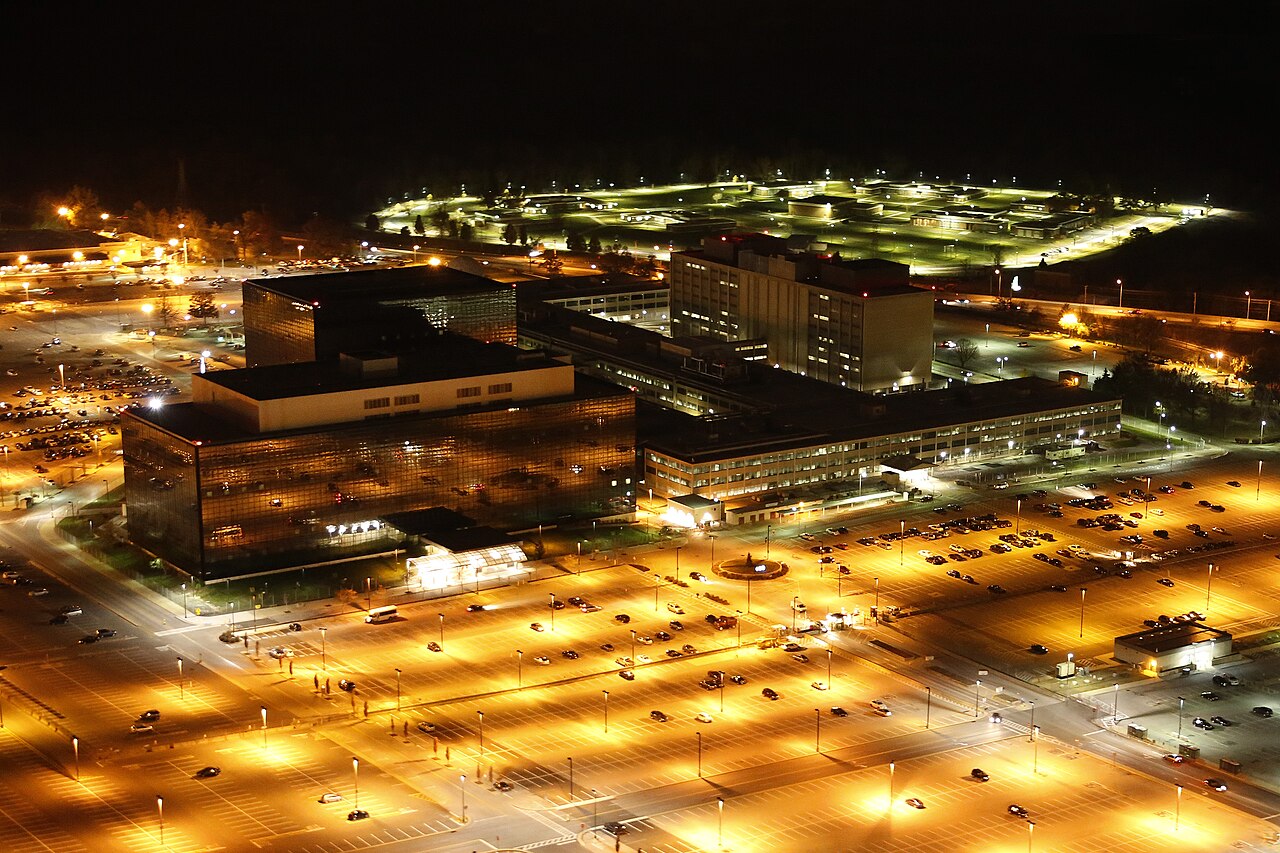
Headquarters for the National Security Agency is located at 39°6′32″N 76°46′17″W / 39.10889°N 76.77139°W / 39.10889; -76.77139 in Fort George G. Meade, Maryland, although it is separate from other compounds and agencies that are based within this same military installation. Fort Meade is about 20 mi (32 km) southwest of Baltimore,[155] and 25 mi (40 km) northeast of Washington, D.C.[156] The NSA has two dedicated exits off Baltimore–Washington Parkway. The Eastbound exit from the Parkway (heading toward Baltimore) is open to the public and provides employee access to its main campus and public access to the National Cryptology Museum. The Westbound side exit, (heading toward Washington) is labeled "NSA Employees Only".[157][158] The exit may only be used by people with the proper clearances, and security vehicles parked along the road guard the entrance.[159]
NSA is the largest employer in the state of Maryland, and two-thirds of its personnel work at Fort Meade.[160] Built on 350 acres (140 ha; 0.55 sq mi)[161] of Fort Meade's 5,000 acres (2,000 ha; 7.8 sq mi),[162] the site has 1,300 buildings and an estimated 18,000 parking spaces.[156][163]
The main NSA headquarters and operations building is what James Bamford, author of Body of Secrets, describes as "a modern boxy structure" that appears similar to "any stylish office building."[164] The building is covered with one-way dark glass, which is lined with copper shielding in order to prevent espionage by trapping in signals and sounds.[164] It contains 3,000,000 square feet (280,000 m2), or more than 68 acres (28 ha), of floor space; Bamford said that the U.S. Capitol "could easily fit inside it four times over."[164]
The facility has over 100 watchposts,[165] one of them being the visitor control center, a two-story area that serves as the entrance.[164] At the entrance, a white pentagonal structure,[166] visitor badges are issued to visitors and security clearances of employees are checked.[167] The visitor center includes a painting of the NSA seal.[166]
The OPS2A building, the tallest building in the NSA complex and the location of much of the agency's operations directorate, is accessible from the visitor center. Bamford described it as a "dark glass Rubik's Cube".[168] The facility's "red corridor" houses non-security operations such as concessions and the drug store. The name refers to the "red badge" which is worn by someone without a security clearance. The NSA headquarters includes a cafeteria, a credit union, ticket counters for airlines and entertainment, a barbershop, and a bank.[166] NSA headquarters has its own post office, fire department, and police force.[169][170][171]
The employees at the NSA headquarters reside in various places in the Baltimore-Washington area, including Annapolis, Baltimore, and Columbia in Maryland and the District of Columbia, including the Georgetown community.[172] The NSA maintains a shuttle service from the Odenton station of MARC to its Visitor Control Center and has done so since 2005.[173]
Power consumption

Following a major power outage in 2000, in 2003, and in follow-ups through 2007, The Baltimore Sun reported that the NSA was at risk of electrical overload because of insufficient internal electrical infrastructure at Fort Meade to support the amount of equipment being installed. This problem was apparently recognized in the 1990s but not made a priority, and "now the agency's ability to keep its operations going is threatened."[174]
On August 6, 2006, The Baltimore Sun reported that the NSA had completely maxed out the grid, and that Baltimore Gas & Electric (BGE, now Constellation Energy) was unable to sell them any more power.[175] NSA decided to move some of its operations to a new satellite facility.
BGE provided NSA with 65 to 75 megawatts at Fort Meade in 2007, and expected that an increase of 10 to 15 megawatts would be needed later that year.[176] In 2011, the NSA was Maryland's largest consumer of power.[160] In 2007, as BGE's largest customer, NSA bought as much electricity as Annapolis, the capital city of Maryland.[174]
One estimate put the potential for power consumption by the new Utah Data Center at US$40 million per year.[177]
Computing assets
In 1995, The Baltimore Sun reported that the NSA is the owner of the single largest group of supercomputers.[178]
NSA held a groundbreaking ceremony at Fort Meade in May 2013 for its High Performance Computing Center 2, expected to open in 2016.[179] Called Site M, the center has a 150 megawatt power substation, 14 administrative buildings and 10 parking garages.[169] It cost $3.2 billion and covers 227 acres (92 ha; 0.355 sq mi).[169] The center is 1,800,000 square feet (17 ha; 0.065 sq mi)[169] and initially uses 60 megawatts of electricity.[180]
Increments II and III are expected to be completed by 2030, and would quadruple the space, covering 5,800,000 square feet (54 ha; 0.21 sq mi) with 60 buildings and 40 parking garages.[169] Defense contractors are also establishing or expanding cybersecurity facilities near the NSA and around the Washington metropolitan area.[169]
National Computer Security Center
The DoD Computer Security Center was founded in 1981 and renamed the National Computer Security Center (NCSC) in 1985. NCSC was responsible for computer security throughout the federal government.[181] NCSC was part of NSA,[182] and during the late 1980s and the 1990s, NSA and NCSC published Trusted Computer System Evaluation Criteria in a six-foot high Rainbow Series of books that detailed trusted computing and network platform specifications.[183] The Rainbow books were replaced by the Common Criteria, however, in the early 2000s.[183]
Other U.S. facilities
.jpg/1280px-Utah_Data_Center_Panorama_(cropped).jpg)
As of 2012, NSA collected intelligence from four geostationary satellites.[177] Satellite receivers were at Roaring Creek Station in Catawissa, Pennsylvania and Salt Creek Station in Arbuckle, California.[177] It operated ten to twenty taps on U.S. telecom switches. NSA had installations in several U.S. states and from them observed intercepts from Europe, the Middle East, North Africa, Latin America, and Asia.[177]
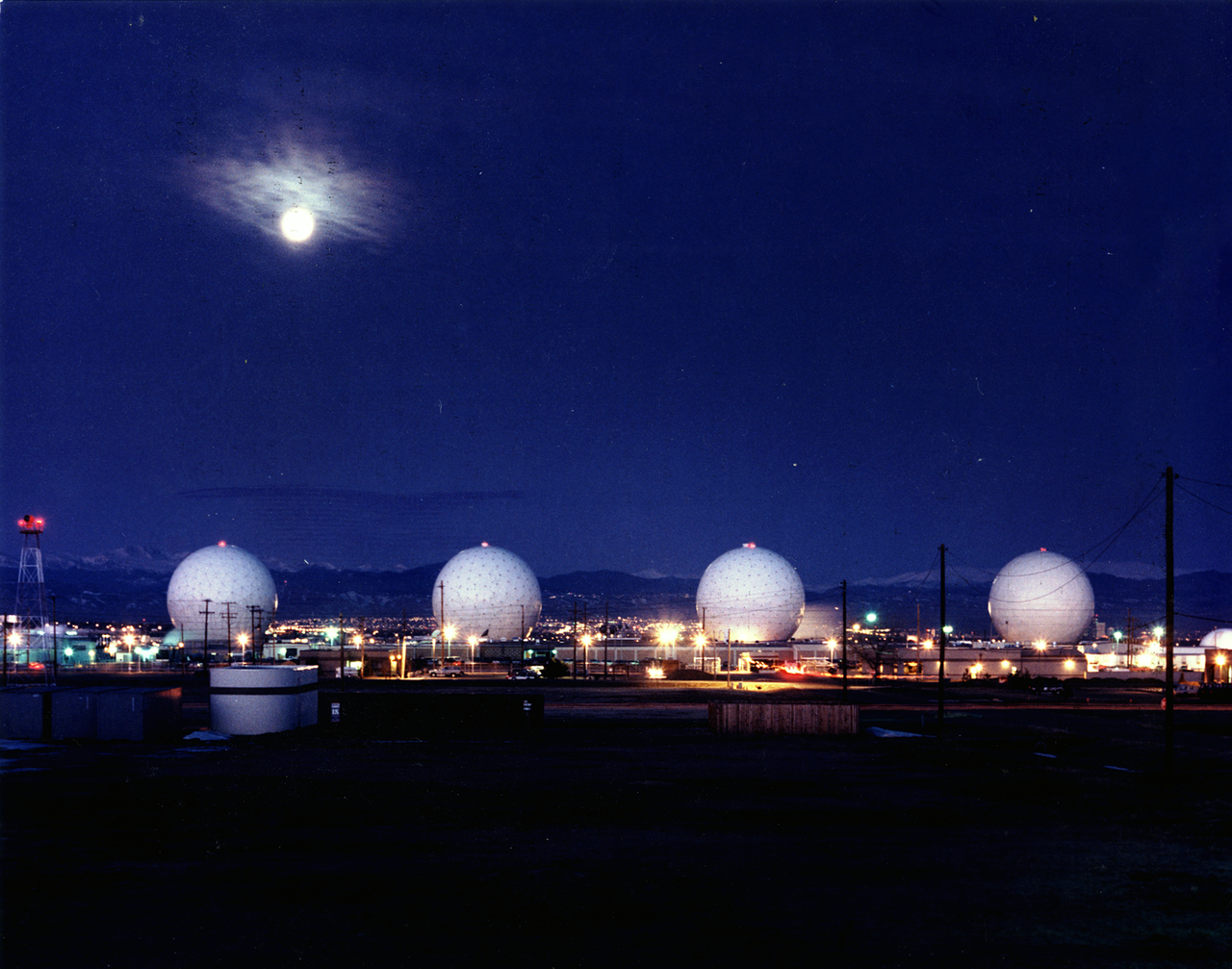
NSA had facilities at Friendship Annex (FANX) in Linthicum, Maryland, which is a 20 to 25-minute drive from Fort Meade;[184] the Aerospace Data Facility at Buckley Space Force Base in Aurora, Colorado; NSA Texas in the Texas Cryptology Center at Lackland Air Force Base in San Antonio, Texas; NSA Georgia, Georgia Cryptologic Center, Fort Gordon (now Fort Eisenhower), Augusta, Georgia; NSA Hawaii, Hawaii Cryptologic Center in Honolulu; the Multiprogram Research Facility in Oak Ridge, Tennessee, and elsewhere.[172][177]
On January 6, 2011, a groundbreaking ceremony was held to begin construction on NSA's first Comprehensive National Cyber-security Initiative (CNCI) Data Center, known as the "Utah Data Center" for short. The $1.5B data center is being built at Camp Williams, Utah, located 25 miles (40 km) south of Salt Lake City, and will help support the agency's National Cyber-security Initiative.[185] It is expected to be operational by September 2013.[177] Construction of Utah Data Center finished in May 2019.[186]
In 2009, to protect its assets and access more electricity, NSA sought to decentralize and expand its existing facilities in Fort Meade and Menwith Hill,[187] the latter expansion expected to be completed by 2015.[188]
The Yakima Herald-Republic cited Bamford, saying that many of NSA's bases for its Echelon program were a legacy system, using outdated, 1990s technology.[58] In 2004, NSA closed its operations at Bad Aibling Station (Field Station 81) in Bad Aibling, Germany.[189] In 2012, NSA began to move some of its operations at Yakima Research Station, Yakima Training Center, in Washington state to Colorado, planning to leave Yakima closed.[190] As of 2013, NSA also intended to close operations at Sugar Grove, West Virginia.[58]
International stations

Following the signing in 1946–1956[191] of the UKUSA Agreement between the United States, United Kingdom, Canada, Australia and New Zealand, who then cooperated on signals intelligence and ECHELON,[192] NSA stations were built at GCHQ Bude in Morwenstow, United Kingdom; Geraldton, Pine Gap and Shoal Bay, Australia; Leitrim and Ottawa, Ontario, Canada; Misawa, Japan; and Waihopai and Tangimoana,[193] New Zealand.[194]
NSA operates RAF Menwith Hill in North Yorkshire, United Kingdom, which was, according to BBC News in 2007, the largest electronic monitoring station in the world.[195] Planned in 1954, and opened in 1960, the base covered 562 acres (227 ha; 0.878 sq mi) in 1999.[196]
The agency's European Cryptologic Center (ECC), with 240 employees in 2011, is headquartered at a US military compound in Griesheim, near Frankfurt in Germany. A 2011 NSA report indicates that the ECC is responsible for the "largest analysis and productivity in Europe" and focuses on various priorities, including Africa, Europe, the Middle East and counterterrorism operations.[197]
In 2013, a new Consolidated Intelligence Center, also to be used by NSA, is being built at the headquarters of the United States Army Europe in Wiesbaden, Germany.[198] NSA's partnership with Bundesnachrichtendienst (BND), the German foreign intelligence service, was confirmed by BND president Gerhard Schindler.[198]
Thailand
Thailand is a "3rd party partner" of the NSA along with nine other nations.[199] These are non-English-speaking countries that have made security agreements for the exchange of SIGINT raw material and end product reports.
Thailand is the site of at least two US SIGINT collection stations. One is at the US Embassy in Bangkok, a joint NSA-CIA Special Collection Service (SCS) unit. It presumably eavesdrops on foreign embassies, governmental communications, and other targets of opportunity.[200]
The second installation is a FORNSAT (foreign satellite interception) station in the Thai city of Khon Kaen. It is codenamed INDRA, but has also been referred to as LEMONWOOD.[200] The station is approximately 40 hectares (99 acres) in size and consists of a large 3,700–4,600 m2 (40,000–50,000 ft2) operations building on the west side of the ops compound and four radome-enclosed parabolic antennas. Possibly two of the radome-enclosed antennas are used for SATCOM intercept and two antennas used for relaying the intercepted material back to NSA. There is also a PUSHER-type circularly-disposed antenna array (CDAA) just north of the ops compound.[201][202]
NSA activated Khon Kaen in October 1979. Its mission was to eavesdrop on the radio traffic of Chinese army and air force units in southern China, especially in and around the city of Kunming in Yunnan Province. In the late 1970s, the base consisted only of a small CDAA antenna array that was remote-controlled via satellite from the NSA listening post at Kunia, Hawaii, and a small force of civilian contractors from Bendix Field Engineering Corp. whose job it was to keep the antenna array and satellite relay facilities up and running 24/7.[201]
According to the papers of the late General William Odom, the INDRA facility was upgraded in 1986 with a new British-made PUSHER CDAA antenna as part of an overall upgrade of NSA and Thai SIGINT facilities whose objective was to spy on the neighboring communist nations of Vietnam, Laos, and Cambodia.[201]
The base apparently fell into disrepair in the 1990s as China and Vietnam became more friendly towards the US, and by 2002 archived satellite imagery showed that the PUSHER CDAA antenna had been torn down, perhaps indicating that the base had been closed. At some point in the period since 9/11, the Khon Kaen base was reactivated and expanded to include a sizeable SATCOM intercept mission. It is likely that the NSA presence at Khon Kaen is relatively small, and that most of the work is done by civilian contractors.[201]
Research and development
NSA has been involved in debates about public policy, both indirectly as a behind-the-scenes adviser to other departments, and directly during and after Vice Admiral Bobby Ray Inman's directorship. NSA was a major player in the debates of the 1990s regarding the export of cryptography in the United States. Restrictions on export were reduced but not eliminated in 1996.
Its secure government communications work has involved the NSA in numerous technology areas, including the design of specialized communications hardware and software, production of dedicated semiconductors (at the Ft. Meade chip fabrication plant), and advanced cryptography research. For 50 years, NSA designed and built most of its computer equipment in-house, but from the 1990s until about 2003 (when the U.S. Congress curtailed the practice), the agency contracted with the private sector in the fields of research and equipment.[203]
Data Encryption Standard

NSA was embroiled in some controversy concerning its involvement in the creation of the Data Encryption Standard (DES), a standard and public block cipher algorithm used by the U.S. government and banking community.[204] During the development of DES by IBM in the 1970s, NSA recommended changes to some details of the design. There was suspicion that these changes had weakened the algorithm sufficiently to enable the agency to eavesdrop if required, including speculation that a critical component—the so-called S-boxes—had been altered to insert a "backdoor" and that the reduction in key length might have made it feasible for NSA to discover DES keys using massive computing power. It has since been observed that the S-boxes in DES are particularly resilient against differential cryptanalysis, a technique which was not publicly discovered until the late 1980s but known to the IBM DES team.
Advanced Encryption Standard
The involvement of NSA in selecting a successor to Data Encryption Standard (DES), the Advanced Encryption Standard (AES), was limited to hardware performance testing (see AES competition).[205] NSA has subsequently certified AES for protection of classified information when used in NSA-approved systems.[206]
NSA encryption systems

The NSA is responsible for the encryption-related components in these legacy systems:
- FNBDT Future Narrow Band Digital Terminal[207]
- KL-7 ADONIS off-line rotor encryption machine (post-WWII – 1980s)[208][209]
- KW-26 ROMULUS electronic in-line teletypewriter encryptor (1960s–1980s)[210]
- KW-37 JASON fleet broadcast encryptor (1960s–1990s)[209]
- KY-57 VINSON tactical radio voice encryptor[210]
- KG-84 Dedicated Data Encryption/Decryption[210]
- STU-III secure telephone unit,[210] phased out by the STE[211]
The NSA oversees encryption in the following systems that are in use today:
- EKMS Electronic Key Management System[212]
- Fortezza encryption based on portable crypto token in PC Card format[213]
- SINCGARS tactical radio with cryptographically controlled frequency hopping[214]
- STE secure terminal equipment[211]
- TACLANE product line by General Dynamics C4 Systems[215]
The NSA has specified Suite A and Suite B cryptographic algorithm suites to be used in U.S. government systems; the Suite B algorithms are a subset of those previously specified by NIST and are expected to serve for most information protection purposes, while the Suite A algorithms are secret and are intended for especially high levels of protection.[206]
SHA
The widely used SHA-1 and SHA-2 hash functions were designed by NSA. SHA-1 is a slight modification of the weaker SHA-0 algorithm, also designed by NSA in 1993. This small modification was suggested by NSA two years later, with no justification other than the fact that it provides additional security. An attack for SHA-0 that does not apply to the revised algorithm was indeed found between 1998 and 2005 by academic cryptographers. Because of weaknesses and key length restrictions in SHA-1, NIST deprecates its use for digital signatures, and approves only the newer SHA-2 algorithms for such applications from 2013 on.[216]
A new hash standard, SHA-3, has recently been selected through the competition concluded October 2, 2012 with the selection of Keccak as the algorithm. The process to select SHA-3 was similar to the one held in choosing the AES, but some doubts have been cast over it,[217][218] since fundamental modifications have been made to Keccak in order to turn it into a standard.[219] These changes potentially undermine the cryptanalysis performed during the competition and reduce the security levels of the algorithm.[217]
Clipper chip
Because of concerns that widespread use of strong cryptography would hamper government use of wiretaps, NSA proposed the concept of key escrow in 1993 and introduced the Clipper chip that would offer stronger protection than DES but would allow access to encrypted data by authorized law enforcement officials.[220] The proposal was strongly opposed and key escrow requirements ultimately went nowhere.[221] However, NSA's Fortezza hardware-based encryption cards, created for the Clipper project, are still used within government, and NSA ultimately declassified and published the design of the Skipjack cipher used on the cards.[222][223]
Dual EC DRBG random number generator cryptotrojan
NSA promoted the inclusion of a random number generator called Dual EC DRBG in the U.S. National Institute of Standards and Technology's 2007 guidelines. This led to speculation of a backdoor which would allow NSA access to data encrypted by systems using that pseudorandom number generator (PRNG).[224]
This is now deemed to be plausible based on the fact that output of next iterations of PRNG can provably be determined if relation between two internal Elliptic Curve points is known.[225][226] Both NIST and RSA are now officially recommending against the use of this PRNG.[227][228]
Perfect Citizen
Perfect Citizen is a program to perform vulnerability assessment by the NSA on U.S. critical infrastructure.[229][230] It was originally reported to be a program to develop a system of sensors to detect cyber attacks on critical infrastructure computer networks in both the private and public sector through a network monitoring system named Einstein.[231][232] It is funded by the Comprehensive National Cybersecurity Initiative and thus far Raytheon has received a contract for up to $100 million for the initial stage.
Academic research
NSA has invested many millions of dollars in academic research under grant code prefix MDA904, resulting in over 3,000 papers as of October 11, 2007.[update] NSA/CSS has, at times, attempted to restrict the publication of academic research into cryptography; for example, the Khufu and Khafre block ciphers were voluntarily withheld in response to an NSA request to do so. In response to a FOIA lawsuit, in 2013 the NSA released the 643-page research paper titled, "Untangling the Web: A Guide to Internet Research",[233] written and compiled by NSA employees to assist other NSA workers in searching for information of interest to the agency on the public Internet.[234]
Patents
NSA has the ability to file for a patent from the U.S. Patent and Trademark Office under gag order. Unlike normal patents, these are not revealed to the public and do not expire. However, if the Patent Office receives an application for an identical patent from a third party, they will reveal NSA's patent and officially grant it to NSA for the full term on that date.[235]
One of NSA's published patents describes a method of geographically locating an individual computer site in an Internet-like network, based on the latency of multiple network connections.[236] Although no public patent exists, NSA is reported to have used a similar locating technology called trilateralization that allows real-time tracking of an individual's location, including altitude from ground level, using data obtained from cellphone towers.[237]
Insignia and memorials
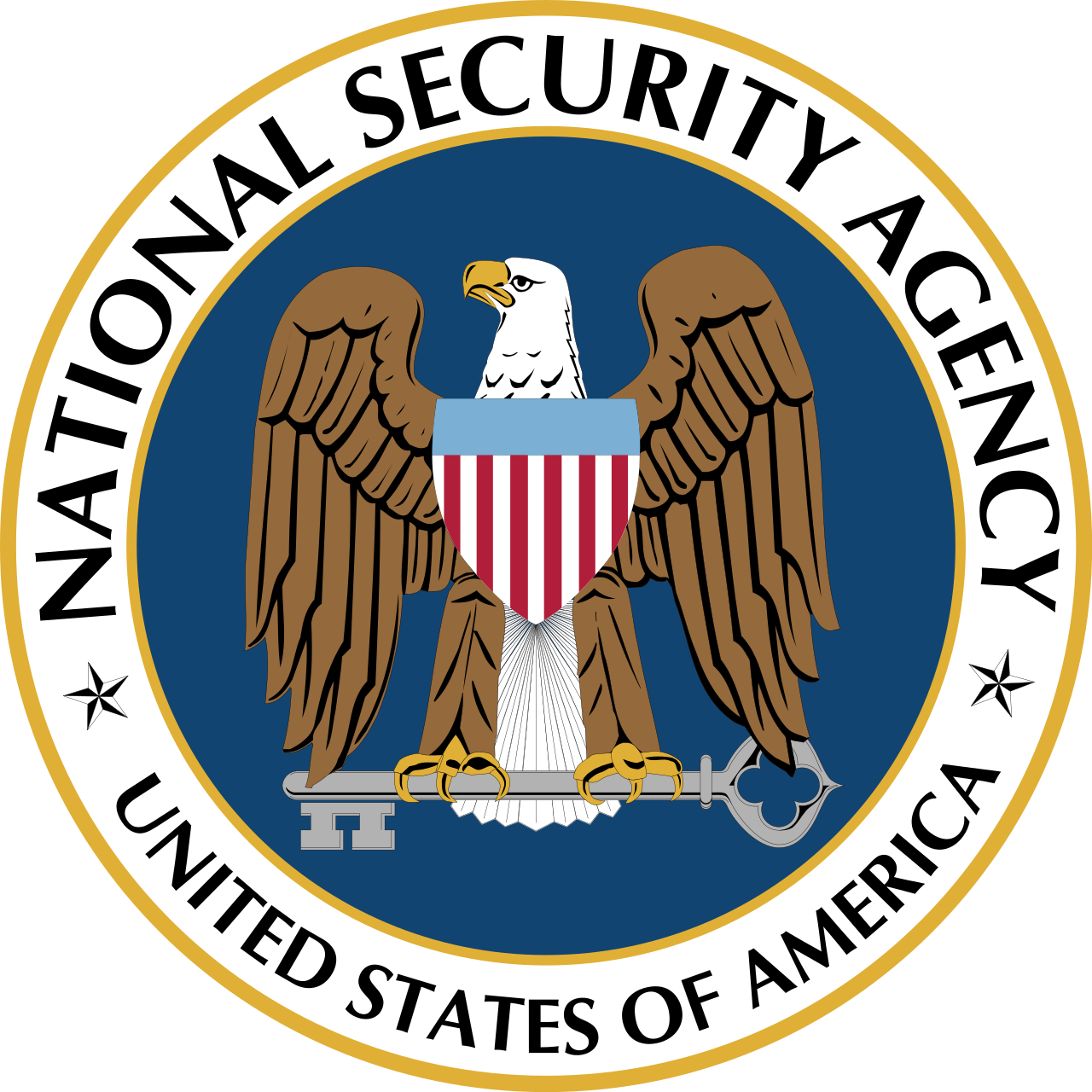
The heraldic insignia of NSA consists of an eagle inside a circle, grasping a key in its talons.[238] The eagle represents the agency's national mission.[238] Its breast features a shield with bands of red and white, taken from the Great Seal of the United States and representing Congress.[238] The key is taken from the emblem of Saint Peter and represents security.[238]
When the NSA was created, the agency had no emblem and used that of the Department of Defense.[239] The agency adopted its first of two emblems in 1963.[239] The current NSA insignia has been in use since 1965, when then-Director, LTG Marshall S. Carter (USA) ordered the creation of a device to represent the agency.[240]
The NSA's flag consists of the agency's seal on a light blue background.

Crews associated with NSA missions have been involved in a number of dangerous and deadly situations.[241] The USS Liberty incident in 1967 and USS Pueblo incident in 1968 are examples of the losses endured during the Cold War.[241]
The National Security Agency/Central Security Service Cryptologic Memorial honors and remembers the fallen personnel, both military and civilian, of these intelligence missions.[242] It is made of black granite, and has 171 names carved into it, as of 2013.[update][242] It is located at NSA headquarters. A tradition of declassifying the stories of the fallen was begun in 2001.[242]
Constitutionality, legality and privacy questions regarding operations
In the United States, at least since 2001,[243] there has been legal controversy over what signal intelligence can be used for and how much freedom the National Security Agency has to use signal intelligence.[244] In 2015, the government made slight changes in how it uses and collects certain types of data,[245] specifically phone records. The government was not analyzing the phone records as of early 2019.[246] The surveillance programs were deemed unlawful in September 2020 in a court of appeals case.[52]
Warrantless wiretaps
On December 16, 2005, The New York Times reported that, under White House pressure and with an executive order from President George W. Bush, the National Security Agency, in an attempt to thwart terrorism, had been tapping phone calls made to persons outside the country, without obtaining warrants from the United States Foreign Intelligence Surveillance Court, a secret court created for that purpose under the Foreign Intelligence Surveillance Act (FISA).[97]
Edward Snowden is a former American intelligence contractor who revealed in 2013 the existence of secret wide-ranging information-gathering programs conducted by the National Security Agency (NSA).[247] More specifically, Snowden released information that demonstrated how the United States government was gathering immense amounts of personal communications, emails, phone locations, web histories and more of American citizens without their knowledge.[248] One of Snowden's primary motivators for releasing this information was fear of a surveillance state developing as a result of the infrastructure being created by the NSA. As Snowden recounts, "I believe that, at this point in history, the greatest danger to our freedom and way of life comes from the reasonable fear of omniscient State powers kept in check by nothing more than policy documents... It is not that I do not value intelligence, but that I oppose . . . omniscient, automatic, mass surveillance. . . . That seems to me a greater threat to the institutions of free society than missed intelligence reports, and unworthy of the costs."[249]
In March 2014, Army General Martin Dempsey, Chairman of the Joint Chiefs of Staff, told the House Armed Services Committee, "The vast majority of the documents that Snowden ... exfiltrated from our highest levels of security ... had nothing to do with exposing government oversight of domestic activities. The vast majority of those were related to our military capabilities, operations, tactics, techniques, and procedures."[250] When asked in a May 2014 interview to quantify the number of documents Snowden stole, retired NSA director Keith Alexander said there was no accurate way of counting what he took, but Snowden may have downloaded more than a million documents.[251]
Other surveillance
On January 17, 2006, the Center for Constitutional Rights filed a lawsuit, CCR v. Bush, against the George W. Bush presidency. The lawsuit challenged the National Security Agency's (NSA's) surveillance of people within the U.S., including the interception of CCR emails without securing a warrant first.[252][253]
In the August 2006 case ACLU v. NSA, U.S. District Court Judge Anna Diggs Taylor concluded that NSA's warrantless surveillance program was both illegal and unconstitutional. On July 6, 2007, the 6th Circuit Court of Appeals vacated the decision on the grounds that the ACLU lacked standing to bring the suit.[254]
In September 2008, the Electronic Frontier Foundation (EFF) filed a class action lawsuit against the NSA and several high-ranking officials of the Bush administration,[255] charging an "illegal and unconstitutional program of dragnet communications surveillance,"[256] based on documentation provided by former AT&T technician Mark Klein.[257]
As a result of the USA Freedom Act passed by Congress in June 2015, the NSA had to shut down its bulk phone surveillance program on November 29 of the same year. The USA Freedom Act forbids the NSA to collect metadata and content of phone calls unless it has a warrant for terrorism investigation. In that case, the agency must ask the telecom companies for the record, which will only be kept for six months. The NSA's use of large telecom companies to assist it with its surveillance efforts has caused several privacy concerns.[258]: 1568–69
AT&T Internet monitoring
In May 2008, Mark Klein, a former AT&T employee, alleged that his company had cooperated with NSA in installing Narus hardware to replace the FBI Carnivore program, to monitor network communications including traffic between U.S. citizens.[259]
Data mining
NSA was reported in 2008 to use its computing capability to analyze "transactional" data that it regularly acquires from other government agencies, which gather it under their own jurisdictional authorities.[260]
A 2013 advisory group for the Obama administration, seeking to reform NSA spying programs following the revelations of documents released by Edward J. Snowden,[261] mentioned in 'Recommendation 30' on page 37, "...that the National Security Council staff should manage an interagency process to review on a regular basis the activities of the US Government regarding attacks that exploit a previously unknown vulnerability in a computer application." Retired cybersecurity expert Richard A. Clarke was a group member and stated on April 11, 2014, that NSA had no advance knowledge of Heartbleed.[262]
Illegally obtained evidence
In August 2013 it was revealed that a 2005 IRS training document showed that NSA intelligence intercepts and wiretaps, both foreign and domestic, were being supplied to the Drug Enforcement Administration (DEA) and Internal Revenue Service (IRS) and were illegally used to launch criminal investigations of US citizens. Law enforcement agents were directed to conceal how the investigations began and recreate an apparently legal investigative trail by re-obtaining the same evidence by other means.[263][264]
Barack Obama administration
In the months leading to April 2009, the NSA intercepted the communications of U.S. citizens, including a Congressman, although the Justice Department believed that the interception was unintentional. The Justice Department then took action to correct the issues and bring the program into compliance with existing laws.[265] United States Attorney General Eric Holder resumed the program according to his understanding of the Foreign Intelligence Surveillance Act amendment of 2008, without explaining what had occurred.[266]
Polls conducted in June 2013 found divided results among Americans regarding NSA's secret data collection.[267] Rasmussen Reports found that 59% of Americans disapprove,[268] Gallup found that 53% disapprove,[269] and Pew found that 56% are in favor of NSA data collection.[270]
Section 215 metadata collection
On April 25, 2013, the NSA obtained a court order requiring Verizon's Business Network Services to provide metadata on all calls in its system to the NSA "on an ongoing daily basis" for a three-month period, as reported by The Guardian on June 6, 2013. This information includes "the numbers of both parties on a call ... location data, call duration, unique identifiers, and the time and duration of all calls" but not "[t]he contents of the conversation itself". The order relies on the so-called "business records" provision of the Patriot Act.[271][272]
In August 2013, following the Snowden leaks, new details about the NSA's data mining activity were revealed. Reportedly, the majority of emails into or out of the United States are captured at "selected communications links" and automatically analyzed for keywords or other "selectors". Emails that do not match are deleted.[273]
The utility of such a massive metadata collection in preventing terrorist attacks is disputed. Many studies reveal the dragnet like system to be ineffective. One such report, released by the New America Foundation concluded that after an analysis of 225 terrorism cases, the NSA "had no discernible impact on preventing acts of terrorism."[274]
Defenders of the program said that while metadata alone cannot provide all the information necessary to prevent an attack, it assures the ability to "connect the dots"[275] between suspect foreign numbers and domestic numbers with a speed only the NSA's software is capable of. One benefit of this is quickly being able to determine the difference between suspicious activity and real threats.[276] As an example, NSA director General Keith B. Alexander mentioned at the annual Cybersecurity Summit in 2013, that metadata analysis of domestic phone call records after the Boston Marathon bombing helped determine that rumors of a follow-up attack in New York were baseless.[275]
In addition to doubts about its effectiveness, many people argue that the collection of metadata is an unconstitutional invasion of privacy. As of 2015[update], the collection process remained legal and grounded in the ruling from Smith v. Maryland (1979). A prominent opponent of the data collection and its legality is U.S. District Judge Richard J. Leon, who issued a report in 2013[277] in which he stated: "I cannot imagine a more 'indiscriminate' and 'arbitrary invasion' than this systematic and high tech collection and retention of personal data on virtually every single citizen for purposes of querying and analyzing it without prior judicial approval...Surely, such a program infringes on 'that degree of privacy' that the founders enshrined in the Fourth Amendment".
As of May 7, 2015, the United States Court of Appeals for the Second Circuit ruled that the interpretation of Section 215 of the Patriot Act was wrong and that the NSA program that has been collecting Americans' phone records in bulk is illegal.[278] It stated that Section 215 cannot be clearly interpreted to allow government to collect national phone data and, as a result, expired on June 1, 2015. This ruling "is the first time a higher-level court in the regular judicial system has reviewed the NSA phone records program."[279] The replacement law known as the USA Freedom Act, which will enable the NSA to continue to have bulk access to citizens' metadata but with the stipulation that the data will now be stored by the companies themselves.[279] This change will not have any effect on other Agency procedures—outside of metadata collection—which have purportedly challenged Americans' Fourth Amendment rights,[280] including Upstream collection, a mass of techniques used by the Agency to collect and store American's data/communications directly from the Internet backbone.[281]
Under the Upstream collection program, the NSA paid telecommunications companies hundreds of millions of dollars in order to collect data from them.[282] While companies such as Google and Yahoo! claim that they do not provide "direct access" from their servers to the NSA unless under a court order,[283] the NSA had access to emails, phone calls, and cellular data users.[284] Under this new ruling, telecommunications companies maintain bulk user metadata on their servers for at least 18 months, to be provided upon request to the NSA.[279] This ruling made the mass storage of specific phone records at NSA datacenters illegal, but it did not rule on Section 215's constitutionality.[279]
Fourth Amendment encroachment
In a declassified document it was revealed that 17,835 phone lines were on an improperly permitted "alert list" from 2006 to 2009 in breach of compliance, which tagged these phone lines for daily monitoring.[285][286][287] Eleven percent of these monitored phone lines met the agency's legal standard for "reasonably articulable suspicion" (RAS).[285][288]
The NSA tracks the locations of hundreds of millions of cellphones per day, allowing it to map people's movements and relationships in detail.[289] The NSA has been reported to have access to all communications made via Google, Microsoft, Facebook, Yahoo, YouTube, AOL, Skype, Apple and Paltalk,[290] and collects hundreds of millions of contact lists from personal email and instant messaging accounts each year.[291] It has also managed to weaken much of the encryption used on the Internet (by collaborating with, coercing or otherwise infiltrating numerous technology companies to leave "backdoors" into their systems), so that the majority of encryption is inadvertently vulnerable to different forms of attack.[292][293]
Domestically, the NSA has been proven to collect and store metadata records of phone calls,[294] including over 120 million US Verizon subscribers,[295] as well as intercept vast amounts of communications via the internet (Upstream).[290] The government's legal standing had been to rely on a secret interpretation of the Patriot Act whereby the entirety of US communications may be considered "relevant" to a terrorism investigation if it is expected that even a tiny minority may relate to terrorism.[296] The NSA also supplies foreign intercepts to the DEA, IRS and other law enforcement agencies, who use these to initiate criminal investigations. Federal agents are then instructed to "recreate" the investigative trail via parallel construction.[297]
The NSA also spies on influential Muslims to obtain information that could be used to discredit them, such as their use of pornography. The targets, both domestic and abroad, are not suspected of any crime but hold religious or political views deemed "radical" by the NSA.[298]
According to a report in The Washington Post in July 2014, relying on information provided by Snowden, 90% of those placed under surveillance in the U.S. are ordinary Americans and are not the intended targets. The newspaper said it had examined documents including emails, text messages, and online accounts that support the claim.[299]
Congressional oversight
The Intelligence Committees of US House and Senate exercise primary oversight over the NSA; other members of congress have been denied access to materials and information regarding the agency and its activities.[300] The United States Foreign Intelligence Surveillance Court, the secret court charged with regulating the NSA's activities is, according to its chief judge, incapable of investigating or verifying how often the NSA breaks even its own secret rules.[301] It has since been reported that the NSA violated its own rules on data access thousands of times a year, many of these violations involving large-scale data interceptions.[302] NSA officers have even used data intercepts to spy on love interests;[303] "most of the NSA violations were self-reported, and each instance resulted in administrative action of termination."[304][attribution needed]
The NSA has "generally disregarded the special rules for disseminating United States person information" by illegally sharing its intercepts with other law enforcement agencies.[305] A March 2009 FISA Court opinion, which the court released, states that protocols restricting data queries had been "so frequently and systemically violated that it can be fairly said that this critical element of the overall ... regime has never functioned effectively."[306][307] In 2011 the same court noted that the "volume and nature" of the NSA's bulk foreign Internet intercepts was "fundamentally different from what the court had been led to believe".[305] Email contact lists (including those of US citizens) are collected at numerous foreign locations to work around the illegality of doing so on US soil.[291]
Legal opinions on the NSA's bulk collection program have differed. In mid-December 2013, U.S. District Judge Richard Leon ruled that the "almost-Orwellian" program likely violates the Constitution, and wrote, "I cannot imagine a more 'indiscriminate' and 'arbitrary invasion' than this systematic and high-tech collection and retention of personal data on virtually every single citizen for purposes of querying and analyzing it without prior judicial approval. Surely, such a program infringes on 'that degree of privacy' that the Founders enshrined in the Fourth Amendment. Indeed, I have little doubt that the author of our Constitution, James Madison, who cautioned us to beware 'the abridgement of freedom of the people by gradual and silent encroachments by those in power,' would be aghast."[308]
Later that month, U.S. District Judge William Pauley ruled that the NSA's collection of telephone records is legal and valuable in the fight against terrorism. In his opinion, he wrote, "a bulk telephony metadata collection program [is] a wide net that could find and isolate gossamer contacts among suspected terrorists in an ocean of seemingly disconnected data" and noted that a similar collection of data prior to 9/11 might have prevented the attack.[309]
Official responses
At a March 2013 Senate Intelligence Committee hearing, Senator Ron Wyden asked Director of National Intelligence James Clapper, "does the NSA collect any type of data at all on millions or hundreds of millions of Americans?" Clapper replied "No, sir. ... Not wittingly. There are cases where they could inadvertently perhaps collect, but not wittingly."[310] This statement came under scrutiny months later, in June 2013, when details of the PRISM surveillance program were published, showing that "the NSA apparently can gain access to the servers of nine Internet companies for a wide range of digital data."[310] Wyden said that Clapper had failed to give a "straight answer" in his testimony. Clapper, in response to criticism, said, "I responded in what I thought was the most truthful, or least untruthful manner." Clapper added, "There are honest differences on the semantics of what—when someone says 'collection' to me, that has a specific meaning, which may have a different meaning to him."[310]
NSA whistle-blower Edward Snowden additionally revealed the existence of XKeyscore, a top secret NSA program that allows the agency to search vast databases of "the metadata as well as the content of emails and other internet activity, such as browser history," with capability to search by "name, telephone number, IP address, keywords, the language in which the internet activity was conducted or the type of browser used."[311] XKeyscore "provides the technological capability, if not the legal authority, to target even US persons for extensive electronic surveillance without a warrant provided that some identifying information, such as their email or IP address, is known to the analyst."[311]
Regarding the necessity of these NSA programs, Alexander stated on June 27, 2013, that the NSA's bulk phone and Internet intercepts had been instrumental in preventing 54 terrorist "events", including 13 in the US, and in all but one of these cases had provided the initial tip to "unravel the threat stream".[312] On July 31 NSA Deputy Director John Inglis conceded to the Senate that these intercepts had not been vital in stopping any terrorist attacks, but were "close" to vital in identifying and convicting four San Diego men for sending US$8,930 to Al-Shabaab, a militia that conducts terrorism in Somalia.[313][314][315]
The U.S. government has aggressively sought to dismiss and challenge Fourth Amendment cases raised against it, and has granted retroactive immunity to ISPs and telecoms participating in domestic surveillance.[316][317]
The U.S. military has acknowledged blocking access to parts of The Guardian website for thousands of defense personnel across the country,[318][319] and blocking the entire Guardian website for personnel stationed throughout Afghanistan, the Middle East, and South Asia.[320]
An October 2014 United Nations report condemned mass surveillance by the United States and other countries as violating multiple international treaties and conventions that guarantee core privacy rights.[321]
Responsibility for international ransomware attack
An exploit dubbed EternalBlue, created by the NSA, was used in the unprecedented worldwide WannaCry ransomware attack in May 2017.[322] The exploit had been leaked online by a hacking group, The Shadow Brokers, nearly a month prior to the attack. A number of experts have pointed the finger at the NSA's non-disclosure of the underlying vulnerability, and their loss of control over the EternalBlue attack tool that exploited it. Edward Snowden said that if the NSA had "privately disclosed the flaw used to attack hospitals when they found it, not when they lost it, [the attack] might not have happened".[323] Wikipedia co-founder, Jimmy Wales, stated that he joined "with Microsoft and the other leaders of the industry in saying this is a huge screw-up by the government ... the moment the NSA found it, they should have notified Microsoft so they could quietly issue a patch and really chivvy people along, long before it became a huge problem."[324]
Activities of previous employees
Former employee David Evenden, who had left the NSA to work for US defense contractor Cyperpoint at a position in the United Arab Emirates, was tasked with hacking UAE neighbor Qatar in 2015 to determine if they were funding terrorist group Muslim Brotherhood. He quit the company after learning his team had hacked Qatari Sheikha Moza bint Nasser's email exchanges with Michelle Obama, just prior to her visit to Doha.[325] Upon Evenden's return to the US, he reported his experiences to the FBI. The incident highlights a growing trend of former NSA employees and contractors leaving the agency to start up their own firms, and then hiring out to countries like Turkey, Sudan and even Russia, a country involved in numerous cyberattacks against the US.[325]
2021 Denmark-NSA collaborative surveillance
In May 2021, it was reported that Danish Defence Intelligence Service collaborated with NSA to wiretap on fellow EU members and leaders,[326][327] leading to wide backlash among EU countries and demands for explanation from Danish and American governments.[328]
See also

- Australian Signals Directorate (ASD) – Australia
- Criticomm
- FAPSI – Russia (1991–2003)
- Garda National Surveillance Unit (NSU) – Ireland
- GCHQ – United Kingdom
- Ghidra (software)
- Internal Security Department (Singapore) (ISD) – Singapore
- Korean Air Lines Flight 007
- Harold T. Martin III
- Mass surveillance in the United Kingdom
- Ministry of State Security (Stasi) – former German Democratic Republic
- Ministry of State Security (China) (MSS) – China
- National Intelligence Priorities Framework
- National Technical Research Organisation (NTRO) – India
- Operation Ivy Bells
- Operation Eikonal
- Special Communications Service of Russia (Spetssvyaz) – Russia
- Unit 8200—Israel's equivalent to the NSA
- U.S. Department of Defense Strategy for Operating in Cyberspace
Notes
- ^ Burns, Thomas L. (1990). "The Origins of the National Security Agency" (PDF). United States Cryptologic History. National Security Agency. p. 97. Archived from the original (PDF) on March 22, 2016. Retrieved August 23, 2016.
- ^ a b "60 Years of Defending Our Nation" (PDF). National Security Agency. 2012. p. 3. Archived from the original (PDF) on 2013-06-14. Retrieved July 6, 2013.
On November 4, 2012, the National Security Agency (NSA) celebrates its 60th anniversary of providing critical information to U.S. decision makers and Armed Forces personnel in defense of our Nation. NSA has evolved from a staff of approximately 7,600 military and civilian employees housed in 1952 in a vacated school in Arlington, VA, into a workforce of more than 30,000 demographically diverse men and women located at NSA headquarters in Ft. Meade, MD, in four national Cryptologic Centers, and at sites throughout the world.
- ^ Priest, Dana (July 21, 2013). "NSA growth fueled by need to target terrorists". The Washington Post. Archived from the original on February 16, 2014. Retrieved July 22, 2013.
Since the attacks of Sept. 11, 2001, its civilian and military workforce has grown by one-third, to about 33,000, according to the NSA. Its budget has roughly doubled.
- ^ a b c d Tuutti, Camille (2012-04-16). "Introverted? Then NSA wants you". Florida Championship Wrestling. Archived from the original on 2020-11-06. Retrieved 2013-07-01.
- ^ a b Rosenbach, Marcel; Stark, Holger; Stock, Jonathan (June 10, 2013). "Prism Exposed: Data Surveillance with Global Implications". Spiegel Online. Spiegel Online International. p. 2. Archived from the original on June 13, 2013. Retrieved June 13, 2013. "How can an intelligence agency, even one as large and well-staffed as the NSA with its 40,000 employees, work meaningfully with such a flood of information?"
- ^ a b Gellman, Barton; Greg Miller (August 29, 2013). "U.S. spy network's successes, failures and objectives detailed in 'black budget' summary". The Washington Post. p. 3. Archived from the original on September 1, 2013. Retrieved August 29, 2013.
- ^ Shane, Scott (August 29, 2013). "New Leaked Document Outlines U.S. Spending on Intelligence Agencies". The New York Times. Archived from the original on August 30, 2013. Retrieved August 29, 2013.
- ^ "About NSA: Mission". National Security Agency. Archived from the original on September 18, 2014. Retrieved September 14, 2014.
- ^ a b Ellen Nakashima (January 26, 2008). "Bush Order Expands Network Monitoring: Intelligence Agencies to Track Intrusions". The Washington Post. Archived from the original on June 24, 2017. Retrieved February 9, 2008.
- ^ Executive Order 13470 – 2008 Amendments to Executive Order 12333 Archived 2018-11-13 at the Wayback Machine, United States Intelligence Activities, July 30, 2008 (PDF)
- ^ Schorr, Daniel (January 29, 2006). "A Brief History of the NSA". NPR. Archived from the original on September 15, 2021. Retrieved September 15, 2021.
- ^ Bamford, James. Body of Secrets: Anatomy of the Ultra-Secret National Security Agency, Random House Digital, Inc., December 18, 2007
- ^ Malkin, Bonnie. "NSA surveillance: US bugged EU offices". The Daily Telegraph, June 30, 2013.
- ^ Ngak, Chenda. "NSA leaker Snowden claimed U.S. and Israel co-wrote Stuxnet virus" Archived 2024-05-12 at the Wayback Machine, CBS, July 9, 2013
- ^ Bamford, James (June 12, 2013). "The Secret War". Wired. Archived from the original on January 25, 2014.
- ^ Lichtblau, Eric (February 28, 2001). "Spy Suspect May Have Revealed U.S. Bugging; Espionage: Hanssen left signs that he told Russia where top-secret overseas eavesdropping devices are placed, officials say". Los Angeles Times. p. A1. Archived from the original on April 17, 2001. Retrieved April 1, 2015.
- ^ Executive Order 13470 – 2008 Amendments to Executive Order 12333 Archived 2018-11-13 at the Wayback Machine, United States Intelligence Activities, Section C.2, July 30, 2008
- ^ a b c Obar, Jonathan A.; Clement, Andrew (July 1, 2013) [June 5–7, 2012]. Ross, P.; Shtern, J. (eds.). Internet Surveillance and Boomerang Routing: A Call for Canadian Network Sovereignty. TEM 2013: Proceedings of the Technology & Emerging Media Track – Annual Conference of the Canadian Communication Association. Victoria, British Columbia. doi:10.2139/ssrn.2311792. SSRN 2311792.
- ^ "The Black Chamber". nsa.gov. 2021-08-20. Archived from the original on 2021-11-04. Retrieved 23 February 2018.
- ^ "Records of the National Security Agency/Central Security Service [NSA/CSS]". National Archives. Archived from the original on October 14, 2006. Retrieved November 22, 2013.
- ^ "The Many Lives of Herbert O. Yardley" (PDF). Archived (PDF) from the original on July 1, 2016. Retrieved May 26, 2016.
- ^ Yardley, Herbert O. (1931). The American Black Chamber. Annapolis, MD: Naval Institute Press. ISBN 978-1-59114-989-7.
- ^ James Bamford. "Building America's secret surveillance state". Reuters. Archived from the original on June 13, 2013. Retrieved November 9, 2013.
- ^ Hastedt, Glenn P.; Guerrier, Steven W. (2009). Spies, wiretaps, and secret operations: An encyclopedia of American espionage. ABC-CLIO. p. 32. ISBN 978-1-85109-807-1.
- ^ a b c USAICoE History Office (6 September 2013). "Army Security Agency Established, 15 September 1945". army.mil. United States Army. Archived from the original on July 16, 2020. Retrieved November 9, 2013.
- ^ a b c Burns, Thomas L. "The Origins of the National Security Agency 1940–1952 (U)" (PDF). gwu.edu. National Security Agency. p. 60. Archived (PDF) from the original on November 29, 2020. Retrieved November 28, 2020.
- ^ "The Creation of NSA – Part 2 of 3: The Brownell Committee" (PDF). nsa.gov. National Security Agency. Archived from the original (PDF) on September 18, 2013. Retrieved July 2, 2013.
- ^ a b Truman, Harry S. (October 24, 1952). "Memorandum" (PDF). nsa.gov. National Security Agency. Archived from the original (PDF) on August 21, 2013. Retrieved July 2, 2013.
- ^ Burns, Thomas L. (1990). "The Origins of the National Security Agency" (PDF). United States Cryptologic History. National Security Agency. pp. 107–08. Archived from the original (PDF) on March 22, 2016. Retrieved August 23, 2016.
- ^ Anne Gearan (June 7, 2013). "'No Such Agency' spies on the communications of the world". The Washington Post. Archived from the original on December 25, 2013. Retrieved November 9, 2013.
- ^ Shane, Scott (October 31, 2005). "Vietnam Study, Casting Doubts, Remains Secret". The New York Times. Archived from the original on March 28, 2015. Retrieved June 7, 2024.
The National Security Agency has kept secret since 2001 a finding by an agency historian that during the Tonkin Gulf episode, which helped precipitate the Vietnam War
- ^ a b "Declassified NSA Files Show Agency Spied on Muhammad Ali and MLK Operation Minaret Set Up in the 1960s to Monitor Anti-Vietnam Critics, Branded 'Disreputable If Not Outright Illegal' by NSA Itself" Archived 2013-09-26 at the Wayback Machine The Guardian, September 26, 2013
- ^ Boak, David G. (July 1973) [1966]. A History of U.S. Communications Security; the David G. Boak Lectures, Vol. 1 (PDF) (2015 partial declassification ed.). Ft. George G. Meade, MD: U.S. National Security Agency. Archived (PDF) from the original on 2017-05-25. Retrieved 2017-04-23.
- ^ "Pre-Emption – The Nsa And The Telecoms – Spying On The Home Front – FRONTLINE – PBS". pbs.org. Archived from the original on 2007-05-18. Retrieved 2024-06-07.
- ^ Cohen, Martin (2006). No Holiday: 80 Places You Don't Want to Visit. New York: Disinformation Company Ltd. ISBN 978-1-932857-29-0. Retrieved March 14, 2014.
- ^ William Burr, ed. (September 25, 2017). "National Security Agency Tracking of U.S. Citizens – "Questionable Practices" from 1960s & 1970s". National Security Archive. Archived from the original on January 3, 2020. Retrieved August 2, 2018.
- ^ a b c Bill Moyers Journal (October 26, 2007). "The Church Committee and FISA". Public Affairs Television. Archived from the original on June 16, 2013. Retrieved June 28, 2013.
- ^ "Book IV, Supplementary Detailed Staff Reports on Foreign and Military Intelligence (94th Congress, Senate report 94-755)" (PDF). United States Senate Select Committee on Intelligence. April 23, 1976. p. 67 (72). Archived from the original (PDF) on September 22, 2013. Retrieved June 28, 2013.
- ^ "Book II, Intelligence Activities and the Rights of Americans (94th Congress, Senate report 94-755)" (PDF). United States Senate Select Committee on Intelligence. April 26, 1976. p. 124 (108). Archived from the original (PDF) on May 21, 2013. Retrieved June 28, 2013.
- ^ Seymour M. Hersh (February 22, 1987). "Target Qaddafi". The New York Times. Archived from the original on January 24, 2014. Retrieved January 12, 2014.
- ^ David Wise (May 18, 1986). "Espionage Case Pits CIA Against News Media". The Los Angeles Times. Archived from the original on January 13, 2014. Retrieved January 12, 2014.
the President took an unprecedented step in discussing the content of the Libyan cables. He was, by implication, revealing that NSA had broken the Libyan code.
- ^ Peggy Becker (October 1999). Development of Surveillance Technology and Risk of Abuse of Economic Information (Report). STOA, European Parliament. p. 12. Archived from the original on January 25, 2014. Retrieved November 3, 2013.
- ^ a b c Staff (June 13, 2003). "NSA honors 4 in the science of codes". The Baltimore Sun. Tribune Company. Archived from the original on June 14, 2013. Retrieved June 11, 2013.
- ^ James Bamford (2007). Body of Secrets: Anatomy of the Ultra-Secret National Security Agency. Knopf Doubleday Publishing Group. p. 454. ISBN 978-0-307-42505-8.
- ^ Koblitz, Neal (2008). Random Curves: Journeys of a Mathematician. Springer-Verlag. p. 312. ISBN 9783540740773.
- ^ Landau, Susan (2015), "NSA and Dual EC_DRBG: Déjà Vu All Over Again?", The Mathematical Intelligencer, 37 (4): 72–83, doi:10.1007/s00283-015-9543-z, S2CID 124392006
- ^ Curtis, Sophie (13 November 2014). "Ex-NSA technical chief: How 9/11 created the surveillance state". The Daily Telegraph. Archived from the original on 2022-01-11.
- ^ "In 2002 Brian Snow was moved from the technical directorship of IAD to a different position within the NSA that had high status but little influence, particularly with regard to actions that were being proposed by SIGINT; Mike Jacobs retired from the NSA the same year." Koblitz, Neal; Menezes, Alfred J. (2016), "A riddle wrapped in an enigma", IEEE Security & Privacy, 14 (6): 34–42, doi:10.1109/MSP.2016.120, S2CID 2310733 Footnote 9 in the full version, see "A riddle wrapped in an enigma" (PDF). Archived (PDF) from the original on 3 December 2017. Retrieved 12 April 2018.
- ^ Gorman, Siobhan (May 17, 2006). "NSA killed system that sifted phone data legally". The Baltimore Sun. Tribune Company (Chicago, IL). Archived from the original on September 27, 2007. Retrieved March 7, 2008.
The privacy protections offered by ThinThread were also abandoned in the post–September 11 push by the president for a faster response to terrorism.
- ^ Bamford, Shadow Factory, pp. 325–340.
- ^ Baltimore Sun (May 6, 2007). "Management shortcomings seen at NSA". baltimoresun.com. Archived from the original on April 22, 2013. Retrieved January 31, 2013.
- ^ a b "NSA surveillance exposed by Snowden ruled unlawful". BBC News. 3 September 2020. Archived from the original on 3 September 2020. Retrieved 4 September 2020.
- ^ Bamford, James (December 25, 2005). "The Agency That Could Be Big Brother". The New York Times. Archived from the original on February 3, 2012. Retrieved September 11, 2005.
- ^ Dana Priest, William Arkin (July 19, 2010). "A hidden world, growing beyond control". The Washington Post. Archived from the original on May 15, 2013. Retrieved April 12, 2015.
- ^ "National Security Agency and the U.S. Department of Homeland Security Form New Partnership to Increase National Focus on Cyber Security Education" (Press release). NSA Public and Media Affairs. April 22, 2004. Archived from the original on 2009-01-17. Retrieved July 4, 2008.
- ^ "Mission & Combat Support". www.nsa.gov. Archived from the original on 2022-01-19. Retrieved 2022-01-21.
- ^ Hager, Nicky (1996). Secret Power: New Zealand's Role in the International Spy Network. Craig Potton Publishing. p. 55. ISBN 978-0-908802-35-7.
- ^ a b c "It's kind of a legacy system, this whole idea, the Echelon," Bamford said. "Communications have changed a great deal since they built it." in Muir, Pat (May 27, 2013). "Secret Yakima facility may be outdated, expert says". Yakima Herald-Republic. Seattle Times. Archived from the original on June 16, 2013. Retrieved June 15, 2013.
- ^ Richelson, Jeffrey T.; Ball, Desmond (1985). The Ties That Bind: Intelligence Cooperation Between the UKUSA Countries. London: Allen & Unwin. ISBN 0-04-327092-1
- ^ Patrick S. Poole, Echelon: America's Secret Global Surveillance Network (Washington, D.C.: Free Congress Foundation, October 1998)
- ^ Echelon" Archived 2014-01-20 at the Wayback Machine, 60 Minutes, February 27, 2000
- ^ Campbell, Duncan (August 12, 1988). "They've Got It Taped" (PDF). New Statesman via duncancampbell.org. Archived from the original (PDF) on June 14, 2013. Retrieved June 19, 2007.
- ^ Bomford, Andrew (November 3, 1999). "Echelon spy network revealed". BBC. Archived from the original on June 14, 2013. Retrieved June 7, 2013.
- ^ "European Parliament Report on Echelon" (PDF). July 2001. Archived (PDF) from the original on June 28, 2019. Retrieved July 4, 2008.
- ^ Glenn Greenwald (November 26, 2013). "Top-Secret Documents Reveal NSA Spied on Porn Habits as Part of Plan to Discredit 'Radicalizers'". The Huffington Post. London. Archived from the original on July 4, 2014. Retrieved May 6, 2014.
- ^ James Risen; Laura Poitras (May 31, 2014). "N.S.A. Collecting Millions of Faces From Web Images". The New York Times. Archived from the original on June 1, 2014. Retrieved June 1, 2014.
- ^ Ellen Nakashima; Joby Warrick (July 14, 2013). "For NSA chief, terrorist threat drives passion to 'collect it all,' observers say". The Washington Post. Archived from the original on March 1, 2017. Retrieved July 15, 2013.
Collect it all, tag it, store it. . . . And whatever it is you want, you go searching for it.
- ^ Glenn Greenwald (July 15, 2013). "The crux of the NSA story in one phrase: 'collect it all': The actual story that matters is not hard to see: the NSA is attempting to collect, monitor and store all forms of human communication". The Guardian. Archived from the original on March 10, 2017. Retrieved July 16, 2013.
- ^ Greg Miller and Julie Tate, October 17, 2013, "Documents reveal NSA's extensive involvement in targeted killing program Archived 2017-08-23 at the Wayback Machine", The Washington Post. Retrieved October 18, 2013.
- ^ Laura Poitras, Marcel Rosenbach, Fidelius Schmid und Holger Stark. "Geheimdokumente: NSA horcht EU-Vertretungen mit Wanzen aus Archived 2024-05-18 at the Wayback Machine". Der Spiegel (in German). Retrieved June 29, 2013.
- ^ "US-Geheimdienst hörte Zentrale der Vereinten Nationen ab Archived 2024-05-12 at the Wayback Machine". Der Spiegel (in German). Retrieved August 25, 2013.
- ^ Spiegel.de: Wikileaks-Enthüllung, NSA soll auch französische Wirtschaft bespizelt haben (German) Archived 2016-09-19 at the Wayback Machine, June 2015
- ^ "Wikileaks: Und täglich grüßt die NSA". Handelsblatt.com. July 9, 2015. Archived from the original on October 18, 2017. Retrieved March 10, 2017.
- ^ Schultz, Tanjev (9 July 2015). "US-Spionage ist eine Demütigung für Deutschland". Süddeutsche.de. Archived from the original on 23 February 2022. Retrieved 23 February 2022.
- ^ "NSA tapped German Chancellery for decades, WikiLeaks claims". The Guardian. Reuters. 8 July 2015.
- ^ France in the NSA's crosshair : phone networks under surveillance Archived 2024-05-12 at the Wayback Machine Le Monde October 21, 2013
- ^ Perlroth, Nicole (September 10, 2013). "Government Announces Steps to Restore Confidence on Encryption Standards". The New York Times (Bits blog). Archived from the original on July 12, 2014. Retrieved June 7, 2024.
- ^ a b Perlroth, Nicole, Larson, Jeff, and Shane, Scott (September 5, 2013). "The NSA's Secret Campaign to Crack, Undermine Internet Security". ProPublica. Archived from the original on February 21, 2020. Retrieved June 7, 2024.
This story has been reported in partnership between The New York Times, the Guardian and ProPublica based on documents obtained by The Guardian. For the Guardian: James Ball, Julian Borger, Glenn Greenwald; For the New York Times: Nicole Perlroth, Scott Shane; For ProPublica: Jeff Larson
{{cite news}}: CS1 maint: multiple names: authors list (link) - ^ "Schneier on Security: The Strange Story of Dual_EC_DRBG". Schneier.com. November 15, 2007. Archived from the original on April 23, 2019. Retrieved October 9, 2013.
- ^ J. Appelbaum; A. Gibson; J. Goetz; V. Kabisch; L. Kampf; L. Ryge (July 3, 2014). "NSA targets the privacy-conscious". Panorama. Norddeutscher Rundfunk. Archived from the original on July 3, 2014. Retrieved July 4, 2014.
- ^ Lena Kampf, Jacob Appelbaum & John Goetz, Norddeutscher Rundfunk (July 3, 2014). "Deutsche im Visier des US-Geheimdienstes: Von der NSA als Extremist gebrandmarkt" (in German). ARD. Archived from the original on July 3, 2014. Retrieved June 7, 2024.
- ^ "TechWeekEurope: Linus Torvalds Jokes The NSA Wanted A Backdoor In Linux". linuxfoundation.org. Archived from the original on 2015-09-16. Retrieved 2014-05-23.
- ^ "NSA Asked Linus Torvalds To Install Backdoors Into GNU/Linux". falkvinge.net. 17 November 2013. Archived from the original on 19 May 2024. Retrieved 7 June 2024.
- ^ "Civil Liberties, Justice and Home Affairs – Hearings". europa.eu. Archived from the original on 2016-09-16. Retrieved 2024-06-07.
- ^ "The Swedes discover Lotus Notes has key escrow!" The Risks Digest, Volume 19, Issue 52, December 24, 1997
- ^ Only NSA can listen, so that's OK Heise, 1999.
- ^ Gallagher, Sean (May 14, 2014). "Photos of an NSA "upgrade" factory show Cisco router getting implant". Ars Technica. Archived from the original on June 4, 2024. Retrieved June 7, 2024.
- ^ Whitwam, Ryan (December 30, 2013). "The NSA regularly intercepts laptop shipments to implant malware report says". extremetech.com. Archived from the original on December 5, 2022. Retrieved June 7, 2024.
- ^ "Archived copy". Archived from the original on 2015-03-10. Retrieved 2015-03-10.
{{cite web}}: CS1 maint: archived copy as title (link) - ^ nsa.gov: The NSA story Archived 2014-12-09 at the Wayback Machine, retrieved January 19, 2015 – Page 3: 'NSA ... will work with the FBI and other agencies to connect the dots between foreign-based actors and their activities in the U.S.'
- ^ Domestic Surveillance Directorate website Archived 2024-05-28 at the Wayback Machine, Nsa.gov1.info, retrieved January 19, 2015
- ^ The Definitive NSA Parody Site Is Actually Informative Archived 2024-05-12 at the Wayback Machine, Forbes.com, retrieved January 19, 2015
- ^ John D Bates (October 3, 2011). "[redacted]" (PDF). pp. 73–74. Archived (PDF) from the original on August 24, 2013. Retrieved June 7, 2024.
- ^ a b David Alan Jordan. Decrypting the Fourth Amendment: Warrantless NSA Surveillance and the Enhanced Expectation of Privacy Provided by Encrypted Voice over Internet Protocol Archived 2007-10-30 at the Wayback Machine. Boston College Law Review. May 2006. Last access date January 23, 2007
- ^ Provost, Colin (2009). President George W. Bush's Influence Over Bureaucracy and Policy. Palgrave Macmillan. pp. 94–99. ISBN 978-0-230-60954-9.
- ^ Charlie Savage (2015-09-20). "George W. Bush Made Retroactive N.S.A. 'Fix' After Hospital Room Showdown". The New York Times. Archived from the original on 2024-05-12. Retrieved 2024-06-07.
- ^ a b James Risen & Eric Lichtblau (December 16, 2005), Bush Lets U.S. Spy on Callers Without Courts Archived 2015-05-24 at the Wayback Machine, The New York Times
- ^ "Gwu.edu". Gwu.edu. Archived from the original on June 2, 2010. Retrieved October 9, 2013.
- ^ "Hamdan v. Rumsfeld, Secretary of Defense, Et Al. Certiorari to the United States Court of Appeals for the District of Columbia Circuit" (PDF). Supreme Court of the United States. Archived from the original (PDF) on 2020-12-07. Retrieved 2022-03-12.
- ^ Gellman, Barton; Poitras, Laura (June 7, 2013). "U.S. intelligence mining data from nine U.S. Internet companies in broad secret program". The Washington Post. Archived from the original on June 15, 2013. Retrieved June 6, 2013.
- ^ Greenwald, Glenn (June 6, 2013). "NSA taps in to internet giants' systems to mine user data, secret files reveal". The Guardian. London. Archived from the original on August 18, 2006. Retrieved June 6, 2013.
- ^ "Microsoft handed the NSA access to encrypted messages". The Guardian. July 12, 2013. Archived from the original on November 19, 2015. Retrieved September 7, 2013.
- ^ Angwin, Julia (2014). Dragnet Nation: A Quest for Privacy, Security, and Freedom in a World of Relentless Surveillance. Times Books / Henry Holt and Company. p. 47. ISBN 978-0-8050-9807-5.
- ^ "Elliott, Justin and Meyer, Theodoric ProPublica. Retrieved October 7, 2016". 23 October 2013. Archived from the original on 7 June 2024. Retrieved 7 June 2024.
- ^ "Goldman, Adam and Apuzzo, Matt Associated Press. Retrieved October 7, 2016". Archived from the original on July 3, 2015. Retrieved October 7, 2016.
- ^ "NSA program stopped no terror attacks, says White House panel member". NBC News. 20 December 2013. Archived from the original on 21 December 2013. Retrieved 7 June 2024.
- ^ Masnick, Mike (December 23, 2013). "Judge And Intelligence Task Force Both Seem Stunned By Lack Of Evidence That Bulk Phone Collection Program Stops Terrorists". Techdirt. Archived from the original on October 10, 2016. Retrieved 2017-10-10.
- ^ a b Narayan Lakshman (2013-12-05). "NSA tracking millions of cellphones globally". The Hindu. Archived from the original on 2014-04-24. Retrieved 2014-03-23.
- ^ a b The Washington Post (2013-12-04). "FASCIA: The NSA's huge trove of location records" (2 slides). The Washington Post. Archived from the original on 2014-11-01. Retrieved 2014-03-23.
- ^ The Washington Post (2013-12-04). "GHOSTMACHINE: The NSA's cloud analytics platform" (4 slides). The Washington Post. Archived from the original on 2017-11-20. Retrieved 2014-03-23.
- ^ Aid, Matthew M. (10 June 2013). "Inside the NSA's Ultra-Secret China Hacking Group". Foreign Policy. Archived from the original on 12 February 2022. Retrieved 11 June 2013.
- ^ "U.S. NSA Unit 'TAO' Hacking China For Years Archived 2024-05-12 at the Wayback Machine". Business Insider. June 11, 2013
- ^ "Secret NSA hackers from TAO Office have been pwning China for nearly 15 years Archived 2018-02-07 at the Wayback Machine". Computerworld. June 11, 2013.
- ^ "Flubbed NSA Hack Caused Massive 2012 Syrian Internet Blackout, Snowden Says Archived 2024-05-12 at the Wayback Machine". International Business Times. August 13, 2013.
- ^ "National Security Agency Office of the Inspector General". Archived from the original on 2024-06-03. Retrieved 2024-06-07.
- ^ These offices are for example mentioned in a FISA court order Archived 2024-05-12 at the Wayback Machine from 2011.
- ^ "National Security Agency". fas.org. Archived from the original on November 6, 2012. Retrieved October 9, 2013.
- ^ Matthew M. Aid, The Secret Sentry, New York, 2009, pp. 130, 138, 156–158.
- ^ See also the information about the historical structure of NSA that is archived at FAS.org Archived 2012-11-06 at the Wayback Machine
- ^ TheWeek.com: The NSA's secret org chart Archived 2015-01-11 at the Wayback Machine, September 15, 2013
- ^ National Security Agency – 60 Years of Defending Our Nation Archived 2018-06-23 at the Wayback Machine, Anniversary booklet, 2012, p. 96.
- ^ Marc Ambinder, 3008 Selectors Archived 2015-01-11 at the Wayback Machine, June 27, 2013.
- ^ Ellen Nakashima. National Security Agency plans major reorganization Archived 2023-05-26 at the Wayback Machine. The Washington Post, 2 Feb 2016.
- ^ National Security Agency (2009). "ARC Registration" (PDF). NSA ARC. Archived from the original (PDF) on January 18, 2012. Retrieved April 13, 2011.
- ^ DNI (2009). "2009 National Intelligence Consumer's Guide" (PDF). Director of National Intelligence. Archived from the original (PDF) on May 24, 2012. Retrieved April 13, 2011.
- ^ US Army. "Theater Army Operations, Field Manual No. 3-93 (100–7)" (PDF). Archived from the original (PDF) on August 24, 2011. Retrieved April 13, 2011.
- ^ Lackland Security Hill Enterprise Infrastructure and Computer Systems Management Archived 2014-02-04 at the Wayback Machine, October 1, 2010, p. 2.
- ^ Marc Ambinder, How a single IT tech could spy on the world Archived 2015-01-11 at the Wayback Machine, June 10, 2013.
- ^ Misiewicz (September 1998). "Thesis; Modeling and Simulation of a Global Reachback Architecture ..." (PDF). Archived from the original (PDF) on August 12, 2011. Retrieved April 13, 2011.
- ^ Joe Jarzombek (2004). "Systems, Network, and Information Integration Context for Software Assurance" (PDF). Carnegie Mellon University. Archived (PDF) from the original on October 28, 2011. Retrieved April 13, 2011.
- ^ Christopher Griffin (2010). "Dealing with Sensitive Data at Penn State's Applied Research Laboratory: Approach and Examples" (PDF). msu.edu. Retrieved April 13, 2011.[dead link]
- ^ NPR.org: Officials: Edward Snowden's Leaks Were Masked By Job Duties Archived 2024-05-12 at the Wayback Machine, September 18, 2013.
- ^ National Security Agency – 60 Years of Defending Our Nation Archived 2018-06-23 at the Wayback Machine, Anniversary booklet, 2012, p. 102.
- ^ "Making a Difference over 30 Years with the NSA Police > National Security Agency Central Security Service > Article View". Archived from the original on 2021-06-24. Retrieved 2021-06-18.
- ^ "NSA Police K-9 Unit Celebrates 140 Dog Years! > National Security Agency Central Security Service > Article View". Archived from the original on 2021-06-24. Retrieved 2021-06-18.
- ^ "Photographic image of vehicle" (JPG). Washington.cbslocal.com. Archived from the original on 2021-06-24. Retrieved 2022-02-23.
- ^ Matthew M. Aid, The Secret Sentry, New York, 2009, pp. 128, 148, 190 and 198.
- ^ Harvey A. Davis (March 12, 2002). Statement for the Record (Speech). 342 Dirksen Senate Office Building, Washington, D.C. Archived from the original on June 19, 2009. Retrieved November 24, 2009.
{{cite speech}}: CS1 maint: location (link) - ^ a b Drew, Christopher & Somini Sengupta (June 24, 2013). "N.S.A. Leak Puts Focus on System Administrators". The New York Times. Archived from the original on June 25, 2013. Retrieved June 25, 2013.
- ^ a b c David Kahn, The Codebreakers, Scribner Press, 1967, chapter 19, pp. 672–733.
- ^ Barton Gellman (December 25, 2013). "Edward Snowden, after months of NSA revelations, says his mission's accomplished". The Washington Post. Archived from the original on December 1, 2015. Retrieved June 7, 2024.
- ^ a b c Bauer, Craig P. (2013). Secret History: The Story of Cryptology. CRC Press. p. 359. ISBN 978-1-4665-6186-1.
- ^ a b Bamford (18 December 2007). "page 538". Body of Secrets. Knopf Doubleday Publishing. ISBN 9780307425058.
- ^ "Your Polygraph Examination: An Important Appointment to Keep" (PDF). National Security Agency. Archived from the original (PDF) on 2013-09-03. Retrieved June 17, 2013.
- ^ McCarthy, Susan. "The truth about the polygraph". Salon. Archived from the original on August 16, 2013. Retrieved July 5, 2013.
- ^ a b Nagesh, Gautham (June 14, 2010). "NSA video tries to dispel fear about polygraph use during job interviews". The Hill. Archived from the original on April 1, 2023. Retrieved June 15, 2013.
- ^ a b Stein, Jeff. "NSA lie detectors no sweat, video says Archived 2013-10-29 at the Wayback Machine." The Washington Post. June 14, 2010. Retrieved July 5, 2013.
- ^ Maschke, George (13 June 2010). "The Truth About the Polygraph (According to the NSA)". Youtube. Archived from the original on 2021-12-11. Retrieved 15 July 2020.
- ^ Drezner, Daniel. "Tone-Deaf at the Listening Post Archived 2014-08-25 at the Wayback Machine." Foreign Policy. December 16, 2013. Retrieved March 1, 2014. "Snowden has also changed the way the NSA is doing business. Analysts have gone from being polygraphed once every five years to once every quarter."
- ^ "Is anyone exempt from this law? | District of Columbia New Hire Registry FAQ". dc-newhire.com. Archived from the original on 18 November 2021. Retrieved 18 November 2021.
- ^ "60 Years of Defending Our Nation" (PDF). National Security Agency. 2012. p. 15. Archived from the original (PDF) on 2013-06-14. Retrieved July 6, 2013.
- ^ a b c "60 Years of Defending Our Nation" (PDF). National Security Agency. 2012. p. 10. Archived from the original (PDF) on 2013-06-14. Retrieved July 6, 2013.
- ^ "60 Years of Defending Our Nation" (PDF). National Security Agency. 2012. p. 23. Archived from the original (PDF) on 2013-06-14. Retrieved July 6, 2013.
- ^ a b c "60 Years of Defending Our Nation" (PDF). National Security Agency. 2012. p. 39. Archived from the original (PDF) on 2013-06-14. Retrieved July 6, 2013.
- ^ "Marine Cryptologic Support Battalion: Intelligence Department: Fort Meade, MD: New Joins". United States Marine Corps. Archived from the original on June 14, 2013. Retrieved June 11, 2013.
- ^ a b "Just off the Baltimore-Washington Parkway, about 25 miles northeast of Washington, is a secret city. Fort Meade, in suburban Maryland, is home to the National Security Agency—the NSA, sometimes wryly referred to as No Such Agency or Never Say Anything." and "It contains almost 70 miles of roads, 1,300 buildings, each identified by a number, and 18,000 parking spaces as well as a shopping centre, golf courses, chain restaurants and every other accoutrement of Anywhere, USA." in "Free introduction to: Who's reading your emails?". The Sunday Times. June 9, 2013. Archived from the original on June 14, 2013. Retrieved June 11, 2013.(subscription required)
- ^ Sernovitz, Daniel J. "NSA opens doors for local businesses Archived 2013-06-14 at the Wayback Machine." Baltimore Business Journal. August 26, 2010. Updated August 27, 2010. Retrieved June 11, 2013. "But for many more, the event was the first time attendees got the chance to take the "NSA Employees Only" exit off the Baltimore-Washington Parkway beyond the restricted gates of the agency's headquarters."
- ^ Weiland and Wilsey, p. 208. "[...]housing integration has invalidated Montpelier's Ivory Pass and the National Security Agency has posted an exit ramp off the Baltimore-Washington Parkway that reads NSA."
- ^ Grier, Peter and Harry Bruinius. "In the end, NSA might not need to snoop so secretly Archived 2013-06-26 at the Wayback Machine." The Christian Science Monitor. June 18, 2013. Retrieved July 1, 2013.
- ^ a b c Barnett, Mark L. (April 26, 2011). "Small Business Brief" (PDF). Office of Small Business Programs, NSA, via The Greater Baltimore Committee. p. 3. Archived from the original (PDF) on June 17, 2013. Retrieved June 11, 2013.
- ^ Gorman, Siobhan (August 6, 2006). "NSA risking electrical overload". The Baltimore Sun. Tribune Company. Archived from the original on June 14, 2013. Retrieved June 10, 2013.
- ^ Dozier, Kimberly (June 9, 2013). "NSA claims know-how to ensure no illegal spying". Associated Press. Archived from the original on June 14, 2013. Retrieved June 12, 2013.
- ^ "Geeks 'R' us". The Baltimore Sun. Tribune Company. January 13, 2010. Archived from the original on June 14, 2013. Retrieved June 11, 2013.
- ^ a b c d Bamford, Body of Secrets: Anatomy of the Ultra-Secret National Security Agency, p. 488. "At the heart of the invisible city is NSA's massive Headquarters/Operations Building. With more than sixty-eight acres of floor space,[...]" and "Entrance is first made through the two-story Visitor Control Center, one[...]"
- ^ Bamford, Body of Secrets: Anatomy of the Ultra-Secret National Security Agency, p. 488–489. "[...]one of more than 100 fixed watch posts within the secret city manned by the armed NSA police. It is here that clearances are checked and visitor badges are issued."
- ^ a b c Bamford, Body of Secrets: Anatomy of the Ultra-Secret National Security Agency, p. 490. "And then there is the red badge—[...]and is normally worn by people working in the "Red Corridor"—the drugstore and other concession areas[...]Those with a red badge are forbidden to go anywhere near classified information and are restricted to a few corridors and administrative areas—the bank, the barbershop, the cafeteria, the credit union, the airline and entertainment ticket counters." and "Once inside the white, pentagonal Visitor Control Center, employees are greeted by a six-foot painting of the NSA seal[...]"
- ^ Bamford, Body of Secrets: Anatomy of the Ultra-Secret National Security Agency, p. 489. "It is here that clearances are checked and visitor badges are issued."
- ^ Bamford, Body of Secrets: Anatomy of the Ultra-Secret National Security Agency, p. 491. "From the Visitor Control Center one enters the eleven-story, million OPS2A, the tallest building in the City. Shaped like a dark glass Rubik's Cube, the building houses much of NSA's Operations Directorate, which is responsible for processing the ocean of intercepts and prying open the complex cipher systems."
- ^ a b c d e f Bamford, James (June 12, 2013). "The Secret War". Wired. Archived from the original on August 2, 2013. Retrieved June 12, 2013.
- ^ "Career Fields/Other Opportunities/NSA Police Officers section of the NSA website". Nsa.gov. Archived from the original on October 11, 2013. Retrieved October 9, 2013.
- ^ T.C. Carrington; Debra L.Z. Potts (September 1999). "National Security Agency Newsletter, Protective Services-More Than Meets the Eye. An Overview of NSA's Protective Services volume XLVII, No. 9" (PDF). nsa.gov. pp. 8–10. Archived from the original (PDF) on 2016-03-18. Retrieved 2016-08-23.
- ^ a b "Explore NSA." (Archive) National Security Agency. Retrieved June 12, 2013. "Other Locations" and "Our employees live along the Colonial-era streets of Annapolis and Georgetown; in the suburban surroundings of Columbia; near the excitement of Baltimore's Inner Harbor; along rolling hills adjacent to working farms; near the shores of the Chesapeake Bay; and amid the monumental history of Washington, DC."
- ^ McCombs, Alan J. (2009-02-23). "Fort Meade launches commuter shuttle service". United States Army. Archived from the original on 2017-06-25. Retrieved 2017-06-25.
- ^ a b Sabar, Ariel (January 2, 2003). "NSA still subject to electronic failure". Archived from the original on 2013-06-14. Retrieved 2013-06-11. and "Agency officials anticipated the problem nearly a decade ago as they looked ahead at the technology needs of the agency, sources said, but it was never made a priority, and now the agency's ability to keep its operations going is threatened." and "The NSA is Baltimore Gas & Electric's largest customer, using as much electricity as the city of Annapolis, according to James Bamford...." in Gorman, Siobhan (August 6, 2006). "NSA risking electrical overload". Archived from the original on 2013-06-14. Retrieved 2013-06-11. and Gorman, Siobhan (January 26, 2007). "NSA electricity crisis gets Senate scrutiny". Archived from the original on 2013-06-14. Retrieved 2013-06-11. and Gorman, Siobhan (June 24, 2007). "Power supply still a vexation for the NSA". The Baltimore Sun. Tribune Company. Archived from the original on June 14, 2013. Retrieved June 11, 2013.
- ^ GORMAN, SIOBHAN. "NSA risking electrical overload". baltimoresun.com. Archived from the original on 2020-08-13. Retrieved 2018-12-23.
- ^ "The NSA uses about 65 to 75 megawatt-hours of electricity, The Sun reported last week. Its needs are projected to grow by 10 to 15 megawatt-hours by next fall." in Staff (January 26, 2007). "NSA electricity crisis gets Senate scrutiny". The Baltimore Sun. Tribune Company. Archived from the original on June 14, 2013. Retrieved June 11, 2013.
- ^ a b c d e f Bamford, James (March 15, 2012). "The NSA Is Building the Country's Biggest Spy Center (Watch What You Say)". Wired. Condé Nast. Archived from the original on April 4, 2012. Retrieved February 26, 2013.
- ^ Scott Shane and Tom Bowman (December 10, 1995). "No Such Agency Part Four – Rigging the Game". The Baltimore Sun. Archived from the original on August 27, 2011. Retrieved October 3, 2015.
- ^ Brown, Matthew Hay (May 6, 2013). "NSA plans new computing center for cyber threats". The Baltimore Sun. Tribune Company. Archived from the original on June 14, 2013. Retrieved June 11, 2013.
- ^ "National Security Agency: FY 2014 Military Construction, Defense-Wide" (PDF). Office of the Under Secretary of Defense (Comptroller), USA.gov. pp. 3–4. Archived from the original (PDF) on January 25, 2014. Retrieved June 13, 2013.
- ^ "The DoD Computer Security Center (DoDCSC) was established in January 1981..." and "In 1985, DoDCSC's name was changed to the National Computer Security Center..." and "its responsibility for computer security throughout the federal government..." in "A Guide to Understanding Audit in Trusted Systems". National Computer Security Center via National Institute of Standards and Technology CSRC. Archived from the original on 2012-11-06. Retrieved June 30, 2013.
- ^ "NSA and its National Computer Security Center (NCSC) have responsibility for..." in "Computer Systems Laboratory Bulletin". National Institute of Standards and Technology CSRC. February 1991. Archived from the original on 2013-07-02. Retrieved June 30, 2013.
- ^ a b "NSA/NCSC Rainbow Series". Federation of American Scientists. Archived from the original on June 14, 2013. Retrieved June 30, 2013.
- ^ "Fort Meade". Expeditionary Combat Readiness Center, United States Navy. Archived from the original on June 14, 2013. Retrieved June 11, 2013.
- ^ Steve Fidel (January 6, 2011). "Utah's billion cyber-security center under way". Deseret News. Archived from the original on January 9, 2011. Retrieved January 6, 2011.
- ^ Office of the Under Secretary of Defense for Acquisition, Technology and Logistics (September 17, 2014). "MilCon Status Report – August, 2014 – Under Secretary of Defense for AT&L". Archived from the original on December 10, 2014. Retrieved April 16, 2015.
- ^ LaPlante, Matthew D. (July 2, 2009). "New NSA center unveiled in budget documents". The Salt Lake Tribune. MediaNews Group. Archived from the original on January 26, 2021. Retrieved June 9, 2013.
- ^ a b Norton-Taylor, Richard (March 1, 2012). "Menwith Hill eavesdropping base undergoes massive expansion". The Guardian. London: Guardian News and Media. Archived from the original on January 26, 2014. Retrieved June 10, 2013.
- ^ Richelson, Jeffrey T. (August 2012). "Eavesdroppers in Disguise". Air Force Magazine. Air Force Association. Archived from the original on June 14, 2013. Retrieved June 10, 2013.
- ^ Troianello, Craig (April 4, 2013). "NSA to close Yakima Training Center facility". Yakima Herald-Republic. Archived from the original on June 16, 2013. Retrieved June 15, 2013.
- ^ "UKUSA Agreement Release: 1940–1956". National Security Agency. Archived from the original on July 2, 2013. Retrieved July 11, 2013.
- ^ Bamford, James (September 13, 2002). "What big ears you have". The Guardian. London. Retrieved July 11, 2013.
- ^ Tangimoana listed in: "Government Communications Security Bureau [GCSB]". Federation of American Scientists. Archived from the original on September 11, 2013. Retrieved July 11, 2013.
- ^ "ECHELON Main Stations". World-Information.org. Archived from the original on October 22, 2013. Retrieved July 11, 2013.
- ^ "UK agrees missile defence request". BBC News. July 25, 2007. Archived from the original on December 8, 2019. Retrieved June 10, 2013.
- ^ Campbell, Duncan (December 6, 1999). "1980 – America's big ear on Europe". New Statesman. Archived from the original on June 2, 2013. Retrieved June 15, 2013.
- ^ Laura Poitras, Marcel Rosenbach and Holger Stark, Ally and Target: US Intelligence Watches Germany Closely Archived 2013-08-20 at the Wayback Machine, August 12, 2013.
- ^ a b "Snowden Interview: NSA and the Germans 'In Bed Together'". Spiegel International. July 7, 2013. Archived from the original on July 8, 2013. Retrieved July 8, 2013.
- ^ Campbell, Duncan (27 May 2001). "Paper 1: Echelon and its role in COMINT". heise online. Archived from the original on 16 August 2016. Retrieved March 11, 2015.
- ^ a b "NSA's global interception network". electrospaces.net. July 17, 2014. Archived from the original on December 25, 2014. Retrieved March 11, 2015.
- ^ a b c d "NSA Satellite Communications SIGINT Station in Thailand Found". matthewaid.com/. July 27, 2013. Archived from the original on March 17, 2015. Retrieved March 11, 2015.
- ^ "Thai map". Google Maps. Archived from the original on October 16, 2015. Retrieved March 11, 2015.
- ^ Sabar, Ariel (July 20, 2013). "Congress curbs NSA's power to contract with suppliers". Baltimore Sun. Tribune Company. Archived from the original on May 10, 2013. Retrieved June 17, 2013.
- ^ "The NSA Comes Out of the Closet: The Debate over Public Cryptography in the Inman Era (U)" (PDF). Cryptologic Quarterly. U.S. National Security Agency. Archived (PDF) from the original on 2024-05-12. Retrieved 2024-06-07.
Public cryptography issues were overwhelming Inman and the NSA. (p.12)
- ^ Weeks, Bryan; et al. "Hardware Performance Simulations of Round 2 Advanced Encryption Standard Algorithms" (PDF). National Institute of Standards and Technology. Archived from the original (PDF) on 2011-10-24. Retrieved June 29, 2013.
- ^ a b "the NIST standards that define Suite B..." in "Suite B Cryptography / Cryptographic Interoperability". National Security Agency. Archived from the original on 2016-01-01. Retrieved June 29, 2013.
- ^ Committee on C4ISR for Future Naval Strike Groups, National Research Council (2006). C4ISR for Future Naval Strike Groups. National Academies Press. p. 167. ISBN 978-0-309-09600-3.
{{cite book}}: CS1 maint: numeric names: authors list (link) - ^ "Adkins Family asked for a pic of the KL-7. Here you go!..." in "NSA – National Cryptologic Museum". Facebook. March 20, 2013. Archived from the original on June 5, 2013. Retrieved June 30, 2013.
- ^ a b "Cryptographic Damage Assessment: DOCID: 3997687" (PDF). National Security Agency. 1968. Archived from the original (PDF) on September 18, 2013. Retrieved June 30, 2013.
- ^ a b c d "Cryptologic Excellence: Yesterday, Today and Tomorrow" (PDF). National Security Agency. 2002. p. 17. Archived from the original (PDF) on 2013-09-18. Retrieved June 30, 2013.
- ^ a b Hickey, Kathleen (January 6, 2010). "NSA certifies Sectera Viper phone for classified communications". GCN. 1105 Media. Archived from the original on January 25, 2014. Retrieved June 30, 2013.
- ^ "JITC Networks, Transmissions, and Integration Division Electronic Key Management System (EKMS)". U.S. Department of Defense: Defense Information Systems Agency: Joint Interoperability Certifier. February 1991. Archived from the original on May 15, 2013. Retrieved June 30, 2013.
- ^ "6.2.6 What is Fortezza?". RSA Laboratories, EMC Corporation. Archived from the original on July 15, 2012. Retrieved June 30, 2013.
- ^ "AN/ARC-231 Airborne Communication System". Raytheon. Archived from the original on December 25, 2012. Retrieved June 30, 2013.
- ^ "NSA approves TACLANE-Router". United Press International. October 24, 2007. Archived from the original on December 15, 2012. Retrieved June 30, 2013.
- ^ Draft NIST SP 800-131, June 2010.
- ^ a b Lorenzo, Joseph (September 24, 2013). "What the heck is going on with NIST's cryptographic standard, SHA-3? | Center for Democracy & Technology". Cdt.org. Archived from the original on January 25, 2014. Retrieved October 9, 2013.
- ^ "Twitter / marshray: Believe it or not, NIST is". Twitter.com. Archived from the original on February 28, 2019. Retrieved October 9, 2013.
- ^ "kelsey-invited-ches-0820.pdf – Google Drive". Retrieved October 9, 2013.
- ^ Baker, Stewart A. "Don't Worry Be Happy". Wired. Vol. 2, no. 6. Archived from the original on October 11, 2008. Retrieved June 28, 2013.
- ^ "Key Escrow, Key Recovery, Trusted Third Parties & Govt. Access to Keys". Electronic Frontier Foundation. Archived from the original on April 29, 2012. Retrieved June 28, 2013.
- ^ Schneier, Bruce (July 15, 1998). "Declassifying Skipjack". Crypto-Gram (schneier.com). Archived from the original on June 23, 2013. Retrieved June 28, 2013.
- ^ "SKIPJACK and KEA Algorithm Specifications" (PDF). National Institute of Standards and Technology. May 29, 1998. Archived from the original (PDF) on 2011-10-21. Retrieved June 28, 2013.
- ^ Schneier, Bruce (November 15, 2007). "Did NSA Put a Secret Backdoor in New Encryption Standard?". Wired News. Archived from the original on October 24, 2012. Retrieved July 4, 2008.
- ^ Matthew Green (September 18, 2013). "A Few Thoughts on Cryptographic Engineering: The Many Flaws of Dual_EC_DRBG". Blog.cryptographyengineering.com. Archived from the original on August 20, 2016. Retrieved October 9, 2013.
- ^ "Dual_Ec_Drbg backdoor: a proof of concept at Aris' Blog – Computers, ssh and rock'n roll". 0xbadc0de.be. 31 December 2013. Archived from the original on 17 December 2014. Retrieved 7 June 2024.
- ^ "itlbul2013 09 Supplemental". ProPublica. Archived from the original on October 8, 2013. Retrieved October 9, 2013.
- ^ Matthew Green (September 20, 2013). "A Few Thoughts on Cryptographic Engineering: RSA warns developers not to use RSA products". Blog.cryptographyengineering.com. Archived from the original on October 10, 2013. Retrieved October 9, 2013.
- ^ NSA Denies It Will Spy on Utilities Archived 2014-02-09 at the Wayback Machine, Threat Level, Wired.com
- ^ Mick, Jason (July 8, 2010). "DailyTech – NSA's "Perfect Citizen" Program: Big Brother or Cybersecurity Savior?". DailyTech. Archived from the original on July 11, 2010. Retrieved July 8, 2010.
- ^ Whitney, Lance (July 8, 2010). "Report: NSA initiating program to detect cyberattacks". CNET.com. Archived from the original on June 17, 2011. Retrieved July 8, 2010.
- ^ Gorman, Siobhan (July 7, 2010). "U.S. Program to Detect Cyber Attacks on Infrastructure". The Wall Street Journal. Archived from the original on May 7, 2018. Retrieved July 7, 2010.
- ^ Robyn Winder & Charlie Speight (April 19, 2013). "Untangling the Web: A Guide to Internet Research" (PDF). National Security Agency Public Information. Archived from the original (PDF) on May 9, 2013. Retrieved May 9, 2013.
- ^ Zetter, Kim (May 9, 2013). "Use These Secret NSA Google Search Tips to Become Your Own Spy Agency". Wired Magazine. Archived from the original on March 22, 2014. Retrieved June 7, 2024.
- ^ Schneier, Bruce (1996). Applied Cryptography, Second Edition. John Wiley & Sons. pp. 609–610. ISBN 978-0-471-11709-4.
- ^ "United States Patent 6,947,978 – Method for geolocating logical network addresses". United States Patent and Trademark Office. September 20, 2005. Archived from the original on September 4, 2015. Retrieved July 4, 2008.
- ^ James Risen and Eric Lichtblau (June 10, 2013). "How the U.S. Uses Technology to Mine More Data More Quickly". The New York Times. Archived from the original on June 13, 2013. Retrieved June 13, 2013.
- ^ a b c d "Frequently Asked Questions About NSA: 9. Can you explain the NSA and CSS seals?". National Security Agency. Archived from the original on July 25, 2013. Retrieved July 18, 2013.
- ^ a b "History of The Insignia". National Security Agency. Archived from the original on July 8, 2013. Retrieved July 18, 2013.
- ^ "The National Security Agency Insignia". National Security Agency via Internet Archive. Archived from the original on April 13, 2008. Retrieved July 18, 2013.
- ^ a b "A Dangerous Business: The U.S. Navy and National Reconnaissance During the Cold War" (PDF). National Security Agency. Archived from the original (PDF) on 2013-09-18. Retrieved June 13, 2013.
- ^ a b c "National Cryptologic Memorial (List of Names) – NSA/CSS". NSA.gov. Archived from the original on June 14, 2013. Retrieved June 13, 2013.
- ^ Echelon and the Legal Restraints on Signals Intelligence: A Need For Reevalualtion Archived 2024-06-06 at the Wayback Machine by Lawrence D. Sloan on April 30, 2001
- ^ Liu, Edward C. et al. (May 21, 2015) Overview of Constitutional Challenges to NSA Collection Activities Archived 2021-03-08 at the Wayback Machine. Washington, DC: Congressional Research Service.
- ^ Sanger, David E. (3 February 2015). "Obama's changes to NSA data collection published on February 5, 2015, by Christina Murray quoting David E. Sanger of The New York Times". The New York Times. Archived from the original on 12 May 2024. Retrieved 7 June 2024.
- ^ Savage, Charlie (2019-03-04). "Disputed N.S.A. Phone Program Is Shut Down, Aide Says". The New York Times. ISSN 0362-4331. Archived from the original on 2019-03-06. Retrieved 2019-03-06.
- ^ "Edward Snowden". Archived from the original on February 2, 2022. Retrieved February 6, 2022.
- ^ "Why Edward Snowden should be pardoned". Archived from the original on February 7, 2022. Retrieved February 6, 2022.
- ^ "Why NSA IT Guy Edward Snowden Leaked Top Secret Documents". Forbes. June 10, 2013. Archived from the original on May 12, 2024. Retrieved June 7, 2024.
- ^ Capra, Tony (March 6, 2014). "Snowden Leaks Could Cost Military Billions: Pentagon". NBC News. Archived from the original on April 10, 2015. Retrieved April 11, 2015.
- ^ "Interview transcript: former head of the NSA and commander of the US cyber command, General Keith Alexander". Australian Financial Review. Archived from the original on October 6, 2014. Retrieved May 30, 2014.
- ^ Mike Rosen-Molina (May 19, 2007). "Ex-Guantanamo lawyers sue for recordings of client meetings". The Jurist. Archived from the original on May 2, 2008. Retrieved May 22, 2007.
- ^ "CCR v. Bush". Center for Constitutional Rights. Archived from the original on June 17, 2009. Retrieved June 15, 2009.
- ^ "6th Circuit Court of Appeals Decision" (PDF). Archived from the original (PDF) on January 17, 2013. Retrieved October 9, 2013.
- ^ KJ Mullins (September 20, 2008). "Jewel Vs. NSA Aims To Stop Illegal Surveillance". Digital Journal. Archived from the original on January 25, 2014. Retrieved December 30, 2011.
- ^ Jewel v. NSA (complaint) Archived 2018-05-28 at the Wayback Machine. September 18, 2008. Electronic Frontier Foundation. Retrieved December 30, 2011.
- ^ Kravets, David (July 15, 2009). "Obama Claims Immunity, As New Spy Case Takes Center Stage". Wired. Archived from the original on December 31, 2011. Retrieved December 30, 2011.
- ^ Van Loo, Rory (2019-10-01). "The Missing Regulatory State: Monitoring Businesses in an Age of Surveillance". Vanderbilt Law Review. 72 (5): 1563. Archived from the original on 2024-05-12. Retrieved 2024-06-07.
- ^ "For Your Eyes Only?". NOW. February 16, 2007. Archived from the original on April 9, 2014. Retrieved June 7, 2024. on PBS
- ^ Gorman, Siobahn (March 10, 2008). "NSA's Domestic Spying Grows As Agency Sweeps Up Data". The Wall Street Journal Online. Archived from the original on January 24, 2009. Retrieved March 14, 2014.
- ^ Liberty and Security in a Changing World Archived 2017-01-24 at the Wayback Machine – Report and Recommendations of The President's Review Group on Intelligence and Communications Technologies, December 12, 2013, 308 pages
- ^ Mark Hosenball; Will Dunham (April 11, 2014). "White House, spy agencies deny NSA exploited 'Heartbleed' bug". Reuters. Archived from the original on April 15, 2014. Retrieved April 16, 2014.
- ^ John Shiffman and Kristina Cooke (August 5, 2013) Exclusive: U.S. directs agents to cover up program used to investigate Americans Archived 2013-08-14 at the Wayback Machine. Reuters. Retrieved August 12, 2013.
- ^ John Shiffman and David Ingram (August 7, 2013) Exclusive: IRS manual detailed DEA's use of hidden intel evidence Archived 2020-07-19 at the Wayback Machine. Reuters. Retrieved August 12, 2013.
- ^ Lichtblau, Eric & Risen, James (April 15, 2009). "N.S.A.'s Intercepts Exceed Limits Set by Congress". The New York Times. Archived from the original on September 2, 2012. Retrieved April 15, 2009.
- ^ Ackerman, Spencer (April 16, 2009). "NSA Revelations Spark Push to Restore FISA". The Washington Independent. Center for Independent Media. Archived from the original on April 18, 2009. Retrieved April 19, 2009.
- ^ "Statistics on whether the NSA's Secret Data Collection is Acceptable". Statista. Archived from the original on November 4, 2013. Retrieved July 19, 2013.
- ^ "59% Oppose Government's Secret Collecting of Phone Records". Rasmussen Reports. June 9, 2013. Archived from the original on July 17, 2013. Retrieved July 19, 2013.
- ^ Newport, Frank (June 12, 2013). "Americans Disapprove of Government Surveillance Programs". Gallup. Archived from the original on July 29, 2013. Retrieved July 19, 2013.
- ^ "Majority Views NSA Phone Tracking as Acceptable Anti-terror Tactic". Pew Research Center. June 10, 2013. Archived from the original on July 14, 2013. Retrieved July 19, 2013.
- ^ Glenn Greenwald (June 6, 2013). "Revealed: NSA collecting phone records of millions of Americans daily". The Guardian. London. Archived from the original on October 12, 2019. Retrieved June 6, 2013.
- ^ Charlie Savage, Edward Wyatt (2013-06-05). "U.S. Is Secretly Collecting Records of Verizon Calls". The New York Times. Archived from the original on 2024-05-12. Retrieved 2024-06-07.
- ^ Savage, Charlie (August 8, 2013). "N.S.A. Said to Search Content of Messages to and From U.S". The New York Times. Archived from the original on August 13, 2013. Retrieved August 13, 2013.
- ^ Nakashima, Ellen. "NSA phone record collection does little to prevent terrorist attacks, group says", The Washington Post, January 12, 2014
- ^ a b Nakashima, Ellen. / "NSA chief defends collecting Americans' data" Archived 2023-03-26 at the Wayback Machine, The Washington Post, September 25, 2013
- ^ Engaging Privacy and Information Technology in a Digital Age. 2007. doi:10.17226/11896. ISBN 978-0-309-10392-3. Archived from the original on 2022-03-27. Retrieved 2024-06-07.
- ^ Federal judge rules NSA program is likely unconstitutional Archived 2017-08-30 at the Wayback Machine, The Washington Post, December 16, 2013
- ^ New Rules for the National Security Agency Archived 2023-03-26 at the Wayback Machine by the editorial board on May 10, 2015
- ^ a b c d Charlie Savage, Jonathan Weisman (2015-05-07). "N.S.A. Collection of Bulk Call Data is Ruled Illegal". The New York Times. Archived from the original on 2024-05-18. Retrieved 2024-06-07.
- ^ "Rand Paul vs. Washington DC on the USA Freedom Act". HotAir. Archived from the original on 2015-06-02. Retrieved 2015-06-02.
- ^ Top Level Telecommunications, Slides about NSA's Upstream collection Archived 2019-11-08 at the Wayback Machine, January 17, 2014
- ^ NSA paying U.S. companies for access to communications networks Archived 2014-03-28 at the Wayback Machine by Craig Timberg and Barton Gellman on August 29, 2013
- ^ NSA PRISM Controversy: Apple, Facebook, Google, more deny knowledge Archived 2015-10-16 at the Wayback Machine by Digital Spy on June 6, 2013
- ^ Microsoft, Facebook, Google and Yahoo release US surveillance requests Archived 2017-01-06 at the Wayback Machine by Spencer Ackerman and Dominic Rushe on February 3, 2014
- ^ a b Memorandum of the United States in Response to the Court's Order Dated January 28, 2009 (PDF). Washington DC: Foreign Intelligence Surveillance Court Washington DC. January 28, 2009. p. 11. Archived (PDF) from the original on May 12, 2024. Retrieved June 7, 2024.
- ^ Greenberg, Andy. "NSA Secretly Admitted Illegally Tracking Thousands Of 'Alert List' Phone Numbers For Years". Forbes. Archived from the original on March 1, 2014. Retrieved February 25, 2014.
- ^ Brandon, Russel (10 September 2013). "NSA illegally searched 15,000 suspects' phone records, according to declassified report". The Verge. Archived from the original on 28 February 2014. Retrieved February 25, 2014.
- ^ Timm, Trevor (10 September 2013). "Government Releases NSA Surveillance Docs and Previously Secret FISA Court Opinions in Response to EFF Lawsuit". Electronic Frontier Foundation. Archived from the original on 9 February 2014. Retrieved February 25, 2014.
- ^ Barton Gellman and Ashton Solanti, December 5, 2013, "NSA tracking cellphone locations worldwide, Snowden documents show" Archived 2017-07-19 at the Wayback Machine, The Washington Post. Retrieved December 7, 2013.
- ^ a b Greenwald, Glenn; MacAskill, Ewen (June 6, 2013). "NSA Prism program taps in to user data of Apple, Google and others Archived 2006-08-18 at the Wayback Machine". The Guardian. Retrieved June 15, 2013.
- ^ a b Gellman and Soltani, October 15, 2013 "NSA collects millions of e-mail address books globally Archived 2014-01-27 at the Wayback Machine", The Washington Post. Retrieved October 16, 2013.
- ^ Perlroth, Larson and Shane, "N.S.A. Able to Foil Basic Safeguards of Privacy on Web Archived 2024-05-22 at the Wayback Machine", The New York Times September 5, 2013. Retrieved September 23, 2013.
- ^ Arthur, Charles "Academics criticise NSA and GCHQ for weakening online encryption", The Guardian September 16, 2013. Retrieved September 23, 2013.
- ^ "Senators: Limit NSA snooping into US phone records". Associated Press. Archived from the original on October 29, 2013. Retrieved October 15, 2013.
"Is it the goal of the NSA to collect the phone records of all Americans?" Udall asked at Thursday's hearing. "Yes, I believe it is in the nation's best interest to put all the phone records into a lockbox that we could search when the nation needs to do it. Yes," Alexander replied.
- ^ Glenn Greenwald (June 6, 2013). "NSA collecting phone records of millions of Verizon customers daily Archived 2019-10-12 at the Wayback Machine". The Guardian. Retrieved September 16, 2013.
- ^ Court Reveals 'Secret Interpretation' Of The Patriot Act, Allowing NSA To Collect All Phone Call Data Archived 2022-02-24 at the Wayback Machine, September 17, 2013. Retrieved September 19, 2013.
- ^ "Exclusive: U.S. directs agents to cover up program used to investigate Americans". Reuters. August 5, 2013. Archived from the original on August 14, 2013. Retrieved August 14, 2013.
- ^ Glenn Greenwald, Ryan Gallagher & Ryan Grim, November 26, 2013, "Top-Secret Document Reveals NSA Spied On Porn Habits As Part Of Plan To Discredit 'Radicalizers' Archived 2013-11-27 at the Wayback Machine", Huffington Post. Retrieved November 28, 2013.
- ^ "Vast majority of NSA spy targets are mistakenly monitored". Philadelphia News.Net. Archived from the original on 2014-07-14. Retrieved July 7, 2014.
- ^ Greenwald, Glen, "Members of Congress denied access to basic information about NSA", The Guardian, August 4, 2013. Retrieved September 23, 2013.
- ^ Loennig, C., "Court: Ability to police U.S. spying program limited Archived 2023-10-08 at the Wayback Machine", The Washington Post, August 16, 2013. Retrieved September 23, 2013.
- ^ Gellman, B. NSA broke privacy rules thousands of times per year, audit finds Archived 2013-12-18 at the Wayback Machine, The Washington Post, August 15, 2013. Retrieved September 23, 2013.
- ^ Gorman, S. NSA Officers Spy on Love Interests Archived 2014-04-01 at the Wayback Machine, Wall St Journal, August 23, 2013. Retrieved September 23, 2013.
- ^ Andrea Peterson, LOVEINT: When NSA officers use their spying power on love interests Archived 2023-09-24 at the Wayback Machine, The Washington Post (August 24, 2013).
- ^ a b Spencer Ackerman, November 19, 2013, "Fisa court documents reveal extent of NSA disregard for privacy restrictions", The Guardian. Retrieved November 21, 2013.
- ^ John D Bates (October 3, 2011). "[redacted] Archived 2013-08-24 at the Wayback Machine". p. 16.
- ^ Ellen Nakashima, Julie Tate and Carol Leonnig (September 10, 2013). "Declassified court documents highlight NSA violations in data collection for surveillance Archived 2022-02-28 at the Wayback Machine". The Washington Post. Retrieved September 14, 2013.
- ^ Richard Leon, December 16, 2013, Memorandum Opinion, Klayman vs. Obama. U.S. District Court for the District of Columbia. Reproduced on The Guardian website. Retrieved February 3, 2013.
- ^ Bazzle, Steph (December 27, 2013). "Judge Says NSA's Data Collection Is Legal". Indyposted. Archived from the original on December 28, 2013. Retrieved December 28, 2013.
- ^ a b c Kessler, Glenn, James Clapper's 'least untruthful' statement to the Senate Archived 2023-06-22 at the Wayback Machine, June 12, 2013. Retrieved September 23, 2013.
- ^ a b Glenn Greenwald, XKeyscore: NSA tool collects 'nearly everything a user does on the internet' Archived 2014-03-20 at the Wayback Machine, The Guardian (July 31, 2013).
- ^ Kube, C., June 27, 2013, "NSA chief says surveillance programs helped foil 54 plots" Archived 2020-09-21 at the Wayback Machine, US News on nbcnews.com. Retrieved September 27, 2013.
- ^ "NSA Confirms Dragnet Phone Records Collection, But Admits It Was Key in Stopping Just 1 Terror Plot" Archived 2024-05-12 at the Wayback Machine, Democracy Now August 1, 2013. Retrieved September 27, 2013.
- ^ "Indictment: USA vs Basaaly Saeed Moalin, Mohamed Mohamed Mohamud and Issa Doreh" Archived 2023-10-05 at the Wayback Machine. Southern District of California July 2010 Grand Jury. Retrieved September 30, 2013.
- ^ "54 Attacks in 20 Countries Thwarted By NSA Collection" (Press release). The Permanent Select Committee on Intelligence. July 23, 2013. Archived from the original on October 23, 2013. Retrieved March 14, 2014.
- ^ "Senate caves, votes to give telecoms retroactive immunity". Ars Technica. February 13, 2008. Archived from the original on July 8, 2017. Retrieved September 16, 2013.
- ^ "Forget Retroactive Immunity, FISA Bill is also about Prospective Immunity". The Progressive. July 10, 2008. Archived from the original on September 18, 2013. Retrieved September 16, 2013.
- ^ "Restricted Web access to the Guardian is Armywide, say officials" Archived 2014-10-20 at the Wayback Machine, Philipp Molnar, Monterey Herald, June 27, 2013. Retrieved October 15, 2014.
- ^ Ackerman, Spencer; Roberts, Dan (June 28, 2013). "US Army Blocks Access to Guardian Website to Preserve 'Network Hygiene'—Military Admits to Filtering Reports and Content Relating to Government Surveillance Programs for Thousands of Personnel" Archived 2017-01-03 at the Wayback Machine. The Guardian. Retrieved June 30, 2013.
- ^ Ackerman, Spencer (July 1, 2013). "US military blocks entire Guardian website for troops stationed abroad". The Guardian. Archived from the original on February 2, 2017. Retrieved June 7, 2024.
- ^ Greenwald, Glenn (October 16, 2014). "UN Report Finds Mass Surveillance Violates International Treaties and Privacy Rights". Archived from the original on January 3, 2015. Retrieved October 23, 2014.
- ^ Nakashima, Ellen; Timberg, Craig (2017-05-16). "NSA officials worried about the day its potent hacking tool would get loose. Then it did". Washington Post. ISSN 0190-8286. Archived from the original on 2022-09-01. Retrieved 2017-12-19.
- ^ Wong, Julia Carrie; Solon, Olivia (12 May 2017). "Massive ransomware cyber-attack hits 74 countries around the world". The Guardian. Archived from the original on 21 May 2017. Retrieved 12 May 2017.
- ^ Kharpal, Arjun (19 May 2017). "Cyberattack that hit 200,000 users was 'huge screw-up' by government, Wikipedia's Jimmy Wales says". CNBC. Archived from the original on 24 May 2017. Retrieved 2 June 2017.
- ^ a b Perlroth, Nicole (6 February 2021). "How the United States Lost to Hackers". The New York Times. Archived from the original on 2021-12-28. Retrieved 6 February 2021.
- ^ "Danish secret service helped US spy on Germany's Angela Merkel: report". Deutsche Welle. 30 May 2021. Archived from the original on 12 May 2024. Retrieved 7 June 2024.
- ^ "How Denmark became the NSA's listening post in Europe". France 24. 1 June 2021. Archived from the original on 12 May 2024. Retrieved 7 June 2024.
- ^ "NSA spying row: US and Denmark pressed over allegations". BBC News. 31 May 2021. Archived from the original on 17 May 2024. Retrieved 7 June 2024.
References
- Bamford, James. Body of Secrets: Anatomy of the Ultra-Secret National Security Agency, Random House Digital, Inc., December 18, 2007. ISBN 0-307-42505-3. Previously published as: Doubleday, 2001, ISBN 0-385-49907-8.
- Bauer, Craig P. Secret History: The Story of Cryptology (Volume 76 of Discrete Mathematics and Its Applications). CRC Press, 2013. ISBN 1-4665-6186-6.
- Weiland, Matt and Sean Wilsey. State by State. HarperCollins, October 19, 2010. ISBN 0-06-204357-9.
Further reading
- Adams, Sam, War of Numbers: An Intelligence Memoir Steerforth; new edition (June 1, 1998).
- Aid, Matthew, The Secret Sentry: The Untold History of the National Security Agency, 432 pages, ISBN 978-1-59691-515-2, Bloomsbury Press (June 9, 2009).
- Mandatory Declassification Review Archived 2024-05-12 at the Wayback Machine – Interagency Security Classification Appeals Panel
- Bamford, James, The Puzzle Palace, Penguin Books, 1982, ISBN 0-14-006748-5.
- Bamford, James, "The Agency That Could Be Big Brother Archived 2015-03-02 at the Wayback Machine", The New York Times, December 25, 2005.
- Bamford, James, The Shadow Factory, Anchor Books, 2009, ISBN 978-0-307-27939-2.
- Budiansky, Stephen (2017). Code Warriors: NSA's Codebreakers and the Secret Intelligence War Against the Soviet Union. ISBN 978-080-417-097-0.
- Hanyok, Robert J. (2002). Spartans in Darkness: American SIGINT and the Indochina War, 1945–1975. National Security Agency. Archived from the original on January 11, 2009. Retrieved November 16, 2008.
- Jackson, David (June 18, 2013). "Obama: NSA surveillance programs are 'transparent'". USA Today. Archived from the original on June 18, 2013. Retrieved June 18, 2013.
- Johnson, Thomas R. (2008). American Cryptology during the Cold War. National Security Agency: Center for Cryptological History. Archived from the original on December 24, 2008. Retrieved November 16, 2008.
- Radden Keefe, Patrick, Chatter: Dispatches from the Secret World of Global Eavesdropping, Random House, ISBN 1-4000-6034-6.
- Kent, Sherman, Strategic Intelligence for American Public Policy.
- Kahn, David, The Codebreakers, 1181 pp., ISBN 0-684-83130-9. Look for the 1967 rather than the 1996 edition[why?].
- Laqueur, Walter, A World of secrets.
- Liston, Robert A., The Pueblo Surrender: A Covert Action by the National Security Agency, ISBN 0-87131-554-8.
- Levy, Steven, Crypto: How the Code Rebels Beat the Government—Saving Privacy in the Digital Age, Penguin Books, ISBN 0-14-024432-8.
- Prados, John, The Soviet estimate: U.S. intelligence analysis & Russian military strength, hardcover, 367 pages, ISBN 0-385-27211-1, Dial Press (1982).
- Perro, Ralph J. "Interviewing With an Intelligence Agency (or, A Funny Thing Happened on the Way to Fort Meade)". (Archive) Federation of American Scientists. November 2003. Updated January 2004. – About the experience of a candidate of an NSA job in pre-employment screening. "Ralph J. Perro" is a pseudonym that is a reference to Ralph J. Canine (perro is Spanish for "dog", and a dog is a type of canine)
- Shaker, Richard J. "The Agency That Came in from the Cold." (Archive Notices. American Mathematical Society. May/June 1992 pp. 408–411.
- Tully, Andrew, The Super Spies: More Secret, More Powerful than the CIA, 1969, LC 71080912.
- Church Committee, Intelligence Activities and the Rights of Americans: 1976 US Senate Report on Illegal Wiretaps and Domestic Spying by the FBI, CIA and NSA, Red and Black Publishers (May 1, 2008).
- "Just what is the NSA? Archived 2014-10-22 at the Wayback Machine" (video). CNN. June 7, 2013.
- "The NSA Files". The Guardian. London. June 8, 2013. Archived from the original on October 3, 2014. Retrieved June 7, 2024.
- "National Security Agency Releases History of Cold War Intelligence Activities Archived 2008-12-24 at the Wayback Machine." George Washington University. National Security Archive Electronic Briefing Book No. 260. Posted November 14, 2008.
- "The Snowden Archive". The Intercept. London. June 8, 2013. Archived from the original on May 12, 2024. Retrieved June 7, 2024.
External links

- Official website
- National Security Agency – 60 Years of Defending Our Nation
- Records of the National Security Agency/Central Security Service Archived 2006-10-14 at the Wayback Machine
- The National Security Archive at George Washington University Archived 2015-03-19 at the Wayback Machine
- "United States Intelligence Community: Who We Are / NSA section". Archived from the original on September 25, 2006.
- National Security Agency (NSA) Archive on the Internet Archive