Articulo de referencia

Filtro (teoría de conjuntos)

En matemáticas , un filtro de un conjunto es una familia de subconjuntos tales que: [1] X {\displaystyle X} B {\displaystyle {\mathcal {B}}} X ∈ B {\displaystyle X\in {\mathcal ...

En matemáticas , un filtro de un conjunto es una familia de subconjuntos tales que: [1] X {\displaystyle X} B {\displaystyle {\mathcal {B}}}

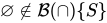
  1. X B {\displaystyle X\in {\mathcal {B}}} y B {\displaystyle \emptyset \notin {\mathcal {B}}}
  2. Si y , entonces A B {\displaystyle A\in {\mathcal {B}}} B B {\displaystyle B\in {\mathcal {B}}} A B B {\displaystyle A\cap B\in {\mathcal {B}}}
  3. Si y , entonces A B X {\displaystyle A\subset B\subset X} A B {\displaystyle A\in {\mathcal {B}}} B B {\displaystyle B\in {\mathcal {B}}}

Se puede pensar que un filtro en un conjunto representa una "colección de grandes subconjuntos", [2] un ejemplo intuitivo es el filtro de vecindad . Los filtros aparecen en la teoría de órdenes , la teoría de modelos y la teoría de conjuntos , pero también se pueden encontrar en la topología , de donde se originan. La noción dual de un filtro es un ideal .

Los filtros fueron introducidos por Henri Cartan en 1937 [3] [4] y como se describe en el artículo dedicado a los filtros en topología , fueron utilizados posteriormente por Nicolas Bourbaki en su libro Topologie Générale como una alternativa a la noción relacionada de una red desarrollada en 1922 por EH Moore y Herman L. Smith . Los filtros de orden son generalizaciones de filtros de conjuntos a conjuntos parcialmente ordenados arbitrarios . Específicamente, un filtro en un conjunto es solo un filtro de orden adecuado en el caso especial donde el conjunto parcialmente ordenado consiste en el conjunto de potencia ordenado por inclusión de conjuntos .

Preliminares, notación y nociones básicas

En este artículo, las letras romanas mayúsculas como y denotan conjuntos (pero no familias a menos que se indique lo contrario) y denotarán el conjunto potencia de Un subconjunto de un conjunto potencia se denomina familia de conjuntos (o simplemente, una familia ) donde es sobre si es un subconjunto de Las familias de conjuntos se denotarán con letras caligráficas mayúsculas como Siempre que se necesiten estas suposiciones, se debe suponer que no está vacío y que etc. son familias de conjuntos sobre S {\displaystyle S} X {\displaystyle X} ( X ) {\displaystyle \wp (X)} X . {\displaystyle X.} X {\displaystyle X} ( X ) . {\displaystyle \wp (X).} B , C ,  and  F . {\displaystyle {\mathcal {B}},{\mathcal {C}},{\text{ and }}{\mathcal {F}}.} X {\displaystyle X} B , F , {\displaystyle {\mathcal {B}},{\mathcal {F}},} X . {\displaystyle X.}

Los términos “prefiltro” y “base de filtro” son sinónimos y se utilizarán indistintamente.

Advertencia sobre definiciones y notaciones en conflicto

Lamentablemente, en la teoría de filtros hay varios términos que se definen de forma diferente según los distintos autores. Entre ellos se incluyen algunos de los términos más importantes, como "filtro". Aunque las distintas definiciones de un mismo término suelen tener una superposición significativa, debido a la naturaleza muy técnica de los filtros (y la topología de conjunto de puntos), estas diferencias en las definiciones suelen tener consecuencias importantes. Al leer literatura matemática, se recomienda que los lectores comprueben cómo define el autor la terminología relacionada con los filtros. Por este motivo, en este artículo se indicarán claramente todas las definiciones tal como se utilizan. Desafortunadamente, no toda la notación relacionada con los filtros está bien establecida y algunas notaciones varían mucho en la literatura (por ejemplo, la notación para el conjunto de todos los prefiltros de un conjunto), por lo que en esos casos este artículo utiliza la notación que sea más autodescriptiva o fácil de recordar.

La teoría de filtros y prefiltros está bien desarrollada y cuenta con una gran cantidad de definiciones y notaciones, muchas de las cuales se enumeran ahora sin ceremonias para evitar que este artículo se vuelva prolijo y para permitir una fácil búsqueda de notaciones y definiciones. Sus propiedades importantes se describen más adelante.

Operaciones de conjuntos

ElEl cierre ascendente oisotonizaciónen[5][6]de unafamilia de conjuntoses X {\displaystyle X} B ( X ) {\displaystyle {\mathcal {B}}\subseteq \wp (X)}

B X := { S X   :   B S  for some  B B } = B B { S   :   B S X } {\displaystyle {\mathcal {B}}^{\uparrow X}:=\{S\subseteq X~:~B\subseteq S{\text{ for some }}B\in {\mathcal {B}}\,\}=\bigcup _{B\in {\mathcal {B}}}\{S~:~B\subseteq S\subseteq X\}}

y de manera similar el cierre hacia abajo de es B {\displaystyle {\mathcal {B}}} B := { S B   :   B B } = B B ( B ) . {\displaystyle {\mathcal {B}}^{\downarrow }:=\{S\subseteq B~:~B\in {\mathcal {B}}\,\}=\bigcup _{B\in {\mathcal {B}}}\wp (B).}

Para dos familias cualesquiera se declara que si y sólo si para cada existe algún en cuyo caso se dice que es más grueso que y que es más fino que (o subordinado a ) [10] [11] [12] La notación también puede usarse en lugar de C  and  F , {\displaystyle {\mathcal {C}}{\text{ and }}{\mathcal {F}},} C F {\displaystyle {\mathcal {C}}\leq {\mathcal {F}}} C C {\displaystyle C\in {\mathcal {C}}} F F  such that  F C , {\displaystyle F\in {\mathcal {F}}{\text{ such that }}F\subseteq C,} C {\displaystyle {\mathcal {C}}} F {\displaystyle {\mathcal {F}}} F {\displaystyle {\mathcal {F}}} C . {\displaystyle {\mathcal {C}}.} F C  or  F C {\displaystyle {\mathcal {F}}\vdash {\mathcal {C}}{\text{ or }}{\mathcal {F}}\geq {\mathcal {C}}} C F . {\displaystyle {\mathcal {C}}\leq {\mathcal {F}}.}

Dos familias se entrelazan , [7] escrito si B  and  C {\displaystyle {\mathcal {B}}{\text{ and }}{\mathcal {C}}} B # C , {\displaystyle {\mathcal {B}}\#{\mathcal {C}},} B C  for all  B B  and  C C . {\displaystyle B\cap C\neq \varnothing {\text{ for all }}B\in {\mathcal {B}}{\text{ and }}C\in {\mathcal {C}}.}

A lo largo de todo, hay un mapa y es un conjunto. f {\displaystyle f} S {\displaystyle S}

Las redes y sus colas

Un conjunto dirigido es un conjunto junto con un preorden , que se denotará por (a menos que se indique explícitamente lo contrario), que hace en un conjunto dirigido ( hacia arriba ) ; [15] esto significa que para todo existe alguno tal que Para cualquier índice la notación se define como que significa mientras que se define como que significa que se cumple pero no es cierto que (si es antisimétrico entonces esto es equivalente a ). I {\displaystyle I} {\displaystyle \,\leq \,} ( I , ) {\displaystyle (I,\leq )} i , j I , {\displaystyle i,j\in I,} k I {\displaystyle k\in I} i k  and  j k . {\displaystyle i\leq k{\text{ and }}j\leq k.} i  and  j , {\displaystyle i{\text{ and }}j,} j i {\displaystyle j\geq i} i j {\displaystyle i\leq j} i < j {\displaystyle i<j} i j {\displaystyle i\leq j} j i {\displaystyle j\leq i} {\displaystyle \,\leq \,} i j  and  i j {\displaystyle i\leq j{\text{ and }}i\neq j}

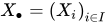
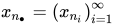
Una red en X {\displaystyle X} [15] es una función de un conjunto dirigido no vacío en La notación se utilizará para denotar una red con dominio X . {\displaystyle X.} x = ( x i ) i I {\displaystyle x_{\bullet }=\left(x_{i}\right)_{i\in I}} I . {\displaystyle I.}

Advertencia sobre el uso de comparaciones estrictas

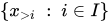
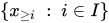
Si es una red y entonces es posible que el conjunto que se llama cola de después de , esté vacío (por ejemplo, esto sucede si es un límite superior del conjunto dirigido ). En este caso, la familia contendría el conjunto vacío, lo que evitaría que fuera un prefiltro (definido más adelante). Esta es la razón (importante) para definir como en lugar de o incluso y es por esta razón que en general, cuando se trata del prefiltro de colas de una red, la desigualdad estricta no puede usarse indistintamente con la desigualdad x = ( x i ) i I {\displaystyle x_{\bullet }=\left(x_{i}\right)_{i\in I}} i I {\displaystyle i\in I} x > i = { x j   :   j > i  and  j I } , {\displaystyle x_{>i}=\left\{x_{j}~:~j>i{\text{ and }}j\in I\right\},} x {\displaystyle x_{\bullet }} i {\displaystyle i} i {\displaystyle i} I {\displaystyle I} { x > i   :   i I } {\displaystyle \left\{x_{>i}~:~i\in I\right\}} Tails ( x ) {\displaystyle \operatorname {Tails} \left(x_{\bullet }\right)} { x i   :   i I } {\displaystyle \left\{x_{\geq i}~:~i\in I\right\}} { x > i   :   i I } {\displaystyle \left\{x_{>i}~:~i\in I\right\}} { x > i   :   i I } { x i   :   i I } {\displaystyle \left\{x_{>i}~:~i\in I\right\}\cup \left\{x_{\geq i}~:~i\in I\right\}} < {\displaystyle \,<\,} . {\displaystyle \,\leq .}

Filtros y prefiltros

La siguiente es una lista de propiedades que puede poseer una familia de conjuntos y que forman las propiedades definitorias de filtros, prefiltros y subbases de filtros. Siempre que sea necesario, se debe suponer que B {\displaystyle {\mathcal {B}}} B ( X ) . {\displaystyle {\mathcal {B}}\subseteq \wp (X).}

La familia de conjuntos es: B {\displaystyle {\mathcal {B}}}
  1. Apropiado ono degenerado siEn caso contrario, sientonces se llamaimpropio[17]odegenerado. B . {\displaystyle \varnothing \not \in {\mathcal {B}}.} B , {\displaystyle \varnothing \in {\mathcal {B}},}
  2. Dirigido hacia abajo [15]si siempreque exista algotal que A , B B {\displaystyle A,B\in {\mathcal {B}}} C B {\displaystyle C\in {\mathcal {B}}} C A B . {\displaystyle C\subseteq A\cap B.}
    • Esta propiedad se puede caracterizar en términos de direccionalidad , lo que explica la palabra "dirigido": Una relación binaria en se llama (hacia arriba) dirigida si para dos cualesquiera hay algún satisfactorio Usando en lugar de da la definición de dirigido hacia abajo mientras que usando en su lugar da la definición de dirigido hacia arriba . Explícitamente, está dirigido hacia abajo (resp. dirigido hacia arriba ) si y solo si para todos existe algún "mayor" tal que (resp. tal que ) − donde el elemento "mayor" siempre está en el lado derecho, [nota 1] − que puede reescribirse como (resp. como ). {\displaystyle \,\preceq \,} B {\displaystyle {\mathcal {B}}} A  and  B , {\displaystyle A{\text{ and }}B,} C {\displaystyle C} A C  and  B C . {\displaystyle A\preceq C{\text{ and }}B\preceq C.} {\displaystyle \,\supseteq \,} {\displaystyle \,\preceq \,} {\displaystyle \,\subseteq \,} B {\displaystyle {\mathcal {B}}} A , B B , {\displaystyle A,B\in {\mathcal {B}},} C B {\displaystyle C\in {\mathcal {B}}} A C  and  B C {\displaystyle A\supseteq C{\text{ and }}B\supseteq C} A C  and  B C {\displaystyle A\subseteq C{\text{ and }}B\subseteq C} A B C {\displaystyle A\cap B\supseteq C} A B C {\displaystyle A\cup B\subseteq C}
    • Si una familia tiene un elemento mayor con respecto a (por ejemplo, si ) entonces necesariamente está dirigida hacia abajo. B {\displaystyle {\mathcal {B}}} {\displaystyle \,\supseteq \,} B {\displaystyle \varnothing \in {\mathcal {B}}}
  3. Cerrado bajo intersecciones finitas (resp.uniones) si la intersección (resp. unión) de dos elementos cualesquiera dees un elemento de B {\displaystyle {\mathcal {B}}} B . {\displaystyle {\mathcal {B}}.}
    • Si es cerrada bajo intersecciones finitas entonces necesariamente está dirigida hacia abajo. La recíproca es generalmente falsa. B {\displaystyle {\mathcal {B}}} B {\displaystyle {\mathcal {B}}}
  4. Cerrado hacia arriba oisótonoen[5]sio equivalentemente, si siempre quey algún conjuntosatisfaceDe manera similar,estácerrado hacia abajosiUn conjunto cerrado hacia arriba (respectivamente, hacia abajo) también se denominaconjunto superioroalterado(resp. unconjunto inferioroconjunto descendente). X {\displaystyle X} B ( X )  and  B = B X , {\displaystyle {\mathcal {B}}\subseteq \wp (X){\text{ and }}{\mathcal {B}}={\mathcal {B}}^{\uparrow X},} B B {\displaystyle B\in {\mathcal {B}}} C {\displaystyle C} B C X ,  then  C B . {\displaystyle B\subseteq C\subseteq X,{\text{ then }}C\in {\mathcal {B}}.} B {\displaystyle {\mathcal {B}}} B = B . {\displaystyle {\mathcal {B}}={\mathcal {B}}^{\downarrow }.}
    • La familia que es el cierre ascendente de es la única familia de isótonos más pequeña (con respecto a ) de conjuntos sobre que tiene como subconjunto. B X , {\displaystyle {\mathcal {B}}^{\uparrow X},} B  in  X , {\displaystyle {\mathcal {B}}{\text{ in }}X,} {\displaystyle \,\subseteq } X {\displaystyle X} B {\displaystyle {\mathcal {B}}}

Muchas de las propiedades de los términos definidos arriba y abajo, como "adecuado" y "dirigido hacia abajo", no dependen de, por lo que mencionar el conjunto es opcional cuando se utilizan dichos términos. Las definiciones que implican estar "cerrado hacia arriba en ", como la de "filtrar sobre ", sí dependen de, por lo que se debe mencionar el conjunto si no queda claro a partir del contexto. B {\displaystyle {\mathcal {B}}} X , {\displaystyle X,} X {\displaystyle X} X , {\displaystyle X,} X , {\displaystyle X,} X {\displaystyle X} X {\displaystyle X}

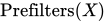
Filters ( X ) = DualIdeals ( X ) { ( X ) } Prefilters ( X ) FilterSubbases ( X ) . {\displaystyle {\textrm {Filters}}(X)\quad =\quad {\textrm {DualIdeals}}(X)\,\setminus \,\{\wp (X)\}\quad \subseteq \quad {\textrm {Prefilters}}(X)\quad \subseteq \quad {\textrm {FilterSubbases}}(X).}

Una familia es un(a): B {\displaystyle {\mathcal {B}}}
  1. Ideal [17][18]sies cerrado hacia abajo y cerrado bajo uniones finitas. B {\displaystyle {\mathcal {B}}\neq \varnothing }
  2. Ideal dual en[19]siestá cerrado hacia arribay también cerrado bajo intersecciones finitas. Equivalentemente,es un ideal dual si para todo[9] X {\displaystyle X} B {\displaystyle {\mathcal {B}}\neq \varnothing } X {\displaystyle X} B {\displaystyle {\mathcal {B}}\neq \varnothing } R , S X , {\displaystyle R,S\subseteq X,} R S B  if and only if  R , S B . {\displaystyle R\cap S\in {\mathcal {B}}\;{\text{ if and only if }}\;R,S\in {\mathcal {B}}.}
    • Explicación de la palabra "dual": Una familia es un ideal dual (o un ideal) si y sólo si B {\displaystyle {\mathcal {B}}} X {\displaystyle X} dual de B  in  X , {\displaystyle {\mathcal {B}}{\text{ in }}X,} la cual es la familia es un ideal (resp. un ideal dual) en En otras palabras, ideal dual significa " dual de un ideal ". La familia no debe confundirse con porque estos dos conjuntos no son iguales en general; por ejemplo, El dual del dual es la familia original, lo que significa que El conjunto pertenece al dual de si y solo si [17] X B := { X B   :   B B } , {\displaystyle X\setminus {\mathcal {B}}:=\{X\setminus B~:~B\in {\mathcal {B}}\},} X . {\displaystyle X.} X B {\displaystyle X\setminus {\mathcal {B}}} ( X ) B = { S X   :   S B } {\displaystyle \wp (X)\setminus {\mathcal {B}}=\{S\subseteq X~:~S\notin {\mathcal {B}}\}} X B = ( X )  if and only if  B = ( X ) . {\displaystyle X\setminus {\mathcal {B}}=\wp (X){\text{ if and only if }}{\mathcal {B}}=\wp (X).} X ( X B ) = B . {\displaystyle X\setminus (X\setminus {\mathcal {B}})={\mathcal {B}}.} X {\displaystyle X} B {\displaystyle {\mathcal {B}}} B . {\displaystyle \varnothing \in {\mathcal {B}}.}
  3. Filtro sobre[19][7]sies un ideal dual propio sobreEs decir, un filtro sobrees un subconjunto no vacío deque está cerrado bajo intersecciones finitas y cerrado hacia arriba enEquivalentemente, es un prefiltro que está cerrado hacia arriba enEn palabras, un filtro sobrees una familia de conjuntos sobreque (1) no está vacía (o equivalentemente, contiene), (2) está cerrado bajo intersecciones finitas, (3) está cerrado hacia arriba eny (4) no tiene al conjunto vacío como elemento. X {\displaystyle X} B {\displaystyle {\mathcal {B}}} X . {\displaystyle X.} X {\displaystyle X} ( X ) { } {\displaystyle \wp (X)\setminus \{\varnothing \}} X . {\displaystyle X.} X . {\displaystyle X.} X {\displaystyle X} X {\displaystyle X} X {\displaystyle X} X , {\displaystyle X,}
    • Advertencia : Algunos autores, particularmente los algebristas, usan "filtro" para significar un ideal dual; otros, particularmente los topólogos, usan "filtro" para significar un ideal dual propio / no degenerado . [20] Se recomienda que los lectores siempre verifiquen cómo se define "filtro" cuando lean literatura matemática. Sin embargo, las definiciones de "ultrafiltro", "prefiltro" y "subbase de filtro" siempre requieren no degeneración. Este artículo usa la definición original de "filtro" de Henri Cartan , [3] [4] que requería no degeneración.
    • Un filtro dual en es una familia cuyo dual es un filtro en Equivalentemente, es un ideal en que no contiene como elemento. X {\displaystyle X} B {\displaystyle {\mathcal {B}}} X B {\displaystyle X\setminus {\mathcal {B}}} X . {\displaystyle X.} X {\displaystyle X} X {\displaystyle X}
    • El conjunto potencia es el único ideal dual que no es también un filtro. Excluirlo de la definición de "filtro" en topología tiene el mismo beneficio que excluirlo de la definición de " número primo ": obvia la necesidad de especificar "no degenerado" (el análogo de "no unitario " o "no- ") en muchos resultados importantes, lo que hace que sus enunciados sean menos complicados. ( X ) {\displaystyle \wp (X)} X {\displaystyle X} ( X ) {\displaystyle \wp (X)} 1 {\displaystyle 1} 1 {\displaystyle 1}
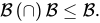
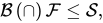
  4. Prefiltro obase de filtro [7][21]sies propia y está dirigida hacia abajo. Equivalentemente,se denomina prefiltro si su cierre ascendentees un filtro. También se puede definir como cualquier familia que sea equivalente (con respecto a) aalgúnfiltro.[8] Una familia propiaes un prefiltro si y solo si[8]Una familia es un prefiltro si y solo si lo mismo es cierto para su cierre ascendente. B {\displaystyle {\mathcal {B}}\neq \varnothing } B {\displaystyle {\mathcal {B}}} B X {\displaystyle {\mathcal {B}}^{\uparrow X}} {\displaystyle \leq } B {\displaystyle {\mathcal {B}}\neq \varnothing } B ( ) B B . {\displaystyle {\mathcal {B}}\,(\cap )\,{\mathcal {B}}\leq {\mathcal {B}}.}
    • Si es un prefiltro, entonces su cierre ascendente es el filtro más pequeño (relativo a ) único que contiene y se llama filtro generado por Se dice que un filtro es generado por un prefiltro si en el cual se llama base de filtro para B {\displaystyle {\mathcal {B}}} B X {\displaystyle {\mathcal {B}}^{\uparrow X}} {\displaystyle \subseteq } X {\displaystyle X} B {\displaystyle {\mathcal {B}}} B . {\displaystyle {\mathcal {B}}.} F {\displaystyle {\mathcal {F}}} B {\displaystyle {\mathcal {B}}} F = B X , {\displaystyle {\mathcal {F}}={\mathcal {B}}^{\uparrow X},} B {\displaystyle {\mathcal {B}}} F . {\displaystyle {\mathcal {F}}.}
    • A diferencia de un filtro, un prefiltro no está necesariamente cerrado bajo intersecciones finitas.
  5. π –sistema si es cerrado bajo intersecciones finitas. Cada familia no vacíaestá contenida en un únicoπ–sistema más pequeño llamadoπ–sistema generado porque a veces se denota porEs igual a la intersección de todoslos π–sistemas que contieneny también al conjunto de todas las posibles intersecciones finitas de conjuntos de: B {\displaystyle {\mathcal {B}}\neq \varnothing } B {\displaystyle {\mathcal {B}}} B , {\displaystyle {\mathcal {B}},} π ( B ) . {\displaystyle \pi ({\mathcal {B}}).} B {\displaystyle {\mathcal {B}}} B {\displaystyle {\mathcal {B}}} π ( B ) = { B 1 B n   :   n 1  and  B 1 , , B n B } . {\displaystyle \pi ({\mathcal {B}})=\left\{B_{1}\cap \cdots \cap B_{n}~:~n\geq 1{\text{ and }}B_{1},\ldots ,B_{n}\in {\mathcal {B}}\right\}.}
    • Un sistema π es un prefiltro si y solo si es propio. Todo filtro es un sistema π propio y todo sistema π propio es un prefiltro, pero las recíprocas no se cumplen en general.
    • Un prefiltro es equivalente (con respecto a ) al sistema π generado por él y ambas familias generan el mismo filtro en {\displaystyle \leq } X . {\displaystyle X.}
  6. Filtrar subbase [7][22]ycentrado[8]siysatisface cualquiera de las siguientes condiciones equivalentes: B {\displaystyle {\mathcal {B}}\neq \varnothing } B {\displaystyle {\mathcal {B}}}
    1. B {\displaystyle {\mathcal {B}}} tiene la propiedad de intersección finita , lo que significa que la intersección de cualquier familia finita de (uno o más) conjuntos en no está vacía; explícitamente, esto significa que siempre que entonces B {\displaystyle {\mathcal {B}}} n 1  and  B 1 , , B n B {\displaystyle n\geq 1{\text{ and }}B_{1},\ldots ,B_{n}\in {\mathcal {B}}} B 1 B n . {\displaystyle \varnothing \neq B_{1}\cap \cdots \cap B_{n}.}
    2. El sistema π generado por es propio; es decir, B {\displaystyle {\mathcal {B}}} π ( B ) . {\displaystyle \varnothing \not \in \pi ({\mathcal {B}}).}
    3. El sistema π generado por es un prefiltro. B {\displaystyle {\mathcal {B}}}
    4. B {\displaystyle {\mathcal {B}}} es un subconjunto de algún prefiltro.
    5. B {\displaystyle {\mathcal {B}}} es un subconjunto de algún filtro.
    • Supongamos que es una subbase de filtro. Entonces, hay un filtro único más pequeño (en relación con ) que contiene, llamado B {\displaystyle {\mathcal {B}}} {\displaystyle \subseteq } F B  on  X {\displaystyle {\mathcal {F}}_{\mathcal {B}}{\text{ on }}X} B {\displaystyle {\mathcal {B}}} filtro generado por B {\displaystyle {\mathcal {B}}} , yse dice quees una subbase de filtro paraeste filtro. Este filtro es igual a la intersección de todos los filtros enque son superconjuntos deElπ–sistema generado pordenotado porserá un prefiltro y un subconjunto de Además, el filtro generado pores igual al cierre ascendente designificado[8]Sin embargo,siy solo sies un prefiltro (aunquesubbasede filtro cerrada ascendentementepara). B {\displaystyle {\mathcal {B}}} X {\displaystyle X} B . {\displaystyle {\mathcal {B}}.} B , {\displaystyle {\mathcal {B}},} π ( B ) , {\displaystyle \pi ({\mathcal {B}}),} F B . {\displaystyle {\mathcal {F}}_{\mathcal {B}}.} B {\displaystyle {\mathcal {B}}} π ( B ) , {\displaystyle \pi ({\mathcal {B}}),} π ( B ) X = F B . {\displaystyle \pi ({\mathcal {B}})^{\uparrow X}={\mathcal {F}}_{\mathcal {B}}.} B X = F B {\displaystyle {\mathcal {B}}^{\uparrow X}={\mathcal {F}}_{\mathcal {B}}} B {\displaystyle {\mathcal {B}}} B X {\displaystyle {\mathcal {B}}^{\uparrow X}} F B {\displaystyle {\mathcal {F}}_{\mathcal {B}}}
    • Un prefiltro  más pequeño (es decir, el más pequeño en relación con  ) que contiene una subbase de filtro existirá solo en ciertas circunstancias. Existe, por ejemplo, si la subbase de filtro también es un prefiltro. También existe si el filtro (o equivalentemente, el π –sistema) generado por es principal, en cuyo caso es el único prefiltro más pequeño que contiene . De lo contrario, en general, un prefiltro  más pequeño que contiene podría no existir. Por esta razón, algunos autores pueden referirse al π –sistema generado por como {\displaystyle \subseteq } {\displaystyle \subseteq } B {\displaystyle {\mathcal {B}}} B {\displaystyle {\mathcal {B}}} B {\displaystyle {\mathcal {B}}} B { ker B } {\displaystyle {\mathcal {B}}\cup \{\ker {\mathcal {B}}\}} B . {\displaystyle {\mathcal {B}}.} {\displaystyle \subseteq } B {\displaystyle {\mathcal {B}}} B {\displaystyle {\mathcal {B}}} el prefiltro generado por B . {\displaystyle {\mathcal {B}}.} Sin embargo, si existe un prefiltro más pequeño (digamos que se denota pornoesnecesariamente igual al "prefiltro generado por B {\displaystyle {\mathcal {B}}} " (es decir,es posible). Y si la subbase del filtroresulta ser también un prefiltro pero no unπ-sistema, entonces, lamentablemente, "el prefiltro generado por este prefiltro" (es decir,) no lo será(es decir,es posible incluso cuandoes un prefiltro), por lo que este artículo preferirá la terminología precisa e inequívoca de "el π -sistemagenerado por". {\displaystyle \subseteq } minPre B {\displaystyle \operatorname {minPre} {\mathcal {B}}} minPre B π ( B ) {\displaystyle \operatorname {minPre} {\mathcal {B}}\neq \pi ({\mathcal {B}})} B {\displaystyle {\mathcal {B}}} π ( B ) {\displaystyle \pi ({\mathcal {B}})} B = minPre B {\displaystyle {\mathcal {B}}=\operatorname {minPre} {\mathcal {B}}} π ( B ) B {\displaystyle \pi ({\mathcal {B}})\neq {\mathcal {B}}} B {\displaystyle {\mathcal {B}}} B {\displaystyle {\mathcal {B}}}
  7. Subfiltro de un filtroy quees un F {\displaystyle {\mathcal {F}}} F {\displaystyle {\mathcal {F}}} superfiltro de[17][23]sies un filtro ydonde para filtros, B {\displaystyle {\mathcal {B}}} B {\displaystyle {\mathcal {B}}} B F {\displaystyle {\mathcal {B}}\subseteq {\mathcal {F}}} B F  if and only if  B F . {\displaystyle {\mathcal {B}}\subseteq {\mathcal {F}}{\text{ if and only if }}{\mathcal {B}}\leq {\mathcal {F}}.}
    • Es importante destacar que la expresión "es un superfiltro de" es para los filtros el análogo de "es una subsecuencia de". Por lo tanto, a pesar de tener el prefijo "sub" en común, "es un subfiltro de" es en realidad el inverso de "es una subsecuencia de". Sin embargo, también se puede escribir, lo que se describe diciendo " es subordinado a ". Con esta terminología, "es subordinado a" se convierte para los filtros (y también para los prefiltros) en el análogo de "es una subsecuencia de", [24] lo que hace que esta sea una situación en la que el uso del término "subordinado" y el símbolo pueden ser útiles. B F {\displaystyle {\mathcal {B}}\leq {\mathcal {F}}} F B {\displaystyle {\mathcal {F}}\vdash {\mathcal {B}}} F {\displaystyle {\mathcal {F}}} B . {\displaystyle {\mathcal {B}}.} {\displaystyle \,\vdash \,}

No hay prefiltros en (ni tampoco hay redes valoradas en ), por lo que este artículo, como la mayoría de los autores, asumirá automáticamente sin comentarios que siempre que se necesite esta suposición. X = {\displaystyle X=\varnothing } {\displaystyle \varnothing } X {\displaystyle X\neq \varnothing }

Ejemplos básicos

Ejemplos con nombre

  • El conjunto singleton se llama indiscreto o B = { X } {\displaystyle {\mathcal {B}}=\{X\}} filtro trivial en X . {\displaystyle X.} [25][10]Es el únicomínimoenporque es un subconjunto de cada filtro en; sin embargo, no necesita ser un subconjunto de cada prefiltro en X {\displaystyle X} X {\displaystyle X} X . {\displaystyle X.}
  • El ideal dual también se denomina filtro degenerado en [9] (a pesar de que en realidad no es un filtro). Es el único ideal dual en que no es un filtro en ( X ) {\displaystyle \wp (X)} X {\displaystyle X} X {\displaystyle X} X . {\displaystyle X.}
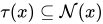
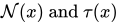
  • Si es un espacio topológico y entonces el filtro de vecindad en es un filtro en Por definición, una familia se llama base de vecindad (resp. una subbase de vecindad ) en si y solo si es un prefiltro (resp. es una subbase de filtro) y el filtro en que genera es igual al filtro de vecindad La subfamilia de vecindades abiertas es una base de filtro para Ambos prefiltros también forman bases para topologías en con la topología generada siendo más burda que Este ejemplo se generaliza inmediatamente desde vecindades de puntos a vecindades de subconjuntos no vacíos ( X , τ ) {\displaystyle (X,\tau )} x X , {\displaystyle x\in X,} N ( x ) {\displaystyle {\mathcal {N}}(x)} x {\displaystyle x} X . {\displaystyle X.} B ( X ) {\displaystyle {\mathcal {B}}\subseteq \wp (X)} x  for  ( X , τ ) {\displaystyle x{\text{ for }}(X,\tau )} B {\displaystyle {\mathcal {B}}} B {\displaystyle {\mathcal {B}}} X {\displaystyle X} B {\displaystyle {\mathcal {B}}} N ( x ) . {\displaystyle {\mathcal {N}}(x).} τ ( x ) N ( x ) {\displaystyle \tau (x)\subseteq {\mathcal {N}}(x)} N ( x ) . {\displaystyle {\mathcal {N}}(x).} N ( x )  and  τ ( x ) {\displaystyle {\mathcal {N}}(x){\text{ and }}\tau (x)} X , {\displaystyle X,} τ ( x ) {\displaystyle \tau (x)} τ . {\displaystyle \tau .} S X . {\displaystyle S\subseteq X.}
  • B {\displaystyle {\mathcal {B}}} es unprefiltro elemental [26]sipara alguna secuencia B = Tails ( x ) {\displaystyle {\mathcal {B}}=\operatorname {Tails} \left(x_{\bullet }\right)} x = ( x i ) i = 1  in  X . {\displaystyle x_{\bullet }=\left(x_{i}\right)_{i=1}^{\infty }{\text{ in }}X.}
  • B {\displaystyle {\mathcal {B}}} es unfiltro elemental o unfiltro secuencial en[27]sies un filtrogenerado por algún prefiltro elemental. El filtro de colas generado por una secuencia que no es eventualmente constantenoun ultrafiltro.[28]Todo filtro principal en un conjunto numerable es secuencial, como lo es todo filtro cofinito en un conjunto numerablemente infinito.[9]La intersección de un número finito de filtros secuenciales es nuevamente secuencial.[9] X {\displaystyle X} B {\displaystyle {\mathcal {B}}} X {\displaystyle X}
  • El conjunto de todos los subconjuntos cofinitos de (es decir, aquellos conjuntos cuyo complemento en es finito) es propio si y solo si es infinito (o equivalentemente, es infinito), en cuyo caso se aplica un filtro conocido como filtro de Fréchet o filtro de Fréchet. F {\displaystyle {\mathcal {F}}} X {\displaystyle X} X {\displaystyle X} F {\displaystyle {\mathcal {F}}} X {\displaystyle X} F {\displaystyle {\mathcal {F}}} X {\displaystyle X} filtro cofinito en[10][25]Sies finito entonceses igual al ideal dualque no es un filtro. Sies infinito entonces la familiade complementos de conjuntos singleton es una subbase de filtro que genera el filtro de Fréchet enComo con cualquier familia de conjuntos sobreque contieneel núcleo del filtro de Fréchet enes el conjunto vacío: X . {\displaystyle X.} X {\displaystyle X} F {\displaystyle {\mathcal {F}}} ( X ) , {\displaystyle \wp (X),} X {\displaystyle X} { X { x }   :   x X } {\displaystyle \{X\setminus \{x\}~:~x\in X\}} X . {\displaystyle X.} X {\displaystyle X} { X { x }   :   x X } , {\displaystyle \{X\setminus \{x\}~:~x\in X\},} X {\displaystyle X} ker F = . {\displaystyle \ker {\mathcal {F}}=\varnothing .}
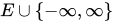
  • La intersección de todos los elementos de cualquier familia no vacía es en sí misma un filtro sobre llamado ínfimo o límite inferior máximo de , por lo que puede denotarse por Dicho de otra manera, Debido a que cada filtro sobre tiene como subconjunto, esta intersección nunca está vacía. Por definición, el ínfimo es el filtro más fino/más grande (en relación con ) contenido como subconjunto de cada miembro de [10] F Filters ( X ) {\displaystyle \mathbb {F} \subseteq \operatorname {Filters} (X)} X {\displaystyle X} F  in  Filters ( X ) , {\displaystyle \mathbb {F} {\text{ in }}\operatorname {Filters} (X),} F F F . {\displaystyle \bigwedge _{{\mathcal {F}}\in \mathbb {F} }{\mathcal {F}}.} ker F = F F F Filters ( X ) . {\displaystyle \ker \mathbb {F} =\bigcap _{{\mathcal {F}}\in \mathbb {F} }{\mathcal {F}}\in \operatorname {Filters} (X).} X {\displaystyle X} { X } {\displaystyle \{X\}}  and  {\displaystyle \,\subseteq \,{\text{ and }}\,\leq \,} F . {\displaystyle \mathbb {F} .}
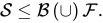
    • Si son filtros entonces su ínfimo en es el filtro [8] Si son prefiltros entonces es un prefiltro que es más grueso (con respecto a ) que ambos (es decir, ); de hecho, es uno de los prefiltros más finos de este tipo , lo que significa que si es un prefiltro tal que entonces necesariamente [8] De manera más general, si son familias no vacías y si entonces y es un elemento más grande (con respecto a ) de [8] B  and  F {\displaystyle {\mathcal {B}}{\text{ and }}{\mathcal {F}}} Filters ( X ) {\displaystyle \operatorname {Filters} (X)} B ( ) F . {\displaystyle {\mathcal {B}}\,(\cup )\,{\mathcal {F}}.} B  and  F {\displaystyle {\mathcal {B}}{\text{ and }}{\mathcal {F}}} B ( ) F {\displaystyle {\mathcal {B}}\,(\cup )\,{\mathcal {F}}} {\displaystyle \,\leq } B  and  F {\displaystyle {\mathcal {B}}{\text{ and }}{\mathcal {F}}} B ( ) F B  and  B ( ) F F {\displaystyle {\mathcal {B}}\,(\cup )\,{\mathcal {F}}\leq {\mathcal {B}}{\text{ and }}{\mathcal {B}}\,(\cup )\,{\mathcal {F}}\leq {\mathcal {F}}} S {\displaystyle {\mathcal {S}}} S B  and  S F {\displaystyle {\mathcal {S}}\leq {\mathcal {B}}{\text{ and }}{\mathcal {S}}\leq {\mathcal {F}}} S B ( ) F . {\displaystyle {\mathcal {S}}\leq {\mathcal {B}}\,(\cup )\,{\mathcal {F}}.} B  and  F {\displaystyle {\mathcal {B}}{\text{ and }}{\mathcal {F}}} S := { S ( X )   :   S B  and  S F } {\displaystyle \mathbb {S} :=\{{\mathcal {S}}\subseteq \wp (X)~:~{\mathcal {S}}\leq {\mathcal {B}}{\text{ and }}{\mathcal {S}}\leq {\mathcal {F}}\}} B ( ) F S {\displaystyle {\mathcal {B}}\,(\cup )\,{\mathcal {F}}\in \mathbb {S} } B ( ) F {\displaystyle {\mathcal {B}}\,(\cup )\,{\mathcal {F}}} {\displaystyle \leq } S . {\displaystyle \mathbb {S} .}
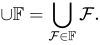
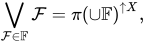
  • Sea y sea El supremo o mínimo límite superior de denotado por es el ideal dual más pequeño (relativo a ) en que contiene cada elemento de como un subconjunto; es decir, es el ideal dual más pequeño (relativo a ) en que contiene como un subconjunto. Este ideal dual es donde es el π –sistema generado por Como con cualquier familia no vacía de conjuntos, está contenido en algún filtro en si y solo si es una subbase de filtro, o equivalentemente, si y solo si es un filtro en en cuyo caso esta familia es el filtro más pequeño (relativo a ) en que contiene cada elemento de como un subconjunto y necesariamente F DualIdeals ( X ) {\displaystyle \varnothing \neq \mathbb {F} \subseteq \operatorname {DualIdeals} (X)} F = F F F . {\displaystyle \cup \mathbb {F} =\bigcup _{{\mathcal {F}}\in \mathbb {F} }{\mathcal {F}}.} F  in  DualIdeals ( X ) , {\displaystyle \mathbb {F} {\text{ in }}\operatorname {DualIdeals} (X),} F F F , {\displaystyle \bigvee _{{\mathcal {F}}\in \mathbb {F} }{\mathcal {F}},} {\displaystyle \subseteq } X {\displaystyle X} F {\displaystyle \mathbb {F} } {\displaystyle \subseteq } X {\displaystyle X} F {\displaystyle \cup \mathbb {F} } F F F = π ( F ) X , {\displaystyle \bigvee _{{\mathcal {F}}\in \mathbb {F} }{\mathcal {F}}=\pi \left(\cup \mathbb {F} \right)^{\uparrow X},} π ( F ) := { F 1 F n   :   n N  and every  F i  belongs to some  F F } {\displaystyle \pi \left(\cup \mathbb {F} \right):=\left\{F_{1}\cap \cdots \cap F_{n}~:~n\in \mathbb {N} {\text{ and every }}F_{i}{\text{ belongs to some }}{\mathcal {F}}\in \mathbb {F} \right\}} F . {\displaystyle \cup \mathbb {F} .} F {\displaystyle \cup \mathbb {F} } X {\displaystyle X} F F F = π ( F ) X {\displaystyle \bigvee _{{\mathcal {F}}\in \mathbb {F} }{\mathcal {F}}=\pi \left(\cup \mathbb {F} \right)^{\uparrow X}} X , {\displaystyle X,} {\displaystyle \subseteq } X {\displaystyle X} F {\displaystyle \mathbb {F} } F Filters ( X ) . {\displaystyle \mathbb {F} \subseteq \operatorname {Filters} (X).}
  • Sea y sea El supremo o límite superior mínimo de denotado por si existe, es por definición el filtro más pequeño (relativo a ) en que contiene cada elemento de como un subconjunto. Si existe entonces necesariamente [10] (como se definió anteriormente) y también será igual a la intersección de todos los filtros en que contiene Este supremo de existe si y solo si el ideal dual es un filtro en El límite superior mínimo de una familia de filtros puede no ser un filtro. [10] De hecho, si contiene al menos 2 elementos distintos entonces existen filtros para los cuales no existe un filtro que contenga ambos Si no es una subbase de filtro entonces el supremo de no existe y lo mismo es cierto de su supremo en pero su supremo en el conjunto de todos los ideales duales en existirá (siendo el filtro degenerado ). [9] F Filters ( X ) {\displaystyle \varnothing \neq \mathbb {F} \subseteq \operatorname {Filters} (X)} F = F F F . {\displaystyle \cup \mathbb {F} =\bigcup _{{\mathcal {F}}\in \mathbb {F} }{\mathcal {F}}.} F  in  Filters ( X ) , {\displaystyle \mathbb {F} {\text{ in }}\operatorname {Filters} (X),} F F F {\displaystyle \bigvee _{{\mathcal {F}}\in \mathbb {F} }{\mathcal {F}}} {\displaystyle \subseteq } X {\displaystyle X} F {\displaystyle \mathbb {F} } F F F = π ( F ) X {\displaystyle \bigvee _{{\mathcal {F}}\in \mathbb {F} }{\mathcal {F}}=\pi \left(\cup \mathbb {F} \right)^{\uparrow X}} F F F {\displaystyle \bigvee _{{\mathcal {F}}\in \mathbb {F} }{\mathcal {F}}} X {\displaystyle X} F . {\displaystyle \cup \mathbb {F} .} F  in  Filters ( X ) {\displaystyle \mathbb {F} {\text{ in }}\operatorname {Filters} (X)} π ( F ) X {\displaystyle \pi \left(\cup \mathbb {F} \right)^{\uparrow X}} X . {\displaystyle X.} F {\displaystyle \mathbb {F} } X {\displaystyle X} B  and  C  on  X {\displaystyle {\mathcal {B}}{\text{ and }}{\mathcal {C}}{\text{ on }}X} F  on  X {\displaystyle {\mathcal {F}}{\text{ on }}X} B  and  C . {\displaystyle {\mathcal {B}}{\text{ and }}{\mathcal {C}}.} F {\displaystyle \cup \mathbb {F} } F  in  Filters ( X ) {\displaystyle \mathbb {F} {\text{ in }}\operatorname {Filters} (X)} Prefilters ( X ) {\displaystyle \operatorname {Prefilters} (X)} X {\displaystyle X} ( X ) {\displaystyle \wp (X)}
    • Si son prefiltros (resp. filtros en ) entonces es un prefiltro (resp. un filtro) si y solo si no es degenerado (o dicho de otra manera, si y solo si malla), en cuyo caso es uno de los prefiltros más gruesos (resp. el filtro más grueso) en (con respecto a ) que es más fino (con respecto a ) que ambos esto significa que si es cualquier prefiltro (resp. cualquier filtro) tal que entonces necesariamente [8] en cuyo caso se denota por [9] B  and  F {\displaystyle {\mathcal {B}}{\text{ and }}{\mathcal {F}}} X {\displaystyle X} B ( ) F {\displaystyle {\mathcal {B}}\,(\cap )\,{\mathcal {F}}} B  and  F {\displaystyle {\mathcal {B}}{\text{ and }}{\mathcal {F}}} X {\displaystyle X} {\displaystyle \,\leq } {\displaystyle \,\leq } B  and  F ; {\displaystyle {\mathcal {B}}{\text{ and }}{\mathcal {F}};} S {\displaystyle {\mathcal {S}}} B S  and  F S {\displaystyle {\mathcal {B}}\leq {\mathcal {S}}{\text{ and }}{\mathcal {F}}\leq {\mathcal {S}}} B ( ) F S , {\displaystyle {\mathcal {B}}\,(\cap )\,{\mathcal {F}}\leq {\mathcal {S}},} B F . {\displaystyle {\mathcal {B}}\vee {\mathcal {F}}.}
  • Sean conjuntos no vacíos y para cada sea un ideal dual en Si es cualquier ideal dual en entonces es un ideal dual en llamado ideal dual de Kowalsky o filtro de Kowalsky . [17] I  and  X {\displaystyle I{\text{ and }}X} i I {\displaystyle i\in I} D i {\displaystyle {\mathcal {D}}_{i}} X . {\displaystyle X.} I {\displaystyle {\mathcal {I}}} I {\displaystyle I} Ξ I i Ξ D i {\displaystyle \bigcup _{\Xi \in {\mathcal {I}}}\;\;\bigcap _{i\in \Xi }\;{\mathcal {D}}_{i}} X {\displaystyle X}
  • El filtro club de un cardinal incontable regular es el filtro de todos los conjuntos que contienen un subconjunto club de Es un filtro -completo cerrado bajo la intersección diagonal . κ . {\displaystyle \kappa .} κ {\displaystyle \kappa }

Otros ejemplos

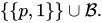
  • Sea y sea que forma un prefiltro y una subbase de filtro que no está cerrada bajo intersecciones finitas. Debido a que es un prefiltro, el prefiltro más pequeño que contiene es El sistema π generado por es En particular, el prefiltro más pequeño que contiene la subbase de filtro no es igual al conjunto de todas las intersecciones finitas de conjuntos en El filtro en generado por es Los tres sistemas π generan y son ejemplos de prefiltros fijos, principales y ultra que son principales en el punto es también un ultrafiltro en X = { p , 1 , 2 , 3 } {\displaystyle X=\{p,1,2,3\}} B = { { p } , { p , 1 , 2 } , { p , 1 , 3 } } , {\displaystyle {\mathcal {B}}=\{\{p\},\{p,1,2\},\{p,1,3\}\},} B {\displaystyle {\mathcal {B}}} B {\displaystyle {\mathcal {B}}} B {\displaystyle {\mathcal {B}}} B . {\displaystyle {\mathcal {B}}.} B {\displaystyle {\mathcal {B}}} { { p , 1 } } B . {\displaystyle \{\{p,1\}\}\cup {\mathcal {B}}.} B {\displaystyle {\mathcal {B}}} B . {\displaystyle {\mathcal {B}}.} X {\displaystyle X} B {\displaystyle {\mathcal {B}}} B X = { S X : p S } = { { p } T   :   T { 1 , 2 , 3 } } . {\displaystyle {\mathcal {B}}^{\uparrow X}=\{S\subseteq X:p\in S\}=\{\{p\}\cup T~:~T\subseteq \{1,2,3\}\}.} B , {\displaystyle {\mathcal {B}},} B {\displaystyle {\mathcal {B}}} B X {\displaystyle {\mathcal {B}}^{\uparrow X}} p ; B X {\displaystyle p;{\mathcal {B}}^{\uparrow X}} X . {\displaystyle X.}
  • Sea un espacio topológico, y definamos donde es necesariamente más fino que [29] Si no es vacío (resp. no degenerado, una subbase de filtro, un prefiltro, cerrado bajo uniones finitas), entonces lo mismo es cierto de Si es un filtro en entonces es un prefiltro pero no necesariamente un filtro en aunque es un filtro en equivalente a ( X , τ ) {\displaystyle (X,\tau )} B ( X ) , {\displaystyle {\mathcal {B}}\subseteq \wp (X),} B ¯ := { cl X B   :   B B } , {\displaystyle {\overline {\mathcal {B}}}:=\left\{\operatorname {cl} _{X}B~:~B\in {\mathcal {B}}\right\},} B {\displaystyle {\mathcal {B}}} B ¯ . {\displaystyle {\overline {\mathcal {B}}}.} B {\displaystyle {\mathcal {B}}} B ¯ . {\displaystyle {\overline {\mathcal {B}}}.} B {\displaystyle {\mathcal {B}}} X {\displaystyle X} B ¯ {\displaystyle {\overline {\mathcal {B}}}} X {\displaystyle X} ( B ¯ ) X {\displaystyle \left({\overline {\mathcal {B}}}\right)^{\uparrow X}} X {\displaystyle X} B ¯ . {\displaystyle {\overline {\mathcal {B}}}.}
  • El conjunto de todos los subconjuntos abiertos densos de un espacio topológico (no vacío) es un π –sistema propio y por lo tanto también un prefiltro. Si el espacio es un espacio de Baire , entonces el conjunto de todas las intersecciones numerables de subconjuntos abiertos densos es un π –sistema y un prefiltro que es más fino que Si (con ) entonces el conjunto de todos los que tiene medida de Lebesgue finita es un π –sistema propio y prefiltro libre que es también un subconjunto propio de Los prefiltros y son equivalentes y por lo tanto generan el mismo filtro en El prefiltro está propiamente contenido en, y no es equivalente a, el prefiltro que consiste en todos los subconjuntos densos de Dado que es un espacio de Baire , cada intersección numerable de conjuntos en es densa en (y también comeagre y no exigua) por lo que el conjunto de todas las intersecciones numerables de elementos de es un prefiltro y π –sistema; también es más fino que, y no es equivalente a, B {\displaystyle {\mathcal {B}}} X {\displaystyle X} B . {\displaystyle {\mathcal {B}}.} X = R n {\displaystyle X=\mathbb {R} ^{n}} 1 n N {\displaystyle 1\leq n\in \mathbb {N} } B LebFinite {\displaystyle {\mathcal {B}}_{\operatorname {LebFinite} }} B B {\displaystyle B\in {\mathcal {B}}} B {\displaystyle B} B . {\displaystyle {\mathcal {B}}.} B LebFinite {\displaystyle {\mathcal {B}}_{\operatorname {LebFinite} }} B {\displaystyle {\mathcal {B}}} X . {\displaystyle X.} B LebFinite {\displaystyle {\mathcal {B}}_{\operatorname {LebFinite} }} R . {\displaystyle \mathbb {R} .} X {\displaystyle X} B LebFinite {\displaystyle {\mathcal {B}}_{\operatorname {LebFinite} }} X {\displaystyle X} B LebFinite {\displaystyle {\mathcal {B}}_{\operatorname {LebFinite} }} B LebFinite . {\displaystyle {\mathcal {B}}_{\operatorname {LebFinite} }.}
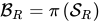
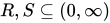
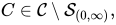
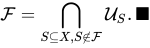
  • Una subbase de filtro sin el prefiltro más pequeño que la contiene {\displaystyle \,\subseteq -} : En general, si una subbase de filtro no es un π –sistema entonces una intersección de conjuntos de usualmente requerirá una descripción que involucre variables que no pueden ser reducidas a solo dos (considere, por ejemplo cuando ). Este ejemplo ilustra una clase atípica de una subbase de filtro donde todos los conjuntos en ambos y su π –sistema generado pueden ser descritos como conjuntos de la forma de modo que en particular, no más de dos variables (específicamente, ) son necesarias para describir el π –sistema generado. Para todos sea donde siempre se cumple por lo que no se pierde generalidad al agregar el supuesto Para todos los reales si es no negativo entonces [nota 2] Para cada conjunto de reales positivos, sea [nota 3] Sea y suponga que no es un conjunto singleton. Entonces es una subbase de filtro pero no un prefiltro y es el π –sistema que genera, de modo que es el único filtro más pequeño en que contiene Sin embargo, no es un filtro sobre (ni es un prefiltro porque no está dirigido hacia abajo, aunque es una subbase de filtro) y es un subconjunto propio del filtro Si son intervalos no vacíos, entonces las subbases de filtro generan el mismo filtro sobre si y solo si Si es un prefiltro que satisface [nota 4] entonces para cualquier la familia también es un prefiltro que satisface Esto muestra que no puede existir un prefiltro mínimo / mínimo (con respecto a ) que contenga y sea un subconjunto del π –sistema generado por Esto sigue siendo cierto incluso si se elimina el requisito de que el prefiltro sea un subconjunto de; es decir, (en marcado contraste con los filtros) no existe un prefiltro mínimo / mínimo (con respecto a ) que contenga la subbase de filtro S {\displaystyle {\mathcal {S}}} S 1 S n {\displaystyle S_{1}\cap \cdots \cap S_{n}} n {\displaystyle n} S {\displaystyle {\mathcal {S}}} n {\displaystyle n} π ( S ) {\displaystyle \pi ({\mathcal {S}})} S = { ( , r ) ( r , )   :   r R } {\displaystyle {\mathcal {S}}=\{(-\infty ,r)\cup (r,\infty )~:~r\in \mathbb {R} \}} S R {\displaystyle {\mathcal {S}}_{R}} S R {\displaystyle {\mathcal {S}}_{R}} B r , s , {\displaystyle B_{r,s},} r  and  s {\displaystyle r{\text{ and }}s} r , s R , {\displaystyle r,s\in \mathbb {R} ,} B r , s = ( r , 0 ) ( s , ) , {\displaystyle B_{r,s}=(r,0)\cup (s,\infty ),} B r , s = B min ( r , s ) , s {\displaystyle B_{r,s}=B_{\min(r,s),s}} r s . {\displaystyle r\leq s.} r s  and  u v , {\displaystyle r\leq s{\text{ and }}u\leq v,} s  or  v {\displaystyle s{\text{ or }}v} B r , s B u , v = B min ( r , u ) , max ( s , v ) . {\displaystyle B_{-r,s}\cap B_{-u,v}=B_{-\min(r,u),\max(s,v)}.} R {\displaystyle R} S R := { B r , r : r R } = { ( r , 0 ) ( r , ) : r R }  and  B R := { B r , s : r s  with  r , s R } = { ( r , 0 ) ( s , ) : r s  in  R } . {\displaystyle {\mathcal {S}}_{R}:=\left\{B_{-r,r}:r\in R\right\}=\{(-r,0)\cup (r,\infty ):r\in R\}\quad {\text{ and }}\quad {\mathcal {B}}_{R}:=\left\{B_{-r,s}:r\leq s{\text{ with }}r,s\in R\right\}=\{(-r,0)\cup (s,\infty ):r\leq s{\text{ in }}R\}.} X = R {\displaystyle X=\mathbb {R} } R ( 0 , ) {\displaystyle \varnothing \neq R\subseteq (0,\infty )} S R {\displaystyle {\mathcal {S}}_{R}} B R = π ( S R ) {\displaystyle {\mathcal {B}}_{R}=\pi \left({\mathcal {S}}_{R}\right)} B R X {\displaystyle {\mathcal {B}}_{R}^{\uparrow X}} X = R {\displaystyle X=\mathbb {R} } S R . {\displaystyle {\mathcal {S}}_{R}.} S R X {\displaystyle {\mathcal {S}}_{R}^{\uparrow X}} X {\displaystyle X} S R X {\displaystyle {\mathcal {S}}_{R}^{\uparrow X}} B R X . {\displaystyle {\mathcal {B}}_{R}^{\uparrow X}.} R , S ( 0 , ) {\displaystyle R,S\subseteq (0,\infty )} S R  and  S S {\displaystyle {\mathcal {S}}_{R}{\text{ and }}{\mathcal {S}}_{S}} X {\displaystyle X} R = S . {\displaystyle R=S.} C {\displaystyle {\mathcal {C}}} S ( 0 , ) C B ( 0 , ) {\displaystyle {\mathcal {S}}_{(0,\infty )}\subseteq {\mathcal {C}}\subseteq {\mathcal {B}}_{(0,\infty )}} C C S ( 0 , ) , {\displaystyle C\in {\mathcal {C}}\setminus {\mathcal {S}}_{(0,\infty )},} C { C } {\displaystyle {\mathcal {C}}\setminus \{C\}} S ( 0 , ) C { C } B ( 0 , ) . {\displaystyle {\mathcal {S}}_{(0,\infty )}\subseteq {\mathcal {C}}\setminus \{C\}\subseteq {\mathcal {B}}_{(0,\infty )}.} {\displaystyle \subseteq } S ( 0 , ) {\displaystyle {\mathcal {S}}_{(0,\infty )}} S ( 0 , ) . {\displaystyle {\mathcal {S}}_{(0,\infty )}.} B ( 0 , ) = π ( S ( 0 , ) ) {\displaystyle {\mathcal {B}}_{(0,\infty )}=\pi \left({\mathcal {S}}_{(0,\infty )}\right)} {\displaystyle \subseteq } S ( 0 , ) . {\displaystyle {\mathcal {S}}_{(0,\infty )}.}

Ultrafiltros

Existen muchas otras caracterizaciones de "ultrafiltro" y "ultraprefiltro", que se enumeran en el artículo sobre ultrafiltros . En ese artículo también se describen propiedades importantes de los ultrafiltros.

Ultrafilters ( X ) = Filters ( X ) UltraPrefilters ( X ) UltraPrefilters ( X ) = UltraFilterSubbases ( X ) Prefilters ( X ) {\displaystyle {\begin{alignedat}{8}{\textrm {Ultrafilters}}(X)\;&=\;{\textrm {Filters}}(X)\,\cap \,{\textrm {UltraPrefilters}}(X)\\&\subseteq \;{\textrm {UltraPrefilters}}(X)={\textrm {UltraFilterSubbases}}(X)\\&\subseteq \;{\textrm {Prefilters}}(X)\\\end{alignedat}}}

Una familia de conjuntos no vacía es/es: B ( X ) {\displaystyle {\mathcal {B}}\subseteq \wp (X)}
  1. Ultra [7] [30] sise cumple alguna de las siguientes condiciones equivalentes: B {\displaystyle \varnothing \not \in {\mathcal {B}}}
    1. Para cada conjunto existe algún conjunto tal que (o equivalentemente, tal que ). S X {\displaystyle S\subseteq X} B B {\displaystyle B\in {\mathcal {B}}} B S  or  B X S {\displaystyle B\subseteq S{\text{ or }}B\subseteq X\setminus S} B S  equals  B  or  {\displaystyle B\cap S{\text{ equals }}B{\text{ or }}\varnothing }
    2. Para cada conjunto existe algún conjunto tal que S B B B {\displaystyle S\subseteq \bigcup _{B\in {\mathcal {B}}}B} B B {\displaystyle B\in {\mathcal {B}}} B S  equals  B  or  . {\displaystyle B\cap S{\text{ equals }}B{\text{ or }}\varnothing .}
      • Esta caracterización de " es ultra" no depende del conjunto , por lo que mencionar el conjunto es opcional cuando se utiliza el término "ultra". B {\displaystyle {\mathcal {B}}} X , {\displaystyle X,} X {\displaystyle X}
    3. Para cada conjunto (no necesariamente ni siquiera un subconjunto de ) existe algún conjunto tal que S {\displaystyle S} X {\displaystyle X} B B {\displaystyle B\in {\mathcal {B}}} B S  equals  B  or  . {\displaystyle B\cap S{\text{ equals }}B{\text{ or }}\varnothing .}
      • Si satisface esta condición, entonces también lo hace cada superconjunto. Por ejemplo, si es cualquier conjunto singleton , entonces es ultra y, en consecuencia, cualquier superconjunto no degenerado de (como su cierre ascendente) también es ultra. B {\displaystyle {\mathcal {B}}} F B . {\displaystyle {\mathcal {F}}\supseteq {\mathcal {B}}.} T {\displaystyle T} { T } {\displaystyle \{T\}} { T } {\displaystyle \{T\}}
  2. Prefiltro ultra [7] [30] si es un prefiltro que también es ultra. Equivalentemente, es una subbase de filtro que es ultra. Un prefiltro es ultra si y solo si satisface cualquiera de las siguientes condiciones equivalentes: B {\displaystyle {\mathcal {B}}}
    1. B {\displaystyle {\mathcal {B}}} es máxima con respecto a lo que significa que Prefilters ( X ) {\displaystyle \operatorname {Prefilters} (X)} , {\displaystyle \,\leq ,\,} For all  C Prefilters ( X ) , B C  implies  C B . {\displaystyle {\text{For all }}{\mathcal {C}}\in \operatorname {Prefilters} (X),\;{\mathcal {B}}\leq {\mathcal {C}}\;{\text{ implies }}\;{\mathcal {C}}\leq {\mathcal {B}}.}
    2. For all  C Filters ( X ) , B C  implies  C B . {\displaystyle {\text{For all }}{\mathcal {C}}\in \operatorname {Filters} (X),\;{\mathcal {B}}\leq {\mathcal {C}}\;{\text{ implies }}\;{\mathcal {C}}\leq {\mathcal {B}}.}
      • Aunque esta afirmación es idéntica a la que se da a continuación para los ultrafiltros, aquí simplemente se supone que es un prefiltro; no necesita ser un filtro. B {\displaystyle {\mathcal {B}}}
    3. B X {\displaystyle {\mathcal {B}}^{\uparrow X}} es ultra (y por lo tanto un ultrafiltro).
    4. B {\displaystyle {\mathcal {B}}} es equivalente (con respecto a ) a algún ultrafiltro. {\displaystyle \leq }
    • Una subbase de filtro que es ultra es necesariamente un prefiltro. Una subbase de filtro es ultra si y solo si es una subbase de filtro máxima con respecto a (como se indicó anteriormente). [17] {\displaystyle \,\leq \,}
  3. Ultrafiltro activado X {\displaystyle X} [7] [30] si es un filtro activadoque es ultra. De manera equivalente, un ultrafiltro activadoes un filtroque satisface cualquiera de las siguientes condiciones equivalentes: X {\displaystyle X} X {\displaystyle X} B  on  X {\displaystyle {\mathcal {B}}{\text{ on }}X}
    1. B {\displaystyle {\mathcal {B}}} se genera mediante un prefiltro ultra.
    2. Para cualquier [17] S X , S B  or  X S B . {\displaystyle S\subseteq X,S\in {\mathcal {B}}{\text{ or }}X\setminus S\in {\mathcal {B}}.}
    3. B ( X B ) = ( X ) . {\displaystyle {\mathcal {B}}\cup (X\setminus {\mathcal {B}})=\wp (X).} Esta condición se puede reformular como: está dividida por y su dual ( X ) {\displaystyle \wp (X)} B {\displaystyle {\mathcal {B}}} X B . {\displaystyle X\setminus {\mathcal {B}}.}
      • Los conjuntos son disjuntos siempre que haya un prefiltro. B  and  X B {\displaystyle {\mathcal {B}}{\text{ and }}X\setminus {\mathcal {B}}} B {\displaystyle {\mathcal {B}}}
    4. ( X ) B = { S ( X ) : S B } {\displaystyle \wp (X)\setminus {\mathcal {B}}=\{S\in \wp (X):S\not \in {\mathcal {B}}\}} es un ideal. [17]
    5. Para cualquier si entonces R , S X , {\displaystyle R,S\subseteq X,} R S = X {\displaystyle R\cup S=X} R B  or  S B . {\displaystyle R\in {\mathcal {B}}{\text{ or }}S\in {\mathcal {B}}.}
    6. Para cualquier caso , si entonces (un filtro con esta propiedad se llama filtro principal ). R , S X , {\displaystyle R,S\subseteq X,} R S B {\displaystyle R\cup S\in {\mathcal {B}}} R B  or  S B {\displaystyle R\in {\mathcal {B}}{\text{ or }}S\in {\mathcal {B}}}
      • Esta propiedad se extiende a cualquier unión finita de dos o más conjuntos.
    7. Para cualquier si entonces cualquiera R , S X , {\displaystyle R,S\subseteq X,} R S B  and  R S = {\displaystyle R\cup S\in {\mathcal {B}}{\text{ and }}R\cap S=\varnothing } R B  or  S B . {\displaystyle R\in {\mathcal {B}}{\text{ or }}S\in {\mathcal {B}}.}
    8. B {\displaystyle {\mathcal {B}}} es un filtro maximo en ; lo que significa que si es un filtro en tal que entonces necesariamente (esta igualdad puede reemplazarse por ). X {\displaystyle X} C {\displaystyle {\mathcal {C}}} X {\displaystyle X} B C {\displaystyle {\mathcal {B}}\subseteq {\mathcal {C}}} C = B {\displaystyle {\mathcal {C}}={\mathcal {B}}} C B  or by  C B {\displaystyle {\mathcal {C}}\subseteq {\mathcal {B}}{\text{ or by }}{\mathcal {C}}\leq {\mathcal {B}}}
      • Si está cerrado hacia arriba entonces Entonces esta caracterización de los ultrafiltros como filtros maximos puede reformularse como: C {\displaystyle {\mathcal {C}}} B C  if and only if  B C . {\displaystyle {\mathcal {B}}\leq {\mathcal {C}}{\text{ if and only if }}{\mathcal {B}}\subseteq {\mathcal {C}}.} For all  C Filters ( X ) , B C  implies  C B . {\displaystyle {\text{For all }}{\mathcal {C}}\in \operatorname {Filters} (X),\;{\mathcal {B}}\leq {\mathcal {C}}\;{\text{ implies }}\;{\mathcal {C}}\leq {\mathcal {B}}.}
      • Debido a que la subordinación es para los filtros el análogo de "es una subred/subsecuencia de" (específicamente, "subred" debería significar "AA–subred", que se define más abajo), esta caracterización de un ultrafiltro como un "filtro máximamente subordinado" sugiere que un ultrafiltro puede interpretarse como análogo a algún tipo de "red máximamente profunda" (lo que podría, por ejemplo, significar que "cuando se ve solo desde " en algún sentido, es indistinguible de sus subredes, como es el caso con cualquier red valorada en un conjunto singleton, por ejemplo), [nota 5] que es una idea que en realidad se vuelve rigurosa por las ultraredes . El lema del ultrafiltro es entonces la afirmación de que cada filtro ("red") tiene algún filtro subordinado ("subred") que es "máximamente subordinado" ("máximamente profundo"). {\displaystyle \,\geq \,} X {\displaystyle X}

Cualquier familia no degenerada que tenga como elemento un conjunto singleton es ultra, en cuyo caso será un prefiltro ultra si y solo si también tiene la propiedad de intersección finita. El filtro trivial es ultra si y solo si es un conjunto singleton. { X }  on  X {\displaystyle \{X\}{\text{ on }}X} X {\displaystyle X}

El lema del ultrafiltro

El siguiente teorema importante se debe a Alfred Tarski (1930). [31]

El lema/principio/teorema del ultrafiltro [10]  ( Tarski )  :  cada filtro de un conjuntoes un subconjunto de algún ultrafiltro de un conjunto. X {\displaystyle X} X . {\displaystyle X.}

Una consecuencia del lema del ultrafiltro es que cada filtro es igual a la intersección de todos los ultrafiltros que lo contienen. [10] [prueba 1] Suponiendo los axiomas de Zermelo–Fraenkel (ZF) , el lema del ultrafiltro se sigue del axioma de elección (en particular del lema de Zorn ) pero es estrictamente más débil que él. El lema del ultrafiltro implica el axioma de elección para conjuntos finitos. Si solo se trata de espacios de Hausdorff , entonces la mayoría de los resultados básicos (como los que se encuentran en los cursos introductorios) en topología (como el teorema de Tichonoff para espacios de Hausdorff compactos y el teorema de la subbase de Alexander ) y en análisis funcional (como el teorema de Hahn–Banach ) se pueden demostrar utilizando solo el lema del ultrafiltro; podría no necesitarse toda la fuerza del axioma de elección.

Granos

El núcleo es útil para clasificar propiedades de prefiltros y otras familias de conjuntos.

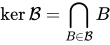
El núcleo [5] de una familia de conjuntos es la intersección de todos los conjuntos que son elementos de B {\displaystyle {\mathcal {B}}} B : {\displaystyle {\mathcal {B}}:} ker B = B B B {\displaystyle \ker {\mathcal {B}}=\bigcap _{B\in {\mathcal {B}}}B}

Si entonces por cualquier punto B ( X ) {\displaystyle {\mathcal {B}}\subseteq \wp (X)} x , x ker B  if and only if  X { x } B X . {\displaystyle x,x\not \in \ker {\mathcal {B}}{\text{ if and only if }}X\setminus \{x\}\in {\mathcal {B}}^{\uparrow X}.}

Propiedades de los granos

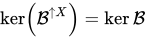
Si entonces y este conjunto también es igual al núcleo del sistema π que se genera por En particular, si es una subbase de filtro, entonces los núcleos de todos los conjuntos siguientes son iguales: B ( X ) {\displaystyle {\mathcal {B}}\subseteq \wp (X)} ker ( B X ) = ker B {\displaystyle \ker \left({\mathcal {B}}^{\uparrow X}\right)=\ker {\mathcal {B}}} B . {\displaystyle {\mathcal {B}}.} B {\displaystyle {\mathcal {B}}}

(1) (2) el sistema π generado por y (3) el filtro generado por B , {\displaystyle {\mathcal {B}},} B , {\displaystyle {\mathcal {B}},} B . {\displaystyle {\mathcal {B}}.}

Si es una función entonces y Si entonces mientras que si y son equivalentes entonces Las familias equivalentes tienen núcleos iguales. Dos familias principales son equivalentes si y solo si sus núcleos son iguales; es decir, si y son principales entonces son equivalentes si y solo si f {\displaystyle f} f ( ker B ) ker f ( B ) {\displaystyle f(\ker {\mathcal {B}})\subseteq \ker f({\mathcal {B}})} f 1 ( ker B ) = ker f 1 ( B ) . {\displaystyle f^{-1}(\ker {\mathcal {B}})=\ker f^{-1}({\mathcal {B}}).} B C {\displaystyle {\mathcal {B}}\leq {\mathcal {C}}} ker C ker B {\displaystyle \ker {\mathcal {C}}\subseteq \ker {\mathcal {B}}} B {\displaystyle {\mathcal {B}}} C {\displaystyle {\mathcal {C}}} ker B = ker C . {\displaystyle \ker {\mathcal {B}}=\ker {\mathcal {C}}.} B {\displaystyle {\mathcal {B}}} C {\displaystyle {\mathcal {C}}} ker B = ker C . {\displaystyle \ker {\mathcal {B}}=\ker {\mathcal {C}}.}

Clasificación de familias por sus núcleos

Una familia de conjuntos es: B {\displaystyle {\mathcal {B}}}
  1. Gratis [6]sio equivalentemente, siesto puede reformularse como ker B = , {\displaystyle \ker {\mathcal {B}}=\varnothing ,} { X { x }   :   x X } B X ; {\displaystyle \{X\setminus \{x\}~:~x\in X\}\subseteq {\mathcal {B}}^{\uparrow X};} { X { x }   :   x X } B . {\displaystyle \{X\setminus \{x\}~:~x\in X\}\leq {\mathcal {B}}.}
    • Un filtro en es libre si y solo si es infinito y contiene el filtro de Fréchet en como subconjunto. F {\displaystyle {\mathcal {F}}} X {\displaystyle X} X {\displaystyle X} F {\displaystyle {\mathcal {F}}} X {\displaystyle X}
  2. Fijo sien cuyo caso,se dice que estáfijado porcualquier punto ker B {\displaystyle \ker {\mathcal {B}}\neq \varnothing } B {\displaystyle {\mathcal {B}}} x ker B . {\displaystyle x\in \ker {\mathcal {B}}.}
    • Cualquier familia fija es necesariamente una subbase de filtro.
  3. Principal [6]si ker B B . {\displaystyle \ker {\mathcal {B}}\in {\mathcal {B}}.}
    • Una familia principal adecuada de conjuntos es necesariamente un prefiltro.
  4. Discreto oPrincipal en [25]sien cuyo casose llama su x X {\displaystyle x\in X} { x } = ker B B , {\displaystyle \{x\}=\ker {\mathcal {B}}\in {\mathcal {B}},} x {\displaystyle x} elemento principal .
    • El filtro principal en on x {\displaystyle x} X {\displaystyle X} es el filtro Un filtro es principal en si y solo si { x } X . {\displaystyle \{x\}^{\uparrow X}.} F {\displaystyle {\mathcal {F}}} x {\displaystyle x} F = { x } X . {\displaystyle {\mathcal {F}}=\{x\}^{\uparrow X}.}
  5. Contablemente profundo si siempre que es un subconjunto contable entonces [9] C F {\displaystyle {\mathcal {C}}\subseteq {\mathcal {F}}} ker C B . {\displaystyle \ker {\mathcal {C}}\in {\mathcal {B}}.}

Si es un filtro principal entonces y donde es también el prefiltro más pequeño que genera B {\displaystyle {\mathcal {B}}} X {\displaystyle X} ker B B {\displaystyle \varnothing \neq \ker {\mathcal {B}}\in {\mathcal {B}}} B = { ker B } X = { S ker B : S X ker B } = ( X ker B ) ( ) { ker B } {\displaystyle {\mathcal {B}}=\{\ker {\mathcal {B}}\}^{\uparrow X}=\{S\cup \ker {\mathcal {B}}:S\subseteq X\setminus \ker {\mathcal {B}}\}=\wp (X\setminus \ker {\mathcal {B}})\,(\cup )\,\{\ker {\mathcal {B}}\}} { ker B } {\displaystyle \{\ker {\mathcal {B}}\}} B . {\displaystyle {\mathcal {B}}.}

Familia de ejemplos: Para cualquier no vacío la familia es libre pero es una subbase de filtro si y solo si ninguna unión finita de la forma cubre en cuyo caso el filtro que genera también será libre. En particular, es una subbase de filtro si es numerable (por ejemplo, los primos), un conjunto exiguo en un conjunto de medida finita, o un subconjunto acotado de Si es un conjunto singleton entonces es una subbase para el filtro de Fréchet en C R , {\displaystyle C\subseteq \mathbb {R} ,} B C = { R ( r + C )   :   r R } {\displaystyle {\mathcal {B}}_{C}=\{\mathbb {R} \setminus (r+C)~:~r\in \mathbb {R} \}} ( r 1 + C ) ( r n + C ) {\displaystyle \left(r_{1}+C\right)\cup \cdots \cup \left(r_{n}+C\right)} R , {\displaystyle \mathbb {R} ,} B C {\displaystyle {\mathcal {B}}_{C}} C {\displaystyle C} C = Q , Z , {\displaystyle C=\mathbb {Q} ,\mathbb {Z} ,} R , {\displaystyle \mathbb {R} ,} R . {\displaystyle \mathbb {R} .} C {\displaystyle C} B C {\displaystyle {\mathcal {B}}_{C}} R . {\displaystyle \mathbb {R} .}

Para cada filtro existe un único par de ideales duales tales que es libre, es principal y y no se engranan (es decir, ). El ideal dual se llama parte libre de mientras que se llama parte principal [9] donde al menos uno de estos ideales duales es filtro. Si es principal entonces en caso contrario, y es un filtro libre (no degenerado). [9] F  on  X {\displaystyle {\mathcal {F}}{\text{ on }}X} F  and  F  on  X {\displaystyle {\mathcal {F}}^{*}{\text{ and }}{\mathcal {F}}^{\bullet }{\text{ on }}X} F {\displaystyle {\mathcal {F}}^{*}} F {\displaystyle {\mathcal {F}}^{\bullet }} F F = F , {\displaystyle {\mathcal {F}}^{*}\wedge {\mathcal {F}}^{\bullet }={\mathcal {F}},} F  and  F {\displaystyle {\mathcal {F}}^{*}{\text{ and }}{\mathcal {F}}^{\bullet }} F F = ( X ) {\displaystyle {\mathcal {F}}^{*}\vee {\mathcal {F}}^{\bullet }=\wp (X)} F {\displaystyle {\mathcal {F}}^{*}} F {\displaystyle {\mathcal {F}}} F {\displaystyle {\mathcal {F}}^{\bullet }} F {\displaystyle {\mathcal {F}}} F := F  and  F := ( X ) ; {\displaystyle {\mathcal {F}}^{\bullet }:={\mathcal {F}}{\text{ and }}{\mathcal {F}}^{*}:=\wp (X);} F := { ker F } X {\displaystyle {\mathcal {F}}^{\bullet }:=\{\ker {\mathcal {F}}\}^{\uparrow X}} F := F { X ( ker F ) } X {\displaystyle {\mathcal {F}}^{*}:={\mathcal {F}}\vee \{X\setminus \left(\ker {\mathcal {F}}\right)\}^{\uparrow X}}

Prefiltros finitos y conjuntos finitos

Si una subbase de filtro es finita, entonces es fija (es decir, no libre); esto se debe a que es una intersección finita y la subbase de filtro tiene la propiedad de intersección finita. Un prefiltro finito es necesariamente principal, aunque no tiene por qué ser cerrado en caso de intersecciones finitas. B {\displaystyle {\mathcal {B}}} ker B = B B B {\displaystyle \ker {\mathcal {B}}=\bigcap _{B\in {\mathcal {B}}}B} B {\displaystyle {\mathcal {B}}}

Si es finito, entonces todas las conclusiones anteriores son válidas para cualquier conjunto . En particular, en un conjunto finito no hay subbases de filtro libres (y, por lo tanto, no hay prefiltros libres), todos los prefiltros son principales y todos los filtros son filtros principales generados por sus núcleos (no vacíos). X {\displaystyle X} B ( X ) . {\displaystyle {\mathcal {B}}\subseteq \wp (X).} X , {\displaystyle X,} X {\displaystyle X}

El filtro trivial es siempre un filtro finito en y si es infinito entonces es el único filtro finito porque un filtro finito no trivial en un conjunto es posible si y solo si es finito. Sin embargo, en cualquier conjunto infinito hay subbases de filtro y prefiltros no triviales que son finitos (aunque no pueden ser filtros). Si es un conjunto singleton entonces el filtro trivial es el único subconjunto propio de y además, este conjunto es un ultraprefiltro principal y cualquier superconjunto (donde ) con la propiedad de intersección finita también será un ultraprefiltro principal (incluso si es infinito). { X } {\displaystyle \{X\}} X {\displaystyle X} X {\displaystyle X} X {\displaystyle X} X {\displaystyle X} X {\displaystyle X} { X } {\displaystyle \{X\}} ( X ) {\displaystyle \wp (X)} { X } {\displaystyle \{X\}} F B {\displaystyle {\mathcal {F}}\supseteq {\mathcal {B}}} F ( Y )  and  X Y {\displaystyle {\mathcal {F}}\subseteq \wp (Y){\text{ and }}X\subseteq Y} Y {\displaystyle Y}

Caracterización de los prefiltros ultrafijos

Si una familia de conjuntos es fija (es decir, ), entonces es ultra si y solo si algún elemento de es un conjunto singleton, en cuyo caso será necesariamente un prefiltro. Todo prefiltro principal es fijo, por lo que un prefiltro principal es ultra si y solo si es un conjunto singleton. B {\displaystyle {\mathcal {B}}} ker B {\displaystyle \ker {\mathcal {B}}\neq \varnothing } B {\displaystyle {\mathcal {B}}} B {\displaystyle {\mathcal {B}}} B {\displaystyle {\mathcal {B}}} B {\displaystyle {\mathcal {B}}} ker B {\displaystyle \ker {\mathcal {B}}}

Todo filtro que es principal en un único punto es un ultrafiltro, y si además es finito, entonces no hay ultrafiltros en otros que no sean estos. [6] X {\displaystyle X} X {\displaystyle X} X {\displaystyle X}

El siguiente teorema muestra que cada ultrafiltro cae en una de dos categorías: o es gratuito o es un filtro principal generado por un solo punto.

Proposición  —  Si es un ultrafiltro entonces los siguientes son equivalentes: F {\displaystyle {\mathcal {F}}} X {\displaystyle X}

  1. F {\displaystyle {\mathcal {F}}} es fijo, o equivalentemente, no libre, es decir ker F . {\displaystyle \ker {\mathcal {F}}\neq \varnothing .}
  2. F {\displaystyle {\mathcal {F}}} es principal, es decir ker F F . {\displaystyle \ker {\mathcal {F}}\in {\mathcal {F}}.}
  3. Algún elemento de es un conjunto finito. F {\displaystyle {\mathcal {F}}}
  4. Algún elemento de es un conjunto singleton. F {\displaystyle {\mathcal {F}}}
  5. F {\displaystyle {\mathcal {F}}} es principal en algún punto de lo cual significa para algún X , {\displaystyle X,} ker F = { x } F {\displaystyle \ker {\mathcal {F}}=\{x\}\in {\mathcal {F}}} x X . {\displaystyle x\in X.}
  6. F {\displaystyle {\mathcal {F}}} no contiene el filtro Fréchet X . {\displaystyle X.}
  7. F {\displaystyle {\mathcal {F}}} es secuencial. [9]

Más fino/más grueso, subordinación y mallado

El preorden que se define a continuación es de importancia fundamental para el uso de prefiltros (y filtros) en topología. Por ejemplo, este preorden se utiliza para definir el equivalente de prefiltro de "subsecuencia", [24] donde " " se puede interpretar como " es una subsecuencia de " (por lo que "subordinado a" es el equivalente de prefiltro de "subsecuencia de"). También se utiliza para definir la convergencia de prefiltros en un espacio topológico. La definición de mallas con las que está estrechamente relacionada con el preorden se utiliza en Topología para definir puntos de clúster . {\displaystyle \,\leq \,} F C {\displaystyle {\mathcal {F}}\geq {\mathcal {C}}} F {\displaystyle {\mathcal {F}}} C {\displaystyle {\mathcal {C}}} B {\displaystyle {\mathcal {B}}} C , {\displaystyle {\mathcal {C}},} , {\displaystyle \,\leq ,}

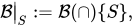
Dos familias de conjuntos B  and  C {\displaystyle {\mathcal {B}}{\text{ and }}{\mathcal {C}}} malla [7]y soncompatibles, indicado escribiendosiSino se mallan entonces estándisociados. Sientoncesse dice que semallansise mallan, o equivalentemente, si B # C , {\displaystyle {\mathcal {B}}\#{\mathcal {C}},} B C  for all  B B  and  C C . {\displaystyle B\cap C\neq \varnothing {\text{ for all }}B\in {\mathcal {B}}{\text{ and }}C\in {\mathcal {C}}.} B  and  C {\displaystyle {\mathcal {B}}{\text{ and }}{\mathcal {C}}} S X  and  B ( X ) {\displaystyle S\subseteq X{\text{ and }}{\mathcal {B}}\subseteq \wp (X)} B  and  S {\displaystyle {\mathcal {B}}{\text{ and }}S} B  and  { S } {\displaystyle {\mathcal {B}}{\text{ and }}\{S\}} traza dela cual es la familia no contiene el conjunto vacío, donde la traza también se llama B  on  S , {\displaystyle {\mathcal {B}}{\text{ on }}S,} B | S = { B S   :   B B } , {\displaystyle {\mathcal {B}}{\big \vert }_{S}=\{B\cap S~:~B\in {\mathcal {B}}\},} restricción de B  to  S . {\displaystyle {\mathcal {B}}{\text{ to }}S.}

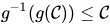
Declare que lo establecido como es más grueso que y es más fino que (o subordinado a ) [10] [11] [12] [8] [9] si se cumple alguna de las siguientes condiciones equivalentes: C F , F C ,  and  F C , {\displaystyle {\mathcal {C}}\leq {\mathcal {F}},{\mathcal {F}}\geq {\mathcal {C}},{\text{ and }}{\mathcal {F}}\vdash {\mathcal {C}},} C {\displaystyle {\mathcal {C}}} F {\displaystyle {\mathcal {F}}} F {\displaystyle {\mathcal {F}}} C , {\displaystyle {\mathcal {C}},}
  1. Definición: Todo contiene algo Explícitamente, esto significa que para todo hay algo tal que C C {\displaystyle C\in {\mathcal {C}}} F F . {\displaystyle F\in {\mathcal {F}}.} C C , {\displaystyle C\in {\mathcal {C}},} F F {\displaystyle F\in {\mathcal {F}}} F C . {\displaystyle F\subseteq C.}
    • Dicho de manera más breve y sencilla, si cada conjunto en es mayor que algún conjunto en Aquí, un "conjunto mayor" significa un superconjunto. C F {\displaystyle {\mathcal {C}}\leq {\mathcal {F}}} C {\displaystyle {\mathcal {C}}} F . {\displaystyle {\mathcal {F}}.}
  2. { C } F  for every  C C . {\displaystyle \{C\}\leq {\mathcal {F}}{\text{ for every }}C\in {\mathcal {C}}.}
    • En palabras, establece exactamente qué es mayor que algún conjunto en La equivalencia de (a) y (b) se sigue inmediatamente. { C } F {\displaystyle \{C\}\leq {\mathcal {F}}} C {\displaystyle C} F . {\displaystyle {\mathcal {F}}.}
    • De esta caracterización se deduce que si son familias de conjuntos, entonces ( C i ) i I {\displaystyle \left({\mathcal {C}}_{i}\right)_{i\in I}} i I C i F  if and only if  C i F  for all  i I . {\displaystyle \bigcup _{i\in I}{\mathcal {C}}_{i}\leq {\mathcal {F}}{\text{ if and only if }}{\mathcal {C}}_{i}\leq {\mathcal {F}}{\text{ for all }}i\in I.}
  3. C F X , {\displaystyle {\mathcal {C}}\leq {\mathcal {F}}^{\uparrow X},} que es equivalente a ; C F X {\displaystyle {\mathcal {C}}\subseteq {\mathcal {F}}^{\uparrow X}}
  4. C X F {\displaystyle {\mathcal {C}}^{\uparrow X}\leq {\mathcal {F}}} ;
  5. C X F X , {\displaystyle {\mathcal {C}}^{\uparrow X}\leq {\mathcal {F}}^{\uparrow X},} que es equivalente a ; C X F X {\displaystyle {\mathcal {C}}^{\uparrow X}\subseteq {\mathcal {F}}^{\uparrow X}}

y si además está cerrado al alza, lo que significa que entonces esta lista se puede ampliar para incluir: F {\displaystyle {\mathcal {F}}} F = F X , {\displaystyle {\mathcal {F}}={\mathcal {F}}^{\uparrow X},}

  1. C F . {\displaystyle {\mathcal {C}}\subseteq {\mathcal {F}}.} [5]
    • Así que en este caso, esta definición de " es más fino que " sería idéntica a la definición topológica de "más fino" si se hubieran utilizado topologías F {\displaystyle {\mathcal {F}}} C {\displaystyle {\mathcal {C}}} C  and  F {\displaystyle {\mathcal {C}}{\text{ and }}{\mathcal {F}}} X . {\displaystyle X.}

Si una familia cerrada hacia arriba es más fina que (es decir, ) pero entonces se dice que es estrictamente más fina que y es estrictamente más gruesa que F {\displaystyle {\mathcal {F}}} C {\displaystyle {\mathcal {C}}} C F {\displaystyle {\mathcal {C}}\leq {\mathcal {F}}} C F {\displaystyle {\mathcal {C}}\neq {\mathcal {F}}} F {\displaystyle {\mathcal {F}}} C {\displaystyle {\mathcal {C}}} C {\displaystyle {\mathcal {C}}} F . {\displaystyle {\mathcal {F}}.}

Dos familias son comparables si uno de estos conjuntos es más fino que el otro. [10]

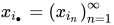
Ejemplo : Si es una subsecuencia de entonces está subordinada a en símbolos: y también Expresado en términos sencillos, el prefiltro de colas de una subsecuencia siempre está subordinado al de la secuencia original. Para ver esto, sea arbitrario (o equivalentemente, sea arbitrario) y queda por demostrar que este conjunto contiene algunos Para que el conjunto lo contenga es suficiente tener Dado que son números enteros estrictamente crecientes, existe tal que y por lo tanto se cumple, como se desea. En consecuencia, El lado izquierdo será un subconjunto estricto/propio del lado derecho si (por ejemplo) cada punto de es único (es decir, cuando es inyectivo) y es la subsecuencia de índice par porque en estas condiciones, cada cola (para cada ) de la subsecuencia pertenecerá al filtro del lado derecho pero no al filtro del lado izquierdo. x i = ( x i n ) n = 1 {\displaystyle x_{i_{\bullet }}=\left(x_{i_{n}}\right)_{n=1}^{\infty }} x = ( x i ) i = 1 {\displaystyle x_{\bullet }=\left(x_{i}\right)_{i=1}^{\infty }} Tails ( x i ) {\displaystyle \operatorname {Tails} \left(x_{i_{\bullet }}\right)} Tails ( x ) ; {\displaystyle \operatorname {Tails} \left(x_{\bullet }\right);} Tails ( x i ) Tails ( x ) {\displaystyle \operatorname {Tails} \left(x_{i_{\bullet }}\right)\vdash \operatorname {Tails} \left(x_{\bullet }\right)} Tails ( x ) Tails ( x i ) . {\displaystyle \operatorname {Tails} \left(x_{\bullet }\right)\leq \operatorname {Tails} \left(x_{i_{\bullet }}\right).} C := x i Tails ( x ) {\displaystyle C:=x_{\geq i}\in \operatorname {Tails} \left(x_{\bullet }\right)} i N {\displaystyle i\in \mathbb {N} } F := x i n Tails ( x i ) . {\displaystyle F:=x_{i_{\geq n}}\in \operatorname {Tails} \left(x_{i_{\bullet }}\right).} x i = { x i , x i + 1 , } {\displaystyle x_{\geq i}=\left\{x_{i},x_{i+1},\ldots \right\}} x i n = { x i n , x i n + 1 , } , {\displaystyle x_{i_{\geq n}}=\left\{x_{i_{n}},x_{i_{n+1}},\ldots \right\},} i i n . {\displaystyle i\leq i_{n}.} i 1 < i 2 < {\displaystyle i_{1}<i_{2}<\cdots } n N {\displaystyle n\in \mathbb {N} } i n i , {\displaystyle i_{n}\geq i,} x i x i n {\displaystyle x_{\geq i}\supseteq x_{i_{\geq n}}} TailsFilter ( x ) TailsFilter ( x i ) . {\displaystyle \operatorname {TailsFilter} \left(x_{\bullet }\right)\subseteq \operatorname {TailsFilter} \left(x_{i_{\bullet }}\right).} x {\displaystyle x_{\bullet }} x : N X {\displaystyle x_{\bullet }:\mathbb {N} \to X} x i {\displaystyle x_{i_{\bullet }}} ( x 2 , x 4 , x 6 , ) {\displaystyle \left(x_{2},x_{4},x_{6},\ldots \right)} x i n = { x 2 n , x 2 n + 2 , x 2 n + 4 , } {\displaystyle x_{i_{\geq n}}=\left\{x_{2n},x_{2n+2},x_{2n+4},\ldots \right\}} n N {\displaystyle n\in \mathbb {N} }

Para dar otro ejemplo, si es cualquier familia entonces siempre se cumple y además, B {\displaystyle {\mathcal {B}}} B B { } {\displaystyle \varnothing \leq {\mathcal {B}}\leq {\mathcal {B}}\leq \{\varnothing \}} { } B  if and only if  B . {\displaystyle \{\varnothing \}\leq {\mathcal {B}}{\text{ if and only if }}\varnothing \in {\mathcal {B}}.}

Supóngase que son familias de conjuntos que satisfacen Entonces y y también Si además de es una subbase de filtro y entonces es una subbase de filtro [8] y también malla. [19] [prueba 2] De manera más general, si tanto y si la intersección de dos elementos cualesquiera de no está vacía, entonces malla. [prueba 2] Cada subbase de filtro es más gruesa que el sistema π que genera y el filtro que genera. [8] C  and  F {\displaystyle {\mathcal {C}}{\text{ and }}{\mathcal {F}}} B F  and  C F . {\displaystyle {\mathcal {B}}\leq {\mathcal {F}}{\text{ and }}{\mathcal {C}}\leq {\mathcal {F}}.} ker F ker C , {\displaystyle \ker {\mathcal {F}}\subseteq \ker {\mathcal {C}},} C  implies  F , {\displaystyle {\mathcal {C}}\neq \varnothing {\text{ implies }}{\mathcal {F}}\neq \varnothing ,} C  implies  F . {\displaystyle \varnothing \in {\mathcal {C}}{\text{ implies }}\varnothing \in {\mathcal {F}}.} C F , F {\displaystyle {\mathcal {C}}\leq {\mathcal {F}},{\mathcal {F}}} C , {\displaystyle {\mathcal {C}}\neq \varnothing ,} C {\displaystyle {\mathcal {C}}} C  and  F {\displaystyle {\mathcal {C}}{\text{ and }}{\mathcal {F}}} B F  and  C F {\displaystyle \varnothing \neq {\mathcal {B}}\leq {\mathcal {F}}{\text{ and }}\varnothing \neq {\mathcal {C}}\leq {\mathcal {F}}} F {\displaystyle {\mathcal {F}}} B  and  C {\displaystyle {\mathcal {B}}{\text{ and }}{\mathcal {C}}}

Si son familias tales que la familia es ultra, y entonces es necesariamente ultra. De ello se deduce que cualquier familia que sea equivalente a una familia ultra será necesariamente ultra . En particular, si es un prefiltro, entonces ambos y el filtro que genera son ultra o ninguno de los dos es ultra. Si una subbase de filtro es ultra, entonces es necesariamente un prefiltro, en cuyo caso el filtro que genera también será ultra. Una subbase de filtro que no es un prefiltro no puede ser ultra; pero, no obstante, todavía es posible que el prefiltro y el filtro generado por sean ultra. Si es cerrado hacia arriba en entonces [9] C  and  F {\displaystyle {\mathcal {C}}{\text{ and }}{\mathcal {F}}} C F , {\displaystyle {\mathcal {C}}\leq {\mathcal {F}},} C {\displaystyle {\mathcal {C}}} F , {\displaystyle \varnothing \not \in {\mathcal {F}},} F {\displaystyle {\mathcal {F}}} C {\displaystyle {\mathcal {C}}} C {\displaystyle {\mathcal {C}}} C X {\displaystyle {\mathcal {C}}^{\uparrow X}} B {\displaystyle {\mathcal {B}}} B {\displaystyle {\mathcal {B}}} S X  and  B ( X ) {\displaystyle S\subseteq X{\text{ and }}{\mathcal {B}}\subseteq \wp (X)} X {\displaystyle X} S B  if and only if  ( X S ) # B . {\displaystyle S\not \in {\mathcal {B}}{\text{ if and only if }}(X\setminus S)\#{\mathcal {B}}.}

Propiedades relacionales de la subordinación

La relación es reflexiva y transitiva , lo que la convierte en un preorden en [32] La relación es antisimétrica pero si tiene más de un punto entonces no es simétrica . {\displaystyle \,\leq \,} ( ( X ) ) . {\displaystyle \wp (\wp (X)).}  on  Filters ( X ) {\displaystyle \,\leq \,{\text{ on }}\operatorname {Filters} (X)} X {\displaystyle X}

Simetría : Para cualquier conjunto , entonces el conjunto tiene más de un punto si y sólo si la relación no es simétrica . B ( X ) , B { X }  if and only if  { X } = B . {\displaystyle {\mathcal {B}}\subseteq \wp (X),{\mathcal {B}}\leq \{X\}{\text{ if and only if }}\{X\}={\mathcal {B}}.} X {\displaystyle X}  on  Filters ( X ) {\displaystyle \,\leq \,{\text{ on }}\operatorname {Filters} (X)}

Antisimetría : Si pero mientras que el recíproco no se cumple en general, sí se cumple si es cerrado hacia arriba (como si es un filtro). Dos filtros son equivalentes si y solo si son iguales, lo que hace que la restricción de sea antisimétrica . Pero en general, no es antisimétrica en ni en ; es decir, no implica necesariamente ; ni siquiera si ambos son prefiltros. [12] Por ejemplo, si es un prefiltro pero no un filtro entonces B C  then  B C {\displaystyle {\mathcal {B}}\subseteq {\mathcal {C}}{\text{ then }}{\mathcal {B}}\leq {\mathcal {C}}} C {\displaystyle {\mathcal {C}}} C {\displaystyle {\mathcal {C}}} {\displaystyle \,\leq \,} Filters ( X ) {\displaystyle \operatorname {Filters} (X)} {\displaystyle \,\leq \,} Prefilters ( X ) {\displaystyle \operatorname {Prefilters} (X)} ( ( X ) ) {\displaystyle \wp (\wp (X))} C B  and  B C {\displaystyle {\mathcal {C}}\leq {\mathcal {B}}{\text{ and }}{\mathcal {B}}\leq {\mathcal {C}}} B = C {\displaystyle {\mathcal {B}}={\mathcal {C}}} C  and  B {\displaystyle {\mathcal {C}}{\text{ and }}{\mathcal {B}}} B {\displaystyle {\mathcal {B}}} B B X  and  B X B  but  B B X . {\displaystyle {\mathcal {B}}\leq {\mathcal {B}}^{\uparrow X}{\text{ and }}{\mathcal {B}}^{\uparrow X}\leq {\mathcal {B}}{\text{ but }}{\mathcal {B}}\neq {\mathcal {B}}^{\uparrow X}.}

Familias equivalentes de conjuntos

El preorden induce su relación de equivalencia canónica en donde para todo es equivalente a si se cumple alguna de las siguientes condiciones equivalentes: [8] [5] {\displaystyle \,\leq \,} ( ( X ) ) , {\displaystyle \wp (\wp (X)),} B , C ( ( X ) ) , {\displaystyle {\mathcal {B}},{\mathcal {C}}\in \wp (\wp (X)),} B {\displaystyle {\mathcal {B}}} C {\displaystyle {\mathcal {C}}}

  1. C B  and  B C . {\displaystyle {\mathcal {C}}\leq {\mathcal {B}}{\text{ and }}{\mathcal {B}}\leq {\mathcal {C}}.}
  2. Los cierres ascendentes de son iguales. C  and  B {\displaystyle {\mathcal {C}}{\text{ and }}{\mathcal {B}}}

Dos subconjuntos cerrados hacia arriba (en ) de son equivalentes si y solo si son iguales. [8] Si entonces necesariamente y es equivalente a Toda clase de equivalencia distinta de contiene un representante único (es decir, elemento de la clase de equivalencia) que está cerrado hacia arriba en [8] X {\displaystyle X} ( X ) {\displaystyle \wp (X)} B ( X ) {\displaystyle {\mathcal {B}}\subseteq \wp (X)} B ( X ) {\displaystyle \varnothing \leq {\mathcal {B}}\leq \wp (X)} B {\displaystyle {\mathcal {B}}} B X . {\displaystyle {\mathcal {B}}^{\uparrow X}.} { } {\displaystyle \{\varnothing \}} X . {\displaystyle X.}

Propiedades conservadas entre familias equivalentes

Sea arbitrario y sea cualquier familia de conjuntos. Si son equivalentes (lo que implica que ), entonces para cada una de las afirmaciones/propiedades que se enumeran a continuación, o bien es verdadero para ambas o bien es falso para ambas : [32] B , C ( ( X ) ) {\displaystyle {\mathcal {B}},{\mathcal {C}}\in \wp (\wp (X))} F {\displaystyle {\mathcal {F}}} B  and  C {\displaystyle {\mathcal {B}}{\text{ and }}{\mathcal {C}}} ker B = ker C {\displaystyle \ker {\mathcal {B}}=\ker {\mathcal {C}}} B  and  C {\displaystyle {\mathcal {B}}{\text{ and }}{\mathcal {C}}} B  and  C {\displaystyle {\mathcal {B}}{\text{ and }}{\mathcal {C}}}

  1. No vacío
  2. Propia (es decir, no es un elemento) {\displaystyle \varnothing }
    • Además, dos familias degeneradas son necesariamente equivalentes.
  3. Subbase de filtro
  4. Prefiltro
    • En cuyo caso se genera el mismo filtro en (es decir, sus cierres ascendentes en son iguales). B  and  C {\displaystyle {\mathcal {B}}{\text{ and }}{\mathcal {C}}} X {\displaystyle X} X {\displaystyle X}
  5. Gratis
  6. Principal
  7. Ultra
  8. Es igual al filtro trivial { X } {\displaystyle \{X\}}
    • En palabras, esto significa que el único subconjunto de ese filtro que es equivalente al filtro trivial es el filtro trivial. En general, esta conclusión de igualdad no se extiende a los filtros no triviales (una excepción es cuando ambas familias son filtros). ( X ) {\displaystyle \wp (X)}
  9. Mallas con F {\displaystyle {\mathcal {F}}}
  10. Es más fino que F {\displaystyle {\mathcal {F}}}
  11. Es más grueso que F {\displaystyle {\mathcal {F}}}
  12. Es equivalente a F {\displaystyle {\mathcal {F}}}

En la lista anterior falta la palabra "filtro" porque esta propiedad no se conserva por equivalencia. Sin embargo, si hay filtros activados , entonces son equivalentes si y solo si son iguales; esta caracterización no se extiende a los prefiltros. B  and  C {\displaystyle {\mathcal {B}}{\text{ and }}{\mathcal {C}}} X , {\displaystyle X,}

Equivalencia de prefiltros y subbases filtrantes

Si hay un prefiltro activado, entonces las siguientes familias siempre son equivalentes entre sí: B {\displaystyle {\mathcal {B}}} X {\displaystyle X}

  1. B {\displaystyle {\mathcal {B}}} ;
  2. el sistema π generado por ; B {\displaystyle {\mathcal {B}}}
  3. el filtro generado por ; X {\displaystyle X} B {\displaystyle {\mathcal {B}}}

y además, estas tres familias generan el mismo filtro (es decir, los cierres ascendentes de estas familias son iguales). X {\displaystyle X} X {\displaystyle X}

En particular, cada prefiltro es equivalente al filtro que genera. Por transitividad, dos prefiltros son equivalentes si y solo si generan el mismo filtro. [8] [prueba 3] Cada prefiltro es equivalente a exactamente un filtro en el que se encuentra el filtro que genera (es decir, el cierre ascendente del prefiltro). Dicho de otra manera, cada clase de equivalencia de prefiltros contiene exactamente un representante que es un filtro. De esta manera, los filtros pueden considerarse simplemente como elementos distinguidos de estas clases de equivalencia de prefiltros. [8] X , {\displaystyle X,}

Una subbase de filtro que no sea también un prefiltro no puede ser equivalente al prefiltro (o filtro) que genera. Por el contrario, cada prefiltro es equivalente al filtro que genera. Por esta razón, los prefiltros pueden, en general, usarse indistintamente con los filtros que generan, mientras que las subbases de filtro no. Cada filtro es a la vez un sistema π y un anillo de conjuntos .

Ejemplos de determinación de equivalencia/no equivalencia

Ejemplos: Sean y el conjunto de números enteros (o el conjunto ). Defina los conjuntos X = R {\displaystyle X=\mathbb {R} } E {\displaystyle E} Z {\displaystyle \mathbb {Z} } N {\displaystyle \mathbb {N} } B = { [ e , )   :   e E }  and  C open = { ( , e ) ( 1 + e , )   :   e E }  and  C closed = { ( , e ] [ 1 + e , )   :   e E } . {\displaystyle {\mathcal {B}}=\{[e,\infty )~:~e\in E\}\qquad {\text{ and }}\qquad {\mathcal {C}}_{\operatorname {open} }=\{(-\infty ,e)\cup (1+e,\infty )~:~e\in E\}\qquad {\text{ and }}\qquad {\mathcal {C}}_{\operatorname {closed} }=\{(-\infty ,e]\cup [1+e,\infty )~:~e\in E\}.}

Los tres conjuntos son subbases de filtro pero ninguno es filtro en y solo es prefiltro (de hecho, es incluso libre y cerrado bajo intersecciones finitas). El conjunto es fijo mientras es libre (a menos que ). Satisfacen pero ninguna de estas familias es equivalente; además, ninguno de los filtros generados por estas tres subbases de filtro es equivalente/igual. Se puede llegar a esta conclusión mostrando que los π –sistemas que generan no son equivalentes. A diferencia de cada conjunto en el π –sistema generado por contiene como subconjunto, [nota 6] que es lo que impide que sus π –sistemas generados (y por lo tanto sus filtros generados) sean equivalentes. Si fuera en cambio entonces las tres familias serían libres y aunque los conjuntos permanecerían no equivalentes entre sí, sus π –sistemas generados serían equivalentes y en consecuencia, generarían el mismo filtro en ; sin embargo, este filtro común seguiría siendo estrictamente más burdo que el filtro generado por X {\displaystyle X} B {\displaystyle {\mathcal {B}}} B {\displaystyle {\mathcal {B}}} C closed {\displaystyle {\mathcal {C}}_{\operatorname {closed} }} C open {\displaystyle {\mathcal {C}}_{\operatorname {open} }} E = N {\displaystyle E=\mathbb {N} } C closed C open B , {\displaystyle {\mathcal {C}}_{\operatorname {closed} }\leq {\mathcal {C}}_{\operatorname {open} }\leq {\mathcal {B}},} C open , {\displaystyle {\mathcal {C}}_{\operatorname {open} },} C closed {\displaystyle {\mathcal {C}}_{\operatorname {closed} }} Z {\displaystyle \mathbb {Z} } E {\displaystyle E} Q  or  R {\displaystyle \mathbb {Q} {\text{ or }}\mathbb {R} } C closed  and  C open {\displaystyle {\mathcal {C}}_{\operatorname {closed} }{\text{ and }}{\mathcal {C}}_{\operatorname {open} }} X {\displaystyle X} B . {\displaystyle {\mathcal {B}}.}

Propiedades y construcciones de la teoría de conjuntos

Trazabilidad y mallado

Si es un prefiltro (resp. filtro) en entonces la traza de la cual es la familia es un prefiltro (resp. filtro) si y solo si malla (es decir, [10] ), en cuyo caso se dice que la traza de es inducida por . Si es ultra y si malla entonces la traza es ultra. Si es un ultrafiltro en entonces la traza de es un filtro en si y solo si B {\displaystyle {\mathcal {B}}} X  and  S X {\displaystyle X{\text{ and }}S\subseteq X} B  on  S , {\displaystyle {\mathcal {B}}{\text{ on }}S,} B | S := B ( ) { S } , {\displaystyle {\mathcal {B}}{\big \vert }_{S}:={\mathcal {B}}(\cap )\{S\},} B  and  S {\displaystyle {\mathcal {B}}{\text{ and }}S} B ( ) { S } {\displaystyle \varnothing \not \in {\mathcal {B}}(\cap )\{S\}} B  on  S {\displaystyle {\mathcal {B}}{\text{ on }}S} S {\displaystyle S} B {\displaystyle {\mathcal {B}}} B  and  S {\displaystyle {\mathcal {B}}{\text{ and }}S} B | S {\displaystyle {\mathcal {B}}{\big \vert }_{S}} B {\displaystyle {\mathcal {B}}} X {\displaystyle X} B  on  S {\displaystyle {\mathcal {B}}{\text{ on }}S} S {\displaystyle S} S B . {\displaystyle S\in {\mathcal {B}}.}

Por ejemplo, supongamos que es un filtro en tal que Entonces malla y genera un filtro en que es estrictamente más fino que [10] B {\displaystyle {\mathcal {B}}} X  and  S X {\displaystyle X{\text{ and }}S\subseteq X} S X  and  X S B . {\displaystyle S\neq X{\text{ and }}X\setminus S\not \in {\mathcal {B}}.} B  and  S {\displaystyle {\mathcal {B}}{\text{ and }}S} B { S } {\displaystyle {\mathcal {B}}\cup \{S\}} X {\displaystyle X} B . {\displaystyle {\mathcal {B}}.}

Cuando los prefiltros se engranan

Dadas familias no vacías, la familia satisface y Si es apropiada (resp. un prefiltro, una subbase de filtro), entonces esto también es cierto para ambos. Para hacer deducciones significativas acerca de de debe ser apropiada (es decir, que es la motivación para la definición de "malla". En este caso, es un prefiltro (resp. subbase de filtro) si y solo si esto es cierto para ambos. Dicho de otra manera, si son prefiltros, entonces se engranan si y solo si es un prefiltro. Generalizando se obtiene una caracterización bien conocida de "malla" completamente en términos de subordinación (es decir, ): B  and  C , {\displaystyle {\mathcal {B}}{\text{ and }}{\mathcal {C}},} B ( ) C := { B C   :   B B  and  C C } {\displaystyle {\mathcal {B}}(\cap ){\mathcal {C}}:=\{B\cap C~:~B\in {\mathcal {B}}{\text{ and }}C\in {\mathcal {C}}\}} C B ( ) C {\displaystyle {\mathcal {C}}\leq {\mathcal {B}}(\cap ){\mathcal {C}}} B B ( ) C . {\displaystyle {\mathcal {B}}\leq {\mathcal {B}}(\cap ){\mathcal {C}}.} B ( ) C {\displaystyle {\mathcal {B}}(\cap ){\mathcal {C}}} B  and  C . {\displaystyle {\mathcal {B}}{\text{ and }}{\mathcal {C}}.} B ( ) C {\displaystyle {\mathcal {B}}(\cap ){\mathcal {C}}} B  and  C , B ( ) C {\displaystyle {\mathcal {B}}{\text{ and }}{\mathcal {C}},{\mathcal {B}}(\cap ){\mathcal {C}}} B ( ) C , {\displaystyle \varnothing \not \in {\mathcal {B}}(\cap ){\mathcal {C}},} B ( ) C {\displaystyle {\mathcal {B}}(\cap ){\mathcal {C}}} B  and  C . {\displaystyle {\mathcal {B}}{\text{ and }}{\mathcal {C}}.} B  and  C {\displaystyle {\mathcal {B}}{\text{ and }}{\mathcal {C}}} B ( ) C {\displaystyle {\mathcal {B}}(\cap ){\mathcal {C}}} {\displaystyle \,\leq \,}

     Dos prefiltros (o subbases de filtro) se engranan si y solo si existe un prefiltro (o subbase de filtro) tal que y B  and  C {\displaystyle {\mathcal {B}}{\text{ and }}{\mathcal {C}}} F {\displaystyle {\mathcal {F}}} C F {\displaystyle {\mathcal {C}}\leq {\mathcal {F}}} B F . {\displaystyle {\mathcal {B}}\leq {\mathcal {F}}.}

Si el límite superior mínimo de dos filtros existe, entonces este límite superior mínimo es igual a [28] B  and  C {\displaystyle {\mathcal {B}}{\text{ and }}{\mathcal {C}}} Filters ( X ) {\displaystyle \operatorname {Filters} (X)} B ( ) C . {\displaystyle {\mathcal {B}}(\cap ){\mathcal {C}}.}

Imágenes y preimágenes bajo funciones

A lo largo del texto se presentarán mapas entre conjuntos no vacíos. f : X Y  and  g : Y Z {\displaystyle f:X\to Y{\text{ and }}g:Y\to Z}

Imágenes de prefiltros

Muchas de las propiedades que puede tener se conservan bajo imágenes de mapas; las excepciones notables incluyen estar cerrado hacia arriba, estar cerrado bajo intersecciones finitas y ser un filtro, que no necesariamente se conservan. B ( Y ) . {\displaystyle {\mathcal {B}}\subseteq \wp (Y).} B {\displaystyle {\mathcal {B}}}

Explícitamente, si una de las siguientes propiedades es verdadera para entonces necesariamente también será verdadera para (aunque posiblemente no en el codominio a menos que sea sobreyectiva): [10] [13] [33] [34] [35] [31] B  on  Y , {\displaystyle {\mathcal {B}}{\text{ on }}Y,} g ( B )  on  g ( Y ) {\displaystyle g({\mathcal {B}}){\text{ on }}g(Y)} Z {\displaystyle Z} g {\displaystyle g}

  • Propiedades del filtro: ultra, ultrafiltro, filtro, prefiltro, subbase de filtro, ideal dual, cerrado hacia arriba, propio/no degenerado.
  • Propiedades ideales: ideal, cerrado bajo uniones finitas, cerrado hacia abajo, dirigido hacia arriba.

Además, si es un prefiltro entonces también lo son ambos [10] La imagen bajo un mapa de un conjunto ultra es nuevamente ultra y si es un prefiltro ultra entonces también lo es B ( Y ) {\displaystyle {\mathcal {B}}\subseteq \wp (Y)} g ( B )  and  g 1 ( g ( B ) ) . {\displaystyle g({\mathcal {B}}){\text{ and }}g^{-1}(g({\mathcal {B}})).} f : X Y {\displaystyle f:X\to Y} B ( X ) {\displaystyle {\mathcal {B}}\subseteq \wp (X)} B {\displaystyle {\mathcal {B}}} f ( B ) . {\displaystyle f({\mathcal {B}}).}

Si es un filtro, entonces es un filtro en el rango , pero es un filtro en el codominio si y solo si es sobreyectivo. [33] De lo contrario, es solo un prefiltro en y su cierre ascendente debe tomarse en cuenta para obtener un filtro. El cierre ascendente de es donde si está cerrado hacia arriba en (es decir, un filtro), entonces esto se simplifica a: B {\displaystyle {\mathcal {B}}} g ( B ) {\displaystyle g({\mathcal {B}})} g ( Y ) , {\displaystyle g(Y),} Z {\displaystyle Z} g {\displaystyle g} Z {\displaystyle Z} Z {\displaystyle Z} g ( B )  in  Z {\displaystyle g({\mathcal {B}}){\text{ in }}Z} g ( B ) Z = { S Z   :   B g 1 ( S )  for some  B B } {\displaystyle g({\mathcal {B}})^{\uparrow Z}=\left\{S\subseteq Z~:~B\subseteq g^{-1}(S){\text{ for some }}B\in {\mathcal {B}}\right\}} B {\displaystyle {\mathcal {B}}} Y {\displaystyle Y} g ( B ) Z = { S Z   :   g 1 ( S ) B } . {\displaystyle g({\mathcal {B}})^{\uparrow Z}=\left\{S\subseteq Z~:~g^{-1}(S)\in {\mathcal {B}}\right\}.}

Si entonces se toma como el mapa de inclusión se muestra que cualquier prefiltro (resp. ultra prefiltro, subbase de filtro) en también es un prefiltro (resp. ultra prefiltro, subbase de filtro) en [10] X Y {\displaystyle X\subseteq Y} g {\displaystyle g} X Y {\displaystyle X\to Y} X {\displaystyle X} Y . {\displaystyle Y.}

Preimágenes de prefiltros

Sea bajo el supuesto de que es sobreyectiva : B ( Y ) . {\displaystyle {\mathcal {B}}\subseteq \wp (Y).} f : X Y {\displaystyle f:X\to Y}

      f 1 ( B ) {\displaystyle f^{-1}({\mathcal {B}})} es un prefiltro (resp. subbase de filtro, π –sistema, cerrado bajo uniones finitas, propio) si y solo si esto es cierto para B . {\displaystyle {\mathcal {B}}.}

Sin embargo, si es un ultrafiltro en entonces incluso si es sobreyectiva (lo que formaría un prefiltro), es de todas formas posible que el prefiltro no sea ni ultra ni un filtro en [34] (ver esta nota al pie [nota 7] para un ejemplo). B {\displaystyle {\mathcal {B}}} Y {\displaystyle Y} f {\displaystyle f} f 1 ( B ) {\displaystyle f^{-1}({\mathcal {B}})} f 1 ( B ) {\displaystyle f^{-1}({\mathcal {B}})} X {\displaystyle X}

Si no es sobreyectiva entonces denotamos la traza de por donde en este caso particular la traza satisface: y en consecuencia también: f : X Y {\displaystyle f:X\to Y} B  on  f ( X ) {\displaystyle {\mathcal {B}}{\text{ on }}f(X)} B | f ( X ) , {\displaystyle {\mathcal {B}}{\big \vert }_{f(X)},} B | f ( X ) = f ( f 1 ( B ) ) {\displaystyle {\mathcal {B}}{\big \vert }_{f(X)}=f\left(f^{-1}({\mathcal {B}})\right)} f 1 ( B ) = f 1 ( B | f ( X ) ) . {\displaystyle f^{-1}({\mathcal {B}})=f^{-1}\left({\mathcal {B}}{\big \vert }_{f(X)}\right).}

This last equality and the fact that the trace B | f ( X ) {\displaystyle {\mathcal {B}}{\big \vert }_{f(X)}} is a family of sets over f ( X ) {\displaystyle f(X)} means that to draw conclusions about f 1 ( B ) , {\displaystyle f^{-1}({\mathcal {B}}),} the trace B | f ( X ) {\displaystyle {\mathcal {B}}{\big \vert }_{f(X)}} can be used in place of B {\displaystyle {\mathcal {B}}} and the surjection f : X f ( X ) {\displaystyle f:X\to f(X)} can be used in place of f : X Y . {\displaystyle f:X\to Y.} For example:[13][10][35]

      f 1 ( B ) {\displaystyle f^{-1}({\mathcal {B}})} is a prefilter (resp. filter subbase, π–system, proper) if and only if this is true of B | f ( X ) . {\displaystyle {\mathcal {B}}{\big \vert }_{f(X)}.}

In this way, the case where f {\displaystyle f} is not (necessarily) surjective can be reduced down to the case of a surjective function (which is a case that was described at the start of this subsection).

Even if B {\displaystyle {\mathcal {B}}} is an ultrafilter on Y , {\displaystyle Y,} if f {\displaystyle f} is not surjective then it is nevertheless possible that B | f ( X ) , {\displaystyle \varnothing \in {\mathcal {B}}{\big \vert }_{f(X)},} which would make f 1 ( B ) {\displaystyle f^{-1}({\mathcal {B}})} degenerate as well. The next characterization shows that degeneracy is the only obstacle. If B {\displaystyle {\mathcal {B}}} is a prefilter then the following are equivalent:[13][10][35]

  1. f 1 ( B ) {\displaystyle f^{-1}({\mathcal {B}})} is a prefilter;
  2. B | f ( X ) {\displaystyle {\mathcal {B}}{\big \vert }_{f(X)}} is a prefilter;
  3. B | f ( X ) {\displaystyle \varnothing \not \in {\mathcal {B}}{\big \vert }_{f(X)}} ;
  4. B {\displaystyle {\mathcal {B}}} meshes with f ( X ) {\displaystyle f(X)}

and moreover, if f 1 ( B ) {\displaystyle f^{-1}({\mathcal {B}})} is a prefilter then so is f ( f 1 ( B ) ) . {\displaystyle f\left(f^{-1}({\mathcal {B}})\right).} [13][10]

If S Y {\displaystyle S\subseteq Y} and if In : S Y {\displaystyle \operatorname {In} :S\to Y} denotes the inclusion map then the trace of B  on  S {\displaystyle {\mathcal {B}}{\text{ on }}S} is equal to In 1 ( B ) . {\displaystyle \operatorname {In} ^{-1}({\mathcal {B}}).} [10] This observation allows the results in this subsection to be applied to investigating the trace on a set.

Bijections, injections, and surjections

All properties involving filters are preserved under bijections. This means that if B ( Y )  and  g : Y Z {\displaystyle {\mathcal {B}}\subseteq \wp (Y){\text{ and }}g:Y\to Z} is a bijection, then B {\displaystyle {\mathcal {B}}} is a prefilter (resp. ultra, ultra prefilter, filter on X , {\displaystyle X,} ultrafilter on X , {\displaystyle X,} filter subbase, π–system, ideal on X , {\displaystyle X,} etc.) if and only if the same is true of g ( B )  on  Z . {\displaystyle g({\mathcal {B}}){\text{ on }}Z.} [34]

A map g : Y Z {\displaystyle g:Y\to Z} is injective if and only if for all prefilters B  on  Y , B {\displaystyle {\mathcal {B}}{\text{ on }}Y,{\mathcal {B}}} is equivalent to g 1 ( g ( B ) ) . {\displaystyle g^{-1}(g({\mathcal {B}})).} [28] The image of an ultra family of sets under an injection is again ultra.

The map f : X Y {\displaystyle f:X\to Y} is a surjection if and only if whenever B {\displaystyle {\mathcal {B}}} is a prefilter on Y {\displaystyle Y} then the same is true of f 1 ( B )  on  X {\displaystyle f^{-1}({\mathcal {B}}){\text{ on }}X} (this result does not require the ultrafilter lemma).

Subordination is preserved by images and preimages

The relation {\displaystyle \,\leq \,} is preserved under both images and preimages of families of sets.[10] This means that for any families C  and  F , {\displaystyle {\mathcal {C}}{\text{ and }}{\mathcal {F}},} [35] C F  implies  g ( C ) g ( F )  and  f 1 ( C ) f 1 ( F ) . {\displaystyle {\mathcal {C}}\leq {\mathcal {F}}\quad {\text{ implies }}\quad g({\mathcal {C}})\leq g({\mathcal {F}})\quad {\text{ and }}\quad f^{-1}({\mathcal {C}})\leq f^{-1}({\mathcal {F}}).}

Moreover, the following relations always hold for any family of sets C {\displaystyle {\mathcal {C}}} :[35] C f ( f 1 ( C ) ) {\displaystyle {\mathcal {C}}\leq f\left(f^{-1}({\mathcal {C}})\right)} where equality will hold if f {\displaystyle f} is surjective.[35] Furthermore, f 1 ( C ) = f 1 ( f ( f 1 ( C ) ) )  and  g ( C ) = g ( g 1 ( g ( C ) ) ) . {\displaystyle f^{-1}({\mathcal {C}})=f^{-1}\left(f\left(f^{-1}({\mathcal {C}})\right)\right)\quad {\text{ and }}\quad g({\mathcal {C}})=g\left(g^{-1}(g({\mathcal {C}}))\right).}

If B ( X )  and  C ( Y ) {\displaystyle {\mathcal {B}}\subseteq \wp (X){\text{ and }}{\mathcal {C}}\subseteq \wp (Y)} then[9] f ( B ) C  if and only if  B f 1 ( C ) {\displaystyle f({\mathcal {B}})\leq {\mathcal {C}}\quad {\text{ if and only if }}\quad {\mathcal {B}}\leq f^{-1}({\mathcal {C}})} and g 1 ( g ( C ) ) C {\displaystyle g^{-1}(g({\mathcal {C}}))\leq {\mathcal {C}}} [35] where equality will hold if g {\displaystyle g} is injective.[35]

Products of prefilters

Suppose X = ( X i ) i I {\displaystyle X_{\bullet }=\left(X_{i}\right)_{i\in I}} is a family of one or more non–empty sets, whose product will be denoted by X := i I X i , {\displaystyle \prod X_{\bullet }:=\prod _{i\in I}X_{i},} and for every index i I , {\displaystyle i\in I,} let Pr X i : X X i {\displaystyle \Pr {}_{X_{i}}:\prod X_{\bullet }\to X_{i}} denote the canonical projection. Let B := ( B i ) i I {\displaystyle {\mathcal {B}}_{\bullet }:=\left({\mathcal {B}}_{i}\right)_{i\in I}} be non−empty families, also indexed by I , {\displaystyle I,} such that B i ( X i ) {\displaystyle {\mathcal {B}}_{i}\subseteq \wp \left(X_{i}\right)} for each i I . {\displaystyle i\in I.} The product of the families B {\displaystyle {\mathcal {B}}_{\bullet }} [10] is defined identically to how the basic open subsets of the product topology are defined (had all of these B i {\displaystyle {\mathcal {B}}_{i}} been topologies). That is, both the notations B = i I B i {\displaystyle \prod _{}{\mathcal {B}}_{\bullet }=\prod _{i\in I}{\mathcal {B}}_{i}} denote the family of all cylinder subsets i I S i X {\displaystyle \prod _{i\in I}S_{i}\subseteq \prod _{}X_{\bullet }} such that S i = X i {\displaystyle S_{i}=X_{i}} for all but finitely many i I {\displaystyle i\in I} and where S i B i {\displaystyle S_{i}\in {\mathcal {B}}_{i}} for any one of these finitely many exceptions (that is, for any i {\displaystyle i} such that S i X i , {\displaystyle S_{i}\neq X_{i},} necessarily S i B i {\displaystyle S_{i}\in {\mathcal {B}}_{i}} ). When every B i {\displaystyle {\mathcal {B}}_{i}} is a filter subbase then the family i I Pr X i 1 ( B i ) {\displaystyle \bigcup _{i\in I}\Pr {}_{X_{i}}^{-1}\left({\mathcal {B}}_{i}\right)} is a filter subbase for the filter on X {\displaystyle \prod X_{\bullet }} generated by B . {\displaystyle {\mathcal {B}}_{\bullet }.} [10] If B {\displaystyle \prod {\mathcal {B}}_{\bullet }} is a filter subbase then the filter on X {\displaystyle \prod X_{\bullet }} that it generates is called the filter generated by B {\displaystyle {\mathcal {B}}_{\bullet }} .[10] If every B i {\displaystyle {\mathcal {B}}_{i}} is a prefilter on X i {\displaystyle X_{i}} then B {\displaystyle \prod {\mathcal {B}}_{\bullet }} will be a prefilter on X {\displaystyle \prod X_{\bullet }} and moreover, this prefilter is equal to the coarsest prefilter F  on  X {\displaystyle {\mathcal {F}}{\text{ on }}\prod X_{\bullet }} such that Pr X i ( F ) = B i {\displaystyle \Pr {}_{X_{i}}({\mathcal {F}})={\mathcal {B}}_{i}} for every i I . {\displaystyle i\in I.} [10] However, B {\displaystyle \prod {\mathcal {B}}_{\bullet }} may fail to be a filter on X {\displaystyle \prod X_{\bullet }} even if every B i {\displaystyle {\mathcal {B}}_{i}} is a filter on X i . {\displaystyle X_{i}.} [10]

Set subtraction and some examples

Set subtracting away a subset of the kernel

If B {\displaystyle {\mathcal {B}}} is a prefilter on X , S ker B ,  and  S B {\displaystyle X,S\subseteq \ker {\mathcal {B}},{\text{ and }}S\not \in {\mathcal {B}}} then { B S   :   B B } {\displaystyle \{B\setminus S~:~B\in {\mathcal {B}}\}} is a prefilter, where this latter set is a filter if and only if B {\displaystyle {\mathcal {B}}} is a filter and S = . {\displaystyle S=\varnothing .} In particular, if B {\displaystyle {\mathcal {B}}} is a neighborhood basis at a point x {\displaystyle x} in a topological space X {\displaystyle X} having at least 2 points, then { B { x }   :   B B } {\displaystyle \{B\setminus \{x\}~:~B\in {\mathcal {B}}\}} is a prefilter on X . {\displaystyle X.} This construction is used to define lim x x 0 x x 0 f ( x ) y {\displaystyle \lim _{\stackrel {x\to x_{0}}{x\neq x_{0}}}f(x)\to y} in terms of prefilter convergence.

Using duality between ideals and dual ideals

There is a dual relation B C {\displaystyle {\mathcal {B}}\vartriangleleft {\mathcal {C}}} or C B , {\displaystyle {\mathcal {C}}\vartriangleright {\mathcal {B}},} which is defined to mean that every B B {\displaystyle B\in {\mathcal {B}}} is contained in some C C . {\displaystyle C\in {\mathcal {C}}.} Explicitly, this means that for every B B {\displaystyle B\in {\mathcal {B}}} , there is some C C {\displaystyle C\in {\mathcal {C}}} such that B C . {\displaystyle B\subseteq C.} This relation is dual to {\displaystyle \,\leq \,} in sense that B C {\displaystyle {\mathcal {B}}\vartriangleleft {\mathcal {C}}} if and only if ( X B ) ( X C ) . {\displaystyle (X\setminus {\mathcal {B}})\leq (X\setminus {\mathcal {C}}).} [5] The relation B C {\displaystyle {\mathcal {B}}\vartriangleleft {\mathcal {C}}} is closely related to the downward closure of a family in a manner similar to how {\displaystyle \,\leq \,} is related to the upward closure family.

For an example that uses this duality, suppose f : X Y {\displaystyle f:X\to Y} is a map and Ξ ( Y ) . {\displaystyle \Xi \subseteq \wp (Y).} Define Ξ f := { I X   :   f ( I ) Ξ } {\displaystyle \Xi _{f}:=\{I\subseteq X~:~f(I)\in \Xi \}} which contains the empty set if and only if Ξ {\displaystyle \Xi } does. It is possible for Ξ {\displaystyle \Xi } to be an ultrafilter and for Ξ f {\displaystyle \Xi _{f}} to be empty or not closed under finite intersections (see footnote for example).[note 8] Although Ξ f {\displaystyle \Xi _{f}} does not preserve properties of filters very well, if Ξ {\displaystyle \Xi } is downward closed (resp. closed under finite unions, an ideal) then this will also be true for Ξ f . {\displaystyle \Xi _{f}.} Using the duality between ideals and dual ideals allows for a construction of the following filter.

     Suppose B {\displaystyle {\mathcal {B}}} is a filter on Y {\displaystyle Y} and let Ξ := Y B {\displaystyle \Xi :=Y\setminus {\mathcal {B}}} be its dual in Y . {\displaystyle Y.} If X Ξ f {\displaystyle X\not \in \Xi _{f}} then Ξ f {\displaystyle \Xi _{f}} 's dual X Ξ f {\displaystyle X\setminus \Xi _{f}} will be a filter.

Other examples

Example: The set B {\displaystyle {\mathcal {B}}} of all dense open subsets of a topological space is a proper π–system and a prefilter. If the space is a Baire space, then the set of all countable intersections of dense open subsets is a π–system and a prefilter that is finer than B . {\displaystyle {\mathcal {B}}.}

Example: The family B Open {\displaystyle {\mathcal {B}}_{\operatorname {Open} }} of all dense open sets of X = R {\displaystyle X=\mathbb {R} } having finite Lebesgue measure is a proper π–system and a free prefilter. The prefilter B Open {\displaystyle {\mathcal {B}}_{\operatorname {Open} }} is properly contained in, and not equivalent to, the prefilter consisting of all dense open subsets of R . {\displaystyle \mathbb {R} .} Since X {\displaystyle X} is a Baire space, every countable intersection of sets in B Open {\displaystyle {\mathcal {B}}_{\operatorname {Open} }} is dense in X {\displaystyle X} (and also comeagre and non–meager) so the set of all countable intersections of elements of B Open {\displaystyle {\mathcal {B}}_{\operatorname {Open} }} is a prefilter and π–system; it is also finer than, and not equivalent to, B Open . {\displaystyle {\mathcal {B}}_{\operatorname {Open} }.}

Filters and nets

This section will describe the relationships between prefilters and nets in great detail because of how important these details are applying filters to topology − particularly in switching from utilizing nets to utilizing filters and vice verse − and because it to make it easier to understand later why subnets (with their most commonly used definitions) are not generally equivalent with "sub–prefilters".

Nets to prefilters

A net x = ( x i ) i I  in  X {\displaystyle x_{\bullet }=\left(x_{i}\right)_{i\in I}{\text{ in }}X} is canonically associated with its prefilter of tails Tails ( x ) . {\displaystyle \operatorname {Tails} \left(x_{\bullet }\right).} If f : X Y {\displaystyle f:X\to Y} is a map and x {\displaystyle x_{\bullet }} is a net in X {\displaystyle X} then Tails ( f ( x ) ) = f ( Tails ( x ) ) . {\displaystyle \operatorname {Tails} \left(f\left(x_{\bullet }\right)\right)=f\left(\operatorname {Tails} \left(x_{\bullet }\right)\right).} [36]

Prefilters to nets

A pointed set is a pair ( S , s ) {\displaystyle (S,s)} consisting of a non–empty set S {\displaystyle S} and an element s S . {\displaystyle s\in S.} For any family B , {\displaystyle {\mathcal {B}},} let PointedSets ( B ) := { ( B , b )   :   B B  and  b B } . {\displaystyle \operatorname {PointedSets} ({\mathcal {B}}):=\left\{(B,b)~:~B\in {\mathcal {B}}{\text{ and }}b\in B\right\}.}

Define a canonical preorder {\displaystyle \,\leq \,} on pointed sets by declaring ( R , r ) ( S , s )  if and only if  R S . {\displaystyle (R,r)\leq (S,s)\quad {\text{ if and only if }}\quad R\supseteq S.}

If s 0 , s 1 S  then  ( S , s 0 ) ( S , s 1 )  and  ( S , s 1 ) ( S , s 0 ) {\displaystyle s_{0},s_{1}\in S{\text{ then }}\left(S,s_{0}\right)\leq \left(S,s_{1}\right){\text{ and }}\left(S,s_{1}\right)\leq \left(S,s_{0}\right)} even if s 0 s 1 , {\displaystyle s_{0}\neq s_{1},} so this preorder is not antisymmetric and given any family of sets B , {\displaystyle {\mathcal {B}},} ( PointedSets ( B ) , ) {\displaystyle (\operatorname {PointedSets} ({\mathcal {B}}),\leq )} is partially ordered if and only if B {\displaystyle {\mathcal {B}}\neq \varnothing } consists entirely of singleton sets. If { x } B  then  ( { x } , x ) {\displaystyle \{x\}\in {\mathcal {B}}{\text{ then }}(\{x\},x)} is a maximal element of PointedSets ( B ) {\displaystyle \operatorname {PointedSets} ({\mathcal {B}})} ; moreover, all maximal elements are of this form. If ( B , b 0 ) PointedSets ( B )  then  ( B , b 0 ) {\displaystyle \left(B,b_{0}\right)\in \operatorname {PointedSets} ({\mathcal {B}}){\text{ then }}\left(B,b_{0}\right)} is a greatest element if and only if B = ker B , {\displaystyle B=\ker {\mathcal {B}},} in which case { ( B , b )   :   b B } {\displaystyle \{(B,b)~:~b\in B\}} is the set of all greatest elements. However, a greatest element ( B , b ) {\displaystyle (B,b)} is a maximal element if and only if B = { b } = ker B , {\displaystyle B=\{b\}=\ker {\mathcal {B}},} so there is at most one element that is both maximal and greatest. There is a canonical map Point B   :   PointedSets ( B ) X {\displaystyle \operatorname {Point} _{\mathcal {B}}~:~\operatorname {PointedSets} ({\mathcal {B}})\to X} defined by ( B , b ) b . {\displaystyle (B,b)\mapsto b.}

If i 0 = ( B 0 , b 0 ) PointedSets ( B ) {\displaystyle i_{0}=\left(B_{0},b_{0}\right)\in \operatorname {PointedSets} ({\mathcal {B}})} then the tail of the assignment Point B {\displaystyle \operatorname {Point} _{\mathcal {B}}} starting at i 0 {\displaystyle i_{0}} is { c   :   ( C , c ) PointedSets ( B )  and  ( B 0 , b 0 ) ( C , c ) } = B 0 . {\displaystyle \left\{c~:~(C,c)\in \operatorname {PointedSets} ({\mathcal {B}}){\text{ and }}\left(B_{0},b_{0}\right)\leq (C,c)\right\}=B_{0}.}

Although ( PointedSets ( B ) , ) {\displaystyle (\operatorname {PointedSets} ({\mathcal {B}}),\leq )} is not, in general, a partially ordered set, it is a directed set if (and only if) B {\displaystyle {\mathcal {B}}} is a prefilter. So the most immediate choice for the definition of "the net in X {\displaystyle X} induced by a prefilter B {\displaystyle {\mathcal {B}}} " is the assignment ( B , b ) b {\displaystyle (B,b)\mapsto b} from PointedSets ( B ) {\displaystyle \operatorname {PointedSets} ({\mathcal {B}})} into X . {\displaystyle X.}

If B {\displaystyle {\mathcal {B}}} is a prefilter on X {\displaystyle X} then the net associated with B {\displaystyle {\mathcal {B}}} is the map

Net B : ( PointedSets ( B ) , ) X ( B , b ) b {\displaystyle {\begin{alignedat}{4}\operatorname {Net} _{\mathcal {B}}:\;&&(\operatorname {PointedSets} ({\mathcal {B}}),\leq )&&\,\to \;&X\\&&(B,b)&&\,\mapsto \;&b\\\end{alignedat}}}

that is, Net B ( B , b ) := b . {\displaystyle \operatorname {Net} _{\mathcal {B}}(B,b):=b.}

If B {\displaystyle {\mathcal {B}}} is a prefilter on X  then  Net B {\displaystyle X{\text{ then }}\operatorname {Net} _{\mathcal {B}}} is a net in X {\displaystyle X} and the prefilter associated with Net B {\displaystyle \operatorname {Net} _{\mathcal {B}}} is B {\displaystyle {\mathcal {B}}} ; that is:[note 9] Tails ( Net B ) = B . {\displaystyle \operatorname {Tails} \left(\operatorname {Net} _{\mathcal {B}}\right)={\mathcal {B}}.}

This would not necessarily be true had Net B {\displaystyle \operatorname {Net} _{\mathcal {B}}} been defined on a proper subset of PointedSets ( B ) . {\displaystyle \operatorname {PointedSets} ({\mathcal {B}}).} For example, suppose X {\displaystyle X} has at least two distinct elements, B := { X } {\displaystyle {\mathcal {B}}:=\{X\}} is the indiscrete filter, and x X {\displaystyle x\in X} is arbitrary. Had Net B {\displaystyle \operatorname {Net} _{\mathcal {B}}} instead been defined on the singleton set D := { ( X , x ) } , {\displaystyle D:=\{(X,x)\},} where the restriction of Net B {\displaystyle \operatorname {Net} _{\mathcal {B}}} to D {\displaystyle D} will temporarily be denote by Net D : D X , {\displaystyle \operatorname {Net} _{D}:D\to X,} then the prefilter of tails associated with Net D : D X {\displaystyle \operatorname {Net} _{D}:D\to X} would be the principal prefilter { { x } } {\displaystyle \{\,\{x\}\,\}} rather than the original filter B = { X } {\displaystyle {\mathcal {B}}=\{X\}} ; this means that the equality Tails ( Net D ) = B {\displaystyle \operatorname {Tails} \left(\operatorname {Net} _{D}\right)={\mathcal {B}}} is false, so unlike Net B , {\displaystyle \operatorname {Net} _{\mathcal {B}},} the prefilter B {\displaystyle {\mathcal {B}}} can not be recovered from Net D . {\displaystyle \operatorname {Net} _{D}.} Worse still, while B {\displaystyle {\mathcal {B}}} is the unique minimal filter on X , {\displaystyle X,} the prefilter Tails ( Net D ) = { { x } } {\displaystyle \operatorname {Tails} \left(\operatorname {Net} _{D}\right)=\{\{x\}\}} instead generates a maximal filter (that is, an ultrafilter) on X . {\displaystyle X.}

However, if x = ( x i ) i I {\displaystyle x_{\bullet }=\left(x_{i}\right)_{i\in I}} is a net in X {\displaystyle X} then it is not in general true that Net Tails ( x ) {\displaystyle \operatorname {Net} _{\operatorname {Tails} \left(x_{\bullet }\right)}} is equal to x {\displaystyle x_{\bullet }} because, for example, the domain of x {\displaystyle x_{\bullet }} may be of a completely different cardinality than that of Net Tails ( x ) {\displaystyle \operatorname {Net} _{\operatorname {Tails} \left(x_{\bullet }\right)}} (since unlike the domain of Net Tails ( x ) , {\displaystyle \operatorname {Net} _{\operatorname {Tails} \left(x_{\bullet }\right)},} the domain of an arbitrary net in X {\displaystyle X} could have any cardinality).

Ultranets and ultra prefilters

A net x  in  X {\displaystyle x_{\bullet }{\text{ in }}X} is called an ultranet or universal net in X {\displaystyle X} if for every subset S X , x {\displaystyle S\subseteq X,x_{\bullet }} is eventually in S {\displaystyle S} or it is eventually in X S {\displaystyle X\setminus S} ; this happens if and only if Tails ( x ) {\displaystyle \operatorname {Tails} \left(x_{\bullet }\right)} is an ultra prefilter. A prefilter B  on  X {\displaystyle {\mathcal {B}}{\text{ on }}X} is an ultra prefilter if and only if Net B {\displaystyle \operatorname {Net} _{\mathcal {B}}} is an ultranet in X . {\displaystyle X.}

Partially ordered net

The domain of the canonical net Net B {\displaystyle \operatorname {Net} _{\mathcal {B}}} is in general not partially ordered. However, in 1955 Bruns and Schmidt discovered[37] a construction that allows for the canonical net to have a domain that is both partially ordered and directed; this was independently rediscovered by Albert Wilansky in 1970.[36] It begins with the construction of a strict partial order (meaning a transitive and irreflexive relation) < {\displaystyle \,<\,} on a subset of B × N × X {\displaystyle {\mathcal {B}}\times \mathbb {N} \times X} that is similar to the lexicographical order on B × N {\displaystyle {\mathcal {B}}\times \mathbb {N} } of the strict partial orders ( B , )  and  ( N , < ) . {\displaystyle ({\mathcal {B}},\supsetneq ){\text{ and }}(\mathbb {N} ,<).} For any i = ( B , m , b )  and  j = ( C , n , c ) {\displaystyle i=(B,m,b){\text{ and }}j=(C,n,c)} in B × N × X , {\displaystyle {\mathcal {B}}\times \mathbb {N} \times X,} declare that i < j {\displaystyle i<j} if and only if B C  and either:  (1)  B C  or else (2)  B = C  and  m < n , {\displaystyle B\supseteq C{\text{ and either: }}{\text{(1) }}B\neq C{\text{ or else (2) }}B=C{\text{ and }}m<n,} or equivalently, if and only if (1)  B C ,  and (2) if  B = C  then  m < n . {\displaystyle {\text{(1) }}B\supseteq C,{\text{ and (2) if }}B=C{\text{ then }}m<n.}

The non−strict partial order associated with < , {\displaystyle \,<,} denoted by , {\displaystyle \,\leq ,} is defined by declaring that i j  if and only if  i < j  or  i = j . {\displaystyle i\leq j\,{\text{ if and only if }}i<j{\text{ or }}i=j.} Unwinding these definitions gives the following characterization:

i j {\displaystyle i\leq j} if and only if (1)  B C ,  and (2) if  B = C  then  m n , {\displaystyle {\text{(1) }}B\supseteq C,{\text{ and (2) if }}B=C{\text{ then }}m\leq n,} and also (3) if  B = C  and  m = n  then  b = c , {\displaystyle {\text{(3) if }}B=C{\text{ and }}m=n{\text{ then }}b=c,}

which shows that {\displaystyle \,\leq \,} is just the lexicographical order on B × N × X {\displaystyle {\mathcal {B}}\times \mathbb {N} \times X} induced by ( B , ) , ( N , ) ,  and  ( X , = ) , {\displaystyle ({\mathcal {B}},\supseteq ),\,(\mathbb {N} ,\leq ),{\text{ and }}(X,=),} where X {\displaystyle X} is partially ordered by equality = . {\displaystyle \,=.\,} [note 10] Both <  and  {\displaystyle \,<{\text{ and }}\leq \,} are serial and neither possesses a greatest element or a maximal element; this remains true if they are each restricted to the subset of B × N × X {\displaystyle {\mathcal {B}}\times \mathbb {N} \times X} defined by Poset B := { ( B , m , b ) B × N × X   :   b B } , {\displaystyle {\begin{alignedat}{4}\operatorname {Poset} _{\mathcal {B}}\;&:=\;\{\,(B,m,b)\;\in \;{\mathcal {B}}\times \mathbb {N} \times X~:~b\in B\,\},\\\end{alignedat}}} where it will henceforth be assumed that they are. Denote the assignment i = ( B , m , b ) b {\displaystyle i=(B,m,b)\mapsto b} from this subset by: PosetNet B   :     Poset B   X   ( B , m , b )   b {\displaystyle {\begin{alignedat}{4}\operatorname {PosetNet} _{\mathcal {B}}\ :\ &&\ \operatorname {Poset} _{\mathcal {B}}\ &&\,\to \;&X\\[0.5ex]&&\ (B,m,b)\ &&\,\mapsto \;&b\\[0.5ex]\end{alignedat}}} If i 0 = ( B 0 , m 0 , b 0 ) Poset B {\displaystyle i_{0}=\left(B_{0},m_{0},b_{0}\right)\in \operatorname {Poset} _{\mathcal {B}}} then just as with Net B {\displaystyle \operatorname {Net} _{\mathcal {B}}} before, the tail of the PosetNet B {\displaystyle \operatorname {PosetNet} _{\mathcal {B}}} starting at i 0 {\displaystyle i_{0}} is equal to B 0 . {\displaystyle B_{0}.} If B {\displaystyle {\mathcal {B}}} is a prefilter on X {\displaystyle X} then PosetNet B {\displaystyle \operatorname {PosetNet} _{\mathcal {B}}} is a net in X {\displaystyle X} whose domain Poset B {\displaystyle \operatorname {Poset} _{\mathcal {B}}} is a partially ordered set and moreover, Tails ( PosetNet B ) = B . {\displaystyle \operatorname {Tails} \left(\operatorname {PosetNet} _{\mathcal {B}}\right)={\mathcal {B}}.} [36] Because the tails of PosetNet B  and  Net B {\displaystyle \operatorname {PosetNet} _{\mathcal {B}}{\text{ and }}\operatorname {Net} _{\mathcal {B}}} are identical (since both are equal to the prefilter B {\displaystyle {\mathcal {B}}} ), there is typically nothing lost by assuming that the domain of the net associated with a prefilter is both directed and partially ordered.[36] If the set N {\displaystyle \mathbb {N} } is replaced with the positive rational numbers then the strict partial order < {\displaystyle <} will also be a dense order.

Subordinate filters and subnets

The notion of " B {\displaystyle {\mathcal {B}}} is subordinate to C {\displaystyle {\mathcal {C}}} " (written B C {\displaystyle {\mathcal {B}}\vdash {\mathcal {C}}} ) is for filters and prefilters what " x n = ( x n i ) i = 1 {\displaystyle x_{n_{\bullet }}=\left(x_{n_{i}}\right)_{i=1}^{\infty }} is a subsequence of x = ( x i ) i = 1 {\displaystyle x_{\bullet }=\left(x_{i}\right)_{i=1}^{\infty }} " is for sequences.[24] For example, if Tails ( x ) = { x i : i N } {\displaystyle \operatorname {Tails} \left(x_{\bullet }\right)=\left\{x_{\geq i}:i\in \mathbb {N} \right\}} denotes the set of tails of x {\displaystyle x_{\bullet }} and if Tails ( x n ) = { x n i : i N } {\displaystyle \operatorname {Tails} \left(x_{n_{\bullet }}\right)=\left\{x_{n_{\geq i}}:i\in \mathbb {N} \right\}} denotes the set of tails of the subsequence x n {\displaystyle x_{n_{\bullet }}} (where x n i := { x n i   :   i N } {\displaystyle x_{n_{\geq i}}:=\left\{x_{n_{i}}~:~i\in \mathbb {N} \right\}} ) then Tails ( x n )     Tails ( x ) {\displaystyle \operatorname {Tails} \left(x_{n_{\bullet }}\right)~\vdash ~\operatorname {Tails} \left(x_{\bullet }\right)} (that is, Tails ( x ) Tails ( x n ) {\displaystyle \operatorname {Tails} \left(x_{\bullet }\right)\leq \operatorname {Tails} \left(x_{n_{\bullet }}\right)} ) is true but Tails ( x )     Tails ( x n ) {\displaystyle \operatorname {Tails} \left(x_{\bullet }\right)~\vdash ~\operatorname {Tails} \left(x_{n_{\bullet }}\right)} is in general false.

Non–equivalence of subnets and subordinate filters

A subset R I {\displaystyle R\subseteq I} of a preordered space ( I , ) {\displaystyle (I,\leq )} is frequent or cofinal in I {\displaystyle I} if for every i I {\displaystyle i\in I} there exists some r R  such that  i r . {\displaystyle r\in R{\text{ such that }}i\leq r.} If R I {\displaystyle R\subseteq I} contains a tail of I {\displaystyle I} then R {\displaystyle R} is said to be eventual or eventually in I {\displaystyle I} ; explicitly, this means that there exists some i I  such that  I i R {\displaystyle i\in I{\text{ such that }}I_{\geq i}\subseteq R} (that is, j R  for all  j I  satisfying  i j {\displaystyle j\in R{\text{ for all }}j\in I{\text{ satisfying }}i\leq j} ). An eventual set is necessarily not empty. A subset is eventual if and only if its complement is not frequent (which is termed infrequent).[38] A map h : A I {\displaystyle h:A\to I} between two preordered sets is order–preserving if whenever a , b A  satisfy  a b ,  then  h ( a ) h ( b ) . {\displaystyle a,b\in A{\text{ satisfy }}a\leq b,{\text{ then }}h(a)\leq h(b).}

Subnets in the sense of Willard and subnets in the sense of Kelley are the most commonly used definitions of "subnet."[38] The first definition of a subnet was introduced by John L. Kelley in 1955.[38] Stephen Willard introduced his own variant of Kelley's definition of subnet in 1970.[38] AA–subnets were introduced independently by Smiley (1957), Aarnes and Andenaes (1972), and Murdeshwar (1983); AA–subnets were studied in great detail by Aarnes and Andenaes but they are not often used.[38]

Let S = S   :   ( A , ) X  and  N = N   :   ( I , ) X {\displaystyle S=S_{\bullet }~:~(A,\leq )\to X{\text{ and }}N=N_{\bullet }~:~(I,\leq )\to X} be nets. Then[38]
  1. S {\displaystyle S_{\bullet }} is a Willard–subnet of N {\displaystyle N_{\bullet }} or a subnet in the sense of Willard if there exists an order–preserving map h : A I {\displaystyle h:A\to I} such that S = N h  and  h ( A ) {\displaystyle S=N\circ h{\text{ and }}h(A)} is cofinal in I . {\displaystyle I.}
  2. S {\displaystyle S_{\bullet }} is a Kelley–subnet of N {\displaystyle N_{\bullet }} or a subnet in the sense of Kelley if there exists a map h   :   A I  such that  S = N h {\displaystyle h~:~A\to I{\text{ such that }}S=N\circ h} and whenever E I {\displaystyle E\subseteq I} is eventually in I {\displaystyle I} then h 1 ( E ) {\displaystyle h^{-1}(E)} is eventually in A . {\displaystyle A.}
  3. S {\displaystyle S_{\bullet }} is an AA–subnet of N {\displaystyle N_{\bullet }} or a subnet in the sense of Aarnes and Andenaes if any of the following equivalent conditions are satisfied:
    1. Tails ( N ) Tails ( S ) . {\displaystyle \operatorname {Tails} \left(N_{\bullet }\right)\leq \operatorname {Tails} \left(S_{\bullet }\right).}
    2. TailsFilter ( N ) TailsFilter ( S ) . {\displaystyle \operatorname {TailsFilter} \left(N_{\bullet }\right)\subseteq \operatorname {TailsFilter} \left(S_{\bullet }\right).}
    3. If J {\displaystyle J} is eventually in I  then  S 1 ( N ( J ) ) {\displaystyle I{\text{ then }}S^{-1}(N(J))} is eventually in A . {\displaystyle A.}
    4. For any subset R X ,  if  Tails ( S )  and  { R } {\displaystyle R\subseteq X,{\text{ if }}\operatorname {Tails} \left(S_{\bullet }\right){\text{ and }}\{R\}} mesh, then so do Tails ( N )  and  { R } . {\displaystyle \operatorname {Tails} \left(N_{\bullet }\right){\text{ and }}\{R\}.}
    5. For any subset R X ,  if  Tails ( S ) { R }  then  Tails ( N ) { R } . {\displaystyle R\subseteq X,{\text{ if }}\operatorname {Tails} \left(S_{\bullet }\right)\leq \{R\}{\text{ then }}\operatorname {Tails} \left(N_{\bullet }\right)\leq \{R\}.}

Kelley did not require the map h {\displaystyle h} to be order preserving while the definition of an AA–subnet does away entirely with any map between the two nets' domains and instead focuses entirely on X {\displaystyle X} − the nets' common codomain. Every Willard–subnet is a Kelley–subnet and both are AA–subnets.[38] In particular, if y = ( y a ) a A {\displaystyle y_{\bullet }=\left(y_{a}\right)_{a\in A}} is a Willard–subnet or a Kelley–subnet of x = ( x i ) i I {\displaystyle x_{\bullet }=\left(x_{i}\right)_{i\in I}} then Tails ( x ) Tails ( y ) . {\displaystyle \operatorname {Tails} \left(x_{\bullet }\right)\leq \operatorname {Tails} \left(y_{\bullet }\right).}

  • Example: Let I = N {\displaystyle I=\mathbb {N} } and let x {\displaystyle x_{\bullet }} be a constant sequence, say x = ( 0 ) i N . {\displaystyle x_{\bullet }=\left(0\right)_{i\in \mathbb {N} }.} Let s 1 = 0 {\displaystyle s_{1}=0} and A = { 1 } {\displaystyle A=\{1\}} so that s = ( s a ) a A = ( s 1 ) {\displaystyle s_{\bullet }=\left(s_{a}\right)_{a\in A}=\left(s_{1}\right)} is a net on A . {\displaystyle A.} Then s {\displaystyle s_{\bullet }} is an AA-subnet of x {\displaystyle x_{\bullet }} because Tails ( x ) = { { 0 } } = Tails ( s ) . {\displaystyle \operatorname {Tails} \left(x_{\bullet }\right)=\{\{0\}\}=\operatorname {Tails} \left(s_{\bullet }\right).} But s {\displaystyle s_{\bullet }} is not a Willard-subnet of x {\displaystyle x_{\bullet }} because there does not exist any map h : A I {\displaystyle h:A\to I} whose image is a cofinal subset of I = N . {\displaystyle I=\mathbb {N} .} Nor is s {\displaystyle s_{\bullet }} a Kelley-subnet of x {\displaystyle x_{\bullet }} because if h : A I {\displaystyle h:A\to I} is any map then E := I { h ( 1 ) } {\displaystyle E:=I\setminus \{h(1)\}} is a cofinal subset of I = N {\displaystyle I=\mathbb {N} } but h 1 ( E ) = {\displaystyle h^{-1}(E)=\varnothing } is not eventually in A . {\displaystyle A.}

AA–subnets have a defining characterization that immediately shows that they are fully interchangeable with sub(ordinate)filters.[38][39] Explicitly, what is meant is that the following statement is true for AA–subnets:

     If B  and  F {\displaystyle {\mathcal {B}}{\text{ and }}{\mathcal {F}}} are prefilters then B F  if and only if  Net F {\displaystyle {\mathcal {B}}\leq {\mathcal {F}}{\text{ if and only if }}\operatorname {Net} _{\mathcal {F}}} is an AA–subnet of Net B . {\displaystyle \;\operatorname {Net} _{\mathcal {B}}.}

If "AA–subnet" is replaced by "Willard–subnet" or "Kelley–subnet" then the above statement becomes false. In particular, the problem is that the following statement is in general false:

     False statement: If B  and  F {\displaystyle {\mathcal {B}}{\text{ and }}{\mathcal {F}}} are prefilters such that B F  then  Net F {\displaystyle {\mathcal {B}}\leq {\mathcal {F}}{\text{ then }}\operatorname {Net} _{\mathcal {F}}} is a Kelley–subnet of Net B . {\displaystyle \;\operatorname {Net} _{\mathcal {B}}.}

Since every Willard–subnet is a Kelley–subnet, this statement remains false if the word "Kelley–subnet" is replaced with "Willard–subnet".

  • Counter example: For all n N , {\displaystyle n\in \mathbb {N} ,} let B n = { 1 } N n . {\displaystyle B_{n}=\{1\}\cup \mathbb {N} _{\geq n}.} Let B = { B n   :   n N } , {\displaystyle {\mathcal {B}}=\{B_{n}~:~n\in \mathbb {N} \},} which is a proper π–system, and let F = { { 1 } } B , {\displaystyle {\mathcal {F}}=\{\{1\}\}\cup {\mathcal {B}},} where both families are prefilters on the natural numbers X := N = { 1 , 2 , } . {\displaystyle X:=\mathbb {N} =\{1,2,\ldots \}.} Because B F , F {\displaystyle {\mathcal {B}}\leq {\mathcal {F}},{\mathcal {F}}} is to B {\displaystyle {\mathcal {B}}} as a subsequence is to a sequence. So ideally, S = Net F {\displaystyle S=\operatorname {Net} _{\mathcal {F}}} should be a subnet of B = Net B . {\displaystyle B=\operatorname {Net} _{\mathcal {B}}.} Let I := PointedSets ( B ) {\displaystyle I:=\operatorname {PointedSets} ({\mathcal {B}})} be the domain of Net B , {\displaystyle \operatorname {Net} _{\mathcal {B}},} so I {\displaystyle I} contains a cofinal subset that is order isomorphic to N {\displaystyle \mathbb {N} } and consequently contains neither a maximal nor greatest element. Let A := PointedSets ( F ) = { M } I ,  where  M := ( 1 , { 1 } ) {\displaystyle A:=\operatorname {PointedSets} ({\mathcal {F}})=\{M\}\cup I,{\text{ where }}M:=(1,\{1\})} is both a maximal and greatest element of A . {\displaystyle A.} The directed set A {\displaystyle A} also contains a subset that is order isomorphic to N {\displaystyle \mathbb {N} } (because it contains I , {\displaystyle I,} which contains such a subset) but no such subset can be cofinal in A {\displaystyle A} because of the maximal element M . {\displaystyle M.} Consequently, any order–preserving map h : A I {\displaystyle h:A\to I} must be eventually constant (with value h ( M ) {\displaystyle h(M)} ) where h ( M ) {\displaystyle h(M)} is then a greatest element of the range h ( A ) . {\displaystyle h(A).} Because of this, there can be no order preserving map h : A I {\displaystyle h:A\to I} that satisfies the conditions required for Net F {\displaystyle \operatorname {Net} _{\mathcal {F}}} to be a Willard–subnet of Net B {\displaystyle \operatorname {Net} _{\mathcal {B}}} (because the range of such a map h {\displaystyle h} cannot be cofinal in I {\displaystyle I} ). Suppose for the sake of contradiction that there exists a map h : A I {\displaystyle h:A\to I} such that h 1 ( I i ) {\displaystyle h^{-1}\left(I_{\geq i}\right)} is eventually in A {\displaystyle A} for all i I . {\displaystyle i\in I.} Because h ( M ) I , {\displaystyle h(M)\in I,} there exist n , n 0 N {\displaystyle n,n_{0}\in \mathbb {N} } such that h ( M ) = ( n 0 , B n )  with  n 0 B n . {\displaystyle h(M)=\left(n_{0},B_{n}\right){\text{ with }}n_{0}\in B_{n}.} For every i I , {\displaystyle i\in I,} because h 1 ( I i ) {\displaystyle h^{-1}\left(I_{\geq i}\right)} is eventually in A , {\displaystyle A,} it is necessary that h ( M ) I i . {\displaystyle h(M)\in I_{\geq i}.} In particular, if i := ( n + 2 , B n + 2 ) {\displaystyle i:=\left(n+2,B_{n+2}\right)} then h ( M ) i = ( n + 2 , B n + 2 ) , {\displaystyle h(M)\geq i=\left(n+2,B_{n+2}\right),} which by definition is equivalent to B n B n + 2 , {\displaystyle B_{n}\subseteq B_{n+2},} which is false. Consequently, Net F {\displaystyle \operatorname {Net} _{\mathcal {F}}} is not a Kelley–subnet of Net B . {\displaystyle \operatorname {Net} _{\mathcal {B}}.} [39]

If "subnet" is defined to mean Willard–subnet or Kelley–subnet then nets and filters are not completely interchangeable because there exists a filter–sub(ordinate)filter relationships that cannot be expressed in terms of a net–subnet relationship between the two induced nets. In particular, the problem is that Kelley–subnets and Willard–subnets are not fully interchangeable with subordinate filters. If the notion of "subnet" is not used or if "subnet" is defined to mean AA–subnet, then this ceases to be a problem and so it becomes correct to say that nets and filters are interchangeable. Despite the fact that AA–subnets do not have the problem that Willard and Kelley subnets have, they are not widely used or known about.[38][39]

See also

Notes

  1. ^ Indeed, in both the cases  and  , {\displaystyle \,\supseteq {\text{ and }}\subseteq ,} appearing on the right is precisely what makes C {\displaystyle C} "greater", for if A  and  B {\displaystyle A{\text{ and }}B} are related by some binary relation {\displaystyle \,\preceq \,} (meaning that A B  or  B A {\displaystyle A\preceq B{\text{ or }}B\preceq A} ) then whichever one of A  and  B {\displaystyle A{\text{ and }}B} appears on the right is said to be greater than or equal to the one that appears on the left with respect to {\displaystyle \,\preceq \,} (or less verbosely, " {\displaystyle \,\preceq } –greater than or equal to").
  2. ^ More generally, for any real numbers satisfying r s  and  u v , B r , s B u , v = B m , max ( s , v ) {\displaystyle r\leq s{\text{ and }}u\leq v,B_{r,s}\cap B_{u,v}=B_{m,\max(s,v)}} where m := min ( s , v , max ( r , u ) ) . {\displaystyle m:=\min(s,v,\max(r,u)).}
  3. ^ If R , S R  then  B R B S = B R S . {\displaystyle R,S\subseteq \mathbb {R} {\text{ then }}{\mathcal {B}}_{R}\cap {\mathcal {B}}_{S}={\mathcal {B}}_{R\cap S}.} This property and the fact that B R {\displaystyle {\mathcal {B}}_{R}} is nonempty and proper if and only if R {\displaystyle R\neq \varnothing } actually allows for the construction of even more examples of prefilters, because if S ( R ) {\displaystyle {\mathcal {S}}\subseteq \wp (\mathbb {R} )} is any prefilter (resp. filter subbase, π–system) then so is { B S : S S } . {\displaystyle \left\{{\mathcal {B}}_{S}:S\in {\mathcal {S}}\right\}.}
  4. ^ It may be shown that if C {\displaystyle {\mathcal {C}}} is any family such that S ( 0 , ) C B ( 0 , ) {\displaystyle {\mathcal {S}}_{(0,\infty )}\subseteq {\mathcal {C}}\subseteq {\mathcal {B}}_{(0,\infty )}} then C {\displaystyle {\mathcal {C}}} is a prefilter if and only if for all real 0 < r s {\displaystyle 0<r\leq s} there exist real 0 < u v {\displaystyle 0<u\leq v} such that u r s v  and  B u , v C . {\displaystyle u\leq r\leq s\leq v{\text{ and }}B_{-u,v}\in {\mathcal {C}}.}
  5. ^ For instance, one sense in which a net u  in  X {\displaystyle u_{\bullet }{\text{ in }}X} could be interpreted as being "maximally deep" is if all important properties related to X {\displaystyle X} (such as convergence for example) of any subnet is completely determined by u {\displaystyle u_{\bullet }} in all topologies on X . {\displaystyle X.} In this case u {\displaystyle u_{\bullet }} and its subnet become effectively indistinguishable (at least topologically) if one's information about them is limited to only that which can be described in solely in terms of X {\displaystyle X} and directly related sets (such as its subsets).
  6. ^ The π–system generated by C open {\displaystyle {\mathcal {C}}_{\operatorname {open} }} (resp. by C closed {\displaystyle {\mathcal {C}}_{\operatorname {closed} }} ) is a prefilter whose elements are finite unions of open (resp. closed) intervals having endpoints in E { , } {\displaystyle E\cup \{-\infty ,\infty \}} with two of these intervals being of the forms ( , e 1 )  and  ( e 2 , ) {\displaystyle (-\infty ,e_{1}){\text{ and }}(e_{2},\infty )} (resp. ( , e 1 ]  and  [ e 2 , ) {\displaystyle (-\infty ,e_{1}]{\text{ and }}[e_{2},\infty )} ) where e 1 1 + e 2 {\displaystyle e_{1}\leq 1+e_{2}} ; in the case of C closed , {\displaystyle {\mathcal {C}}_{\operatorname {closed} },} it is possible for one or more of these closed intervals to be singleton sets (that is, degenerate closed intervals).
  7. ^ For an example of how this failure can happen, consider the case where there exists some B B  and  y Y B {\displaystyle B\in {\mathcal {B}}{\text{ and }}y\in Y\setminus B} such that both f 1 ( y ) {\displaystyle f^{-1}(y)} and its complement in X {\displaystyle X} contains at least two distinct points.
  8. ^ Suppose X {\displaystyle X} has more than one point, f : X Y {\displaystyle f:X\to Y} is a constant map, and Ξ = { f ( X ) } {\displaystyle \Xi =\{f(X)\}} then Ξ f {\displaystyle \Xi _{f}} will consist of all non–empty subsets of Y . {\displaystyle Y.}
  9. ^ The set equality Tails ( Net B ) = B {\displaystyle \operatorname {Tails} \left(\operatorname {Net} _{\mathcal {B}}\right)={\mathcal {B}}} holds more generally: if the family of sets B  satisfies  B {\displaystyle {\mathcal {B}}\neq \varnothing {\text{ satisfies }}\varnothing \not \in {\mathcal {B}}} then the family of tails of the map PointedSets ( B ) X {\displaystyle \operatorname {PointedSets} ({\mathcal {B}})\to X} (defined by ( B , b ) b {\displaystyle (B,b)\mapsto b} ) is equal to B . {\displaystyle {\mathcal {B}}.}
  10. ^ Explicitly, the partial order on X {\displaystyle X} induced by equality = {\displaystyle \,=\,} refers to the diagonal Δ := { ( x , x ) : x X } , {\displaystyle \Delta :=\{(x,x):x\in X\},} which is a homogeneous relation on X {\displaystyle X} that makes ( X , Δ ) {\displaystyle (X,\Delta )} into a partially ordered set. If this partial order Δ {\displaystyle \Delta } is denoted by the more familiar symbol {\displaystyle \,\leq \,} (that is, define := Δ {\displaystyle \leq \;:=\;\Delta } ) then for any b , c X , {\displaystyle b,c\in X,} b c  if and only if  b = c , {\displaystyle \;b\leq c\,{\text{ if and only if }}\,b=c,} which shows that {\displaystyle \,\leq \,} (and thus also Δ {\displaystyle \Delta } ) is nothing more than a new symbol for equality on X ; {\displaystyle X;} that is, ( X , Δ )   =   ( X , = ) . {\displaystyle (X,\Delta )\ =\ (X,=).} The notation ( X , = ) {\displaystyle (X,=)} is used because it avoids the unnecessary introduction of a new symbol for the diagonal.

Proofs

  1. ^ Let F {\displaystyle {\mathcal {F}}} be a filter on X {\displaystyle X} that is not an ultrafilter. If S X {\displaystyle S\subseteq X} is such that S F  then  { X S } F {\displaystyle S\not \in {\mathcal {F}}{\text{ then }}\{X\setminus S\}\cup {\mathcal {F}}} has the finite intersection property (because if F F  then  F ( X S ) =  if and only if  F S {\displaystyle F\in {\mathcal {F}}{\text{ then }}F\cap (X\setminus S)=\varnothing {\text{ if and only if }}F\subseteq S} ) so that by the ultrafilter lemma, there exists some ultrafilter U S  on  X {\displaystyle {\mathcal {U}}_{S}{\text{ on }}X} such that { X S } F U S {\displaystyle \{X\setminus S\}\cup {\mathcal {F}}\subseteq {\mathcal {U}}_{S}} (so in particular, S U S {\displaystyle S\not \in {\mathcal {U}}_{S}} ). Intersecting all such U S {\displaystyle {\mathcal {U}}_{S}} proves that F = S X , S F U S . {\displaystyle {\mathcal {F}}=\bigcap _{S\subseteq X,S\not \in {\mathcal {F}}}{\mathcal {U}}_{S}.\blacksquare }
  2. ^ a b To prove that B  and  C {\displaystyle {\mathcal {B}}{\text{ and }}{\mathcal {C}}} mesh, let B B  and  C C . {\displaystyle B\in {\mathcal {B}}{\text{ and }}C\in {\mathcal {C}}.} Because B F {\displaystyle {\mathcal {B}}\leq {\mathcal {F}}} (resp. because C F {\displaystyle {\mathcal {C}}\leq {\mathcal {F}}} ), there exists some F , G F  such that  F B  and  G C {\displaystyle F,G\in {\mathcal {F}}{\text{ such that }}F\subseteq B{\text{ and }}G\subseteq C} where by assumption F G {\displaystyle F\cap G\neq \varnothing } so G F B C . {\displaystyle \varnothing \neq G\cap F\subseteq B\cap C.\blacksquare } If F {\displaystyle {\mathcal {F}}} is a filter subbase and if C F , {\displaystyle \varnothing \neq {\mathcal {C}}\leq {\mathcal {F}},} then taking B := F {\displaystyle {\mathcal {B}}:={\mathcal {F}}} implies that C  and  F  mesh.  {\displaystyle {\mathcal {C}}{\text{ and }}{\mathcal {F}}{\text{ mesh. }}\blacksquare } If C 1 , , C n C {\displaystyle C_{1},\ldots ,C_{n}\in {\mathcal {C}}} then there are F 1 , , F n F {\displaystyle F_{1},\ldots ,F_{n}\in {\mathcal {F}}} such that F i C i {\displaystyle F_{i}\subseteq C_{i}} and now F 1 F n C 1 C n . {\displaystyle \varnothing \neq F_{1}\cap \cdots F_{n}\subseteq C_{1}\cap \cdots C_{n}.} This shows that C {\displaystyle {\mathcal {C}}} is a filter subbase. {\displaystyle \blacksquare }
  3. ^ This is because if C  and  F {\displaystyle {\mathcal {C}}{\text{ and }}{\mathcal {F}}} are prefilters on X {\displaystyle X} then C F  if and only if  C X F X . {\displaystyle {\mathcal {C}}\leq {\mathcal {F}}{\text{ if and only if }}{\mathcal {C}}^{\uparrow X}\subseteq {\mathcal {F}}^{\uparrow X}.}

Citations

  1. ^ Jech 2006, p. 73.
  2. ^ Koutras et al. 2021.
  3. ^ a b Cartan 1937a.
  4. ^ a b Cartan 1937b.
  5. ^ a b c d e f Dolecki & Mynard 2016, pp. 27–29.
  6. ^ a b c d e f Dolecki & Mynard 2016, pp. 33–35.
  7. ^ a b c d e f g h i j Narici & Beckenstein 2011, pp. 2–7.
  8. ^ a b c d e f g h i j k l m n o p q r Császár 1978, pp. 53–65.
  9. ^ a b c d e f g h i j k l m n Dolecki & Mynard 2016, pp. 27–54.
  10. ^ a b c d e f g h i j k l m n o p q r s t u v w x y Bourbaki 1987, pp. 57–68.
  11. ^ a b Schubert 1968, pp. 48–71.
  12. ^ a b c Narici & Beckenstein 2011, pp. 3–4.
  13. ^ a b c d e Dugundji 1966, pp. 215–221.
  14. ^ Dugundji 1966, p. 215.
  15. ^ a b c Wilansky 2013, p. 5.
  16. ^ a b c Dolecki & Mynard 2016, p. 10.
  17. ^ a b c d e f g h Schechter 1996, pp. 100–130.
  18. ^ Császár 1978, pp. 82–91.
  19. ^ a b c Dugundji 1966, pp. 211–213.
  20. ^ Schechter 1996, p. 100.
  21. ^ Császár 1978, pp. 53–65, 82–91.
  22. ^ Arkhangel'skii & Ponomarev 1984, pp. 7–8.
  23. ^ Joshi 1983, p. 244.
  24. ^ a b c Dugundji 1966, p. 212.
  25. ^ a b c Wilansky 2013, pp. 44–46.
  26. ^ Castillo, Jesus M. F.; Montalvo, Francisco (January 1990), "A Counterexample in Semimetric Spaces" (PDF), Extracta Mathematicae, 5 (1): 38–40
  27. ^ Schaefer & Wolff 1999, pp. 1–11.
  28. ^ a b c Bourbaki 1987, pp. 129–133.
  29. ^ Wilansky 2008, pp. 32–35.
  30. ^ a b c Dugundji 1966, pp. 219–221.
  31. ^ a b Jech 2006, pp. 73–89.
  32. ^ a b Császár 1978, pp. 53–65, 82–91, 102–120.
  33. ^ a b Dolecki & Mynard 2016, pp. 37–39.
  34. ^ a b c Arkhangel'skii & Ponomarev 1984, pp. 20–22.
  35. ^ a b c d e f g h Császár 1978, pp. 102–120.
  36. ^ a b c d Schechter 1996, pp. 155–171.
  37. ^ Bruns G., Schmidt J., Zur Aquivalenz von Moore-Smith-Folgen und Filtern, Math. Nachr. 13 (1955), 169-186.
  38. ^ a b c d e f g h i Schechter 1996, pp. 157–168.
  39. ^ a b c Clark, Pete L. (18 October 2016). "Convergence" (PDF). math.uga.edu/. Retrieved 18 August 2020.

References

  • Adams, Colin; Franzosa, Robert (2009). Introduction to Topology: Pure and Applied. New Delhi: Pearson Education. ISBN 978-81-317-2692-1. OCLC 789880519.
  • Arkhangel'skii, Alexander Vladimirovich; Ponomarev, V.I. (1984). Fundamentals of General Topology: Problems and Exercises. Mathematics and Its Applications. Vol. 13. Dordrecht Boston: D. Reidel. ISBN 978-90-277-1355-1. OCLC 9944489.
  • Berberian, Sterling K. (1974). Lectures in Functional Analysis and Operator Theory. Graduate Texts in Mathematics. Vol. 15. New York: Springer. ISBN 978-0-387-90081-0. OCLC 878109401.
  • Bourbaki, Nicolas (1989) [1966]. General Topology: Chapters 1–4 [Topologie Générale]. Éléments de mathématique. Berlin New York: Springer Science & Business Media. ISBN 978-3-540-64241-1. OCLC 18588129.
  • Bourbaki, Nicolas (1989) [1967]. General Topology 2: Chapters 5–10 [Topologie Générale]. Éléments de mathématique. Vol. 4. Berlin New York: Springer Science & Business Media. ISBN 978-3-540-64563-4. OCLC 246032063.
  • Bourbaki, Nicolas (1987) [1981]. Topological Vector Spaces: Chapters 1–5. Éléments de mathématique. Translated by Eggleston, H.G.; Madan, S. Berlin New York: Springer-Verlag. ISBN 3-540-13627-4. OCLC 17499190.
  • Burris, Stanley; Sankappanavar, Hanamantagouda P. (2012). A Course in Universal Algebra (PDF). Springer-Verlag. ISBN 978-0-9880552-0-9. Archived from the original on 1 April 2022.
  • Cartan, Henri (1937a). "Théorie des filtres". Comptes rendus hebdomadaires des séances de l'Académie des sciences. 205: 595–598.
  • Cartan, Henri (1937b). "Filtres et ultrafiltres". Comptes rendus hebdomadaires des séances de l'Académie des sciences. 205: 777–779.
  • Comfort, William Wistar; Negrepontis, Stylianos (1974). The Theory of Ultrafilters. Vol. 211. Berlin Heidelberg New York: Springer-Verlag. ISBN 978-0-387-06604-2. OCLC 1205452.
  • Császár, Ákos (1978). General topology. Translated by Császár, Klára. Bristol England: Adam Hilger Ltd. ISBN 0-85274-275-4. OCLC 4146011.
  • Dixmier, Jacques (1984). General Topology. Undergraduate Texts in Mathematics. Translated by Berberian, S. K. New York: Springer-Verlag. ISBN 978-0-387-90972-1. OCLC 10277303.
  • Dolecki, Szymon; Mynard, Frédéric (2016). Convergence Foundations Of Topology. New Jersey: World Scientific Publishing Company. ISBN 978-981-4571-52-4. OCLC 945169917.
  • Dugundji, James (1966). Topology. Boston: Allyn and Bacon. ISBN 978-0-697-06889-7. OCLC 395340485.
  • Dunford, Nelson; Schwartz, Jacob T. (1988). Linear Operators. Pure and applied mathematics. Vol. 1. New York: Wiley-Interscience. ISBN 978-0-471-60848-6. OCLC 18412261.
  • Edwards, Robert E. (1995). Functional Analysis: Theory and Applications. New York: Dover Publications. ISBN 978-0-486-68143-6. OCLC 30593138.
  • Howes, Norman R. (23 June 1995). Modern Analysis and Topology. Graduate Texts in Mathematics. New York: Springer-Verlag Science & Business Media. ISBN 978-0-387-97986-1. OCLC 31969970. OL 1272666M.
  • Jarchow, Hans (1981). Locally convex spaces. Stuttgart: B.G. Teubner. ISBN 978-3-519-02224-4. OCLC 8210342.
  • Jech, Thomas (2006). Set Theory: The Third Millennium Edition, Revised and Expanded. Berlin New York: Springer Science & Business Media. ISBN 978-3-540-44085-7. OCLC 50422939.
  • Joshi, K. D. (1983). Introduction to General Topology. New York: John Wiley and Sons Ltd. ISBN 978-0-85226-444-7. OCLC 9218750.
  • Kelley, John L. (1975). General Topology. Graduate Texts in Mathematics. Vol. 27. New York: Springer Science & Business Media. ISBN 978-0-387-90125-1. OCLC 338047.
  • Köthe, Gottfried (1983) [1969]. Topological Vector Spaces I. Grundlehren der mathematischen Wissenschaften. Vol. 159. Translated by Garling, D.J.H. New York: Springer Science & Business Media. ISBN 978-3-642-64988-2. MR 0248498. OCLC 840293704.
  • Koutras, Costas D.; Moyzes, Christos; Nomikos, Christos; Tsaprounis, Konstantinos; Zikos, Yorgos (20 October 2021). "On Weak Filters and Ultrafilters: Set Theory From (and for) Knowledge Representation". Logic Journal of the IGPL. 31: 68–95. doi:10.1093/jigpal/jzab030.
  • MacIver R., David (1 July 2004). "Filters in Analysis and Topology" (PDF). Archived from the original (PDF) on 2007-10-09. (Provides an introductory review of filters in topology and in metric spaces.)
  • Narici, Lawrence; Beckenstein, Edward (2011). Topological Vector Spaces. Pure and applied mathematics (Second ed.). Boca Raton, FL: CRC Press. ISBN 978-1584888666. OCLC 144216834.
  • Robertson, Alex P.; Robertson, Wendy J. (1980). Topological Vector Spaces. Cambridge Tracts in Mathematics. Vol. 53. Cambridge England: Cambridge University Press. ISBN 978-0-521-29882-7. OCLC 589250.
  • Schaefer, Helmut H.; Wolff, Manfred P. (1999). Topological Vector Spaces. GTM. Vol. 8 (Second ed.). New York, NY: Springer New York Imprint Springer. ISBN 978-1-4612-7155-0. OCLC 840278135.
  • Schechter, Eric (1996). Handbook of Analysis and Its Foundations. San Diego, CA: Academic Press. ISBN 978-0-12-622760-4. OCLC 175294365.
  • Schubert, Horst (1968). Topology. London: Macdonald & Co. ISBN 978-0-356-02077-8. OCLC 463753.
  • Trèves, François (2006) [1967]. Topological Vector Spaces, Distributions and Kernels. Mineola, N.Y.: Dover Publications. ISBN 978-0-486-45352-1. OCLC 853623322.
  • Wilansky, Albert (2013). Modern Methods in Topological Vector Spaces. Mineola, New York: Dover Publications, Inc. ISBN 978-0-486-49353-4. OCLC 849801114.
  • Wilansky, Albert (17 October 2008) [1970]. Topology for Analysis. Mineola, New York: Dover Publications, Inc. ISBN 978-0-486-46903-4. OCLC 227923899.

  • Willard, Stephen (2004) [1970]. General Topology. Mineola, N.Y.: Dover Publications. ISBN 978-0-486-43479-7. OCLC 115240.

Retrieved from "https://en.wikipedia.org/w/index.php?title=Filter_(set_theory)&oldid=1246524206#elementary_filter"