 Hispanopedia Wiki
Donald John Trump (nacido el 14 de junio de 1946) es un político, personalidad de los medios y empresario estadounidense que se desempeñó como el 45.º presidente de los Estados Unidos de 2017 a 2021.
Trump se licenció en Ciencias Económicas en la Universidad de Pensilvania en 1968. Su padre lo nombró presidente del negocio inmobiliario familiar en 1971. Trump le cambió el nombre a Trump Organization y reorientó la empresa hacia la construcción y renovación de rascacielos, hoteles, casinos y campos de golf. Después de una serie de fracasos comerciales a fines de la década de 1990, lanzó emprendimientos paralelos, principalmente licenciando el nombre Trump. De 2004 a 2015, coprodujo y presentó la serie de telerrealidad The Apprentice . Él y sus empresas han sido demandantes o demandados en más de 4000 acciones legales, incluidas seis quiebras comerciales.
Trump ganó las elecciones presidenciales de 2016 como candidato del Partido Republicano contra la candidata del Partido Demócrata Hillary Clinton, aunque perdió el voto popular. [a] La investigación del fiscal especial Mueller determinó que Rusia interfirió en las elecciones de 2016 para favorecer a Trump. Durante la campaña, sus posiciones políticas fueron descritas como populistas, proteccionistas y nacionalistas. Su elección y sus políticas provocaron numerosas protestas. Fue el único presidente de Estados Unidos sin experiencia militar o gubernamental previa. Trump promovió teorías de conspiración e hizo muchas declaraciones falsas y engañosas durante sus campañas y presidencia, en un grado sin precedentes en la política estadounidense. Muchos de sus comentarios y acciones han sido caracterizados como racialmente cargados, racistas y misóginos.
Como presidente, Trump ordenó la prohibición de viajes a ciudadanos de varios países de mayoría musulmana, desvió fondos militares para construir un muro en la frontera entre Estados Unidos y México e implementó una política de separación de familias . Revocó más de 100 políticas y regulaciones ambientales. Firmó la Ley de Reducción de Impuestos y Empleos de 2017, que redujo los impuestos y eliminó la penalización del mandato de seguro médico individual de la Ley de Atención Médica Asequible . Designó a Neil Gorsuch , Brett Kavanaugh y Amy Coney Barrett para la Corte Suprema de Estados Unidos. Reaccionó lentamente a la pandemia de COVID-19 , ignoró o contradijo muchas recomendaciones de los funcionarios de salud, usó presión política para interferir con los esfuerzos de prueba y difundió información errónea sobre tratamientos no probados. Trump inició una guerra comercial con China y retiró a Estados Unidos del acuerdo comercial propuesto de la Asociación Transpacífica , el Acuerdo de París sobre el cambio climático y el acuerdo nuclear con Irán . Se reunió con el líder norcoreano Kim Jong Un tres veces, pero no hizo ningún progreso en la desnuclearización.
Trump es el único presidente estadounidense que ha sido sometido a juicio político dos veces, en 2019 por abuso de poder y obstrucción del Congreso después de presionar a Ucrania para que investigara a Joe Biden , y en 2021 por incitación a la insurrección. El Senado lo absolvió en ambos casos. Trump perdió las elecciones presidenciales de 2020 ante Biden, pero se negó a reconocer su derrota. Afirmó falsamente que se había producido un fraude electoral generalizado e intentó anular los resultados . El 6 de enero de 2021, instó a sus partidarios a marchar hacia el Capitolio de Estados Unidos , que muchos de ellos atacaron . Los académicos e historiadores clasifican a Trump como uno de los peores presidentes de la historia estadounidense.
Desde que dejó el cargo, Trump ha seguido dominando el Partido Republicano y es su candidato nuevamente en las elecciones presidenciales de 2024. En mayo de 2024, un jurado de Nueva York declaró a Trump culpable de 34 delitos graves por falsificación de registros comerciales relacionados con un pago de dinero para silenciar a Stormy Daniels en un intento de influir en las elecciones de 2016, lo que lo convirtió en el primer expresidente de Estados Unidos en ser condenado por un delito. Ha sido acusado en otras tres jurisdicciones por otros 54 delitos graves relacionados con su mal manejo de documentos clasificados y por los esfuerzos para anular las elecciones presidenciales de 2020. En procedimientos civiles, Trump fue declarado responsable de abuso sexual y difamación en 2023, difamación en 2024 y fraude financiero en 2024 .
Vida personal
Primeros años de vida

Trump nació el 14 de junio de 1946 en el Hospital Jamaica en Queens , Nueva York, [1] el cuarto hijo de Fred Trump y Mary Anne MacLeod Trump . Creció con sus hermanos mayores Maryanne , Fred Jr. y Elizabeth y su hermano menor Robert en el vecindario Jamaica Estates de Queens, y asistió a la escuela privada Kew-Forest School desde el jardín de infantes hasta el séptimo grado. [2] [3] [4] Fue a la escuela dominical y fue confirmado en 1959 en la Primera Iglesia Presbiteriana en Jamaica , Queens. [5] [6] A los 13 años, ingresó en la Academia Militar de Nueva York , un internado privado. [7] En 1964, se inscribió en la Universidad de Fordham . Dos años más tarde, se transfirió a la Escuela Wharton de la Universidad de Pensilvania , graduándose en mayo de 1968 con una Licenciatura en Ciencias en Economía. [8] [9] En 2015, el abogado de Trump amenazó a las universidades de Trump, a su escuela secundaria y al College Board con acciones legales si publicaban sus registros académicos. [10]
Mientras estaba en la universidad, Trump obtuvo cuatro aplazamientos del reclutamiento estudiantil durante la Guerra de Vietnam . [11] En 1966, fue considerado apto para el servicio militar con base en un examen médico, y en julio de 1968, una junta de reclutamiento local lo clasificó como elegible para servir. [12] [13] [14] En octubre de 1968, fue clasificado 1-Y , un aplazamiento médico condicional por espolones óseos , [12] y en 1972, fue reclasificado 4-F , no apto para el servicio militar, descalificándolo permanentemente. [14]
Familia
En 1977, Trump se casó con la modelo checa Ivana Zelníčková . [15] Tuvieron tres hijos: Donald Jr. (nacido en 1977), Ivanka (1981) y Eric (1984). La pareja se divorció en 1990, tras el romance de Trump con la actriz Marla Maples . [16] Trump y Maples se casaron en 1993 y se divorciaron en 1999. Tienen una hija, Tiffany (nacida en 1993), que fue criada por Maples en California. [17] En 2005, Trump se casó con la modelo eslovena Melania Knauss . [18] Tienen un hijo, Barron (nacido en 2006). [19]
Religión
En la década de 1970, los padres de Trump se unieron a la Marble Collegiate Church , parte de la Iglesia Reformada en Estados Unidos . [5] [20] En 2015, dijo que era presbiteriano y asistía a la Marble Collegiate Church; la iglesia dijo que no era un miembro activo. [6] En 2019, nombró a su pastora personal, la televangelista Paula White , para la Oficina de Enlace Público de la Casa Blanca . [21] En 2020, dijo que se identificaba como un cristiano no confesional . [22]
Hábitos de salud
Trump dice que nunca ha bebido alcohol, fumado cigarrillos ni consumido drogas. [23] [24] Duerme unas cuatro o cinco horas por noche. [25] [26] Ha llamado al golf su "forma principal de ejercicio", pero por lo general no camina por el campo. [27] Considera que el ejercicio es un desperdicio de energía porque cree que el cuerpo es "como una batería, con una cantidad finita de energía", que se agota con el ejercicio. [28] [29] En 2015, la campaña de Trump publicó una carta de su médico personal de toda la vida, Harold Bornstein , afirmando que Trump "sería el individuo más saludable jamás elegido para la presidencia". [30] En 2018, Bornstein dijo que Trump había dictado el contenido de la carta y que tres de los agentes de Trump habían confiscado sus registros médicos en una redada en febrero de 2017 en el consultorio del médico. [30] [31]
Poder

En 1982, Trump apareció en la lista Forbes inicial de personas ricas por poseer una parte del patrimonio neto estimado de su familia en 200 millones de dólares (equivalente a 631 millones de dólares en 2023). [32] Sus pérdidas en la década de 1980 lo sacaron de la lista entre 1990 y 1995. [33] Después de presentar el informe de divulgación financiera obligatorio ante la FEC en julio de 2015, anunció un patrimonio neto de aproximadamente 10 mil millones de dólares. Los registros publicados por la FEC mostraron al menos 1.400 millones de dólares en activos y 265 millones de dólares en pasivos. [34] Forbes estimó que su patrimonio neto se redujo en 1.400 millones de dólares entre 2015 y 2018. [35] En su clasificación de multimillonarios de 2024, el patrimonio neto de Trump se estimó en 2.300 millones de dólares (el 1.438.º en el mundo). [36]
El periodista Jonathan Greenberg informó que Trump lo llamó en 1984, haciéndose pasar por un funcionario ficticio de la Organización Trump llamado " John Barron ". Greenberg dijo que Trump, solo para obtener un puesto más alto en la lista Forbes 400 de estadounidenses ricos, se identificó como "Barron", y luego afirmó falsamente que Donald Trump poseía más del 90 por ciento del negocio de su padre. Greenberg también escribió que Forbes había sobreestimado enormemente la riqueza de Trump y lo incluyó erróneamente en las clasificaciones de 1982, 1983 y 1984. [37]
Trump ha dicho a menudo que comenzó su carrera con "un pequeño préstamo de un millón de dólares" de su padre y que tuvo que devolverlo con intereses. [38] Era millonario a los ocho años, pidió prestados al menos 60 millones de dólares a su padre, en gran medida no pudo devolver esos préstamos y recibió otros 413 millones de dólares (dólares de 2018 ajustados por inflación) de la empresa de su padre. [39] [40] En 2018, se informó que él y su familia habían cometido fraude fiscal, y el Departamento de Impuestos y Finanzas del Estado de Nueva York inició una investigación. [40] Sus inversiones tuvieron un rendimiento inferior al de los mercados bursátiles y inmobiliarios de Nueva York. [41] [42] Forbes estimó en octubre de 2018 que su patrimonio neto disminuyó de 4.500 millones de dólares en 2015 a 3.100 millones de dólares en 2017 y sus ingresos por licencias de productos de 23 millones de dólares a 3 millones de dólares. [43]
Contrariamente a sus afirmaciones de salud financiera y perspicacia empresarial, las declaraciones de impuestos de Trump de 1985 a 1994 muestran pérdidas netas por un total de 1.170 millones de dólares. Las pérdidas fueron mayores que las de casi todos los demás contribuyentes estadounidenses. Las pérdidas en 1990 y 1991, más de 250 millones de dólares cada año, fueron más del doble de las de los contribuyentes más cercanos. En 1995, sus pérdidas declaradas fueron de 915,7 millones de dólares (equivalentes a 1.830 millones de dólares en 2023). [44] [45] [32]
En 2020, The New York Times obtuvo información fiscal de Trump que abarcaba más de dos décadas. Sus reporteros descubrieron que Trump había declarado pérdidas de cientos de millones de dólares y que, desde 2010, había postergado la declaración de 287 millones de dólares en deudas condonadas como ingresos tributables. Sus ingresos provenían principalmente de su participación en The Apprentice y de empresas en las que era socio minoritario, y sus pérdidas principalmente de empresas de propiedad mayoritaria. Gran parte de sus ingresos fueron créditos fiscales por sus pérdidas, que le permitieron evitar los pagos anuales del impuesto sobre la renta o reducirlos a 750 dólares. Durante la década de 2010, Trump compensó las pérdidas de sus empresas vendiendo y pidiendo préstamos con garantía de activos, incluida una hipoteca de 100 millones de dólares sobre la Torre Trump (con vencimiento en 2022) y la liquidación de más de 200 millones de dólares en acciones y bonos. Él personalmente garantizó 421 millones de dólares en deuda, la mayor parte de la cual vence en 2024. [46]
En octubre de 2021 [update], Trump tenía más de 1.300 millones de dólares en deudas, gran parte de las cuales están garantizadas con sus activos. [47] En 2020, debía 640 millones de dólares a bancos y organizaciones fiduciarias, incluidos Bank of China , Deutsche Bank y UBS , y aproximadamente 450 millones de dólares a acreedores desconocidos. El valor de sus activos supera su deuda. [48]
Carrera empresarial
Bienes raíces

A partir de 1968, Trump trabajó en la empresa inmobiliaria de su padre, Trump Management, que poseía viviendas de alquiler para la clase media racialmente segregadas en los distritos exteriores de la ciudad de Nueva York. [50] [51] En 1971, su padre lo nombró presidente de la empresa y comenzó a utilizar la Organización Trump como marca paraguas . [52] Entre 1991 y 2009, solicitó protección por bancarrota del Capítulo 11 para seis de sus negocios: el Hotel Plaza en Manhattan, los casinos en Atlantic City, Nueva Jersey , y la empresa Trump Hotels & Casino Resorts . [53]
Desarrollos en Manhattan y Chicago
Trump atrajo la atención del público en 1978 con el lanzamiento del primer emprendimiento de su familia en Manhattan, la renovación del abandonado Commodore Hotel , adyacente a Grand Central Terminal. [54] La financiación fue facilitada por una reducción de impuestos a la propiedad de la ciudad de $400 millones organizada para Trump por su padre, quien también, junto con Hyatt , garantizó un préstamo bancario de construcción de $70 millones. [51] [55] El hotel reabrió en 1980 como Grand Hyatt Hotel , [56] y ese mismo año, Trump obtuvo los derechos para desarrollar Trump Tower , un rascacielos de uso mixto en Midtown Manhattan. [57] El edificio alberga la sede de Trump Corporation y el PAC de Trump y fue la residencia principal de Trump hasta 2019. [58] [59]
En 1988, Trump adquirió el Hotel Plaza con un préstamo de un consorcio de dieciséis bancos. [60] El hotel se declaró en quiebra en 1992, y un mes después se aprobó un plan de reorganización, en el que los bancos tomaron el control de la propiedad. [61] En 1995, Trump incumplió con más de 3.000 millones de dólares en préstamos bancarios, y los prestamistas se apoderaron del Hotel Plaza junto con la mayoría de sus otras propiedades en una "vasta y humillante reestructuración" que le permitió a Trump evitar la quiebra personal. [62] [63] El abogado del banco principal dijo sobre la decisión de los bancos que "todos estaban de acuerdo en que estaría mejor vivo que muerto". [62]
En 1996, Trump adquirió y renovó el rascacielos de 71 pisos en su mayoría vacío en 40 Wall Street , más tarde rebautizado como Trump Building. [64] A principios de la década de 1990, Trump ganó el derecho a desarrollar un terreno de 70 acres (28 ha) en el vecindario de Lincoln Square cerca del río Hudson. Luchando con la deuda de otras empresas en 1994, Trump vendió la mayor parte de su participación en el proyecto a inversores asiáticos, quienes financiaron la finalización del proyecto, Riverside South . [65]
El último gran proyecto de construcción de Trump fue el Trump International Hotel and Tower (Chicago), un edificio de uso mixto de 92 pisos que se inauguró en 2008. En 2024, el New York Times y ProPublica informaron que el Servicio de Impuestos Internos estaba investigando si Trump había amortizado dos veces las pérdidas incurridas por sobrecostos de construcción y ventas retrasadas de unidades residenciales en el edificio que Trump había declarado sin valor en su declaración de impuestos de 2008. [66] [67]
Casinos de Atlantic City

En 1984, Trump abrió Harrah's en Trump Plaza , un hotel y casino, con ayuda financiera y administrativa de Holiday Corporation . [68] No fue rentable y Trump le pagó a Holiday $70 millones en mayo de 1986 para tomar el control exclusivo. [69] En 1985, Trump compró el Atlantic City Hilton Hotel sin abrir y lo rebautizó como Trump Castle . [70] Ambos casinos solicitaron protección por bancarrota del Capítulo 11 en 1992. [71]
Trump compró un tercer local en Atlantic City en 1988, el Trump Taj Mahal . Fue financiado con 675 millones de dólares en bonos basura y completado por 1.100 millones de dólares, inaugurado en abril de 1990. [72] [73] Trump solicitó protección por bancarrota del Capítulo 11 en 1991. Según las disposiciones del acuerdo de reestructuración, Trump renunció a la mitad de su participación inicial y garantizó personalmente el rendimiento futuro. [74] Para reducir su deuda personal de 900 millones de dólares, vendió la aerolínea Trump Shuttle ; su megayate, el Trump Princess , que había sido arrendado a sus casinos y se mantenía atracado; y otros negocios. [75]
En 1995, Trump fundó Trump Hotels & Casino Resorts (THCR), que asumió la propiedad del Trump Plaza. [76] THCR compró el Taj Mahal y el Trump Castle en 1996 y se declaró en quiebra en 2004 y 2009, dejando a Trump con el 10 por ciento de la propiedad. [68] Siguió siendo presidente hasta 2009. [77]
Clubs
En 1985, Trump adquirió la finca Mar-a-Lago en Palm Beach, Florida. [78] En 1995, convirtió la finca en un club privado con una tarifa de inscripción y cuotas anuales. Continuó utilizando un ala de la casa como residencia privada. [79] Trump declaró el club su residencia principal en 2019. [59] La Organización Trump comenzó a construir y comprar campos de golf en 1999. [80] Posee catorce y administra otros tres campos de golf de la marca Trump en todo el mundo. [80] [81]
Licencia de la marca Trump
El nombre Trump ha sido licenciado para productos y servicios de consumo, incluidos alimentos, ropa, cursos de aprendizaje y muebles para el hogar. [82] [83] Según The Washington Post , hay más de 50 acuerdos de licencia o gestión que involucran el nombre de Trump, y han generado al menos $ 59 millones en ingresos para sus empresas. [84] Para 2018, solo dos empresas de bienes de consumo continuaron licenciando su nombre. [82]
Empresas paralelas

En septiembre de 1983, Trump compró los New Jersey Generals , un equipo de la Liga de Fútbol de los Estados Unidos . Después de la temporada de 1985, la liga cerró, en gran parte debido al intento de Trump de cambiar a un calendario de otoño (cuando habría competido con la NFL por audiencia) y tratar de forzar una fusión con la NFL presentando una demanda antimonopolio. [85] [86]
Trump y su Hotel Plaza albergaron varios combates de boxeo en el Atlantic City Convention Hall . [68] [87] En 1989 y 1990, Trump prestó su nombre a la carrera ciclista por etapas Tour de Trump , un intento de crear un equivalente estadounidense de carreras europeas como el Tour de Francia o el Giro de Italia . [88]
Entre 1986 y 1988, Trump compró importantes paquetes de acciones en varias empresas públicas, sugiriendo al mismo tiempo que tenía la intención de hacerse cargo de la empresa, y luego vendió sus acciones para obtener ganancias, [44] lo que llevó a algunos observadores a pensar que estaba haciendo chantaje . [89] El New York Times descubrió que Trump inicialmente ganó millones de dólares en dichas transacciones de acciones, pero "perdió la mayoría, si no todas, de esas ganancias después de que los inversores dejaron de tomar en serio sus conversaciones sobre adquisiciones". [44]
En 1988, Trump compró Eastern Air Lines Shuttle , financiando la compra con 380 millones de dólares (equivalentes a 979 millones de dólares en 2023) [32] en préstamos de un sindicato de 22 bancos. Cambió el nombre de la aerolínea a Trump Shuttle y la operó hasta 1992. [90] Trump incumplió sus préstamos en 1991, y la propiedad pasó a los bancos. [91]

En 1992, Trump, sus hermanos Maryanne , Elizabeth y Robert , y su primo John W. Walter, cada uno con una participación del 20 por ciento, formaron All County Building Supply & Maintenance Corp. La empresa no tenía oficinas y se alega que era una empresa fantasma para pagar a los proveedores que proporcionaban servicios y suministros para las unidades de alquiler de Trump, y luego facturar esos servicios y suministros a Trump Management con márgenes de beneficio del 20 al 50 por ciento y más. Los propietarios compartían las ganancias generadas por los márgenes de beneficio. [40] [92] Los costos aumentados se utilizaron para obtener la aprobación estatal para aumentar los alquileres de las unidades de alquiler estabilizado de Trump. [40]
De 1996 a 2015, Trump fue propietario de todos o parte de los concursos de Miss Universo , incluidos Miss USA y Miss Teen USA . [93] [94] Debido a desacuerdos con CBS sobre la programación, llevó ambos concursos a NBC en 2002. [95] [96] En 2007, Trump recibió una estrella en el Paseo de la Fama de Hollywood por su trabajo como productor de Miss Universo. [97] NBC y Univision abandonaron los concursos en junio de 2015. [98]
Universidad Trump
En 2004, Trump cofundó la Trump University , una empresa que vendía seminarios sobre bienes raíces por hasta 35.000 dólares. [99] Después de que las autoridades del estado de Nueva York notificaran a la empresa que su uso de "universidad" violaba la ley estatal (ya que no era una institución académica), su nombre se cambió a Trump Entrepreneur Initiative en 2010. [100]
En 2013, el estado de Nueva York presentó una demanda civil por 40 millones de dólares contra la Universidad Trump, alegando que la empresa había hecho declaraciones falsas y defraudado a los consumidores. [101] Además, se presentaron dos demandas colectivas en un tribunal federal contra Trump y sus empresas. Documentos internos revelaron que se había instruido a los empleados para que utilizaran un enfoque de venta agresiva, y los ex empleados testificaron que la Universidad Trump había defraudado o mentido a sus estudiantes. [102] [103] [104] Poco después de ganar las elecciones presidenciales de 2016, Trump acordó pagar un total de 25 millones de dólares para resolver los tres casos. [105]
Base
La Fundación Donald J. Trump fue una fundación privada establecida en 1988. [106] [107] De 1987 a 2006, Trump le dio a su fundación 5,4 millones de dólares que se habían gastado a finales de 2006. Después de donar un total de 65.000 dólares en 2007-2008, dejó de donar fondos personales a la organización benéfica, [108] que recibió millones de otros donantes, incluidos 5 millones de dólares de Vince McMahon . [109] La fundación donó a organizaciones benéficas relacionadas con la salud y el deporte, grupos conservadores, [110] y organizaciones benéficas que celebraron eventos en propiedades de Trump. [108]
En 2016, The Washington Post informó que la organización benéfica cometió varias posibles violaciones legales y éticas, incluyendo presuntos negocios en beneficio propio y posible evasión fiscal . [111] También en 2016, el fiscal general de Nueva York determinó que la fundación violaba la ley estatal, por solicitar donaciones sin someterse a las auditorías externas anuales requeridas, y le ordenó que cesara sus actividades de recaudación de fondos en Nueva York de inmediato. [112] El equipo de Trump anunció en diciembre de 2016 que la fundación se disolvería. [113]
En junio de 2018, la oficina del fiscal general de Nueva York presentó una demanda civil contra la fundación, Trump y sus hijos adultos, solicitando una restitución de 2,8 millones de dólares y sanciones adicionales. [114] En diciembre de 2018, la fundación cesó sus operaciones y desembolsó sus activos a otras organizaciones benéficas. [115] En noviembre de 2019, un juez del estado de Nueva York ordenó a Trump pagar 2 millones de dólares a un grupo de organizaciones benéficas por mal uso de los fondos de la fundación, en parte para financiar su campaña presidencial. [116] [117]
Asuntos legales y quiebras
Roy Cohn fue el solucionador de problemas , abogado y mentor de Trump durante 13 años en las décadas de 1970 y 1980. [118] Según Trump, Cohn a veces renunciaba a los honorarios debido a su amistad. [118] En 1973, Cohn ayudó a Trump a contrademandar al gobierno de los EE. UU. por $ 100 millones (equivalentes a $ 686 millones en 2023) [32] por sus acusaciones de que las propiedades de Trump tenían prácticas discriminatorias raciales. Las contrademandas de Trump fueron desestimadas y el caso del gobierno siguió adelante, lo que finalmente resultó en un acuerdo. [119] En 1975, se llegó a un acuerdo que requería que las propiedades de Trump proporcionaran a la Liga Urbana de Nueva York una lista de todos los apartamentos vacantes, cada semana durante dos años, entre otras cosas. [120] Cohn presentó al consultor político Roger Stone a Trump, quien solicitó los servicios de Stone para tratar con el gobierno federal. [121]
Según una revisión de los archivos de los tribunales estatales y federales realizada por USA Today en 2018, Trump y sus empresas habían estado involucrados en más de 4.000 acciones legales estatales y federales. [122] Si bien Trump no se ha declarado en quiebra personal , sus negocios de hoteles y casinos sobreapalancados en Atlantic City y Nueva York solicitaron protección por bancarrota del Capítulo 11 seis veces entre 1991 y 2009. [123] Continuaron operando mientras los bancos reestructuraban la deuda y reducían las acciones de Trump en las propiedades. [123]
Durante la década de 1980, más de 70 bancos le habían prestado a Trump 4.000 millones de dólares. [124] Después de sus quiebras corporativas de principios de la década de 1990, la mayoría de los bancos importantes, con la excepción del Deutsche Bank, se negaron a prestarle dinero. [125] Después del ataque al Capitolio del 6 de enero , el banco decidió no hacer negocios con Trump ni con su empresa en el futuro. [126]
Carrera en los medios
Libros
Trump ha escrito 19 libros bajo su nombre, utilizando escritores fantasma . [127] Su primer libro, The Art of the Deal (1987), fue un best seller del New York Times . Si bien Trump fue acreditado como coautor, el libro completo fue escrito por Tony Schwartz . Según The New Yorker , el libro hizo famoso a Trump como un "emblema del magnate exitoso". [128]
Cine y televisión
Trump hizo apariciones especiales en muchas películas y programas de televisión entre 1985 y 2001. [129]
A partir de la década de 1990, Trump fue invitado unas 24 veces al programa de radio Howard Stern Show, de difusión nacional . [130] También tuvo su propio programa de radio de entrevistas de formato corto llamado Trumped! (de uno a dos minutos de duración entre semana) de 2004 a 2008. [131] [132] Desde 2011 hasta 2015, fue un comentarista invitado semanal no remunerado en Fox & Friends . [133] [134]
De 2004 a 2015, Trump fue coproductor y presentador de los reality shows The Apprentice y The Celebrity Apprentice . Trump interpretó una versión halagadora y altamente ficticia de sí mismo como un director ejecutivo superrico y exitoso que eliminaba a los concursantes con el eslogan "Estás despedido". Los programas rehicieron su imagen para millones de espectadores en todo el país. [135] [136] Con los acuerdos de licencia relacionados, ganó más de $400 millones que invirtió en negocios en gran parte no rentables. [137]
En febrero de 2021, Trump, que había sido miembro de SAG-AFTRA desde 1989, renunció para evitar una audiencia disciplinaria por el ataque del 6 de enero. [138] Dos días después, el sindicato le prohibió permanentemente la readmisión. [139]
Carrera política

Trump se registró como republicano en 1987; [140] miembro del Partido de la Independencia , la filial del Partido Reformista en el estado de Nueva York , en 1999; [141] demócrata en 2001; republicano en 2009; no afiliado en 2011; y republicano en 2012. [140]
En 1987, Trump colocó anuncios de página completa en tres periódicos importantes, [142] expresando sus puntos de vista sobre política exterior y cómo eliminar el déficit presupuestario federal. [143] En 1988, se acercó a Lee Atwater , pidiéndole que lo considerara como compañero de fórmula del candidato republicano George HW Bush . Bush encontró la solicitud "extraña e increíble". [144]
Campañas presidenciales (2000-2016)
Trump fue candidato en las primarias presidenciales del Partido Reformista de 2000 durante tres meses, pero se retiró de la carrera en febrero de 2000. [145] [146] [147]

En 2011, Trump especuló sobre competir contra el presidente Barack Obama en las elecciones de 2012 , haciendo su primera aparición como orador en la Conferencia de Acción Política Conservadora (CPAC) en febrero de 2011 y dando discursos en los primeros estados de las primarias. [148] [149] En mayo de 2011, anunció que no se presentaría. [148] Las ambiciones presidenciales de Trump generalmente no fueron tomadas en serio en ese momento. [150]
Campaña presidencial 2016
La fama de Trump y sus provocativas declaraciones le valieron una cantidad sin precedentes de cobertura mediática gratuita , elevando su posición en las primarias republicanas. [151] Adoptó la frase "hipérbole veraz", acuñada por su escritor fantasma Tony Schwartz, para describir su estilo de hablar en público. [128] [152] Sus declaraciones de campaña fueron a menudo opacas y sugerentes, [153] y un número récord fueron falsas. [154] [155] [156] Trump dijo que desdeñaba la corrección política y con frecuencia hacía afirmaciones de sesgo mediático . [157] [158]
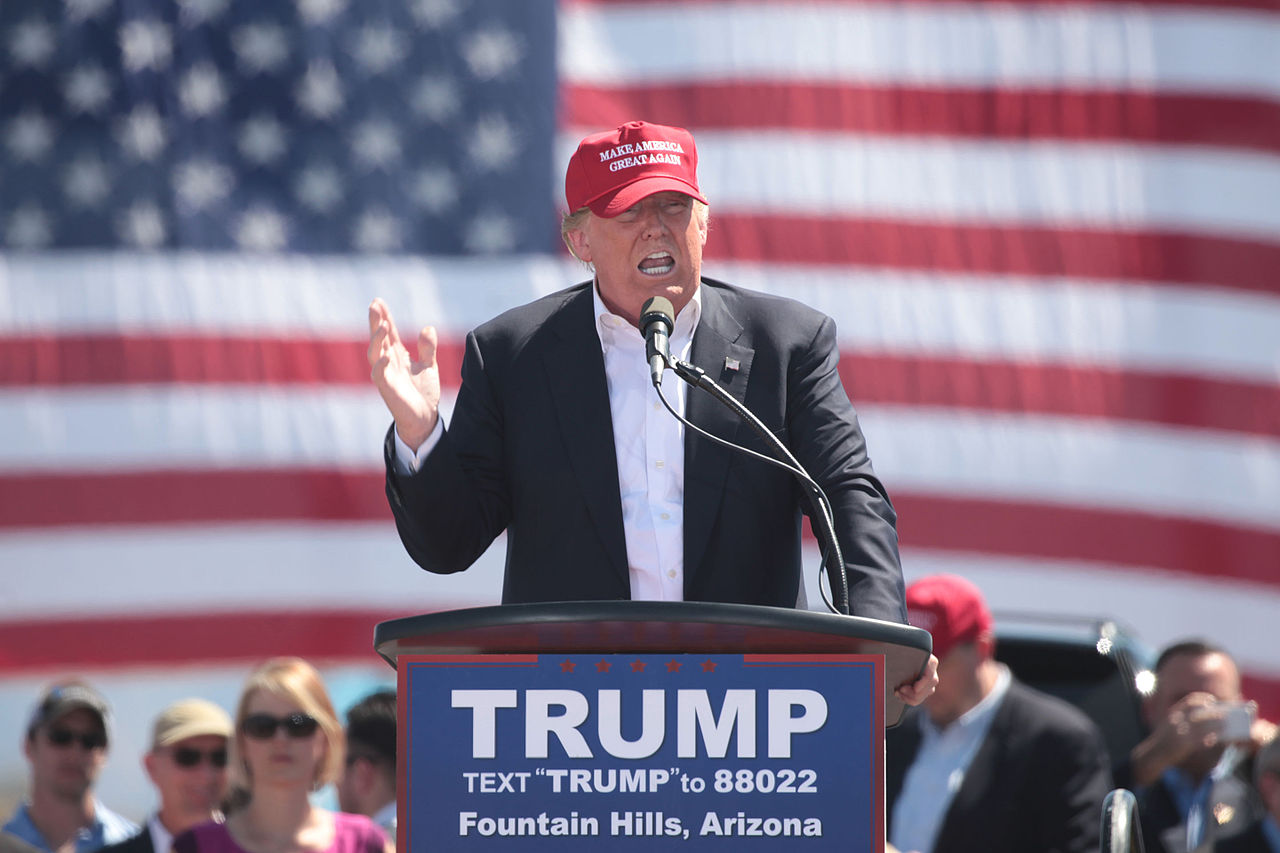
Trump anunció su candidatura en junio de 2015. [159] [160] Al principio, los analistas políticos no tomaron en serio su campaña , pero rápidamente llegó a la cima de las encuestas de opinión. [161] Se convirtió en el favorito en marzo de 2016 [162] y fue declarado candidato republicano en mayo. [163]
Hillary Clinton lideró a Trump en los promedios de las encuestas nacionales durante toda la campaña, pero, a principios de julio, su ventaja se redujo. [164] [165] A mediados de julio, Trump seleccionó al gobernador de Indiana Mike Pence como su compañero de fórmula, [166] y los dos fueron nominados oficialmente en la Convención Nacional Republicana de 2016. [ 167] Trump y Clinton se enfrentaron en tres debates presidenciales en septiembre y octubre de 2016. Trump se negó dos veces a decir si aceptaría el resultado de la elección. [168]
Retórica de campaña y posiciones políticas
Las posiciones políticas y la retórica de Trump eran populistas de derecha . [169] [170] [171] Politico las describió como "eclécticas, improvisadas y a menudo contradictorias", citando a un experto en políticas de atención médica del American Enterprise Institute que dijo que sus posiciones políticas eran una "variedad aleatoria de lo que se escucha públicamente". [172] NBC News contabilizó "141 cambios distintos en 23 temas importantes" durante su campaña. [173]
Trump describió a la OTAN como "obsoleta" [174] [175] y adoptó puntos de vista que fueron descritos como no intervencionistas y proteccionistas. [176] Su plataforma de campaña enfatizó la renegociación de las relaciones entre Estados Unidos y China y los acuerdos de libre comercio como el TLCAN , la aplicación estricta de las leyes de inmigración y la construcción de un nuevo muro a lo largo de la frontera entre Estados Unidos y México . Otras posiciones de campaña incluyeron la búsqueda de la independencia energética al tiempo que se opone a las regulaciones sobre el cambio climático, la modernización de los servicios para los veteranos , la derogación y reemplazo de la Ley de Atención Médica Asequible , la abolición de los estándares educativos Common Core , la inversión en infraestructura , la simplificación del código tributario al tiempo que se reducen los impuestos y la imposición de aranceles a las importaciones de empresas que deslocalizan puestos de trabajo. Abogó por aumentar el gasto militar y la investigación extrema o la prohibición de inmigrantes de países de mayoría musulmana. [177]
Trump ayudó a llevar las ideas y organizaciones de extrema derecha al mainstream. [178] En agosto de 2016, Trump contrató a Steve Bannon , el presidente ejecutivo de Breitbart News —descrito por Bannon como "la plataforma para la extrema derecha"— como su director ejecutivo de campaña. [179] El movimiento de extrema derecha se unió y apoyó la candidatura de Trump, debido en parte a su oposición al multiculturalismo y la inmigración . [180] [181] [182]
Divulgación financiera
Los informes requeridos por la FEC de Trump enumeraban activos superiores a $ 1.4 mil millones y deudas pendientes de al menos $ 315 millones. [34] [183] Trump no publicó sus declaraciones de impuestos , contrariamente a la práctica de todos los candidatos importantes desde 1976 y sus promesas en 2014 y 2015 de hacerlo si se postulaba para un cargo. [184] [185] Dijo que sus declaraciones de impuestos estaban siendo auditadas y que sus abogados le habían aconsejado que no las publicara. [186] Después de una larga batalla judicial para bloquear la publicación de sus declaraciones de impuestos y otros registros al fiscal de distrito de Manhattan para una investigación criminal, incluidas dos apelaciones de Trump ante la Corte Suprema de los Estados Unidos , en febrero de 2021 el tribunal superior permitió que los registros se entregaran al fiscal para su revisión por un gran jurado. [187] [188]
En octubre de 2016, un periodista de The New York Times filtró a su cuenta partes de los informes estatales de Trump correspondientes al año 1995. En ellos se muestra que Trump había declarado una pérdida de 916 millones de dólares ese año, lo que podría haberle permitido evitar el pago de impuestos durante hasta 18 años. [189]
Elección a la presidencia
El 8 de noviembre de 2016, Trump recibió 306 votos electorales prometidos frente a los 232 de Clinton, aunque, después de las deserciones de electores de ambos lados , el recuento oficial fue finalmente de 304 a 227. [190] Trump, la quinta persona en ser elegida presidente perdiendo el voto popular , recibió casi 2,9 millones de votos menos que Clinton. [191] También fue el único presidente que no sirvió en el ejército ni ocupó ningún cargo gubernamental antes de convertirse en presidente. [192] La victoria de Trump fue una sorpresa política . [193] Las encuestas habían mostrado constantemente a Clinton con una ventaja a nivel nacional , aunque decreciente, así como una ventaja en la mayoría de los estados competitivos . [194]
Trump ganó en 30 estados, incluidos Michigan , Pensilvania y Wisconsin , estados que habían sido considerados un muro azul de bastiones demócratas desde la década de 1990. Clinton ganó en 20 estados y el Distrito de Columbia . La victoria de Trump marcó el regreso de un gobierno republicano indiviso : una Casa Blanca republicana combinada con el control republicano de ambas cámaras del Congreso . [195]
.jpg/1280px-Women's_March_on_Washington_(32593123745).jpg)
La victoria electoral de Trump desató protestas en las principales ciudades de Estados Unidos. [196] [197] El día después de la toma de posesión de Trump, aproximadamente 2,6 millones de personas en todo el mundo, incluido aproximadamente medio millón en Washington, DC, protestaron contra Trump en las Marchas de las Mujeres . [198]
Presidencia (2017-2021)
Acciones tempranas

Trump fue investido el 20 de enero de 2017. Durante su primera semana en el cargo, firmó seis órdenes ejecutivas , que autorizaron: procedimientos provisionales en previsión de la derogación de la Ley de Atención Médica Asequible ("Obamacare"), el retiro de las negociaciones de la Asociación Transpacífica, el restablecimiento de la política de la Ciudad de México , el avance de los proyectos de construcción de los oleoductos Keystone XL y Dakota Access , el refuerzo de la seguridad fronteriza y un proceso de planificación y diseño para construir un muro a lo largo de la frontera de Estados Unidos con México. [199]
La hija de Trump, Ivanka, y su yerno, Jared Kushner, se convirtieron en su asistente y asesor principal , respectivamente. [200] [201]
Conflictos de intereses
Antes de asumir el cargo, Trump trasladó sus negocios a un fideicomiso revocable , [202] [203] en lugar de un fideicomiso ciego o un acuerdo equivalente "para separarse limpiamente de sus intereses comerciales". [204] Trump continuó beneficiándose de sus negocios y sabiendo cómo las políticas de su administración afectaban a sus negocios. [203] [205] Aunque dijo que evitaría "nuevos acuerdos extranjeros", la Organización Trump buscó expansiones de sus operaciones en Dubai, Escocia y la República Dominicana. [203] [205]
Trump fue demandado por violar las Cláusulas de Emolumentos Nacionales y Extranjeros de la Constitución de los Estados Unidos , lo que marca la primera vez que las cláusulas habían sido litigadas sustancialmente. [206] Un caso fue desestimado en un tribunal inferior. [207] Dos fueron desestimados por la Corte Suprema de los Estados Unidos por ser discutibles después del final del mandato de Trump. [208] Durante el mandato de Trump, visitó una propiedad de la Organización Trump durante 428 días, una visita cada 3,4 días de su presidencia. [209]
Política interna
Economía
Trump asumió el cargo en el apogeo de la expansión económica más larga en la historia de Estados Unidos, [210] que comenzó en 2009 y continuó hasta febrero de 2020, cuando comenzó la recesión de COVID-19 . [211]
En diciembre de 2017, Trump firmó la Ley de Reducción de Impuestos y Empleos de 2017 aprobada por el Congreso sin votos demócratas. [ ¿ relevante? ] Redujo las tasas impositivas para empresas e individuos, con recortes de impuestos a las empresas que serían permanentes y recortes de impuestos individuales que expirarían después de 2025, [ ¿importancia? ] y estableció la multa asociada con el mandato individual de la Ley de Atención Médica Asequible en $ 0. [212] [213] La administración Trump afirmó que la ley no disminuiría los ingresos del gobierno, pero los ingresos de 2018 fueron un 7,6 por ciento más bajos de lo proyectado. [214]
A pesar de la promesa de campaña de eliminar la deuda nacional en ocho años, Trump aprobó grandes aumentos del gasto público y la reducción de impuestos de 2017. Como resultado, el déficit del presupuesto federal aumentó casi un 50 por ciento, a casi 1 billón de dólares en 2019. [215] Bajo Trump, la deuda nacional de Estados Unidos aumentó un 39 por ciento, alcanzando los 27,75 billones de dólares al final de su mandato, y la relación deuda/PIB de Estados Unidos alcanzó un máximo posterior a la Segunda Guerra Mundial. [216] Trump tampoco cumplió con el plan de gasto en infraestructura de 1 billón de dólares por el que había hecho campaña. [217]
Trump es el único presidente estadounidense moderno que deja el cargo con una fuerza laboral menor que cuando asumió el cargo, en 3 millones de personas. [210] [218]
Cambio climático, medio ambiente y energía
Trump rechaza el consenso científico sobre el cambio climático . [219] [220] [221] [222] Redujo el presupuesto para la investigación de energía renovable en un 40 por ciento y revirtió las políticas de la era Obama dirigidas a frenar el cambio climático. [223] Se retiró del Acuerdo de París , convirtiendo a Estados Unidos en la única nación que no lo ratificó. [224]
Trump se propuso impulsar la producción y las exportaciones de combustibles fósiles . [225] [226] El gas natural se expandió bajo Trump, pero el carbón siguió disminuyendo. [227] [228] Trump revocó más de 100 regulaciones ambientales federales, incluidas las que restringían las emisiones de gases de efecto invernadero , la contaminación del aire y del agua y el uso de sustancias tóxicas. Debilitó las protecciones para los animales y los estándares ambientales para los proyectos de infraestructura federal, y amplió las áreas permitidas para la perforación y la extracción de recursos, como permitir la perforación en el Refugio Ártico . [229]
Desregulación
En 2017, Trump firmó la Orden Ejecutiva 13771 , que ordenaba que, por cada nueva regulación, las agencias federales "identificaran" dos regulaciones existentes para su eliminación, aunque no exigía su eliminación. [230] Desmanteló muchas regulaciones federales sobre salud, [231] [232] trabajo, [233] [232] y medio ambiente, [234] [232] entre otras, incluyendo un proyecto de ley que facilitaba a las personas con enfermedades mentales graves la compra de armas. [235] Durante sus primeras seis semanas en el cargo, retrasó, suspendió o revirtió noventa regulaciones federales, [236] a menudo "después de solicitudes de las industrias reguladas". [237] El Institute for Policy Integrity descubrió que el 78 por ciento de las propuestas de Trump fueron bloqueadas por los tribunales o no prevalecieron sobre los litigios. [238]
Cuidado de la salud
Durante su campaña, Trump prometió derogar y reemplazar la Ley de Atención Médica Asequible . [239] En el cargo, redujo la implementación de la Ley a través de órdenes ejecutivas. [240] [241] Trump expresó su deseo de "dejar que Obamacare fracase"; su administración redujo a la mitad el período de inscripción y redujo drásticamente la financiación para la promoción de la inscripción. [242] [ 243] En junio de 2018, la administración Trump se unió a 18 estados liderados por republicanos para argumentar ante la Corte Suprema que la eliminación de las sanciones financieras asociadas con el mandato individual había hecho que la Ley fuera inconstitucional. [244] [245] Su alegato habría eliminado la cobertura del seguro médico para hasta 23 millones de estadounidenses, pero no tuvo éxito. [244] Durante la campaña de 2016, Trump prometió proteger la financiación de Medicare y otros programas de red de seguridad social, pero en enero de 2020, expresó su voluntad de considerar recortes a los mismos. [246]
En respuesta a la epidemia de opioides , Trump firmó una ley en 2018 para aumentar la financiación de los tratamientos farmacológicos, pero fue ampliamente criticado por no elaborar una estrategia concreta. Las muertes por sobredosis de opioides en Estados Unidos disminuyeron ligeramente en 2018, pero aumentaron a un récord de 50.052 en 2019. [247]
Cuestiones sociales
Trump prohibió a las organizaciones que ofrecen abortos o derivaciones a centros de aborto recibir fondos federales. [248] Dijo que apoyaba el "matrimonio tradicional", pero consideró que la legalidad nacional del matrimonio entre personas del mismo sexo estaba "resuelta". [249] Su administración hizo retroceder componentes clave de las protecciones laborales de la administración Obama contra la discriminación de las personas LGBT . [250] El intento de Trump de revertir las protecciones contra la discriminación para los pacientes transgénero en agosto de 2020 fue detenido por un juez federal después de que un fallo de la Corte Suprema extendiera las protecciones de los derechos civiles de los empleados a la identidad de género y la orientación sexual. [251]
Trump ha dicho que se opone al control de armas , aunque sus opiniones han cambiado con el tiempo. [252] Después de varios tiroteos masivos durante su mandato, dijo que propondría una legislación relacionada con las armas, pero abandonó ese esfuerzo en noviembre de 2019. [253] Su administración adoptó una posición anti-marihuana , revocando las políticas de la era Obama que brindaban protecciones a los estados que legalizaban la marihuana. [254]
Trump es un defensor de la pena capital desde hace mucho tiempo. [255] [256] Bajo su administración, el gobierno federal ejecutó a 13 prisioneros, más que en los 56 años anteriores combinados y después de una moratoria de 17 años. [257] En 2016, Trump dijo que apoyaba el uso de métodos de tortura en interrogatorios como el ahogamiento simulado [258] [259] pero luego pareció retractarse debido a la oposición del Secretario de Defensa James Mattis . [260]
.jpg/1280px-President_Trump_Visits_St._John's_Episcopal_Church_(49964153176).jpg)
En junio de 2020, durante las protestas por George Floyd , los agentes federales encargados de hacer cumplir la ley utilizaron, de manera controvertida, armas menos letales para retirar a una multitud mayoritariamente pacífica de manifestantes legales de Lafayette Square , frente a la Casa Blanca . [261] [262] Trump luego posó con una Biblia para una sesión de fotos en la cercana Iglesia Episcopal de San Juan , [261] [263] [264] y los líderes religiosos condenaron tanto el trato a los manifestantes como la oportunidad de la foto en sí. [265] Muchos líderes militares retirados y funcionarios de defensa condenaron la propuesta de Trump de utilizar al ejército estadounidense contra los manifestantes contra la brutalidad policial. [266]
Indultos y conmutaciones
Trump concedió 237 solicitudes de clemencia, menos que todos los presidentes desde 1900 con la excepción de George HW Bush y George W. Bush . [267] Solo 25 de ellas habían sido examinadas por la Oficina del Fiscal de Indultos del Departamento de Justicia ; las otras fueron concedidas a personas con conexiones personales o políticas con él, su familia y sus aliados, o recomendadas por celebridades. [268] [269] En su último día completo en el cargo, Trump concedió 73 indultos y conmutó 70 sentencias. [270] Varios aliados de Trump no eran elegibles para indultos según las reglas del Departamento de Justicia, y en otros casos el departamento se había opuesto a la clemencia. [268] Los indultos de tres miembros del servicio militar condenados o acusados de delitos violentos fueron rechazados por los líderes militares. [271]
Inmigración
Las políticas de inmigración propuestas por Trump fueron un tema de acalorado debate durante la campaña. Prometió construir un muro en la frontera entre México y Estados Unidos para restringir el movimiento ilegal y prometió que México pagaría por ello. [272] Se comprometió a deportar a millones de inmigrantes ilegales que residen en los EE. UU. , [273] y criticó la ciudadanía por derecho de nacimiento por incentivar a los " bebés ancla ". [274] Como presidente, con frecuencia describió la inmigración ilegal como una "invasión" y confundió a los inmigrantes con la pandilla criminal MS-13 . [275]
Trump intentó intensificar drásticamente la aplicación de medidas de control de la inmigración, incluida la implementación de políticas de control de la inmigración más severas contra los solicitantes de asilo de América Central que cualquier presidente moderno de Estados Unidos. [276] [277]
A partir de 2018, Trump desplegó casi 6.000 tropas en la frontera entre Estados Unidos y México [278] para impedir que la mayoría de los migrantes centroamericanos solicitaran asilo. En 2020, su administración amplió la regla de carga pública para restringir aún más la posibilidad de que los inmigrantes que pudieran utilizar los beneficios del gobierno obtuvieran la residencia permanente. [279] Trump redujo el número de refugiados admitidos a mínimos históricos. Cuando Trump asumió el cargo, el límite anual era de 110.000; Trump estableció un límite de 18.000 en el año fiscal 2020 y de 15.000 en el año fiscal 2021. [280] [281] Las restricciones adicionales implementadas por la administración Trump causaron cuellos de botella significativos en el procesamiento de las solicitudes de refugio, lo que resultó en que se aceptaran menos refugiados que los límites permitidos. [282]
Prohibición de viajar
Tras el ataque de San Bernardino en 2015 , Trump propuso prohibir la entrada de extranjeros musulmanes a Estados Unidos hasta que se pudieran implementar sistemas de investigación más estrictos. [283] Más tarde reformuló la prohibición propuesta para que se aplicara a países con una "historia comprobada de terrorismo". [284]
El 27 de enero de 2017, Trump firmó la Orden Ejecutiva 13769 , que suspendió la admisión de refugiados durante 120 días y negó la entrada a ciudadanos de Irak, Irán, Libia, Somalia, Sudán, Siria y Yemen durante 90 días, citando preocupaciones de seguridad. La orden entró en vigor de inmediato y sin previo aviso, provocando caos en los aeropuertos. [285] [286] Las protestas comenzaron en los aeropuertos al día siguiente, [285] [286] y los desafíos legales resultaron en medidas cautelares a nivel nacional . [287] Una orden revisada del 6 de marzo , que excluía a Irak y otorgaba otras exenciones, nuevamente fue bloqueada por jueces federales en tres estados. [288] [289] En una decisión de junio de 2017 , la Corte Suprema dictaminó que la prohibición podría aplicarse a los visitantes que carezcan de una "afirmación creíble de una relación de buena fe con una persona o entidad en los Estados Unidos". [290]
La orden temporal fue reemplazada por la Proclamación Presidencial 9645 el 24 de septiembre de 2017, que restringió los viajes desde los países originalmente afectados, excepto Irak y Sudán, y además prohibió los viajeros de Corea del Norte y Chad, junto con ciertos funcionarios venezolanos. [291] Después de que los tribunales inferiores bloquearan parcialmente las nuevas restricciones, la Corte Suprema permitió que la versión de septiembre entrara en pleno vigor el 4 de diciembre de 2017, [292] y finalmente confirmó la prohibición de viajes en un fallo en junio de 2019. [293]
Separación familiar en la frontera
La administración Trump separó a más de 5.400 niños de familias migrantes de sus padres en la frontera entre Estados Unidos y México, un marcado aumento en el número de separaciones familiares en la frontera a partir del verano de 2017. [294] [295] En abril de 2018, la administración Trump anunció una política de " tolerancia cero " por la cual los adultos sospechosos de entrada ilegal serían detenidos y procesados penalmente mientras que sus hijos eran llevados como menores extranjeros no acompañados. [296] [297] La política no tenía precedentes en administraciones anteriores y provocó indignación pública. [298] [299] Trump afirmó falsamente que su administración simplemente estaba siguiendo la ley, culpando a los demócratas, a pesar de que las separaciones eran la política de su administración. [300] [301] [302]
Aunque Trump argumentó originalmente que las separaciones no podían detenerse mediante una orden ejecutiva, accedió a la intensa objeción pública y firmó una orden ejecutiva en junio de 2018, ordenando que las familias migrantes fueran detenidas juntas a menos que "exista una preocupación" de un riesgo para el niño. [303] [304] El 26 de junio de 2018, la jueza Dana Sabraw concluyó que la administración Trump "no tenía ningún sistema establecido para realizar un seguimiento" de los niños separados, ni ninguna medida efectiva para la comunicación y reunificación familiar; [305] Sabraw ordenó que las familias se reunieran y que se detuvieran las separaciones familiares excepto en circunstancias limitadas. [306] Después de la orden, la administración Trump separó a más de mil niños migrantes de sus familias; la ACLU sostuvo que la administración Trump había abusado de su discreción y le pidió a Sabraw que definiera de manera más estricta las circunstancias que justificaban la separación. [295]
El muro de Trump y el cierre del gobierno

Una de las promesas centrales de la campaña de Trump fue construir un muro fronterizo de 1.600 kilómetros hasta México y que México lo pagara. [307] Al final de su mandato, Estados Unidos había construido "64 kilómetros de nuevo muro primario y 53 kilómetros de muro secundario" en lugares donde no había barreras y 587 kilómetros de cercas fronterizas primarias o secundarias que reemplazaban barreras deterioradas u obsoletas. [308]
En 2018, Trump se negó a firmar cualquier proyecto de ley de asignaciones del Congreso a menos que asignara $ 5.6 mil millones para el muro fronterizo, [309] lo que resultó en el cierre parcial del gobierno federal durante 35 días desde diciembre de 2018 hasta enero de 2019, el cierre gubernamental más largo de la historia de los EE. UU . [310] [311] Alrededor de 800.000 empleados del gobierno fueron suspendidos o trabajaron sin paga. [312] Trump y el Congreso pusieron fin al cierre aprobando una financiación temporal que proporcionó pagos retrasados a los trabajadores del gobierno, pero ningún fondo para el muro. [310] El cierre resultó en una pérdida permanente estimada de $ 3 mil millones para la economía, según la Oficina de Presupuesto del Congreso . [313] Aproximadamente la mitad de los encuestados culparon a Trump por el cierre, y los índices de aprobación de Trump cayeron. [314]
Para evitar otro cierre inminente en febrero de 2019, el Congreso aprobó y Trump firmó un proyecto de ley de financiación que incluía 1.375 millones de dólares para 55 millas (89 km) de vallas fronterizas de bolardos. [315] Trump también declaró una emergencia nacional en la frontera sur , con la intención de desviar 6.100 millones de dólares de fondos que el Congreso había asignado a otros fines. [315] Trump vetó una resolución conjunta para revocar la declaración, y el Senado votó en contra de una anulación del veto . [316] Los desafíos legales al desvío de 2.500 millones de dólares originalmente destinados a los esfuerzos de interdicción de drogas del Departamento de Defensa [317] [318] y 3.600 millones de dólares originalmente destinados a la construcción militar [319] [320] no tuvieron éxito.
Política exterior
.jpg/1280px--G7Biarritz_(48616362963).jpg)
Trump se describió a sí mismo como un "nacionalista" [321] y su política exterior como " Estados Unidos primero ". [322] Elogió y apoyó a los gobiernos populistas , neonacionalistas y autoritarios. [323] Las características distintivas de las relaciones exteriores durante el mandato de Trump incluyeron imprevisibilidad, incertidumbre e inconsistencia. [322] [324] Las tensiones entre los EE. UU. y sus aliados europeos se tensaron bajo Trump. [325] Criticó a los aliados de la OTAN y sugirió en privado en múltiples ocasiones que Estados Unidos debería retirarse de la OTAN . [326] [327]
Comercio
Trump retiró a Estados Unidos de las negociaciones del Acuerdo Transpacífico (TPP), [328] impuso aranceles a las importaciones de acero y aluminio, [329] y lanzó una guerra comercial con China al aumentar drásticamente los aranceles a 818 categorías (por valor de 50 mil millones de dólares) de productos chinos importados a Estados Unidos. [330] Si bien Trump dijo que los aranceles de importación los paga China al Tesoro de Estados Unidos , los pagan las empresas estadounidenses que importan bienes de China. [331] Aunque prometió durante la campaña reducir significativamente los grandes déficits comerciales de Estados Unidos , el déficit comercial se disparó bajo Trump. [332] Después de una renegociación de 2017-2018, el Acuerdo Estados Unidos-México-Canadá (T-MEC) entró en vigencia en julio de 2020 como sucesor del TLCAN. [333]
Rusia
.jpg/1280px-President_Trump_at_the_G20_(48144047611).jpg)
La administración Trump debilitó las sanciones más duras impuestas por Estados Unidos contra entidades rusas después de la anexión de Crimea por parte de Rusia en 2014. [334] [335] Trump retiró a Estados Unidos del Tratado de Fuerzas Nucleares de Alcance Intermedio , citando un presunto incumplimiento ruso, [336] y apoyó un posible regreso de Rusia al G7 . [337]
Trump elogió repetidamente y rara vez criticó al presidente ruso Vladimir Putin [338] [339] pero se opuso a algunas acciones del gobierno ruso. [340] [341] Después de reunirse con Putin en la Cumbre de Helsinki en 2018, Trump recibió críticas bipartidistas por aceptar la negación de Putin de la interferencia rusa en las elecciones presidenciales de 2016 , en lugar de aceptar las conclusiones de las agencias de inteligencia estadounidenses. [342] [343] [344] Trump no discutió con Putin las supuestas recompensas rusas ofrecidas a los combatientes talibanes por atacar a los soldados estadounidenses en Afganistán, diciendo que dudaba de la inteligencia y que no estaba informado al respecto. [345]
Porcelana

Trump acusó repetidamente a China de aprovecharse injustamente de los EE. UU. [346] Lanzó una guerra comercial contra China que fue ampliamente caracterizada como un fracaso, [347] [348] [349] sancionó a Huawei por supuestos vínculos con Irán, [350] aumentó significativamente las restricciones de visado para estudiantes y académicos chinos, [351] y clasificó a China como un manipulador de divisas . [352] Trump también yuxtapuso ataques verbales a China con elogios al líder del Partido Comunista Chino, Xi Jinping , [353] lo que se atribuyó a las negociaciones de la guerra comercial. [354] Después de elogiar inicialmente a China por su manejo del COVID-19 , [355] comenzó una campaña de críticas a partir de marzo de 2020. [356]
Trump dijo que se resistía a castigar a China por sus abusos de los derechos humanos contra las minorías étnicas en la región de Xinjiang por temor a poner en peligro las negociaciones comerciales. [357] En julio de 2020, la administración Trump impuso sanciones y restricciones de visado contra altos funcionarios chinos, en respuesta a la ampliación de los campos de detención masiva que albergaban a más de un millón de miembros de la minoría uigur del país . [358]
Corea del Norte

En 2017, cuando las armas nucleares de Corea del Norte eran vistas cada vez más como una amenaza seria, [359] Trump intensificó su retórica, advirtiendo que la agresión norcoreana sería respondida con "fuego y furia como el mundo nunca ha visto". [360] [361] En 2017, Trump declaró que quería la "desnuclearización completa" de Corea del Norte, y se dedicó a insultar al líder Kim Jong Un . [360] [362] Después de este período de tensión, Trump y Kim intercambiaron al menos 27 cartas en las que los dos hombres describieron una cálida amistad personal. [363] [364] En marzo de 2019, Trump levantó algunas sanciones estadounidenses contra Corea del Norte en contra del consejo de su Departamento del Tesoro. [365]
Trump, el primer presidente estadounidense en funciones que se reúne con un líder norcoreano, se reunió con Kim tres veces: en Singapur en 2018, en Hanoi en 2019 y en la Zona Desmilitarizada de Corea en 2019. [366] Sin embargo, no se llegó a ningún acuerdo de desnuclearización , [367] y las conversaciones en octubre de 2019 fracasaron después de un día. [368] Si bien no ha realizado pruebas nucleares desde 2017, Corea del Norte continuó aumentando su arsenal de armas nucleares y misiles balísticos. [369] [370]
Afganistán
.jpg/1280px-Secretary_Pompeo_Meets_With_the_Taliban_Delegation_(50333305012).jpg)
El número de tropas estadounidenses en Afganistán aumentó de 8.500 en enero de 2017 a 14.000 un año después, [371] revirtiendo la posición preelectoral de Trump crítica a una mayor participación en Afganistán. [372] En febrero de 2020, la administración Trump firmó un acuerdo de paz con los talibanes , que exigía la retirada de las tropas extranjeras en 14 meses "condicionada a una garantía de los talibanes de que el suelo afgano no será utilizado por terroristas con el objetivo de atacar a los Estados Unidos o sus aliados" y que Estados Unidos buscara la liberación de 5.000 talibanes encarcelados por el gobierno afgano. [373] [374] [375] Al final del mandato de Trump, 5.000 talibanes habían sido liberados y, a pesar de que los talibanes continuaban atacando a las fuerzas afganas e integrando a miembros de Al-Qaeda en su liderazgo, las tropas estadounidenses se habían reducido a 2.500. [375]
Israel
Trump apoyó muchas de las políticas del primer ministro israelí, Benjamin Netanyahu . [376] Bajo Trump, Estados Unidos reconoció a Jerusalén como la capital de Israel [377] y la soberanía israelí sobre los Altos del Golán , [378] lo que provocó la condena internacional, incluso de la Asamblea General de la ONU , la Unión Europea y la Liga Árabe . [379] [380] En 2020, la Casa Blanca organizó la firma de acuerdos, denominados Acuerdos de Abraham , entre Israel y los Emiratos Árabes Unidos y Bahréin para normalizar sus relaciones exteriores. [381]
Arabia Saudita

Trump apoyó activamente la intervención liderada por Arabia Saudita en Yemen contra los hutíes y en 2017 firmó un acuerdo de 110 mil millones de dólares para vender armas a Arabia Saudita . [382] En 2018, Estados Unidos proporcionó inteligencia limitada y apoyo logístico para la intervención. [383] [384] Tras el ataque de 2019 a las instalaciones petroleras sauditas , que Estados Unidos y Arabia Saudita culparon a Irán , Trump aprobó el despliegue de 3.000 tropas estadounidenses adicionales, incluidos escuadrones de combate, dos baterías Patriot y un sistema de defensa de área de gran altitud terminal , a Arabia Saudita y los Emiratos Árabes Unidos. [385]
Siria

Trump ordenó ataques con misiles en abril de 2017 y abril de 2018 contra el régimen de Assad en Siria, en represalia por los ataques químicos de Khan Shaykhun y Duma , respectivamente. [386] [387] En diciembre de 2018, Trump declaró "hemos ganado contra ISIS", contradiciendo las evaluaciones del Departamento de Defensa, y ordenó la retirada de todas las tropas de Siria. [388] [389] Al día siguiente, Mattis renunció en protesta, calificando la decisión de Trump de abandono de los aliados kurdos de Estados Unidos que desempeñaron un papel clave en la lucha contra ISIS. [390] En octubre de 2019, después de que Trump hablara con el presidente turco Recep Tayyip Erdoğan , las tropas estadounidenses en el norte de Siria se retiraron del área y Turquía invadió el norte de Siria , atacando y desplazando a los kurdos aliados de Estados Unidos . [391] Más tarde ese mes, la Cámara de Representantes de Estados Unidos, en una rara votación bipartidista de 354 a 60, condenó la retirada de las tropas estadounidenses de Siria por parte de Trump, por "abandonar a los aliados estadounidenses, socavar la lucha contra ISIS y estimular una catástrofe humanitaria". [392] [393]
Irán
En mayo de 2018, Trump retiró a Estados Unidos del Plan de Acción Integral Conjunto , el acuerdo de 2015 que levantó la mayoría de las sanciones económicas contra Irán a cambio de restricciones al programa nuclear de Irán . [394] [395] En agosto de 2020, la administración Trump intentó sin éxito utilizar una sección del acuerdo nuclear para que la ONU volviera a imponer sanciones contra Irán. [396] Los analistas determinaron que, después de la retirada de Estados Unidos, Irán se acercó más al desarrollo de un arma nuclear. [397]
El 1 de enero de 2020, Trump ordenó un ataque aéreo estadounidense que mató al general iraní Qasem Soleimani , que había planeado casi todas las operaciones importantes de Irán y respaldadas por Irán durante las dos décadas anteriores. [398] [399] Una semana después, Irán tomó represalias con ataques con misiles balísticos contra dos bases aéreas estadounidenses en Irak. Decenas de soldados sufrieron lesiones cerebrales traumáticas. Trump restó importancia a sus lesiones, y en un principio se les negaron los Corazones Púrpuras y los beneficios acordados a sus destinatarios. [400] [397]
Personal
La administración Trump tuvo una alta rotación de personal, particularmente entre el personal de la Casa Blanca. Al final del primer año de Trump en el cargo, el 34 por ciento de su personal original había renunciado, había sido despedido o había sido reasignado. [401] A principios de julio de 2018 [update], el 61 por ciento de los asistentes principales de Trump se habían ido [402] y 141 empleados se habían ido el año anterior. [403] Ambas cifras establecieron un récord para los presidentes recientes: más cambios en los primeros 13 meses de los que vieron sus cuatro predecesores inmediatos en sus primeros dos años. [404] Entre las salidas tempranas notables se encuentran el asesor de seguridad nacional Michael Flynn (después de solo 25 días) y el secretario de prensa Sean Spicer . [404] Los asistentes personales cercanos a Trump, incluidos Bannon, Hope Hicks , John McEntee y Keith Schiller , renunciaron o se vieron obligados a renunciar. [405] Algunos regresaron más tarde en diferentes puestos. [406] Trump menospreció públicamente a varios de sus antiguos altos funcionarios, llamándolos incompetentes, estúpidos o locos. [407]
Trump tuvo cuatro jefes de gabinete en la Casa Blanca , marginando o expulsando a varios. [408] Reince Priebus fue reemplazado después de siete meses por el general retirado de la Marina John F. Kelly . [409] Kelly renunció en diciembre de 2018 después de un mandato tumultuoso en el que su influencia disminuyó, y Trump posteriormente lo menospreció. [410] Kelly fue sucedido por Mick Mulvaney como jefe de gabinete interino; fue reemplazado en marzo de 2020 por Mark Meadows . [408]
El 9 de mayo de 2017, Trump despidió al director del FBI, James Comey . Aunque inicialmente atribuyó esta acción a la conducta de Comey en la investigación sobre los correos electrónicos de Hillary Clinton , Trump dijo unos días después que le preocupaba el papel de Comey en las investigaciones en curso sobre Trump y Rusia, y que había tenido la intención de despedir a Comey antes. [411] En una conversación privada en febrero, Trump dijo que esperaba que Comey abandonara la investigación sobre Flynn. [412] En marzo y abril, Trump le pidió a Comey que "levante la nube que afecta su capacidad de actuar" al decir públicamente que el FBI no lo estaba investigando. [412] [413]
Trump perdió a tres de los 15 miembros originales de su gabinete durante su primer año. [414] El secretario de Salud y Servicios Humanos, Tom Price, se vio obligado a dimitir en septiembre de 2017 debido al uso excesivo de aviones chárter privados y aviones militares. [414] [405] El administrador de la Agencia de Protección Ambiental, Scott Pruitt, dimitió en 2018 y el secretario del Interior, Ryan Zinke, en enero de 2019 en medio de múltiples investigaciones sobre su conducta. [415] [416]
Trump tardó en nombrar funcionarios de segundo nivel en el poder ejecutivo, alegando que muchos de los puestos son innecesarios. En octubre de 2017, todavía había cientos de puestos de subgabinete sin nominado. [417] Para el 8 de enero de 2019, de 706 puestos clave, 433 habían sido cubiertos (61 por ciento) y Trump no tenía nominado para 264 (37 por ciento). [418]
Judicial
.jpg/1280px-President_Trump_Nominates_Judge_Amy_Coney_Barrett_for_Associate_Justice_of_the_U.S._Supreme_Court_(50397882607).jpg)
Trump nombró a 226 jueces del Artículo III , incluidos 54 para los tribunales de apelaciones y tres para la Corte Suprema : Neil Gorsuch , Brett Kavanaugh y Amy Coney Barrett . [419] Sus nominados a la Corte Suprema fueron señalados por haber desplazado políticamente la Corte hacia la derecha. [420] [421] [422] En la campaña de 2016, prometió que Roe v. Wade sería revocado "automáticamente" si era elegido y brindó la oportunidad de nombrar a dos o tres jueces antiabortistas. Más tarde se atribuyó el mérito cuando Roe fue revocado en Dobbs v. Jackson Women's Health Organization ; los tres nominados a la Corte Suprema votaron con la mayoría. [423] [424] [425]
Trump desprestigió a los tribunales y jueces con los que no estaba de acuerdo, a menudo en términos personales, y cuestionó la autoridad constitucional del poder judicial. Sus ataques a los tribunales provocaron críticas de los observadores, incluidos los jueces federales en funciones, preocupados por el efecto de sus declaraciones sobre la independencia judicial y la confianza pública en el poder judicial. [426] [427] [428]
Pandemia de COVID-19
Respuesta inicial
El primer caso confirmado de COVID-19 en los EE. UU. se informó el 20 de enero de 2020. [429] El brote fue declarado oficialmente una emergencia de salud pública por el Secretario de Salud y Servicios Humanos (HHS), Alex Azar, el 31 de enero de 2020. [430] Trump inicialmente ignoró las persistentes advertencias de salud pública y los llamados a la acción de los funcionarios de salud dentro de su administración y el Secretario Azar. [431] [432] A lo largo de enero y febrero se centró en consideraciones económicas y políticas del brote. [433] En febrero de 2020, Trump afirmó públicamente que el brote en los EE. UU. era menos mortal que la influenza , estaba "muy bajo control" y pronto terminaría. [434] El 19 de marzo de 2020, Trump le dijo en privado a Bob Woodward que deliberadamente estaba "minimizándolo, porque no quiero crear pánico". [435] [436]
A mediados de marzo, la mayoría de los mercados financieros mundiales se habían contraído severamente en respuesta a la pandemia. [437] El 6 de marzo, Trump firmó la Ley de Asignaciones Suplementarias para la Preparación y Respuesta al Coronavirus , que proporcionó $8.3 mil millones en fondos de emergencia para agencias federales. [438] El 11 de marzo, la Organización Mundial de la Salud (OMS) reconoció al COVID-19 como una pandemia , [439] y Trump anunció restricciones parciales de viaje para la mayor parte de Europa, a partir del 13 de marzo. [440] Ese mismo día, dio su primera evaluación seria del virus en un discurso a nivel nacional en la Oficina Oval, calificando el brote de "horrible" pero "un momento temporal" y diciendo que no había una crisis financiera. [441] El 13 de marzo, declaró una emergencia nacional , liberando recursos federales. [442] Trump afirmó que "cualquiera que quiera una prueba puede hacerse una prueba", a pesar de que la disponibilidad de pruebas está severamente limitada. [443]
El 22 de abril, Trump firmó una orden ejecutiva que restringía algunas formas de inmigración. [444] A fines de la primavera y principios del verano, cuando las infecciones y las muertes seguían aumentando, adoptó una estrategia de culpar a los estados en lugar de aceptar que sus evaluaciones iniciales de la pandemia eran demasiado optimistas o su fracaso a la hora de proporcionar liderazgo presidencial. [445]
Grupo de trabajo de la Casa Blanca sobre el coronavirus
.jpg/1280px-White_House_Press_Briefing_(49666120807).jpg)
Trump estableció el Grupo de Trabajo sobre el Coronavirus de la Casa Blanca el 29 de enero de 2020. [446] A partir de mediados de marzo, Trump celebró una conferencia de prensa diaria del grupo de trabajo, a la que se unieron expertos médicos y otros funcionarios de la administración, [447] a veces en desacuerdo con ellos al promover tratamientos no probados. [448] Trump fue el orador principal en las reuniones informativas, donde elogió su propia respuesta a la pandemia, criticó con frecuencia al candidato presidencial rival Joe Biden y denunció a la prensa. [447] [449] El 16 de marzo, reconoció por primera vez que la pandemia no estaba bajo control y que podrían ocurrir meses de interrupción de la vida diaria y una recesión. [450] Su uso repetido de "virus chino" y "virus de China" para describir COVID-19 provocó críticas de los expertos en salud. [451] [452] [453]
A principios de abril, cuando la pandemia empeoró y en medio de críticas a la respuesta de su administración, Trump se negó a admitir ningún error en su manejo del brote, y en cambio culpó a los medios, a los gobernadores estatales demócratas, a la administración anterior, a China y a la OMS. [454] Las reuniones informativas diarias del grupo de trabajo sobre el coronavirus terminaron a fines de abril, después de una reunión informativa en la que Trump sugirió la peligrosa idea de inyectar un desinfectante para tratar el COVID-19; [455] el comentario fue ampliamente condenado por los profesionales médicos. [456] [457]
A principios de mayo, Trump propuso la eliminación gradual del grupo de trabajo sobre el coronavirus y su reemplazo por otro grupo centrado en la reapertura de la economía. En medio de una reacción negativa, Trump dijo que el grupo de trabajo continuaría "indefinidamente". [458] A fines de mayo, las reuniones del grupo de trabajo sobre el coronavirus se redujeron drásticamente. [459]
Organización Mundial de la Salud
Antes de la pandemia, Trump criticó a la OMS y otros organismos internacionales, que afirmó que se estaban aprovechando de la ayuda estadounidense. [460] El presupuesto federal propuesto por su administración para 2021, publicado en febrero, propuso reducir la financiación de la OMS a más de la mitad. [460] En mayo y abril, Trump acusó a la OMS de "administrar gravemente mal" la COVID-19, alegó sin pruebas que la organización estaba bajo control chino y había permitido que el gobierno chino ocultara los orígenes de la pandemia, [460] [461] [462] y anunció que estaba retirando la financiación a la organización. [460] Estos fueron vistos como intentos de distraer la atención de su propio mal manejo de la pandemia. [460] [463] [464] En julio de 2020, Trump anunció la retirada formal de Estados Unidos de la OMS, que entraría en vigor a partir de julio de 2021. [461] [462] La decisión fue ampliamente condenada por los funcionarios de salud y del gobierno como "miope", "sin sentido" y "peligrosa". [461] [462]
Presión para abandonar las medidas de mitigación de la pandemia
En abril de 2020, grupos relacionados con los republicanos organizaron protestas contra las medidas que estaban tomando los gobiernos estatales para combatir la pandemia; [465] [466] Trump alentó las protestas en Twitter, [467] a pesar de que los estados afectados no cumplían con las pautas de la administración Trump para la reapertura. [468] En abril de 2020, primero apoyó, y luego criticó, el plan del gobernador de Georgia, Brian Kemp, de reabrir algunos negocios no esenciales. [469] A lo largo de la primavera, presionó cada vez más para poner fin a las restricciones para revertir el daño a la economía del país. [470] Trump a menudo se negó a usar mascarillas en eventos públicos, en contra de la guía de su administración de abril de 2020 de usar mascarillas en público [471] y a pesar del consenso médico casi unánime de que las mascarillas son importantes para prevenir la propagación del virus. [472] En junio, Trump había dicho que las mascarillas eran un "arma de doble filo"; ridiculizó a Biden por usar mascarillas; enfatizó continuamente que el uso de mascarillas era opcional; y sugirió que usar una mascarilla era una declaración política contra él personalmente. [472] La contradicción de Trump con las recomendaciones médicas debilitó los esfuerzos nacionales para mitigar la pandemia. [471] [472]
In June and July, Trump said several times that the U.S. would have fewer cases of coronavirus if it did less testing, that having a large number of reported cases "makes us look bad".[473][474] The CDC guideline at the time was that any person exposed to the virus should be "quickly identified and tested" even if they are not showing symptoms, because asymptomatic people can still spread the virus.[475][476] In August 2020 the CDC quietly lowered its recommendation for testing, advising that people who have been exposed to the virus, but are not showing symptoms, "do not necessarily need a test". The change in guidelines was made by HHS political appointees under Trump administration pressure, against the wishes of CDC scientists.[477][478] The day after this political interference was reported, the testing guideline was changed back to its original recommendation.[478]
Despite record numbers of COVID-19 cases in the U.S. from mid-June onward and an increasing percentage of positive test results, Trump largely continued to downplay the pandemic, including his false claim in early July 2020 that 99 percent of COVID-19 cases are "totally harmless".[479][480] He began insisting that all states should resume in-person education in the fall despite a July spike in reported cases.[481]
Political pressure on health agencies
Trump repeatedly pressured federal health agencies to take actions he favored,[477] such as approving unproven treatments[482][483] or speeding up vaccine approvals.[483] Trump administration political appointees at HHS sought to control CDC communications to the public that undermined Trump's claims that the pandemic was under control. CDC resisted many of the changes, but increasingly allowed HHS personnel to review articles and suggest changes before publication.[484][485] Trump alleged without evidence that FDA scientists were part of a "deep state" opposing him and delaying approval of vaccines and treatments to hurt him politically.[486]
Outbreak at the White House
.jpg/1280px-President_Trump_Boards_Marine_One_(50436803733).jpg)
On October 2, 2020, Trump tweeted that he had tested positive for COVID-19, part of a White House outbreak.[487] Later that day Trump was hospitalized at Walter Reed National Military Medical Center, reportedly due to fever and labored breathing. He was treated with antiviral and experimental antibody drugs and a steroid. He returned to the White House on October 5, still infectious and unwell.[488][489] During and after his treatment he continued to downplay the virus.[488] In 2021, it was revealed that his condition had been far more serious; he had dangerously low blood oxygen levels, a high fever, and lung infiltrates, indicating a severe case.[489]
Effects on the 2020 presidential campaign
By July 2020, Trump's handling of the COVID-19 pandemic had become a major issue in the presidential election.[490] Biden sought to make the pandemic the central issue.[491] Polls suggested voters blamed Trump for his pandemic response[490] and disbelieved his rhetoric concerning the virus, with an Ipsos/ABC News poll indicating 65 percent of respondents disapproved of his pandemic response.[492] In the final months of the campaign, Trump repeatedly said that the U.S. was "rounding the turn" in managing the pandemic, despite increasing cases and deaths.[493] A few days before the November 3 election, the U.S. reported more than 100,000 cases in a single day for the first time.[494]
Investigations
After he assumed office, Trump was the subject of increasing Justice Department and congressional scrutiny, with investigations covering his election campaign, transition, and inauguration, actions taken during his presidency, his private businesses, personal taxes, and charitable foundation.[495] There were ten federal criminal investigations, eight state and local investigations, and twelve congressional investigations.[496]
In April 2019, the House Oversight Committee issued subpoenas seeking financial details from Trump's banks, Deutsche Bank and Capital One, and his accounting firm, Mazars USA. Trump sued the banks, Mazars, and committee chair Elijah Cummings to prevent the disclosures.[497] In May, DC District Court judge Amit Mehta ruled that Mazars must comply with the subpoena,[498] and judge Edgardo Ramos of the Southern District Court of New York ruled that the banks must also comply.[499][500] Trump's attorneys appealed.[501] In September 2022, the committee and Trump agreed to a settlement about Mazars, and the accounting firm began turning over documents.[502]
Russian election interference
In January 2017, American intelligence agencies—the CIA, the FBI, and the NSA, represented by the Director of National Intelligence—jointly stated with "high confidence" that the Russian government interfered in the 2016 presidential election to favor the election of Trump.[503][504] In March 2017, FBI Director James Comey told Congress, "[T]he FBI, as part of our counterintelligence mission, is investigating the Russian government's efforts to interfere in the 2016 presidential election. That includes investigating the nature of any links between individuals associated with the Trump campaign and the Russian government, and whether there was any coordination between the campaign and Russia's efforts."[505]
Many suspicious[506] links between Trump associates and Russian officials and spies were discovered and the relationships between Russians and "team Trump", including Manafort, Flynn, and Stone, were widely reported by the press.[507][508][509][510] Members of Trump's campaign and his White House staff, particularly Flynn, were in contact with Russian officials both before and after the election.[511][512] On December 29, 2016, Flynn talked with Russian Ambassador Sergey Kislyak about sanctions that were imposed that same day; Flynn later resigned in the midst of controversy over whether he misled Pence.[513] Trump told Kislyak and Sergei Lavrov in May 2017 he was unconcerned about Russian interference in U.S. elections.[514]
Trump and his allies promoted a conspiracy theory that Ukraine, rather than Russia, interfered in the 2016 election—which was also promoted by Russia to frame Ukraine.[515]
FBI Crossfire Hurricane and 2017 counterintelligence investigations
In July 2016, the FBI launched an investigation, codenamed Crossfire Hurricane, into possible links between Russia and the Trump campaign.[516] After Trump fired FBI director James Comey in May 2017, the FBI opened a counterintelligence investigation into Trump's personal and business dealings with Russia.[517] Crossfire Hurricane was transferred to the Mueller investigation,[518] but Deputy Attorney General Rod Rosenstein ended the investigation into Trump's direct ties to Russia while giving the bureau the false impression that the Robert Mueller's special counsel investigation would pursue the matter.[519][520]
Mueller investigation
In May 2017, Rosenstein appointed former FBI director Mueller special counsel for the Department of Justice (DOJ), ordering him to "examine 'any links and/or coordination between the Russian government' and the Trump campaign". He privately told Mueller to restrict the investigation to criminal matters "in connection with Russia's 2016 election interference".[519] The special counsel also investigated whether Trump's dismissal of James Comey as FBI director constituted obstruction of justice[521] and the Trump campaign's possible ties to Saudi Arabia, the United Arab Emirates, Turkey, Qatar, Israel, and China.[522] Trump sought to fire Mueller and shut down the investigation multiple times but backed down after his staff objected or after changing his mind.[523]
In March 2019, Mueller gave his final report to Attorney General William Barr,[524] which Barr purported to summarize in a letter to Congress. A federal court, and Mueller himself, said Barr mischaracterized the investigation's conclusions and, in so doing, confused the public.[525][526][527] Trump repeatedly claimed that the investigation exonerated him; the Mueller report expressly stated that it did not.[528]
A redacted version of the report, publicly released in April 2019, found that Russia interfered in 2016 to favor Trump.[529] Despite "numerous links between the Russian government and the Trump campaign", the report found that the prevailing evidence "did not establish" that Trump campaign members conspired or coordinated with Russian interference.[530][531] The report revealed sweeping Russian interference[531] and detailed how Trump and his campaign welcomed and encouraged it, believing it would benefit them electorally.[532][533][534][535]
The report also detailed multiple acts of potential obstruction of justice by Trump but "did not draw ultimate conclusions about the President's conduct".[536][537] Investigators decided they could not "apply an approach that could potentially result in a judgment that the President committed crimes" as an Office of Legal Counsel opinion stated that a sitting president could not be indicted,[538] and investigators would not accuse him of a crime when he cannot clear his name in court.[539] The report concluded that Congress, having the authority to take action against a president for wrongdoing, "may apply the obstruction laws".[538] The House of Representatives subsequently launched an impeachment inquiry following the Trump–Ukraine scandal, but did not pursue an article of impeachment related to the Mueller investigation.[540][541]
Several Trump associates pleaded guilty or were convicted in connection with Mueller's investigation and related cases, including Manafort[542] and Flynn.[543][544] Trump's former attorney Michael Cohen pleaded guilty to lying to Congress about Trump's 2016 attempts to reach a deal with Russia to build a Trump Tower in Moscow. Cohen said he had made the false statements on behalf of Trump.[545] In February 2020, Stone was sentenced to 40 months in prison for lying to Congress and witness tampering. The sentencing judge said Stone "was prosecuted for covering up for the president".[546]
First impeachment

In August 2019, a whistleblower filed a complaint with the Inspector General of the Intelligence Community about a July 25 phone call between Trump and President of Ukraine Volodymyr Zelenskyy, during which Trump had pressured Zelenskyy to investigate CrowdStrike and Democratic presidential candidate Biden and his son Hunter.[547] The whistleblower said that the White House had attempted to cover up the incident and that the call was part of a wider campaign by the Trump administration and Trump attorney Rudy Giuliani that may have included withholding financial aid from Ukraine in July 2019 and canceling Pence's May 2019 Ukraine trip.[548]
House Speaker Nancy Pelosi initiated a formal impeachment inquiry on September 24.[549] Trump then confirmed that he withheld military aid from Ukraine, offering contradictory reasons for the decision.[550][551] On September 25, the Trump administration released a memorandum of the phone call which confirmed that, after Zelenskyy mentioned purchasing American anti-tank missiles, Trump asked him to discuss investigating Biden and his son with Giuliani and Barr.[547][552] The testimony of multiple administration officials and former officials confirmed that this was part of a broader effort to further Trump's personal interests by giving him an advantage in the upcoming presidential election.[553] In October, William B. Taylor Jr., the chargé d'affaires for Ukraine, testified before congressional committees that soon after arriving in Ukraine in June 2019, he found that Zelenskyy was being subjected to pressure directed by Trump and led by Giuliani. According to Taylor and others, the goal was to coerce Zelenskyy into making a public commitment to investigate the company that employed Hunter Biden, as well as rumors about Ukrainian involvement in the 2016 U.S. presidential election.[554] He said it was made clear that until Zelenskyy made such an announcement, the administration would not release scheduled military aid for Ukraine and not invite Zelenskyy to the White House.[555]
On December 13, the House Judiciary Committee voted along party lines to pass two articles of impeachment: one for abuse of power and one for obstruction of Congress.[556] After debate, the House of Representatives impeached Trump on both articles on December 18.[557]
Impeachment trial in the Senate
.jpg/1280px-President_Trump_Delivers_Remarks_(49498772251).jpg)
During the trial in January 2020, the House impeachment managers cited evidence to support charges of abuse of power and obstruction of Congress and asserted that Trump's actions were exactly what the founding fathers had in mind when they created the impeachment process.[558]
Trump's lawyers did not deny the facts as presented in the charges but said Trump had not broken any laws or obstructed Congress.[559] They argued that the impeachment was "constitutionally and legally invalid" because Trump was not charged with a crime and that abuse of power is not an impeachable offense.[559]
On January 31, the Senate voted against allowing subpoenas for witnesses or documents.[560] The impeachment trial was the first in U.S. history without witness testimony.[561]
Trump was acquitted of both charges by the Republican majority. Senator Mitt Romney was the only Republican who voted to convict Trump on one charge, the abuse of power.[562] Following his acquittal, Trump fired impeachment witnesses and other political appointees and career officials he deemed insufficiently loyal.[563]
2020 presidential campaign
Breaking with precedent, Trump filed to run for a second term within a few hours of assuming the presidency.[564] He held his first reelection rally less than a month after taking office[565] and officially became the Republican nominee in August 2020.[566]
In his first two years in office, Trump's reelection committee reported raising $67.5 million and began 2019 with $19.3 million in cash.[567] By July 2020, the Trump campaign and the Republican Party had raised $1.1 billion and spent $800 million, losing their cash advantage over Biden.[568] The cash shortage forced the campaign to scale back advertising spending.[569]
Trump campaign advertisements focused on crime, claiming that cities would descend into lawlessness if Biden won.[570] Trump repeatedly misrepresented Biden's positions[571][572] and shifted to appeals to racism.[573]
2020 presidential election
Starting in the spring of 2020, Trump began to sow doubts about the election, claiming without evidence that the election would be rigged and that the expected widespread use of mail balloting would produce massive election fraud.[574][575] When, in August, the House of Representatives voted for a $25 billion grant to the U.S. Postal Service for the expected surge in mail voting, Trump blocked funding, saying he wanted to prevent any increase in voting by mail.[576] He repeatedly refused to say whether he would accept the results if he lost and commit to a peaceful transition of power.[577][578]
Biden won the election on November 3, receiving 81.3 million votes (51.3 percent) to Trump's 74.2 million (46.8 percent)[579][580] and 306 Electoral College votes to Trump's 232.[581]
False claims of voting fraud, attempt to prevent presidential transition
At 2 a.m. the morning after the election, with the results still unclear, Trump declared victory.[582] After Biden was projected the winner days later, Trump stated that "this election is far from over" and baselessly alleged election fraud.[583] Trump and his allies filed many legal challenges to the results, which were rejected by at least 86 judges in both the state and federal courts, including by federal judges appointed by Trump himself, finding no factual or legal basis.[584][585] Trump's allegations were also refuted by state election officials.[586] After Cybersecurity and Infrastructure Security Agency director Chris Krebs contradicted Trump's fraud allegations, Trump dismissed him on November 17.[587] On December 11, the U.S. Supreme Court declined to hear a case from the Texas attorney general that asked the court to overturn the election results in four states won by Biden.[588]
Trump withdrew from public activities in the weeks following the election.[589] He initially blocked government officials from cooperating in Biden's presidential transition.[590][591] After three weeks, the administrator of the General Services Administration declared Biden the "apparent winner" of the election, allowing the disbursement of transition resources to his team.[592] Trump still did not formally concede while claiming he recommended the GSA begin transition protocols.[593][594]
The Electoral College formalized Biden's victory on December 14.[581] From November to January, Trump repeatedly sought help to overturn the results, personally pressuring Republican local and state office-holders,[595] Republican state and federal legislators,[596] the Justice Department,[597] and Vice President Pence,[598] urging various actions such as replacing presidential electors, or a request for Georgia officials to "find" votes and announce a "recalculated" result.[596] On February 10, 2021, Georgia prosecutors opened a criminal investigation into Trump's efforts to subvert the election in Georgia.[599]
Trump did not attend Biden's inauguration.[600]
Concern about a possible coup attempt or military action
In December 2020, Newsweek reported the Pentagon was on red alert, and ranking officers had discussed what to do if Trump declared martial law. The Pentagon responded with quotes from defense leaders that the military has no role in the outcome of elections.[601]
When Trump moved supporters into positions of power at the Pentagon after the November 2020 election, Chairman of the Joint Chiefs of Staff Mark Milley and CIA director Gina Haspel became concerned about the threat of a possible coup attempt or military action against China or Iran.[602][603] Milley insisted that he should be consulted about any military orders from Trump, including the use of nuclear weapons, and he instructed Haspel and NSA director Paul Nakasone to monitor developments closely.[604][605]
January 6 Capitol attack
On January 6, 2021, while congressional certification of the presidential election results was taking place in the U.S. Capitol, Trump held a noon rally at the Ellipse, Washington, D.C.. He called for the election result to be overturned and urged his supporters to "take back our country" by marching to the Capitol to "fight like hell".[606][607] Many supporters did, joining a crowd already there. The mob broke into the building, disrupting certification and causing the evacuation of Congress.[608] During the violence, Trump posted messages on Twitter without asking the rioters to disperse. At 6 p.m., Trump tweeted that the rioters should "go home with love & in peace", calling them "great patriots" and repeating that the election was stolen.[609] After the mob was removed, Congress reconvened and confirmed Biden's win in the early hours of the following morning.[610] According to the Department of Justice, more than 140 police officers were injured, and five people died.[611][612]
In March 2023, Trump collaborated with incarcerated rioters on a song to benefit the prisoners, and, in June, he said that, if elected, he would pardon many of them.[613]
Second impeachment

On January 11, 2021, an article of impeachment charging Trump with incitement of insurrection against the U.S. government was introduced to the House.[614] The House voted 232–197 to impeach Trump on January 13, making him the first U.S. president to be impeached twice.[615] Ten Republicans voted for the impeachment—the most members of a party ever to vote to impeach a president of their own party.[616]
On February 13, following a five-day Senate trial, Trump was acquitted when the Senate vote fell ten votes short of the two-thirds majority required to convict; seven Republicans joined every Democrat in voting to convict, the most bipartisan support in any Senate impeachment trial of a president or former president.[617][618] Most Republicans voted to acquit Trump, although some held him responsible but felt the Senate did not have jurisdiction over former presidents (Trump had left office on January 20; the Senate voted 56–44 that the trial was constitutional).[619]
Post-presidency (2021–present)
At the end of his term, Trump went to live at his Mar-a-Lago club and established an office as provided for by the Former Presidents Act.[59][620][621] Trump is entitled to live there legally as a club employee.[622][623]
Trump's false claims concerning the 2020 election were commonly referred to as the "big lie" in the press and by his critics. In May 2021, Trump and his supporters attempted to co-opt the term, using it to refer to the election itself.[624][625] The Republican Party used Trump's false election narrative to justify the imposition of new voting restrictions in its favor.[625][626] As late as July 2022, Trump was still pressuring state legislators to overturn the 2020 election.[627]
Unlike other former presidents, Trump continued to dominate his party; he has been described as a modern party boss. He continued fundraising, raising more than twice as much as the Republican Party itself, and profited from fundraisers many Republican candidates held at Mar-a-Lago. Much of his focus was on how elections are run and on ousting election officials who had resisted his attempts to overturn the 2020 election results. In the 2022 midterm elections he endorsed over 200 candidates for various offices, most of whom supported his false claim that the 2020 presidential election was stolen from him.[628][629][630]
Business activities
In February 2021, Trump registered a new company, Trump Media & Technology Group (TMTG), for providing "social networking services" to U.S. customers.[631][632] In March 2024, TMTG merged with special-purpose acquisition company Digital World Acquisition and became a public company.[633] In February 2022, TMTG launched Truth Social, a social media platform.[634] As of March 2023[update], Trump Media, which had taken $8 million from Russia-connected entities, was being investigated by federal prosecutors for possible money laundering.[635][636]
Investigations, criminal indictments and convictions, civil lawsuits
Trump is the only U.S. president or former president to be convicted of a crime and the first major-party candidate to run for president after a felony conviction.[637] He faces numerous criminal charges and civil cases.[638][639]
FBI investigations

When Trump left the White House in January 2021, he took government materials with him to Mar-a-Lago. By May 2021, the National Archives and Records Administration (NARA) realized that important documents had not been turned over to them and asked his office to locate them. In January 2022, they retrieved 15 boxes of White House records from Mar-a-Lago. NARA later informed the Department of Justice that some of the retrieved documents were classified material.[640] The Justice Department began an investigation[641] and sent Trump a subpoena for additional material.[640] Justice Department officials visited Mar-a-Lago and received some classified documents from Trump's lawyers,[640] one of whom signed a statement affirming that all material marked as classified had been returned.[642]
On August 8, 2022, FBI agents searched Mar-a-Lago to recover government documents and material Trump had taken with him when he left office in violation of the Presidential Records Act,[643][644] reportedly including some related to nuclear weapons.[645] The search warrant indicates an investigation of potential violations of the Espionage Act and obstruction of justice laws.[646] The items taken in the search included 11 sets of classified documents, four of them tagged as "top secret" and one as "top secret/SCI", the highest level of classification.[643][644]
On November 18, 2022, U.S. attorney general Merrick Garland appointed federal prosecutor Jack Smith as a special counsel to oversee the federal criminal investigations into Trump retaining government property at Mar-a-Lago and examining Trump's role in the events leading up to the Capitol attack.[647][648]
Criminal referral by the House January 6 Committee
On December 19, 2022, the United States House Select Committee on the January 6 Attack recommended criminal charges against Trump for obstructing an official proceeding, conspiracy to defraud the United States, and inciting or assisting an insurrection.[649]
Federal and state criminal indictments
In December 2022, following a jury trial, the Trump Organization was convicted on 17 counts of criminal tax fraud, conspiracy, and falsifying business records in connection with a tax-fraud scheme stretching over 15 years. In January 2023, the organization was fined the maximum $1.6 million, and its chief financial officer Allen Weisselberg was sentenced to jail and probation after a plea deal. Trump was not personally charged in the case.[650][651]
In June 2023, following a special counsel investigation, a federal grand jury in Miami indicted Trump on 31 counts of "willfully retaining national defense information" under the Espionage Act, one count of making false statements, and one count each of conspiracy to obstruct justice, withholding government documents, corruptly concealing records, concealing a document in a federal investigation and scheming to conceal their efforts.[652] He pleaded not guilty.[653] A superseding indictment the following month added three charges.[654] The judge assigned to the case, Aileen Cannon, was appointed to the bench by Trump and had previously issued rulings favorable to him in a past civil case, some of which were overturned by an appellate court.[655] She moved slowly on the case, indefinitely postponed the trial in May 2024, and dismissed it on July 15, ruling that the special counsel's appointment was unconstitutional.[656] On August 26, Special Counsel Smith appealed the dismissal.[657]
On August 1, 2023, a Washington, D.C., federal grand jury indicted Trump for his efforts to overturn the 2020 election results. He was charged with conspiring to defraud the U.S., obstruct the certification of the Electoral College vote, and deprive voters of the civil right to have their votes counted, and obstructing an official proceeding.[658] Trump pleaded not guilty.[659]
Later in August, a Fulton County, Georgia, grand jury indicted Trump on 13 charges, including racketeering, for his efforts to subvert the election outcome in Georgia; multiple Trump campaign officials were also indicted.[660][661] Trump surrendered, was processed at Fulton County Jail, and was released on bail pending trial.[662] He pleaded not guilty.[663] On March 13, 2024, the judge dismissed three of the 13 charges against Trump.[664]
Criminal conviction in the 2016 campaign fraud case
During the 2016 presidential election campaign, American Media, Inc. (AMI), publisher of the National Enquirer,[665] and a company set up by Cohen paid Playboy model Karen McDougal and adult film actress Stormy Daniels for keeping silent about their alleged affairs with Trump between 2006 and 2007.[666] Cohen pleaded guilty in 2018 to breaking campaign finance laws, saying he had arranged both payments at Trump's direction to influence the presidential election.[667] Trump denied the affairs and said he was not aware of Cohen's payment to Daniels, but he reimbursed him in 2017.[668][669] Federal prosecutors asserted that Trump had been involved in discussions regarding non-disclosure payments as early as 2014.[670] Court documents showed that the FBI believed Trump was directly involved in the payment to Daniels, based on calls he had with Cohen in October 2016.[671][672] Federal prosecutors closed the investigation in 2019,[673] but in 2021, the New York State Attorney General's Office and Manhattan District Attorney's Office opened a criminal investigations into Trump's business activities.[674] The Manhattan DA's Office subpoenaed the Trump Organization and AMI for records related to the payments[675] and Trump and the Trump Organization for eight years of tax returns.[676]
In March 2023, a New York grand jury indicted Trump on 34 felony counts of falsifying business records to book the hush money payments to Daniels as business expenses, in an attempt to influence the 2016 election.[677][678][679] The trial began in April 2024, and in May a jury convicted Trump on all 34 counts.[680] Sentencing is set for November 26, 2024.[681]
Civil judgments against Trump
In September 2022, the attorney general of New York filed a civil fraud case against Trump, his three oldest children, and the Trump Organization.[682] During the investigation leading up to the lawsuit, Trump was fined $110,000 for failing to turn over records subpoenaed by the attorney general.[683] In an August 2022 deposition, Trump invoked his Fifth Amendment right against self-incrimination more than 400 times.[684] The presiding judge ruled in September 2023 that Trump, his adult sons and the Trump Organization repeatedly committed fraud and ordered their New York business certificates canceled and their business entities sent into receivership for dissolution.[685] In February 2024, the court found Trump liable, ordered him to pay a penalty of more than $350 million plus interest, for a total exceeding $450 million, and barred him from serving as an officer or director of any New York corporation or legal entity for three years. Trump said he would appeal the verdict. The judge also ordered the company to be overseen by the monitor appointed by the court in 2023 and an independent director of compliance, and that any "restructuring and potential dissolution" would be the decision of the monitor.[686]
In May 2023, a New York jury in a federal lawsuit brought by journalist E. Jean Carroll in 2022 ("Carroll II") found Trump liable for sexual abuse and defamation and ordered him to pay her $5 million.[687] Trump asked for a new trial or a reduction of the award, arguing that the jury had not found him liable for rape. He also separately countersued Carroll for defamation. The judge for the two lawsuits ruled against Trump,[688][689] writing that Carroll's accusation of "rape" is "substantially true".[690] Trump appealed both decisions.[688][691] In January 2024, the jury in the defamation case brought by Carroll in 2019 ("Carroll I") ordered Trump to pay Carroll $83.3 million in damages. In March, Trump posted a $91.6 million bond and appealed.[692]
2024 presidential campaign

On November 15, 2022, Trump announced his candidacy for the 2024 presidential election and set up a fundraising account.[693][694] In March 2023, the campaign began diverting 10 percent of the donations to Trump's leadership PAC. Trump's campaign had paid $100 million towards his legal bills by March 2024.[695][696]
In December 2023, the Colorado Supreme Court ruled Trump disqualified for the Colorado Republican primary for his role in inciting the January 6, 2021, attack on Congress. In March 2024, the U.S. Supreme Court restored his name to the ballot in a unanimous decision, ruling that Colorado lacks the authority to enforce Section 3 of the 14th Amendment, which bars insurrectionists from holding federal office.[697]
During the campaign, Trump made increasingly violent and authoritarian statements.[698][699][700][701] He also said that he would weaponize the FBI and the Justice Department against his political opponents,[702][703] and used harsher, more dehumanizing anti-immigrant rhetoric than during his presidency.[704][705][706][707] He mentioned "rigged election" and "election interference" earlier and more frequently than in the 2016 and 2020 campaigns and refused to commit to accepting the 2024 election results;[708][709] analysts for The New York Times described this as an intensification of Trump's "heads I win; tails you cheated" rhetorical strategy.[709]
On July 13, 2024, Trump's ear was grazed by a bullet[710] in an assassination attempt at a campaign rally in Butler Township, Pennsylvania.[711][712] The campaign declined to disclose medical records.[713] Two days later, the 2024 Republican National Convention nominated Trump as their presidential candidate, with Senator JD Vance as his running mate.[714]
Public image
Scholarly assessment and public approval surveys
In the C-SPAN "Presidential Historians Survey 2021",[715] historians ranked Trump as the fourth-worst president. He rated lowest in the leadership characteristics categories for moral authority and administrative skills.[716][717] The Siena College Research Institute's 2022 survey ranked Trump 43rd out of 45 presidents. He was ranked near the bottom in all categories except for luck, willingness to take risks, and party leadership, and he ranked last in several categories.[718] In 2018 and 2024, surveys of members of the American Political Science Association ranked Trump the worst president in American history.[719][720]
Trump was the only president never to reach a 50 percent approval rating in the Gallup poll, which dates to 1938. His approval ratings showed a record-high partisan gap: 88 percent among Republicans and 7 percent among Democrats.[721] Until September 2020, the ratings were unusually stable, reaching a high of 49 percent and a low of 35 percent.[722] Trump finished his term with an approval rating between 29 and 34 percent—the lowest of any president since modern polling began—and a record-low average of 41 percent throughout his presidency.[721][723]
In Gallup's annual poll asking Americans to name the man they admire the most, Trump placed second to Obama in 2017 and 2018, tied with Obama for first in 2019, and placed first in 2020.[724][725] Since Gallup started conducting the poll in 1948, Trump is the first elected president not to be named most admired in his first year in office.[726]
A Gallup poll in 134 countries comparing the approval ratings of U.S. leadership between 2016 and 2017 found that Trump led Obama in job approval in only 29 countries, most of them non-democracies;[727] approval of U.S. leadership plummeted among allies and G7 countries. Overall ratings were similar to those in the last two years of the George W. Bush presidency.[728] By mid-2020, only 16 percent of international respondents to a 13-nation Pew Research poll expressed confidence in Trump, lower than China's Xi Jinping and Russia's Vladimir Putin.[729]
False or misleading statements
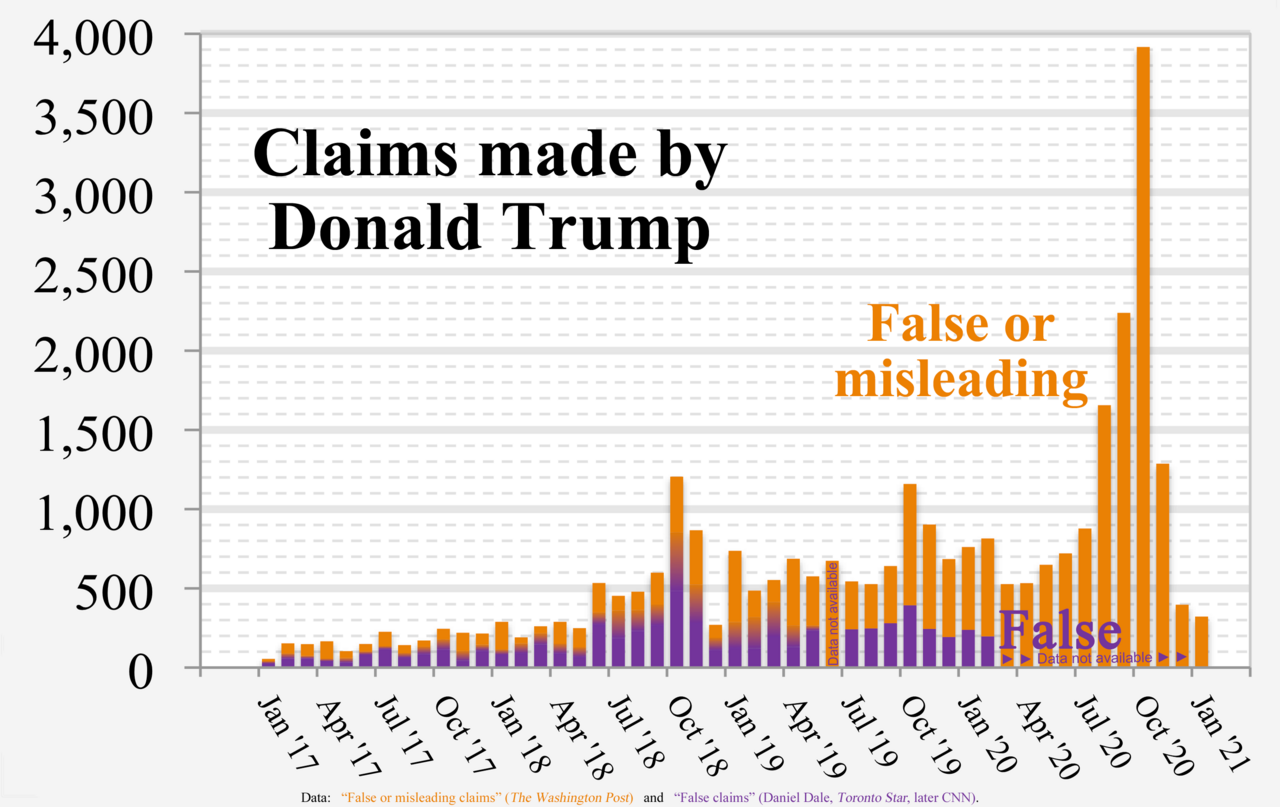
As a candidate and as president, Trump frequently made false statements in public remarks[733][154] to an extent unprecedented in American politics.[733][734][735] His falsehoods became a distinctive part of his political identity.[734]
Trump's false and misleading statements were documented by fact-checkers, including at The Washington Post, which tallied 30,573 false or misleading statements made by Trump over his four-year term.[730] Trump's falsehoods increased in frequency over time, rising from about six false or misleading claims per day in his first year as president to 39 per day in his final year.[736]
Some of Trump's falsehoods were inconsequential, such as his repeated claim of the "biggest inaugural crowd ever".[737][738] Others had more far-reaching effects, such as his promotion of antimalarial drugs as an unproven treatment for COVID-19,[739][740] causing a U.S. shortage of these drugs and panic-buying in Africa and South Asia.[741][742] Other misinformation, such as misattributing a rise in crime in England and Wales to the "spread of radical Islamic terror", served Trump's domestic political purposes.[743] Trump habitually does not apologize for his falsehoods.[744]
Until 2018, the media rarely referred to Trump's falsehoods as lies, including when he repeated demonstrably false statements.[745][746][747]
In 2020, Trump was a significant source of disinformation on mail-in voting and the COVID-19 pandemic.[748][749] His attacks on mail-in ballots and other election practices weakened public faith in the integrity of the 2020 presidential election,[750][751] while his disinformation about the pandemic delayed and weakened the national response to it.[432][748]
Promotion of conspiracy theories
Before and throughout his presidency, Trump promoted numerous conspiracy theories, including Obama birtherism, the Clinton body count conspiracy theory, the conspiracy theory movement QAnon, the Global warming hoax theory, Trump Tower wiretapping allegations, a John F. Kennedy assassination conspiracy theory involving Rafael Cruz, alleged foul-play in the death of Justice Antonin Scalia, alleged Ukrainian interference in U.S. elections, that Osama bin Laden was alive and Obama and Biden had members of Navy SEAL Team 6 killed,[752][753][754][755][756] and linking talk show host Joe Scarborough to the death of a staffer.[757] In at least two instances, Trump clarified to press that he believed the conspiracy theory in question.[754]
During and since the 2020 presidential election, Trump promoted various conspiracy theories for his defeat including dead people voting,[758] voting machines changing or deleting Trump votes, fraudulent mail-in voting, throwing out Trump votes, and "finding" suitcases full of Biden votes.[759][760]
Incitement of violence
Research suggests Trump's rhetoric caused an increased incidence of hate crimes.[761][762] During his 2016 campaign, he urged or praised physical attacks against protesters or reporters.[763][764] Numerous defendants investigated or prosecuted for violent acts and hate crimes, including participants of the January 6, 2021, storming of the U.S. Capitol, cited Trump's rhetoric in arguing that they were not culpable or should receive leniency.[765][766] A nationwide review by ABC News in May 2020 identified at least 54 criminal cases from August 2015 to April 2020 in which Trump was invoked in direct connection with violence or threats of violence mostly by white men and primarily against minorities.[767]
Social media
Trump's social media presence attracted worldwide attention after he joined Twitter in 2009. He tweeted frequently during his 2016 campaign and as president until Twitter banned him after the January 6 attack, in the final days of his term.[768] Trump often used Twitter to communicate directly with the public and sideline the press.[769] In June 2017, the White House press secretary said that Trump's tweets were official presidential statements.[770]
After years of criticism for allowing Trump to post misinformation and falsehoods, Twitter began to tag some of his tweets with fact-checks in May 2020.[771] In response, Trump tweeted that social media platforms "totally silence" conservatives and that he would "strongly regulate, or close them down".[772] In the days after the storming of the Capitol, Trump was banned from Facebook, Instagram, Twitter and other platforms.[773] The loss of his social media presence diminished his ability to shape events[774][775] and prompted a dramatic decrease in the volume of misinformation shared on Twitter.[776] Trump's early attempts to re-establish a social media presence were unsuccessful.[777] In February 2022, he launched social media platform Truth Social where he only attracted a fraction of his Twitter following.[778] Elon Musk, after acquiring Twitter, reinstated Trump's Twitter account in November 2022.[779][780] Meta Platforms' two-year ban lapsed in January 2023, allowing Trump to return to Facebook and Instagram,[781] although in 2024 Trump continued to call the company an "enemy of the people."[782]
Relationship with the press
.jpg/1280px-President_Trump's_First_100_Days-_45_(33573172373).jpg)
Trump sought media attention throughout his career, sustaining a "love-hate" relationship with the press.[783] In the 2016 campaign, Trump benefited from a record amount of free media coverage, elevating his standing in the Republican primaries.[151] The New York Times writer Amy Chozick wrote in 2018 that Trump's media dominance enthralled the public and created "must-see TV."[784]
As a candidate and as president, Trump frequently accused the press of bias, calling it the "fake news media" and "the enemy of the people".[785][786] In 2018, journalist Lesley Stahl recounted Trump's saying he intentionally discredited the media "so when you write negative stories about me no one will believe you".[787]
As president, Trump mused about revoking the press credentials of journalists he viewed as critical.[788] His administration moved to revoke the press passes of two White House reporters, which were restored by the courts.[789] The Trump White House held about a hundred formal press briefings in 2017, declining by half during 2018 and to two in 2019.[789]
Trump also deployed the legal system to intimidate the press.[790] In early 2020, the Trump campaign sued The New York Times, The Washington Post, and CNN for defamation in opinion pieces about Russian election interference.[791][792] All the suits were dismissed.[793][794][795]
Racial views
Many of Trump's comments and actions have been considered racist.[796][797][798] In national polling, about half of respondents said that Trump is racist; a greater proportion believed that he emboldened racists.[799][800] Several studies and surveys found that racist attitudes fueled Trump's political ascent and were more important than economic factors in determining the allegiance of Trump voters.[801][802] Racist and Islamophobic attitudes are a powerful indicator of support for Trump.[803]
In 1975, he settled a 1973 Department of Justice lawsuit that alleged housing discrimination against black renters.[50] He has also been accused of racism for insisting a group of black and Latino teenagers were guilty of raping a white woman in the 1989 Central Park jogger case, even after they were exonerated by DNA evidence in 2002. As of 2019, he maintained this position.[804]
In 2011, when he was reportedly considering a presidential run, he became the leading proponent of the racist "birther" conspiracy theory, alleging that Barack Obama, the first black U.S. president, was not born in the U.S.[805][806] In April, he claimed credit for pressuring the White House to publish the "long-form" birth certificate, which he considered fraudulent, and later said this made him "very popular".[807][808] In September 2016, amid pressure, he acknowledged that Obama was born in the U.S.[809] In 2017, he reportedly expressed birther views privately.[810]
According to an analysis in Political Science Quarterly, Trump made "explicitly racist appeals to whites" during his 2016 presidential campaign.[811] In particular, his campaign launch speech drew widespread criticism for claiming Mexican immigrants were "bringing drugs, they're bringing crime, they're rapists".[812][813] His later comments about a Mexican-American judge presiding over a civil suit regarding Trump University were also criticized as racist.[814]
Trump's comments on the 2017 Unite the Right rally, condemning "this egregious display of hatred, bigotry and violence on many sides" and stating that there were "very fine people on both sides", were widely criticized as implying a moral equivalence between the white supremacist demonstrators and the counter-protesters.[815][816][817][818]
In a January 2018 discussion of immigration legislation, Trump reportedly referred to El Salvador, Haiti, Honduras, and African nations as "shithole countries".[819] His remarks were condemned as racist.[820][821]
In July 2019, Trump tweeted that four Democratic congresswomen—all from minorities, three of whom are native-born Americans—should "go back" to the countries they "came from".[822] Two days later the House of Representatives voted 240–187, mostly along party lines, to condemn his "racist comments".[823] White nationalist publications and social media praised his remarks, which continued over the following days.[824] Trump continued to make similar remarks during his 2020 campaign.[825]
Misogyny and allegations of sexual misconduct
Trump has a history of insulting and belittling women when speaking to the media and on social media.[826][827] He made lewd comments, disparaged women's physical appearances, and referred to them using derogatory epithets.[827][828][829][830] At least 26 women publicly accused Trump of rape, kissing, and groping without consent; looking under women's skirts; and walking in on naked teenage pageant contestants.[831][832][833] Trump has denied the allegations.[833]
In October 2016, two days before the second presidential debate, a 2005 "hot mic" recording surfaced in which Trump was heard bragging about kissing and groping women without their consent, saying that "when you're a star, they let you do it. You can do anything. ... Grab 'em by the pussy."[834] The incident's widespread media exposure led to Trump's first public apology during the campaign[835] and caused outrage across the political spectrum.[836]
Popular culture
Trump has been the subject of comedy and caricature on television, in films, and in comics. He was named in hundreds of hip hop songs from 1989 until 2015; most of these cast Trump in a positive light, but they turned largely negative after he began running for office.[837]
Notes
- ^ Presidential elections in the U.S. are decided by the Electoral College. Each state names a number of electors equal to its representation in Congress and (in most states) all electors vote for the winner of their state's popular vote.
References
- ^ "Donald Trump Steps Up Calls for Obama to Release Birth Certificate". ABC News. March 28, 2011. Retrieved September 11, 2024.
- ^ Kranish & Fisher 2017, p. 33.
- ^ Schwartzman, Paul; Miller, Michael E. (June 22, 2016). "Confident. Incorrigible. Bully: Little Donny was a lot like candidate Donald Trump". The Washington Post. Retrieved June 2, 2024.
- ^ Horowitz, Jason (September 22, 2015). "Donald Trump's Old Queens Neighborhood Contrasts With the Diverse Area Around It". The New York Times. Retrieved November 7, 2018.
- ^ a b Barron, James (September 5, 2016). "Overlooked Influences on Donald Trump: A Famous Minister and His Church". The New York Times. Retrieved October 13, 2016.
- ^ a b Scott, Eugene (August 28, 2015). "Church says Donald Trump is not an 'active member'". CNN. Retrieved September 14, 2022.
- ^ Kranish & Fisher 2017, p. 38.
- ^ "Two Hundred and Twelfth Commencement for the Conferring of Degrees" (PDF). University of Pennsylvania. May 20, 1968. pp. 19–21. Retrieved March 31, 2023.
- ^ Viser, Matt (August 28, 2015). "Even in college, Donald Trump was brash". The Boston Globe. Retrieved May 28, 2018.
- ^ Ashford, Grace (February 27, 2019). "Michael Cohen Says Trump Told Him to Threaten Schools Not to Release Grades". The New York Times. Retrieved June 9, 2019.
- ^ Montopoli, Brian (April 29, 2011). "Donald Trump avoided Vietnam with deferments, records show". CBS News. Retrieved July 17, 2015.
- ^ a b Whitlock, Craig (July 21, 2015). "Questions linger about Trump's draft deferments during Vietnam War". The Washington Post. Retrieved April 2, 2017.
- ^ "Donald John Trump's Selective Service Draft Card and Selective Service Classification Ledger". National Archives. March 14, 2019. Retrieved September 23, 2019. – via Freedom of Information Act (FOIA)
- ^ a b Eder, Steve; Philipps, Dave (August 1, 2016). "Donald Trump's Draft Deferments: Four for College, One for Bad Feet". The New York Times. Retrieved August 2, 2016.
- ^ Blair 2015, p. 300.
- ^ Baron, James (December 12, 1990). "Trumps Get Divorce; Next, Who Gets What?". The New York Times. Retrieved March 5, 2023.
- ^ Hafner, Josh (July 19, 2016). "Get to know Donald's other daughter: Tiffany Trump". USA Today. Retrieved July 10, 2022.
- ^ Brown, Tina (January 27, 2005). "Donald Trump, Settling Down". The Washington Post. Retrieved May 7, 2017.
- ^ "Donald Trump Fast Facts". CNN. July 2, 2021. Retrieved September 29, 2021.
- ^ Schwartzman, Paul (January 21, 2016). "How Trump got religion – and why his legendary minister's son now rejects him". The Washington Post. Retrieved March 18, 2017.
- ^ Peters, Jeremy W.; Haberman, Maggie (October 31, 2019). "Paula White, Trump's Personal Pastor, Joins the White House". The New York Times. Retrieved September 29, 2021.
- ^ Jenkins, Jack; Mwaura, Maina (October 23, 2020). "Exclusive: Trump, confirmed a Presbyterian, now identifies as 'non-denominational Christian'". Religion News Service. Retrieved September 29, 2021.
- ^ Nagourney, Adam (October 30, 2020). "In Trump and Biden, a Choice of Teetotalers for President". The New York Times. Retrieved February 5, 2021.
- ^ Parker, Ashley; Rucker, Philip (October 2, 2018). "Kavanaugh likes beer — but Trump is a teetotaler: 'He doesn't like drinkers.'". The Washington Post. Retrieved February 5, 2021.
- ^ Dangerfield, Katie (January 17, 2018). "Donald Trump sleeps 4-5 hours each night; he's not the only famous 'short sleeper'". Global News. Retrieved February 5, 2021.
- ^ Almond, Douglas; Du, Xinming (December 2020). "Later bedtimes predict President Trump's performance". Economics Letters. 197. doi:10.1016/j.econlet.2020.109590. ISSN 0165-1765. PMC 7518119. PMID 33012904.
- ^ Ballengee, Ryan (July 14, 2018). "Donald Trump says he gets most of his exercise from golf, then uses cart at Turnberry". Golf News Net. Retrieved July 4, 2019.
- ^ Rettner, Rachael (May 14, 2017). "Trump thinks that exercising too much uses up the body's 'finite' energy". The Washington Post. Retrieved September 29, 2021.
- ^ O'Donnell & Rutherford 1991, p. 133.
- ^ a b Marquardt, Alex; Crook, Lawrence III (May 1, 2018). "Exclusive: Bornstein claims Trump dictated the glowing health letter". CNN. Retrieved May 20, 2018.
- ^ Schecter, Anna (May 1, 2018). "Trump doctor Harold Bornstein says bodyguard, lawyer 'raided' his office, took medical files". NBC News. Retrieved June 6, 2019.
- ^ a b c d 1634–1699: McCusker, J. J. (1997). How Much Is That in Real Money? A Historical Price Index for Use as a Deflator of Money Values in the Economy of the United States: Addenda et Corrigenda (PDF). American Antiquarian Society. 1700–1799: McCusker, J. J. (1992). How Much Is That in Real Money? A Historical Price Index for Use as a Deflator of Money Values in the Economy of the United States (PDF). American Antiquarian Society. 1800–present: Federal Reserve Bank of Minneapolis. "Consumer Price Index (estimate) 1800–". Retrieved February 29, 2024.
- ^ O'Brien, Timothy L. (October 23, 2005). "What's He Really Worth?". The New York Times. Retrieved February 25, 2016.
- ^ a b Diamond, Jeremy; Frates, Chris (July 22, 2015). "Donald Trump's 92-page financial disclosure released". CNN. Retrieved September 14, 2022.
- ^ Walsh, John (October 3, 2018). "Trump has fallen 138 spots on Forbes' wealthiest-Americans list, his net worth down over $1 billion, since he announced his presidential bid in 2015". Business Insider. Retrieved October 12, 2021.
- ^ "Profile Donald Trump". Forbes. 2024. Retrieved March 28, 2024.
- ^ Greenberg, Jonathan (April 20, 2018). "Trump lied to me about his wealth to get onto the Forbes 400. Here are the tapes". The Washington Post. Retrieved September 29, 2021.
- ^ Stump, Scott (October 26, 2015). "Donald Trump: My dad gave me 'a small loan' of $1 million to get started". CNBC. Retrieved November 13, 2016.
- ^ Barstow, David; Craig, Susanne; Buettner, Russ (October 2, 2018). "11 Takeaways From The Times's Investigation into Trump's Wealth". The New York Times. Retrieved October 3, 2018.
- ^ a b c d Barstow, David; Craig, Susanne; Buettner, Russ (October 2, 2018). "Trump Engaged in Suspect Tax Schemes as He Reaped Riches From His Father". The New York Times. Retrieved October 2, 2018.
- ^ "From the Tower to the White House". The Economist. February 20, 2016. Retrieved February 29, 2016.
Mr Trump's performance has been mediocre compared with the stockmarket and property in New York.
- ^ Swanson, Ana (February 29, 2016). "The myth and the reality of Donald Trump's business empire". The Washington Post. Retrieved September 29, 2021.
- ^ Alexander, Dan; Peterson-Whithorn, Chase (October 2, 2018). "How Trump Is Trying—And Failing—To Get Rich Off His Presidency". Forbes. Retrieved September 29, 2021.
- ^ a b c Buettner, Russ; Craig, Susanne (May 7, 2019). "Decade in the Red: Trump Tax Figures Show Over $1 Billion in Business Losses". The New York Times. Retrieved May 8, 2019.
- ^ Friedersdorf, Conor (May 8, 2019). "The Secret That Was Hiding in Trump's Taxes". The Atlantic. Retrieved May 8, 2019.
- ^ Buettner, Russ; Craig, Susanne; McIntire, Mike (September 27, 2020). "Long-concealed Records Show Trump's Chronic Losses And Years Of Tax Avoidance". The New York Times. Retrieved September 28, 2020.
- ^ Alexander, Dan (October 7, 2021). "Trump's Debt Now Totals An Estimated $1.3 Billion". Forbes. Retrieved December 21, 2023.
- ^ Alexander, Dan (October 16, 2020). "Donald Trump Has at Least $1 Billion in Debt, More Than Twice The Amount He Suggested". Forbes. Retrieved October 17, 2020.
- ^ Handy, Bruce (April 1, 2019). "Trump Once Proposed Building a Castle on Madison Avenue". The Atlantic. Retrieved July 28, 2024.
- ^ a b Mahler, Jonathan; Eder, Steve (August 27, 2016). "'No Vacancies' for Blacks: How Donald Trump Got His Start, and Was First Accused of Bias". The New York Times. Retrieved January 13, 2018.
- ^ a b Rich, Frank (April 30, 2018). "The Original Donald Trump". New York. Retrieved May 8, 2018.
- ^ Blair 2015, p. 250.
- ^ Qiu, Linda (June 21, 2016). "Yep, Donald Trump's companies have declared bankruptcy...more than four times". PolitiFact. Retrieved May 25, 2023.
- ^ Nevius, James (April 3, 2019). "The winding history of Donald Trump's first major Manhattan real estate project". Curbed.
- ^ Kessler, Glenn (March 3, 2016). "Trump's false claim he built his empire with a 'small loan' from his father". The Washington Post. Retrieved September 29, 2021.
- ^ Kranish & Fisher 2017, p. 84.
- ^ Geist, William E. (April 8, 1984). "The Expanding Empire of Donald Trump". The New York Times. Retrieved September 29, 2021.
- ^ Jacobs, Shayna; Fahrenthold, David A.; O'Connell, Jonathan; Dawsey, Josh (September 3, 2021). "Trump Tower's key tenants have fallen behind on rent and moved out. But Trump has one reliable customer: His own PAC". The Washington Post. Retrieved February 15, 2022.
- ^ a b c Haberman, Maggie (October 31, 2019). "Trump, Lifelong New Yorker, Declares Himself a Resident of Florida". The New York Times. Retrieved January 24, 2020.
- ^ "Trump Revises Plaza Loan". The New York Times. November 4, 1992. Retrieved May 23, 2023.
- ^ "Trump's Plaza Hotel Bankruptcy Plan Approved". The New York Times. Reuters. December 12, 1992. Retrieved May 24, 2023.
- ^ a b Segal, David (January 16, 2016). "What Donald Trump's Plaza Deal Reveals About His White House Bid". The New York Times. Retrieved May 3, 2022.
- ^ Stout, David; Gilpin, Kenneth N. (April 12, 1995). "Trump Is Selling Plaza Hotel To Saudi and Asian Investors". The New York Times. Retrieved July 18, 2019.
- ^ Kranish & Fisher 2017, p. 298.
- ^ Bagli, Charles V. (June 1, 2005). "Trump Group Selling West Side Parcel for $1.8 billion". The New York Times. Retrieved May 17, 2016.
- ^ Buettner, Russ; Kiel, Paul (May 11, 2024). "Trump May Owe $100 Million From Double-Dip Tax Breaks, Audit Shows". The New York Times. Retrieved August 26, 2024.
- ^ Kiel, Paul; Buettner, Russ (May 11, 2024). "IRS Audit of Trump Could Cost Former President More Than $100 Million". ProPublica. Retrieved August 26, 2024.
- ^ a b c McQuade, Dan (August 16, 2015). "The Truth About the Rise and Fall of Donald Trump's Atlantic City Empire". Philadelphia. Retrieved March 21, 2016.
- ^ Kranish & Fisher 2017, p. 128.
- ^ Saxon, Wolfgang (April 28, 1986). "Trump Buys Hilton's Hotel in Atlantic City". The New York Times. Retrieved May 25, 2023.
- ^ "Trump's Castle and Plaza file for bankruptcy". United Press International. March 9, 1992. Retrieved May 25, 2023.
- ^ Glynn, Lenny (April 8, 1990). "Trump's Taj – Open at Last, With a Scary Appetite". The New York Times. Retrieved August 14, 2016.
- ^ Kranish & Fisher 2017, p. 135.
- ^ "Company News; Taj Mahal is out of Bankruptcy". The New York Times. October 5, 1991. Retrieved May 22, 2008.
- ^ O'Connor, Claire (May 29, 2011). "Fourth Time's A Charm: How Donald Trump Made Bankruptcy Work For Him". Forbes. Retrieved January 27, 2022.
- ^ Norris, Floyd (June 7, 1995). "Trump Plaza casino stock trades today on Big Board". The New York Times. Retrieved December 14, 2014.
- ^ Tully, Shawn (March 10, 2016). "How Donald Trump Made Millions Off His Biggest Business Failure". Fortune. Retrieved May 6, 2018.
- ^ Peterson-Withorn, Chase (April 23, 2018). "Donald Trump Has Gained More Than $100 Million On Mar-a-Lago". Forbes. Retrieved July 4, 2018.
- ^ Dangremond, Sam; Kim, Leena (December 22, 2017). "A History of Mar-a-Lago, Donald Trump's American Castle". Town & Country. Retrieved July 3, 2018.
- ^ a b Garcia, Ahiza (December 29, 2016). "Trump's 17 golf courses teed up: Everything you need to know". CNN Money. Retrieved January 21, 2018.
- ^ "Take a look at the golf courses owned by Donald Trump". Golfweek. July 24, 2020. Retrieved July 7, 2021.
- ^ a b Anthony, Zane; Sanders, Kathryn; Fahrenthold, David A. (April 13, 2018). "Whatever happened to Trump neckties? They're over. So is most of Trump's merchandising empire". The Washington Post. Retrieved September 29, 2021.
- ^ Martin, Jonathan (June 29, 2016). "Trump Institute Offered Get-Rich Schemes With Plagiarized Lessons". The New York Times. Retrieved January 8, 2021.
- ^ Williams, Aaron; Narayanswamy, Anu (January 25, 2017). "How Trump has made millions by selling his name". The Washington Post. Retrieved December 12, 2017.
- ^ Markazi, Arash (July 14, 2015). "5 things to know about Donald Trump's foray into doomed USFL". ESPN. Retrieved September 30, 2021.
- ^ Morris, David Z. (September 24, 2017). "Donald Trump Fought the NFL Once Before. He Got Crushed". Fortune. Retrieved June 22, 2018.
- ^ O'Donnell & Rutherford 1991, p. 137–143.
- ^ Hogan, Kevin (April 10, 2016). "The Strange Tale of Donald Trump's 1989 Biking Extravaganza". Politico. Retrieved April 12, 2016.
- ^ Mattingly, Phil; Jorgensen, Sarah (August 23, 2016). "The Gordon Gekko era: Donald Trump's lucrative and controversial time as an activist investor". CNN. Retrieved September 14, 2022.
- ^ Peterson, Barbara (April 13, 2017). "The Crash of Trump Air". The Daily Beast. Retrieved May 17, 2023.
- ^ "10 Donald Trump Business Failures". Time. October 11, 2016. Retrieved May 17, 2023.
- ^ Blair, Gwenda (October 7, 2018). "Did the Trump Family Historian Drop a Dime to the New York Times?". Politico. Retrieved August 14, 2020.
- ^ Koblin, John (September 14, 2015). "Trump Sells Miss Universe Organization to WME-IMG Talent Agency". The New York Times. Retrieved January 9, 2016.
- ^ Nededog, Jethro (September 14, 2015). "Donald Trump just sold off the entire Miss Universe Organization after buying it 3 days ago". Business Insider. Retrieved May 6, 2016.
- ^ Rutenberg, Jim (June 22, 2002). "Three Beauty Pageants Leaving CBS for NBC". The New York Times. Retrieved August 14, 2016.
- ^ de Moraes, Lisa (June 22, 2002). "There She Goes: Pageants Move to NBC". The Washington Post. Retrieved August 14, 2016.
- ^ Zara, Christopher (October 26, 2016). "Why the heck does Donald Trump have a Walk of Fame star, anyway? It's not the reason you think". Fast Company. Retrieved June 16, 2018.
- ^ Puente, Maria (June 29, 2015). "NBC to Donald Trump: You're fired". USA Today. Retrieved July 28, 2015.
- ^ Cohan, William D. (December 3, 2013). "Big Hair on Campus: Did Donald Trump Defraud Thousands of Real Estate Students?". Vanity Fair. Retrieved March 6, 2016.
- ^ Barbaro, Michael (May 19, 2011). "New York Attorney General Is Investigating Trump's For-Profit School". The New York Times. Retrieved September 30, 2021.
- ^ Lee, Michelle Ye Hee (February 27, 2016). "Donald Trump's misleading claim that he's 'won most of' lawsuits over Trump University". The Washington Post. Retrieved February 27, 2016.
- ^ McCoy, Kevin (August 26, 2013). "Trump faces two-front legal fight over 'university'". USA Today. Retrieved September 29, 2021.
- ^ Barbaro, Michael; Eder, Steve (May 31, 2016). "Former Trump University Workers Call the School a 'Lie' and a 'Scheme' in Testimony". The New York Times. Retrieved March 24, 2018.
- ^ Montanaro, Domenico (June 1, 2016). "Hard Sell: The Potential Political Consequences of the Trump University Documents". NPR. Retrieved June 2, 2016.
- ^ Eder, Steve (November 18, 2016). "Donald Trump Agrees to Pay $25 Million in Trump University Settlement". The New York Times. Retrieved November 18, 2016.
- ^ Tigas, Mike; Wei, Sisi (May 9, 2013). "Nonprofit Explorer". ProPublica. Retrieved September 9, 2016.
- ^ Fahrenthold, David A. (September 1, 2016). "Trump pays IRS a penalty for his foundation violating rules with gift to aid Florida attorney general". The Washington Post. Retrieved September 30, 2021.
- ^ a b Fahrenthold, David A. (September 10, 2016). "How Donald Trump retooled his charity to spend other people's money". The Washington Post. Retrieved March 19, 2024.
- ^ Pallotta, Frank (August 18, 2022). "Investigation into Vince McMahon's hush money payments reportedly turns up Trump charity donations". CNN. Retrieved March 19, 2024.
- ^ Solnik, Claude (September 15, 2016). "Taking a peek at Trump's (foundation) tax returns". Long Island Business News. Retrieved September 30, 2021.
- ^ Cillizza, Chris; Fahrenthold, David A. (September 15, 2016). "Meet the reporter who's giving Donald Trump fits". The Washington Post. Retrieved June 26, 2021.
- ^ Fahrenthold, David A. (October 3, 2016). "Trump Foundation ordered to stop fundraising by N.Y. attorney general's office". The Washington Post. Retrieved May 17, 2023.
- ^ Jacobs, Ben (December 24, 2016). "Donald Trump to dissolve his charitable foundation after mounting complaints". The Guardian. Retrieved December 25, 2016.
- ^ Thomsen, Jacqueline (June 14, 2018). "Five things to know about the lawsuit against the Trump Foundation". The Hill. Retrieved June 15, 2018.
- ^ Goldmacher, Shane (December 18, 2018). "Trump Foundation Will Dissolve, Accused of 'Shocking Pattern of Illegality'". The New York Times. Retrieved May 9, 2019.
- ^ Katersky, Aaron (November 7, 2019). "President Donald Trump ordered to pay $2M to collection of nonprofits as part of civil lawsuit". ABC News. Retrieved November 7, 2019.
- ^ "Judge orders Trump to pay $2m for misusing Trump Foundation funds". BBC News. November 8, 2019. Retrieved March 5, 2020.
- ^ a b Mahler, Jonathan; Flegenheimer, Matt (June 20, 2016). "What Donald Trump Learned From Joseph McCarthy's Right-Hand Man". The New York Times. Retrieved May 26, 2020.
- ^ Kranish, Michael; O'Harrow, Robert Jr. (January 23, 2016). "Inside the government's racial bias case against Donald Trump's company, and how he fought it". The Washington Post. Retrieved January 7, 2021.
- ^ Dunlap, David W. (July 30, 2015). "1973: Meet Donald Trump". The New York Times. Retrieved May 26, 2020.
- ^ Brenner, Marie (June 28, 2017). "How Donald Trump and Roy Cohn's Ruthless Symbiosis Changed America". Vanity Fair. Retrieved May 26, 2020.
- ^ "Donald Trump: Three decades, 4,095 lawsuits". USA Today. Archived from the original on April 17, 2018. Retrieved April 17, 2018.
- ^ a b Winter, Tom (June 24, 2016). "Trump Bankruptcy Math Doesn't Add Up". NBC News. Retrieved February 26, 2020.
- ^ Flitter, Emily (July 17, 2016). "Art of the spin: Trump bankers question his portrayal of financial comeback". Reuters. Retrieved October 14, 2018.
- ^ Smith, Allan (December 8, 2017). "Trump's long and winding history with Deutsche Bank could now be at the center of Robert Mueller's investigation". Business Insider. Retrieved October 14, 2018.
- ^ Riley, Charles; Egan, Matt (January 12, 2021). "Deutsche Bank won't do any more business with Trump". CNN. Retrieved September 14, 2022.
- ^ Buncombe, Andrew (July 4, 2018). "Trump boasted about writing many books – his ghostwriter says otherwise". The Independent. Retrieved October 11, 2020.
- ^ a b Mayer, Jane (July 18, 2016). "Donald Trump's Ghostwriter Tells All". The New Yorker. Retrieved June 19, 2017.
- ^ LaFrance, Adrienne (December 21, 2015). "Three Decades of Donald Trump Film and TV Cameos". The Atlantic.
- ^ Kranish & Fisher 2017, p. 166.
- ^ Silverman, Stephen M. (April 29, 2004). "The Donald to Get New Wife, Radio Show". People. Retrieved November 19, 2013.
- ^ Tedeschi, Bob (February 6, 2006). "Now for Sale Online, the Art of the Vacation". The New York Times. Retrieved October 21, 2018.
- ^ Montopoli, Brian (April 1, 2011). "Donald Trump gets regular Fox News spot". CBS News. Retrieved July 7, 2018.
- ^ Grossmann, Matt; Hopkins, David A. (September 9, 2016). "How the conservative media is taking over the Republican Party". The Washington Post. Retrieved October 19, 2018.
- ^ Grynbaum, Michael M.; Parker, Ashley (July 16, 2016). "Donald Trump the Political Showman, Born on 'The Apprentice'". The New York Times. Retrieved July 8, 2018.
- ^ Nussbaum, Emily (July 24, 2017). "The TV That Created Donald Trump". The New Yorker. Retrieved October 18, 2023.
- ^ Poniewozik, James (September 28, 2020). "Donald Trump Was the Real Winner of 'The Apprentice'". The New York Times. Retrieved October 18, 2023.
- ^ Rao, Sonia (February 4, 2021). "Facing expulsion, Trump resigns from the Screen Actors Guild: 'You have done nothing for me'". The Washington Post. Retrieved February 5, 2021.
- ^ Harmata, Claudia (February 7, 2021). "Donald Trump Banned from Future Re-Admission to SAG-AFTRA: It's 'More Than a Symbolic Step'". People. Retrieved February 8, 2021.
- ^ a b Gillin, Joshua (August 24, 2015). "Bush says Trump was a Democrat longer than a Republican 'in the last decade'". PolitiFact. Retrieved March 18, 2017.
- ^ "Trump Officially Joins Reform Party". CNN. October 25, 1999. Retrieved December 26, 2020.
- ^ Oreskes, Michael (September 2, 1987). "Trump Gives a Vague Hint of Candidacy". The New York Times. Retrieved February 17, 2016.
- ^ Butterfield, Fox (November 18, 1987). "Trump Urged To Head Gala Of Democrats". The New York Times. Retrieved October 1, 2021.
- ^ Meacham, Jon (2016). Destiny and Power: The American Odyssey of George Herbert Walker Bush. Random House. p. 326. ISBN 978-0-8129-7947-3.
- ^ Winger, Richard (December 25, 2011). "Donald Trump Ran For President in 2000 in Several Reform Party Presidential Primaries". Ballot Access News. Retrieved October 1, 2021.
- ^ Clift, Eleanor (July 18, 2016). "The Last Time Trump Wrecked a Party". The Daily Beast. Retrieved October 14, 2021.
- ^ Nagourney, Adam (February 14, 2000). "Reform Bid Said to Be a No-Go for Trump". The New York Times. Retrieved December 26, 2020.
- ^ a b MacAskill, Ewen (May 16, 2011). "Donald Trump bows out of 2012 US presidential election race". The Guardian. Retrieved February 28, 2020.
- ^ Bobic, Igor; Stein, Sam (February 22, 2017). "How CPAC Helped Launch Donald Trump's Political Career". HuffPost. Retrieved February 28, 2020.
- ^ Linkins, Jason (February 11, 2011). "Donald Trump Brings His 'Pretend To Run For President' Act To CPAC". HuffPost. Retrieved September 14, 2022.
- ^ a b Cillizza, Chris (June 14, 2016). "This Harvard study is a powerful indictment of the media's role in Donald Trump's rise". The Washington Post. Retrieved October 1, 2021.
- ^ Flitter, Emily; Oliphant, James (August 28, 2015). "Best president ever! How Trump's love of hyperbole could backfire". Reuters. Retrieved October 1, 2021.
- ^ McCammon, Sarah (August 10, 2016). "Donald Trump's controversial speech often walks the line". NPR. Retrieved October 1, 2021.
- ^ a b "The 'King of Whoppers': Donald Trump". FactCheck.org. December 21, 2015. Retrieved March 4, 2019.
- ^ Holan, Angie Drobnic; Qiu, Linda (December 21, 2015). "2015 Lie of the Year: the campaign misstatements of Donald Trump". PolitiFact. Retrieved October 1, 2021.
- ^ Farhi, Paul (February 26, 2016). "Think Trump's wrong? Fact checkers can tell you how often. (Hint: A lot.)". The Washington Post. Retrieved October 1, 2021.
- ^ Walsh, Kenneth T. (August 15, 2016). "Trump: Media Is 'Dishonest and Corrupt'". U.S. News & World Report. Retrieved October 1, 2021.
- ^ Blake, Aaron (July 6, 2016). "Donald Trump is waging war on political correctness. And he's losing". The Washington Post. Retrieved October 1, 2021.
- ^ Lerner, Adam B. (June 16, 2015). "The 10 best lines from Donald Trump's announcement speech". Politico. Retrieved June 7, 2018.
- ^ Graham, David A. (May 13, 2016). "The Lie of Trump's 'Self-Funding' Campaign". The Atlantic. Retrieved June 7, 2018.
- ^ Reeve, Elspeth (October 27, 2015). "How Donald Trump Evolved From a Joke to an Almost Serious Candidate". The New Republic. Retrieved July 23, 2018.
- ^ Bump, Philip (March 23, 2016). "Why Donald Trump is poised to win the nomination and lose the general election, in one poll". The Washington Post. Retrieved October 1, 2021.
- ^ Nussbaum, Matthew (May 3, 2016). "RNC Chairman: Trump is our nominee". Politico. Retrieved May 4, 2016.
- ^ Hartig, Hannah; Lapinski, John; Psyllos, Stephanie (July 19, 2016). "Poll: Clinton and Trump Now Tied as GOP Convention Kicks Off". NBC News. Retrieved October 1, 2021.
- ^ "2016 General Election: Trump vs. Clinton". HuffPost. Archived from the original on October 2, 2016. Retrieved November 8, 2016.
- ^ Levingston, Ivan (July 15, 2016). "Donald Trump officially names Mike Pence for VP". CNBC. Retrieved October 1, 2021.
- ^ "Trump closes the deal, becomes Republican nominee for president". Fox News. July 19, 2016. Retrieved October 1, 2021.
- ^ "US presidential debate: Trump won't commit to accept election result". BBC News. October 20, 2016. Retrieved October 27, 2016.
- ^ "The Republican Party has lurched towards populism and illiberalism". The Economist. October 31, 2020. Retrieved October 14, 2021.
- ^ Borger, Julian (October 26, 2021). "Republicans closely resemble autocratic parties in Hungary and Turkey – study". The Guardian. Retrieved October 14, 2021.
- ^ Chotiner, Isaac (July 29, 2021). "Redefining Populism". The New Yorker. Retrieved October 14, 2021.
- ^ Noah, Timothy (July 26, 2015). "Will the real Donald Trump please stand up?". Politico. Retrieved October 1, 2021.
- ^ Timm, Jane C. (March 30, 2016). "A Full List of Donald Trump's Rapidly Changing Policy Positions". NBC News. Retrieved July 12, 2016.
- ^ Johnson, Jenna (April 12, 2017). "Trump on NATO: 'I said it was obsolete. It's no longer obsolete.'". The Washington Post. Retrieved November 26, 2019.
- ^ Edwards, Jason A. (2018). "Make America Great Again: Donald Trump and Redefining the U.S. Role in the World". Communication Quarterly. 66 (2): 176. doi:10.1080/01463373.2018.1438485.
On the campaign trail, Trump repeatedly called North Atlantic Treaty Organization (NATO) 'obsolete'.
- ^ Rucker, Philip; Costa, Robert (March 21, 2016). "Trump questions need for NATO, outlines noninterventionist foreign policy". The Washington Post. Retrieved August 24, 2021.
- ^ "Trump's promises before and after the election". BBC. September 19, 2017. Retrieved October 1, 2021.
- ^ Bierman, Noah (August 22, 2016). "Donald Trump helps bring far-right media's edgier elements into the mainstream". Los Angeles Times. Retrieved October 7, 2021.
- ^ Wilson, Jason (November 15, 2016). "Clickbait scoops and an engaged alt-right: everything to know about Breitbart News". The Guardian. Retrieved November 18, 2016.
- ^ Weigel, David (August 20, 2016). "'Racialists' are cheered by Trump's latest strategy". The Washington Post. Retrieved June 23, 2018.
- ^ Krieg, Gregory (August 25, 2016). "Clinton is attacking the 'Alt-Right' – What is it?". CNN. Retrieved August 25, 2016.
- ^ Pierce, Matt (September 20, 2020). "Q&A: What is President Trump's relationship with far-right and white supremacist groups?". Los Angeles Times. Retrieved October 7, 2021.
- ^ Executive Branch Personnel Public Financial Disclosure Report (U.S. OGE Form 278e) (PDF). U.S. Office of Government Ethics (Report). July 15, 2015. Archived from the original (PDF) on July 23, 2015. Retrieved December 21, 2023 – via Bloomberg Businessweek.
- ^ Rappeport, Alan (May 11, 2016). "Donald Trump Breaks With Recent History by Not Releasing Tax Returns". The New York Times. Retrieved July 19, 2016.
- ^ Qiu, Linda (October 5, 2016). "Pence's False claim that Trump 'hasn't broken' tax return promise". PolitiFact. Retrieved April 29, 2020.
- ^ Isidore, Chris; Sahadi, Jeanne (February 26, 2016). "Trump says he can't release tax returns because of audits". CNN. Retrieved March 1, 2023.
- ^ de Vogue, Ariane (February 22, 2021). "Supreme Court allows release of Trump tax returns to NY prosecutor". CNN. Retrieved September 14, 2022.
- ^ Gresko, Jessica (February 22, 2021). "Supreme Court won't halt turnover of Trump's tax records". AP News. Retrieved October 2, 2021.
- ^ Eder, Steve; Twohey, Megan (October 10, 2016). "Donald Trump Acknowledges Not Paying Federal Income Taxes for Years". The New York Times. Retrieved October 2, 2021.
- ^ Schmidt, Kiersten; Andrews, Wilson (December 19, 2016). "A Historic Number of Electors Defected, and Most Were Supposed to Vote for Clinton". The New York Times. Retrieved January 31, 2017.
- ^ Desilver, Drew (December 20, 2016). "Trump's victory another example of how Electoral College wins are bigger than popular vote ones". Pew Research Center. Retrieved October 2, 2021.
- ^ Crockett, Zachary (November 11, 2016). "Donald Trump will be the only US president ever with no political or military experience". Vox. Retrieved January 3, 2017.
- ^ Goldmacher, Shane; Schreckinger, Ben (November 9, 2016). "Trump pulls off biggest upset in U.S. history". Politico. Retrieved November 9, 2016.
- ^ Cohn, Nate (November 9, 2016). "Why Trump Won: Working-Class Whites". The New York Times. Retrieved November 9, 2016.
- ^ Phillips, Amber (November 9, 2016). "Republicans are poised to grasp the holy grail of governance". The Washington Post. Retrieved October 2, 2021.
- ^ Logan, Brian; Sanchez, Chris (November 10, 2016). "Protests against Donald Trump break out nationwide". Business Insider. Retrieved September 16, 2022.
- ^ Mele, Christopher; Correal, Annie (November 9, 2016). "'Not Our President': Protests Spread After Donald Trump's Election". The New York Times. Retrieved May 10, 2024.
- ^ Przybyla, Heidi M.; Schouten, Fredreka (January 21, 2017). "At 2.6 million strong, Women's Marches crush expectations". USA Today. Retrieved January 22, 2017.
- ^ Quigley, Aidan (January 25, 2017). "All of Trump's executive actions so far". Politico. Retrieved January 28, 2017.
- ^ V.V.B (March 31, 2017). "Ivanka Trump's new job". The Economist. Retrieved April 3, 2017.
- ^ Schmidt, Michael S.; Lipton, Eric; Savage, Charlie (January 21, 2017). "Jared Kushner, Trump's Son-in-Law, Is Cleared to Serve as Adviser". The New York Times. Retrieved May 7, 2017.
- ^ Geewax, Marilyn (January 20, 2018). "Trump Has Revealed Assumptions About Handling Presidential Wealth, Businesses". NPR. Retrieved October 2, 2021.
- ^ a b c "Donald Trump: A list of potential conflicts of interest". BBC. April 18, 2017. Retrieved October 2, 2021.
- ^ Yourish, Karen; Buchanan, Larry (January 12, 2017). "It 'Falls Short in Every Respect': Ethics Experts Pan Trump's Conflicts Plan". The New York Times. Retrieved September 3, 2024.
- ^ a b Venook, Jeremy (August 9, 2017). "Trump's Interests vs. America's, Dubai Edition". The Atlantic. Retrieved October 2, 2021.
- ^ In Focus: The Emoluments Clauses of the U.S. Constitution (PDF). Congressional Research Service (Report). August 19, 2020. Retrieved October 2, 2021.
- ^ LaFraniere, Sharon (January 25, 2018). "Lawsuit on Trump Emoluments Violations Gains Traction in Court". The New York Times. Retrieved January 25, 2018.
- ^ de Vogue, Ariane; Cole, Devan (January 25, 2021). "Supreme Court dismisses emoluments cases against Trump". CNN. Retrieved September 14, 2022.
- ^ Bump, Philip (January 20, 2021). "Trump's presidency ends where so much of it was spent: A Trump Organization property". The Washington Post. Retrieved January 27, 2022.
- ^ a b Van Dam, Andrew (January 8, 2021). "Trump will have the worst jobs record in modern U.S. history. It's not just the pandemic". The Washington Post. Retrieved October 2, 2021.
- ^ Smialek, Jeanna (June 8, 2020). "The U.S. Entered a Recession in February". The New York Times. Retrieved June 10, 2020.
- ^ Long, Heather (December 15, 2017). "The final GOP tax bill is complete. Here's what is in it". The Washington Post. Retrieved July 31, 2021.
- ^ Andrews, Wilson; Parlapiano, Alicia (December 15, 2017). "What's in the Final Republican Tax Bill". The New York Times. Retrieved December 22, 2017.
- ^ Gale, William G. (February 14, 2020). "Did the 2017 tax cut—the Tax Cuts and Jobs Act—pay for itself?". Brookings Institution. Retrieved July 31, 2021.
- ^ Long, Heather; Stein, Jeff (October 25, 2019). "The U.S. deficit hit $984 billion in 2019, soaring during Trump era". The Washington Post. Retrieved June 10, 2020.
- ^ Sloan, Allan; Podkul, Cezary (January 14, 2021). "Donald Trump Built a National Debt So Big (Even Before the Pandemic) That It'll Weigh Down the Economy for Years". ProPublica. Retrieved October 3, 2021.
- ^ Bliss, Laura (November 16, 2020). "How Trump's $1 Trillion Infrastructure Pledge Added Up". Bloomberg News. Retrieved December 29, 2021.
- ^ Burns, Dan (January 8, 2021). "Trump ends his term like a growing number of Americans: out of a job". Reuters. Retrieved May 10, 2024.
- ^ Parker, Ashley; Davenport, Coral (May 26, 2016). "Donald Trump's Energy Plan: More Fossil Fuels and Fewer Rules". The New York Times. Retrieved October 3, 2021.
- ^ Samenow, Jason (March 22, 2016). "Donald Trump's unsettling nonsense on weather and climate". The Washington Post. Retrieved October 3, 2021.
- ^ Lemire, Jonathan; Madhani, Aamer; Weissert, Will; Knickmeyer, Ellen (September 15, 2020). "Trump spurns science on climate: 'Don't think science knows'". AP News. Retrieved May 11, 2024.
- ^ Plumer, Brad; Davenport, Coral (December 28, 2019). "Science Under Attack: How Trump Is Sidelining Researchers and Their Work". The New York Times. Retrieved May 11, 2024.
- ^ "Trump proposes cuts to climate and clean-energy programs". National Geographic Society. May 3, 2019. Retrieved November 24, 2023.
- ^ Dennis, Brady (November 7, 2017). "As Syria embraces Paris climate deal, it's the United States against the world". The Washington Post. Retrieved May 28, 2018.
- ^ Gardner, Timothy (December 3, 2019). "Senate confirms Brouillette, former Ford lobbyist, as energy secretary". Reuters. Retrieved December 15, 2019.
- ^ Brown, Matthew (September 15, 2020). "Trump's fossil fuel agenda gets pushback from federal judges". AP News. Retrieved October 3, 2021.
- ^ Lipton, Eric (October 5, 2020). "'The Coal Industry Is Back,' Trump Proclaimed. It Wasn't". The New York Times. Retrieved October 3, 2021.
- ^ Subramaniam, Tara (January 30, 2021). "From building the wall to bringing back coal: Some of Trump's more notable broken promises". CNN. Retrieved October 3, 2021.
- ^ Popovich, Nadja; Albeck-Ripka, Livia; Pierre-Louis, Kendra (January 20, 2021). "The Trump Administration Rolled Back More Than 100 Environmental Rules. Here's the Full List". The New York Times. Retrieved December 21, 2023.
- ^ Plumer, Brad (January 30, 2017). "Trump wants to kill two old regulations for every new one issued. Sort of". Vox. Retrieved March 11, 2023.
- ^ Thompson, Frank W. (October 9, 2020). "Six ways Trump has sabotaged the Affordable Care Act". Brookings Institution. Retrieved January 3, 2022.
- ^ a b c Arnsdorf, Isaac; DePillis, Lydia; Lind, Dara; Song, Lisa; Syed, Moiz; Osei, Zipporah (November 25, 2020). "Tracking the Trump Administration's "Midnight Regulations"". ProPublica. Retrieved January 3, 2022.
- ^ Poydock, Margaret (September 17, 2020). "President Trump has attacked workers' safety, wages, and rights since Day One". Economic Policy Institute. Retrieved January 3, 2022.
- ^ Baker, Cayli (December 15, 2020). "The Trump administration's major environmental deregulations". Brookings Institution. Retrieved January 29, 2022.
- ^ Grunwald, Michael (April 10, 2017). "Trump's Secret Weapon Against Obama's Legacy". Politico Magazine. Retrieved January 29, 2022.
- ^ Lipton, Eric; Appelbaum, Binyamin (March 5, 2017). "Leashes Come Off Wall Street, Gun Sellers, Polluters and More". The New York Times. Retrieved January 29, 2022.
- ^ "Trump-Era Trend: Industries Protest. Regulations Rolled Back. A Dozen Examples". The New York Times. March 5, 2017. Retrieved January 29, 2022 – via DocumentCloud.
- ^ "Roundup: Trump-Era Agency Policy in the Courts". Institute for Policy Integrity. April 25, 2022. Retrieved January 8, 2022.
- ^ Kodjak, Alison (November 9, 2016). "Trump Can Kill Obamacare With Or Without Help From Congress". NPR. Retrieved January 12, 2017.
- ^ Davis, Julie Hirschfeld; Pear, Robert (January 20, 2017). "Trump Issues Executive Order Scaling Back Parts of Obamacare". The New York Times. Retrieved January 23, 2017.
- ^ Luhby, Tami (October 13, 2017). "What's in Trump's health care executive order?". CNN. Retrieved October 14, 2017.
- ^ Nelson, Louis (July 18, 2017). "Trump says he plans to 'let Obamacare fail'". Politico. Retrieved September 29, 2017.
- ^ Young, Jeffrey (August 31, 2017). "Trump Ramps Up Obamacare Sabotage With Huge Cuts To Enrollment Programs". HuffPost. Retrieved September 29, 2017.
- ^ a b Stolberg, Sheryl Gay (June 26, 2020). "Trump Administration Asks Supreme Court to Strike Down Affordable Care Act". The New York Times. Retrieved October 3, 2021.
- ^ Katkov, Mark (June 26, 2020). "Obamacare Must 'Fall,' Trump Administration Tells Supreme Court". NPR. Retrieved September 29, 2021.
- ^ Rappeport, Alan; Haberman, Maggie (January 22, 2020). "Trump Opens Door to Cuts to Medicare and Other Entitlement Programs". The New York Times. Retrieved January 24, 2020.
- ^ Mann, Brian (October 29, 2020). "Opioid Crisis: Critics Say Trump Fumbled Response To Another Deadly Epidemic". NPR. Retrieved December 13, 2020.
- ^ "Abortion: How do Trump and Biden's policies compare?". BBC News. September 9, 2020. Retrieved July 17, 2023.
- ^ de Vogue, Ariane (November 15, 2016). "Trump: Same-sex marriage is 'settled', but Roe v Wade can be changed". CNN. Retrieved November 30, 2016.
- ^ O'Hara, Mary Emily (March 30, 2017). "LGBTQ Advocates Say Trump's New Executive Order Makes Them Vulnerable to Discrimination". NBC News. Retrieved July 30, 2017.
- ^ Luthi, Susannah (August 17, 2020). "Judge halts Trump's rollback of transgender health protections". Politico. Retrieved November 8, 2023.
- ^ Krieg, Gregory (June 20, 2016). "The times Trump changed his positions on guns". CNN. Retrieved October 3, 2021.
- ^ Dawsey, Josh (November 1, 2019). "Trump abandons proposing ideas to curb gun violence after saying he would following mass shootings". The Washington Post. Retrieved October 3, 2021.
- ^ Bures, Brendan (February 21, 2020). "Trump administration doubles down on anti-marijuana position". Chicago Tribune. Retrieved October 3, 2021.
- ^ Wolf, Zachary B. (July 27, 2019). "Trump returns to the death penalty as Democrats turn against it". CNN. Retrieved September 18, 2022.
- ^ Honderich, Holly (January 16, 2021). "In Trump's final days, a rush of federal executions". BBC. Retrieved September 18, 2022.
- ^ Tarm, Michael; Kunzelman, Michael (January 15, 2021). "Trump administration carries out 13th and final execution". AP News. Retrieved January 30, 2022.
- ^ McCarthy, Tom (February 7, 2016). "Donald Trump: I'd bring back 'a hell of a lot worse than waterboarding'". The Guardian. Retrieved February 8, 2016.
- ^ "Ted Cruz, Donald Trump Advocate Bringing Back Waterboarding". ABC News. February 6, 2016. Retrieved February 9, 2016.
- ^ Hassner, Ron E. (2020). "What Do We Know about Interrogational Torture?". International Journal of Intelligence and CounterIntelligence. 33 (1): 4–42. doi:10.1080/08850607.2019.1660951.
- ^ a b Leonnig, Carol D.; Zapotosky, Matt; Dawsey, Josh; Tan, Rebecca (June 2, 2020). "Barr personally ordered removal of protesters near White House, leading to use of force against largely peaceful crowd". The Washington Post. Retrieved June 3, 2020.
- ^ Bump, Philip (June 2, 2020). "Timeline: The clearing of Lafayette Square". The Washington Post. Retrieved June 6, 2020.
- ^ Gittleson, Ben; Phelps, Jordyn (June 3, 2020). "Police use munitions to forcibly push back peaceful protesters for Trump church visit". ABC News. Retrieved June 29, 2021.
- ^ O'Neil, Luke (June 2, 2020). "What do we know about Trump's love for the Bible?". The Guardian. Retrieved June 11, 2020.
- ^ Stableford, Dylan; Wilson, Christopher (June 3, 2020). "Religious leaders condemn teargassing protesters to clear street for Trump". Yahoo! News. Retrieved June 8, 2020.
- ^ "Scores of retired military leaders publicly denounce Trump". AP News. June 6, 2020. Retrieved June 8, 2020.
- ^ Gramlich, John (January 22, 2021). "Trump used his clemency power sparingly despite a raft of late pardons and commutations". Pew Research Center. Retrieved July 23, 2023.
- ^ a b Vogel, Kenneth P. (March 21, 2021). "The Road to Clemency From Trump Was Closed to Most Who Sought It". The New York Times. Retrieved July 23, 2023.
- ^ Olorunnipa, Toluse; Dawsey, Josh (December 24, 2020). "Trump wields pardon power as political weapon, rewarding loyalists and undermining prosecutors". The Washington Post. Retrieved October 3, 2021.
- ^ Johnson, Kevin; Jackson, David; Wagner, Dennis (January 19, 2021). "Donald Trump grants clemency to 144 people (not himself or family members) in final hours". USA Today. Retrieved July 23, 2023.
- ^ Phillips, Dave (November 22, 2019). "Trump Clears Three Service Members in War Crimes Cases". The New York Times. Retrieved April 18, 2024.
- ^ "Donald Trump's Mexico wall: Who is going to pay for it?". BBC. February 6, 2017. Retrieved December 9, 2017.
- ^ "Donald Trump emphasizes plans to build 'real' wall at Mexico border". Canadian Broadcasting Corporation. August 19, 2015. Retrieved September 29, 2015.
- ^ Oh, Inae (August 19, 2015). "Donald Trump: The 14th Amendment is Unconstitutional". Mother Jones. Retrieved November 22, 2015.
- ^ Fritze, John (August 8, 2019). "A USA Today analysis found Trump used words like 'invasion' and 'killer' at rallies more than 500 times since 2017". USA Today. Retrieved August 9, 2019.
- ^ Johnson, Kevin R. (2017). "Immigration and civil rights in the Trump administration: Law and policy making by executive order". Santa Clara Law Review. 57 (3): 611–665. Retrieved June 1, 2020.
- ^ Johnson, Kevin R.; Cuison-Villazor, Rose (May 2, 2019). "The Trump Administration and the War on Immigration Diversity". Wake Forest Law Review. 54 (2): 575–616. Retrieved June 1, 2020.
- ^ Mitchell, Ellen (January 29, 2019). "Pentagon to send a 'few thousand' more troops to southern border". The Hill. Retrieved June 4, 2020.
- ^ Snow, Anita (February 25, 2020). "Crackdown on immigrants who use public benefits takes effect". AP News. Retrieved June 4, 2020.
- ^ "Donald Trump has cut refugee admissions to America to a record low". The Economist. November 4, 2019. Retrieved June 25, 2020.
- ^ Kanno-Youngs, Zolan; Shear, Michael D. (October 1, 2020). "Trump Virtually Cuts Off Refugees as He Unleashes a Tirade on Immigrants". The New York Times. Retrieved September 30, 2021.
- ^ Hesson, Ted (October 11, 2019). "Trump ending U.S. role as worldwide leader on refugees". Politico. Retrieved June 25, 2020.
- ^ Pilkington, Ed (December 8, 2015). "Donald Trump: ban all Muslims entering US". The Guardian. Retrieved October 10, 2020.
- ^ Johnson, Jenna (June 25, 2016). "Trump now proposes only Muslims from terrorism-heavy countries would be banned from U.S." The Washington Post. Retrieved October 3, 2021.
- ^ a b Walters, Joanna; Helmore, Edward; Dehghan, Saeed Kamali (January 28, 2017). "US airports on frontline as Donald Trump's travel ban causes chaos and protests". The Guardian. Retrieved July 19, 2017.
- ^ a b "Protests erupt at airports nationwide over immigration action". CBS News. January 28, 2017. Retrieved March 22, 2021.
- ^ Barrett, Devlin; Frosch, Dan (February 4, 2017). "Federal Judge Temporarily Halts Trump Order on Immigration, Refugees". The Wall Street Journal. Retrieved October 3, 2021.
- ^ Levine, Dan; Rosenberg, Mica (March 15, 2017). "Hawaii judge halts Trump's new travel ban before it can go into effect". Reuters. Retrieved October 3, 2021.
- ^ "Trump signs new travel ban directive". BBC News. March 6, 2017. Retrieved March 18, 2017.
- ^ Sherman, Mark (June 26, 2017). "Limited version of Trump's travel ban to take effect Thursday". Chicago Tribune. Associated Press. Retrieved August 5, 2017.
- ^ Laughland, Oliver (September 25, 2017). "Trump travel ban extended to blocks on North Korea, Venezuela and Chad". The Guardian. Retrieved October 13, 2017.
- ^ Hurley, Lawrence (December 4, 2017). "Supreme Court lets Trump's latest travel ban go into full effect". Reuters. Retrieved October 3, 2021.
- ^ Wagner, Meg; Ries, Brian; Rocha, Veronica (June 26, 2018). "Supreme Court upholds travel ban". CNN. Retrieved June 26, 2018.
- ^ Pearle, Lauren (February 5, 2019). "Trump administration admits thousands more migrant families may have been separated than estimated". ABC News. Retrieved May 30, 2020.
- ^ a b Spagat, Elliot (October 25, 2019). "Tally of children split at border tops 5,400 in new count". AP News. Retrieved May 30, 2020.
- ^ Davis, Julie Hirschfeld; Shear, Michael D. (June 16, 2018). "How Trump Came to Enforce a Practice of Separating Migrant Families". The New York Times. Retrieved May 30, 2020.
- ^ Savage, Charlie (June 20, 2018). "Explaining Trump's Executive Order on Family Separation". The New York Times. Retrieved May 30, 2020.
- ^ Domonoske, Camila; Gonzales, Richard (June 19, 2018). "What We Know: Family Separation And 'Zero Tolerance' At The Border". NPR. Retrieved May 30, 2020.
- ^ Epstein, Jennifer (June 18, 2018). "Donald Trump's family separations bedevil GOP as public outrage grows". Bloomberg News. Retrieved May 30, 2020 – via The Sydney Morning Herald.
- ^ Davis, Julie Hirschfeld (June 15, 2018). "Separated at the Border From Their Parents: In Six Weeks, 1,995 Children". The New York Times. Retrieved June 18, 2018.
- ^ Sarlin, Benjy (June 15, 2018). "Despite claims, GOP immigration bill would not end family separation, experts say". NBC News. Retrieved June 18, 2018.
- ^ Davis, Julie Hirschfeld; Nixon, Ron (May 29, 2018). "Trump Officials, Moving to Break Up Migrant Families, Blame Democrats". The New York Times. Retrieved December 29, 2020.
- ^ Beckwith, Ryan Teague (June 20, 2018). "Here's What President Trump's Immigration Order Actually Does". Time. Retrieved May 30, 2020.
- ^ Shear, Michael D.; Goodnough, Abby; Haberman, Maggie (June 20, 2018). "Trump Retreats on Separating Families, but Thousands May Remain Apart". The New York Times. Retrieved June 20, 2018.
- ^ Hansler, Jennifer (June 27, 2018). "Judge says government does a better job of tracking 'personal property' than separated kids". CNN. Retrieved May 30, 2020.
- ^ Walters, Joanna (June 27, 2018). "Judge orders US to reunite families separated at border within 30 days". The Guardian. Retrieved May 30, 2020.
- ^ Timm, Jane C. (January 13, 2021). "Fact check: Mexico never paid for it. But what about Trump's other border wall promises?". NBC News. Retrieved December 21, 2021.
- ^ Farley, Robert (February 16, 2021). "Trump's Border Wall: Where Does It Stand?". FactCheck.org. Retrieved December 21, 2021.
- ^ Davis, Julie Hirschfeld; Tackett, Michael (January 2, 2019). "Trump and Democrats Dig in After Talks to Reopen Government Go Nowhere". The New York Times. Retrieved January 3, 2019.
- ^ a b Gambino, Lauren; Walters, Joanna (January 26, 2019). "Trump signs bill to end $6bn shutdown and temporarily reopen government". The Guardian. Reuters. Retrieved May 31, 2020.
- ^ Pramuk, Jacob (January 25, 2019). "Trump signs bill to temporarily reopen government after longest shutdown in history". CNBC. Retrieved May 31, 2020.
- ^ Fritze, John (January 24, 2019). "By the numbers: How the government shutdown is affecting the US". USA Today. Retrieved May 31, 2020.
- ^ Mui, Ylan (January 28, 2019). "The government shutdown cost the economy $11 billion, including a permanent $3 billion loss, Congressional Budget Office says". CNBC. Retrieved May 31, 2020.
- ^ Bacon, Perry Jr. (January 25, 2019). "Why Trump Blinked". FiveThirtyEight. Retrieved October 3, 2021.
- ^ a b Pramuk, Jacob; Wilkie, Christina (February 15, 2019). "Trump declares national emergency to build border wall, setting up massive legal fight". CNBC. Retrieved May 31, 2020.
- ^ Carney, Jordain (October 17, 2019). "Senate fails to override Trump veto over emergency declaration". The Hill. Retrieved May 31, 2020.
- ^ Quinn, Melissa (December 11, 2019). "Supreme Court allows Trump to use military funds for border wall construction". CBS News. Retrieved September 19, 2022.
- ^ Trump v. Sierra Club, No. 19A60, 588 U.S. ___ (2019)
- ^ Allyn, Bobby (January 9, 2020). "Appeals Court Allows Trump To Divert $3.6 Billion In Military Funds For Border Wall". NPR. Retrieved September 19, 2022.
- ^ El Paso Cty. v. Trump, 982 F.3d 332 (5th Cir. December 4, 2020).
- ^ Cummings, William (October 24, 2018). "'I am a nationalist': Trump's embrace of controversial label sparks uproar". USA Today. Retrieved August 24, 2021.
- ^ a b Bennhold, Katrin (June 6, 2020). "Has 'America First' Become 'Trump First'? Germans Wonder". The New York Times. Retrieved August 24, 2021.
- ^ Carothers, Thomas; Brown, Frances Z. (October 1, 2018). "Can U.S. Democracy Policy Survive Trump?". Carnegie Endowment for International Peace. Retrieved October 19, 2019.
- ^ McGurk, Brett (January 22, 2020). "The Cost of an Incoherent Foreign Policy: Trump's Iran Imbroglio Undermines U.S. Priorities Everywhere Else". Foreign Affairs. Retrieved August 24, 2021.
- ^ Swanson, Ana (March 12, 2020). "Trump Administration Escalates Tensions With Europe as Crisis Looms". The New York Times. Retrieved October 4, 2021.
- ^ Baker, Peter (May 26, 2017). "Trump Says NATO Allies Don't Pay Their Share. Is That True?". The New York Times. Retrieved October 4, 2021.
- ^ Barnes, Julian E.; Cooper, Helene (January 14, 2019). "Trump Discussed Pulling U.S. From NATO, Aides Say Amid New Concerns Over Russia". The New York Times. Retrieved April 5, 2021.
- ^ Bradner, Eric (January 23, 2017). "Trump's TPP withdrawal: 5 things to know". CNN. Retrieved March 12, 2018.
- ^ Inman, Phillip (March 10, 2018). "The war over steel: Trump tips global trade into new turmoil". The Guardian. Retrieved March 15, 2018.
- ^ Lawder, David; Blanchard, Ben (June 15, 2018). "Trump sets tariffs on $50 billion in Chinese goods; Beijing strikes back". Reuters. Retrieved October 3, 2021.
- ^ Singh, Rajesh Kumar (August 2, 2019). "Explainer: Trump's China tariffs – Paid by U.S. importers, not by China". Reuters. Retrieved November 27, 2022.
- ^ Palmer, Doug (February 5, 2021). "America's trade gap soared under Trump, final figures show". Politico. Retrieved June 1, 2024.
- ^ Rodriguez, Sabrina (April 24, 2020). "North American trade deal to take effect on July 1". Politico. Retrieved January 31, 2022.
- ^ Zengerle, Patricia (January 16, 2019). "Bid to keep U.S. sanctions on Russia's Rusal fails in Senate". Reuters. Retrieved October 5, 2021.
- ^ Whalen, Jeanne (January 15, 2019). "In rare rebuke of Trump administration, some GOP lawmakers advance measure to oppose lifting Russian sanctions". The Washington Post. Retrieved October 5, 2021.
- ^ Bugos, Shannon (September 2019). "U.S. Completes INF Treaty Withdrawal". Arms Control Association. Retrieved October 5, 2021.
- ^ Panetta, Grace (June 14, 2018). "Trump reportedly claimed to leaders at the G7 that Crimea is part of Russia because everyone there speaks Russian". Business Insider. Retrieved February 13, 2020.
- ^ Baker, Peter (August 10, 2017). "Trump Praises Putin Instead of Critiquing Cuts to U.S. Embassy Staff". The New York Times. Retrieved June 7, 2020.
- ^ Nussbaum, Matthew (April 8, 2018). "Trump blames Putin for backing 'Animal Assad'". Politico. Retrieved October 5, 2021.
- ^ "Nord Stream 2: Trump approves sanctions on Russia gas pipeline". BBC News. December 21, 2019. Retrieved October 5, 2021.
- ^ Diamond, Jeremy; Malloy, Allie; Dewan, Angela (March 26, 2018). "Trump expelling 60 Russian diplomats in wake of UK nerve agent attack". CNN. Retrieved October 5, 2021.
- ^ Zurcher, Anthony (July 16, 2018). "Trump-Putin summit: After Helsinki, the fallout at home". BBC. Retrieved July 18, 2018.
- ^ Calamur, Krishnadev (July 16, 2018). "Trump Sides With the Kremlin, Against the U.S. Government". The Atlantic. Retrieved July 18, 2018.
- ^ Fox, Lauren (July 16, 2018). "Top Republicans in Congress break with Trump over Putin comments". CNN. Retrieved July 18, 2018.
- ^ Savage, Charlie; Schmitt, Eric; Schwirtz, Michael (May 17, 2021). "Russian Spy Team Left Traces That Bolstered C.I.A.'s Bounty Judgment". The New York Times. Retrieved March 4, 2022.
- ^ Bose, Nandita; Shalal, Andrea (August 7, 2019). "Trump says China is 'killing us with unfair trade deals'". Reuters. Retrieved August 24, 2019.
- ^ Hass, Ryan; Denmark, Abraham (August 7, 2020). "More pain than gain: How the US-China trade war hurt America". Brookings Institution. Retrieved October 4, 2021.
- ^ "How China Won Trump's Trade War and Got Americans to Foot the Bill". Bloomberg News. January 11, 2021. Retrieved October 4, 2021.
- ^ Disis, Jill (October 25, 2020). "Trump promised to win the trade war with China. He failed". CNN. Retrieved October 3, 2022.
- ^ Bajak, Frank; Liedtke, Michael (May 21, 2019). "Huawei sanctions: Who gets hurt in dispute?". USA Today. Retrieved August 24, 2019.
- ^ "Trump's Trade War Targets Chinese Students at Elite U.S. Schools". Time. June 3, 2019. Retrieved August 24, 2019.
- ^ Meredith, Sam (August 6, 2019). "China responds to US after Treasury designates Beijing a 'currency manipulator'". CNBC. Retrieved August 6, 2019.
- ^ Sink, Justin (April 11, 2018). "Trump Praises China's Xi's Trade Speech, Easing Tariff Tensions". IndustryWeek. Retrieved October 5, 2021.
- ^ Nakamura, David (August 23, 2019). "Amid trade war, Trump drops pretense of friendship with China's Xi Jinping, calls him an 'enemy'". The Washington Post. Retrieved October 25, 2020.
- ^ Ward, Myah (April 15, 2020). "15 times Trump praised China as coronavirus was spreading across the globe". Politico. Retrieved October 5, 2021.
- ^ Mason, Jeff; Spetalnick, Matt; Alper, Alexandra (March 18, 2020). "Trump ratchets up criticism of China over coronavirus". Reuters. Retrieved October 25, 2020.
- ^ "Trump held off sanctioning Chinese over Uighurs to pursue trade deal". BBC News. June 22, 2020. Retrieved October 5, 2021.
- ^ Verma, Pranshu; Wong, Edward (July 9, 2020). "U.S. Imposes Sanctions on Chinese Officials Over Mass Detention of Muslims". The New York Times. Retrieved October 5, 2021.
- ^ Taylor, Adam; Meko, Tim (December 21, 2017). "What made North Korea's weapons programs so much scarier in 2017". The Washington Post. Retrieved July 5, 2019.
- ^ a b Windrem, Robert; Siemaszko, Corky; Arkin, Daniel (May 2, 2017). "North Korea crisis: How events have unfolded under Trump". NBC News. Retrieved June 8, 2020.
- ^ Borger, Julian (September 19, 2017). "Donald Trump threatens to 'totally destroy' North Korea in UN speech". The Guardian. Retrieved June 8, 2020.
- ^ McCausland, Phil (September 22, 2017). "Kim Jong Un Calls President Trump 'Dotard' and 'Frightened Dog'". NBC News. Retrieved June 8, 2020.
- ^ "Transcript: Kim Jong Un's letters to President Trump". CNN. September 9, 2020. Retrieved October 5, 2021.
- ^ Gangel, Jamie; Herb, Jeremy (September 9, 2020). "'A magical force': New Trump-Kim letters provide window into their 'special friendship'". CNN. Retrieved October 5, 2021.
- ^ Rappeport, Alan (March 22, 2019). "Trump Overrules Own Experts on Sanctions, in Favor to North Korea". The New York Times. Retrieved September 30, 2021.
- ^ Baker, Peter; Crowley, Michael (June 30, 2019). "Trump Steps Into North Korea and Agrees With Kim Jong-un to Resume Talks". The New York Times. Retrieved October 5, 2021.
- ^ Sanger, David E.; Sang-Hun, Choe (June 12, 2020). "Two Years After Trump-Kim Meeting, Little to Show for Personal Diplomacy". The New York Times. Retrieved October 5, 2021.
- ^ Tanner, Jari; Lee, Matthew (October 5, 2019). "North Korea Says Nuclear Talks Break Down While U.S. Says They Were 'Good'". AP News. Retrieved July 21, 2021.
- ^ Herskovitz, Jon (December 28, 2020). "Kim Jong Un's Nuclear Weapons Got More Dangerous Under Trump". Bloomberg News. Retrieved October 5, 2021.
- ^ Warrick, Joby; Denyer, Simon (September 30, 2020). "As Kim wooed Trump with 'love letters', he kept building his nuclear capability, intelligence shows". The Washington Post. Retrieved October 5, 2021.
- ^ Jaffe, Greg; Ryan, Missy (January 21, 2018). "Up to 1,000 more U.S. troops could be headed to Afghanistan this spring". The Washington Post. Retrieved October 4, 2021.
- ^ Gordon, Michael R.; Schmitt, Eric; Haberman, Maggie (August 20, 2017). "Trump Settles on Afghan Strategy Expected to Raise Troop Levels". The New York Times. Retrieved October 4, 2021.
- ^ George, Susannah; Dadouch, Sarah; Lamothe, Dan (February 29, 2020). "U.S. signs peace deal with Taliban agreeing to full withdrawal of American troops from Afghanistan". The Washington Post. Retrieved October 4, 2021.
- ^ Mashal, Mujib (February 29, 2020). "Taliban and U.S. Strike Deal to Withdraw American Troops From Afghanistan". The New York Times. Retrieved December 29, 2020.
- ^ a b Kiely, Eugene; Farley, Robert (August 17, 2021). "Timeline of U.S. Withdrawal from Afghanistan". FactCheck.org. Retrieved August 31, 2021.
- ^ Sommer, Allison Kaplan (July 25, 2019). "How Trump and Netanyahu Became Each Other's Most Effective Political Weapon". Haaretz. Retrieved August 2, 2019.
- ^ Nelson, Louis; Nussbaum, Matthew (December 6, 2017). "Trump says U.S. recognizes Jerusalem as Israel's capital, despite global condemnation". Politico. Retrieved December 6, 2017.
- ^ Romo, Vanessa (March 25, 2019). "Trump Formally Recognizes Israeli Sovereignty Over Golan Heights". NPR. Retrieved April 5, 2021.
- ^ Gladstone, Rick; Landler, Mark (December 21, 2017). "Defying Trump, U.N. General Assembly Condemns U.S. Decree on Jerusalem". The New York Times. Retrieved December 21, 2017.
- ^ Huet, Natalie (March 22, 2019). "Outcry as Trump backs Israeli sovereignty over Golan Heights". Euronews. Reuters. Retrieved October 4, 2021.
- ^ Crowley, Michael (September 15, 2020). "Israel, U.A.E. and Bahrain Sign Accords, With an Eager Trump Playing Host". The New York Times. Retrieved February 9, 2024.
- ^ Phelps, Jordyn; Struyk, Ryan (May 20, 2017). "Trump signs $110 billion arms deal with Saudi Arabia on 'a tremendous day'". ABC News. Retrieved July 6, 2018.
- ^ Holland, Steve; Bayoumy, Yara (March 20, 2018). "Trump praises U.S. military sales to Saudi as he welcomes crown prince". Reuters. Retrieved June 2, 2021.
- ^ Chiacu, Doina; Ali, Idrees (March 21, 2018). "Trump, Saudi leader discuss Houthi 'threat' in Yemen: White House". Reuters. Retrieved June 2, 2021.
- ^ Stewart, Phil; Ali, Idrees (October 11, 2019). "U.S. says deploying more forces to Saudi Arabia to counter Iran threat". Reuters. Retrieved October 4, 2021.
- ^ "Syria war: Trump's missile strike attracts US praise – and barbs". BBC News. April 7, 2017. Retrieved April 8, 2017.
- ^ Joyce, Kathleen (April 14, 2018). "US strikes Syria after suspected chemical attack by Assad regime". Fox News. Retrieved April 14, 2018.
- ^ Landler, Mark; Cooper, Helene; Schmitt, Eric (December 19, 2018). "Trump withdraws U.S. Forces From Syria, Declaring 'We Have Won Against ISIS'". The New York Times. Retrieved December 31, 2018.
- ^ Borger, Julian; Chulov, Martin (December 20, 2018). "Trump shocks allies and advisers with plan to pull US troops out of Syria". The Guardian. Retrieved December 20, 2018.
- ^ Cooper, Helene (December 20, 2018). "Jim Mattis, Defense Secretary, Resigns in Rebuke of Trump's Worldview". The New York Times. Retrieved December 21, 2018.
- ^ McKernan, Bethan; Borger, Julian; Sabbagh, Dan (October 9, 2019). "Turkey launches military operation in northern Syria". The Guardian. Retrieved September 28, 2021.
- ^ O'Brien, Connor (October 16, 2019). "House condemns Trump's Syria withdrawal". Politico. Retrieved October 17, 2019.
- ^ Edmondson, Catie (October 16, 2019). "In Bipartisan Rebuke, House Majority Condemns Trump for Syria Withdrawal". The New York Times. Retrieved October 17, 2019.
- ^ Lederman, Josh; Lucey, Catherine (May 8, 2018). "Trump declares US leaving 'horrible' Iran nuclear accord". AP News. Retrieved May 8, 2018.
- ^ Landler, Mark (May 8, 2018). "Trump Abandons Iran Nuclear Deal He Long Scorned". The New York Times. Retrieved October 4, 2021.
- ^ Nichols, Michelle (February 18, 2021). "U.S. rescinds Trump White House claim that all U.N. sanctions had been reimposed on Iran". Reuters. Retrieved December 14, 2021.
- ^ a b Hennigan, W.J. (November 24, 2021). "'They're Very Close.' U.S. General Says Iran Is Nearly Able to Build a Nuclear Weapon". Time. Retrieved December 18, 2021.
- ^ Crowley, Michael; Hassan, Falih; Schmitt, Eric (January 2, 2020). "U.S. Strike in Iraq Kills Qassim Suleimani, Commander of Iranian Forces". The New York Times. Retrieved January 3, 2020.
- ^ Baker, Peter; Bergman, Ronen; Kirkpatrick, David D.; Barnes, Julian E.; Rubin, Alissa J. (January 11, 2020). "Seven Days in January: How Trump Pushed U.S. and Iran to the Brink of War". The New York Times. Retrieved November 8, 2022.
- ^ Horton, Alex; Lamothe, Dan (December 8, 2021). "Army awards more Purple Hearts for troops hurt in Iranian attack that Trump downplayed". The Washington Post. Retrieved November 8, 2021.
- ^ Trimble, Megan (December 28, 2017). "Trump White House Has Highest Turnover in 40 Years". U.S. News & World Report. Retrieved March 16, 2018.
- ^ Wise, Justin (July 2, 2018). "AP: Trump admin sets record for White House turnover". The Hill. Retrieved July 3, 2018.
- ^ "Trump White House sets turnover records, analysis shows". NBC News. Associated Press. July 2, 2018. Retrieved July 3, 2018.
- ^ a b Keith, Tamara (March 7, 2018). "White House Staff Turnover Was Already Record-Setting. Then More Advisers Left". NPR. Retrieved March 16, 2018.
- ^ a b Tenpas, Kathryn Dunn; Kamarck, Elaine; Zeppos, Nicholas W. (March 16, 2018). "Tracking Turnover in the Trump Administration". Brookings Institution. Retrieved March 16, 2018.
- ^ Rogers, Katie; Karni, Annie (April 23, 2020). "Home Alone at the White House: A Sour President, With TV His Constant Companion". The New York Times. Retrieved May 5, 2020.
- ^ Cillizza, Chris (June 19, 2020). "Donald Trump makes terrible hires, according to Donald Trump". CNN. Retrieved June 24, 2020.
- ^ a b Keith, Tamara (March 6, 2020). "Mick Mulvaney Out, Mark Meadows in As White House Chief Of Staff". NPR. Retrieved October 5, 2021.
- ^ Baker, Peter; Haberman, Maggie (July 28, 2017). "Reince Priebus Pushed Out After Rocky Tenure as Trump Chief of Staff". The New York Times. Retrieved October 6, 2021.
- ^ Fritze, John; Subramanian, Courtney; Collins, Michael (September 4, 2020). "Trump says former chief of staff Gen. John Kelly couldn't 'handle the pressure' of the job". USA Today. Retrieved October 6, 2021.
- ^ Stanek, Becca (May 11, 2017). "President Trump just completely contradicted the official White House account of the Comey firing". The Week. Retrieved May 11, 2017.
- ^ a b Schmidt, Michael S.; Apuzzo, Matt (June 7, 2017). "Comey Says Trump Pressured Him to 'Lift the Cloud' of Inquiry". The New York Times. Retrieved November 2, 2021.
- ^ "Statement for the Record Senate Select Committee on Intelligence James B. Comey" (PDF). United States Senate Select Committee on Intelligence. June 8, 2017. p. 7. Retrieved November 2, 2021.
- ^ a b Jones-Rooy, Andrea (November 29, 2017). "The Incredibly And Historically Unstable First Year Of Trump's Cabinet". FiveThirtyEight. Retrieved March 16, 2018.
- ^ Hersher, Rebecca; Neely, Brett (July 5, 2018). "Scott Pruitt Out at EPA". NPR. Retrieved July 5, 2018.
- ^ Eilperin, Juliet; Dawsey, Josh; Fears, Darryl (December 15, 2018). "Interior Secretary Zinke resigns amid investigations". The Washington Post. Retrieved August 7, 2024.
- ^ Keith, Tamara (October 12, 2017). "Trump Leaves Top Administration Positions Unfilled, Says Hollow Government By Design". NPR. Retrieved March 16, 2018.
- ^ "Tracking how many key positions Trump has filled so far". The Washington Post. January 8, 2019. Retrieved October 6, 2021.
- ^ Gramlich, John (January 13, 2021). "How Trump compares with other recent presidents in appointing federal judges". Pew Research Center. Retrieved May 30, 2021.
- ^ Kumar, Anita (September 26, 2020). "Trump's legacy is now the Supreme Court". Politico.
- ^ Farivar, Masood (December 24, 2020). "Trump's Lasting Legacy: Conservative Supermajority on Supreme Court". Voice of America. Retrieved December 21, 2023.
- ^ Biskupic, Joan (June 2, 2023). "Nine Black Robes: Inside the Supreme Court's Drive to the Right and Its Historic Consequences". WBUR-FM. Retrieved December 21, 2023.
- ^ Quay, Grayson (June 25, 2022). "Trump takes credit for Dobbs decision but worries it 'won't help him in the future'". The Week. Retrieved October 2, 2023.
- ^ Liptak, Adam (June 24, 2022). "In 6-to-3 Ruling, Supreme Court Ends Nearly 50 Years of Abortion Rights". The New York Times. Retrieved December 21, 2023.
- ^ Kapur, Sahil (May 17, 2023). "Trump: 'I was able to kill Roe v. Wade'". NBC News. Retrieved December 21, 2023.
- ^ Phillip, Abby; Barnes, Robert; O'Keefe, Ed (February 8, 2017). "Supreme Court nominee Gorsuch says Trump's attacks on judiciary are 'demoralizing'". The Washington Post. Retrieved October 6, 2021.
- ^ In His Own Words: The President's Attacks on the Courts. Brennan Center for Justice (Report). June 5, 2017. Retrieved October 6, 2021.
- ^ Shepherd, Katie (November 8, 2019). "Trump 'violates all recognized democratic norms,' federal judge says in biting speech on judicial independence". The Washington Post. Retrieved October 6, 2021.
- ^ Holshue, Michelle L.; et al. (March 5, 2020). "First Case of 2019 Novel Coronavirus in the United States". The New England Journal of Medicine. 382 (10): 929–936. doi:10.1056/NEJMoa2001191. PMC 7092802. PMID 32004427.
- ^ Hein, Alexandria (January 31, 2020). "Coronavirus declared public health emergency in US". Fox News. Retrieved October 2, 2020.
- ^ Cloud, David S.; Pringle, Paul; Stokols, Eli (April 19, 2020). "How Trump let the U.S. fall behind the curve on coronavirus threat". Los Angeles Times. Retrieved April 21, 2020.
- ^ a b Lipton, Eric; Sanger, David E.; Haberman, Maggie; Shear, Michael D.; Mazzetti, Mark; Barnes, Julian E. (April 11, 2020). "He Could Have Seen What Was Coming: Behind Trump's Failure on the Virus". The New York Times. Retrieved April 11, 2020.
- ^ Kelly, Caroline (March 21, 2020). "Washington Post: US intelligence warned Trump in January and February as he dismissed coronavirus threat". CNN. Retrieved April 21, 2020.
- ^ Watson, Kathryn (April 3, 2020). "A timeline of what Trump has said on coronavirus". CBS News. Retrieved January 27, 2021.
- ^ "Trump deliberately played down virus, Woodward book says". BBC News. September 10, 2020. Retrieved September 18, 2020.
- ^ Gangel, Jamie; Herb, Jeremy; Stuart, Elizabeth (September 9, 2020). "'Play it down': Trump admits to concealing the true threat of coronavirus in new Woodward book". CNN. Retrieved September 14, 2022.
- ^ Partington, Richard; Wearden, Graeme (March 9, 2020). "Global stock markets post biggest falls since 2008 financial crisis". The Guardian. Retrieved March 15, 2020.
- ^ Heeb, Gina (March 6, 2020). "Trump signs emergency coronavirus package, injecting $8.3 billion into efforts to fight the outbreak". Business Insider. Retrieved October 6, 2021.
- ^ "WHO Director-General's opening remarks at the media briefing on COVID-19 – 11 March 2020". World Health Organization. March 11, 2020. Retrieved March 11, 2020.
- ^ "Coronavirus: What you need to know about Trump's Europe travel ban". The Local. March 12, 2020. Retrieved October 6, 2021.
- ^ Karni, Annie; Haberman, Maggie (March 12, 2020). "In Rare Oval Office Speech, Trump Voices New Concerns and Old Themes". The New York Times. Retrieved March 18, 2020.
- ^ Liptak, Kevin (March 13, 2020). "Trump declares national emergency – and denies responsibility for coronavirus testing failures". CNN. Retrieved March 18, 2020.
- ^ Valverde, Miriam (March 12, 2020). "Donald Trump's Wrong Claim That 'Anybody' Can Get Tested For Coronavirus". Kaiser Health News. Retrieved March 18, 2020.
- ^ "Trump's immigration executive order: What you need to know". Al Jazeera. April 23, 2020. Retrieved October 6, 2021.
- ^ Shear, Michael D.; Weiland, Noah; Lipton, Eric; Haberman, Maggie; Sanger, David E. (July 18, 2020). "Inside Trump's Failure: The Rush to Abandon Leadership Role on the Virus". The New York Times. Retrieved July 19, 2020.
- ^ "Trump creates task force to lead U.S. coronavirus response". CBS News. January 30, 2020. Retrieved October 10, 2020.
- ^ a b Karni, Annie (March 23, 2020). "In Daily Coronavirus Briefing, Trump Tries to Redefine Himself". The New York Times. Retrieved April 8, 2020.
- ^ Baker, Peter; Rogers, Katie; Enrich, David; Haberman, Maggie (April 6, 2020). "Trump's Aggressive Advocacy of Malaria Drug for Treating Coronavirus Divides Medical Community". The New York Times. Retrieved April 8, 2020.
- ^ Berenson, Tessa (March 30, 2020). "'He's Walking the Tightrope.' How Donald Trump Is Getting Out His Message on Coronavirus". Time. Retrieved April 8, 2020.
- ^ Dale, Daniel (March 17, 2020). "Fact check: Trump tries to erase the memory of him downplaying the coronavirus". CNN. Retrieved March 19, 2020.
- ^ Scott, Dylan (March 18, 2020). "Trump's new fixation on using a racist name for the coronavirus is dangerous". Vox. Retrieved March 19, 2020.
- ^ Georgiou, Aristos (March 19, 2020). "WHO expert condemns language stigmatizing coronavirus after Trump repeatedly calls it the 'Chinese virus'". Newsweek. Retrieved March 19, 2020.
- ^ Beavers, Olivia (March 19, 2020). "US-China relationship worsens over coronavirus". The Hill. Retrieved March 19, 2020.
- ^ Lemire, Jonathan (April 9, 2020). "As pandemic deepens, Trump cycles through targets to blame". AP News. Retrieved May 5, 2020.
- ^ "Coronavirus: Outcry after Trump suggests injecting disinfectant as treatment". BBC News. April 24, 2020. Retrieved August 11, 2020.
- ^ Aratani, Lauren (May 5, 2020). "Why is the White House winding down the coronavirus taskforce?". The Guardian. Retrieved June 8, 2020.
- ^ "Coronavirus: Trump says virus task force to focus on reopening economy". BBC News. May 6, 2020. Retrieved June 8, 2020.
- ^ Liptak, Kevin (May 6, 2020). "In reversal, Trump says task force will continue 'indefinitely' – eyes vaccine czar". CNN. Retrieved June 8, 2020.
- ^ Acosta, Jim; Liptak, Kevin; Westwood, Sarah (May 29, 2020). "As US deaths top 100,000, Trump's coronavirus task force is curtailed". CNN. Retrieved June 8, 2020.
- ^ a b c d e Ollstein, Alice Miranda (April 14, 2020). "Trump halts funding to World Health Organization". Politico. Retrieved September 7, 2020.
- ^ a b c Cohen, Zachary; Hansler, Jennifer; Atwood, Kylie; Salama, Vivian; Murray, Sara (July 7, 2020). "Trump administration begins formal withdrawal from World Health Organization". CNN. Retrieved July 19, 2020.
- ^ a b c "Coronavirus: Trump moves to pull US out of World Health Organization". BBC News. July 7, 2020. Retrieved August 11, 2020.
- ^ Wood, Graeme (April 15, 2020). "The WHO Defunding Move Isn't What It Seems". The Atlantic. Retrieved September 7, 2020.
- ^ Phillips, Amber (April 8, 2020). "Why exactly is Trump lashing out at the World Health Organization?". The Washington Post. Retrieved September 8, 2020.
- ^ Wilson, Jason (April 17, 2020). "The rightwing groups behind wave of protests against Covid-19 restrictions". The Guardian. Retrieved April 18, 2020.
- ^ Andone, Dakin (April 16, 2020). "Protests Are Popping Up Across the US over Stay-at-Home Restrictions". CNN. Retrieved October 7, 2021.
- ^ Shear, Michael D.; Mervosh, Sarah (April 17, 2020). "Trump Encourages Protest Against Governors Who Have Imposed Virus Restrictions". The New York Times. Retrieved April 19, 2020.
- ^ Chalfant, Morgan; Samuels, Brett (April 20, 2020). "Trump support for protests threatens to undermine social distancing rules". The Hill. Retrieved July 10, 2020.
- ^ Lemire, Jonathan; Nadler, Ben (April 24, 2020). "Trump approved of Georgia's plan to reopen before bashing it". AP News. Retrieved April 28, 2020.
- ^ Kumar, Anita (April 18, 2020). "Trump's unspoken factor on reopening the economy: Politics". Politico. Retrieved July 10, 2020.
- ^ a b Danner, Chas (July 11, 2020). "99 Days Later, Trump Finally Wears a Face Mask in Public". New York. Retrieved July 12, 2020.
- ^ a b c Blake, Aaron (June 25, 2020). "Trump's dumbfounding refusal to encourage wearing masks". The Washington Post. Retrieved July 10, 2020.
- ^ Higgins-Dunn, Noah (July 14, 2020). "Trump says U.S. would have half the number of coronavirus cases if it did half the testing". CNBC. Retrieved August 26, 2020.
- ^ Bump, Philip (July 23, 2020). "Trump is right that with lower testing, we record fewer cases. That's already happening". The Washington Post. Retrieved August 26, 2020.
- ^ Feuer, Will (August 26, 2020). "CDC quietly revises coronavirus guidance to downplay importance of testing for asymptomatic people". CNBC. Retrieved August 26, 2020.
- ^ "The C.D.C. changes testing guidelines to exclude those exposed to virus who don't exhibit symptoms". The New York Times. August 26, 2020. Retrieved August 26, 2020.
- ^ a b Valencia, Nick; Murray, Sara; Holmes, Kristen (August 26, 2020). "CDC was pressured 'from the top down' to change coronavirus testing guidance, official says". CNN. Retrieved August 26, 2020.
- ^ a b Gumbrecht, Jamie; Gupta, Sanjay; Valencia, Nick (September 18, 2020). "Controversial coronavirus testing guidance came from HHS and didn't go through CDC scientific review, sources say". CNN. Retrieved September 18, 2020.
- ^ Blake, Aaron (July 6, 2020). "President Trump, coronavirus truther". The Washington Post. Retrieved July 11, 2020.
- ^ Rabin, Roni Caryn; Cameron, Chris (July 5, 2020). "Trump Falsely Claims '99 Percent' of Virus Cases Are 'Totally Harmless'". The New York Times. Retrieved October 7, 2021.
- ^ Sprunt, Barbara (July 7, 2020). "Trump Pledges To 'Pressure' Governors To Reopen Schools Despite Health Concerns". NPR. Retrieved July 10, 2020.
- ^ McGinley, Laurie; Johnson, Carolyn Y. (June 15, 2020). "FDA pulls emergency approval for antimalarial drugs touted by Trump as covid-19 treatment". The Washington Post. Retrieved October 7, 2021.
- ^ a b LaFraniere, Sharon; Weiland, Noah; Shear, Michael D. (September 12, 2020). "Trump Pressed for Plasma Therapy. Officials Worry, Is an Unvetted Vaccine Next?". The New York Times. Retrieved September 13, 2020.
- ^ Diamond, Dan (September 11, 2020). "Trump officials interfered with CDC reports on Covid-19". Politico. Retrieved September 14, 2020.
- ^ Sun, Lena H. (September 12, 2020). "Trump officials seek greater control over CDC reports on coronavirus". The Washington Post. Retrieved September 14, 2020.
- ^ McGinley, Laurie; Johnson, Carolyn Y.; Dawsey, Josh (August 22, 2020). "Trump without evidence accuses 'deep state' at FDA of slow-walking coronavirus vaccines and treatments". The Washington Post. Retrieved October 7, 2021.
- ^ Liptak, Kevin; Klein, Betsy (October 5, 2020). "A timeline of Trump and those in his orbit during a week of coronavirus developments". CNN. Retrieved October 3, 2020.
- ^ a b Olorunnipa, Toluse; Dawsey, Josh (October 5, 2020). "Trump returns to White House, downplaying virus that hospitalized him and turned West Wing into a 'ghost town'". The Washington Post. Retrieved October 5, 2020.
- ^ a b Weiland, Noah; Haberman, Maggie; Mazzetti, Mark; Karni, Annie (February 11, 2021). "Trump Was Sicker Than Acknowledged With Covid-19". The New York Times. Retrieved February 16, 2021.
- ^ a b Edelman, Adam (July 5, 2020). "Warning signs flash for Trump in Wisconsin as pandemic response fuels disapproval". NBC News. Retrieved September 14, 2020.
- ^ Strauss, Daniel (September 7, 2020). "Biden aims to make election about Covid-19 as Trump steers focus elsewhere". The Guardian. Retrieved November 4, 2021.
- ^ Karson, Kendall (September 13, 2020). "Deep skepticism for Trump's coronavirus response endures: POLL". ABC News. Retrieved September 14, 2020.
- ^ Impelli, Matthew (October 26, 2020). "Fact Check: Is U.S. 'Rounding the Turn' On COVID, as Trump Claims?". Newsweek. Retrieved October 31, 2020.
- ^ Maan, Anurag (October 31, 2020). "U.S. reports world record of more than 100,000 COVID-19 cases in single day". Reuters. Retrieved October 31, 2020.
- ^ Woodward, Calvin; Pace, Julie (December 16, 2018). "Scope of investigations into Trump has shaped his presidency". AP News. Retrieved December 19, 2018.
- ^ Buchanan, Larry; Yourish, Karen (September 25, 2019). "Tracking 30 Investigations Related to Trump". The New York Times. Retrieved October 4, 2020.
- ^ Fahrenthold, David A.; Bade, Rachael; Wagner, John (April 22, 2019). "Trump sues in bid to block congressional subpoena of financial records". The Washington Post. Retrieved May 1, 2019.
- ^ Savage, Charlie (May 20, 2019). "Accountants Must Turn Over Trump's Financial Records, Lower-Court Judge Rules". The New York Times. Retrieved September 30, 2021.
- ^ Merle, Renae; Kranish, Michael; Sonmez, Felicia (May 22, 2019). "Judge rejects Trump's request to halt congressional subpoenas for his banking records". The Washington Post. Retrieved September 30, 2021.
- ^ Flitter, Emily; McKinley, Jesse; Enrich, David; Fandos, Nicholas (May 22, 2019). "Trump's Financial Secrets Move Closer to Disclosure". The New York Times. Retrieved September 30, 2021.
- ^ Hutzler, Alexandra (May 21, 2019). "Donald Trump's Subpoena Appeals Now Head to Merrick Garland's Court". Newsweek. Retrieved August 24, 2021.
- ^ Broadwater, Luke (September 17, 2022). "Trump's Former Accounting Firm Begins Turning Over Documents to Congress". The New York Times. Retrieved January 28, 2023.
- ^ Rosenberg, Matthew (July 6, 2017). "Trump Misleads on Russian Meddling: Why 17 Intelligence Agencies Don't Need to Agree". The New York Times. Retrieved October 7, 2021.
- ^ Sanger, David E. (January 6, 2017). "Putin Ordered 'Influence Campaign' Aimed at U.S. Election, Report Says". The New York Times. Retrieved October 4, 2021.
- ^ Berman, Russell (March 20, 2017). "It's Official: The FBI Is Investigating Trump's Links to Russia". The Atlantic. Retrieved June 7, 2017.
- ^ Harding, Luke (November 15, 2017). "How Trump walked into Putin's web". The Guardian. Retrieved May 22, 2019.
- ^ McCarthy, Tom (December 13, 2016). "Trump's relationship with Russia – what we know and what comes next". The Guardian. Retrieved March 11, 2017.
- ^ Bump, Philip (March 3, 2017). "The web of relationships between Team Trump and Russia". The Washington Post. Retrieved March 11, 2017.
- ^ Nesbit, Jeff (August 2, 2016). "Donald Trump's Many, Many, Many, Many Ties to Russia". Time. Retrieved February 28, 2017.
- ^ Phillips, Amber (August 19, 2016). "Paul Manafort's complicated ties to Ukraine, explained". The Washington Post. Retrieved June 14, 2017.
- ^ Graham, David A. (November 15, 2019). "We Still Don't Know What Happened Between Trump and Russia". The Atlantic. Retrieved October 7, 2021.
- ^ Parker, Ned; Landay, Jonathan; Strobel, Warren (May 18, 2017). "Exclusive: Trump campaign had at least 18 undisclosed contacts with Russians: sources". Reuters. Retrieved May 19, 2017.
- ^ Murray, Sara; Borger, Gloria; Diamond, Jeremy (February 14, 2017). "Flynn resigns amid controversy over Russia contacts". CNN. Retrieved March 2, 2017.
- ^ Harris, Shane; Dawsey, Josh; Nakashima, Ellen (September 27, 2019). "Trump told Russian officials in 2017 he wasn't concerned about Moscow's interference in U.S. election". The Washington Post. Retrieved October 8, 2021.
- ^ Barnes, Julian E.; Rosenberg, Matthew (November 22, 2019). "Charges of Ukrainian Meddling? A Russian Operation, U.S. Intelligence Says". The New York Times. Retrieved October 8, 2021.
- ^ Apuzzo, Matt; Goldman, Adam; Fandos, Nicholas (May 16, 2018). "Code Name Crossfire Hurricane: The Secret Origins of the Trump Investigation". The New York Times. Retrieved December 21, 2023.
- ^ Dilanian, Ken (September 7, 2020). "FBI agent who helped launch Russia investigation says Trump was 'compromised'". NBC News. Retrieved December 21, 2023.
- ^ Pearson, Nick (May 17, 2018). "Crossfire Hurricane: Trump Russia investigation started with Alexander Downer interview". Nine News. Retrieved December 21, 2023.
- ^ a b Schmidt, Michael S. (August 30, 2020). "Justice Dept. Never Fully Examined Trump's Ties to Russia, Ex-Officials Say". The New York Times. Retrieved October 8, 2021.
- ^ "Rosenstein to testify in Senate on Trump-Russia probe". Reuters. May 27, 2020. Retrieved October 19, 2021.
- ^ Vitkovskaya, Julie (June 16, 2017). "Trump Is Officially under Investigation. How Did We Get Here?". The Washington Post. Retrieved June 16, 2017.
- ^ Keating, Joshua (March 8, 2018). "It's Not Just a "Russia" Investigation Anymore". Slate. Retrieved October 8, 2021.
- ^ Haberman, Maggie; Schmidt, Michael S. (April 10, 2018). "Trump Sought to Fire Mueller in December". The New York Times. Retrieved October 8, 2021.
- ^ Breuninger, Kevin (March 22, 2019). "Mueller probe ends: Special counsel submits Russia report to Attorney General William Barr". CNBC. Retrieved March 22, 2019.
- ^ Barrett, Devlin; Zapotosky, Matt (April 30, 2019). "Mueller complained that Barr's letter did not capture 'context' of Trump probe". The Washington Post. Retrieved May 30, 2019.
- ^ Hsu, Spencer S.; Barrett, Devlin (March 5, 2020). "Judge cites Barr's 'misleading' statements in ordering review of Mueller report redactions". The Washington Post. Retrieved October 8, 2021.
- ^ Savage, Charlie (March 5, 2020). "Judge Calls Barr's Handling of Mueller Report 'Distorted' and 'Misleading'". The New York Times. Retrieved October 8, 2021.
- ^ Yen, Hope; Woodward, Calvin (July 24, 2019). "AP FACT CHECK: Trump falsely claims Mueller exonerated him". AP News. Retrieved October 8, 2021.
- ^ "Main points of Mueller report". Agence France-Presse. January 16, 2012. Archived from the original on April 20, 2019. Retrieved April 20, 2019.
- ^ Ostriker, Rebecca; Puzzanghera, Jim; Finucane, Martin; Datar, Saurabh; Uraizee, Irfan; Garvin, Patrick (April 18, 2019). "What the Mueller report says about Trump and more". The Boston Globe. Retrieved April 22, 2019.
- ^ a b Law, Tara (April 18, 2019). "Here Are the Biggest Takeaways From the Mueller Report". Time. Retrieved April 22, 2019.
- ^ Lynch, Sarah N.; Sullivan, Andy (April 18, 2018). "In unflattering detail, Mueller report reveals Trump actions to impede inquiry". Reuters. Retrieved July 10, 2022.
- ^ Mazzetti, Mark (July 24, 2019). "Mueller Warns of Russian Sabotage and Rejects Trump's 'Witch Hunt' Claims". The New York Times. Retrieved March 4, 2020.
- ^ Bump, Philip (May 30, 2019). "Trump briefly acknowledges that Russia aided his election – and falsely says he didn't help the effort". The Washington Post. Retrieved March 5, 2020.
- ^ Polantz, Katelyn; Kaufman, Ellie; Murray, Sara (June 19, 2020). "Mueller raised possibility Trump lied to him, newly unsealed report reveals". CNN. Retrieved October 30, 2022.
- ^ Barrett, Devlin; Zapotosky, Matt (April 17, 2019). "Mueller report lays out obstruction evidence against the president". The Washington Post. Retrieved April 20, 2019.
- ^ Farley, Robert; Robertson, Lori; Gore, D'Angelo; Spencer, Saranac Hale; Fichera, Angelo; McDonald, Jessica (April 18, 2019). "What the Mueller Report Says About Obstruction". FactCheck.org. Retrieved April 22, 2019.
- ^ a b Mascaro, Lisa (April 18, 2019). "Mueller drops obstruction dilemma on Congress". AP News. Retrieved April 20, 2019.
- ^ Segers, Grace (May 29, 2019). "Mueller: If it were clear president committed no crime, "we would have said so"". CBS News. Retrieved June 2, 2019.
- ^ Cheney, Kyle; Caygle, Heather; Bresnahan, John (December 10, 2019). "Why Democrats sidelined Mueller in impeachment articles". Politico. Retrieved October 8, 2021.
- ^ Blake, Aaron (December 10, 2019). "Democrats ditch 'bribery' and Mueller in Trump impeachment articles. But is that the smart play?". The Washington Post. Retrieved October 8, 2021.
- ^ Zapotosky, Matt; Bui, Lynh; Jackman, Tom; Barrett, Devlin (August 21, 2018). "Manafort convicted on 8 counts; mistrial declared on 10 others". The Washington Post. Retrieved August 21, 2018.
- ^ Mangan, Dan (July 30, 2018). "Trump and Giuliani are right that 'collusion is not a crime.' But that doesn't matter for Mueller's probe". CNBC. Retrieved October 8, 2021.
- ^ "Mueller investigation: No jail time sought for Trump ex-adviser Michael Flynn". BBC. December 5, 2018. Retrieved October 8, 2021.
- ^ Barrett, Devlin; Zapotosky, Matt; Helderman, Rosalind S. (November 29, 2018). "Michael Cohen, Trump's former lawyer, pleads guilty to lying to Congress about Moscow project". The Washington Post. Retrieved December 12, 2018.
- ^ Weiner, Rachel; Zapotosky, Matt; Jackman, Tom; Barrett, Devlin (February 20, 2020). "Roger Stone sentenced to three years and four months in prison, as Trump predicts 'exoneration' for his friend". The Washington Post. Retrieved March 3, 2020.
- ^ a b Bump, Philip (September 25, 2019). "Trump wanted Russia's main geopolitical adversary to help undermine the Russian interference story". The Washington Post. Retrieved October 1, 2019.
- ^ Cohen, Marshall; Polantz, Katelyn; Shortell, David; Kupperman, Tammy; Callahan, Michael (September 26, 2019). "Whistleblower says White House tried to cover up Trump's abuse of power". CNN. Retrieved October 4, 2022.
- ^ Fandos, Nicholas (September 24, 2019). "Nancy Pelosi Announces Formal Impeachment Inquiry of Trump". The New York Times. Retrieved October 8, 2021.
- ^ Forgey, Quint (September 24, 2019). "Trump changes story on withholding Ukraine aid". Politico. Retrieved October 1, 2019.
- ^ Graham, David A. (September 25, 2019). "Trump's Incriminating Conversation With the Ukrainian President". The Atlantic. Retrieved July 7, 2021.
- ^ Santucci, John; Mallin, Alexander; Thomas, Pierre; Faulders, Katherine (September 25, 2019). "Trump urged Ukraine to work with Barr and Giuliani to probe Biden: Call transcript". ABC News. Retrieved October 1, 2019.
- ^ "Document: Read the Whistle-Blower Complaint". The New York Times. September 24, 2019. Retrieved October 2, 2019.
- ^ Shear, Michael D.; Fandos, Nicholas (October 22, 2019). "Ukraine Envoy Testifies Trump Linked Military Aid to Investigations, Lawmaker Says". The New York Times. Retrieved October 22, 2019.
- ^ LaFraniere, Sharon (October 22, 2019). "6 Key Revelations of Taylor's Opening Statement to Impeachment Investigators". The New York Times. Retrieved October 23, 2019.
- ^ Siegel, Benjamin; Faulders, Katherine; Pecorin, Allison (December 13, 2019). "House Judiciary Committee passes articles of impeachment against President Trump". ABC News. Retrieved December 13, 2019.
- ^ Gregorian, Dareh (December 18, 2019). "Trump impeached by the House for abuse of power, obstruction of Congress". NBC News. Retrieved December 18, 2019.
- ^ Kim, Seung Min; Wagner, John; Demirjian, Karoun (January 23, 2020). "Democrats detail abuse-of-power charge against Trump as Republicans complain of repetitive arguments". The Washington Post. Retrieved January 27, 2020.
- ^ a b Shear, Michael D.; Fandos, Nicholas (January 18, 2020). "Trump's Defense Team Calls Impeachment Charges 'Brazen' as Democrats Make Legal Case". The New York Times. Retrieved January 30, 2020.
- ^ Herb, Jeremy; Mattingly, Phil; Raju, Manu; Fox, Lauren (January 31, 2020). "Senate impeachment trial: Wednesday acquittal vote scheduled after effort to have witnesses fails". CNN. Retrieved February 2, 2020.
- ^ Bookbinder, Noah (January 9, 2020). "The Senate has conducted 15 impeachment trials. It heard witnesses in every one". The Washington Post. Retrieved February 8, 2020.
- ^ Wilkie, Christina; Breuninger, Kevin (February 5, 2020). "Trump acquitted of both charges in Senate impeachment trial". CNBC. Retrieved February 2, 2021.
- ^ Baker, Peter (February 22, 2020). "Trump's Efforts to Remove the Disloyal Heightens Unease Across His Administration". The New York Times. Retrieved February 22, 2020.
- ^ Morehouse, Lee (January 31, 2017). "Trump breaks precedent, files as candidate for re-election on first day". KTVK. Archived from the original on February 2, 2017. Retrieved February 19, 2017.
- ^ Graham, David A. (February 15, 2017). "Trump Kicks Off His 2020 Reelection Campaign on Saturday". The Atlantic. Retrieved February 19, 2017.
- ^ Martin, Jonathan; Burns, Alexander; Karni, Annie (August 24, 2020). "Nominating Trump, Republicans Rewrite His Record". The New York Times. Retrieved August 25, 2020.
- ^ Balcerzak, Ashley; Levinthal, Dave; Levine, Carrie; Kleiner, Sarah; Beachum, Lateshia (February 1, 2019). "Donald Trump's campaign cash machine: big, brawny and burning money". Center for Public Integrity. Retrieved October 8, 2021.
- ^ Goldmacher, Shane; Haberman, Maggie (September 7, 2020). "How Trump's Billion-Dollar Campaign Lost Its Cash Advantage". The New York Times. Retrieved October 8, 2021.
- ^ Egkolfopoulou, Misyrlena; Allison, Bill; Korte, Gregory (September 14, 2020). "Trump Campaign Slashes Ad Spending in Key States in Cash Crunch". Bloomberg News. Retrieved October 8, 2021.
- ^ Haberman, Maggie; Corasaniti, Nick; Karni, Annie (July 21, 2020). "As Trump Pushes into Portland, His Campaign Ads Turn Darker". The New York Times. Retrieved July 25, 2020.
- ^ Bump, Philip (August 28, 2020). "Nearly every claim Trump made about Biden's positions was false". The Washington Post. Retrieved October 9, 2021.
- ^ Dale, Daniel; Subramaniam, Tara; Lybrand, Holmes (August 31, 2020). "Fact check: Trump makes more false claims about Biden and protests". CNN. Retrieved October 9, 2021.
- ^ Hopkins, Dan (August 27, 2020). "Why Trump's Racist Appeals Might Be Less Effective In 2020 Than They Were In 2016". FiveThirtyEight. Retrieved May 28, 2021.
- ^ Kumar, Anita (August 8, 2020). "Trump aides exploring executive actions to curb voting by mail". Politico. Retrieved August 15, 2020.
- ^ Saul, Stephanie; Epstein, Reid J. (August 31, 2020). "Trump Is Pushing a False Argument on Vote-by-Mail Fraud. Here Are the Facts". The New York Times. Retrieved October 8, 2021.
- ^ Bogage, Jacob (August 12, 2020). "Trump says Postal Service needs money for mail-in voting, but he'll keep blocking funding". The Washington Post. Retrieved August 14, 2020.
- ^ Sonmez, Felicia (July 19, 2020). "Trump declines to say whether he will accept November election results". The Washington Post. Retrieved October 8, 2021.
- ^ Browne, Ryan; Starr, Barbara (September 25, 2020). "As Trump refuses to commit to a peaceful transition, Pentagon stresses it will play no role in the election". CNN. Retrieved October 8, 2021.
- ^ "Presidential Election Results: Biden Wins". The New York Times. December 11, 2020. Retrieved December 11, 2020.
- ^ "2020 US Presidential Election Results: Live Map". ABC News. December 10, 2020. Retrieved December 11, 2020.
- ^ a b Holder, Josh; Gabriel, Trip; Paz, Isabella Grullón (December 14, 2020). "Biden's 306 Electoral College Votes Make His Victory Official". The New York Times. Retrieved October 9, 2021.
- ^ "With results from key states unclear, Trump declares victory". Reuters. November 4, 2020. Retrieved November 10, 2020.
- ^ King, Ledyard (November 7, 2020). "Trump revives baseless claims of election fraud after Biden wins presidential race". USA Today. Retrieved November 7, 2020.
- ^ Helderman, Rosalind S.; Viebeck, Elise (December 12, 2020). "'The last wall': How dozens of judges across the political spectrum rejected Trump's efforts to overturn the election". The Washington Post. Retrieved October 9, 2021.
- ^ Blake, Aaron (December 14, 2020). "The most remarkable rebukes of Trump's legal case: From the judges he hand-picked". The Washington Post. Retrieved October 9, 2021.
- ^ Woodward, Calvin (November 16, 2020). "AP Fact Check: Trump conclusively lost, denies the evidence". AP News. Retrieved November 17, 2020.
- ^ "Trump fires election security official who contradicted him". BBC News. November 18, 2020. Retrieved November 18, 2020.
- ^ Liptak, Adam (December 11, 2020). "Supreme Court Rejects Texas Suit Seeking to Subvert Election". The New York Times. Retrieved October 9, 2021.
- ^ Smith, David (November 21, 2020). "Trump's monumental sulk: president retreats from public eye as Covid ravages US". The Guardian. Retrieved October 9, 2021.
- ^ Lamire, Jonathan; Miller, Zeke (November 9, 2020). "Refusing to concede, Trump blocks cooperation on transition". AP News. Retrieved November 10, 2020.
- ^ Timm, Jane C.; Smith, Allan (November 14, 2020). "Trump is stonewalling Biden's transition. Here's why it matters". NBC News. Retrieved November 26, 2020.
- ^ Rein, Lisa (November 23, 2020). "Under pressure, Trump appointee Emily Murphy approves transition in unusually personal letter to Biden". The Washington Post. Retrieved November 24, 2020.
- ^ Naylor, Brian; Wise, Alana (November 23, 2020). "President-Elect Biden To Begin Formal Transition Process After Agency OK". NPR. Retrieved December 11, 2020.
- ^ Ordoñez, Franco; Rampton, Roberta (November 26, 2020). "Trump Is In No Mood To Concede, But Says Will Leave White House". NPR. Retrieved December 11, 2020.
- ^ Gardner, Amy (January 3, 2021). "'I just want to find 11,780 votes': In extraordinary hour-long call, Trump pressures Georgia secretary of state to recalculate the vote in his favor". The Washington Post. Retrieved January 20, 2021.
- ^ a b Kumar, Anita; Orr, Gabby; McGraw, Meridith (December 21, 2020). "Inside Trump's pressure campaign to overturn the election". Politico. Retrieved December 22, 2020.
- ^ Cohen, Marshall (November 5, 2021). "Timeline of the coup: How Trump tried to weaponize the Justice Department to overturn the 2020 election". CNN. Retrieved November 6, 2021.
- ^ Haberman, Maggie; Karni, Annie (January 5, 2021). "Pence Said to Have Told Trump He Lacks Power to Change Election Result". The New York Times. Retrieved January 7, 2021.
- ^ Fausset, Richard; Hakim, Danny (February 10, 2021). "Georgia Prosecutors Open Criminal Inquiry Into Trump's Efforts to Subvert Election". The New York Times. Retrieved February 11, 2021.
- ^ Haberman, Maggie (January 20, 2021). "Trump Departs Vowing, 'We Will Be Back in Some Form'". The New York Times. Retrieved January 25, 2021.
- ^ Arkin, William M. (December 24, 2020). "Exclusive: Donald Trump's martial-law talk has military on red alert". Newsweek. Retrieved September 15, 2021.
- ^ Gangel, Jamie; Herb, Jeremy; Cohen, Marshall; Stuart, Elizabeth; Starr, Barbara (July 14, 2021). "'They're not going to f**king succeed': Top generals feared Trump would attempt a coup after election, according to new book". CNN. Retrieved September 15, 2021.
- ^ Breuninger, Kevin (July 15, 2021). "Top U.S. Gen. Mark Milley feared Trump would attempt a coup after his loss to Biden, new book says". CNBC. Retrieved September 15, 2021.
- ^ Gangel, Jamie; Herb, Jeremy; Stuart, Elizabeth (September 14, 2021). "Woodward/Costa book: Worried Trump could 'go rogue,' Milley took top-secret action to protect nuclear weapons". CNN. Retrieved September 15, 2021.
- ^ Schmidt, Michael S. (September 14, 2021). "Fears That Trump Might Launch a Strike Prompted General to Reassure China, Book Says". The New York Times. Retrieved September 15, 2021.
- ^ Savage, Charlie (January 10, 2021). "Incitement to Riot? What Trump Told Supporters Before Mob Stormed Capitol". The New York Times. Retrieved January 11, 2021.
- ^ "Donald Trump Speech 'Save America' Rally Transcript January 6". Rev. January 6, 2021. Retrieved January 8, 2021.
- ^ Tan, Shelley; Shin, Youjin; Rindler, Danielle (January 9, 2021). "How one of America's ugliest days unraveled inside and outside the Capitol". The Washington Post. Retrieved May 2, 2021.
- ^ Panetta, Grace; Lahut, Jake; Zavarise, Isabella; Frias, Lauren (December 21, 2022). "A timeline of what Trump was doing as his MAGA mob attacked the US Capitol on Jan. 6". Business Insider. Retrieved June 1, 2023.
- ^ Gregorian, Dareh; Gibson, Ginger; Kapur, Sahil; Helsel, Phil (January 6, 2021). "Congress confirms Biden's win after pro-Trump mob's assault on Capitol". NBC News. Retrieved January 8, 2021.
- ^ Rubin, Olivia; Mallin, Alexander; Steakin, Will (January 4, 2022). "By the numbers: How the Jan. 6 investigation is shaping up 1 year later". ABC News. Retrieved June 4, 2023.
- ^ Cameron, Chris (January 5, 2022). "These Are the People Who Died in Connection With the Capitol Riot". The New York Times. Retrieved January 29, 2022.
- ^ Terkel, Amanda (May 11, 2023). "Trump says he would pardon a 'large portion' of Jan. 6 rioters". NBC. Retrieved June 3, 2023.
- ^ Naylor, Brian (January 11, 2021). "Impeachment Resolution Cites Trump's 'Incitement' of Capitol Insurrection". NPR. Retrieved January 11, 2021.
- ^ Fandos, Nicholas (January 13, 2021). "Trump Impeached for Inciting Insurrection". The New York Times. Retrieved January 14, 2021.
- ^ Blake, Aaron (January 13, 2021). "Trump's second impeachment is the most bipartisan one in history". The Washington Post. Retrieved January 19, 2021.
- ^ Levine, Sam; Gambino, Lauren (February 13, 2021). "Donald Trump acquitted in impeachment trial". The Guardian. Retrieved February 13, 2021.
- ^ Fandos, Nicholas (February 13, 2021). "Trump Acquitted of Inciting Insurrection, Even as Bipartisan Majority Votes 'Guilty'". The New York Times. Retrieved February 14, 2021.
- ^ Watson, Kathryn; Quinn, Melissa; Segers, Grace; Becket, Stefan (February 10, 2021). "Senate finds Trump impeachment trial constitutional on first day of proceedings". CBS News. Retrieved February 18, 2021.
- ^ Wolfe, Jan (January 27, 2021). "Explainer: Why Trump's post-presidency perks, like a pension and office, are safe for the rest of his life". Reuters. Retrieved February 2, 2021.
- ^ Quinn, Melissa (January 27, 2021). "Trump opens 'Office of the Former President' in Florida". CBS News. Retrieved February 2, 2021.
- ^ Spencer, Terry (January 28, 2021). "Palm Beach considers options as Trump remains at Mar-a-Lago". AP News. Retrieved February 2, 2021.
- ^ Durkee, Allison (May 7, 2021). "Trump Can Legally Live At Mar-A-Lago, Palm Beach Says". Forbes. Retrieved March 7, 2024.
- ^ Solender, Andrew (May 3, 2021). "Trump Says He'll Appropriate 'The Big Lie' To Refer To His Election Loss". Forbes. Retrieved October 10, 2021.
- ^ a b Wolf, Zachary B. (May 19, 2021). "The 5 key elements of Trump's Big Lie and how it came to be". CNN. Retrieved October 10, 2021.
- ^ Balz, Dan (May 29, 2021). "The GOP push to revisit 2020 has worrisome implications for future elections". The Washington Post. Retrieved June 18, 2021.
- ^ Bender, Michael C.; Epstein, Reid J. (July 20, 2022). "Trump Recently Urged a Powerful Legislator to Overturn His 2020 Defeat in Wisconsin". The New York Times. Retrieved August 13, 2022.
- ^ Goldmacher, Shane (April 17, 2022). "Mar-a-Lago Machine: Trump as a Modern-Day Party Boss". The New York Times. Retrieved July 31, 2022.
- ^ Paybarah, Azi (August 2, 2022). "Where Trump's Endorsement Record Stands Halfway through Primary Season". The New York Times. Retrieved August 3, 2022.
- ^ Castleman, Terry; Mason, Melanie (August 5, 2022). "Tracking Trump's endorsement record in the 2022 primary elections". Los Angeles Times. Retrieved August 6, 2022.
- ^ Lyons, Kim (December 6, 2021). "SEC investigating Trump SPAC deal to take his social media platform public". The Verge. Retrieved December 30, 2021.
- ^ "Trump Media & Technology Group Corp". Bloomberg News. Retrieved December 30, 2021.
- ^ Harwell, Drew (March 26, 2024). "Trump Media soars in first day of public tradings". The Washington Post. Retrieved March 28, 2024.
- ^ Bhuyian, Johana (February 21, 2022). "Donald Trump's social media app launches on Apple store". The Guardian. Retrieved May 7, 2023.
- ^ Lowell, Hugo (March 15, 2023). "Federal investigators examined Trump Media for possible money laundering, sources say". The Guardian. Retrieved April 5, 2023.
- ^ Durkee, Alison (March 15, 2023). "Trump's Media Company Reportedly Under Federal Investigation For Money Laundering Linked To Russia". Forbes. Retrieved March 15, 2023.
- ^ Roebuck, Jeremy (May 30, 2024). "Donald Trump conviction: Will he go to prison? Can he still run for president? What happens now?". Philadelphia Inquirer. Retrieved June 1, 2024.
- ^ Sisak, Michael R. (May 30, 2024). "Trump Investigations". AP News. Retrieved June 1, 2024.
- ^ "Keeping Track of the Trump Criminal Cases". The New York Times. May 30, 2024. Retrieved June 1, 2024.
- ^ a b c Lybrand, Holmes; Cohen, Marshall; Rabinowitz, Hannah (August 12, 2022). "Timeline: The Justice Department criminal inquiry into Trump taking classified documents to Mar-a-Lago". CNN. Retrieved August 14, 2022.
- ^ Montague, Zach; McCarthy, Lauren (August 9, 2022). "The Timeline Related to the F.B.I.'s Search of Mar-a-Lago". The New York Times. Retrieved August 14, 2022.
- ^ Haberman, Maggie; Thrush, Glenn (August 13, 2022). "Trump Lawyer Told Justice Dept. That Classified Material Had Been Returned". The New York Times. Retrieved August 14, 2022.
- ^ a b Barrett, Devlin; Dawsey, Josh (August 12, 2022). "Agents at Trump's Mar-a-Lago seized 11 sets of classified documents, court filing shows". The Washington Post. Retrieved August 12, 2022.
- ^ a b Haberman, Maggie; Thrush, Glenn; Savage, Charlie (August 12, 2022). "Files Seized From Trump Are Part of Espionage Act Inquiry". The New York Times. Retrieved August 13, 2022.
- ^ Barrett, Devlin; Dawsey, Josh; Stein, Perry; Harris, Shane (August 12, 2022). "FBI searched Trump's home to look for nuclear documents and other items, sources say". The Washington Post. Retrieved August 12, 2022.
- ^ Swan, Betsy; Cheney, Kyle; Wu, Nicholas (August 12, 2022). "FBI search warrant shows Trump under investigation for potential obstruction of justice, Espionage Act violations". Politico. Retrieved August 12, 2022.
- ^ Thrush, Glenn; Savage, Charlie; Haberman, Maggie; Feuer, Alan (November 18, 2022). "Garland Names Special Counsel for Trump Inquiries". The New York Times. Retrieved November 19, 2022.
- ^ Tucker, Eric; Balsamo, Michael (November 18, 2022). "Garland names special counsel to lead Trump-related probes". AP News. Retrieved November 19, 2022.
- ^ Feuer, Alan (December 19, 2022). "It's Unclear Whether the Justice Dept. Will Take Up the Jan. 6 Panel's Charges". The New York Times. Retrieved March 25, 2023.
- ^ Scannell, Kara; del Valle, Lauren (December 6, 2022). "Trump Organization found guilty on all counts of criminal tax fraud". CNN. Retrieved September 3, 2024.
- ^ Sisek, Michael R. (January 13, 2023). "Trump Organization fined $1.6 million for tax fraud". Associated Press. Retrieved September 3, 2024.
- ^ Barrett, Devlin; Dawsey, Josh; Stein, Perry; Alemany, Jacqueline (June 9, 2023). "Trump Put National Secrets at Risk, Prosecutors Say in Historic Indictment". The Washington Post. Retrieved June 10, 2023.
- ^ Greve, Joan E.; Lowell, Hugo (June 14, 2023). "Trump pleads not guilty to 37 federal criminal counts in Mar-a-Lago case". The Guardian. Retrieved June 14, 2023.
- ^ Schonfeld, Zach (July 28, 2023). "5 revelations from new Trump charges". The Hill. Retrieved August 4, 2023.
- ^ Savage, Charlie (June 9, 2023). "A Trump-Appointed Judge Who Showed Him Favor Gets the Documents Case". The New York Times.
- ^ Tucker, Eric (July 15, 2024). "Federal judge dismisses Trump classified documents case over concerns with prosecutor's appointment". AP News. Retrieved July 15, 2024.
- ^ Mallin, Alexander (August 26, 2024). "Prosecutors Appeal Dismissal of Trump Documents Case". The New York Times. Retrieved August 27, 2024.
- ^ Barrett, Devlin; Hsu, Spencer S.; Stein, Perry; Dawsey, Josh; Alemany, Jacqueline (August 2, 2023). "Trump charged in probe of Jan. 6, efforts to overturn 2020 election". The Washington Post. Retrieved August 2, 2023.
- ^ Sneed, Tierney; Rabinowitz, Hannah; Polantz, Katelyn; Lybrand, Holmes (August 3, 2023). "Donald Trump pleads not guilty to January 6-related charges". CNN. Retrieved August 3, 2023.
- ^ Lowell, Hugo; Wicker, Jewel (August 15, 2023). "Donald Trump and allies indicted in Georgia over bid to reverse 2020 election loss". The Guardian. Retrieved December 22, 2023.
- ^ Drenon, Brandon (August 25, 2023). "What are the charges in Trump's Georgia indictment?". BBC News. Retrieved December 22, 2023.
- ^ Pereira, Ivan; Barr, Luke (August 25, 2023). "Trump mug shot released by Fulton County Sheriff's Office". ABC News. Retrieved August 25, 2023.
- ^ Rabinowitz, Hannah (August 31, 2023). "Trump pleads not guilty in Georgia election subversion case". CNN. Retrieved August 31, 2023.
- ^ Bailey, Holly (March 13, 2024). "Georgia judge dismisses six charges in Trump election interference case". The Washington Post. Retrieved March 14, 2024.
- ^ Ellison, Sarah; Farhi, Paul (December 12, 2018). "Publisher of the National Enquirer admits to hush-money payments made on Trump's behalf". The Washington Post. Retrieved January 17, 2021.
- ^ Bump, Philip (August 21, 2018). "How the campaign finance charges against Michael Cohen implicate Trump". The Washington Post. Retrieved July 25, 2019.
- ^ Neumeister, Larry; Hays, Tom (August 22, 2018). "Cohen pleads guilty, implicates Trump in hush-money scheme". AP News. Retrieved October 7, 2021.
- ^ Nelson, Louis (March 7, 2018). "White House on Stormy Daniels: Trump 'denied all these allegations'". Politico. Retrieved March 16, 2018.
- ^ Singman, Brooke (August 22, 2018). "Trump insists he learned of Michael Cohen payments 'later on', in 'Fox & Friends' exclusive". Fox News. Retrieved August 23, 2018.
- ^ Barrett, Devlin; Zapotosky, Matt (December 7, 2018). "Court filings directly implicate Trump in efforts to buy women's silence, reveal new contact between inner circle and Russian". The Washington Post. Retrieved December 7, 2018.
- ^ Allen, Jonathan; Stempel, Jonathan (July 18, 2019). "FBI documents point to Trump role in hush money for porn star Daniels". Reuters. Retrieved July 22, 2019.
- ^ Mustian, Jim (July 19, 2019). "Records detail frenetic effort to bury stories about Trump". AP News. Retrieved July 22, 2019.
- ^ Mustian, Jim (July 19, 2019). "Why no hush-money charges against Trump? Feds are silent". AP News. Retrieved October 7, 2021.
- ^ Harding, Luke; Holpuch, Amanda (May 19, 2021). "New York attorney general opens criminal investigation into Trump Organization". The Guardian. Retrieved May 19, 2021.
- ^ Protess, Ben; Rashbaum, William K. (August 1, 2019). "Manhattan D.A. Subpoenas Trump Organization Over Stormy Daniels Hush Money". The New York Times. Retrieved August 2, 2019.
- ^ Rashbaum, William K.; Protess, Ben (September 16, 2019). "8 Years of Trump Tax Returns Are Subpoenaed by Manhattan D.A." The New York Times. Retrieved October 7, 2021.
- ^ Barrett, Devlin (May 29, 2024). "Jurors must be unanimous to convict Trump, can disagree on underlying crimes". The Washington Post. Retrieved June 15, 2024.
- ^ Scannell, Kara; Miller, John; Herb, Jeremy; Cole, Devan (March 31, 2023). "Donald Trump indicted by Manhattan grand jury on 34 counts related to fraud". CNN. Retrieved April 1, 2023.
- ^ Marimow, Ann E. (April 4, 2023). "Here are the 34 charges against Trump and what they mean". The Washington Post. Retrieved April 5, 2023.
- ^ Reiss, Adam; Grumbach, Gary; Gregorian, Dareh; Winter, Tom; Frankel, Jillian (May 30, 2024). "Donald Trump found guilty in historic New York hush money case". NBC News. Retrieved May 31, 2024.
- ^ Reiss, Adam; Jarrett, Laura; Gregorian, Dareh (September 7, 2024). "Judge delays Trump sentencing in hush money case until after November election". NBC News. Retrieved September 7, 2024.
- ^ Scannell, Kara (September 21, 2022). "New York attorney general files civil fraud lawsuit against Trump, some of his children and his business". CNN. Retrieved September 21, 2022.
- ^ Katersky, Aaron (February 14, 2023). "Court upholds fine imposed on Trump over his failure to comply with subpoena". ABC News. Retrieved April 8, 2024.
- ^ Bromwich, Jonah E.; Protess, Ben; Rashbaum, William K. (August 10, 2022). "Trump Invokes Fifth Amendment, Attacking Legal System as Troubles Mount". The New York Times. Retrieved August 11, 2011.
- ^ Kates, Graham (September 26, 2023). "Donald Trump and his company "repeatedly" violated fraud law, New York judge rules". CBS News.
- ^ Bromwich, Jonah E.; Protess, Ben (February 17, 2024). "Trump Fraud Trial Penalty Will Exceed $450 Million". The New York Times. Retrieved February 17, 2024.
- ^ Sullivan, Becky; Bernstein, Andrea; Marritz, Ilya; Lawrence, Quil (May 9, 2023). "A jury finds Trump liable for battery and defamation in E. Jean Carroll trial". NPR. Retrieved May 10, 2023.
- ^ a b Orden, Erica (July 19, 2023). "Trump loses bid for new trial in E. Jean Carroll case". Politico. Retrieved August 13, 2023.
- ^ Scannell, Kara (August 7, 2023). "Judge dismisses Trump's defamation lawsuit against Carroll for statements she made on CNN". CNN. Retrieved August 7, 2023.
- ^ Reiss, Adam; Gregorian, Dareh (August 7, 2023). "Judge tosses Trump's counterclaim against E. Jean Carroll, finding rape claim is 'substantially true'". NBC News. Retrieved August 13, 2023.
- ^ Stempel, Jonathan (August 10, 2023). "Trump appeals dismissal of defamation claim against E. Jean Carroll". Reuters. Retrieved August 17, 2023.
- ^ Kates, Graham (March 8, 2024). "Trump posts $91 million bond to appeal E. Jean Carroll defamation verdict". CBS News. Retrieved April 8, 2024.
- ^ Arnsdorf, Isaac; Scherer, Michael (November 15, 2022). "Trump, who as president fomented an insurrection, says he is running again". The Washington Post. Retrieved December 5, 2022.
- ^ Schouten, Fredreka (November 16, 2022). "Questions about Donald Trump's campaign money, answered". CNN. Retrieved December 5, 2022.
- ^ Goldmacher, Shane; Haberman, Maggie (June 25, 2023). "As Legal Fees Mount, Trump Steers Donations Into PAC That Has Covered Them". The New York Times. Retrieved June 25, 2023.
- ^ Escobar, Molly Cook; Sun, Albert; Goldmacher, Shane (March 27, 2024). "How Trump Moved Money to Pay $100 Million in Legal Bills". The New York Times. Retrieved April 3, 2024.
- ^ Levine, Sam (March 4, 2024). "Trump was wrongly removed from Colorado ballot, US supreme court rules". The Guardian. Retrieved June 23, 2024.
- ^ Bender, Michael C.; Gold, Michael (November 20, 2023). "Trump's Dire Words Raise New Fears About His Authoritarian Bent". The New York Times.
- ^ Stone, Peter (November 22, 2023). "'Openly authoritarian campaign': Trump's threats of revenge fuel alarm". The Guardian.
- ^ Colvin, Jill; Barrow, Bill (December 7, 2023). "Trump's vow to only be a dictator on 'day one' follows growing worry over his authoritarian rhetoric". AP News.
- ^ LeVine, Marianne (November 12, 2023). "Trump calls political enemies 'vermin,' echoing dictators Hitler, Mussolini". The Washington Post.
- ^ Sam Levine (November 10, 2023). "Trump suggests he would use FBI to go after political rivals if elected in 2024". The Guardian.
- ^ Vazquez, Maegan (November 10, 2023). "Trump says on Univision he could weaponize FBI, DOJ against his enemies". The Washington Post.
- ^ Gold, Michael; Huynh, Anjali (April 2, 2024). "Trump Again Invokes 'Blood Bath' and Dehumanizes Migrants in Border Remarks". The New York Times. Retrieved April 3, 2024.
- ^ Savage, Charlie; Haberman, Maggie; Swan, Jonathan (November 11, 2023). "Sweeping Raids, Giant Camps and Mass Deportations: Inside Trump's 2025 Immigration Plans". The New York Times.
- ^ Layne, Nathan; Slattery, Gram; Reid, Tim (April 3, 2024). "Trump calls migrants 'animals,' intensifying focus on illegal immigration". Reuters. Retrieved April 3, 2024.
- ^ Philbrick, Ian Prasad; Bentahar, Lyna (December 5, 2023). "Donald Trump's 2024 Campaign, in His Own Menacing Words". The New York Times. Retrieved May 10, 2024.
- ^ Lane, Nathan; Ulmer, Alexandra (May 16, 2024). "Trump, allies are laying the groundwork to contest potential election loss". Reuters. Retrieved September 12, 2024.}}
- ^ a b Yourish, Karen; Smart, Charlie (May 24, 2024). "Trump's Pattern of Sowing Election Doubt Intensifies in 2024". The New York Times. Retrieved August 30, 2024.
- ^ Browne, Malachy; Lum, Devon; Cardia, Alexander (July 26, 2024). "Speculation Swirls About What Hit Trump. An Analysis Suggests It was a Bullet". The New York Times. Retrieved July 29, 2024.
- ^ Hutchinson, Bill; Cohen, Miles (July 16, 2024). "Gunman opened fire at Trump rally as witnesses say they tried to alert police". ABC News. Retrieved July 17, 2024.
- ^ "AP PHOTOS: Shooting at Trump rally in Pennsylvania". AP News. July 14, 2024. Retrieved July 23, 2024.
- ^ Colvin, Jill; Condon, Bernard (July 21, 2024). "Trump campaign releases letter on his injury, treatment after last week's assassination attempt". AP News. Retrieved August 20, 2024.
- ^ Astor, Maggie (July 15, 2024). "What to Know About J.D. Vance, Trump's Running Mate". The New York Times. Retrieved July 15, 2024.
- ^ "Presidential Historians Survey 2021". C-SPAN. Retrieved June 30, 2021.
- ^ Sheehey, Maeve (June 30, 2021). "Trump debuts at 41st in C-SPAN presidential rankings". Politico. Retrieved March 31, 2023.
- ^ Brockell, Gillian (June 30, 2021). "Historians just ranked the presidents. Trump wasn't last". The Washington Post. Retrieved July 1, 2021.
- ^ "American Presidents: Greatest and Worst". Siena College Research Institute. June 22, 2022. Retrieved July 11, 2022.
- ^ Rottinghaus, Brandon; Vaughn, Justin S. (February 19, 2018). "Opinion: How Does Trump Stack Up Against the Best—and Worst—Presidents?". The New York Times. Retrieved July 13, 2024.
- ^ Chappell, Bill (February 19, 2024). "In historians' Presidents Day survey, Biden vs. Trump is not a close call". NPR.
- ^ a b Jones, Jeffrey M. (January 18, 2021). "Last Trump Job Approval 34%; Average Is Record-Low 41%". Gallup. Retrieved October 3, 2021.
- ^ Klein, Ezra (September 2, 2020). "Can anything change Americans' minds about Donald Trump? The eerie stability of Trump's approval rating, explained". Vox. Retrieved October 10, 2021.
- ^ Enten, Harry (January 16, 2021). "Trump finishes with worst first term approval rating ever". CNN. Retrieved October 3, 2021.
- ^ "Most Admired Man and Woman". Gallup. December 28, 2006. Retrieved October 3, 2021.
- ^ Budryk, Zack (December 29, 2020). "Trump ends Obama's 12-year run as most admired man: Gallup". The Hill. Retrieved December 31, 2020.
- ^ Panetta, Grace (December 30, 2019). "Donald Trump and Barack Obama are tied for 2019's most admired man in the US". Business Insider. Retrieved July 24, 2020.
- ^ Datta, Monti (September 16, 2019). "3 countries where Trump is popular". The Conversation. Retrieved October 3, 2021.
- ^ "Rating World Leaders: 2018 The U.S. vs. Germany, China and Russia". Gallup. Retrieved October 3, 2021. Page 9
- ^ Wike, Richard; Fetterolf, Janell; Mordecai, Mara (September 15, 2020). "U.S. Image Plummets Internationally as Most Say Country Has Handled Coronavirus Badly". Pew Research Center. Retrieved December 24, 2020.
- ^ a b Kessler, Glenn; Kelly, Meg; Rizzo, Salvador; Lee, Michelle Ye Hee (January 20, 2021). "In four years, President Trump made 30,573 false or misleading claims". The Washington Post. Retrieved October 11, 2021.
- ^ Dale, Daniel (June 5, 2019). "Donald Trump has now said more than 5,000 false things as president". Toronto Star. Retrieved October 11, 2021.
- ^ Dale, Daniel; Subramiam, Tara (March 9, 2020). "Fact check: Donald Trump made 115 false claims in the last two weeks of February". CNN. Retrieved November 1, 2023.
- ^ a b Finnegan, Michael (September 25, 2016). "Scope of Trump's falsehoods unprecedented for a modern presidential candidate". Los Angeles Times. Retrieved October 10, 2021.
- ^ a b Glasser, Susan B. (August 3, 2018). "It's True: Trump Is Lying More, and He's Doing It on Purpose". The New Yorker. Retrieved January 10, 2019.
- ^ Konnikova, Maria (January 20, 2017). "Trump's Lies vs. Your Brain". Politico. Retrieved March 31, 2018.
- ^ Kessler, Glenn; Kelly, Meg; Rizzo, Salvador; Shapiro, Leslie; Dominguez, Leo (January 23, 2021). "A term of untruths: The longer Trump was president, the more frequently he made false or misleading claims". The Washington Post. Retrieved October 11, 2021.
- ^ Qiu, Linda (January 21, 2017). "Donald Trump had biggest inaugural crowd ever? Metrics don't show it". PolitiFact. Retrieved March 30, 2018.
- ^ Rein, Lisa (March 6, 2017). "Here are the photos that show Obama's inauguration crowd was bigger than Trump's". The Washington Post. Retrieved March 8, 2017.
- ^ Wong, Julia Carrie (April 7, 2020). "Hydroxychloroquine: how an unproven drug became Trump's coronavirus 'miracle cure'". The Guardian. Retrieved June 25, 2021.
- ^ Spring, Marianna (May 27, 2020). "Coronavirus: The human cost of virus misinformation". BBC News. Retrieved June 13, 2020.
- ^ Rowland, Christopher (March 23, 2020). "As Trump touts an unproven coronavirus treatment, supplies evaporate for patients who need those drugs". The Washington Post. Retrieved March 24, 2020.
- ^ Parkinson, Joe; Gauthier-Villars, David (March 23, 2020). "Trump Claim That Malaria Drugs Treat Coronavirus Sparks Warnings, Shortages". The Wall Street Journal. Retrieved March 26, 2020.
- ^ Zurcher, Anthony (November 29, 2017). "Trump's anti-Muslim retweet fits a pattern". BBC News. Retrieved June 13, 2020.
- ^ Allen, Jonathan (December 31, 2018). "Does being President Trump still mean never having to say you're sorry?". NBC News. Retrieved June 14, 2020.
- ^ Greenberg, David (January 28, 2017). "The Perils of Calling Trump a Liar". Politico. Retrieved June 13, 2020.
- ^ Bauder, David (August 29, 2018). "News media hesitate to use 'lie' for Trump's misstatements". AP News. Retrieved September 27, 2023.
- ^ Farhi, Paul (June 5, 2019). "Lies? The news media is starting to describe Trump's 'falsehoods' that way". The Washington Post. Retrieved April 11, 2024.
- ^ a b Guynn, Jessica (October 5, 2020). "From COVID-19 to voting: Trump is nation's single largest spreader of disinformation, studies say". USA Today. Retrieved October 7, 2020.
- ^ Bergengruen, Vera; Hennigan, W.J. (October 6, 2020). "'You're Gonna Beat It.' How Donald Trump's COVID-19 Battle Has Only Fueled Misinformation". Time. Retrieved October 7, 2020.
- ^ Siders, David (May 25, 2020). "Trump sees a 'rigged election' ahead. Democrats see a constitutional crisis in the making". Politico. Retrieved October 9, 2021.
- ^ Riccardi, Nicholas (September 17, 2020). "AP Fact Check: Trump's big distortions on mail-in voting". AP News. Retrieved October 7, 2020.
- ^ Fichera, Angelo; Spencer, Saranac Hale (October 20, 2020). "Trump's Long History With Conspiracy Theories". FactCheck.org. Retrieved September 15, 2021.
- ^ Subramaniam, Tara; Lybrand, Holmes (October 15, 2020). "Fact-checking the dangerous bin Laden conspiracy theory that Trump touted". CNN. Retrieved October 11, 2021.
- ^ a b Haberman, Maggie (February 29, 2016). "Even as He Rises, Donald Trump Entertains Conspiracy Theories". The New York Times. Retrieved October 11, 2021.
- ^ Bump, Philip (November 26, 2019). "President Trump loves conspiracy theories. Has he ever been right?". The Washington Post. Retrieved October 11, 2021.
- ^ Reston, Maeve (July 2, 2020). "The Conspiracy-Theorist-in-Chief clears the way for fringe candidates to become mainstream". CNN. Retrieved October 11, 2021.
- ^ Baker, Peter; Astor, Maggie (May 26, 2020). "Trump Pushes a Conspiracy Theory That Falsely Accuses a TV Host of Murder". The New York Times. Retrieved October 11, 2021.
- ^ Perkins, Tom (November 18, 2020). "The dead voter conspiracy theory peddled by Trump voters, debunked". The Guardian. Retrieved October 11, 2021.
- ^ Cohen, Li (January 15, 2021). "6 conspiracy theories about the 2020 election – debunked". CBS News. Retrieved September 13, 2021.
- ^ McEvoy, Jemima (December 17, 2020). "These Are The Voter Fraud Claims Trump Tried (And Failed) To Overturn The Election With". Forbes. Retrieved September 13, 2021.
- ^ Kunzelman, Michael; Galvan, Astrid (August 7, 2019). "Trump words linked to more hate crime? Some experts think so". AP News. Retrieved October 7, 2021.
- ^ Feinberg, Ayal; Branton, Regina; Martinez-Ebers, Valerie (March 22, 2019). "Analysis | Counties that hosted a 2016 Trump rally saw a 226 percent increase in hate crimes". The Washington Post. Retrieved October 7, 2021.
- ^ White, Daniel (February 1, 2016). "Donald Trump Tells Crowd To 'Knock the Crap Out Of' Hecklers". Time. Retrieved August 9, 2019.
- ^ Koerner, Claudia (October 18, 2018). "Trump Thinks It's Totally Cool That A Congressman Assaulted A Journalist For Asking A Question". BuzzFeed News. Retrieved October 19, 2018.
- ^ Tracy, Abigail (August 8, 2019). ""The President of the United States Says It's Okay": The Rise of the Trump Defense". Vanity Fair. Retrieved October 7, 2021.
- ^ Helderman, Rosalind S.; Hsu, Spencer S.; Weiner, Rachel (January 16, 2021). "'Trump said to do so': Accounts of rioters who say the president spurred them to rush the Capitol could be pivotal testimony". The Washington Post. Retrieved September 27, 2021.
- ^ Levine, Mike (May 30, 2020). "'No Blame?' ABC News finds 54 cases invoking 'Trump' in connection with violence, threats, alleged assaults". ABC News. Retrieved February 4, 2021.
- ^ Conger, Kate; Isaac, Mike (January 16, 2021). "Inside Twitter's Decision to Cut Off Trump". The New York Times. Retrieved October 10, 2021.
- ^ Madhani, Aamer; Colvin, Jill (January 9, 2021). "A farewell to @realDonaldTrump, gone after 57,000 tweets". AP News. Retrieved October 10, 2021.
- ^ Landers, Elizabeth (June 6, 2017). "White House: Trump's tweets are 'official statements'". CNN. Retrieved October 10, 2021.
- ^ Dwoskin, Elizabeth (May 27, 2020). "Twitter labels Trump's tweets with a fact check for the first time". The Washington Post. Retrieved July 7, 2020.
- ^ Dwoskin, Elizabeth (May 27, 2020). "Trump lashes out at social media companies after Twitter labels tweets with fact checks". The Washington Post. Retrieved May 28, 2020.
- ^ Fischer, Sara; Gold, Ashley (January 11, 2021). "All the platforms that have banned or restricted Trump so far". Axios. Retrieved January 16, 2021.
- ^ Timberg, Craig (January 14, 2021). "Twitter ban reveals that tech companies held keys to Trump's power all along". The Washington Post. Retrieved February 17, 2021.
- ^ Alba, Davey; Koeze, Ella; Silver, Jacob (June 7, 2021). "What Happened When Trump Was Banned on Social Media". The New York Times. Retrieved December 21, 2023.
- ^ Dwoskin, Elizabeth; Timberg, Craig (January 16, 2021). "Misinformation dropped dramatically the week after Twitter banned Trump and some allies". The Washington Post. Retrieved February 17, 2021.
- ^ Harwell, Drew; Dawsey, Josh (June 2, 2021). "Trump ends blog after 29 days, infuriated by measly readership". The Washington Post. Retrieved December 29, 2021.
- ^ Harwell, Drew; Dawsey, Josh (November 7, 2022). "Trump once reconsidered sticking with Truth Social. Now he's stuck". The Washington Post. Retrieved May 7, 2023.
- ^ Mac, Ryan; Browning, Kellen (November 19, 2022). "Elon Musk Reinstates Trump's Twitter Account". The New York Times. Retrieved November 21, 2022.
- ^ Dang, Sheila; Coster, Helen (November 20, 2022). "Trump snubs Twitter after Musk announces reactivation of ex-president's account". Reuters. Retrieved May 10, 2024.
- ^ Bond, Shannon (January 23, 2023). "Meta allows Donald Trump back on Facebook and Instagram". NPR.
- ^ Egan, Matt (March 11, 2024). "Trump calls Facebook the enemy of the people. Meta's stock sinks". CNN.
- ^ Parnes, Amie (April 28, 2018). "Trump's love-hate relationship with the press". The Hill. Retrieved July 4, 2018.
- ^ Chozick, Amy (September 29, 2018). "Why Trump Will Win a Second Term". The New York Times. Retrieved September 22, 2019.
- ^ Hetherington, Marc; Ladd, Jonathan M. (May 1, 2020). "Destroying trust in the media, science, and government has left America vulnerable to disaster". Brookings Institution. Retrieved October 11, 2021.
- ^ Rosen, Jacob (March 11, 2024). "Trump, in reversal, opposes TikTok ban, calls Facebook "enemy of the people"". CBS News. Retrieved July 31, 2024.
- ^ Thomsen, Jacqueline (May 22, 2018). "'60 Minutes' correspondent: Trump said he attacks the press so no one believes negative coverage". The Hill. Retrieved May 23, 2018.
- ^ Stelter, Brian; Collins, Kaitlan (May 9, 2018). "Trump's latest shot at the press corps: 'Take away credentials?'". CNN Money. Archived from the original on October 8, 2022. Retrieved May 9, 2018.
- ^ a b Grynbaum, Michael M. (December 30, 2019). "After Another Year of Trump Attacks, 'Ominous Signs' for the American Press". The New York Times. Retrieved October 11, 2021.
- ^ Geltzer, Joshua A.; Katyal, Neal K. (March 11, 2020). "The True Danger of the Trump Campaign's Defamation Lawsuits". The Atlantic. Retrieved October 1, 2020.
- ^ Folkenflik, David (March 3, 2020). "Trump 2020 Sues 'Washington Post,' Days After 'N.Y. Times' Defamation Suit". NPR. Retrieved October 11, 2021.
- ^ Flood, Brian; Singman, Brooke (March 6, 2020). "Trump campaign sues CNN over 'false and defamatory' statements, seeks millions in damages". Fox News. Retrieved October 11, 2021.
- ^ Darcy, Oliver (November 12, 2020). "Judge dismisses Trump campaign's lawsuit against CNN". CNN. Retrieved June 7, 2021.
- ^ Klasfeld, Adam (March 9, 2021). "Judge Throws Out Trump Campaign's Defamation Lawsuit Against New York Times Over Russia 'Quid Pro Quo' Op-Ed". Law and Crime. Retrieved October 11, 2021.
- ^ Tillman, Zoe (February 3, 2023). "Trump 2020 Campaign Suit Against Washington Post Dismissed (1)". Bloomberg News.
- ^ Multiple sources:
- Lopez, German (February 14, 2019). "Donald Trump's long history of racism, from the 1970s to 2019". Vox. Retrieved June 15, 2019.
- Desjardins, Lisa (January 12, 2018). "Every moment in Trump's charged relationship with race". PBS NewsHour. Retrieved January 13, 2018.
- Dawsey, Josh (January 11, 2018). "Trump's history of making offensive comments about nonwhite immigrants". The Washington Post. Retrieved January 11, 2018.
- Weaver, Aubree Eliza (January 12, 2018). "Trump's 'shithole' comment denounced across the globe". Politico. Retrieved January 13, 2018.
- Stoddard, Ed; Mfula, Chris (January 12, 2018). "Africa calls Trump racist after 'shithole' remark". Reuters. Retrieved October 1, 2019.
- ^ "Trump: 'I am the least racist person there is anywhere in the world' – video". The Guardian. July 30, 2019. Retrieved November 29, 2021.
- ^ Marcelo, Philip (July 28, 2023). "Donald Trump was accused of racism long before his presidency, despite what online posts claim". AP News. Retrieved May 10, 2024.
- ^ Cummins, William (July 31, 2019). "A majority of voters say President Donald Trump is a racist, Quinnipiac University poll finds". USA Today. Retrieved December 21, 2023.
- ^ "Harsh Words For U.S. Family Separation Policy, Quinnipiac University National Poll Finds; Voters Have Dim View Of Trump, Dems On Immigration". Quinnipiac University Polling Institute. July 3, 2018. Retrieved July 5, 2018.
- ^ McElwee, Sean; McDaniel, Jason (May 8, 2017). "Economic Anxiety Didn't Make People Vote Trump, Racism Did". The Nation. Retrieved January 13, 2018.
- ^ Lopez, German (December 15, 2017). "The past year of research has made it very clear: Trump won because of racial resentment". Vox. Retrieved January 14, 2018.
- ^ Lajevardi, Nazita; Oskooii, Kassra A. R. (2018). "Old-Fashioned Racism, Contemporary Islamophobia, and the Isolation of Muslim Americans in the Age of Trump". Journal of Race, Ethnicity, and Politics. 3 (1): 112–152. doi:10.1017/rep.2017.37.
- ^ Bohlen, Celestine (May 12, 1989). "The Park Attack, Weeks Later: An Anger That Will Not Let Go". The New York Times. Retrieved March 5, 2024.
- ^ John, Arit (June 23, 2020). "From birtherism to 'treason': Trump's false allegations against Obama". Los Angeles Times. Retrieved February 17, 2023.
- ^ Farley, Robert (February 14, 2011). "Donald Trump says people who went to school with Obama never saw him". PolitiFact. Retrieved January 31, 2020.
- ^ Madison, Lucy (April 27, 2011). "Trump takes credit for Obama birth certificate release, but wonders 'is it real?'". CBS News. Retrieved May 9, 2011.
- ^ Keneally, Meghan (September 18, 2015). "Donald Trump's History of Raising Birther Questions About President Obama". ABC News. Retrieved August 27, 2016.
- ^ Haberman, Maggie; Rappeport, Alan (September 16, 2016). "Trump Drops False 'Birther' Theory, but Floats a New One: Clinton Started It". The New York Times. Retrieved October 12, 2021.
- ^ Haberman, Maggie; Martin, Jonathan (November 28, 2017). "Trump Once Said the 'Access Hollywood' Tape Was Real. Now He's Not Sure". The New York Times. Retrieved June 11, 2020.
- ^ Schaffner, Brian F.; Macwilliams, Matthew; Nteta, Tatishe (March 2018). "Understanding White Polarization in the 2016 Vote for President: The Sobering Role of Racism and Sexism". Political Science Quarterly. 133 (1): 9–34. doi:10.1002/polq.12737.
- ^ Reilly, Katie (August 31, 2016). "Here Are All the Times Donald Trump Insulted Mexico". Time. Retrieved January 13, 2018.
- ^ Wolf, Z. Byron (April 6, 2018). "Trump basically called Mexicans rapists again". CNN. Retrieved June 28, 2022.
- ^ Steinhauer, Jennifer; Martin, Jonathan; Herszenhorn, David M. (June 7, 2016). "Paul Ryan Calls Donald Trump's Attack on Judge 'Racist', but Still Backs Him". The New York Times. Retrieved January 13, 2018.
- ^ Merica, Dan (August 26, 2017). "Trump: 'Both sides' to blame for Charlottesville". CNN. Retrieved January 13, 2018.
- ^ Johnson, Jenna; Wagner, John (August 12, 2017). "Trump condemns Charlottesville violence but doesn't single out white nationalists". The Washington Post. Retrieved October 22, 2021.
- ^ Kessler, Glenn (May 8, 2020). "The 'very fine people' at Charlottesville: Who were they?". The Washington Post. Retrieved October 23, 2021.
- ^ Holan, Angie Dobric (April 26, 2019). "In Context: Donald Trump's 'very fine people on both sides' remarks (transcript)". PolitiFact. Retrieved October 22, 2021.
- ^ Beauchamp, Zack (January 11, 2018). "Trump's "shithole countries" comment exposes the core of Trumpism". Vox. Retrieved January 11, 2018.
- ^ Weaver, Aubree Eliza (January 12, 2018). "Trump's 'shithole' comment denounced across the globe". Politico. Retrieved January 13, 2018.
- ^ Wintour, Patrick; Burke, Jason; Livsey, Anna (January 13, 2018). "'There's no other word but racist': Trump's global rebuke for 'shithole' remark". The Guardian. Retrieved January 13, 2018.
- ^ Rogers, Katie; Fandos, Nicholas (July 14, 2019). "Trump Tells Congresswomen to 'Go Back' to the Countries They Came From". The New York Times. Retrieved September 30, 2021.
- ^ Mak, Tim (July 16, 2019). "House Votes To Condemn Trump's 'Racist Comments'". NPR. Retrieved July 17, 2019.
- ^ Simon, Mallory; Sidner, Sara (July 16, 2019). "Trump said 'many people agree' with his racist tweets. These white supremacists certainly do". CNN. Retrieved July 20, 2019.
- ^ Choi, Matthew (September 22, 2020). "'She's telling us how to run our country': Trump again goes after Ilhan Omar's Somali roots". Politico. Retrieved October 12, 2021.
- ^ Rothe, Dawn L.; Collins, Victoria E. (November 17, 2019). "Turning Back the Clock? Violence against Women and the Trump Administration". Victims & Offenders. 14 (8): 965–978. doi:10.1080/15564886.2019.1671284.
- ^ a b Shear, Michael D.; Sullivan, Eileen (October 16, 2018). "'Horseface,' 'Lowlife,' 'Fat, Ugly': How the President Demeans Women". The New York Times. Retrieved August 5, 2020.
- ^ Mahdawi, Arwa (May 10, 2023). "'The more women accuse him, the better he does': the meaning and misogyny of the Trump-Carroll case". The Guardian. Retrieved July 25, 2024.
- ^ Prasad, Ritu (November 29, 2019). "How Trump talks about women – and does it matter?". BBC News. Retrieved August 5, 2020.
- ^ Fieldstadt, Elisha (October 9, 2016). "Donald Trump Consistently Made Lewd Comments on 'The Howard Stern Show'". NBC News. Retrieved November 27, 2020.
- ^ Nelson, Libby; McGann, Laura (June 21, 2019). "E. Jean Carroll joins at least 21 other women in publicly accusing Trump of sexual assault or misconduct". Vox. Retrieved June 25, 2019.
- ^ Rupar, Aaron (October 9, 2019). "Trump faces a new allegation of sexually assaulting a woman at Mar-a-Lago". Vox. Retrieved April 27, 2020.
- ^ a b Osborne, Lucy (September 17, 2020). "'It felt like tentacles': the women who accuse Trump of sexual misconduct". The Guardian. Retrieved June 6, 2024.
- ^ Timm, Jane C. (October 7, 2016). "Trump caught on hot mic making lewd comments about women in 2005". NBC News. Retrieved June 10, 2018.
- ^ Burns, Alexander; Haberman, Maggie; Martin, Jonathan (October 7, 2016). "Donald Trump Apology Caps Day of Outrage Over Lewd Tape". The New York Times. Retrieved October 8, 2016.
- ^ Hagen, Lisa (October 7, 2016). "Kaine on lewd Trump tapes: 'Makes me sick to my stomach'". The Hill. Retrieved October 8, 2016.
- ^ McCann, Allison (July 14, 2016). "Hip-Hop Is Turning On Donald Trump". FiveThirtyEight. Retrieved October 7, 2021.
Works cited
- Blair, Gwenda (2015) [2001]. The Trumps: Three Generations That Built an Empire. Simon & Schuster. ISBN 978-1-5011-3936-9.
- Kranish, Michael; Fisher, Marc (2017) [2016]. Trump Revealed: The Definitive Biography of the 45th President. Simon & Schuster. ISBN 978-1-5011-5652-6.
- O'Donnell, John R.; Rutherford, James (1991). Trumped!. Crossroad Press Trade Edition. ISBN 978-1-946025-26-5.
External links
- Archive of Donald Trump's tweets
- Appearances on C-SPAN
- Donald Trump at IMDb
- Donald Trump on the Internet Archive
- Donald Trump's page on whitehouse.gov


.svg/1280px-SARS-CoV-2_(Wikimedia_colors).svg.png)