 Hispanopedia Wiki
En matemáticas, un haz de O -módulos o simplemente un O -módulo sobre un espacio anillado ( X , O ) es un haz de grupos abelianos F tal que, para cualquier subconjunto abierto U de X , F ( U ) es un O ( U )-módulo y los mapas de restricción F ( U ) → F ( V ) son compatibles con los mapas de restricción O ( U ) → O ( V ): la restricción de fs es la restricción de f por la restricción de s para cualquier f en O ( U ) y s en F ( U ).
El caso estándar es cuando X es un esquema y O su haz de estructura. Si O es el haz constante, entonces un haz de O -módulos es lo mismo que un haz de grupos abelianos (es decir, un haz abeliano ).

Si X es el espectro primo de un anillo R , entonces cualquier R -módulo define un O X -módulo (llamado haz asociado ) de forma natural. De manera similar, si R es un anillo graduado y X es el Proj de R , entonces cualquier módulo graduado define un O X -módulo de forma natural. Los O -módulos que surgen de esta manera son ejemplos de haces cuasi-coherentes , y de hecho, en esquemas afines o proyectivos, todos los haces cuasi-coherentes se obtienen de esta forma.
Los haces de módulos sobre un espacio anillado forman una categoría abeliana . [ 1 ] Además, esta categoría tiene suficientes inyectivos , [ 2 ] y, en consecuencia, se puede definir y se define la cohomología de haces.como el i -ésimo functor derivado derecho del functor de sección global. [ 3 ]


Ejemplos
- Dado un espacio anillado ( X , O ), si F es un O -submódulo de O , entonces se le llama haz de ideales o haz de ideales de O , ya que para cada subconjunto abierto U de X , F ( U ) es un ideal del anillo O ( U ).
- Sea X una variedad lisa de dimensión n . Entonces el haz tangente de X es el dual del haz cotangente.y el haz canónicoes la n -ésima potencia exterior ( determinante ) de.
- Un haz de álgebras es un haz de módulos que también es un haz de anillos.


Operaciones
Sea ( X , O ) un espacio anillado. Si F y G son O -módulos, entonces su producto tensorial, denotado por
- o,


es el módulo O que es el haz asociado al prehaz(Para ver que la cesación no se puede evitar, calcule las secciones globales dedonde O (1) es el haz retorcido de Serre en un espacio proyectivo.)


De manera similar, si F y G son O -módulos, entonces

denota el O -módulo que es el haz. [ 4 ] En particular, el módulo O

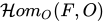
se denomina módulo dual de F y se denota por. Nota: para cualesquiera O -módulos E , F , existe un homomorfismo canónico

- ,

which is an isomorphism if E is a locally free sheaf of finite rank. In particular, if L is locally free of rank one (such L is called an invertible sheaf or a line bundle),[5] then this reads:

implying the isomorphism classes of invertible sheaves form a group. This group is called the Picard group of X and is canonically identified with the first cohomology group (by the standard argument with Čech cohomology).

If E is a locally free sheaf of finite rank, then there is an O-linear map given by the pairing; it is called the trace map of E.

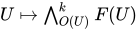
For any O-module F, the tensor algebra, exterior algebra and symmetric algebra of F are defined in the same way. For example, the k-th exterior power

is the sheaf associated to the presheaf . If F is locally free of rank n, then is called the determinant line bundle (though technically invertible sheaf) of F, denoted by det(F). There is a natural perfect pairing:


Let f: (X, O) →(X', O') be a morphism of ringed spaces. If F is an O-module, then the direct image sheaf is an O'-module through the natural map O' →f*O (such a natural map is part of the data of a morphism of ringed spaces.)

If G is an O'-module, then the module inverse image of G is the O-module given as the tensor product of modules:

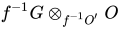
where is the inverse image sheaf of G and is obtained from by adjuction.


There is an adjoint relation between and : for any O-module F and O'-module G,



as abelian group. There is also the projection formula: for an O-module F and a locally free O'-module E of finite rank,

Properties
Let (X, O) be a ringed space. An O-module F is said to be generated by global sections if there is a surjection of O-modules:
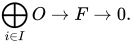
Explicitly, this means that there are global sections si of F such that the images of si in each stalk Fx generates Fx as Ox-module.
An example of such a sheaf is that associated in algebraic geometry to an R-module M, R being any commutative ring, on the spectrum of a ringSpec(R). Another example: according to Cartan's theorem A, any coherent sheaf on a Stein manifold is spanned by global sections. (cf. Serre's theorem A below.) In the theory of schemes, a related notion is ample line bundle. (For example, if L is an ample line bundle, some power of it is generated by global sections.)
An injective O-module is flasque (i.e., all restrictions maps F(U) → F(V) are surjective).[6] Since a flasque sheaf is acyclic in the category of abelian sheaves, this implies that the i-th right derived functor of the global section functor in the category of O-modules coincides with the usual i-th sheaf cohomology in the category of abelian sheaves.[7]
Sheaf associated to a module
Let be a module over a ring . Put and write . For each pair , by the universal property of localization, there is a natural map


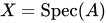
![{\displaystyle D(f)=\{f\neq 0\}=\operatorname {Spec} (A[f^{-1}])}](https://wikimedia.org/api/rest_v1/media/math/render/svg/ed209cfddafaab71225e00d5372ca6cc65168bbf)
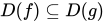
![{\displaystyle \rho _{g,f}:M[g^{-1}]\to M[f^{-1}]}](https://wikimedia.org/api/rest_v1/media/math/render/svg/70cb90947ee387662b3ba064e0c0b726f2f98538)
having the property that . Then

![{\displaystyle D(f)\mapsto M[f^{-1}]}](https://wikimedia.org/api/rest_v1/media/math/render/svg/85c5fbf31be70749ad8d44a4effb32c573b25f5a)
is a contravariant functor from the category whose objects are the sets D(f) and morphisms the inclusions of sets to the category of abelian groups. One can show[8] it is in fact a B-sheaf (i.e., it satisfies the gluing axiom) and thus defines the sheaf on X called the sheaf associated to M.

The most basic example is the structure sheaf on X; i.e., . Moreover, has the structure of -module and thus one gets the exact functor from ModA, the category of modules over A to the category of modules over . It defines an equivalence from ModA to the category of quasi-coherent sheaves on X, with the inverse , the global section functor. When X is Noetherian, the functor is an equivalence from the category of finitely generated A-modules to the category of coherent sheaves on X.


The construction has the following properties: for any A-modules M, N, and any morphism ,

- .[9]
- For any prime ideal p of A, as Op = Ap-module.
- .[10]
- If M is finitely presented, .[10]
- , since the equivalence between ModA and the category of quasi-coherent sheaves on X.
- ;[11] in particular, taking a direct sum and ~ commute.
- A sequence of A-modules is exact if and only if the induced sequence by is exact. In particular, .
![{\displaystyle M[f^{-1}]^{\sim }={\widetilde {M}}|_{D(f)}}](https://wikimedia.org/api/rest_v1/media/math/render/svg/58b54f210365bb77a31f233cee1fc02581d3a2f9)




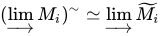


Sheaf associated to a graded module
There is a graded analog of the construction and equivalence in the preceding section. Let R be a graded ring generated by degree-one elements as R0-algebra (R0 means the degree-zero piece) and M a graded R-module. Let X be the Proj of R (so X is a projective scheme if R is Noetherian). Then there is an O-module such that for any homogeneous element f of positive degree of R, there is a natural isomorphism
![{\displaystyle {\widetilde {M}}|_{\{f\neq 0\}}\simeq (M[f^{-1}]_{0})^{\sim }}](https://wikimedia.org/api/rest_v1/media/math/render/svg/78e3c8df95226bf9fa13c36b7656d599552f28b0)
as sheaves of modules on the affine scheme ;[12] in fact, this defines by gluing.
![{\displaystyle \{f\neq 0\}=\operatorname {Spec} (R[f^{-1}]_{0})}](https://wikimedia.org/api/rest_v1/media/math/render/svg/967fed6f4464945e714e78d26ad7b4f64641ba3f)
Example: Let R(1) be the graded R-module given by R(1)n = Rn+1. Then is called Serre's twisting sheaf, which is the dual of the tautological line bundle if R is finitely generated in degree-one.
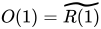
If F is an O-module on X, then, writing , there is a canonical homomorphism:

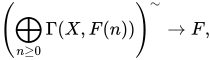
which is an isomorphism if and only if F is quasi-coherent.
Computing sheaf cohomology
Sheaf cohomology has a reputation for being difficult to calculate. Because of this, the next general fact is fundamental for any practical computation:
Theorem—Let X be a topological space, F an abelian sheaf on it and an open cover of X such that for any i, p and 's in . Then for any i,



where the right-hand side is the i-th Čech cohomology.
Serre's vanishing theorem[13] states that if X is a projective variety and F a coherent sheaf on it, then, for sufficiently large n, the Serre twistF(n) is generated by finitely many global sections. Moreover,
- For each i, Hi(X, F) is finitely generated over R0, and
- There is an integer n0, depending on F, such that

Sheaf extension
Let (X, O) be a ringed space, and let F, H be sheaves of O-modules on X. An extension of H by F is a short exact sequence of O-modules

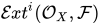
As with group extensions, if we fix F and H, then all equivalence classes of extensions of H by F form an abelian group (cf. Baer sum), which is isomorphic to the Ext group, where the identity element in corresponds to the trivial extension.

In the case where H is O, we have: for any i ≥ 0,

since both the sides are the right derived functors of the same functor

Note: Some authors, notably Hartshorne, drop the subscript O.
Assume X is a projective scheme over a Noetherian ring. Let F, G be coherent sheaves on X and i an integer. Then there exists n0 such that
- ,

where denotes the derived functors of .[17]


Locally free resolutions
can be readily computed for any coherent sheaf using a locally free resolution:[18] given a complex



then

hence

Examples
Hypersurface
Consider a smooth hypersurface of degree . Then, we can compute a resolution


and find that

Union of smooth complete intersections
Consider the scheme
![{\displaystyle X={\text{Proj}}\left({\frac {\mathbb {C} [x_{0},\ldots ,x_{n}]}{(f)(g_{1},g_{2},g_{3})}}\right)\subseteq \mathbb {P} ^{n}}](https://wikimedia.org/api/rest_v1/media/math/render/svg/9fc2605ff5732feb4d573b72e7f9d80e84d80053)
where is a smooth complete intersection and , . We have a complex
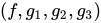



resolving which we can use to compute .

See also
- D-module (in place of O, one can also consider D, the sheaf of differential operators.)
- fractional ideal
- holomorphic vector bundle
- generic freeness
Notes
- ↑Vakil, Math 216: Foundations of algebraic geometry, 2.5.
- ↑Hartshorne, Ch. III, Proposition 2.2.
- ↑This cohomology functor coincides with the right derived functor of the global section functor in the category of abelian sheaves; cf. Hartshorne, Ch. III, Proposition 2.6.
- ↑There is a canonical homomorphism:
- ↑For coherent sheaves, having a tensor inverse is the same as being locally free of rank one; in fact, there is the following fact: if and if F is coherent, then F, G are locally free of rank one. (cf. EGA, Ch 0, 5.4.3.)
- ↑Hartshorne, Ch III, Lemma 2.4.
- ↑see also: https://math.stackexchange.com/q/447234
- ↑Hartshorne, Ch. II, Proposition 5.1.
- ↑EGA I 1971, Ch. I, Proposition 1.3.6.
- 12EGA I 1971, Ch. I, Corollaire 1.3.12.
- ↑EGA I 1971, Ch. I, Corollaire 1.3.9.
- ↑Hartshorne, Ch. II, Proposition 5.11.
- ↑"Section 30.2 (01X8): Čech cohomology of quasi-coherent sheaves—The Stacks project". stacks.math.columbia.edu. Retrieved 2023-12-07.
- ↑Costa, Miró-Roig & Pons-Llopis 2021, Theorem 1.3.1
- ↑"Links with sheaf cohomology". Local Cohomology. Cambridge Studies in Advanced Mathematics. Cambridge University Press. 2012. pp. 438–479. doi:10.1017/CBO9781139044059.023. ISBN 9780521513630.
- ↑Serre 1955, §.66 Faisceaux algébriques cohérents sur les variétés projectives.
- ↑Hartshorne, Ch. III, Proposition 6.9.
- ↑Hartshorne, Robin. Algebraic Geometry. pp. 233–235.


References
- Grothendieck, Alexandre; Dieudonné, Jean (1960). "Éléments de géométrie algébrique: I. Le langage des schémas". Publications Mathématiques de l'IHÉS. 4. doi:10.1007/bf02684778. MR 0217083.
- Hartshorne, Robin (1977), Algebraic Geometry, Graduate Texts in Mathematics, vol. 52, New York: Springer-Verlag, ISBN 978-0-387-90244-9, MR 0463157
- Costa, Laura; Miró-Roig, Rosa María; Pons-Llopis, Joan (2021). Ulrich Bundles. doi:10.1515/9783110647686. ISBN 9783110647686.
- "Links with sheaf cohomology". Local Cohomology. Cambridge Studies in Advanced Mathematics. Cambridge University Press. 2012. pp. 438–479. doi:10.1017/CBO9781139044059.023. ISBN 9780521513630.
- Serre, Jean-Pierre (1955), "Faisceaux algébriques cohérents (§.66 Faisceaux algébriques cohérents sur les variétés projectives.)"(PDF), Annals of Mathematics, 61 (2): 197–278, doi:10.2307/1969915, JSTOR 1969915, MR 0068874
- Sheaf theory