 Hispanopedia Wiki
In Einstein's theory of general relativity, the Schwarzschild metric (also known as the Schwarzschild solution) is an exact solution to the Einstein field equations that describes the gravitational field outside a spherical mass, on the assumption that the electric charge of the mass, angular momentum of the mass, and universal cosmological constant are all zero. The solution is a useful approximation for describing slowly rotating astronomical objects such as many stars and planets, including Earth and the Sun. It was found by Karl Schwarzschild and independently of him by Johannes Droste in 1916.
According to Birkhoff's theorem, the Schwarzschild metric is the most general spherically symmetricvacuum solution of the Einstein field equations. A Schwarzschild black hole or static black hole is a black hole that has neither electric charge nor angular momentum (non-rotating). A Schwarzschild black hole is described by the Schwarzschild metric, and cannot be distinguished from any other Schwarzschild black hole except by its mass.
The Schwarzschild black hole is characterized by a surrounding spherical boundary, called the event horizon, which is situated at the Schwarzschild radius (), often called the radius of a black hole. The boundary is not a physical surface, and a person who fell through the event horizon (before being torn apart by tidal forces) would not notice any physical surface at that position; it is a mathematical surface which is significant in determining the black hole's properties. Any non-rotating and non-charged mass that is smaller than its Schwarzschild radius forms a black hole. The solution of the Einstein field equations is valid for any mass M, so in principle (within the theory of general relativity) a Schwarzschild black hole of any mass could exist if conditions became sufficiently favorable to allow for its formation.

In the vicinity of a Schwarzschild black hole, space curves so much that even light rays are deflected, and very nearby light can be deflected so much that it travels several times around the black hole.[1][2][3]
Formulation
The Schwarzschild metric is a spherically symmetric Lorentzian metric (here, with signature convention (+ − − −)), defined on (a subset of) where is 3 dimensional Euclidean space, and is the two-sphere. The rotation group acts on the or factor as rotations around the center , while leaving the first factor unchanged. The Schwarzschild metric is a solution of Einstein's field equations in empty space, meaning that it is valid only outside the gravitating body. That is, for a spherical body of radius the solution is valid for . To describe the gravitational field both inside and outside the gravitating body the Schwarzschild solution must be matched with some suitable interior solution at ,[4] such as the interior Schwarzschild metric.






In Schwarzschild coordinates the Schwarzschild metric (or equivalently, the line element for proper time) has the form where is the metric on the two-sphere, i.e. . Furthermore,




- is positive for timelike curves, in which case is the proper time (time measured by a clock moving along the same world line with a test particle),
- is the speed of light,
- is, for , the time coordinate (measured by a clock located infinitely far from the massive body and stationary with respect to it),
- is, for , the radial coordinate (measured as the circumference, divided by 2π, of a sphere centered around the massive body),
- is a point on the two-sphere ,
- is the colatitude of (angle from north, in units of radians) defined after arbitrarily choosing a z-axis,
- is the longitude of (also in radians) around the chosen z-axis, and
- is the Schwarzschild radius of the massive body, a scale factor which is related to its mass by , where is the gravitational constant.[5]


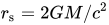

The Schwarzschild metric has a singularity for r = 0, which is an intrinsic curvature singularity. It also seems to have a singularity on the event horizonr = rs. Depending on the point of view, the metric is therefore defined only on the exterior region , only on the interior region or their disjoint union. However, the metric is actually non-singular across the event horizon, as one sees in suitable coordinates (see below). For , the Schwarzschild metric is asymptotic to the standard Lorentz metric on Minkowski space. For almost all astrophysical objects, the ratio is extremely small. For example, the Schwarzschild radius of the Earth is roughly 8.9 mm, while the Sun, which is 3.3×10⁵ times as massive[6] has a Schwarzschild radius of approximately 3.0 km. The ratio becomes large only in close proximity to black holes and other ultra-dense objects such as neutron stars.


The radial coordinate turns out to have physical significance as the "proper distance between two events that occur simultaneously relative to the radially moving geodesic clocks, the two events lying on the same radial coordinate line".[7]
The Schwarzschild solution is analogous to a classical Newtonian theory of gravity that corresponds to the gravitational field around a point particle. Even at the surface of the Earth, the corrections to Newtonian gravity are only one part in a billion.[8] However, this is enough for the metric to be used to correct for gravitational time dilation in the Global Positioning System.
History
The Schwarzschild solution is named in honour of Karl Schwarzschild, who found the exact solution in 1915 and published it in January 1916,[9] a little more than a month after the publication of Einstein's theory of general relativity. It was the first exact solution of the Einstein field equations other than the trivial flat space solution. Schwarzschild died shortly after his paper was published, as a result of a disease (thought to be pemphigus) he developed while serving in the German army during World War I.[10]
Johannes Droste in 1916[11] independently produced the same solution as Schwarzschild, using a simpler, more direct derivation.[12]
In the early years of general relativity there was a lot of confusion about the nature of the singularities found in the Schwarzschild and other solutions of the Einstein field equations. In Schwarzschild's original paper, he put what we now call the event horizon at the origin of his coordinate system. In this paper he also introduced what is now known as the Schwarzschild radial coordinate (r in the equations above), as an auxiliary variable. In his equations, Schwarzschild was using a different radial coordinate that was zero at the Schwarzschild radius.
A more complete analysis of the singularity structure was given by David Hilbert[13] in the following year, identifying the singularities both at r = 0 and r = rs. Although there was general consensus that the singularity at r = 0 was a 'genuine' physical singularity, the nature of the singularity at r = rs remained unclear.[14]
En 1921, Paul Painlevé y, en 1922 , Allvar Gullstrand, produjeron de forma independiente una métrica, una solución esféricamente simétrica de las ecuaciones de Einstein, que ahora sabemos que es una transformación de coordenadas de la métrica de Schwarzschild, las coordenadas de Gullstrand-Painlevé , en la que no había singularidad en r = r s . Sin embargo, no reconocieron que sus soluciones eran simplemente transformaciones de coordenadas y, de hecho, utilizaron su solución para argumentar que la teoría de Einstein era errónea. En 1924, Arthur Eddington produjo la primera transformación de coordenadas ( coordenadas de Eddington-Finkelstein ) que demostró que la singularidad en r = r s era un artefacto de coordenadas, aunque también parece haber ignorado la importancia de este descubrimiento. Más tarde, en 1932, Georges Lemaître dio una transformación de coordenadas diferente ( coordenadas de Lemaître ) con el mismo efecto y fue el primero en reconocer que esto implicaba que la singularidad en r = r s no era física. En 1939, Howard Robertson demostró que un observador en caída libre que desciende en la métrica de Schwarzschild cruzaría la singularidad r = r s en una cantidad finita de tiempo propio, aunque esto tomaría una cantidad infinita de tiempo en términos de tiempo de coordenadas t . [ 14 ]
En 1950, John Synge publicó un artículo [ 15 ] que mostraba la extensión analítica máxima de la métrica de Schwarzschild, demostrando nuevamente que la singularidad en r = r s era un artefacto de coordenadas y que representaba dos horizontes. Un resultado similar fue redescubierto posteriormente por George Szekeres [ 16 ] e independientemente por Martin Kruskal [ 17 ] . Las nuevas coordenadas, conocidas hoy como coordenadas de Kruskal-Szekeres, eran mucho más simples que las de Synge, pero ambas proporcionaban un único conjunto de coordenadas que abarcaba todo el espaciotiempo. Sin embargo, quizás debido a la poca repercusión de las revistas en las que se publicaron los artículos de Lemaître y Synge, sus conclusiones pasaron desapercibidas, y muchos de los principales actores en el campo, incluido Einstein, creían que la singularidad en el radio de Schwarzschild era física. [ 14 ] La derivación posterior de Synge de la solución métrica de Kruskal-Szekeres, [ 18 ] que fue motivada por el deseo de evitar "usar coordenadas [Schwarzschild] 'malas' para obtener coordenadas [Kruskal-Szekeres] 'buenas'", ha sido generalmente subestimada en la literatura, pero fue adoptada por Chandrasekhar en su monografía sobre agujeros negros. [ 19 ]
Se lograron avances reales en la década de 1960 cuando la formulación matemáticamente rigurosa, expresada en términos de geometría diferencial , se incorporó al campo de la relatividad general, lo que permitió definiciones más exactas de lo que significa que una variedad lorentziana sea singular. Esto condujo a la identificación definitiva de la singularidad r = r s en la métrica de Schwarzschild como un horizonte de eventos , es decir, una hipersuperficie en el espaciotiempo que solo puede cruzarse en una dirección. [ 14 ]
Singularidades y agujeros negros
La solución de Schwarzschild parece tener singularidades en r = 0 y r = r s ; algunos de los componentes métricos "explotan" (implican división por cero o multiplicación por infinito) en estos radios. Dado que se espera que la métrica de Schwarzschild sea válida solo para aquellos radios mayores que el radio R del cuerpo gravitante, no hay problema siempre que R > r s . Para las estrellas y planetas ordinarios, esto siempre es así. Por ejemplo, el radio del Sol es aproximadamente700000 km, while its Schwarzschild radius is only 3 km.
The singularity at r = rs divides the Schwarzschild coordinates in two disconnectedpatches. The exterior Schwarzschild solution with r > rs is the one that is related to the gravitational fields of stars and planets. The interior Schwarzschild solution with 0 ≤ r < rs, which contains the singularity at r = 0, is completely separated from the outer patch by the singularity at r = rs. The Schwarzschild coordinates therefore give no physical connection between the two patches, which may be viewed as separate solutions. The singularity at r = rs is an illusion however; it is an instance of what is called a coordinate singularity. As the name implies, the singularity arises from a bad choice of coordinates or coordinate conditions. When changing to a different coordinate system (for example Lemaître coordinates, Eddington–Finkelstein coordinates, Kruskal–Szekeres coordinates, Novikov coordinates, or Gullstrand–Painlevé coordinates) the metric becomes regular at r = rs and can extend the external patch to values of r smaller than rs. Using a different coordinate transformation one can then relate the extended external patch to the inner patch.[20]
The case r = 0 is different, however. If one asks that the solution be valid for all r one runs into a true physical singularity, or gravitational singularity, at the origin. To see that this is a true singularity one must look at quantities that are independent of the choice of coordinates. One such important quantity is the Kretschmann invariant, which is given by

At r = 0 the curvature becomes infinite, indicating the presence of a singularity. At this point the metric cannot be extended in a smooth manner (the Kretschmann invariant involves second derivatives of the metric), spacetime itself is then no longer well-defined. Furthermore, Sbierski[21] showed the metric cannot be extended even in a continuous manner. For a long time it was thought that such a solution was non-physical. However, a greater understanding of general relativity led to the realization that such singularities were a generic feature of the theory and not just an exotic special case.
The Schwarzschild solution, taken to be valid for all r > 0, is called a Schwarzschild black hole. It is a perfectly valid solution of the Einstein field equations, although (like other black holes) it has rather bizarre properties. For r < rs the Schwarzschild radial coordinate r becomes timelike and the time coordinate t becomes spacelike.[22] A curve at constant r is no longer a possible worldline of a particle or observer, not even if a force is exerted to try to keep it there; this occurs because spacetime has been curved so much that the direction of cause and effect (the particle's future light cone) points into the singularity. The surface r = rs demarcates what is called the event horizon of the black hole. It represents the point past which light can no longer escape the gravitational field. Any physical object whose radius R becomes less than or equal to the Schwarzschild radius has undergone gravitational collapse and become a black hole.
Alternative coordinates
The Schwarzschild solution can be expressed in a range of different choices of coordinates besides the Schwarzschild coordinates used above. Different choices tend to highlight different features of the solution. The table below shows some popular choices.
In table above, some shorthand has been introduced for brevity. The speed of light chas been set to one. The notation is used for the metric of a unit radius 2-dimensional sphere. Moreover, in each entry R and T denote alternative choices of radial and time coordinate for the particular coordinates. Note, the R or T may vary from entry to entry.

The Kruskal–Szekeres coordinates have the form to which the Belinski–Zakharov transform can be applied. This implies that the Schwarzschild black hole is a form of gravitational soliton.
Flamm's paraboloid

The spatial curvature of the Schwarzschild solution for r > rs can be visualized as the graphic shows. Consider a constant time equatorial slice H through the Schwarzschild solution by fixing θ = π/2, t = constant, and letting the remaining Schwarzschild coordinates (r, φ) vary. Imagine now that there is an additional Euclidean dimension w, which has no physical reality (it is not part of spacetime). Then replace the (r, φ) plane with a surface dimpled in the w direction according to the equation (Flamm's paraboloid)

This surface has the property that distances measured within it match distances in the Schwarzschild metric, because with the definition of w above,

Thus, Flamm's paraboloid is useful for visualizing the spatial curvature of the Schwarzschild metric. It should not, however, be confused with a gravity well. No ordinary (massive or massless) particle can have a worldline lying on the paraboloid, since all distances on it are spacelike (this is a cross-section at one moment of time, so any particle moving on it would have an infinite velocity). A tachyon could have a spacelike worldline that lies entirely on a single paraboloid. However, even in that case its geodesic path is not the trajectory one gets through a "rubber sheet" analogy of gravitational well: in particular, if the dimple is drawn pointing upward rather than downward, the tachyon's geodesic path still curves toward the central mass, not away. See the gravity well article for more information.
Flamm's paraboloid may be derived as follows. The Euclidean metric in the cylindrical coordinates(r, φ, w) is written

Letting the surface be described by the function w = w(r), the Euclidean metric can be written as

Comparing this with the Schwarzschild metric in the equatorial plane (θ = π/2) at a fixed time (t = constant, dt = 0), yields an integral expression for w(r): whose solution is Flamm's paraboloid.


Orbital motion

A particle orbiting in the Schwarzschild metric can have a stable circular orbit with r > 3rs. Circular orbits with r between 1.5rs and 3rs are unstable, and no circular orbits exist for r < 1.5rs. The circular orbit of minimum radius 1.5rs corresponds to an orbital velocity approaching the speed of light. It is possible for a particle to have a constant value of r between rs and 1.5rs, but only if some force acts to keep it there.
Noncircular orbits, such as Mercury's, dwell longer at small radii than would be expected in Newtonian gravity. This can be seen as a less extreme version of the more dramatic case in which a particle passes through the event horizon and dwells inside it forever. Intermediate between the case of Mercury and the case of an object falling past the event horizon, there are exotic possibilities such as knife-edge orbits, in which the satellite can be made to execute an arbitrarily large number of nearly circular orbits, after which it flies back outward.
Symmetries
The isometry group of the Schwarzschild metric is , where is the orthogonal group of rotations and reflections in three dimensions, comprises the time translations, and is the group generated by time reversal.



This is thus the subgroup of the ten-dimensional Poincaré group which takes the time axis (trajectory of the star) to itself. It omits the spatial translations (three dimensions) and boosts (three dimensions). It retains the time translations (one dimension) and rotations (three dimensions). Thus it has four dimensions. Like the Poincaré group, it has four connected components: the component of the identity; the time reversed component; the spatial inversion component; and the component which is both time reversed and spatially inverted.
Curvatures
The Ricci curvature scalar and the Ricci curvature tensor are both zero. Non-zero components of the Riemann curvature tensor are given by[25] from which one can see that . Six of these formulas are Eq. 5.13 in Carroll[26] and imply the other 6 by . Components which are obtainable by other symmetries of the Riemann tensor are not displayed.


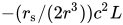
To understand the physical meaning of these quantities, it is useful to express the curvature tensor in an orthonormal basis. In an orthonormal basis of an observer the non-zero components in geometric units are[25] Again, components which are obtainable by the symmetries of the Riemann tensor are not displayed. These results are invariant to any Lorentz boost, thus the components do not change for non-static observers. The geodesic deviation equation shows that the tidal acceleration between two observers separated by is , so a body of length is stretched in the radial direction by an apparent acceleration and squeezed in the perpendicular directions by .





See also
- Derivation of the Schwarzschild solution
- Reissner–Nordström metric (charged, non-rotating solution)
- Kerr metric (uncharged, rotating solution)
- Kerr–Newman metric (charged, rotating solution)
- Black hole, a general review
- Schwarzschild coordinates
- Kruskal–Szekeres coordinates
- Eddington–Finkelstein coordinates
- Gullstrand–Painlevé coordinates
- Lemaître coordinates (Schwarzschild solution in synchronous coordinates)
- Frame fields in general relativity (Lemaître observers in the Schwarzschild vacuum)
- Tolman–Oppenheimer–Volkoff equation (metric and pressure equations of a static and spherically symmetric body of isotropic material)
- Planck length
Notes
- ^Luminet, J.-P. (1979-05-01). "Image of a spherical black hole with thin accretion disk". Astronomy and Astrophysics. 75: 228–235. Bibcode:1979A&A....75..228L. ISSN 0004-6361.
- ^Bozza, V. (2002-11-22). "Gravitational lensing in the strong field limit". Physical Review D. 66 (10) 103001. arXiv:gr-qc/0208075. Bibcode:2002PhRvD..66j3001B. doi:10.1103/PhysRevD.66.103001. S2CID 119476658.
- ^Sneppen, Albert (2021-07-09). "Divergent reflections around the photon sphere of a black hole". Scientific Reports. 11 (1) 14247. Bibcode:2021NatSR..1114247S. doi:10.1038/s41598-021-93595-w. ISSN 2045-2322. PMC 8270963. PMID 34244573.
- ^Frolov, Valeri; Zelnikov, Andrei (2011). Introduction to Black Hole Physics. Oxford. p. 168. ISBN 978-0-19-969229-3.
- ^Landau & Lifshitz (1975)
- ^Tennent, R.M., ed. (1971). Science Data Book. Oliver & Boyd. ISBN 0-05-002487-6.
- ^Gautreau, Ronald; Hoffmann, Banesh (1978-05-15). "The Schwarzschild radial coordinate as a measure of proper distance". Physical Review D. 17 (10): 2552–2555. Bibcode:1978PhRvD..17.2552G. doi:10.1103/PhysRevD.17.2552. ISSN 0556-2821.
- ^Ehlers, Jürgen (January 1997). "Examples of Newtonian limits of relativistic spacetimes"(PDF). Classical and Quantum Gravity. 14 (1A): A119–A126. Bibcode:1997CQGra..14A.119E. doi:10.1088/0264-9381/14/1A/010. hdl:11858/00-001M-0000-0013-5AC5-F. S2CID 250804865.
- ^Schwarzschild, K. (1916). "Über das Gravitationsfeld eines Massenpunktes nach der Einsteinschen Theorie". Sitzungsberichte der Königlich Preussischen Akademie der Wissenschaften. 7: 189–196. Bibcode:1916SPAW.......189S. For a translation, see Antoci, S.; Loinger, A. (1999). "On the gravitational field of a mass point according to Einstein's theory". arXiv:physics/9905030.
- ^O'Connor, John J.; Robertson, Edmund F., "Karl Schwarzschild", MacTutor History of Mathematics Archive, University of St Andrews
- ^Droste, J. (1917). "The field of a single centre in Einstein's theory of gravitation, and the motion of a particle in that field"(PDF). Proceedings of the Royal Netherlands Academy of Arts and Science. 19 (1): 197–215. Bibcode:1917KNAB...19..197D.
- ^Kox, A. J. (1992). "General Relativity in the Netherlands: 1915–1920". In Eisenstaedt, J.; Kox, A. J. (eds.). Studies in the History of General Relativity. Birkhäuser. p. 41. ISBN 978-0-8176-3479-7.
- ^Hilbert, David (1924). "Die Grundlagen der Physik". Mathematische Annalen. 92 (1–2). Springer-Verlag: 1–32. doi:10.1007/BF01448427. S2CID 179177367.
- ^ abcdEarman, J. (1999). "The Penrose–Hawking singularity theorems: History and Implications". In Goenner, H. (ed.). The expanding worlds of general relativity. Birkhäuser. p. 236-. ISBN 978-0-8176-4060-6.
- ^Synge, J. L. (1950). "The gravitational field of a particle". Proceedings of the Royal Irish Academy. 53 (6): 83–114. doi:10.1038/164148b0. PMID 18210531. S2CID 4108538.
- ^Szekeres, G. (1960). "On the singularities of a Riemannian manifold". Publicationes Mathematicae Debrecen. 7: 285. Bibcode:2002GReGr..34.2001S. doi:10.1023/A:1020744914721. S2CID 118200205.
- ^Kruskal, M. D. (1960). "Maximal extension of Schwarzschild metric". Physical Review. 119 (5): 1743–1745. Bibcode:1960PhRv..119.1743K. doi:10.1103/PhysRev.119.1743.
- ^Synge, J. L. (December 1974). "Model universes with spherical symmetry". Annali di Matematica Pura ed Applicata. 98 (1): 239–255. doi:10.1007/BF02414024. ISSN 0373-3114.
- ^Chandrasekhar, Subrahmanyan (2009). The mathematical theory of black holes. Oxford classic texts in the physical sciences (Reprinted ed.). Oxford: Clarendon Press. ISBN 978-0-19-850370-5.
- ^Hughston, L. P.; Tod, K. P. (1990). An introduction to general relativity. Cambridge University Press. Chapter 19. ISBN 978-0-521-33943-8.
- ^Sbierski, Jan (2015). "The C0-inextendibility of the Schwarzschild spacetime and the spacelike diameter in Lorentzian Geometry". arXiv:1507.00601 [gr-qc].
- ^Time: A Traveler's Guide. Oxford University Press, Incorporated. 1999. ISBN 9780199929924.
If you look at black holes, the metric inside the event horizon reverses spacelike and timelike coordinates. The radius starts to act timelike, and time starts to act spacelike.
- ^Ni, Wei-Tou, ed. (26 May 2017). One Hundred Years of General Relativity: From Genesis and Empirical Foundations to Gravitational Waves, Cosmology and Quantum Gravity. Vol. 1. World Scientific. p. I-126. ISBN 9789814635141.
- ^Eddington, A. S. (1924). The Mathematical Theory of Relativity (2nd ed.). Cambridge University Press. p. 93.
- ^ abMisner, Charles W.; Thorne, Kip S.; Wheeler, John Archibald (1973). Gravitation. New York: W. H. Freeman. ISBN 978-0-7167-0334-1.
- ^Carroll, Sean M. (2003). Spacetime and Geometry: An Introduction to General Relativity. Addison-Wesley. ISBN 0-8053-8732-3.
References
- Schwarzschild, K. (1916). "Über das Gravitationsfeld eines Massenpunktes nach der Einsteinschen Theorie". Sitzungsberichte der Königlich Preussischen Akademie der Wissenschaften. 7: 189–196. Bibcode:1916AbhKP1916..189S.
- Text of the original paper, in Wikisource
- Translation: Antoci, S.; Loinger, A. (1999). "On the gravitational field of a mass point according to Einstein's theory". arXiv:physics/9905030.
- A commentary on the paper, giving a simpler derivation: Bel, L. (2007). "Über das Gravitationsfeld eines Massenpunktesnach der Einsteinschen Theorie". arXiv:0709.2257 [gr-qc].
- Schwarzschild, K. (1916). "Über das Gravitationsfeld einer Kugel aus inkompressibler Flüssigkeit". Sitzungsberichte der Königlich Preussischen Akademie der Wissenschaften. 1: 424.
- Text of the original paper, in Wikisource
- Translation: Antoci, S. (1999). "On the gravitational field of a sphere of incompressible fluid according to Einstein's theory". arXiv:physics/9912033.
- Flamm, L. (1916). "Beiträge zur Einstein'schen Gravitationstheorie". Physikalische Zeitschrift. 17: 448.
- Adler, R.; Bazin, M.; Schiffer, M. (1975). Introduction to General Relativity (2nd ed.). McGraw-Hill. Chapter 6. ISBN 0-07-000423-4.
- Landau, L. D.; Lifshitz, E. M. (1975). The Classical Theory of Fields. Course of Theoretical Physics. Vol. 2 (4th Revised English ed.). Pergamon Press. Chapter 12. ISBN 0-08-025072-6.
- Misner, C. W.; Thorne, K. S.; Wheeler, J. A. (1970). Gravitation. W.H. Freeman. Chapters 31 and 32. ISBN 0-7167-0344-0.
- Weinberg, S. (1972). Gravitation and Cosmology: Principles and Applications of the General Theory of Relativity. John Wiley & Sons. Chapter 8. ISBN 0-471-92567-5.
- Taylor, E. F.; Wheeler, J. A. (2000). Exploring Black Holes: Introduction to General Relativity. Addison-Wesley. ISBN 0-201-38423-X.
- Heinzle, J. M.; Steinbauer, R. (2002). "Remarks on the distributional Schwarzschild geometry". Journal of Mathematical Physics. 43 (3): 1493–1508. arXiv:gr-qc/0112047. Bibcode:2002JMP....43.1493H. doi:10.1063/1.1448684. S2CID 119677857.
- Sanchez, Norma (15 August 1978). "Absorption and emission spectra of a Schwarzschild black hole". Physical Review D. 18 (4): 1030–1036. Bibcode:1978PhRvD..18.1030S. doi:10.1103/PhysRevD.18.1030.
- Persides, S. (1 August 1973). "On the radial wave equation in Schwarzschild's space-time". Journal of Mathematical Physics. 14 (8): 1017–1021. Bibcode:1973JMP....14.1017P. doi:10.1063/1.1666431. ISSN 0022-2488.
- Exact solutions in general relativity
- Black holes
- 1916 in science
- Gravitational singularities