Neto En geometría de cuatro dimensiones , la celda de 24 es el politopo regular convexo de 4 dimensiones [1] (análogo de cuatro dimensiones de un sólido platónico ) con símbolo ...
Hispanopedia WikiContenido en espanolLectura gratuita
El límite de la figura de 24 celdas está compuesto por 24 celdas octaédricas , seis de las cuales se encuentran en cada vértice y tres en cada arista. Juntas tienen 96 caras triangulares, 96 aristas y 24 vértices. La figura del vértice es un cubo . La figura de 24 celdas es autodual . [a] La figura de 24 celdas y el teseracto son los únicos 4-politopos regulares convexos en los que la longitud de la arista es igual al radio. [b]
El poliedro de 24 celdas no tiene un análogo regular en tres dimensiones ni en ningún otro número de dimensiones, ni por debajo ni por encima. [4] Es el único de los seis politopos de 4 celdas regulares convexos que no es análogo de uno de los cinco sólidos platónicos. Sin embargo, puede verse como el análogo de un par de sólidos irregulares: el cuboctaedro y su dual, el dodecaedro rómbico . [5]
Las copias trasladadas del modelo de 24 celdas pueden teselar el espacio de cuatro dimensiones cara a cara, formando el panal de abejas de 24 celdas . Como politopo que puede teselar por traslación, el modelo de 24 celdas es un ejemplo de paralelepípedo , el más simple que no es también un zonotopo . [6]
Geometría
El politopo de 24 celdas incorpora las geometrías de todos los politopos regulares convexos en las primeras cuatro dimensiones, excepto el politopo de 5 celdas, aquellos con un 5 en su símbolo de Schlöfli, [c] y los polígonos regulares con 7 o más lados. En otras palabras, el politopo de 24 celdas contiene todos los politopos regulares formados por triángulos y cuadrados que existen en cuatro dimensiones excepto el politopo regular de 5 celdas, pero ninguno de los politopos pentagonales. Las relaciones geométricas entre todos estos politopos regulares se pueden observar en un solo politopo de 24 celdas o en el panal de abejas de 24 celdas .
El teseracto de 24 celdas es el cuarto en la secuencia de seis politopos convexos regulares de 4 celdas (en orden de tamaño y complejidad). [d] Puede deconstruirse en 3 instancias superpuestas de su predecesor, el teseracto (de 8 celdas), al igual que el de 8 celdas puede deconstruirse en 2 instancias superpuestas de su predecesor, el de 16 celdas . [9] El procedimiento inverso para construir cada uno de estos a partir de una instancia de su predecesor conserva el radio del predecesor, pero generalmente produce un sucesor con una longitud de arista más pequeña. [e]
Esas coordenadas [10] se pueden construir como, rectificando las 16 celdascon 8 permutaciones de vértices de (±2,0,0,0). La figura de vértices de un sistema de 16 celdas es el octaedro ; por lo tanto, cortar los vértices del sistema de 16 celdas en el punto medio de sus aristas incidentes produce 8 celdas octaédricas. Este proceso [11] también rectifica las celdas tetraédricas del sistema de 16 celdas que se convierten en 16 octaedros, dando como resultado 24 celdas octaédricas.
En este marco de referencia, la celda de 24 tiene aristas de longitud √ 2 y está inscrita en una esfera de 3 lados de radio √ 2. Sorprendentemente, la longitud de la arista es igual al radio circunscrito, como en el hexágono o el cuboctaedro . Dichos politopos son radialmente equiláteros . [b]
Los 24 vértices forman 18 grandes cuadrados [f] (3 conjuntos de 6 cuadrados centrales ortogonales [g] ), 3 de los cuales se intersecan en cada vértice. Al observar solo un cuadrado en cada vértice, las 24 celdas pueden verse como los vértices de 3 pares de grandes cuadrados completamente ortogonales que no se intersecan [i] en ningún vértice. [j]
Hexágonos
La celda de 24 es autodual , ya que tiene el mismo número de vértices (24) que celdas y el mismo número de aristas (96) que caras.
Si se toma el dual de la celda de 24 elementos anterior con una longitud de arista de √ 2 moviéndolo en sentido inverso alrededor de su esfera inscrita , se encuentra otra celda de 24 elementos que tiene una longitud de arista y un radio circunscrito de 1, y sus coordenadas revelan una estructura más compleja. En este marco de referencia, la celda de 24 elementos se encuentra con el vértice hacia arriba, y sus vértices se pueden dar de la siguiente manera:
8 vértices obtenidos permutando las coordenadas
enteras :
y 16 vértices con coordenadas semienteras de la forma:
los 24 se encuentran a una distancia de 1 del origen.
En este sistema de coordenadas , la celda de 24 celdas tiene un radio unitario y una longitud de arista unitaria [b] . Nos referimos al sistema como coordenadas de radio unitario para distinguirlo de otros, como las coordenadas de radio √ 2 utilizadas anteriormente. [l]
Los 24 vértices y 96 aristas forman 16 grandes hexágonos no ortogonales, [o] cuatro de los cuales se intersecan [i] en cada vértice. [q] Al observar solo un hexágono en cada vértice, las 24 celdas se pueden ver como los 24 vértices de 4 grandes círculos hexagonales que no se intersecan y que son paralelos entre sí en el método de Clifford. [r]
Los 12 ejes y 16 hexágonos de las 24 celdas constituyen una configuración de Reye , que en el lenguaje de las configuraciones se escribe como 12 4 16 3 para indicar que cada eje pertenece a 4 hexágonos, y cada hexágono contiene 3 ejes. [12]
Triángulos
Los 24 vértices forman 32 triángulos grandes equiláteros, de longitud de arista √ 3 en la celda de radio unitario de 24, [u] inscritos en los 16 grandes hexágonos. [v] Cada triángulo grande es un anillo que une tres cuadrados grandes completamente disjuntos [w] . [aa]
Acordes hipercúbicos
Geometría de vértice del triángulo radialmente equilátero [b] de 24 celdas, que muestra los 3 polígonos de círculo máximo y las 4 longitudes de cuerda de vértice a vértice.
Los 24 vértices de las 24 celdas se distribuyen [13] en cuatro longitudes de cuerda diferentes entre sí: √ 1 , √ 2 , √ 3 y √ 4 .
Cada vértice está unido a otros 8 [ab] por una arista de longitud 1, que abarca 60° = π/3 de arco. Los siguientes más cercanos son 6 vértices [ac] ubicados a 90° = π/2 de distancia, a lo largo de una cuerda interior de longitud √ 2 . Otros 8 vértices se encuentran a 120° = 2π/3 de distancia, a lo largo de una cuerda interior de longitud √ 3 . [ad] El vértice opuesto está a 180° = π de distancia a lo largo de un diámetro de longitud 2. Finalmente, como la celda de 24 es radialmente equilátera, su centro está a 1 longitud de arista de distancia de todos los vértices.
Para visualizar cómo encajan los politopos interiores del conjunto de 24 celdas (como se describe a continuación), tenga en cuenta que las cuatro longitudes de cuerda ( √ 1 , √ 2 , √ 3 , √ 4 ) son los diámetros largos de los hipercubos de dimensiones 1 a 4: el diámetro largo del cuadrado es √ 2 ; el diámetro largo del cubo es √ 3 ; y el diámetro largo del teseracto es √ 4. [ae] Además, el diámetro largo del octaedro es √ 2 como el cuadrado; y el diámetro largo del propio conjunto de 24 celdas es √ 4 como el teseracto. En el conjunto de 24 celdas, las √ 2 cuerdas son los bordes de los cuadrados centrales, y las √ 4 cuerdas son las diagonales de los cuadrados centrales.
Geodésicas
Proyección estereográfica de los 16 hexágonos centrales de las 24 celdas sobre sus círculos máximos. Cada círculo máximo está dividido en 6 aristas de arco en las intersecciones donde se cruzan 4 círculos máximos.
Las cuerdas de los vértices de las 24 celdas están dispuestas en polígonos de círculo máximo geodésicos . [ag] La distancia geodésica entre dos vértices de 24 celdas a lo largo de una ruta de √ 1 aristas es siempre 1, 2 o 3, y es 3 solo para vértices opuestos. [ah]
Las aristas √ 1 se encuentran en 16 círculos máximos hexagonales (en planos inclinados 60 grados entre sí), 4 de los cuales se cruzan [q] en cada vértice. [p] Las 96 aristas √ 1 distintas dividen la superficie en 96 caras triangulares y 24 celdas octaédricas: una superficie de 24 celdas. Los 16 círculos máximos hexagonales se pueden dividir en 4 conjuntos de 4 geodésicas paralelas de Clifford que no se intersecan , de modo que solo un círculo máximo hexagonal de cada conjunto pase por cada vértice y los 4 hexágonos de cada conjunto alcancen los 24 vértices. [ak]
Las cuerdas √ 2 se encuentran en 18 círculos grandes cuadrados (3 conjuntos de 6 planos ortogonales [x] ), 3 de los cuales se cruzan en cada vértice. [al] Las 72 cuerdas √ 2 distintas no discurren en los mismos planos que los círculos grandes hexagonales; no siguen las aristas de la celda de 24, sino que pasan por los centros de sus celdas octagonales. [am] Las 72 cuerdas √ 2 son los 3 ejes ortogonales de las 24 celdas octaédricas, que unen vértices que están separados por 2 aristas √ 1. Los 18 círculos grandes cuadrados se pueden dividir en 3 conjuntos de 6 geodésicas paralelas de Clifford que no se intersecan, [af] de modo que solo un círculo grande cuadrado de cada conjunto pasa por cada vértice, y los 6 cuadrados de cada conjunto alcanzan los 24 vértices. [aq]
Las cuerdas √ 3 se encuentran en 32 círculos máximos triangulares en 16 planos, 4 de los cuales se cruzan en cada vértice. [ad] Las 96 cuerdas √ 3 distintas [u] corren de vértice a vértice en los mismos planos que los círculos máximos hexagonales. [v] Son las 3 aristas de los 32 triángulos máximos inscritos en los 16 hexágonos máximos, que unen vértices que están separados por 2 aristas √ 1 en un círculo máximo. [t]
Las √ 4 cuerdas se presentan como 12 diámetros de vértice a vértice (3 conjuntos de 4 ejes ortogonales) y los 24 radios alrededor del 25º vértice central.
La suma de las longitudes al cuadrado [ar] de todas estas cuerdas distintas de la celda de 24 es 576 = 24 2 . [as] Estos son todos los polígonos centrales que pasan por los vértices, pero en el espacio de 4 celdas hay geodésicas en la esfera de 3 celdas que no se encuentran en ningún plano central. Hay caminos geodésicos más cortos entre dos vértices de 24 celdas que son helicoidales en lugar de simplemente circulares; corresponden a rotaciones isoclínicas diagonales en lugar de rotaciones simples. [at]
Las aristas √ 1 se encuentran en 48 pares paralelos, separados por √ 3. Las cuerdas √ 2 se encuentran en 36 pares paralelos, separados por √ 2. Las cuerdas √ 3 se encuentran en 48 pares paralelos, separados por √ 1. [au]
Los planos centrales de las 24 celdas se pueden dividir en 4 hiperplanos centrales ortogonales (3-espacios), cada uno de los cuales forma un cuboctaedro . Los grandes hexágonos están separados por 60 grados; los grandes cuadrados están separados por 90 grados o 60 grados; un gran cuadrado y un gran hexágono están separados por 90 grados y 60 grados. [aw] Cada conjunto de polígonos centrales similares (cuadrados o hexágonos) se puede dividir en 4 conjuntos de polígonos paralelos de Clifford que no se intersecan (de 6 cuadrados o 4 hexágonos). [ax] Cada conjunto de grandes círculos paralelos de Clifford es un haz de fibras paralelas que visita los 24 vértices solo una vez.
Cada círculo máximo interseca [i] con los otros círculos máximos a los que no es paralelo de Clifford en un diámetro de √ 4 de la celda de 24. [ay] Los círculos máximos que son completamente ortogonales o, de otro modo, paralelos de Clifford [af] no se intersecan en absoluto: pasan por conjuntos disjuntos de vértices. [az]
Construcciones
Los triángulos y los cuadrados se unen de manera única en las 24 celdas para generar, como características interiores, [ba] todos los politopos convexos regulares con caras triangulares y cuadradas en las primeras cuatro dimensiones (con salvedades para las 5 celdas y las 600 celdas ). [bb] En consecuencia, existen numerosas formas de construir o deconstruir las 24 celdas.
Construcciones recíprocas de 8 y 16 celdas
Los 8 vértices enteros (±1, 0, 0, 0) son los vértices de un sistema regular de 16 celdas , y los 16 vértices semienteros (± 1/2 , ± 1/2 , ± 1/2 , ± 1/2) son los vértices de su dual, el teseracto (de 8 celdas). [22] El teseracto da la construcción de Gosset [23] de las 24 celdas, equivalente a cortar un teseracto en 8 pirámides cúbicas y luego unirlas a las facetas de un segundo teseracto. La construcción análoga en el espacio tridimensional da el dodecaedro rómbico que, sin embargo, no es regular. [bc] Las 16 celdas dan la construcción recíproca de las 24 celdas, la construcción de Cesaro, [24] equivalente a rectificar una 16 celdas (truncando sus esquinas en los bordes medios, como se describió anteriormente). La construcción análoga en el espacio tridimensional da el cuboctaedro (dual del dodecaedro rómbico) que, sin embargo, no es regular. El teseracto y el de 16 celdas son los únicos 4-politopos regulares en el de 24 celdas. [25]
Podemos dividir los 16 vértices semienteros en dos grupos: aquellos cuyas coordenadas contienen un número par de signos menos (−) y aquellos con un número impar. Cada uno de estos grupos de 8 vértices también define un conjunto regular de 16 celdas. Esto demuestra que los vértices del conjunto de 24 celdas se pueden agrupar en tres conjuntos disjuntos de ocho, definiendo cada conjunto un conjunto regular de 16 celdas y definiendo el complemento el teseracto dual. [26] Esto también demuestra que las simetrías del conjunto de 16 celdas forman un subgrupo de índice 3 del grupo de simetría del conjunto de 24 celdas. [z]
Disminuciones
Podemos realizar facetas en el sistema de 24 celdas cortando [bd] a través de celdas interiores limitadas por cuerdas de vértices para eliminar vértices, exponiendo las facetas de los 4-politopos interiores inscritos en el sistema de 24 celdas. Se puede cortar un sistema de 24 celdas a través de cualquier hexágono plano de 6 vértices, cualquier rectángulo plano de 4 vértices o cualquier triángulo de 3 vértices. Los planos centrales del círculo máximo (arriba) son solo algunos de esos planos. Aquí expondremos algunos de los otros: los planos de las caras [be] de los politopos interiores. [bf]
8 celdas
Partiendo de un conjunto completo de 24 celdas, se eliminan 8 vértices ortogonales (4 pares opuestos en 4 ejes perpendiculares) y las 8 aristas que irradian desde cada una, cortando a través de 8 celdas cúbicas limitadas por √ 1 aristas para eliminar 8 pirámides cúbicas cuyos vértices son los vértices que se eliminarán. Esto elimina 4 aristas de cada círculo máximo hexagonal (conservando solo un par opuesto de aristas), por lo que no quedan círculos máximos hexagonales continuos. Ahora, 3 aristas perpendiculares se encuentran y forman la esquina de un cubo en cada uno de los 16 vértices restantes, [bg] y las 32 aristas restantes dividen la superficie en 24 caras cuadradas y 8 celdas cúbicas: un teseracto . Hay tres formas de hacer esto (elige un conjunto de 8 vértices ortogonales de 24), por lo que hay tres teseractos de este tipo inscritos en el conjunto de 24 celdas. [t] Se superponen entre sí, pero la mayoría de sus conjuntos de elementos son disjuntos: comparten cierto número de vértices, pero no la longitud de las aristas, el área de la cara o el volumen de la celda. [bh] Comparten 4-contenido, su núcleo común. [bi]
16 celdas
Partiendo de un teseracto completo de 24 celdas, elimine los 16 vértices de un teseracto (conservando los 8 vértices que eliminó anteriormente), cortando 16 celdas tetraédricas limitadas por cuerdas de √ 2 para eliminar 16 pirámides tetraédricas cuyos vértices son los vértices que se eliminarán. Esto elimina 12 grandes cuadrados (conservando solo un conjunto ortogonal) y todas las aristas de √ 1 , exponiendo las cuerdas de √ 2 como las nuevas aristas. Ahora los 6 grandes cuadrados restantes se cruzan perpendicularmente, 3 en cada uno de los 8 vértices restantes, [bj] y sus 24 aristas dividen la superficie en 32 caras triangulares y 16 celdas tetraédricas: un teseracto de 16 celdas . Hay tres formas de hacer esto (eliminar 1 de los 3 conjuntos de vértices del teseracto), por lo que hay tres de esas 16 celdas inscritas en el teseracto de 24 celdas. [y] Se superponen entre sí, pero todos sus conjuntos de elementos son disjuntos: [w] no comparten ningún número de vértices, longitud de arista, [bk] o área de cara, pero sí comparten volumen de celda. También comparten 4-contenido, su núcleo común. [bi]
Construcciones tetraédricas
El politopo de 24 celdas se puede construir radialmente a partir de 96 triángulos equiláteros de longitud de arista √ 1 que se encuentran en el centro del politopo, cada uno de los cuales contribuye con dos radios y una arista. [b] Forman 96 tetraedros de √ 1 (cada uno de los cuales contribuye con una cara de 24 celdas), todos compartiendo el vértice central número 25. Estos forman 24 pirámides octaédricas (medias de 16 celdas) con sus vértices en el centro.
El triángulo de 24 celdas se puede construir a partir de 96 triángulos equiláteros con una longitud de arista de √ 2 , donde los tres vértices de cada triángulo están ubicados a 90° = π/2 se alejan entre sí en la esfera de 3 dimensiones. Forman 48 tetraedros de 2 aristas (las celdas de las tres celdas de 16 dimensiones), centrados en los 24 radios de aristas medias de las 24 celdas. [bk]
La celda de 24 no es sólo la celda de 24 octahédricas, es también la celda de 24 cúbicas, aunque los cubos son celdas de las tres celdas de 8, no celdas de la celda de 24, en las que no están volumétricamente disjuntas.
Las 24 celdas se pueden construir a partir de 24 cubos con su propia longitud de arista (tres celdas de 8). [t] Cada uno de los cubos es compartido por 2 celdas de 8, cada una de las caras cuadradas de los cubos es compartida por 4 cubos (en 2 celdas de 8), cada una de las 96 aristas es compartida por 8 caras cuadradas (en 4 cubos en 2 celdas de 8), y cada uno de los 96 vértices es compartido por 16 aristas (en 8 caras cuadradas en 4 cubos en 2 celdas de 8).
Relaciones entre politopos interiores
Los 24 teseractos, tres teseractos y tres teseractos de 16 celdas están profundamente entrelazados alrededor de su centro común y se intersecan en un núcleo común. [bi] Los teseractos y los 16 teseractos están rotados 60° isoclínicamente [m] entre sí. Esto significa que los vértices correspondientes de dos teseractos o dos teseractos de 16 celdas están separados por √ 3 (120°). [t]
Los teseractos están inscritos en el conjunto de 24 celdas [bm] de modo que sus vértices y aristas son elementos exteriores del conjunto de 24 celdas, pero sus caras cuadradas y celdas cúbicas se encuentran dentro del conjunto de 24 celdas (no son elementos del conjunto de 24 celdas). Los conjuntos de 16 celdas están inscritos en el conjunto de 24 celdas [bn] de modo que solo sus vértices son elementos exteriores del conjunto de 24 celdas: sus aristas, caras triangulares y celdas tetraédricas se encuentran dentro del conjunto de 24 celdas. Las aristas interiores [bo] del conjunto de 16 celdas tienen una longitud de √ 2 . [aa]
Dibujo de Kepler de tetraedros en el cubo. [29]
Las 16 celdas también están inscritas en los teseractos: sus √ 2 aristas son las diagonales de las caras del teseracto, y sus 8 vértices ocupan cada uno de los otros vértices del teseracto. Cada teseracto tiene dos celdas de 16 inscritas en él (que ocupan los vértices opuestos y las diagonales de las caras), por lo que cada celda de 16 está inscrita en dos de las tres celdas de 8. [30] [z] Esto recuerda la forma en que, en 3 dimensiones, dos tetraedros regulares opuestos pueden inscribirse en un cubo, como descubrió Kepler. [29] De hecho, es la analogía dimensional exacta (los semihipercubos ), y las 48 celdas tetraédricas están inscritas en las 24 celdas cúbicas de esa misma manera. [31] [bk]
El teseracto de 24 celdas encierra los tres teseractos dentro de su envoltura de facetas octaédricas, dejando espacio de 4 dimensiones en algunos lugares entre su envoltura y la envoltura de cubos de cada teseracto. Cada teseracto encierra dos de las tres celdas de 16, dejando espacio de 4 dimensiones en algunos lugares entre su envoltura y la envoltura de tetraedros de cada una de las 16 celdas. Por lo tanto, hay intersticios de 4 dimensiones [bp] medibles [8 ] entre las envolturas de 24, 8 y 16 celdas. Las formas que llenan estos espacios son 4-pirámides , a las que se hizo referencia anteriormente. [bq]
Celdas limítrofes
A pesar de los intersticios de 4 dimensiones entre las envolturas de 24, 8 y 16 células, sus volúmenes tridimensionales se superponen. Las diferentes envolturas están separadas en algunos lugares y en contacto en otros (donde no hay una pirámide de 4 entre ellas). Donde están en contacto, se fusionan y comparten el volumen celular: son la misma membrana de 3 dimensiones en esos lugares, no dos capas tridimensionales separadas sino adyacentes. [bs] Debido a que hay un total de 7 envolturas, hay lugares donde varias envolturas se unen y fusionan volumen, y también lugares donde las envolturas se interpenetran (se cruzan de adentro hacia afuera una de otra).
Algunas características interiores se encuentran dentro del espacio tridimensional de la envoltura límite (externa) de la propia celda de 24: cada celda octaédrica está bisecada por tres cuadrados perpendiculares (uno de cada uno de los teseractos), y las diagonales de esos cuadrados (que se cruzan perpendicularmente en el centro del octaedro) son aristas de 16 celdas (una de cada 16 celdas). Cada cuadrado biseca un octaedro en dos pirámides cuadradas, y también une dos celdas cúbicas adyacentes de un teseracto como su cara común. [br]
Como vimos arriba, las celdas tetraédricas de 16 celdas √ 2 están inscritas en teseractos de √ 1 celdas cúbicas, compartiendo el mismo volumen. Las celdas octaédricas de 24 celdas √ 1 superponen su volumen con el de las celdas cúbicas √ 1 : están divididas por una cara cuadrada en dos pirámides cuadradas, [33] cuyos vértices también se encuentran en un vértice de un cubo. [bt] Los octaedros comparten volumen no sólo con los cubos, sino también con los tetraedros inscritos en ellos; por lo tanto, los teseractos de 24 celdas y los de 16 celdas comparten algún volumen límite. [bs]
Como configuración
Esta matriz de configuración [34] representa las 24 celdas. Las filas y columnas corresponden a vértices, aristas, caras y celdas. Los números diagonales indican cuántos elementos de cada tipo se encuentran en las 24 celdas. Los números no diagonales indican cuántos elementos de la columna se encuentran en el elemento de la fila o en su interior.
Dado que la celda de 24 es autodual, su matriz es idéntica a su rotación de 180 grados.
Simetrías, sistemas de raíces y teselaciones
El compuesto de los 24 vértices de las 24 celdas (nodos rojos) y su dual sin escalar (nodos amarillos) representan los 48 vectores raíz del grupo F 4 , como se muestra en esta proyección del plano de Coxeter F 4
Los 24 vectores raíz del sistema raíz D 4 del grupo de Lie simple SO(8) forman los vértices de un sistema de 24 celdas. Los vértices se pueden ver en 3 hiperplanos , [av] con los 6 vértices de una celda octaédrica en cada uno de los hiperplanos externos y 12 vértices de un cuboctaedro en un hiperplano central. Estos vértices, combinados con los 8 vértices del sistema de 16 celdas , representan los 32 vectores raíz de los grupos de Lie simples
B 4 y C 4 .
Los 48 vértices (o estrictamente hablando sus radios vectores) de la unión de la celda de 24 y su dual forman el sistema raíz de tipo F 4 . [36] Los 24 vértices de la celda original de 24 forman un sistema raíz de tipo D 4 ; su tamaño tiene la relación √ 2 :1. Esto también es cierto para los 24 vértices de su dual. El grupo de simetría completo de la celda de 24 es el grupo de Weyl de F 4 , que se genera por reflexiones a través de los hiperplanos ortogonales a las raíces de F 4 . Este es un grupo resoluble de orden 1152. El grupo de simetría rotacional de la celda de 24 es de orden 576.
Interpretación cuaterniónica
Los 24 elementos cuaternión [k] del grupo tetraédrico binario coinciden con los vértices de la celda de 24. Vistos en proyección de simetría cuádruple: * 1 orden-1: 1 * 1 orden-2: -1 * 6 orden-4: ±i, ±j, ±k * 8 orden-6: (+1±i±j±k)/2 * 8 orden-3: (-1±i±j±k)/2.
Cuando se interpreta como los cuaterniones , [k] la red de raíces F 4 (que es el espacio integral de los vértices de las 24 celdas) está cerrada bajo multiplicación y, por lo tanto, es un anillo . Este es el anillo de cuaterniones integrales de Hurwitz . Los vértices de las 24 celdas forman el grupo de unidades (es decir, el grupo de elementos invertibles) en el anillo de cuaterniones de Hurwitz (este grupo también se conoce como el grupo tetraédrico binario ). Los vértices de las 24 celdas son precisamente los 24 cuaterniones de Hurwitz con norma al cuadrado 1, y los vértices de las 24 celdas duales son aquellos con norma al cuadrado 2. La red de raíces D 4 es la dual de F 4 y está dada por el subanillo de cuaterniones de Hurwitz con norma par al cuadrado. [38]
Consideradas como los 24 cuaterniones de Hurwitz unitarios , las coordenadas del radio unitario de las 24 celdas representan (en pares antípodas) las 12 rotaciones de un tetraedro regular. [39]
Los vértices de otros 4-politopos regulares convexos también forman grupos multiplicativos de cuaterniones, pero pocos de ellos generan una red de raíces. [40]
Células de Voronoi
Las celdas de Voronoi de la red de raíces D 4 son celdas regulares de 24 celdas. La teselación de Voronoi correspondiente da la teselación del espacio euclidiano de 4 dimensiones por celdas regulares de 24 celdas, el panal de abeja de 24 celdas . Las 24 celdas están centradas en los puntos de la red D 4 (cuaterniones de Hurwitz con norma par al cuadrado) mientras que los vértices están en los puntos de la red F 4 con norma impar al cuadrado. Cada celda de 24 de esta teselación tiene 24 vecinos. Con cada uno de ellos comparte un octaedro. También tiene otros 24 vecinos con los que comparte solo un vértice. Ocho celdas de 24 se encuentran en cualquier vértice dado en esta teselación. El símbolo de Schläfli para esta teselación es {3,4,3,3}. Es una de las tres únicas teselaciones regulares de R 4 .
La teselación dual del panal de 24 celdas {3,4,3,3} es el panal de 16 celdas {3,3,4,3} . La tercera teselación regular del espacio de cuatro dimensiones es el panal teseractico {4,3,3,4} , cuyos vértices pueden describirse mediante coordenadas cartesianas de 4 enteros. [k] Las relaciones congruentes entre estas tres teselaciones pueden ser útiles para visualizar el panal de 24 celdas, en particular la simetría equilátera radial que comparte con el teseracto. [b]
Un panal de abejas de 24 celdas de longitud de arista unitaria puede superponerse a un panal de abejas de teseractos de longitud de arista unitaria de manera que cada vértice de un teseracto (cada coordenada de 4 enteros) sea también el vértice de una celda de 24 (y las aristas de un teseracto sean también aristas de 24 celdas), y cada centro de una celda de 24 sea también el centro de un teseracto. [41] Las 24 celdas son el doble de grandes que los teseractos por contenido de 4 dimensiones (hipervolumen), por lo que en general hay dos teseractos por cada 24 celdas, de los cuales solo la mitad están inscritos en una celda de 24. Si esos teseractos se colorean de negro y sus teseractos adyacentes (con los que comparten una faceta cúbica) se colorean de rojo, resulta un tablero de ajedrez de 4 dimensiones. [42] De los 24 radios de centro a vértice [bu] de cada celda de 24, 16 son también los radios de un teseracto negro inscrito en la celda de 24. Los otros 8 radios se extienden fuera del teseracto negro (a través de los centros de sus facetas cúbicas) hasta los centros de los 8 teseractos rojos adyacentes. Por lo tanto, el panal de 24 celdas y el panal teseractico coinciden de una manera especial: 8 de los 24 vértices de cada celda de 24 no ocurren en un vértice de un teseracto (ocurren en su lugar en el centro de un teseracto). Cada teseracto negro se corta de una celda de 24 truncándolo en estos 8 vértices, cortando 8 pirámides cúbicas (como en la construcción inversa de Gosset, [23] pero en lugar de eliminarlas, las pirámides simplemente se colorean de rojo y se dejan en su lugar). Ocho celdas de 24 elementos se encuentran en el centro de cada teseracto rojo: cada una se encuentra con su opuesto en ese vértice compartido, y las otras seis en una celda octaédrica compartida.
Los teseractos rojos son celdas rellenas (contienen un vértice central y radios); los teseractos negros son celdas vacías. El conjunto de vértices de esta unión de dos panales incluye los vértices de todas las 24 celdas y teseractos, más los centros de los teseractos rojos. Al sumar los centros de las 24 celdas (que también son los centros de los teseractos negros) a este panal, se obtiene un panal de 16 celdas, cuyo conjunto de vértices incluye todos los vértices y centros de todas las 24 celdas y teseractos. Los centros anteriormente vacíos de las 24 celdas adyacentes se convierten en los vértices opuestos de un panal de 16 celdas con una longitud de arista unitaria. 24 medias celdas de 16 elementos (pirámides octaédricas) se unen en cada centro anteriormente vacío para llenar cada celda de 24 elementos, y sus bases octaédricas son las facetas octaédricas de 6 vértices de las 24 celdas (compartidas con una celda de 24 elementos adyacente). [bv]
Obsérvese la ausencia total de pentágonos en cualquier parte de esta unión de tres panales. Al igual que el espacio euclidiano de 24 celdas y 4 dimensiones, está completamente lleno por un complejo de todos los politopos que se pueden construir a partir de triángulos y cuadrados regulares (excepto el de 5 celdas), pero ese complejo no requiere (ni permite) ninguno de los politopos pentagonales. [c]
Rotaciones
Los 4-politopos convexos regulares son una expresión de su simetría subyacente , conocida como SO(4) , el grupo de rotaciones [43] alrededor de un punto fijo en el espacio euclidiano de 4 dimensiones. [por]
Las 3 bases cartesianas del modelo de 24 celdas
Hay tres orientaciones distintas del panal teseractico que podrían hacerse coincidir con el panal de 24 celdas, dependiendo de cuál de los tres conjuntos disjuntos de 8 vértices ortogonales de las 24 celdas (qué conjunto de 4 ejes perpendiculares, o equivalentemente, qué base inscrita de 16 celdas) [n] se eligió para alinearlo, al igual que tres teseractos pueden inscribirse en las 24 celdas, rotados uno con respecto al otro. [t] La distancia de una de estas orientaciones a otra es una rotación isoclínica de 60 grados (una rotación doble de 60 grados en cada par de planos invariantes ortogonales, alrededor de un único punto fijo). [bz] Esta rotación se puede ver más claramente en los planos centrales hexagonales, donde cada hexágono rota para cambiar cuál de sus tres diámetros está alineado con un eje del sistema de coordenadas. [o]
Planos de rotación
Las rotaciones en el espacio euclidiano de cuatro dimensiones pueden verse como la composición de dos rotaciones bidimensionales en planos completamente ortogonales. [45] Por lo tanto, la rotación general en el espacio de cuatro dimensiones es una rotación doble . [46] Hay dos casos especiales importantes, llamados rotación simple y rotación isoclínica . [ce]
Rotaciones simples
Una proyección 3D de un sistema de 24 celdas que realiza una rotación simple . [bf]
En tres dimensiones, un poliedro giratorio tiene un único plano central de rotación invariante . El plano es un conjunto invariante porque cada punto del plano se mueve en un círculo pero permanece dentro del plano. Solo uno de los planos centrales de un poliedro puede ser invariante durante una rotación particular; la elección del plano central invariante y la distancia angular y la dirección en la que se gira especifican completamente la rotación. Los puntos fuera del plano invariante también se mueven en círculos (a menos que estén en el eje fijo de rotación perpendicular al plano invariante), pero los círculos no se encuentran dentro de un plano central.
Cuando un politopo de 4 celdas está rotando con un solo plano central invariante, está ocurriendo el mismo tipo de rotación simple que ocurre en 3 dimensiones. Una diferencia es que en lugar de un eje fijo de rotación, hay un plano central fijo completo en el que los puntos no se mueven. El plano fijo es el único plano central que es completamente ortogonal al plano invariante de rotación. En el politopo de 24 celdas, hay una rotación simple que llevará cualquier vértice directamente a cualquier otro vértice, moviendo también la mayoría de los otros vértices pero dejando al menos 2 y como máximo 6 vértices fijos (los vértices que el plano central fijo interseca). El vértice se mueve a lo largo de un gran círculo en el plano invariante de rotación entre vértices adyacentes de un gran hexágono, un gran cuadrado o un gran digón , y el plano fijo completamente ortogonal es un digón, un cuadrado o un hexágono, respectivamente. [az]
Rotaciones dobles
Una proyección 3D de 24 celdas realizando una doble rotación .
Los puntos en el plano central completamente ortogonal no están obligados a ser fijos. También es posible que estén rotando en círculos, como un segundo plano invariante, a una velocidad independiente de la rotación del primer plano invariante: una doble rotación en dos planos de rotación perpendiculares no intersecantes [h] a la vez. [cc] En una doble rotación no hay un plano o eje fijo: cada punto se mueve excepto el punto central. La distancia angular rotada puede ser diferente en los dos planos centrales completamente ortogonales, pero siempre son ambos invariantes: sus puntos que se mueven circularmente permanecen dentro del plano mientras todo el plano se inclina lateralmente en la rotación completamente ortogonal. Una rotación en el espacio 4 siempre tiene (al menos) dos planos de rotación invariantes completamente ortogonales, aunque en una rotación simple el ángulo de rotación en uno de ellos es 0.
Las rotaciones dobles se presentan en dos formas quirales : rotaciones hacia la izquierda y hacia la derecha . [cf] En una rotación doble, cada vértice se mueve en espiral a lo largo de dos círculos máximos ortogonales a la vez. [ca] O bien el camino tiene una rosca hacia la derecha (como la mayoría de los tornillos y pernos), moviéndose a lo largo de los círculos en las "mismas" direcciones, o tiene una rosca hacia la izquierda (como un perno con rosca inversa), moviéndose a lo largo de los círculos en lo que convencionalmente llamamos direcciones "opuestas" (de acuerdo con la regla de la mano derecha por la que convencionalmente decimos qué lado está "arriba" en cada uno de los 4 ejes de coordenadas). [48]
En rotaciones dobles de la celda de 24 que llevan vértices a vértices, un plano invariante de rotación contiene un gran hexágono, un gran cuadrado o sólo un eje (dos vértices, un gran digón). El plano invariante de rotación completamente ortogonal contendrá necesariamente un gran digón, un gran cuadrado o un gran hexágono, respectivamente. La selección de un plano invariante de rotación, una dirección y un ángulo de rotación a través de los cuales rotarlo, y una dirección y un ángulo de rotación a través de los cuales rotar su plano completamente ortogonal, determina completamente la naturaleza del desplazamiento rotacional. En la celda de 24 hay varios tipos notables de rotación doble permitidos por estos parámetros. [49]
Rotaciones isoclínicas
Cuando los ángulos de rotación en los dos planos invariantes son exactamente los mismos, se produce una transformación notablemente simétrica : [50] todos los planos de círculo máximo paralelos de Clifford [af] a los planos invariantes se convierten en planos de rotación invariantes ellos mismos, a través de ese mismo ángulo, y el 4-politopo gira isoclínicamente en muchas direcciones a la vez. [51] Cada vértice se mueve una distancia igual en cuatro direcciones ortogonales al mismo tiempo. [m] En el plano de 24 celdas, cualquier rotación isoclínica a través de 60 grados en un plano hexagonal lleva cada vértice a un vértice a dos longitudes de arista de distancia, gira los 16 hexágonos 60 grados y lleva cada polígono de círculo máximo (cuadrado, [un] hexágono o triángulo) a un polígono de círculo máximo paralelo de Clifford del mismo tipo a 120 grados de distancia. Una rotación isoclínica también se llama desplazamiento de Clifford , en honor a su descubridor . [bz]
La célula de 24 en la animación de doble rotación parece darse vuelta al revés. [ci] Parece que lo hace, porque en realidad lo hace, invirtiendo la quiralidad de todo el politopo de 4, de la misma manera que el espejo de su baño invierte la quiralidad de su imagen mediante un reflejo de 180 grados. Cada rotación isoclínica de 360 grados es como si la superficie de 24 células hubiera sido desprendida como un guante y dada vuelta al revés, convirtiendo un guante de mano derecha en un guante de mano izquierda (o viceversa). [52]
En una rotación simple de la celda de 24 en un plano hexagonal, cada vértice en el plano rota primero a lo largo de un borde hacia un vértice adyacente a 60 grados de distancia. Pero en una rotación isoclínica en dos planos completamente ortogonales, uno de los cuales es un gran hexágono, [az] cada vértice rota primero hacia un vértice a dos longitudes de borde de distancia ( √ 3 y 120° de distancia). Las geodésicas helicoidales de la doble rotación de 60 grados pasan por cada uno de los otros vértices, sin tocar los vértices intermedios. [s] Cada cuerda √ 3 de la geodésica helicoidal [cp] cruza entre dos planos centrales de hexágonos paralelos de Clifford y se encuentra en otro plano central de hexágono que los interseca a ambos. [cu] Las cuerdas √ 3 se encuentran en un ángulo de 60°, pero como se encuentran en planos diferentes, forman una hélice, no un triángulo. Tres cuerdas de √ 3 y una rotación de 360° llevan al vértice a un vértice adyacente, no de vuelta a sí mismo. La hélice de cuerdas de √ 3 se cierra en un bucle sólo después de seis cuerdas de √ 3 : una rotación de 720° dos veces alrededor de las 24 celdas [cb] en un hexagrama oblicuo con aristas de √ 3. [ct] Aunque los 24 vértices y todos los hexágonos giran a la vez, una rotación isoclínica de 360 grados mueve cada vértice sólo la mitad de su circuito. Después de 360 grados, cada hélice ha partido de 3 vértices y ha llegado a un cuarto vértice adyacente al vértice original, pero no ha llegado exactamente al vértice del que partió. Cada plano central (cada hexágono o cuadrado en las 24 celdas) ha rotado 360 grados y se ha inclinado lateralmente 360 grados hasta su posición original (como una moneda lanzada dos veces), pero la orientación de las 24 celdas en el espacio de 4 en el que están insertas ahora es diferente. [54] Debido a que las 24 celdas ahora están al revés, si la rotación isoclínica continúa en la misma dirección a través de otros 360 grados, los 24 vértices en movimiento pasarán por la otra mitad de los vértices que se pasaron por alto en la primera revolución (los 12 vértices antípodas de los 12 que se tocaron la primera vez), y cada geodésica isoclínica llegará de regreso al vértice del que partió, formando un bucle helicoidal cerrado de seis cuerdas. Se necesita una rotación isoclínica de 720 grados para que cada geodésica del hexagrama2 complete un circuito a través de cada segundo vértice de sus seis vértices enrollandoalrededor de las 24 celdas dos veces, devolviendo las 24 celdas a su orientación quiral original. [dc]
El camino hexagonal sinuoso que toma cada vértice al dar dos vueltas alrededor de las 24 celdas forma una doble hélice doblada en un anillo de Möbius , de modo que las dos hebras de la doble hélice forman una sola hebra continua en un bucle cerrado. [cw] En la primera revolución, el vértice atraviesa una hebra de 3 cuerdas de la doble hélice; en la segunda revolución, atraviesa la segunda hebra de 3 cuerdas, moviéndose en la misma dirección de rotación con la misma lateralidad (doblándose hacia la izquierda o hacia la derecha) en todo momento. Aunque este anillo de Möbius isoclínico es una espiral cerrada, no un círculo bidimensional, al igual que un círculo máximo es una geodésica porque es el camino más corto de vértice a vértice. [at]
Politopos paralelos de Clifford
Dos planos también se llaman isoclínicos si una rotación isoclínica los unirá. [aw] Los planos isoclínicos son precisamente aquellos planos centrales con grandes círculos geodésicos paralelos de Clifford. [56] Los grandes círculos paralelos de Clifford no se intersecan, [af] por lo que los polígonos de gran círculo isoclínicos tienen vértices disjuntos. En las 24 celdas, cada plano central hexagonal es isoclínico con otros tres, y cada plano central cuadrado es isoclínico con otros cinco. Podemos elegir 4 grandes hexágonos mutuamente isoclínicos (paralelos de Clifford) (de cuatro formas diferentes) que cubran los 24 vértices de las 24 celdas solo una vez (una fibración hexagonal). [ak] Podemos elegir 6 grandes cuadrados mutuamente isoclínicos (paralelos de Clifford) [ck] (de tres formas diferentes) que cubran los 24 vértices de las 24 celdas solo una vez (una fibración cuadrada). [aq] Toda rotación isoclínica que lleva vértices a vértices corresponde a una fibración discreta. [dg]
Los polígonos bidimensionales de círculo máximo no son los únicos politopos en el sistema de 24 celdas que son paralelos en el sentido de Clifford. [58] Se puede decir que los politopos congruentes de 2, 3 o 4 dimensiones son paralelos de Clifford en 4 dimensiones si sus vértices correspondientes están todos a la misma distancia. Las tres celdas de 16 inscritas en el sistema de 24 celdas son paralelas de Clifford. Los politopos paralelos de Clifford son politopos completamente disjuntos . [w] Una rotación isoclínica de 60 grados en planos hexagonales lleva cada celda de 16 a una celda de 16 disjunta. Como todas las rotaciones dobles, las rotaciones isoclínicas vienen en dos formas quirales : hay una celda de 16 disjunta a la izquierda de cada celda de 16 y otra a su derecha . [y]
Todos los politopos de 4 paralelos de Clifford están relacionados por una rotación isoclínica, [bz] pero no todos los politopos isoclínicos son paralelos de Clifford (completamente disjuntos). [dh] Las tres celdas de 8 en el politopo de 24 celdas son isoclínicas pero no paralelas de Clifford. Al igual que las de 16 celdas, están rotadas 60 grados isoclínicamente entre sí, pero sus vértices no son todos disjuntos (y por lo tanto no todos equidistantes). Cada vértice ocurre en dos de las tres celdas de 8 (como cada celda de 16 celdas ocurre en dos de las tres celdas de 8). [t]
Las rotaciones isoclínicas relacionan los 4-politopos regulares convexos entre sí. Una rotación isoclínica de un único 16-cell generará [di] un 24-cell. Una rotación simple de un único 16-cell no lo hará, porque sus vértices no alcanzarán ninguno de los otros dos 16-cells en el curso de la rotación. Una rotación isoclínica del 24-cell generará el 600-cell, y una rotación isoclínica del 600-cell generará el 120-cell. (O todos ellos pueden ser generados directamente por una rotación isoclínica del 16-cell, generando copias isoclínicas de sí mismo.) Los 4-politopos regulares convexos se anidan uno dentro del otro, y se esconden uno al lado del otro en los espacios paralelos de Clifford que componen la 3-esfera. [59] Para un objeto de más de una dimensión, la única forma de alcanzar estos subespacios paralelos directamente es por rotación isoclínica. [DJ]
Anillos
En el conjunto de 24 celdas hay conjuntos de anillos de seis tipos diferentes, que se describen en detalle por separado en otras secciones de este artículo. En esta sección se describe cómo se entrelazan los diferentes tipos de anillos.
Las 24 celdas contienen cuatro tipos de fibras geodésicas (anillos poligonales que pasan por los vértices): cuadrados de círculo máximo y sus octagramas de hélice isoclínicas , [aq] y hexágonos de círculo máximo y sus hexagramas de hélice isoclínicas. [ak] También contiene dos tipos de anillos de celdas (cadenas de octaedros doblados en un anillo en la cuarta dimensión): cuatro octaedros conectados vértice con vértice y doblados en un cuadrado, y seis octaedros conectados cara con cara y doblados en un hexágono.
Anillos de 4 celdas
Cuatro octaedros de arista unitaria pueden conectarse vértice con vértice a lo largo de un eje común de longitud 4 √ 2 . Luego, el eje puede doblarse hasta formar un cuadrado de arista de longitud √ 2 . Aunque es posible hacer esto en un espacio de solo tres dimensiones, no es así como ocurre en el modelo de 24 celdas. Aunque los ejes √ 2 de los cuatro octaedros ocupan el mismo plano, formando uno de los 18 √ 2 grandes cuadrados del modelo de 24 celdas, cada octaedro ocupa un hiperplano tridimensional diferente, [dk] y se utilizan las cuatro dimensiones. El modelo de 24 celdas puede dividirse en 6 anillos de 4 celdas (de tres maneras diferentes), interconectados entre sí como eslabones adyacentes de una cadena (pero todos estos eslabones tienen un centro común). Una rotación isoclínica en el plano del gran cuadrado por un múltiplo de 90° convierte cada octaedro del anillo en un octaedro del anillo.
Anillos de 6 celdas
Un anillo de cuatro dimensiones de 6 octaedros unidos por caras, delimitado por dos conjuntos de tres grandes hexágonos paralelos de Clifford que se cruzan de diferentes colores, cortados y dispuestos de forma plana en un espacio tridimensional. [dl]
Se pueden conectar seis octaedros regulares cara a cara a lo largo de un eje común que pasa por sus centros de volumen, formando una pila o columna con solo caras triangulares. En un espacio de cuatro dimensiones, el eje puede doblarse 60° en la cuarta dimensión en cada uno de los seis centros del octaedro, en un plano ortogonal a los tres planos centrales ortogonales de cada octaedro, de modo que las caras triangulares superior e inferior de la columna coincidan. La columna se convierte en un anillo alrededor de un eje hexagonal. Las 24 celdas se pueden dividir en 4 anillos de este tipo (de cuatro formas diferentes), interconectados entre sí. Debido a que el eje hexagonal une los centros de las celdas (no los vértices), no es un gran hexágono de las 24 celdas. [dn] Sin embargo, se pueden encontrar seis grandes hexágonos en el anillo de seis octaedros, que recorren los bordes de los octaedros. En la columna de seis octaedros (antes de que se doble en un anillo) hay seis trayectorias espirales a lo largo de los bordes que recorren la columna: tres hélices paralelas que giran en espiral en el sentido de las agujas del reloj y tres hélices paralelas que giran en espiral en el sentido contrario a las agujas del reloj. Cada hélice en el sentido de las agujas del reloj interseca a cada hélice en el sentido contrario a las agujas del reloj en dos vértices separados por tres longitudes de arista. Al doblar la columna en un anillo, estas hélices se transforman en hexágonos de círculo máximo. [dl] El anillo tiene dos conjuntos de tres hexágonos grandes, cada uno en tres círculos máximos paralelos de Clifford. [dp] Los hexágonos grandes en cada conjunto paralelo de tres no se intersecan, pero cada uno interseca a los otros tres hexágonos grandes (a los que no es paralelo de Clifford) en dos vértices antípodas.
Una rotación simple en cualquiera de los planos de los grandes hexágonos por un múltiplo de 60° hace rotar únicamente ese hexágono de manera invariable, llevando cada vértice de ese hexágono a un vértice del mismo hexágono. Una rotación isoclínica de 60° en cualquiera de los seis planos de los grandes hexágonos hace rotar los tres grandes hexágonos paralelos de Clifford de manera invariable, y lleva cada octaedro del anillo a un octaedro no adyacente del anillo. [dr]
Cada octaedro desplazado isoclínicamente también se rota a sí mismo. Después de una rotación isoclínica de 360°, cada octaedro vuelve a la misma posición, pero con una orientación diferente. En una rotación isoclínica de 720°, sus vértices vuelven a su orientación original .
Cuatro grandes hexágonos paralelos de Clifford comprenden un haz de fibras discreto que cubre los 24 vértices de una fibración de Hopf . Cuatro anillos de 6 celdas disjuntos entre sí comprenden la misma fibración discreta. El de 24 celdas tiene cuatro de esas fibraciones hexagonales discretas, y cada una es el dominio (contenedor) de un par único de rotaciones isoclínicas izquierda-derecha (haces de fibras de Hopf izquierdo y derecho). Cada gran hexágono pertenece a una sola fibración, [61] pero cada anillo de 6 celdas pertenece a tres fibraciones. El de 24 celdas contiene 16 grandes hexágonos, divididos entre cuatro fibraciones, cada una de las cuales es un conjunto de cuatro anillos de 6 celdas, pero el de 24 celdas tiene solo cuatro anillos de 6 celdas distintos. Cada anillo de 6 celdas contiene 3 de los grandes hexágonos en cada una de las tres fibraciones: solo 3 de los 4 hexágonos paralelos de Clifford de cada una de las tres fibraciones, y solo 18 de los 24 vértices. [español:es]
Hexagramas helicoidales y sus isoclinas
Otro tipo de fibra geodésica, las isoclinas helicoidales del hexagrama, se pueden encontrar dentro de un anillo de 6 celdas de octaedros. Cada una de estas geodésicas pasa por cada segundo vértice de un hexagrama oblicuo 2 , que en el hexagrama de 24 celdas con radio unitario y longitud de arista unitaria tiene seis aristas de √ 3 . El hexagrama no se encuentra en un único plano central, sino que está compuesto por seis cuerdas √ 3 enlazadas de los seis círculos máximos hexagonales diferentes en el anillo de 6 celdas. La fibra geodésica isoclina es la trayectoria de una rotación isoclínica, [en] una trayectoria helicoidal en lugar de simplemente circular alrededor de las 24 celdas que vincula vértices separados por dos longitudes de arista y, en consecuencia, debe dar dos vueltas alrededor de las 24 celdas antes de completar su bucle de seis vértices. [cl] En lugar de un hexágono plano, forma un hexagrama oblicuo a partir de dos semibucles de 360 grados de tres lados: triángulos abiertos unidos por los extremos entre sí en un bucle de Möbius de seis lados. [cw]
Cada anillo de 6 celdas contiene seis isoclinas de hexagrama, tres negras y tres blancas, que conectan vértices pares e impares respectivamente. [do] Cada uno de los tres pares de isoclinas negras y blancas pertenece a una de las tres fibraciones en las que se encuentra el anillo de 6 celdas. La rotación hacia la derecha (o hacia la izquierda) de cada fibración atraviesa dos isoclinas negras y dos isoclinas blancas en paralelo, rotando los 24 vértices. [s]
Partiendo de cualquier vértice en un extremo de la columna de seis octaedros, podemos seguir un camino isoclínico de √ 3 cuerdas de una isoclina de octaedro a octaedro. En el modelo de 24 celdas, las aristas √ 1 son aristas de grandes hexágonos (y aristas de octaedros); en la columna de seis octaedros vemos seis grandes hexágonos que recorren las aristas de los octaedros. Las √ 3 cuerdas son diagonales de grandes hexágonos que unen los vértices de grandes hexágonos separados por dos aristas √ 1. Las encontramos en el anillo de seis octaedros que va de un vértice de un octaedro a un vértice del siguiente octaedro, pasando por la cara compartida por los dos octaedros (pero sin tocar ninguno de los 3 vértices de la cara). Cada cuerda √ 3 es una cuerda de un solo gran hexágono (una arista de un gran triángulo inscrito en ese gran hexágono), pero las cuerdas √ 3 sucesivas pertenecen a diferentes grandes hexágonos. [cu] En cada vértice, el camino isoclínico de las cuerdas √ 3 se dobla 60 grados en dos planos centrales [ds] a la vez: 60 grados alrededor del gran hexágono al que pertenece la cuerda antes del vértice, y 60 grados en el plano de un gran hexágono completamente diferente, al que pertenece la cuerda después del vértice. [dv] Así, el camino sigue un gran hexágono desde cada octaedro al siguiente, pero cambia a otro de los seis grandes hexágonos en el siguiente enlace del camino del hexagrama 2 . Siguiendo la columna de seis octaedros (y "alrededor del final" donde la columna se dobla en un anillo), el camino puede parecer al principio que zigzaguea entre tres planos centrales hexagonales paralelos adyacentes (como un polígono de Petrie ), pero no es así: cualquier camino isoclínico que podamos distinguir siempre zigzaguea entre dos conjuntos de tres planos centrales hexagonales paralelos adyacentes, intersectando solo cada vértice par (o impar) y nunca cambiando su paridad inherente par/impar, mientras visita los seis grandes hexágonos en el anillo de 6 celdas en rotación. [cg] Cuando ha atravesado una cuerda de cada uno de los seis grandes hexágonos, después de 720 grados de rotación isoclínica (ya sea hacia la izquierda o hacia la derecha), cierra su hexagrama oblicuo y comienza a repetirse, dando vueltas nuevamente a través de los vértices y celdas negras (o blancas).
En cada vértice, hay cuatro grandes hexágonos [dx] y cuatro isoclinas de hexagrama (todas negras o todas blancas) que se cruzan en el vértice. [dy] Cuatro isoclinas de hexagrama (dos negras y dos blancas) comprenden un haz de fibras único (izquierdo o derecho) de isoclinas que cubre los 24 vértices en cada rotación isoclínica distinta (izquierda o derecha). Cada fibración tiene una rotación isoclínica izquierda y derecha única, y haces de fibras de isoclinas izquierdo y derecho únicos correspondientes. [dz] Hay 16 isoclinas de hexagrama distintas en las 24 celdas (8 negras y 8 blancas). [ea] Cada isoclina es un polígono de Clifford oblicuo sin quiralidad inherente, pero actúa como una isoclina izquierda (o derecha) cuando es atravesada por una rotación izquierda (o derecha) en diferentes fibraciones. [cl]
Octagramas helicoidales y sus isoclinas
El sistema de 24 celdas contiene 18 isoclinas octagonales helicoidales (9 negras y 9 blancas). En cada una de las tres celdas inscritas de 16 celdas se encuentran tres pares de hélices de arista octagonal, descritas en otra parte como la construcción helicoidal del sistema de 16 celdas . En resumen, cada celda de 16 celdas se puede descomponer (de tres maneras diferentes) en un par de anillos de 8 celdas de izquierda a derecha de celdas tetraédricas de √ 2 aristas. Cada anillo de 8 celdas gira hacia la izquierda o hacia la derecha alrededor de una hélice octagonal axial de ocho cuerdas. En cada celda de 16 celdas hay exactamente 6 hélices distintas, octagramas idénticos que giran cada uno a través de los ocho vértices. Cada uno actúa como una hélice izquierda o una hélice derecha o un polígono de Petrie en cada una de las seis rotaciones isoclínicas distintas (tres izquierdas y tres derechas), y no tiene quiralidad inherente excepto con respecto a una rotación particular. Los vértices adyacentes en las isoclinas del octagrama están separados por una distancia de √ 2 = 90°, por lo que la circunferencia de la isoclina es 4𝝅. Una rotación isoclínica de 90° en planos invariantes del gran cuadrado lleva cada vértice a su vértice antípoda, a cuatro vértices de distancia en cualquier dirección a lo largo de la isoclina, y a una distancia de √ 4 = 180° a través del diámetro de la isoclina.
Cada una de las 3 fibraciones de los 18 grandes cuadrados de las 24 celdas corresponde a una rotación isoclínica izquierda (y derecha) distinta en planos invariantes de grandes cuadrados. Cada paso de 60° de la rotación lleva 6 grandes cuadrados disjuntos (2 de cada 16 celdas) a grandes cuadrados en una celda vecina de 16 celdas, en isoclinas helicoidales de 8 cuerdas características de las 16 celdas . [eb]
En el anillo de 24 celdas, estas 18 isoclinas octagonales helicoidales se pueden encontrar dentro de los seis anillos ortogonales de 4 celdas de octaedros. Cada anillo de 4 celdas tiene celdas unidas vértice con vértice alrededor de un eje cuadrado mayor, y encontramos vértices antípodas en vértices opuestos del gran cuadrado. Una cuerda √ 4 (el diámetro del gran cuadrado y de la isoclina) las conecta. Las celdas límite describen cómo los ejes √ 2 de las celdas octaédricas de 24 celdas son los bordes de las celdas tetraédricas de 16 celdas, cada tetraedro está inscrito en un cubo (teseracto), y cada octaedro está inscrito en un par de cubos (de diferentes teseractos), uniéndolos. [br] Los octaedros unidos por vértices del anillo de 4 celdas también se encuentran en diferentes teseractos. [bh] Las cuatro cuerdas de diámetro √ 4 de la isoclina forman un octagrama 8{4}=4{2} con aristas √ 4 que van desde el vértice de un cubo y octaedro y tetraedro hasta el vértice de otro cubo y octaedro y tetraedro (en un teseracto diferente), directamente a través del centro de las 24 celdas en uno de los 12 ejes
√ 4 .
Los octaedros de los anillos de 4 celdas están unidos por vértices a más de otros dos octaedros, porque tres anillos de 4 celdas (y sus tres grandes cuadrados axiales, que pertenecen a diferentes 16 celdas) se cruzan a 90° en cada vértice de enlace. En ese vértice, el octagrama realiza dos giros en ángulo recto a la vez: 90° alrededor del gran cuadrado y 90° ortogonalmente hacia un anillo de 4 celdas completamente diferente. El arco de cuatro aristas de 180° que une dos extremos de cada cuerda de diámetro √ 4 del octagrama pasa por los volúmenes y vértices opuestos de dos tetraedros √ 2 unidos por caras (en el mismo anillo de 16 celdas), que también son los vértices opuestos de dos octaedros unidos por vértices en diferentes anillos de 4 celdas (y diferentes teseractos). La isoclina del octagrama de 720° atraviesa 8 vértices del anillo de cuatro celdas y los volúmenes de 16 tetraedros. En cada vértice hay tres grandes cuadrados y seis isoclinas del octagrama (tres pares de blanco y negro) que se cruzan en el vértice. [ck]
Esta es la rotación característica de las 16 celdas, no la rotación característica de las 24 celdas, y no une las 16 celdas enteras de las 24 celdas entre sí como lo hace la rotación de las 24 celdas en los grandes planos hexagonales. [ec]
Ortoesquema característico
Cada 4-politopo regular tiene su 4-ortosquema característico , un 5-cell irregular . [bl] El 5-cell característico del 24-cell regular está representado por el diagrama de Coxeter-Dynkin, que puede leerse como una lista de los ángulos diedros entre sus facetas especulares. [ee] Es una pirámide tetraédrica irregular basada en el tetraedro característico del octaedro regular . La pirámide regular de 24 celdas se subdivide por sus hiperplanos de simetría en 1152 instancias de su pirámide característica de 5 celdas que se encuentran todas en su centro. [71]
La celda característica de 5 (4-ortosquema) tiene cuatro aristas más que su tetraedro característico de base (3-ortosquema), uniendo los cuatro vértices de la base a su vértice (el quinto vértice del 4-ortosquema, en el centro de la celda regular de 24). [ef] Si la celda regular de 24 tiene radio y longitud de arista 𝒍 = 1, las diez aristas de su celda característica de 5 tienen longitudes , , alrededor de su cara exterior de triángulo rectángulo (las aristas opuestas a los ángulos característicos 𝟀, 𝝉, 𝟁), [ed] más , , (las otras tres aristas del 3-ortosquema exterior hacen faceta del tetraedro característico, que son los radios característicos del octaedro), más , , , (aristas que son los radios característicos de la celda regular de 24). La ruta de 4 aristas a lo largo de las aristas ortogonales del ortoesquema es , , , , primero desde un vértice de 24 celdas hasta un centro de arista de 24 celdas, luego gira 90° hasta un centro de cara de 24 celdas, luego gira 90° hasta un centro de celda octaédrica de 24 celdas, luego gira 90° hasta el centro de 24 celdas.
Reflexiones
El sistema de 24 celdas se puede construir mediante las reflexiones de su característica celda de 5 en sus propias facetas (sus paredes de espejo tetraédricas). [p. ej.] Las reflexiones y las rotaciones están relacionadas: una reflexión en un número par de espejos que se intersecan es una rotación. [72] En consecuencia, los politopos regulares se pueden generar mediante reflexiones o rotaciones. Por ejemplo, cualquier rotación isoclínica de 720° del sistema de 24 celdas en un plano invariante hexagonal lleva cada uno de los 24 vértices hacia y a través de otros 5 vértices y de regreso a sí mismo, en una isoclina geodésica hexagrama2 oblicua que gira dos veces alrededor de la esfera de 3 en cada segundo vértice del hexagrama. Cualquier conjunto de cuatro pares ortogonales de vértices antípodas (los 8 vértices de una de las tres 16 celdas inscritas) que realice la mitad de dicha órbita visita 3 * 8 = 24 vértices distintos y genera las 24 celdas secuencialmente en 3 pasos de una única rotación isoclínica de 360°, de la misma manera que cualquier única celda característica de 5 que se refleja en sus propias paredes de espejo genera los 24 vértices simultáneamente por reflexión.
El rastreo de la órbita de uno de esos vértices de 16 celdas durante la rotación isoclínica de 360° revela más sobre la relación entre reflexiones y rotaciones como operaciones generativas. [eh] El vértice sigue una isoclina (un círculo geodésico doblemente curvado) en lugar de cualquiera de los círculos geodésicos de curva simple que son los segmentos del gran círculo sobre cada cuerda de √ 3 de la rotación. [cu] La isoclina conecta vértices separados por dos longitudes de arista, pero se curva alejándose de la trayectoria del gran círculo sobre las dos aristas que conectan esos vértices, perdiendo el vértice intermedio. [cp] Aunque la isoclina no sigue ningún gran círculo, está contenida dentro de un anillo de otro tipo: en la celda de 24, permanece dentro de un anillo de 6 celdas de celdas octaédricas esféricas [74] , interseccionando un vértice en cada celda y pasando por el volumen de dos celdas adyacentes cerca del vértice perdido.
Operaciones de simetría quiral
Una operación de simetría es una rotación o reflexión que deja al objeto en la misma orientación, indistinguible de sí mismo antes de la transformación. El modelo de 24 celdas tiene 1152 operaciones de simetría distintas (576 rotaciones y 576 reflexiones). Cada rotación equivale a dos reflexiones, en un par distinto de planos de espejo no paralelos. [eh]
Se muestran conjuntos de polígonos circulares máximos disjuntos, cada uno en un plano central distinto del sistema de 24 celdas. Por ejemplo, {24/4}=4{6} es una proyección ortogonal del sistema de 24 celdas que representa 4 de sus [16] planos hexagonales máximos. [r] Los 4 planos se encuentran paralelos en el sentido de Clifford al plano de proyección y entre sí, y sus polígonos máximos constituyen colectivamente una fibración de Hopf discreta de 4 círculos máximos que no se intersecan y que visitan los 24 vértices solo una vez.
Cada fila de la tabla describe una clase de rotaciones distintas. Cada clase de rotación lleva los planos izquierdos representados a los planos derechos correspondientes representados. [ei] Los vértices de los planos móviles se mueven en paralelo a lo largo de las trayectorias isoclinas poligonales representadas. Por ejemplo, la clase de rotación consta de [32] desplazamientos rotacionales distintos por una distancia de arco de 2𝝅/3 = 120° entre 16 grandes planos hexagonales representados por el grupo de cuaterniones y un conjunto correspondiente de 16 grandes planos hexagonales representados por el grupo de cuaterniones . [ek] Una de las [32] rotaciones distintas de esta clase mueve la coordenada del vértice representativa a la coordenada del vértice . [el]
En una clase de rotación, cada grupo de cuaterniones puede ser representativo no solo de su propia fibración de planos paralelos de Clifford [ek] sino también de las otras fibraciones congruentes. [r] Por ejemplo, la clase de rotación toma los 4 planos hexagonales de a los 4 planos hexagonales de que están a 120° de distancia, en una rotación isoclínica. Pero en una rotación rígida de este tipo, [em] todos los [16] planos hexagonales se mueven en desplazamientos rotacionales congruentes, por lo que esta clase de rotación también incluye , y . El nombre es la representación convencional para todos los [16] desplazamientos de planos congruentes.
Estas clases de rotación son todas subclases de las cuales [32] tiene desplazamientos rotacionales distintos en lugar de [16] porque hay dos formas quirales de realizar cualquier clase de rotaciones, designadas sus rotaciones a la izquierda y sus rotaciones a la derecha . Los [16] desplazamientos a la izquierda de esta clase no son congruentes con los [16] desplazamientos a la derecha, sino enantiomorfos como un par de zapatos. [fu] Cada rotación isoclínica izquierda (o derecha) lleva [16] planos izquierdos a [16] planos derechos, pero los planos izquierdo y derecho se corresponden de manera diferente en las rotaciones izquierda y derecha. Los desplazamientos rotacionales izquierdo y derecho del mismo plano izquierdo lo llevan a diferentes planos derechos.
Cada clase de rotación (fila de la tabla) describe una rotación isoclínica izquierda (y derecha) distinta. Las rotaciones izquierda (o derecha) llevan los planos izquierdos a los planos derechos simultáneamente, [cd] a través de un ángulo de rotación característico. [aw] Por ejemplo, la rotación mueve todos los [16] planos hexagonales a la vez mediante 2𝝅/3 = 120° cada uno. Repetida 6 veces, esta rotación isoclínica hacia la izquierda (o derecha) mueve cada plano 720° y de regreso a sí mismo en la misma orientación , pasando por los 4 planos del conjunto izquierdo y los 4 planos del conjunto derecho una vez cada uno. [ej] La imagen en la columna de isoclinas representa esta unión de los conjuntos de planos izquierdo y derecho. En el ejemplo, se puede ver como un conjunto de 4 hexagramas oblicuo paralelos de Clifford , cada uno con una arista en cada plano del gran hexágono y oblicuo hacia la izquierda (o derecha) en cada vértice a lo largo de la rotación isoclínica hacia la izquierda (o derecha). [cf]
El modelo de 24 celdas está delimitado por 24 celdas octaédricas . Para fines de visualización, es conveniente que el octaedro tenga caras paralelas opuestas (un rasgo que comparte con las celdas del teseracto y el modelo de 120 celdas ). Se pueden apilar octaedros cara a cara en una línea recta doblada en la cuarta dirección en un gran círculo con una circunferencia de 6 celdas. [76] [77] Las ubicaciones de las celdas se prestan a una descripción hiperesférica . Elija una celda arbitraria y etiquétela como " Polo Norte ". Ocho meridianos del gran círculo (de dos celdas de largo) irradian en 3 dimensiones, convergiendo en la tercera celda del " Polo Sur ". Este esqueleto representa 18 de las 24 celdas (2 + 8 × 2 ). Vea la tabla a continuación.
Hay otro gran círculo relacionado en el politopo de 24 celdas, el dual del anterior. Un camino que recorre 6 vértices únicamente a lo largo de las aristas reside en el dual de este politopo, que es él mismo, ya que es autodual. Estas son las geodésicas hexagonales descritas anteriormente. [ak] Se puede seguir fácilmente este camino en una representación de la sección transversal
del cuboctaedro ecuatorial.
Comenzando por el Polo Norte, podemos construir las 24 celdas en 5 capas latitudinales. Con la excepción de los polos, cada capa representa una 2-esfera separada, siendo el ecuador una gran 2-esfera. [ap] Las celdas etiquetadas como ecuatoriales en la siguiente tabla son intersticiales a las celdas del círculo máximo meridiano. Las celdas "ecuatoriales" intersticiales tocan las celdas meridianas en sus caras. Se tocan entre sí, y las celdas polares en sus vértices. Este último subconjunto de ocho celdas no meridianas y polares tiene la misma posición relativa entre sí que las celdas en un teseracto (8 celdas), aunque se tocan en sus vértices en lugar de sus caras.
Una proyección en perspectiva de borde-centro, que muestra uno de los cuatro anillos de 6 octaedros alrededor del ecuador.
El conjunto de 24 células se puede dividir en conjuntos de cuatro de estos anillos de gran círculo de 6 células, que no tienen células unidas, formando una fibración de Hopf discreta de cuatro anillos entrelazados. [dg] Un anillo es "vertical" y abarca las células polares y cuatro células meridianas. Los otros tres anillos abarcan cada uno dos células ecuatoriales y cuatro células meridianas, dos del hemisferio norte y dos del sur. [78]
Tenga en cuenta que esta trayectoria de círculo máximo del hexágono implica que el ángulo interior/diédrico entre celdas adyacentes es de 180 - 360/6 = 120 grados. Esto sugiere que puede apilar de manera adyacente exactamente tres celdas de 24 en un plano y formar un panal de abejas de 24 celdas en 4 dimensiones, como se describió anteriormente.
También se puede seguir una ruta de círculo máximo, a través de los vértices opuestos de los octaedros, que tiene cuatro celdas de largo. Estas son las geodésicas cuadradas a lo largo de cuatro cuerdas √ 2 descritas anteriormente. Este camino corresponde a atravesar diagonalmente los cuadrados en la sección transversal del cuboctaedro. El de 24 celdas es el único politopo regular en más de dos dimensiones donde se puede atravesar un círculo máximo puramente a través de vértices opuestos (y el interior) de cada celda. Este círculo máximo es autodual. Este camino se mencionó anteriormente con respecto al conjunto de 8 celdas no meridianas (ecuatoriales) y polares.
Las 24 celdas se pueden equiparticionar en tres subconjuntos de 8 celdas, cada uno con la organización de un teseracto. Cada uno de estos subconjuntos se puede equiparticionar a su vez en dos cadenas de círculos máximos entrelazadas, de cuatro celdas de longitud. En conjunto, estos tres subconjuntos producen ahora otra fibración de Hopf discreta de seis anillos.
Proyecciones paralelas
Envolventes de proyección de las 24 celdas. (Cada celda se dibuja con caras de colores diferentes, las celdas invertidas no se dibujan)
La proyección paralela de vértice primero de las 24 celdas en el espacio tridimensional tiene una envoltura dodecaédrica rómbica . Doce de las 24 celdas octaédricas se proyectan en pares sobre seis bipirámides cuadradas que se encuentran en el centro del dodecaedro rómbico. Las 12 celdas octaédricas restantes se proyectan sobre las 12 caras rómbicas del dodecaedro rómbico.
La proyección paralela de las 24 celdas en el espacio tridimensional tiene una envoltura cuboctaédrica . Dos de las celdas octaédricas, la más cercana y la más lejana al observador a lo largo del eje w , se proyectan sobre un octaedro cuyos vértices se encuentran en el centro de las caras cuadradas del cuboctaedro. Alrededor de este octaedro central se encuentran las proyecciones de otras 16 celdas, que tienen 8 pares que se proyectan cada uno a uno de los 8 volúmenes que se encuentran entre una cara triangular del octaedro central y la cara triangular más cercana del cuboctaedro. Las 6 celdas restantes se proyectan sobre las caras cuadradas del cuboctaedro. Esto corresponde a la descomposición del cuboctaedro en un octaedro regular y 8 octaedros irregulares pero iguales, cada uno de los cuales tiene la forma de la envoltura convexa de un cubo con dos vértices opuestos eliminados.
La proyección en perspectiva de vértice primero de las 24 celdas en un espacio tridimensional tiene una envoltura tetrakis hexaédrica . La disposición de las celdas en esta imagen es similar a la imagen bajo proyección paralela.
La siguiente secuencia de imágenes muestra la estructura de la proyección en perspectiva de las 24 celdas en tres dimensiones. El punto de vista 4D se coloca a una distancia de cinco veces el radio del centro del vértice de las 24 celdas.
Politopos relacionados
Tres construcciones del grupo Coxeter
Existen dos formas de simetría inferior del modelo de 24 celdas, derivadas como un modelo rectificado de 16 celdas , con simetría B 4 o [3,3,4] dibujada bicolor con 8 y 16 celdas octaédricas . Por último, se puede construir a partir de simetría D 4 o [3 1,1,1 ] y dibujarla tricolor con 8 octaedros cada una.
Polígonos complejos relacionados
El polígono complejo regular 4 {3} 4 ,ocontiene los 24 vértices de las 24 celdas y 24 aristas de 4 que corresponden a los cuadrados centrales de 24 de las 48 celdas octaédricas. Su simetría es 4 [3] 4 , orden 96. [79]
El politopo complejo regular 3 {4} 3 ,o, tiene una representación real como una celda de 24 en un espacio de 4 dimensiones. 3 {4} 3 tiene 24 vértices y 24 aristas de 3 dimensiones. Su simetría es 3 [4] 3 , orden 72.
Las 96 aristas de las 24 celdas se pueden dividir en la proporción áurea para producir los 96 vértices de las 24 celdas chatas . Esto se hace colocando primero vectores a lo largo de las aristas de las 24 celdas de modo que cada cara bidimensional esté delimitada por un ciclo, y luego dividiendo de manera similar cada arista en la proporción áurea a lo largo de la dirección de su vector. Una modificación análoga a un octaedro produce un icosaedro o " octaedro chato ".
^The 24-cell is one of only three self-dual regular Euclidean polytopes which are neither a polygon nor a simplex. The other two are also 4-polytopes, but not convex: the grand stellated 120-cell and the great 120-cell. The 24-cell is nearly unique among self-dual regular convex polytopes in that it and the even polygons are the only such polytopes where a face is not opposite an edge.
^ a b c d e f g h i jThe long radius (center to vertex) of the 24-cell is equal to its edge length; thus its long diameter (vertex to opposite vertex) is 2 edge lengths. Only a few uniform polytopes have this property, including the four-dimensional 24-cell and tesseract, the three-dimensional cuboctahedron, and the two-dimensional hexagon. (The cuboctahedron is the equatorial cross section of the 24-cell, and the hexagon is the equatorial cross section of the cuboctahedron.) Radially equilateral polytopes are those which can be constructed, with their long radii, from equilateral triangles which meet at the center of the polytope, each contributing two radii and an edge.
^ a bThe convex regular polytopes in the first four dimensions with a 5 in their Schlӓfli symbol are the pentagon {5}, the icosahedron {3, 5}, the dodecahedron {5, 3}, the 600-cell {3,3,5} and the 120-cell {5,3,3}. The 5-cell {3, 3, 3} is also pentagonal in the sense that its Petrie polygon is the pentagon.
^The convex regular 4-polytopes can be ordered by size as a measure of 4-dimensional content (hypervolume) for the same radius. This is their proper order of enumeration, the order in which they nest inside each other as compounds.[7] Each greater polytope in the sequence is rounder than its predecessor, enclosing more content[8] within the same radius. The 4-simplex (5-cell) is the limit smallest case, and the 120-cell is the largest. Complexity (as measured by comparing configuration matrices or simply the number of vertices) follows the same ordering. This provides an alternative numerical naming scheme for regular polytopes in which the 24-cell is the 24-point 4-polytope: fourth in the ascending sequence that runs from 5-point 4-polytope to 600-point 4-polytope.
^The edge length will always be different unless predecessor and successor are both radially equilateral, i.e. their edge length is the same as their radius (so both are preserved). Since radially equilateral polytopes[b] are rare, it seems that the only such construction (in any dimension) is from the 8-cell to the 24-cell, making the 24-cell the unique regular polytope (in any dimension) which has the same edge length as its predecessor of the same radius.
^The edges of six of the squares are aligned with the grid lines of the √2 radius coordinate system. For example:
(0, −1,1,0)(0,1,1,0)
(0, −1, −1,0)(0,1, −1,0)
is the square in the xy plane. The edges of the squares are not 24-cell edges, they are interior chords joining two vertices 90o distant from each other; so the squares are merely invisible configurations of four of the 24-cell's vertices, not visible 24-cell features.
^Up to 6 planes can be mutually orthogonal in 4 dimensions. 3 dimensional space accommodates only 3 perpendicular axes and 3 perpendicular planes through a single point. In 4 dimensional space we may have 4 perpendicular axes and 6 perpendicular planes through a point (for the same reason that the tetrahedron has 6 edges, not 4): there are 6 ways to take 4 dimensions 2 at a time. Three such perpendicular planes (pairs of axes) meet at each vertex of the 24-cell (for the same reason that three edges meet at each vertex of the tetrahedron). Each of the 6 planes is completely orthogonal to just one of the other planes: the only one with which it does not share a line (for the same reason that each edge of the tetrahedron is orthogonal to just one of the other edges: the only one with which it does not share a point). Two completely orthogonal planes are perpendicular and opposite each other, as two edges of the tetrahedron are perpendicular and opposite.
^ a bTo visualize how two planes can intersect in a single point in a four dimensional space, consider the Euclidean space (w, x, y, z) and imagine that the w dimension represents time rather than a spatial dimension. The xy central plane (where w=0, z=0) shares no axis with the wz central plane (where x=0, y=0). The xy plane exists at only a single instant in time (w=0); the wz plane (and in particular the w axis) exists all the time. Thus their only moment and place of intersection is at the origin point (0,0,0,0).
^ a b c d eTwo planes in 4-dimensional space can have four possible reciprocal positions: (1) they can coincide (be exactly the same plane); (2) they can be parallel (the only way they can fail to intersect at all); (3) they can intersect in a single line, as two non-parallel planes do in 3-dimensional space; or (4) they can intersect in a single point[h] if they are completely orthogonal.
^ a b c d eThe 24-cell as a compound of six non-intersecting great squares {24/6}=6{4}.There are 3 sets of 6 disjoint great squares in the 24-cell (of a total of [18] distinct great squares),[fc] designated , , and . Each named set[fd] of 6 Clifford parallel[af] squares comprises a discrete fibration covering all 24 vertices.
^ a b c dIn four-dimensional Euclidean geometry, a quaternion is simply a (w, x, y, z) Cartesian coordinate. Hamilton did not see them as such when he discovered the quaternions. Schläfli would be the first to consider four-dimensional Euclidean space, publishing his discovery of the regular polyschemes in 1852, but Hamilton would never be influenced by that work, which remained obscure into the 20th century. Hamilton found the quaternions when he realized that a fourth dimension, in some sense, would be necessary in order to model rotations in three-dimensional space.[37] Although he described a quaternion as an ordered four-element multiple of real numbers, the quaternions were for him an extension of the complex numbers, not a Euclidean space of four dimensions.
^The edges of the orthogonal great squares are not aligned with the grid lines of the unit radius coordinate system. Six of the squares do lie in the 6 orthogonal planes of this coordinate system, but their edges are the √2diagonals of unit edge length squares of the coordinate lattice. For example:
(0,0,1,0)
(0, −1,0,0)(0,1,0,0)
(0,0, −1,0)
is the square in the xy plane. Notice that the 8 integer coordinates comprise the vertices of the 6 orthogonal squares.
^ a b c d e f g hIn an isoclinic rotation, each point anywhere in the 4-polytope moves an equal distance in four orthogonal directions at once, on a 4-dimensional diagonal. The point is displaced a total Pythagorean distance equal to the square root of four times the square of that distance. All vertices are displaced to a vertex at least two edge lengths away.[s] For example, when the unit-radius 24-cell rotates isoclinically 60° in a hexagon invariant plane and 60° in its completely orthogonal invariant plane,[az] each vertex is displaced to another vertex √3 (120°) away, moving √3/4 ≈ 0.866 (half the √3 chord length) in four orthogonal directions.[ch]
^ a b cEach great hexagon of the 24-cell contains one axis (one pair of antipodal vertices) belonging to each of the three inscribed 16-cells. The 24-cell contains three disjoint inscribed 16-cells, rotated 60° isoclinically[m] with respect to each other (so their corresponding vertices are 120° = √3 apart). A 16-cell is an orthonormal basis for a 4-dimensional coordinate system, because its 8 vertices define the four orthogonal axes. In any choice of a vertex-up coordinate system (such as the unit radius coordinates used in this article), one of the three inscribed 16-cells is the basis for the coordinate system, and each hexagon has only one axis which is a coordinate system axis.
^ a b c d eThe hexagons are inclined (tilted) at 60 degrees with respect to the unit radius coordinate system's orthogonal planes. Each hexagonal plane contains only one of the 4 coordinate system axes.[n] The hexagon consists of 3 pairs of opposite vertices (three 24-cell diameters): one opposite pair of integer coordinate vertices (one of the four coordinate axes), and two opposite pairs of half-integer coordinate vertices (not coordinate axes). For example:
(0,0,1,0)
(1/2, −1/2,1/2, −1/2)(1/2,1/2,1/2,1/2)
(−1/2, −1/2, −1/2, −1/2)(−1/2,1/2, −1/2,1/2)
(0,0, −1,0)
is a hexagon on the y axis. Unlike the √2 squares, the hexagons are actually made of 24-cell edges, so they are visible features of the 24-cell.
^ a b cEight √1 edges converge in curved 3-dimensional space from the corners of the 24-cell's cubical vertex figure[ai] and meet at its center (the vertex), where they form 4 straight lines which cross there. The 8 vertices of the cube are the eight nearest other vertices of the 24-cell. The straight lines are geodesics: two √1-length segments of an apparently straight line (in the 3-space of the 24-cell's curved surface) that is bent in the 4th dimension into a great circle hexagon (in 4-space). Imagined from inside this curved 3-space, the bends in the hexagons are invisible. From outside (if we could view the 24-cell in 4-space), the straight lines would be seen to bend in the 4th dimension at the cube centers, because the center is displaced outward in the 4th dimension, out of the hyperplane defined by the cube's vertices. Thus the vertex cube is actually a cubic pyramid. Unlike a cube, it seems to be radially equilateral (like the tesseract and the 24-cell itself): its "radius" equals its edge length.[aj]
^ a b c dIt is not difficult to visualize four hexagonal planes intersecting at 60 degrees to each other, even in three dimensions. Four hexagonal central planes intersect at 60 degrees in the cuboctahedron. Four of the 24-cell's 16 hexagonal central planes (lying in the same 3-dimensional hyperplane) intersect at each of the 24-cell's vertices exactly the way they do at the center of a cuboctahedron. But the edges around the vertex do not meet as the radii do at the center of a cuboctahedron; the 24-cell has 8 edges around each vertex, not 12, so its vertex figure is the cube, not the cuboctahedron. The 8 edges meet exactly the way 8 edges do at the apex of a canonical cubic pyramid.[p]
^ a b c d e f g h i j k lThe 24-cell as a compound of four non-intersecting great hexagons {24/4}=4{6}.There are 4 sets of 4 disjoint great hexagons in the 24-cell (of a total of [16] distinct great hexagons), designated , , and .[ej] Each named set of 4 Clifford parallel[af] hexagons comprises a discrete fibration covering all 24 vertices.
^ a b c d e f g h i jIn an isoclinic rotation vertices move diagonally, like the bishops in chess. Vertices in an isoclinic rotation cannot reach their orthogonally nearest neighbor vertices[ab] by double-rotating directly toward them (and also orthogonally to that direction), because that double rotation takes them diagonally between their nearest vertices, missing them, to a vertex farther away in a larger-radius surrounding shell of vertices,[ad] the way bishops are confined to the white or black squares of the chessboard and cannot reach squares of the opposite color, even those immediately adjacent.[co] Things moving diagonally move farther than 1 unit of distance in each movement step (√2 on the chessboard, √3 in the 24-cell), but at the cost of missing half the destinations.[cb] However, in an isoclinic rotation of a rigid body all the vertices rotate at once, so every destination will be reached by some vertex. Moreover, there is another isoclinic rotation in hexagon invariant planes which does take each vertex to an adjacent (nearest) vertex. A 24-cell can displace each vertex to a vertex 60° away (a nearest vertex) by rotating isoclinically by 30° in two completely orthogonal invariant planes (one of them a hexagon), not by double-rotating directly toward the nearest vertex (and also orthogonally to that direction), but instead by double-rotating directly toward a more distant vertex (and also orthogonally to that direction). This helical 30° isoclinic rotation takes the vertex 60° to its nearest-neighbor vertex by a different path than a simple 60° rotation would. The path along the helical isocline and the path along the simple great circle have the same 60° arc-length, but they consist of disjoint sets of points (except for their endpoints, the two vertices). They are both geodesic (shortest) arcs, but on two alternate kinds of geodesic circle. One is doubly curved (through all four dimensions), and one is simply curved (lying in a two-dimensional plane).
^ a b c d e f g h i j kThe 24-cell contains 3 distinct 8-cells (tesseracts), rotated 60° isoclinically with respect to each other. The corresponding vertices of two 8-cells are √3 (120°) apart. Each 8-cell contains 8 cubical cells, and each cube contains four √3 chords (its long diameters). The 8-cells are not completely disjoint (they share vertices),[w] but each √3 chord occurs as a cube long diameter in just one 8-cell. The √3 chords joining the corresponding vertices of two 8-cells belong to the third 8-cell as cube diameters.[ad]
^ a bThese triangles' edges of length √3 are the diagonals[s] of cubical cells of unit edge length found within the 24-cell, but those cubical (tesseract)[t] cells are not cells of the unit radius coordinate lattice.
^ a bThese triangles lie in the same planes containing the hexagons;[o] two triangles of edge length √3 are inscribed in each hexagon. For example, in unit radius coordinates:
(0,0,1,0)
(1/2, −1/2,1/2, −1/2)(1/2,1/2,1/2,1/2)
(−1/2, −1/2, −1/2, −1/2)(−1/2,1/2, −1/2,1/2)
(0,0, −1,0)
are two opposing central triangles on the y axis, with each triangle formed by the vertices in alternating rows. Unlike the hexagons, the √3 triangles are not made of actual 24-cell edges, so they are invisible features of the 24-cell, like the √2 squares.
^ a b c d e fPolytopes are completely disjoint if all their element sets are disjoint: they do not share any vertices, edges, faces or cells. They may still overlap in space, sharing 4-content, volume, area, or lineage.
^ a b c d eIn 4 dimensional space we can construct 4 perpendicular axes and 6 perpendicular planes through a point. Without loss of generality, we may take these to be the axes and orthogonal central planes of a (w, x, y, z) Cartesian coordinate system. In 4 dimensions we have the same 3 orthogonal planes (xy, xz, yz) that we have in 3 dimensions, and also 3 others (wx, wy, wz). Each of the 6 orthogonal planes shares an axis with 4 of the others, and is completely orthogonal to just one of the others: the only one with which it does not share an axis. Thus there are 3 pairs of completely orthogonal planes: xy and wz intersect only at the origin; xz and wy intersect only at the origin; yz and wx intersect only at the origin.
^ a b cVisualize the three 16-cells inscribed in the 24-cell (left, right, and middle), and the rotation which takes them to each other. The vertices of the middle 16-cell lie on the (w, x, y, z) coordinate axes;[x] the other two are rotated 60° isoclinically to its left and its right. The 24-vertex 24-cell is a compound of three 16-cells, whose three sets of 8 vertices are distributed around the 24-cell symmetrically; each vertex is surrounded by 8 others (in the 3-dimensional space of the 4-dimensional 24-cell's surface), the way the vertices of a cube surround its center.[p] The 8 surrounding vertices (the cube corners) lie in other 16-cells: 4 in the other 16-cell to the left, and 4 in the other 16-cell to the right. They are the vertices of two tetrahedra inscribed in the cube, one belonging (as a cell) to each 16-cell. If the 16-cell edges are √2, each vertex of the compound of three 16-cells is √1 away from its 8 surrounding vertices in other 16-cells. Now visualize those √1 distances as the edges of the 24-cell (while continuing to visualize the disjoint 16-cells). The √1 edges form great hexagons of 6 vertices which run around the 24-cell in a central plane. Four hexagons cross at each vertex (and its antipodal vertex), inclined at 60° to each other.[q] The hexagons are not perpendicular to each other, or to the 16-cells' perpendicular square central planes.[o] The left and right 16-cells form a tesseract.[z] Two 16-cells have vertex-pairs which are one √1 edge (one hexagon edge) apart. But a simple rotation of 60° will not take one whole 16-cell to another 16-cell, because their vertices are 60° apart in different directions, and a simple rotation has only one hexagonal plane of rotation. One 16-cell can be taken to another 16-cell by a 60° isoclinic rotation, because an isoclinic rotation is 3-sphere symmetric: four Clifford parallel hexagonal planes rotate together, but in four different rotational directions,[bz] taking each 16-cell to another 16-cell. But since an isoclinic 60° rotation is a diagonal rotation by 60° in two orthogonal great circles at once,[at] the corresponding vertices of the 16-cell and the 16-cell it is taken to are 120° apart: two√1 hexagon edges (or one √3 hexagon chord) apart, not one √1 edge (60°) apart.[m] By the chiral diagonal nature of isoclinic rotations, the 16-cell cannot reach the adjacent 16-cell (whose vertices are one √1 edge away) by rotating toward it;[s] it can only reach the 16-cell beyond it (120° away). But of course, the 16-cell beyond the 16-cell to its right is the 16-cell to its left. So a 60° isoclinic rotation will take every 16-cell to another 16-cell: a 60° right isoclinic rotation will take the middle 16-cell to the 16-cell we may have originally visualized as the left 16-cell, and a 60° left isoclinic rotation will take the middle 16-cell to the 16-cell we visualized as the right 16-cell. (If so, that was our error in visualization; the 16-cell to the "left" is in fact the one reached by the left isoclinic rotation, as that is the only sense in which the two 16-cells are left or right of each other.)[cf]
^ a b c dEach pair of the three 16-cells inscribed in the 24-cell forms a 4-dimensional hypercube (a tesseract or 8-cell), in dimensional analogy to the way two tetrahedra form a cube: the two 8-vertex 16-cells are inscribed in the 16-vertex tesseract, occupying its alternate vertices. The third 16-cell does not lie within the tesseract; its 8 vertices protrude from the sides of the tesseract, forming a cubic pyramid on each of the tesseract's cubic cells (as in Gosset's construction of the 24-cell). The three pairs of 16-cells form three tesseracts.[t] The tesseracts share vertices, but the 16-cells are completely disjoint.[w]
^ a bThe 18 great squares of the 24-cell occur as three sets of 6 orthogonal great squares,[x] each forming a 16-cell.[y] The three 16-cells are completely disjoint (and Clifford parallel): each has its own 8 vertices (on 4 orthogonal axes) and its own 24 edges (of length √2). The 18 square great circles are crossed by 16 hexagonal great circles; each hexagon has one axis (2 vertices) in each 16-cell.[o] The two great triangles inscribed in each great hexagon (occupying its alternate vertices, and with edges that are its √3 chords) have one vertex in each 16-cell. Thus each great triangle is a ring linking the three completely disjoint 16-cells. There are four different ways (four different fibrations of the 24-cell) in which the 8 vertices of the 16-cells correspond by being triangles of vertices √3 apart: there are 32 distinct linking triangles. Each pair of 16-cells forms a tesseract (8-cell).[z] Each great triangle has one √3 edge in each tesseract, so it is also a ring linking the three tesseracts.
^ a bThe 8 nearest neighbor vertices surround the vertex (in the curved 3-dimensional space of the 24-cell's boundary surface) the way a cube's 8 corners surround its center. (The vertex figure of the 24-cell is a cube.)
^The 6 second-nearest neighbor vertices surround the vertex in curved 3-dimensional space the way an octahedron's 6 corners surround its center.
^ a b c dEight √3 chords converge from the corners of the 24-cell's cubical vertex figure[ai] and meet at its center (the vertex), where they form 4 straight lines which cross there. Each of the eight √3 chords runs from this cube's center to the center of a diagonally adjacent (vertex-bonded) cube,[s] which is another vertex of the 24-cell: one located 120° away in a third concentric shell of eight √3-distant vertices surrounding the second shell of six √2-distant vertices that surrounds the first shell of eight √1-distant vertices.
^Thus (√1, √2, √3, √4) are the vertex chord lengths of the tesseract as well as of the 24-cell. They are also the diameters of the tesseract (from short to long), though not of the 24-cell.
^ a b c d e f g h i j k l m n o p qTwo Clifford parallelgreat circles on the 3-sphere spanned by a twisted annulus. They have a common center point in 4-dimensional Euclidean space, and could lie in completely orthogonal rotation planes.Clifford parallels are non-intersecting curved lines that are parallel in the sense that the perpendicular (shortest) distance between them is the same at each point.[15] A double helix is an example of Clifford parallelism in ordinary 3-dimensional Euclidean space. In 4-space Clifford parallels occur as geodesic great circles on the 3-sphere.[16] Whereas in 3-dimensional space, any two geodesic great circles on the 2-sphere will always intersect at two antipodal points, in 4-dimensional space not all great circles intersect; various sets of Clifford parallel non-intersecting geodesic great circles can be found on the 3-sphere. Perhaps the simplest example is that six mutually orthogonal great circles can be drawn on the 3-sphere, as three pairs of completely orthogonal great circles.[x] Each completely orthogonal pair is Clifford parallel. The two circles cannot intersect at all, because they lie in planes which intersect at only one point: the center of the 3-sphere.[ao] Because they are perpendicular and share a common center,[ap] the two circles are obviously not parallel and separate in the usual way of parallel circles in 3 dimensions; rather they are connected like adjacent links in a chain, each passing through the other without intersecting at any points, forming a Hopf link.
^A geodesic great circle lies in a 2-dimensional plane which passes through the center of the polytope. Notice that in 4 dimensions this central plane does not bisect the polytope into two equal-sized parts, as it would in 3 dimensions, just as a diameter (a central line) bisects a circle but does not bisect a sphere. Another difference is that in 4 dimensions not all pairs of great circles intersect at two points, as they do in 3 dimensions; some pairs do, but some pairs of great circles are non-intersecting Clifford parallels.[af]
^ a bIf the Pythagorean distance between any two vertices is √1, their geodesic distance is 1; they may be two adjacent vertices (in the curved 3-space of the surface), or a vertex and the center (in 4-space). If their Pythagorean distance is √2, their geodesic distance is 2 (whether via 3-space or 4-space, because the path along the edges is the same straight line with one 90o bend in it as the path through the center). If their Pythagorean distance is √3, their geodesic distance is still 2 (whether on a hexagonal great circle past one 60o bend, or as a straight line with one 60o bend in it through the center). Finally, if their Pythagorean distance is √4, their geodesic distance is still 2 in 4-space (straight through the center), but it reaches 3 in 3-space (by going halfway around a hexagonal great circle).
^ a b c d eThe vertex figure is the facet which is made by truncating a vertex; canonically, at the mid-edges incident to the vertex. But one can make similar vertex figures of different radii by truncating at any point along those edges, up to and including truncating at the adjacent vertices to make a full size vertex figure. Stillwell defines the vertex figure as "the convex hull of the neighbouring vertices of a given vertex".[14] That is what serves the illustrative purpose here.
^The cube is not radially equilateral in Euclidean 3-space , but a cubic pyramid is radially equilateral in the curved 3-space of the 24-cell's surface, the 3-sphere. In 4-space the 8 edges radiating from its apex are not actually its radii: the apex of the cubic pyramid is not actually its center, just one of its vertices. But in curved 3-space the edges radiating symmetrically from the apex are radii, so the cube is radially equilateral in that curved 3-space. In Euclidean 4-space 24 edges radiating symmetrically from a central point make the radially equilateral 24-cell,[b] and a symmetrical subset of 16 of those edges make the radially equilateral tesseract.
^ a b c d e f gThe 24-cell has four sets of 4 non-intersecting Clifford parallel[af] great circles each passing through 6 vertices (a great hexagon), with only one great hexagon in each set passing through each vertex, and the 4 hexagons in each set reaching all 24 vertices.[r] Each set constitutes a discrete Hopf fibration of interlocking great circles. The 24-cell can also be divided (eight different ways) into 4 disjoint subsets of 6 vertices (hexagrams) that do not lie in a hexagonal central plane, each skew hexagram forming an isoclinic geodesic or isocline that is the rotational circle traversed by those 6 vertices in one particular left or right isoclinic rotation. Each of these sets of four Clifford parallel isoclines belongs to one of the four discrete Hopf fibrations of hexagonal great circles.[df]
^Six √2 chords converge in 3-space from the face centers of the 24-cell's cubical vertex figure[ai] and meet at its center (the vertex), where they form 3 straight lines which cross there perpendicularly. The 8 vertices of the cube are the eight nearest other vertices of the 24-cell, and eight √1 edges converge from there, but let us ignore them now, since 7 straight lines crossing at the center is confusing to visualize all at once. Each of the six √2 chords runs from this cube's center (the vertex) through a face center to the center of an adjacent (face-bonded) cube, which is another vertex of the 24-cell: not a nearest vertex (at the cube corners), but one located 90° away in a second concentric shell of six √2-distant vertices that surrounds the first shell of eight √1-distant vertices. The face-center through which the √2 chord passes is the mid-point of the √2 chord, so it lies inside the 24-cell.
^One can cut the 24-cell through 6 vertices (in any hexagonal great circle plane), or through 4 vertices (in any square great circle plane). One can see this in the cuboctahedron (the central hyperplane of the 24-cell), where there are four hexagonal great circles (along the edges) and six square great circles (across the square faces diagonally).
^ a b c dIn the 16-cell the 6 orthogonal great squares form 3 pairs of completely orthogonal great circles; each pair is Clifford parallel. In the 24-cell, the 3 inscribed 16-cells lie rotated 60 degrees isoclinically[m] with respect to each other; consequently their corresponding vertices are 120 degrees apart on a hexagonal great circle. Pairing their vertices which are 90 degrees apart reveals corresponding square great circles which are Clifford parallel. Each of the 18 square great circles is Clifford parallel not only to one other square great circle in the same 16-cell (the completely orthogonal one), but also to two square great circles (which are completely orthogonal to each other) in each of the other two 16-cells. (Completely orthogonal great circles are Clifford parallel, but not all Clifford parallels are orthogonal.[ao]) A 60 degree isoclinic rotation of the 24-cell in hexagonal invariant planes takes each square great circle to a Clifford parallel (but non-orthogonal) square great circle in a different 16-cell.
^ a bEach square plane is isoclinic (Clifford parallel) to five other square planes but completely orthogonal to only one of them.[an] Every pair of completely orthogonal planes has Clifford parallel great circles, but not all Clifford parallel great circles are orthogonal (e.g., none of the hexagonal geodesics in the 24-cell are mutually orthogonal).
^ a b cIn 4-space, two great circles can be perpendicular and share a common center which is their only point of intersection, because there is more than one great 2-sphere on the 3-sphere. The dimensionally analogous structure to a great circle (a great 1-sphere) is a great 2-sphere,[17] which is an ordinary sphere that constitutes an equator boundary dividing the 3-sphere into two equal halves, just as a great circle divides the 2-sphere. Although two Clifford parallel great circles[af] occupy the same 3-sphere, they lie on different great 2-spheres. The great 2-spheres are Clifford parallel 3-dimensional objects, displaced relative to each other by a fixed distance d in the fourth dimension. Their corresponding points (on their two surfaces) are d apart. The 2-spheres (by which we mean their surfaces) do not intersect at all, although they have a common center point in 4-space. The displacement d between a pair of their corresponding points is the chord of a great circle which intersects both 2-spheres, so d can be represented equivalently as a linear chordal distance, or as an angular distance.
^ a b c dThe 24-cell has three sets of 6 non-intersecting Clifford parallel great circles each passing through 4 vertices (a great square), with only one great square in each set passing through each vertex, and the 6 squares in each set reaching all 24 vertices.[j] Each set constitutes a discrete Hopf fibration of 6 interlocking great squares, which is simply the compound of the three inscribed 16-cell's discrete Hopf fibrations of 2 interlocking great squares. The 24-cell can also be divided (six different ways) into 3 disjoint subsets of 8 vertices (octagrams) that do not lie in a square central plane, but comprise a 16-cell and lie on a skew octagram3 forming an isoclinic geodesic or isocline that is the rotational cirle traversed by those 8 vertices in one particular left or right isoclinic rotation as they rotate positions within the 16-cell.
^The sum of 1・96 + 2・72 + 3・96 + 4・12 is 576.
^The sum of the squared lengths of all the distinct chords of any regular convex n-polytope of unit radius is the square of the number of vertices.[18]
^ a b c d e f g h i j k l mA point under isoclinic rotation traverses the diagonal[m] straight line of a single isoclinic geodesic, reaching its destination directly, instead of the bent line of two successive simple geodesics.[cc] A geodesic is the shortest path through a space (intuitively, a string pulled taught between two points). Simple geodesics are great circles lying in a central plane (the only kind of geodesics that occur in 3-space on the 2-sphere). Isoclinic geodesics are different: they do not lie in a single plane; they are 4-dimensional spirals rather than simple 2-dimensional circles.[ca] But they are not like 3-dimensional screw threads either, because they form a closed loop like any circle.[cw] Isoclinic geodesics are 4-dimensional great circles, and they are just as circular as 2-dimensional circles: in fact, twice as circular, because they curve in two orthogonal great circles at once.[cx] They are true circles,[cb] and even form fibrations like ordinary 2-dimensional great circles.[ak][aq] These isoclines are geodesic 1-dimensional lines embedded in a 4-dimensional space. On the 3-sphere[cy] they always occur in pairs[da] as Villarceau circles on the Clifford torus, the geodesic paths traversed by vertices in an isoclinic rotation. They are helices bent into a Möbius loop in the fourth dimension, taking a diagonal winding route around the 3-sphere through the non-adjacent vertices[s] of a 4-polytope's skewClifford polygon.[cl]
^Each pair of parallel √1 edges joins a pair of parallel √3 chords to form one of 48 rectangles (inscribed in the 16 central hexagons), and each pair of parallel √2 chords joins another pair of parallel √2 chords to form one of the 18 central squares.
^ a b c dOne way to visualize the n-dimensional hyperplanes is as the n-spaces which can be defined by n + 1 points. A point is the 0-space which is defined by 1 point. A line is the 1-space which is defined by 2 points which are not coincident. A plane is the 2-space which is defined by 3 points which are not colinear (any triangle). In 4-space, a 3-dimensional hyperplane is the 3-space which is defined by 4 points which are not coplanar (any tetrahedron). In 5-space, a 4-dimensional hyperplane is the 4-space which is defined by 5 points which are not cocellular (any 5-cell). These simplex figures divide the hyperplane into two parts (inside and outside the figure), but in addition they divide the enclosing space into two parts (above and below the hyperplane). The n points bound a finite simplex figure (from the outside), and they define an infinite hyperplane (from the inside).[35] These two divisions are orthogonal, so the defining simplex divides space into six regions: inside the simplex and in the hyperplane, inside the simplex but above or below the hyperplane, outside the simplex but in the hyperplane, and outside the simplex above or below the hyperplane.
^ a b c d e f g hTwo angles are required to fix the relative positions of two planes in 4-space.[19] Since all planes in the same hyperplane[av] are 0 degrees apart in one of the two angles, only one angle is required in 3-space. Great hexagons in different hyperplanes are 60 degrees apart in both angles. Great squares in different hyperplanes are 90 degrees apart in both angles (completely orthogonal) or 60 degrees apart in both angles.[an] Planes which are separated by two equal angles are called isoclinic. Planes which are isoclinic have Clifford parallel great circles.[af] A great square and a great hexagon in different hyperplanes may be isoclinic, but often they are separated by a 90 degree angle and a 60 degree angle.
^Each pair of Clifford parallel polygons lies in two different hyperplanes (cuboctahedrons). The 4 Clifford parallel hexagons lie in 4 different cuboctahedrons.
^Two intersecting great squares or great hexagons share two opposing vertices, but squares or hexagons on Clifford parallel great circles share no vertices. Two intersecting great triangles share only one vertex, since they lack opposing vertices.
^ a b c dIn the 24-cell each great square plane is completely orthogonal to another great square plane, and each great hexagon plane is completely orthogonal to a plane which intersects only two antipodal vertices: a great digon plane.
^ a b cInterior features are not considered elements of the polytope. For example, the center of a 24-cell is a noteworthy feature (as are its long radii), but these interior features do not count as elements in its configuration matrix, which counts only elementary features (which are not interior to any other feature including the polytope itself). Interior features are not rendered in most of the diagrams and illustrations in this article (they are normally invisible). In illustrations showing interior features, we always draw interior edges as dashed lines, to distinguish them from elementary edges.
^The 600-cell is larger than the 24-cell, and contains the 24-cell as an interior feature.[20] The regular 5-cell is not found in the interior of any convex regular 4-polytope except the 120-cell,[21] though every convex 4-polytope can be deconstructed into irregular 5-cells.
^Construction of a rhombic dodecahedron from a cube.This animation shows the construction of a rhombic dodecahedron from a cube, by inverting the center-to-face pyramids of a cube. Gosset's construction of a 24-cell from a tesseract is the 4-dimensional analogue of this process, inverting the center-to-cell pyramids of an 8-cell (tesseract).[23]
^We can cut a vertex off a polygon with a 0-dimensional cutting instrument (like the point of a knife, or the head of a zipper) by sweeping it along a 1-dimensional line, exposing a new edge. We can cut a vertex off a polyhedron with a 1-dimensional cutting edge (like a knife) by sweeping it through a 2-dimensional face plane, exposing a new face. We can cut a vertex off a polychoron (a 4-polytope) with a 2-dimensional cutting plane (like a snowplow), by sweeping it through a 3-dimensional cell volume, exposing a new cell. Notice that as within the new edge length of the polygon or the new face area of the polyhedron, every point within the new cell volume is now exposed on the surface of the polychoron.
^Each cell face plane intersects with the other face planes of its kind to which it is not completely orthogonal or parallel at their characteristic vertex chord edge. Adjacent face planes of orthogonally-faced cells (such as cubes) intersect at an edge since they are not completely orthogonal.[i] Although their dihedral angle is 90 degrees in the boundary 3-space, they lie in the same hyperplane[av] (they are coincident rather than perpendicular in the fourth dimension); thus they intersect in a line, as non-parallel planes do in any 3-space.
^ a bThe only planes through exactly 6 vertices of the 24-cell (not counting the central vertex) are the 16 hexagonal great circles. There are no planes through exactly 5 vertices. There are several kinds of planes through exactly 4 vertices: the 18 √2 square great circles, the 72 √1 square (tesseract) faces, and 144 √1 by √2 rectangles. The planes through exactly 3 vertices are the 96 √2 equilateral triangle (16-cell) faces, and the 96 √1 equilateral triangle (24-cell) faces. There are an infinite number of central planes through exactly two vertices (great circle digons); 16 are distinguished, as each is completely orthogonal to one of the 16 hexagonal great circles. Only the polygons composed of 24-cell √1 edges are visible in the projections and rotating animations illustrating this article; the others contain invisible interior chords.[ba]
^The 24-cell's cubical vertex figure[ai] has been truncated to a tetrahedral vertex figure (see Kepler's drawing). The vertex cube has vanished, and now there are only 4 corners of the vertex figure where before there were 8. Four tesseract edges converge from the tetrahedron vertices and meet at its center, where they do not cross (since the tetrahedron does not have opposing vertices).
^ a b cTwo tesseracts share only vertices, not any edges, faces, cubes (with inscribed tetrahedra), or octahedra (whose central square planes are square faces of cubes). An octahedron that touches another octahedron at a vertex (but not at an edge or a face) is touching an octahedron in another tesseract, and a pair of adjacent cubes in the other tesseract whose common square face the octahedron spans, and a tetrahedron inscribed in each of those cubes.
^ a b c dThe common core of the 24-cell and its inscribed 8-cells and 16-cells is the unit-radius 24-cell's insphere-inscribed dual 24-cell of edge length and radius 1/2.[27] Rectifying any of the three 16-cells reveals this smaller 24-cell, which has a 4-content of only 1/8 (1/16 that of the unit-radius 24-cell). Its vertices lie at the centers of the 24-cell's octahedral cells, which are also the centers of the tesseracts' square faces, and are also the centers of the 16-cells' edges.[28]
^The 24-cell's cubical vertex figure[ai] has been truncated to an octahedral vertex figure. The vertex cube has vanished, and now there are only 6 corners of the vertex figure where before there were 8. The 6 √2 chords which formerly converged from cube face centers now converge from octahedron vertices; but just as before, they meet at the center where 3 straight lines cross perpendicularly. The octahedron vertices are located 90° away outside the vanished cube, at the new nearest vertices; before truncation those were 24-cell vertices in the second shell of surrounding vertices.
^ a b c dEach of the 72 √2 chords in the 24-cell is a face diagonal in two distinct cubical cells (of different 8-cells) and an edge of four tetrahedral cells (in just one 16-cell).
^ a bAn orthoscheme is a chiral irregular simplex with right triangle faces that is characteristic of some polytope if it will exactly fill that polytope with the reflections of itself in its own facets (its mirror walls). Every regular polytope can be dissected radially into instances of its characteristic orthoscheme surrounding its center. The characteristic orthoscheme has the shape described by the same Coxeter-Dynkin diagram as the regular polytope without the generating point ring.
^The 24 vertices of the 24-cell, each used twice, are the vertices of three 16-vertex tesseracts.
^The 24 vertices of the 24-cell, each used once, are the vertices of three 8-vertex 16-cells.[n]
^The edges of the 16-cells are not shown in any of the renderings in this article; if we wanted to show interior edges, they could be drawn as dashed lines. The edges of the inscribed tesseracts are always visible, because they are also edges of the 24-cell.
^The 4-dimensional content of the unit edge length tesseract is 1 (by definition). The content of the unit edge length 24-cell is 2, so half its content is inside each tesseract, and half is between their envelopes. Each 16-cell (edge length √2) encloses a content of 2/3, leaving 1/3 of an enclosing tesseract between their envelopes.
^Between the 24-cell envelope and the 8-cell envelope, we have the 8 cubic pyramids of Gosset's construction. Between the 8-cell envelope and the 16-cell envelope, we have 16 right tetrahedral pyramids, with their apexes filling the corners of the tesseract.
^ a b cConsider the three perpendicular √2 long diameters of the octahedral cell.[32] Each of them is an edge of a different 16-cell. Two of them are the face diagonals of the square face between two cubes; each is a √2 chord that connects two vertices of those 8-cell cubes across a square face, connects two vertices of two 16-cell tetrahedra (inscribed in the cubes), and connects two opposite vertices of a 24-cell octahedron (diagonally across two of the three orthogonal square central sections).[bk] The third perpendicular long diameter of the octahedron does exactly the same (by symmetry); so it also connects two vertices of a pair of cubes across their common square face: but a different pair of cubes, from one of the other tesseracts in the 24-cell.[bh]
^ a b cBecause there are three overlapping tesseracts inscribed in the 24-cell,[t] each octahedral cell lies on a cubic cell of one tesseract (in the cubic pyramid based on the cube, but not in the cube's volume), and in two cubic cells of each of the other two tesseracts (cubic cells which it spans, sharing their volume).[br]
^This might appear at first to be angularly impossible, and indeed it would be in a flat space of only three dimensions. If two cubes rest face-to-face in an ordinary 3-dimensional space (e.g. on the surface of a table in an ordinary 3-dimensional room), an octahedron will fit inside them such that four of its six vertices are at the four corners of the square face between the two cubes; but then the other two octahedral vertices will not lie at a cube corner (they will fall within the volume of the two cubes, but not at a cube vertex). In four dimensions, this is no less true! The other two octahedral vertices do not lie at a corner of the adjacent face-bonded cube in the same tesseract. However, in the 24-cell there is not just one inscribed tesseract (of 8 cubes), there are three overlapping tesseracts (of 8 cubes each). The other two octahedral vertices do lie at the corner of a cube: but a cube in another (overlapping) tesseract.[bs]
^It is important to visualize the radii only as invisible interior features of the 24-cell (dashed lines), since they are not edges of the honeycomb. Similarly, the center of the 24-cell is empty (not a vertex of the honeycomb).
^Unlike the 24-cell and the tesseract, the 16-cell is not radially equilateral; therefore 16-cells of two different sizes (unit edge length versus unit radius) occur in the unit edge length honeycomb. The twenty-four 16-cells that meet at the center of each 24-cell have unit edge length, and radius √2/2. The three 16-cells inscribed in each 24-cell have edge length √2, and unit radius.
^Three dimensional rotations occur around an axis line. Four dimensional rotations may occur around a plane. So in three dimensions we may fold planes around a common line (as when folding a flat net of 6 squares up into a cube), and in four dimensions we may fold cells around a common plane (as when folding a flat net of 8 cubes up into a tesseract). Folding around a square face is just folding around two of its orthogonal edges at the same time; there is not enough space in three dimensions to do this, just as there is not enough space in two dimensions to fold around a line (only enough to fold around a point).
^There are (at least) two kinds of correct dimensional analogies: the usual kind between dimension n and dimension n + 1, and the much rarer and less obvious kind between dimension n and dimension n + 2. An example of the latter is that rotations in 4-space may take place around a single point, as do rotations in 2-space. Another is the n-sphere rule that the surface area of the sphere embedded in n+2 dimensions is exactly 2π r times the volume enclosed by the sphere embedded in n dimensions, the most well-known examples being that the circumference of a circle is 2π r times 1, and the surface area of the ordinary sphere is 2π r times 2r. Coxeter cites[44] this as an instance in which dimensional analogy can fail us as a method, but it is really our failure to recognize whether a one- or two-dimensional analogy is the appropriate method.
^Rotations in 4-dimensional Euclidean space may occur around a plane, as when adjacent cells are folded around their plane of intersection (by analogy to the way adjacent faces are folded around their line of intersection).[bw] But in four dimensions there is yet another way in which rotations can occur, called a double rotation. Double rotations are an emergent phenomenon in the fourth dimension and have no analogy in three dimensions: folding up square faces and folding up cubical cells are both examples of simple rotations, the only kind that occur in fewer than four dimensions. In 3-dimensional rotations, the points in a line remain fixed during the rotation, while every other point moves. In 4-dimensional simple rotations, the points in a plane remain fixed during the rotation, while every other point moves. In 4-dimensional double rotations, a point remains fixed during rotation, and every other point moves (as in a 2-dimensional rotation!).[bx]
^ a b c d eIn a Clifford displacement, also known as an isoclinic rotation, all the Clifford parallel[af] invariant planes are displaced in four orthogonal directions at once: they are rotated by the same angle, and at the same time they are tilted sideways by that same angle in the completely orthogonal rotation.[cb] A Clifford displacement is 4-dimensionally diagonal.[m] Every plane that is Clifford parallel to one of the completely orthogonal planes (including in this case an entire Clifford parallel bundle of 4 hexagons, but not all 16 hexagons) is invariant under the isoclinic rotation: all the points in the plane rotate in circles but remain in the plane, even as the whole plane tilts sideways.[cd] All 16 hexagons rotate by the same angle (though only 4 of them do so invariantly). All 16 hexagons are rotated by 60 degrees, and also displaced sideways by 60 degrees to a Clifford parallel hexagon. All of the other central polygons (e.g. squares) are also displaced to a Clifford parallel polygon 60 degrees away.
^ a b cIn a double rotation each vertex can be said to move along two completely orthogonal great circles at the same time, but it does not stay within the central plane of either of those original great circles; rather, it moves along a helical geodesic that traverses diagonally between great circles. The two completely orthogonal planes of rotation are said to be invariant because the points in each stay in their places in the plane as the plane moves, rotating and tilting sideways by the angle that the other plane rotates.
^ a b c d e f gAn isoclinic rotation by 60° is two simple rotations by 60° at the same time.[cv] It moves all the vertices 120° at the same time, in various different directions. Six successive diagonal rotational increments, of 60°x60° each, move each vertex through 720° on a Möbius double loop called an isocline, twice around the 24-cell and back to its point of origin, in the same time (six rotational units) that it would take a simple rotation to take the vertex once around the 24-cell on an ordinary great circle.[cw] The helical double loop 4𝝅 isocline is just another kind of single full circle, of the same time interval and period (6 chords) as the simple great circle. The isocline is one true circle,[cx] as perfectly round and geodesic as the simple great circle, even through its chords are √3 longer, its circumference is 4𝝅 instead of 2𝝅,[cz] it circles through four dimensions instead of two,[da] and it acts in two chiral forms (left and right) even though all such circles of the same circumference are directly congruent.[cl] Nevertheless, to avoid confusion we always refer to it as an isocline and reserve the term great circle for an ordinary great circle in the plane.[db]
^ a b c dAny double rotation (including an isoclinic rotation) can be seen as the composition of two simple rotations a and b: the left double rotation as a then b, and the right double rotation as b then a. Simple rotations are not commutative; left and right rotations (in general) reach different destinations. The difference between a double rotation and its two composing simple rotations is that the double rotation is 4-dimensionally diagonal: each moving vertex reaches its destination directly without passing through the intermediate point touched by a then b, or the other intermediate point touched by b then a, by rotating on a single helical geodesic (so it is the shortest path).[ca] Conversely, any simple rotation can be seen as the composition of two equal-angled double rotations (a left isoclinic rotation and a right isoclinic rotation),[cb] as discovered by Cayley; perhaps surprisingly, this composition is commutative, and is possible for any double rotation as well.[47]
^ a b c d e fIn an isoclinic rotation each invariant plane is Clifford parallel to the plane it moves to, and they do not intersect at any time (except at the central point). In a simple rotation the invariant plane intersects the plane it moves to in a line, and moves to it by rotating around that line.
^A rotation in 4-space is completely characterized by choosing an invariant plane and an angle and direction (left or right) through which it rotates, and another angle and direction through which its one completely orthogonal invariant plane rotates. Two rotational displacements are identical if they have the same pair of invariant planes of rotation, through the same angles in the same directions (and hence also the same chiral pairing of directions). Thus the general rotation in 4-space is a double rotation, characterized by two angles. A simple rotation is a special case in which one rotational angle is 0.[cc] An isoclinic rotation is a different special case,[bz] similar but not identical to two simple rotations through the same angle.[cd]
^ a b c dThe adjectives left and right are commonly used in two different senses, to distinguish two distinct kinds of pairing. They can refer to alternate directions: the hand on the left side of the body, versus the hand on the right side. Or they can refer to a chiral pair of enantiomorphous objects: a left hand is the mirror image of a right hand (like an inside-out glove). In the case of hands the sense intended is rarely ambiguous, because of course the hand on your left side is the mirror image of the hand on your right side: a hand is either left or right in both senses. But in the case of double-rotating 4-dimensional objects, only one sense of left versus right properly applies: the enantiomorphous sense, in which the left and right rotation are inside-out mirror images of each other. There are two directions, which we may call positive and negative, in which moving vertices may be circling on their isoclines, but it would be ambiguous to label those circular directions "right" and "left", since a rotation's direction and its chirality are independent properties: a right (or left) rotation may be circling in either the positive or negative direction. The left rotation is not rotating "to the left", the right rotation is not rotating "to the right", and unlike your left and right hands, double rotations do not lie on the left or right side of the 4-polytope. If double rotations must be analogized to left and right hands, they are better thought of as a pair of clasped hands, centered on the body, because of course they have a common center.
^ a b cThe 24-cell's Petrie polygon is a skew dodecagon {12} and also (orthogonally) a skew dodecagram {12/5} which zig-zags 90° left and right like the edges dividing the black and white squares on the chessboard.[64] In contrast, the skew hexagram2 isocline does not zig-zag, and stays on one side or the other of the dividing line between black and white, like the bishops' paths along the diagonals of either the black or white squares of the chessboard.[s] The Petrie dodecagon is a circular helix of √1 edges that zig-zag 90° left and right along 12 edges of 6 different octahedra (with 3 consecutive edges in each octahedron) in a 360° rotation. In contrast, the isoclinic hexagram2 has √3 edges which all bend either left or right at every second vertex along a geodesic spiral of both chiralities (left and right)[cl] but only one color (black or white),[co] visiting one vertex of each of those same 6 octahedra in a 720° rotation.
^ a b√3/4 ≈ 0.866 is the long radius of the √2-edge regular tetrahedron (the unit-radius 16-cell's cell). Those four tetrahedron radii are not orthogonal, and they radiate symmetrically compressed into 3 dimensions (not 4). The four orthogonal √3/4 ≈ 0.866 displacements summing to a 120° degree displacement in the 24-cell's characteristic isoclinic rotation[m] are not as easy to visualize as radii, but they can be imagined as successive orthogonal steps in a path extending in all 4 dimensions, along the orthogonal edges of a 4-orthoscheme. In an actual left (or right) isoclinic rotation the four orthogonal √3/4 ≈ 0.866 steps of each 120° displacement are concurrent, not successive, so they are actually symmetrical radii in 4 dimensions. In fact they are four orthogonal mid-edge radii of a unit-radius 24-cell centered at the rotating vertex. Finally, in 2 dimensional units, √3/4 ≈ 0.866 is the area of the equilateral triangle face of the unit-edge, unit-radius 24-cell. The area of the radial equilateral triangles in a unit-radius radially equilateral polytope[b] is √3/4 ≈ 0.866.
^That a double rotation can turn a 4-polytope inside out is even more noticeable in the tesseract double rotation.
^Since it is difficult to color points and lines white, we sometimes use black and red instead of black and white. In particular, isocline chords are sometimes shown as black or red dashed lines.[ba]
^ a b cEach great square plane is isoclinic (Clifford parallel) to five other square planes but completely orthogonal to only one of them.[an] Every pair of completely orthogonal planes has Clifford parallel great circles, but not all Clifford parallel great circles are orthogonal (e.g., none of the hexagonal geodesics in the 24-cell are mutually orthogonal). There is also another way in which completely orthogonal planes are in a distinguished category of Clifford parallel planes: they are not chiral, or strictly speaking they possess both chiralities. A pair of isoclinic (Clifford parallel) planes is either a left pair or a right pair, unless they are separated by two angles of 90° (completely orthogonal planes) or 0° (coincident planes).[57] Most isoclinic planes are brought together only by a left isoclinic rotation or a right isoclinic rotation, respectively. Completely orthogonal planes are special: the pair of planes is both a left and a right pair, so either a left or a right isoclinic rotation will bring them together. This occurs because isoclinic square planes are 180° apart at all vertex pairs: not just Clifford parallel but completely orthogonal. The isoclines (chiral vertex paths)[at] of 90° isoclinic rotations are special for the same reason. Left and right isoclines loop through the same set of antipodal vertices (hitting both ends of each 16-cell axis), instead of looping through disjoint left and right subsets of black or white antipodal vertices (hitting just one end of each axis), as the left and right isoclines of all other fibrations do.
^ a b c d e f g h i j k l mThe chord-path of an isocline (the geodesic along which a vertex moves under isoclinic rotation) may be called the 4-polytope's Clifford polygon, as it is the skew polygonal shape of the rotational circles traversed by the 4-polytope's vertices in its characteristic Clifford displacement.[63] The isocline is a helical Möbius double loop which reverses its chirality twice in the course of a full double circuit. The two loops are both entirely contained within the same cell ring, where they both follow chords connecting even (odd) vertices: typically opposite vertices of adjacent cells, two edge lengths apart.[co] Both "halves" of the double loop pass through each cell in the cell ring, but intersect only two even (odd) vertices in each even (odd) cell. Each pair of intersected vertices in an even (odd) cell lie opposite each other on the Möbius strip, exactly one edge length apart. Thus each cell has both helices passing through it, which are Clifford parallels[af] of opposite chirality at each pair of parallel points. Globally these two helices are a single connected circle of both chiralities, with no net torsion. An isocline acts as a left (or right) isocline when traversed by a left (or right) rotation (of different fibrations).[cb]
^Chirality and even/odd parity are distinct flavors. Things which have even/odd coordinate parity are black or white: the squares of the chessboard,[cj]cells, vertices and the isoclines which connect them by isoclinic rotation.[at] Everything else is black and white: e.g. adjacent face-bonded cell pairs, or edges and chords which are black at one end and white at the other. Things which have chirality come in right or left enantiomorphous forms: isoclinic rotations and chiral objects which include characteristic orthoschemes, sets of Clifford parallel great polygon planes,[ck]fiber bundles of Clifford parallel circles (whether or not the circles themselves are chiral), and the chiral cell rings found in the 16-cell and 600-cell. Things which have neither an even/odd parity nor a chirality include all edges and faces (shared by black and white cells), great circle polygons and their fibrations, and non-chiral cell rings such as the 24-cell's cell rings of octahedra. Some things have both an even/odd parity and a chirality: isoclines are black or white because they connect vertices which are all of the same color, and they act as left or right chiral objects when they are vertex paths in a left or right rotation, although they have no inherent chirality themselves. Each left (or right) rotation traverses an equal number of black and white isoclines.[cl]
^Left and right isoclinic rotations partition the 24 cells (and 24 vertices) into black and white in the same way.[42] The rotations of all fibrations of the same kind of great polygon use the same chessboard, which is a convention of the coordinate system based on even and odd coordinates. Left and right are not colors: in either a left (or right) rotation half the moving vertices are black, running along black isoclines through black vertices, and the other half are white vertices, also rotating among themselves.[cm]
^ a b c d e f g hIsoclinic rotations[at] partition the 24 cells (and the 24 vertices) of the 24-cell into two disjoint subsets of 12 cells (and 12 vertices), even and odd (or black and white), which shift places among themselves, in a manner dimensionally analogous to the way the bishops' diagonal moves[s] restrict them to the black or white squares of the chessboard.[cn]
^ a bAlthough adjacent vertices on the isoclinic geodesic are a √3 chord apart, a point on a rigid body under rotation does not travel along a chord: it moves along an arc between the two endpoints of the chord (a longer distance). In a simple rotation between two vertices √3 apart, the vertex moves along the arc of a hexagonal great circle to a vertex two great hexagon edges away, and passes through the intervening hexagon vertex midway. But in an isoclinic rotation between two vertices √3 apart the vertex moves along a helical arc called an isocline (not a planar great circle),[at] which does not pass through an intervening vertex: it misses the vertex nearest to its midpoint.[s]
^P0 and P1 lie in the same hyperplane (the same central cuboctahedron) so their other angle of separation is 0.[aw]
^V0 and V2 are two √3 chords apart on the geodesic path of this rotational isocline, but that is not the shortest geodesic path between them. In the 24-cell, it is impossible for two vertices to be more distant than one√3 chord, unless they are antipodal vertices √4 apart.[ah] V0 and V2 are one√3 chord apart on some other isocline, and just √1 apart on some great hexagon. Between V0 and V2, the isoclinic rotation has gone the long way around the 24-cell over two √3 chords to reach a vertex that was only √1 away. More generally, isoclines are geodesics because the distance between their adjacent vertices is the shortest distance between those two vertices in some rotation connecting them, but on the 3-sphere there may be another rotation which is shorter. A path between two vertices along a geodesic is not always the shortest distance between them (even on ordinary great circle geodesics).
^P0 and P2 are 60° apart in both angles of separation.[aw] Clifford parallel planes are isoclinic (which means they are separated by two equal angles), and their corresponding vertices are all the same distance apart. Although V0 and V2 are two√3 chords apart,[cr] P0 and P2 are just one √1 edge apart (at every pair of nearest vertices).
^ a b c dEach half of a skew hexagram is an open triangle of three √3 chords, the two open ends of which are one √1 edge length apart. The two halves, like the whole isocline, have no inherent chirality but the same parity-color (black or white). The halves are the two opposite "edges" of a Möbius strip that is √1 wide; it actually has only one edge, which is a single continuous circle with 6 chords.
^ a b cDeparting from any vertex V0 in the original great hexagon plane of isoclinic rotation P0, the first vertex reached V1 is 120 degrees away along a √3 chord lying in a different hexagonal plane P1. P1 is inclined to P0 at a 60° angle.[cq] The second vertex reached V2 is 120 degrees beyond V1 along a second √3 chord lying in another hexagonal plane P2 that is Clifford parallel to P0.[cs] (Notice that V1 lies in both intersecting planes P1 and P2, as V0 lies in both P0 and P1. But P0 and P2 have no vertices in common; they do not intersect.) The third vertex reached V3 is 120 degrees beyond V2 along a third √3 chord lying in another hexagonal plane P3 that is Clifford parallel to P1. V0 and V3 are adjacent vertices, √1 apart.[ct] The three √3 chords lie in different 8-cells.[t] V0 to V3 is a 360° isoclinic rotation, and one half of the 24-cell's double-loop hexagram2 Clifford polygon.[cl]
^The composition of two simple 60° rotations in a pair of completely orthogonal invariant planes is a 60° isoclinic rotation in four pairs of completely orthogonal invariant planes.[cc] Thus the isoclinic rotation is the compound of four simple rotations, and all 24 vertices rotate in invariant hexagon planes, versus just 6 vertices in a simple rotation.
^ a b c dBecause the 24-cell's helical hexagram2 geodesic is bent into a twisted ring in the fourth dimension like a Möbius strip, its screw thread doubles back across itself in each revolution, reversing its chirality[cl] but without ever changing its even/odd parity of rotation (black or white).[co] The 6-vertex isoclinic path forms a Möbius double loop, like a 3-dimensional double helix with the ends of its two parallel 3-vertex helices cross-connected to each other. This 60° isocline[de] is a skewed instance of the regular compound polygon denoted {6/2}=2{3} or hexagram2.[ct] Successive √3 edges belong to different 8-cells, as the 720° isoclinic rotation takes each hexagon through all six hexagons in the 6-cell ring, and each 8-cell through all three 8-cells twice.[t]
^ a bIsoclinic geodesics or isoclines are 4-dimensional great circles in the sense that they are 1-dimensional geodesic lines that curve in 4-space in two orthogonal great circles at once.[cy] They should not be confused with great 2-spheres,[17] which are the 4-dimensional analogues of great circles (great 1-spheres).[ap] Discrete isoclines are polygons;[cl] discrete great 2-spheres are polyhedra.
^ a b c dAll isoclines are geodesics, and isoclines on the 3-sphere are circles (curving equally in each dimension), but not all isoclines on 3-manifolds in 4-space are circles.
^All 3-sphere isoclines of the same circumference are directly congruent circles.[cy] An ordinary great circle is an isocline of circumference ; simple rotations of unit-radius polytopes take place on 2𝝅 isoclines. Double rotations may have isoclines of other than circumference. The characteristic rotation of a regular 4-polytope is the isoclinic rotation in which the central planes containing its edges are invariant planes of rotation. The 16-cell and 24-cell edge-rotate on isoclines of 4𝝅 circumference. The 600-cell edge-rotates on isoclines of 5𝝅 circumference.
^ a b cIsoclines on the 3-sphere occur in non-intersecting pairs of even/odd coordinate parity.[co] A single black or white isocline forms a Möbius loop called the {1,1} torus knot or Villarceau circle[55] in which each of two "circles" linked in a Möbius "figure eight" loop traverses through all four dimensions.[cl] The double loop is a true circle in four dimensions.[cb] Even and odd isoclines are also linked, not in a Möbius loop but as a Hopf link of two non-intersecting circles,[af] as are all the Clifford parallel isoclines of a Hopf fiber bundle.
^ a b cAn isocline is the circular geodesic path taken by a vertex that lies in an invariant plane of rotation, during a complete revolution. In an isoclinic rotation every vertex lies in an invariant plane of rotation, and the isocline it rotates on is a helical geodesic circle that winds through all four dimensions, not a simple geodesic great circle in the plane. In a simple rotation there is only one invariant plane of rotation, and each vertex that lies in it rotates on a simple geodesic great circle in the plane. Both the helical geodesic isocline of an isoclinic rotation and the simple geodesic isocline of a simple rotation are great circles, but to avoid confusion between them we generally reserve the term isocline for the former, and reserve the term great circle for the latter, an ordinary great circle in the plane. Strictly, however, the latter is an isocline of circumference , and the former is an isocline of circumference greater than .[at]
^In a 720° isoclinic rotation of a rigid 24-cell the 24 vertices rotate along four separate Clifford parallel hexagram2 geodesic loops (six vertices circling in each loop) and return to their original positions.[da]
^The length of a strip can be measured at its centerline, or by cutting the resulting Möbius strip perpendicularly to its boundary so that it forms a rectangle.
^A strip of paper can form a flattened Möbius strip in the plane by folding it at angles so that its center line lies along an equilateral triangle, and attaching the ends. The shortest strip for which this is possible consists of three equilateral paper triangles, folded at the edges where two triangles meet. Since the loop traverses both sides of each paper triangle, it is a hexagonal loop over six equilateral triangles. Its aspect ratio – the ratio of the strip's length[dd] to its width – is .
^Each set of Clifford parallel great circle polygons is a different bundle of fibers than the corresponding set of Clifford parallel isocline[at] polygrams, but the two fiber bundles together constitute the same discrete Hopf fibration, because they enumerate the 24 vertices together by their intersection in the same distinct (left or right) isoclinic rotation. They are the warp and woof of the same woven fabric that is the fibration.
^ a b cThe choice of a partitioning of a regular 4-polytope into cell rings (a fibration) is arbitrary, because all of its cells are identical. No particular fibration is distinguished, unless the 4-polytope is rotating. Each fibration corresponds to a left-right pair of isoclinic rotations in a particular set of Clifford parallel invariant central planes of rotation. In the 24-cell, distinguishing a hexagonal fibration[ak] means choosing a cell-disjoint set of four 6-cell rings that is the unique container of a left-right pair of isoclinic rotations in four Clifford parallel hexagonal invariant planes. The left and right rotations take place in chiral subspaces of that container,[62] but the fibration and the octahedral cell rings themselves are not chiral objects.[do]
^All isoclinic planes are Clifford parallels (completely disjoint).[w] Three and four dimensional cocentric objects may intersect (sharing elements) but still be related by an isoclinic rotation. Polyhedra and 4-polytopes may be isoclinic and not disjoint, if all of their corresponding planes are either Clifford parallel, or cocellular (in the same hyperplane) or coincident (the same plane).
^By generate we mean simply that some vertex of the first polytope will visit each vertex of the generated polytope in the course of the rotation.
^Like a key operating a four-dimensional lock, an object must twist in two completely perpendicular tumbler cylinders in order to move the short distance between Clifford parallel subspaces.
^Just as each face of a polyhedron occupies a different (2-dimensional) face plane, each cell of a polychoron occupies a different (3-dimensional) cell hyperplane.[av]
^ a bThere is a choice of planes in which to fold the column into a ring, but they are equivalent in that they produce congruent rings. Whichever folding planes are chosen, each of the six helices joins its own two ends and forms a simple great circle hexagon. These hexagons are not helices: they lie on ordinary flat great circles. Three of them are Clifford parallel[af] and belong to one hexagonal fibration. They intersect the other three, which belong to another hexagonal fibration. The three parallel great circles of each fibration spiral around each other in the sense that they form a link of three ordinary circles, but they are not twisted: the 6-cell ring has no torsion, either clockwise or counterclockwise.[do]
^When unit-edge octahedra are placed face-to-face the distance between their centers of volume is √2/3 ≈ 0.816.[60] When 24 face-bonded octahedra are bent into a 24-cell lying on the 3-sphere, the centers of the octahedra are closer together in 4-space. Within the curved 3-dimensional surface space filled by the 24 cells, the cell centers are still √2/3 apart along the curved geodesics that join them. But on the straight chords that join them, which dip inside the 3-sphere, they are only 1/2 edge length apart.
^The axial hexagon of the 6-octahedron ring does not intersect any vertices or edges of the 24-cell, but it does hit faces. In a unit-edge-length 24-cell, it has edges of length 1/2.[dm] Because it joins six cell centers, the axial hexagon is a great hexagon of the smaller dual 24-cell that is formed by joining the 24 cell centers.[bi]
^ a b c d eOnly one kind of 6-cell ring exists, not two different chiral kinds (right-handed and left-handed), because octahedra have opposing faces and form untwisted cell rings. In addition to two sets of three Clifford parallel[af] great hexagons, three black and three white isoclinic hexagram geodesics run through the 6-cell ring.[ak] Each of these chiral skew hexagrams lies on a different kind of circle called an isocline,[cy] a helical circle winding through all four dimensions instead of lying in a single plane.[at] These helical great circles occur in Clifford parallel fiber bundles just as ordinary planar great circles do. In the 6-cell ring, black and white hexagrams pass through even and odd vertices respectively, and miss the vertices in between, so the isoclines are disjoint.[co]
^The three great hexagons are Clifford parallel, which is different than ordinary parallelism.[af] Clifford parallel great hexagons pass through each other like adjacent links of a chain, forming a Hopf link. Unlike links in a 3-dimensional chain, they share the same center point. In the 24-cell, Clifford parallel great hexagons occur in sets of four, not three. The fourth parallel hexagon lies completely outside the 6-cell ring; its 6 vertices are completely disjoint from the ring's 18 vertices.
^In the column of 6 octahedral cells, we number the cells 0-5 going up the column. We also label each vertex with an integer 0-5 based on how many edge lengths it is up the column.
^An isoclinic rotation by a multiple of 60° takes even-numbered octahedra in the ring to even-numbered octahedra, and odd-numbered octahedra to odd-numbered octahedra.[dq] It is impossible for an even-numbered octahedron to reach an odd-numbered octahedron, or vice versa, by a left or a right isoclinic rotation alone.[co]
^Two central planes in which the path bends 60° at the vertex are (a) the great hexagon plane that the chord before the vertex belongs to, and (b) the great hexagon plane that the chord after the vertex belongs to. Plane (b) contains the 120° isocline chord joining the original vertex to a vertex in great hexagon plane (c), Clifford parallel to (a); the vertex moves over this chord to this next vertex. The angle of inclination between the Clifford parallel (isoclinic) great hexagon planes (a) and (c) is also 60°. In this 60° interval of the isoclinic rotation, great hexagon plane (a) rotates 60° within itself and tilts 60° in an orthogonal plane (not plane (b)) to become great hexagon plane (c). The three great hexagon planes (a), (b) and (c) are not orthogonal (they are inclined at 60° to each other), but (a) and (b) are two central hexagons in the same cuboctahedron, and (b) and (c) likewise in an orthogonal cuboctahedron.[q]
^Each vertex of the 6-cell ring is intersected by two skew hexagrams of the same parity (black or white) belonging to different fibrations.[do]
^ a bEach vertex of a 6-cell ring is missed by the two halves of the same Möbius double loop hexagram,[dv] which curve past it on either side.
^ a b cAt each vertex there is only one adjacent great hexagon plane that the isocline can bend 60 degrees into: the isoclinic path is deterministic in the sense that it is linear, not branching, because each vertex in the cell ring is a place where just two of the six great hexagons contained in the cell ring cross. If each great hexagon is given edges and chords of a particular color (as in the 6-cell ring illustration), we can name each great hexagon by its color, and each kind of vertex by a hyphenated two-color name. The cell ring contains 18 vertices named by the 9 unique two-color combinations; each vertex and its antipodal vertex have the same two colors in their name, since when two great hexagons intersect they do so at antipodal vertices. Each isoclinic skew hexagram[ct] contains one √3 chord of each color, and visits 6 of the 9 different color-pairs of vertex.[dt] Each 6-cell ring contains six such isoclinic skew hexagrams, three black and three white.[du]
^The √3 chord passes through the mid-edge of one of the 24-cell's √1 radii. Since the 24-cell can be constructed, with its long radii, from √1 triangles which meet at its center,[b] this is a mid-edge of one of the six √1 triangles in a great hexagon, as seen in the chord diagram.
^Each pair of adjacent edges of a great hexagon has just one isocline curving alongside it,[du] missing the vertex between the two edges (but not the way the √3 edge of the great triangle inscribed in the great hexagon misses the vertex,[dw] because the isocline is an arc on the surface not a chord). If we number the vertices around the hexagon 0-5, the hexagon has three pairs of adjacent edges connecting even vertices (one inscribed great triangle), and three pairs connecting odd vertices (the other inscribed great triangle). Even and odd pairs of edges have the arc of a black and a white isocline respectively curving alongside.[co] The three black and three white isoclines belong to the same 6-cell ring of the same fibration.[dv]
^ a bEach hexagram isocline hits only one end of an axis, unlike a great circle which hits both ends. Clifford parallel pairs of black and white isoclines from the same left-right pair of isoclinic rotations (the same fibration) do not intersect, but they hit opposite (antipodal) vertices of one of the 24-cell's 12 axes.
^The isoclines themselves are not left or right, only the bundles are. Each isocline is left and right.[cl]
^The 12 black-white pairs of hexagram isoclines in each fibration[dy] and the 16 distinct hexagram isoclines in the 24-cell form a Reye configuration 124163, just the way the 24-cell's 12 axes and 16 hexagons do. Each of the 12 black-white pairs occurs in one cell ring of each fibration of 4 hexagram isoclines, and each cell ring contains 3 black-white pairs of the 16 hexagram isoclines.
^ a bAs in the 16-cell, the isocline is an octagram which intersects only 8 vertices, even though the 24-cell has more vertices closer together than the 16-cell. The isocline curve misses the additional vertices in between. As in the 16-cell, the first vertex it intersects is √2 away. The 24-cell employs more octagram isoclines (3 in parallel in each rotation) than the 16-cell does (1 in each rotation). The 3 helical isoclines are Clifford parallel;[af] they spiral around each other in a triple helix, with the disjoint helices' corresponding vertex pairs joined by √1 = 60° chords. The triple helix of 3 isoclines contains 24 disjoint √2 edges (6 disjoint great squares) and 24 vertices, and constitutes a discrete fibration of the 24-cell, just as the 4-cell ring does.
^ a b(Coxeter 1973) uses the greek letter 𝝓 (phi) to represent one of the three characteristic angles 𝟀, 𝝓, 𝟁 of a regular polytope. Because 𝝓 is commonly used to represent the golden ratio constant ≈ 1.618, for which Coxeter uses 𝝉 (tau), we reverse Coxeter's conventions, and use 𝝉 to represent the characteristic angle.
^For a regular k-polytope, the Coxeter-Dynkin diagram of the characteristic k-orthoscheme is the k-polytope's diagram without the generating point ring. The regular k-polytope is subdivided by its symmetry (k-1)-elements into g instances of its characteristic k-orthoscheme that surround its center, where g is the order of the k-polytope's symmetry group.[70]
^The four edges of each 4-orthoscheme which meet at the center of the regular 4-polytope are of unequal length, because they are the four characteristic radii of the regular 4-polytope: a vertex radius, an edge center radius, a face center radius, and a cell center radius. The five vertices of the 4-orthoscheme always include one regular 4-polytope vertex, one regular 4-polytope edge center, one regular 4-polytope face center, one regular 4-polytope cell center, and the regular 4-polytope center. Those five vertices (in that order) comprise a path along four mutually perpendicular edges (that makes three right angle turns), the characteristic feature of a 4-orthoscheme. The 4-orthoscheme has five dissimilar 3-orthoscheme facets.
^The reflecting surface of a (3-dimensional) polyhedron consists of 2-dimensional faces; the reflecting surface of a (4-dimensional) polychoron consists of 3-dimensional cells.
^ a bLet Q denote a rotation, R a reflection, T a translation, and let Qq Rr T denote a product of several such transformations, all commutative with one another. Then RT is a glide-reflection (in two or three dimensions), QR is a rotary-reflection, QT is a screw-displacement, and Q2 is a double rotation (in four dimensions). Every orthogonal transformation is expressible as
Qq Rr
where 2q + r ≤ n, the number of dimensions. Transformations involving a translation are expressible as
Qq Rr T
where 2q + r + 1 ≤ n.
For n = 4 in particular, every displacement is either a double rotation Q2, or a screw-displacement QT (where the rotation component Q is a simple rotation). Every enantiomorphous transformation in 4-space (reversing chirality) is a QRT.[73]
^The left planes are Clifford parallel, and the right planes are Clifford parallel; each set of planes is a fibration. Each left plane is Clifford parallel to its corresponding right plane in an isoclinic rotation,[cd] but the two sets of planes are not all mutually Clifford parallel; they are different fibrations, except in table rows where the left and right planes are the same set.
^ a bThe and sets of planes are not disjoint; the union of any two of these four sets is a set of 6 planes. The left (versus right) isoclinic rotation of each of these rotation classes (table rows) visits a distinct left (versus right) circular sequence of the same set of 6 Clifford parallel planes.
^ a b c d e f g hA quaternion group corresponds to a distinct set of Clifford parallel great circle polygons, e.g. corresponds to a set of four disjoint great hexagons.[r] Note that and generally are distinct sets. The corresponding vertices of the planes and the planes are 180° apart.[aw]
^ a bA quaternion Cartesian coordinate designates a vertex joined to a top vertex by one instance of a distinct chord. The conventional top vertex of a unit radius 4-polytope in standard (vertex-up) orientation is , the Cartesian "north pole". Thus e.g. designates a √1 chord of 60° arc-length. Each such distinct chord is an edge of a distinct great circle polygon, in this example a great hexagon, intersecting the north and south poles. Great circle polygons occur in sets of Clifford parallel central planes, each set of disjoint great circles comprising a discrete Hopf fibration that intersects every vertex just once. One great circle polygon in each set intersects the north and south poles. This quaternion coordinate is thus representative of the 4 disjoint great hexagons pictured, a quaternion group[ek] which comprise one distinct fibration of the [16] great hexagons (four fibrations of great hexagons) that occur in the 24-cell.[r]
^ a b cIn an isoclinic rotation, all the Left planes move together, remain Clifford parallel while moving, and carry all their points with them to the Right planes as they move: they are invariant planes.[cd] Because the left (and right) set of central polygons are a fibration covering all the vertices, every vertex is a point carried along in an invariant plane.
^Each class of rotational displacements (each table row) corresponds to a distinct rigid left (and right) isoclinic rotation in multiple invariant planes concurrently.[em] The Isocline is the path followed by a vertex,[db] which is a helical geodesic circle that does not lie in any one central plane. Each rotational displacement takes one invariant Left plane to the corresponding invariant Right plane, with all the left (or right) displacements taking place concurrently.[cd] Each left plane is separated from the corresponding right plane by two equal angles,[aw] each equal to one half of the arc-angle by which each vertex is displaced (the angle and distance that appears in the Rotation class column).
^Each hexagon rides on only three skew hexagram isoclines, not six, because opposite vertices of each hexagon ride on opposing rails of the same Clifford hexagram, in the same (not opposite) rotational direction.[cl]
^ a bIn this orthogonal projection of the 24-point 24-cell to a {12/4}=4{3} dodecagram, each point represents two vertices, and each line represents multiple √3 chords. Each disjoint triangle can be seen as a skew {6/2} hexagram with √3 edges: two open skew triangles with their opposite ends connected in a Möbius loop with a circumference of 4𝝅. The hexagram projects to a single triangle in two dimensions because it skews through all four dimensions. Those 4 disjoint skew hexagram isoclines are the Clifford parallel circular vertex paths of the fibration's characteristic left (and right) isoclinic rotation.[at] The 4 Clifford parallel great hexagons of the fibration[r] are invariant planes of this rotation. The great hexagons rotate in incremental displacements of 60° like wheels and 60° orthogonally like coins flipping, displacing each vertex by 120°, as their vertices move along parallel helical isocline paths through successive Clifford parallel hexagon planes.[eo] Alternatively, the 4 triangles can be seen as 8 disjoint triangles: 4 pairs of Clifford parallel great triangles, where two opposing great triangles lie in the same great hexagon central plane, so a fibration of 4 Clifford parallel great hexagon planes is represented.[r] This illustrates that the 4 hexagram isoclines also correspond to a distinct fibration, in fact the same fibration as 4 great hexagons.
^The isoclinic rotation in great hexagon invariant planes takes each vertex to a vertex two vertices away (120° = √3 away), without passing through any intervening vertices. Each left hexagon rotates 60° (like a wheel) at the same time that it tilts sideways by 60° (in an orthogonal central plane) into its corresponding right hexagon plane. Repeated 6 times, this rotational displacement turns the 24-cell through 720° and returns it to its original orientation.
^ a bIn this orthogonal projection of the 24-point 24-cell to a {12/4}=4{3} dodecagram, each point represents two vertices, and each line represents multiple √3 chords. The 4 triangles can be seen as 8 disjoint triangles: 4 pairs of Clifford parallel great triangles, where two opposing great triangles lie in the same great hexagon central plane, so a fibration of 4 Clifford parallel great hexagon planes is represented, as in the 4 left planes of this rotation class (table row).[r]
^Each hexagon rides on only two parallel dodecagon isoclines, not six, because only alternate vertices of each hexagon ride on different dodecagon rails; the three vertices of each great triangle inscribed in the great hexagon occupy the same dodecagon Petrie polygon, four vertices apart, and they circulate on that isocline.[cl]
^ a b cIn this orthogonal projection of the 24-point 24-cell to a {12/2}=2{6} dodecagram, each point represents two vertices, and each line represents multiple 24-cell edges. Each disjoint hexagon can be seen as a skew {12} dodecagon, a Petrie polygon of the 24-cell, by viewing it as two open skew hexagons with their opposite ends connected in a Möbius loop with a circumference of 4𝝅. The dodecagon projects to a single hexagon in two dimensions because it skews through all four dimensions. Those 2 disjoint skew dodecagons are the Clifford parallel circular vertex paths of the fibration's characteristic left (and right) isoclinic rotation.[at] The 4 Clifford parallel great hexagons of the fibration[r] are invariant planes of this rotation. The great hexagons rotate in incremental displacements of 30° like wheels and 30° orthogonally like coins flipping, displacing each vertex by 60°, as their vertices move along parallel helical isocline paths through successive Clifford parallel hexagon planes.[es] Alternatively, the 2 hexagons can be seen as 4 disjoint hexagons: 2 pairs of Clifford parallel great hexagons, so a fibration of 4 Clifford parallel great hexagon planes is represented.[r] This illustrates that the 2 dodecagon isoclines also correspond to a distinct fibration, in fact the same fibration as 4 great hexagons.
^At the mid-point of the isocline arc (30° away) it passes directly over the mid-point of a 24-cell edge.
^The isoclinic rotation in great hexagon invariant planes takes each vertex to a vertex one vertex away (60° = √1 away), without passing through any intervening vertices.[eu] Each left hexagon rotates 30° (like a wheel) at the same time that it tilts sideways by 30° (in an orthogonal central plane) into its corresponding right hexagon plane. Repeated 12 times, this rotational displacement turns the 24-cell through 720° and returns it to its original orientation.
^The isoclinic rotation in great hexagon invariant planes takes each vertex through a 360° rotation and back to itself (360° = √0 away), without passing through any intervening vertices. Each left hexagon rotates 180° (like a wheel) at the same time that it tilts sideways by 180° (in an orthogonal central plane) into its corresponding right hexagon plane. Repeated 2 times, this rotational displacement turns the 24-cell through 720° and returns it to its original orientation.
^The isoclinic rotation in hexagon invariant planes takes each vertex to a vertex three vertices away (180° = √4 away),[ek] without passing through any intervening vertices. Each left hexagon rotates 90° (like a wheel) at the same time that it tilts sideways by 90° (in an orthogonal central plane) into its corresponding right hexagon plane. Repeated 4 times, this rotational displacement turns the 24-cell through 720° and returns it to its original orientation.
^The edges and 4𝝅 characteristic rotations of the 16-cell lie in the great square central planes. Rotations of this type are an expression of the symmetry group. The edges and 4𝝅 characteristic rotations of the 24-cell lie in the great hexagon (great triangle) central planes. Rotations of this type are an expression of the symmetry group.
^Two great circle polygons either intersect in a common axis, or they are Clifford parallel (isoclinic) and share no vertices.[aw] Three great squares and four great hexagons intersect at each 24-cell vertex. Each great hexagon intersects 9 distinct great squares, 3 in each of its 3 axes, and lies Clifford parallel to the other 9 great squares. Each great square intersects 8 distinct great hexagons, 4 in each of its 2 axes, and lies Clifford parallel to the other 8 great hexagons.
^ a b cThis hybrid isoclinic rotation carries the two kinds of central planes to each other: great square planes characteristic of the 16-cell and great hexagon (great triangle) planes characteristic of the 24-cell.[ey] This is possible because some great hexagon planes lie Clifford parallel to some great square planes.[ez]
^The isoclinic rotation in great hexagon invariant planes takes each vertex to a vertex one vertex away (60° = √1 away), without passing through any intervening vertices. Each left hexagon rotates 30° (like a wheel) at the same time that it tilts sideways by 30° (in an orthogonal central plane) into its corresponding right square plane.[fa] Repeated 12 times, this rotational displacement turns the 24-cell through 720° and returns it to its original orientation.
^The 24-cell has 18 great squares, in 3 disjoint sets of 6 mutually orthogonal great squares comprising a 16-cell.[x] Within each 16-cell are 3 sets of 2 completely orthogonal great squares, so each great square is disjoint not only from all the great squares in the other two 16-cells, but also from one other great square in the same 16-cell. Each great square is disjoint from 13 others, and shares two vertices (an axis) with 4 others (in the same 16-cell).
^Because in the 24-cell each great square is completely orthogonal to another great square, the quaternion groups and (for example) correspond to the same set of great square planes. That distinct set of 6 disjoint great squares has two names, used in the left (or right) rotational context, because it constitutes both a left and a right fibration of great squares.
^The isoclinic rotation in hexagon invariant planes takes each vertex to a vertex two vertices away (120° = √3 away), without passing through any intervening vertices. Each left hexagon rotates 60° (like a wheel) at the same time that it tilts sideways by 60° (in an orthogonal central plane) into its corresponding right square plane.[fa] Repeated 6 times, this rotational displacement turns the 24-cell through 720° and returns it to its original orientation.
^The isoclinic rotation in great square invariant planes takes each vertex through a 360° rotation and back to itself (360° = √0 away), without passing through any intervening vertices. Each left square rotates 180° (like a wheel) at the same time that it tilts sideways by 180° (in an orthogonal central plane) into its corresponding right square plane. Repeated 2 times, this rotational displacement turns the 24-cell through 720° and returns it to its original orientation.
^A quaternion Cartesian coordinate designates a vertex joined to a top vertex by one instance of a distinct chord. The conventional top vertex of a unit radius 4-polytope in cell-first orientation is . Thus e.g. designates a √2 chord of 90° arc-length. Each such distinct chord is an edge of a distinct great circle polygon, in this example a great square, intersecting the top vertex. Great circle polygons occur in sets of Clifford parallel central planes, each set of disjoint great circles comprising a discrete Hopf fibration that intersects every vertex just once. One great circle polygon in each set intersects the top vertex. This quaternion coordinate is thus representative of the 6 disjoint great squares pictured, a quaternion group[ek] which comprise one distinct fibration of the [18] great squares (three fibrations of great squares) that occur in the 24-cell.[j]
^The representative coordinate is not a vertex of the unit-radius 24-cell in standard (vertex-up) orientation, it is the center of an octahedral cell. Some of the 24-cell's lines of symmetry (Coxeter's "reflecting circles") run through cell centers rather than through vertices, and quaternion group corresponds to a set of those. However, also corresponds to the set of great squares pictured, which lie orthogonal to those cells (completely disjoint from the cell).[fg]
^The isoclinic rotation in great square invariant planes takes each vertex to a vertex 180° = √4 away,[ek] without passing through any intervening vertices. Each left square rotates 90° (like a wheel) at the same time that it tilts sideways by 90° (in an orthogonal central plane) into its corresponding right square, which in this rotation is the completely orthogonal plane. Repeated 4 times, this rotational displacement turns the 24-cell through 720° and returns it to its original orientation.
^Icositetragon {24/9}=3{8/3} is a compound of three octagrams {8/3}, as the 24-cell is a compound of three 16-cells.This orthogonal projection of a 24-cell to a 24-gram {24/9}=3{8/3} exhibits 3 disjoint octagram {8/3} isoclines of a 16-cell, each of which is a circular isocline path through the 8 vertices of one of the 3 disjoint 16-cells inscribed in the 24-cell.
^In this orthogonal projection of the 24-point 24-cell to a {12/3}=3{4} dodecagram, each point represents two vertices, and each line represents multiple √2 chords. Each disjoint square can be seen as a skew {8/3} octagram with √2 edges: two open skew squares with their opposite ends connected in a Möbius loop with a circumference of 4𝝅, visible in the {24/9}=3{8/3} orthogonal projection.[fj] The octagram projects to a single square in two dimensions because it skews through all four dimensions. Those 3 disjoint skew octagram isoclines are the circular vertex paths characteristic of an isoclinic rotation in great square planes, in which the 6 Clifford parallel great squares are invariant rotation planes. The great squares rotate 90° like wheels and 90° orthogonally like coins flipping, displacing each vertex by 180°, so each vertex exchanges places with its antipodal vertex. Each octagram isocline circles through the 8 vertices of a disjoint 16-cell. Alternatively, the 3 squares can be seen as a fibration of 6 Clifford parallel squares.[j] This illustrates that the 3 octagram isoclines also correspond to a distinct fibration, in fact the same fibration as 6 squares.
^At the mid-point of the isocline arc (45° away) it passes directly over the mid-point of a 24-cell edge.
^The isoclinic rotation in great square invariant planes takes each vertex to a vertex 90° = √2 away, without passing through any intervening vertices.[fl] Each left square rotates 45° (like a wheel) at the same time that it tilts sideways by 45° (in an orthogonal central plane) into its corresponding right square plane. Repeated 8 times, this rotational displacement turns the 24-cell through 720° and returns it to its original orientation.
^The isoclinic rotation in great square invariant planes takes each vertex through a 360° rotation and back to itself (360° = √0 away), without passing through any intervening vertices. Each left square rotates 180° (like a wheel) at the same time that it tilts sideways by 180° (in an orthogonal central plane) into its corresponding right square plane. Repeated 2 times, this rotational displacement turns the 24-cell through 720° and returns it to its original orientation.
^The isoclinic rotation in great hexagon invariant planes takes each vertex to a vertex one vertex away (60° = √1 away), without passing through any intervening vertices. Each left square rotates 30° (like a wheel) at the same time that it tilts sideways by 30° (in an orthogonal central plane) into its corresponding right hexagon plane.[fa] Repeated 12 times, this rotational displacement turns the 24-cell through 720° and returns it to its original orientation.
^The isoclinic rotation in great square invariant planes takes each vertex to a vertex 180° = √4 away,[ek] without passing through any intervening vertices. Each left square rotates 90° (like a wheel) at the same time that it tilts sideways by 90° (in an orthogonal central plane) into its corresponding right square plane, which in this rotation is the completely orthogonal plane. Repeated 4 times, this rotational displacement turns the 24-cell through 720° and returns it to its original orientation.
^At the mid-point of the isocline arc (45° away) it passes directly over the mid-point of a 24-cell edge.
^The isoclinic rotation in great digon invariant planes takes each vertex to a vertex 90° = √2 away, without passing through any intervening vertices.[fq] Each left digon rotates 45° (like a wheel) at the same time that it tilts sideways by 45° (in an orthogonal central plane) into its corresponding right digon plane. Repeated 8 times, this rotational displacement turns the 24-cell through 720° and returns it to its original orientation.
^The rotation is the identity operation of the 24-cell, in which no points move.
^The rotation is the central inversion of the 24-cell. This isoclinic rotation in great digon invariant planes takes each vertex to a vertex 180° = √4 away,[ek] without passing through any intervening vertices. Each left digon rotates 90° (like a wheel) at the same time that it tilts sideways by 90° (in an orthogonal central plane) into its corresponding right digon plane, which in this rotation is the completely orthogonal plane. Repeated 4 times, this rotational displacement turns the 24-cell through 720° and returns it to its original orientation.
^A right rotation is performed by rotating the left and right planes in the "same" direction, and a left rotation is performed by rotating left and right planes in "opposite" directions, according to the right hand rule by which we conventionally say which way is "up" on each of the 4 coordinate axes. Left and right rotations are chiral enantiomorphous shapes (like a pair of shoes), not opposite rotational directions. Both left and right rotations can be performed in either the positive or negative rotational direction (from left planes to right planes, or right planes to left planes), but that is an additional distinction.[cf]
Citations
^Coxeter 1973, p. 118, Chapter VII: Ordinary Polytopes in Higher Space.
^Johnson 2018, p. 249, 11.5.
^Ghyka 1977, p. 68.
^Coxeter 1973, p. 289, Epilogue; "Another peculiarity of four-dimensional space is the occurrence of the 24-cell {3,4,3}, which stands quite alone, having no analogue above or below."
^Coxeter 1995, p. 25, (Paper 3) Two aspects of the regular 24-cell in four dimensions.
^Coxeter 1968, p. 70, §4.12 The Classification of Zonohedra.
^Coxeter 1973, p. 136, §7.8 The enumeration of possible regular figures.
^ a bCoxeter 1973, pp. 292–293, Table I(ii): The sixteen regular polytopes {p,q,r} in four dimensions; An invaluable table providing all 20 metrics of each 4-polytope in edge length units. They must be algebraically converted to compare polytopes of unit radius.
^Coxeter 1973, p. 302, Table VI (ii): 𝐈𝐈 = {3,4,3}: see Result column
^Coxeter 1973, p. 156, §8.7. Cartesian Coordinates.
^Coxeter 1973, pp. 145–146, §8.1 The simple truncations of the general regular polytope.
^Waegell & Aravind 2009, pp. 4–5, §3.4 The 24-cell: points, lines and Reye's configuration; In the 24-cell Reye's "points" and "lines" are axes and hexagons, respectively.
^Coxeter 1973, p. 298, Table V: The Distribution of Vertices of Four-Dimensional Polytopes in Parallel Solid Sections (§13.1); (i) Sections of {3,4,3} (edge 2) beginning with a vertex; see column a.
^Stillwell 2001, p. 17.
^Tyrrell & Semple 1971, pp. 5–6, §3. Clifford's original definition of parallelism.
^Kim & Rote 2016, pp. 8–10, Relations to Clifford Parallelism.
^ a bStillwell 2001, p. 24.
^Copher 2019, p. 6, §3.2 Theorem 3.4.
^Kim & Rote 2016, p. 7, §6 Angles between two Planes in 4-Space; "In four (and higher) dimensions, we need two angles to fix the relative position between two planes. (More generally, k angles are defined between k-dimensional subspaces.)".
^Coxeter 1973, p. 153, 8.5. Gosset's construction for {3,3,5}: "In fact, the vertices of {3,3,5}, each taken 5 times, are the vertices of 25 {3,4,3}'s."
^Coxeter 1973, p. 304, Table VI(iv) II={5,3,3}: Faceting {5,3,3}[120𝛼4]{3,3,5} of the 120-cell reveals 120 regular 5-cells.
^Egan 2021, animation of a rotating 24-cell: red half-integer vertices (tesseract), yellow and black integer vertices (16-cell).
^ a b cCoxeter 1973, p. 150, Gosset.
^Coxeter 1973, p. 148, §8.2. Cesaro's construction for {3, 4, 3}..
^Coxeter 1973, p. 302, Table VI(ii) II={3,4,3}, Result column.
^Coxeter 1973, pp. 149–150, §8.22. see illustrations Fig. 8.2A and Fig 8.2B
^Coxeter 1995, p. 29, (Paper 3) Two aspects of the regular 24-cell in four dimensions; "The common content of the 4-cube and the 16-cell is a smaller {3,4,3} whose vertices are the permutations of [(±1/2, ±1/2, 0, 0)]".
^Coxeter 1973, p. 147, §8.1 The simple truncations of the general regular polytope; "At a point of contact, [elements of a regular polytope and elements of its dual in which it is inscribed in some manner] lie in completely orthogonal subspaces of the tangent hyperplane to the sphere [of reciprocation], so their only common point is the point of contact itself....[i] In fact, the [various] radii 0𝑹, 1𝑹, 2𝑹, ... determine the polytopes ... whose vertices are the centers of elements 𝐈𝐈0, 𝐈𝐈1, 𝐈𝐈2, ... of the original polytope."
^ a bKepler 1619, p. 181.
^van Ittersum 2020, pp. 73–79, §4.2.
^Coxeter 1973, p. 269, §14.32. "For instance, in the case of ...."
^van Ittersum 2020, p. 79.
^Coxeter 1973, p. 150: "Thus the 24 cells of the {3, 4, 3} are dipyramids based on the 24 squares of the . (Their centres are the mid-points of the 24 edges of the .)"
^Coxeter 1973, p. 12, §1.8. Configurations.
^Coxeter 1973, p. 120, §7.2.: "... any n+1 points which do not lie in an (n-1)-space are the vertices of an n-dimensional simplex.... Thus the general simplex may alternatively be defined as a finite region of n-space enclosed by n+1 hyperplanes or (n-1)-spaces."
^van Ittersum 2020, p. 78, §4.2.5.
^Stillwell 2001, p. 18-21.
^Egan 2021; quaternions, the binary tetrahedral group and the binary octahedral group, with rotating illustrations.
^Stillwell 2001, p. 22.
^Koca, Al-Ajmi & Koc 2007.
^Coxeter 1973, p. 163: Coxeter notes that Thorold Gosset was apparently the first to see that the cells of the 24-cell honeycomb {3,4,3,3} are concentric with alternate cells of the tesseractic honeycomb {4,3,3,4}, and that this observation enabled Gosset's method of construction of the complete set of regular polytopes and honeycombs.
^ a bCoxeter 1973, p. 156: "...the chess-board has an n-dimensional analogue."
^Mamone, Pileio & Levitt 2010, pp. 1438–1439, §4.5 Regular Convex 4-Polytopes; the 24-cell has 1152 symmetry operations (rotations and reflections) as enumerated in Table 2, symmetry group 𝐹4.
^Coxeter 1973, p. 119, §7.1. Dimensional Analogy: "For instance, seeing that the circumference of a circle is 2π r, while the surface of a sphere is 4π r 2, ... it is unlikely that the use of analogy, unaided by computation, would ever lead us to the correct expression [for the hyper-surface of a hyper-sphere], 2π2r3."
^Kim & Rote 2016, p. 6, §5. Four-Dimensional Rotations.
^Perez-Gracia & Thomas 2017, §7. Conclusions; "Rotations in three dimensions are determined by a rotation axis and the rotation angle about it, where the rotation axis is perpendicular to the plane in which points are being rotated. The situation in four dimensions is more complicated. In this case, rotations are determined by two orthogonal planes and two angles, one for each plane. Cayley proved that a general 4D rotation can always be decomposed into two 4D rotations, each of them being determined by two equal rotation angles up to a sign change."
^Perez-Gracia & Thomas 2017.
^Perez-Gracia & Thomas 2017, pp. 12−13, §5. A useful mapping.
^Coxeter 1995, pp. 30–32, (Paper 3) Two aspects of the regular 24-cell in four dimensions; §3. The Dodecagonal Aspect;[cg] Coxeter considers the 150°/30° double rotation of period 12 which locates 12 of the 225 distinct 24-cells inscribed in the 120-cell, a regular 4-polytope with 120 dodecahedral cells that is the convex hull of the compound of 25 disjoint 24-cells.
^Perez-Gracia & Thomas 2017, pp. 2−3, §2. Isoclinic rotations.
^Kim & Rote 2016, pp. 7–10, §6. Angles between two Planes in 4-Space.
^Coxeter 1973, p. 141, §7.x. Historical remarks; "Möbius realized, as early as 1827, that a four-dimensional rotation would be required to bring two enantiomorphous solids into coincidence. This idea was neatly deployed by H. G. Wells in The Plattner Story."
^Feynman & Weinberg 1987, The reason for antiparticles.
^Mebius 2015, pp. 2–3, Motivation; "This research originated from ... the desire to construct a computer implementation of a specific motion of the human arm, known among folk dance experts as the Philippine wine dance or Binasuan and performed by physicist Richard P. Feynman during his Dirac memorial lecture 1986[53] to show that a single rotation (2𝝅) is not equivalent in all respects to no rotation at all, whereas a double rotation (4𝝅) is."
^Dorst 2019, p. 44, §1. Villarceau Circles; "In mathematics, the path that the (1, 1) knot on the torus traces is also known as a Villarceau circle. Villarceau circles are usually introduced as two intersecting circles that are the cross-section of a torus by a well-chosen plane cutting it. Picking one such circle and rotating it around the torus axis, the resulting family of circles can be used to rule the torus. By nesting tori smartly, the collection of all such circles then form a Hopf fibration.... we prefer to consider the Villarceau circle as the (1, 1) torus knot rather than as a planar cut."
^Kim & Rote 2016, pp. 8–9, Relations to Clifford parallelism.
^Kim & Rote 2016, p. 8, Left and Right Pairs of Isoclinic Planes.
^Tyrrell & Semple 1971, pp. 1–9, §1. Introduction.
^Tyrrell & Semple 1971, pp. 20–33, Clifford Parallel Spaces and Clifford Reguli.
^Coxeter 1973, pp. 292–293, Table I(i): Octahedron.
^Kim & Rote 2016, pp. 14–16, §8.3 Properties of the Hopf Fibration; Corollary 9. Every great circle belongs to a unique right [(and left)] Hopf bundle.
^Kim & Rote 2016, p. 12, §8 The Construction of Hopf Fibrations; 3.
^Tyrrell & Semple 1971, pp. 34–57, Linear Systems of Clifford Parallels.
^Coxeter 1973, pp. 292–293, Table I(ii); 24-cell h1 is {12}, h2 is {12/5}.
^Coxeter 1973, pp. 292–293, Table I(ii); 24-cell Petrie polygon h1 is {12}.
^Coxeter 1973, pp. 292–293, Table I(ii); 24-cell Petrie polygon orthogonal h2 is {12/5}, half of {24/5} as each Petrie polygon is half the 24-cell.
^Coxeter 1973, pp. 292–293, Table I(ii); "24-cell".
^Coxeter 1973, p. 139, §7.9 The characteristic simplex.
^Coxeter 1973, p. 290, Table I(ii); "dihedral angles".
^Coxeter 1973, pp. 130–133, §7.6 The symmetry group of the general regular polytope.
^Kim & Rote 2016, pp. 17–20, §10 The Coxeter Classification of Four-Dimensional Point Groups.
^Coxeter 1973, pp. 33–38, §3.1 Congruent transformations.
^Coxeter 1973, pp. 217–218, §12.2 Congruent transformations.
^Coxeter 1973, p. 138; "We allow the Schläfli symbol {p,..., v} to have three different meanings: a Euclidean polytope, a spherical polytope, and a spherical honeycomb. This need not cause any confusion, so long as the situation is frankly recognized. The differences are clearly seen in the concept of dihedral angle."
^Coxeter 1970, p. 18, §8. The simplex, cube, cross-polytope and 24-cell; Coxeter studied cell rings in the general case of their geometry and group theory, identifying each cell ring as a polytope in its own right which fills a three-dimensional manifold (such as the 3-sphere) with its corresponding honeycomb. He found that cell rings follow Petrie polygons[cg] and some (but not all) cell rings and their honeycombs are twisted, occurring in left- and right-handed chiral forms. Specifically, he found that since the 24-cell's octahedral cells have opposing faces, the cell rings in the 24-cell are of the non-chiral (directly congruent) kind.[do] Each of the 24-cell's cell rings has its corresponding honeycomb in Euclidean (rather than hyperbolic) space, so the 24-cell tiles 4-dimensional Euclidean space by translation to form the 24-cell honeycomb.
^Banchoff 2013, studied the decomposition of regular 4-polytopes into honeycombs of tori tiling the Clifford torus, showed how the honeycombs correspond to Hopf fibrations, and made a particular study of the 24-cell's 4 rings of 6 octahedral cells with illustrations.
Coxeter, H.S.M. (1970), "Twisted Honeycombs", Conference Board of the Mathematical Sciences Regional Conference Series in Mathematics, 4, Providence, Rhode Island: American Mathematical Society
Stillwell, John (January 2001). "The Story of the 120-Cell" (PDF). Notices of the AMS. 48 (1): 17–25.
Johnson, Norman (2018), Geometries and Transformations, Cambridge: Cambridge University Press, ISBN 978-1-107-10340-5
Ghyka, Matila (1977). The Geometry of Art and Life. New York: Dover Publications. ISBN 978-0-486-23542-4.
Banchoff, Thomas F. (2013). "Torus Decompostions of Regular Polytopes in 4-space". In Senechal, Marjorie (ed.). Shaping Space. Springer New York. pp. 257–266. doi:10.1007/978-0-387-92714-5_20. ISBN 978-0-387-92713-8.
Copher, Jessica (2019). "Sums and Products of Regular Polytopes' Squared Chord Lengths". arXiv:1903.06971 [math.MG].
van Ittersum, Clara (2020). Symmetry groups of regular polytopes in three and four dimensions (Thesis). Delft University of Technology.
Kim, Heuna; Rote, G. (2016). "Congruence Testing of Point Sets in 4 Dimensions". arXiv:1603.07269 [cs.CG].
Waegell, Mordecai; Aravind, P. K. (2009-11-12). "Critical noncolorings of the 600-cell proving the Bell-Kochen-Specker theorem". Journal of Physics A: Mathematical and Theoretical. 43 (10): 105304. arXiv:0911.2289. doi:10.1088/1751-8113/43/10/105304. S2CID 118501180.
Egan, Greg (23 December 2021). "Symmetries and the 24-cell". gregegan.net. Retrieved 10 October 2022.
Mamone, Salvatore; Pileio, Giuseppe; Levitt, Malcolm H. (2010). "Orientational Sampling Schemes Based on Four Dimensional Polytopes". Symmetry. 2 (3): 1423–1449. Bibcode:2010Symm....2.1423M. doi:10.3390/sym2031423.
Mebius, Johan (July 2015) [11 Jan 1994]. Applications of Quaternions to Dynamical Simulation, Computer Graphics and Biomechanics (Thesis). Delft University of Technology. doi:10.13140/RG.2.1.3310.3205.
Feynman, Richard; Weinberg, Steven (1987). Elementary particles and the laws of physics. Cambridge University Press.
Dorst, Leo (2019). "Conformal Villarceau Rotors". Advances in Applied Clifford Algebras. 29 (44). doi:10.1007/s00006-019-0960-5. S2CID 253592159.
Koca, Mehmet; Al-Ajmi, Mudhahir; Koc, Ramazan (November 2007). "Polyhedra obtained from Coxeter groups and quaternions". Journal of Mathematical Physics. 48 (11): 113514. Bibcode:2007JMP....48k3514K. doi:10.1063/1.2809467.
External links
24-cell animations
24-cell in stereographic projections
24-cell description and diagrams Archived 2007-07-15 at the Wayback Machine
Petrie dodecagons in the 24-cell: mathematics and animation software
 Hispanopedia Wiki






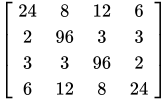


![{\displaystyle [32]R_{q7,q8}}](https://wikimedia.org/api/rest_v1/media/math/render/svg/489741954b4269c41ef0d491551ee3eb322f003d)


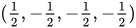
![{\displaystyle [d]{R_{ql,qr}}}](https://wikimedia.org/api/rest_v1/media/math/render/svg/5bbb52ecdb49bbf48eca911c51159a7cde6297b5)

![{\displaystyle [4]R_{q7,q8}}](https://wikimedia.org/api/rest_v1/media/math/render/svg/142972752f455c2ebf6dfa810fad486e42a64adc)
![{\displaystyle [4]R_{-q7,-q8}}](https://wikimedia.org/api/rest_v1/media/math/render/svg/979305387cd62fe7cd50162981451034c04d0a46)
![{\displaystyle [4]R_{q8,q7}}](https://wikimedia.org/api/rest_v1/media/math/render/svg/ce6367e92819738a98ca78a723632627cbac1d46)
![{\displaystyle [4]R_{-q8,-q7}}](https://wikimedia.org/api/rest_v1/media/math/render/svg/55ec9c74197b1c39b504adea0b886925dd1c3c53)
![{\displaystyle [16]R_{q7,q8}}](https://wikimedia.org/api/rest_v1/media/math/render/svg/b226f3971360ad4951192127156d716546993525)


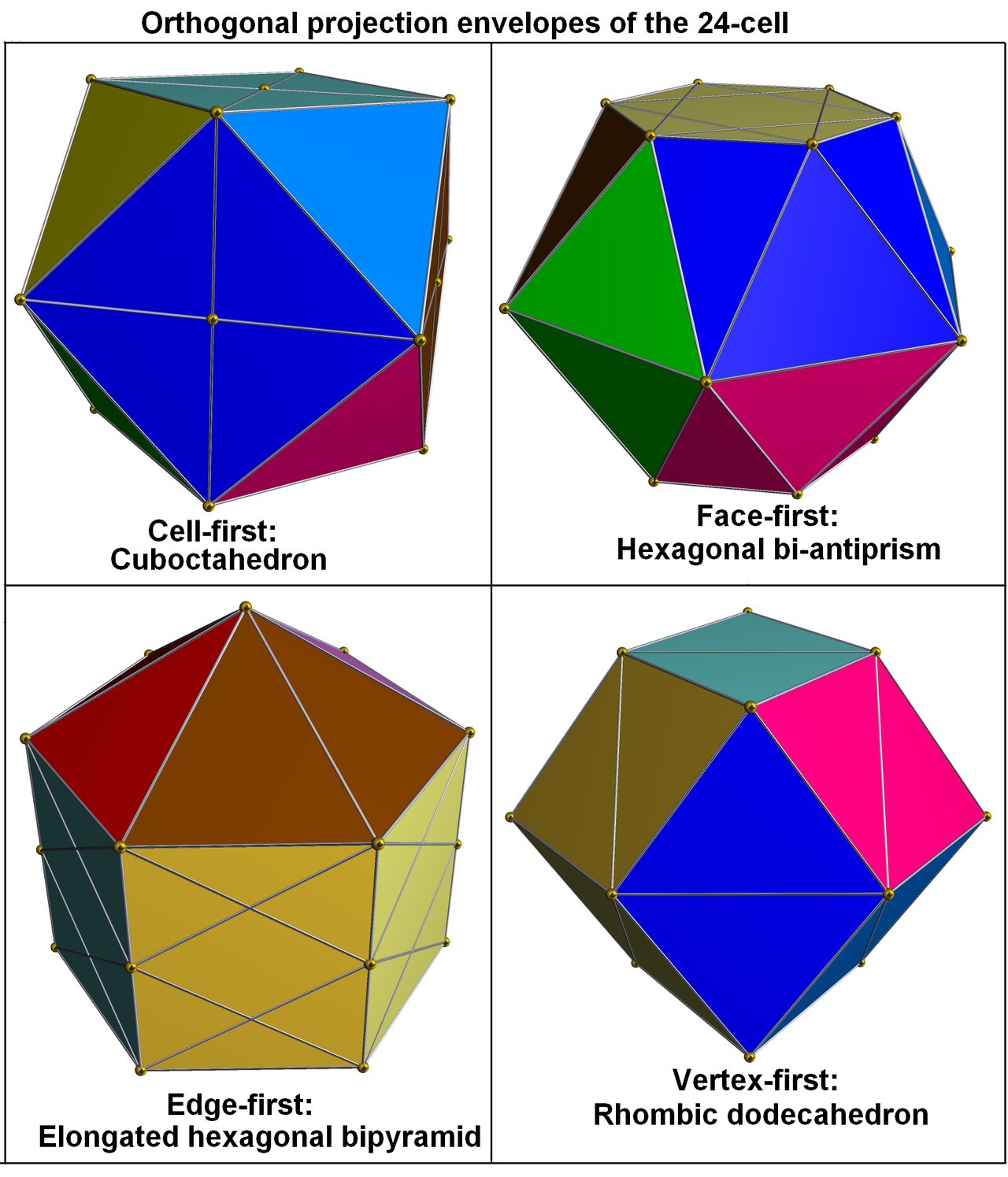

 o
o


 o
o


.svg/1280px-Regular_star_figure_6(4,1).svg.png)


.svg/1280px-Regular_star_figure_4(6,1).svg.png)


![{\displaystyle [32]R_{q7,-q8}}](https://wikimedia.org/api/rest_v1/media/math/render/svg/75389b1a12b5ecc21fcf5aa341e21ea1a735185e)
![{\displaystyle [32]R_{q7,q7}}](https://wikimedia.org/api/rest_v1/media/math/render/svg/0ac021392aa0cc4678c9af39214f175504d374ab)
![{\displaystyle [32]R_{q7,-q7}}](https://wikimedia.org/api/rest_v1/media/math/render/svg/90455b7de215a272c1f8b03f89d553a617c778c2)


![{\displaystyle [16]R_{q7,q1}}](https://wikimedia.org/api/rest_v1/media/math/render/svg/1d24c32c1cbc71058e7641ea96c69e98007561df)


![{\displaystyle [16]R_{q7,-q1}}](https://wikimedia.org/api/rest_v1/media/math/render/svg/13f88d38fb45fb9aef8062cde605b83186924cd8)
![{\displaystyle [36]R_{q6,q6}}](https://wikimedia.org/api/rest_v1/media/math/render/svg/a314e52d3680d2dc1dc28729f1ff0dbbf052b885)
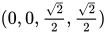
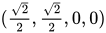

![{\displaystyle [36]R_{q6,-q6}}](https://wikimedia.org/api/rest_v1/media/math/render/svg/d9ebb3a857917b540fe0c670009be886efe59caa)
.svg/1280px-Regular_star_figure_3(8,3).svg.png)
![{\displaystyle [144]R_{q6,-q4}}](https://wikimedia.org/api/rest_v1/media/math/render/svg/2c5b13de83f9b8da9b3751c83873524f5eb6d267)
![{\displaystyle [72]R_{q4,q4}}](https://wikimedia.org/api/rest_v1/media/math/render/svg/306d2b2366566140b924e18d4538c03a27a3db95)
![{\displaystyle [96]R_{q2,q7}}](https://wikimedia.org/api/rest_v1/media/math/render/svg/1a9526fab41f1ec7f186656fc326a4437467f564)
![{\displaystyle [18]R_{q2,-q2}}](https://wikimedia.org/api/rest_v1/media/math/render/svg/e0ba6f25fdb101b789fc5799477ca895d33cfe98)
![{\displaystyle [12]R_{q2,q1}}](https://wikimedia.org/api/rest_v1/media/math/render/svg/a697458f87b1290700d8ce01919f215dc0b038ea)
![{\displaystyle [1]R_{q1,q1}}](https://wikimedia.org/api/rest_v1/media/math/render/svg/6b5c23335f59d47afb2203de0dd0057e5195b2b0)
![{\displaystyle [1]R_{q1,-q1}}](https://wikimedia.org/api/rest_v1/media/math/render/svg/7b4bd1b012a0bed1d34937533f1cc8a6bf4afb73)
![{\displaystyle \gamma _{4}[2\beta _{4}]}](https://wikimedia.org/api/rest_v1/media/math/render/svg/fed6d31ffad37e44fd0966bb3f883b38a4fb178c)

