 Hispanopedia Wiki

In topology, a covering or covering projection is a map between topological spaces that, intuitively, locally acts like a projection of multiple copies of a space onto itself. In particular, coverings are special types of local homeomorphisms. If is a covering, is said to be a covering space or cover of , and is said to be the base of the covering, or simply the base. By abuse of terminology, and may sometimes be called covering spaces as well. Since coverings are local homeomorphisms, a covering space is a special kind of étalé space.


Covering spaces first arose in the context of complex analysis (specifically, the technique of analytic continuation), where they were introduced by Riemann as domains on which naturally multivalued complex functions become single-valued. These spaces are now called Riemann surfaces.[1]:10
Covering spaces are an important tool in several areas of mathematics. In modern geometry, covering spaces (or branched coverings, which have slightly weaker conditions) are used in the construction of manifolds, orbifolds, and the morphisms between them. In algebraic topology, covering spaces are closely related to the fundamental group: for one, since all coverings have the homotopy lifting property, covering spaces are an important tool in the calculation of homotopy groups. A standard example in this vein is the calculation of the fundamental group of the circle by means of the covering of by (see below).[2]:29 Under certain conditions, covering spaces also exhibit a Galois correspondence with the subgroups of the fundamental group.


Definition
Let be a topological space. A covering of is a continuous map
- :{\tilde {X}}\rightarrow X}

such that for every there exists an open neighborhood of and a discrete space such that is the disjoint union and is a homeomorphism for every . The open sets are called sheets, which are uniquely determined up to homeomorphism if is connected.[2]:56 For each the discrete set is called the fiber of . If is connected (and is non-empty), it can be shown that is surjective, and the cardinality of is the same for all ; this value is called the degree of the covering. If is path-connected, then the covering :{\tilde {X}}\rightarrow X} is called a path-connected covering. This definition is equivalent to the statement that is a locally trivial fiber bundle.


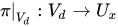


Some authors also require that be surjective in the case that is not connected.[3]
Examples
- For every topological space , the identity map is a covering. Likewise for any discrete space the projection taking is a covering. Coverings of this type are called trivial coverings; if has finitely many (say ) elements, the covering is called the trivial -sheeted covering of .





![{\displaystyle Y=[0,1]\times \mathbb {R} }](https://wikimedia.org/api/rest_v1/media/math/render/svg/b566709fb62d0c99d75506726ea4f22fc3f98078)
![{\displaystyle X=[0,1]\times S^{1}}](https://wikimedia.org/api/rest_v1/media/math/render/svg/3ecfebcfe87fcb8d16f87d9f6dfecca71bf16af1)


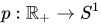
- The map with is a covering of the unit circle. The base of the covering is and the covering space is . For any point such that , the set is an open neighborhood of . The preimage of under is






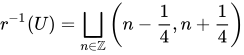
- and the sheets of the covering are for The fiber of is



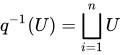
- Another covering of the unit circle is the map with for some positive For an open neighborhood of an , one has:


- .
- A map which is a local homeomorphism but not a covering of the unit circle is with . There is a sheet of an open neighborhood of , which is not mapped homeomorphically onto .


- Let be odd. The map defined by is a homomorphic double covering.


Properties
Local homeomorphism
Since a covering maps each of the disjoint open sets of homeomorphically onto it is a local homeomorphism, i.e. is a continuous map and for every there exists an open neighborhood of , such that is a homeomorphism.



It follows that the covering space and the base space locally share the same properties.

- If is a connected and non-orientable manifold, then there is a covering :{\tilde {X}}\rightarrow X} of degree , whereby is a connected and orientable manifold.[2]:234
- If is a connected Lie group, then there is a covering :{\tilde {X}}\rightarrow X} which is also a Lie group homomorphism and :\gamma {\text{ is a path in X with }}\gamma (0)={\boldsymbol {1_{X}}}{\text{ modulo homotopy with fixed ends}}\}} is a Lie group.[4]:174
- If is a graph, then it follows for a covering that is also a graph.[2]:85
- If is a connected manifold, then there is a covering :{\tilde {X}}\rightarrow X} , whereby is a connected and simply connected manifold.[5]:32
- If is a connected Riemann surface, then there is a covering :{\tilde {X}}\rightarrow X} which is also a holomorphic map[5]:22 and is a connected and simply connected Riemann surface.[5]:32


Factorisation
Let and be path-connected, locally path-connected spaces, and and be continuous maps, such that the diagram


commutes.
- If and are coverings, so is .
- If and are coverings, so is .[6]:485

Product of coverings
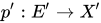
Let and be topological spaces and and be coverings, then with is a covering.[6]:339 However, coverings of are not all of this form in general.





Equivalence of coverings
Let be a topological space and and be coverings. Both coverings are called equivalent, if there exists a homeomorphism , such that the diagram


commutes. If such a homeomorphism exists, then one calls the covering spaces and isomorphic.

Lifting property
All coverings satisfy the lifting property, i.e.:
Let be the unit interval and be a covering. Let be a continuous map and be a lift of , i.e. a continuous map such that . Then there is a uniquely determined, continuous map for which and which is a lift of , i.e. .[2]:60




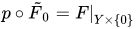



If is a path-connected space, then for it follows that the map is a lift of a path in and for it is a lift of a homotopy of paths in .


As a consequence, one can show that the fundamental group of the unit circle is an infinite cyclic group, which is generated by the homotopy classes of the loop with .[2]:29



Let be a path-connected space and be a connected covering. Let be any two points, which are connected by a path , i.e. and . Let be the unique lift of , then the map


- with


If is a path-connected space and a connected covering, then the induced group homomorphism
- with ,

![{\displaystyle p_{\#}([\gamma ])=[p\circ \gamma ]}](https://wikimedia.org/api/rest_v1/media/math/render/svg/d0da1f32b69d662c4ca704e03c7f6665cc4c2bbe)
is injective and the subgroup of consists of the homotopy classes of loops in , whose lifts are loops in .[2]:61


Branched covering
Definitions
Holomorphic maps between Riemann surfaces
Let and be Riemann surfaces, i.e. one dimensional complex manifolds, and let be a continuous map. is holomorphic in a point, if for any charts of and of , with , the map is holomorphic.





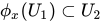

If is holomorphic at all , we say is holomorphic.
The map is called the local expression of in .

If is a non-constant, holomorphic map between compact Riemann surfaces, then is surjective and an open map,[5]:11 i.e. for every open set the image is also open.


Ramification point and branch point
Let be a non-constant, holomorphic map between compact Riemann surfaces. For every there exist charts for and and there exists a uniquely determined , such that the local expression of in is of the form .[5]:10 The number is called the ramification index of in and the point is called a ramification point if . If for an , then is unramified. The image point of a ramification point is called a branch point.


Degree of a holomorphic map
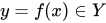
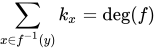
Let be a non-constant, holomorphic map between compact Riemann surfaces. The degree of is the cardinality of the fiber of an unramified point , i.e. .


This number is well-defined, since for every the fiber is discrete[5]:20 and for any two unramified points , it is:



It can be calculated by:
- [5]:29
Branched covering
Definition
A continuous map is called a branched covering, if there exists a closed set with dense complement , such that is a covering.


Examples
- Let and , then with is a branched covering of degree , where by is a branch point.
- Every non-constant, holomorphic map between compact Riemann surfaces of degree is a branched covering of degree .


Universal covering
Definition
Let be a simply connected covering. If is another simply connected covering, then there exists a uniquely determined homeomorphism :{\tilde {X}}\rightarrow E} , such that the diagram


commutes.[6]:482
This means that is, up to equivalence, uniquely determined and because of that universal property denoted as the universal covering of the space .
Existence
A universal covering does not always exist. The following theorem guarantees its existence for a certain class of base spaces.
Let be a connected, locally simply connected topological space. Then, there exists a universal covering

The set is defined as :\gamma {\text{ is a path in }}X{\text{ with }}\gamma (0)=x_{0}\}/{\text{homotopy with fixed ends}},} where is any chosen base point. The map is defined by [2]:64


![{\displaystyle p([\gamma ])=\gamma (1).}](https://wikimedia.org/api/rest_v1/media/math/render/svg/88161f80c6b7485988e4316566ca3403a07d3120)
The topology on is constructed as follows: Let be a path with Let be a simply connected neighborhood of the endpoint Then, for every there is a path inside from to that is unique up to homotopy. Now consider the set The restriction with is a bijection and can be equipped with the final topology of


![{\displaystyle p([\gamma \sigma _{y}])=\gamma \sigma _{y}(1)=y}](https://wikimedia.org/api/rest_v1/media/math/render/svg/6fde7cec13ae9d68141ad43a3b98b5826e0e59e4)


The fundamental group acts freely on by and the orbit space is homeomorphic to through the map
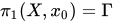
![{\displaystyle ([\gamma ],[{\tilde {x}}])\mapsto [\gamma {\tilde {x}}],}](https://wikimedia.org/api/rest_v1/media/math/render/svg/ce4233e45b128ca2c7c9da8172d420335be02fba)

![{\displaystyle [\Gamma {\tilde {x}}]\mapsto {\tilde {x}}(1).}](https://wikimedia.org/api/rest_v1/media/math/render/svg/8013d086e999f585e622aefa4be8eb7e915a07c1)
Examples

- with is the universal covering of the unit circle .
- with is the universal covering of the projective space for .


![{\displaystyle p(x)=[x]}](https://wikimedia.org/api/rest_v1/media/math/render/svg/24b8773dff8ad19fc5a8f33134a4da367b04fc0c)


- with is the universal covering of the unitary group.


- Since , it follows that the quotient map is the universal covering of .


- A topological space which has no universal covering is the Hawaiian earring: One can show that no neighborhood of the origin is simply connected.[6]:487,Example 1


G-coverings
Let G be a discrete groupacting on the topological spaceX. This means that each element g of G is associated to a homeomorphism Hg of X onto itself, in such a way that Hgh is always equal to Hg Hh for any two elements g and h of G. (Or in other words, a group action of the group G on the space X is just a group homomorphism of the group G into the group Homeo(X) of self-homeomorphisms of X.) It is natural to ask under what conditions the projection from X to the orbit spaceX/G is a covering map. This is not always true since the action may have fixed points. An example for this is the cyclic group of order 2 acting on a product X × X by the twist action where the non-identity element acts by (x, y) ↦ (y, x). Thus the study of the relation between the fundamental groups of X and X/G is not so straightforward.

However the group G does act on the fundamental groupoid of X, and so the study is best handled by considering groups acting on groupoids, and the corresponding orbit groupoids. The theory for this is set down in Chapter 11 of the book Topology and groupoids referred to below. The main result is that for discontinuous actions of a group G on a Hausdorff spaceX which admits a universal cover, then the fundamental groupoid of the orbit space X/G is isomorphic to the orbit groupoid of the fundamental groupoid of X, i.e. the quotient of that groupoid by the action of the group G. This leads to explicit computations, for example of the fundamental group of the symmetric square of a space.
Smooth coverings
Let E and M be smooth manifolds with or without boundary. A covering is called a smooth covering if it is a smooth map and the sheets are mapped diffeomorphically onto the corresponding open subset of M. (This is in contrast to the definition of a covering, which merely requires that the sheets are mapped homeomorphically onto the corresponding open subset.)

Deck transformation
Definition
Let be a covering. A deck transformation is a homeomorphism , such that the diagram of continuous maps


commutes. Together with the composition of maps, the set of deck transformation forms a group, which is the same as .


Now suppose is a covering map and (and therefore also ) is connected and locally path connected. The action of on each fiber is free. If this action is transitive on some fiber, then it is transitive on all fibers, and we call the cover regular (or normal or Galois). Every such regular cover is a principal -bundle, where is considered as a discrete topological group.


Every universal cover is regular, with deck transformation group being isomorphic to the fundamental group.

Examples
- Let be the covering for some , then the map for is a deck transformation and .
- Let be the covering , then the map for is a deck transformation and .
- As another important example, consider the complex plane and the complex plane minus the origin. Then the map with is a regular cover. The deck transformations are multiplications with -th roots of unity and the deck transformation group is therefore isomorphic to the cyclic group. Likewise, the map :\mathbb {C} \to \mathbb {C} ^{\times }} with is the universal cover.











Properties
Let be a path-connected space and be a connected covering. Since a deck transformation is bijective, it permutes the elements of a fiber with and is uniquely determined by where it sends a single point. In particular, only the identity map fixes a point in the fiber.[2]:70 Because of this property every deck transformation defines a group action on , i.e. let be an open neighborhood of a and an open neighborhood of an , then is a group action.


Normal coverings
Definition
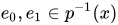
A covering is called normal, if . This means, that for every and any two there exists a deck transformation , such that .


Properties
Let be a path-connected space and be a connected covering. Let be a subgroup of , then is a normal covering iff is a normal subgroup of .


If is a normal covering and , then .

If is a path-connected covering and , then , whereby is the normaliser of .[2]:71


Let be a topological space. A group acts discontinuously on , if every has an open neighborhood with , such that for every with one has .




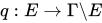
If a group acts discontinuously on a topological space , then the quotient map with is a normal covering.[2]:72 Hereby is the quotient space and is the orbit of the group action.



Examples
- The covering with is a normal coverings for every .
- Every simply connected covering is a normal covering.
Calculation
Let be a group, which acts discontinuously on a topological space and let be the normal covering.
- If is path-connected, then .[2]:72
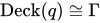
- If is simply connected, then .[2]:71

Examples
- Let . The antipodal map with generates, together with the composition of maps, a group and induces a group action , which acts discontinuously on . Because of it follows, that the quotient map is a normal covering and for a universal covering, hence for .
- Let be the special orthogonal group, then the map is a normal covering and because of , it is the universal covering, hence .
- With the group action of on , whereby is the semidirect product, one gets the universal covering of the klein bottle, hence .
- Let be the torus which is embedded in the . Then one gets a homeomorphism , which induces a discontinuous group action , whereby . It follows, that the map is a normal covering of the klein bottle, hence .
- Let be embedded in the . Since the group action is discontinuously, whereby are coprime, the map is the universal covering of the lens space, hence .


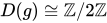


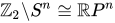










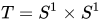







![{\displaystyle S^{3}\times \mathbb {Z/pZ} \rightarrow S^{3}:((z_{1},z_{2}),[k])\mapsto (e^{2\pi ik/p}z_{1},e^{2\pi ikq/p}z_{2})}](https://wikimedia.org/api/rest_v1/media/math/render/svg/72ebd3752fc18f7e53cc92a583d04ac1b95a75ac)




Galois correspondence
Let be a connected and locally simply connected space, then for every subgroup there exists a path-connected covering with .[2]:66



Let and be two path-connected coverings, then they are equivalent iff the subgroups and are conjugate to each other.[6]:482



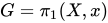
Let be a connected and locally simply connected space, then, up to equivalence between coverings, there is a bijection:

For a sequence of subgroups one gets a sequence of coverings . For a subgroup with index, the covering has degree .



![{\displaystyle \displaystyle [\pi _{1}(X):H]=d}](https://wikimedia.org/api/rest_v1/media/math/render/svg/2b9159dd8a0e29ba795fe865ddb5140ae95fd675)
Classification
Definitions
Category of coverings
Let be a topological space. The objects of the category are the coverings of and the morphisms between two coverings and are continuous maps , such that the diagram


commutes.
G-Set
Let be a topological group. The category is the category of sets which are G-sets. The morphisms are G-maps between G-sets. They satisfy the condition for every .




Equivalence
Let be a connected and locally simply connected space, and be the fundamental group of . Since defines, by lifting of paths and evaluating at the endpoint of the lift, a group action on the fiber of a covering, the functor is an equivalence of categories.[2]:68–70

Applications

An important practical application of covering spaces occurs in charts on SO(3), the rotation group. This group occurs widely in engineering, due to 3-dimensional rotations being heavily used in navigation, nautical engineering, and aerospace engineering, among many other uses. Topologically, SO(3) is the real projective spaceRP3, with fundamental group Z/2, and only (non-trivial) covering space the hypersphere S3, which is the group Spin(3), and represented by the unit quaternions. Thus quaternions are a preferred method for representing spatial rotations – see quaternions and spatial rotation.
However, it is often desirable to represent rotations by a set of three numbers, known as Euler angles (in numerous variants), both because this is conceptually simpler for someone familiar with planar rotation, and because one can build a combination of three gimbals to produce rotations in three dimensions. Topologically this corresponds to a map from the 3-torus T3 of three angles to the real projective space RP3 of rotations, and the resulting map has imperfections due to this map being unable to be a covering map. Specifically, the failure of the map to be a local homeomorphism at certain points is referred to as gimbal lock, and is demonstrated in the animation at the right – at some points (when the axes are coplanar) the rank of the map is 2, rather than 3, meaning that only 2 dimensions of rotations can be realized from that point by changing the angles. This causes problems in applications, and is formalized by the notion of a covering space.
See also
- Bethe lattice is the universal cover of a Cayley graph
- Covering graph, a covering space for an undirected graph, and its special case the bipartite double cover
- Covering group
- Galois connection
- Quotient space (topology)
Further reading
- Hatcher, Allen (2002). Algebraic topology. Cambridge: Cambridge University Press. ISBN 0-521-79160-X. OCLC 45420394.
- Forster, Otto (1981). Lectures on Riemann surfaces. New York. ISBN 0-387-90617-7. OCLC 7596520.
{{cite book}}: CS1 maint: location missing publisher (link) - Munkres, James R. (2018). Topology. New York, NY. ISBN 978-0-13-468951-7. OCLC 964502066.
{{cite book}}: CS1 maint: location missing publisher (link) - Kühnel, Wolfgang (2011). Matrizen und Lie-Gruppen Eine geometrische Einführung (in German). Wiesbaden: Vieweg+Teubner Verlag. doi:10.1007/978-3-8348-9905-7. ISBN 978-3-8348-9905-7. OCLC 706962685.
References
- ↑Forster, Otto (1981). "Chapter 1: Covering Spaces". Lectures on Riemann Surfaces. GTM. Translated by Bruce Gillian. New York: Springer. ISBN 9781461259633.
- 12345678910111213141516Hatcher, Allen (2001). Algebraic Topology. Cambridge: Cambridge Univ. Press. ISBN 0-521-79160-X.
- ↑Rowland, Todd. "Covering Map." From MathWorld--A Wolfram Web Resource, created by Eric W. Weisstein. https://mathworld.wolfram.com/CoveringMap.html
- ↑Kühnel, Wolfgang (6 December 2010). Matrizen und Lie-Gruppen. Stuttgart: Springer Fachmedien Wiesbaden GmbH. ISBN 978-3-8348-9905-7.
- 1234567Forster, Otto (1991). Lectures on Riemann surfaces. München: Springer Berlin. ISBN 978-3-540-90617-9.
- 12345Munkres, James (2000). Topology. Upper Saddle River, NJ: Prentice Hall, Inc. ISBN 978-0-13-468951-7.
- Algebraic topology
- Homotopy theory
- Fiber bundles
- Topological graph theory