 Hispanopedia Wiki
En matemáticas, una función definida sobre los números reales se denomina función escalonada si puede expresarse como una combinación lineal finita de funciones indicadoras de intervalos . En términos informales, una función escalonada es una función constante definida a trozos que solo tiene un número finito de partes.

Definición y primeras consecuencias
Una funciónSe denomina función escalón si se puede escribir como

- para todos los números reales
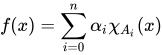

dónde,son números reales,son intervalos yes la función indicadora de:


En esta definición, los intervalosSe puede suponer que tiene las dos propiedades siguientes:
- Los intervalos son disjuntos dos a dos :para
- La unión de los intervalos es toda la recta real:


De hecho, si ese no es el caso desde el principio, se puede elegir un conjunto diferente de intervalos para los que se cumplan estas suposiciones. Por ejemplo, la función escalón.

se puede escribir como
![{\displaystyle f=0\chi _{(-\infty ,-5)}+4\chi _{[-5,0]}+7\chi _{(0,1)}+3\chi _{[1,6)}+0\chi _{[6,\infty )}.}](https://wikimedia.org/api/rest_v1/media/math/render/svg/d5bff43674d124bd16078168fb1aba20c474ca59)
Variaciones en la definición
A veces, se requiere que los intervalos sean abiertos por la derecha [ 1 ] o se permite que sean unitarios. [ 2 ] La condición de que la colección de intervalos debe ser finita a menudo se omite, especialmente en matemáticas escolares, [ 3 ] [ 4 ] [ 5 ] aunque todavía debe ser localmente finita , lo que resulta en la definición de funciones constantes a trozos.
Ejemplos

- Una función constante es un ejemplo trivial de función escalonada. Entonces solo hay un intervalo,
- La función signo sgn( x ) , que es −1 para números negativos y +1 para números positivos, es la función escalón no constante más simple.
- La función de Heaviside H ( x ) , que es 0 para números negativos y 1 para números positivos, es equivalente a la función signo, salvo un desplazamiento y una escala de rango (). It is the mathematical concept behind some test signals, such as those used to determine the step response of a dynamical system.



- The rectangular function, the normalized boxcar function, is used to model a unit pulse.
Non-examples
- The integer part function is not a step function according to the definition of this article, since it has an infinite number of intervals. However, some authors also define step functions with an infinite number of intervals.[6]
Properties
- The sum and product of two step functions is again a step function. The product of a step function with a number is also a step function. As such, the step functions form an algebra over the real numbers.
- A step function takes only a finite number of values. If the intervals for in the above definition of the step function are disjoint and their union is the real line, then for all
- The definite integral of a step function is a piecewise linear function.
- The Lebesgue integral of a step function is where is the length of the interval , and it is assumed here that all intervals have finite length. In fact, this equality (viewed as a definition) can be the first step in constructing the Lebesgue integral.[7]
- A discrete random variable is sometimes defined as a random variable whose cumulative distribution function is piecewise constant.[8] In this case, it is locally a step function (globally, it may have an infinite number of steps). Usually however, any random variable with only countably many possible values is called a discrete random variable, in this case their cumulative distribution function is not necessarily locally a step function, as infinitely many intervals can accumulate in a finite region.








See also
References
- ↑"Step Function".
- ↑"Step Functions - Mathonline".
- ↑"Mathwords: Step Function".
- ↑"Archived copy". Archived from the original on 2015-09-12. Retrieved 2024-12-16.
{{cite web}}: CS1 maint: archived copy as title (link) - ↑"Step Function".
- ↑Bachman, Narici, Beckenstein (5 April 2002). "Example 7.2.2". Fourier and Wavelet Analysis. Springer, New York, 2000. ISBN 0-387-98899-8.
{{cite book}}: CS1 maint: multiple names: authors list (link) - ↑Weir, Alan J (10 May 1973). "3". Lebesgue integration and measure. Cambridge University Press, 1973. ISBN 0-521-09751-7.
- ↑Bertsekas, Dimitri P. (2002). Introduction to Probability. Tsitsiklis, John N., Τσιτσικλής, Γιάννης Ν. Belmont, Mass.: Athena Scientific. ISBN 188652940X. OCLC 51441829.
- Special functions