 Hispanopedia Wiki
En la teoría de la demostración , el análisis ordinal asigna ordinales (a menudo ordinales contables grandes ) a las teorías matemáticas como una medida de su solidez. Si las teorías tienen el mismo ordinal teórico de la demostración, a menudo son equiconsistentes , y si una teoría tiene un ordinal teórico de la demostración más grande que otra, a menudo puede demostrar la consistencia de la segunda teoría.
Además de obtener el ordinal demostrativo de una teoría, en la práctica el análisis ordinal suele producir también otros datos sobre la teoría que se analiza, por ejemplo caracterizaciones de las clases de funciones recursivas demostrables, hiperaritméticas o de la teoría. [1]

Historia
El campo del análisis ordinal se formó cuando Gerhard Gentzen en 1934 utilizó la eliminación de cortes para demostrar, en términos modernos, que el ordinal teórico de la demostración de la aritmética de Peano es ε 0 . Véase la demostración de consistencia de Gentzen .
Definición
El análisis ordinal se ocupa de teorías verdaderas y efectivas (recursivas) que pueden interpretar una porción suficiente de aritmética para hacer afirmaciones sobre notaciones ordinales.
El ordinal demostrativo de una teoría de este tipo es el supremo de los tipos de orden de todas las notaciones ordinales (necesariamente recursivas , véase la siguiente sección) que la teoría puede probar que están bien fundadas —el supremo de todos los ordinales para los que existe una notación en el sentido de Kleene tal que prueba que es una notación ordinal. Equivalentemente, es el supremo de todos los ordinales tales que existe una relación recursiva en (el conjunto de números naturales) que lo ordena bien con ordinal y tal que prueba la inducción transfinita de enunciados aritméticos para .


Notaciones ordinales
Algunas teorías, como los subsistemas de aritmética de segundo orden, no tienen una conceptualización o una forma de argumentar sobre los ordinales transfinitos. Por ejemplo, para formalizar lo que significa que un subsistema de Z 2 "resulte bien ordenado", construimos en cambio una notación ordinal con el tipo de orden . ahora podemos trabajar con varios principios de inducción transfinita junto con , que sustituyen el razonamiento sobre los ordinales de la teoría de conjuntos.

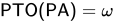
Sin embargo, existen algunos sistemas de notación patológicos con los que resulta inesperadamente difícil trabajar. Por ejemplo, Rathjen ofrece un sistema de notación recursiva primitiva que está bien fundamentado si y solo si PA es consistente, [2] p. 3 a pesar de tener un tipo de orden - incluir una notación de este tipo en el análisis ordinal de PA daría como resultado la falsa igualdad .

Límite superior
Como una notación ordinal debe ser recursiva, el ordinal de prueba teórica de cualquier teoría es menor o igual que el ordinal de Church-Kleene . En particular, el ordinal de prueba teórica de una teoría inconsistente es igual a , porque una teoría inconsistente prueba trivialmente que todas las notaciones ordinales están bien fundadas.

Para cualquier teoría que sea a la vez -axiomatizable y -sólida, la existencia de un orden recursivo que la teoría no puede demostrar que está bien ordenado se sigue del teorema de acotación, y dichas notaciones ordinales demostrablemente bien fundadas están de hecho bien fundadas por -sólida. Por lo tanto, el ordinal demostrativo de una teoría -sólida que tiene una axiomatización siempre será un ordinal recursivo (contable) , es decir, estrictamente menor que . [2] Teorema 2.21


Ejemplos
Teorías con ordinal ω demostrativo
- Q, Aritmética de Robinson (aunque la definición del ordinal de prueba teórica para tales teorías débiles debe ser ajustada) [ cita requerida ] .
- PA – , la teoría de primer orden de la parte no negativa de un anillo discretamente ordenado.
Teorías con ordinal ω demostrativo2
- RFA, aritmética de funciones rudimentarias . [3]
- IΔ 0 , aritmética con inducción sobre predicados Δ 0 sin ningún axioma que afirme que la exponenciación es total.
Teorías con ordinal ω demostrativo3
- EFA, aritmética de funciones elementales .
- IΔ 0 + exp, aritmética con inducción sobre predicados Δ 0 aumentados por un axioma que afirma que la exponenciación es total.
- RCA*
0, una forma de segundo orden de EFA que a veces se utiliza en matemáticas inversas . - WKL*
0, una forma de segundo orden de EFA que a veces se utiliza en matemáticas inversas .
La gran conjetura de Friedman sugiere que muchas matemáticas "ordinarias" pueden demostrarse en sistemas débiles que tengan este como su ordinal de prueba teórica.
Teorías con ordinal ω demostrativonorte(paranorte= 2, 3, ... ω)
- IΔ 0 o EFA aumentado por un axioma que asegura que cada elemento del nivel n -ésimo de la jerarquía de Grzegorczyk es total.

Teorías con ordinal ω demostrativoω
- RCA 0 , comprensión recursiva .
- WKL 0 , lema de König débil .
- PRA, aritmética recursiva primitiva .
- IΣ 1 , aritmética con inducción sobre Σ 1 -predicados.
Teorías con ordinal ε demostrativo0
- PA, aritmética de Peano ( demostrada por Gentzen usando eliminación de corte ).
- ACA 0 , comprensión aritmética .
Teorías con ordinal de prueba teóricaOrdinal de Feferman-Schütte Γ 0
- ATR 0 , recursión transfinita aritmética .
- Teoría de tipo Martin-Löf con un número arbitrario de universos de niveles finitos.
Este ordinal se considera a veces el límite superior de las teorías "predicativas".
Teorías con ordinal de prueba teóricaOrdinario de Bachmann-Howard
- ID 1 , la primera teoría de definiciones inductivas .
- KP, teoría de conjuntos de Kripke-Platek con el axioma de infinito .
- CZF, teoría de conjuntos constructivos de Zermelo-Fraenkel de Aczel .
- EON, una variante débil del sistema matemático explícito de Feferman T 0 .
Las teorías de conjuntos de Kripke-Platek o CZF son teorías de conjuntos débiles sin axiomas para el conjunto potencia completo dado como conjunto de todos los subconjuntos. En cambio, tienden a tener axiomas de separación restringida y formación de nuevos conjuntos, o bien conceden la existencia de ciertos espacios de funciones (exponenciación) en lugar de extraerlos de relaciones mayores.
Teorías con ordinales demostrativos más grandes
- , Π 1 1 la comprensión tiene un ordinal teórico de prueba bastante grande, que fue descrito por Takeuti en términos de "diagramas ordinales", [5] p. 13 y que está limitado por ψ 0 (Ω ω ) en la notación de Buchholz . También es el ordinal de , la teoría de definiciones inductivas finitamente iteradas. Y también el ordinal de MLW, teoría de tipos de Martin-Löf con tipos W indexados Setzer (2004).
- ID ω , la teoría de definiciones inductivas iterativas ω . Su ordinal de demostración teórica es igual al ordinal de Takeuti-Feferman-Buchholz .
- T 0 , el sistema constructivo de matemáticas explícitas de Feferman tiene un ordinal de prueba teórica más grande, que también es el ordinal de prueba teórica de KPi, la teoría de conjuntos de Kripke-Platek con admisibles iterados y .
- KPi, una extensión de la teoría de conjuntos de Kripke-Platek basada en un ordinal recursivamente inaccesible , tiene un ordinal de prueba teórica muy grande descrito en un artículo de 1983 de Jäger y Pohlers, donde I es el inaccesible más pequeño. [6] Este ordinal es también el ordinal de prueba teórica de .
- KPM, una extensión de la teoría de conjuntos de Kripke-Platek basada en un ordinal de Mahlo recursivo , tiene un ordinal de prueba teórica muy grande θ, que fue descrito por Rathjen (1990).
- TTM, una extensión de la teoría de tipos de Martin-Löf mediante un universo Mahlo, tiene un ordinal de prueba teórica aún más grande .
- tiene un ordinal de prueba teórica igual a , donde se refiere al primer débilmente compacto, debido a (Rathjen 1993)
- tiene un ordinal de prueba teórica igual a , donde se refiere al primer -indescriptible y , debido a (Stegert 2010).
- tiene un ordinal de prueba teórica igual a donde es un análogo cardinal del ordinal menos estable para todos y , debido a (Stegert 2010).











La mayoría de las teorías capaces de describir el conjunto potencia de los números naturales tienen ordinales demostrativos que son tan grandes que aún no se ha dado una descripción combinatoria explícita. Esto incluye , la aritmética de segundo orden completa ( ) y las teorías de conjuntos con conjuntos potencia que incluyen ZF y ZFC. La fuerza de ZF intuicionista (IZF) es igual a la de ZF.


Tabla de análisis ordinales
Llave
Esta es una lista de símbolos utilizados en esta tabla:
- ψ representa varias funciones de colapso ordinales tal como se definen en sus respectivas citas.
- Ψ representa la Psi de Rathjen o Stegert.
- φ representa la función de Veblen.
- ω representa el primer ordinal transfinito.
- ε α representa los números épsilon .
- Γ α representa los números gamma (Γ 0 es el ordinal de Feferman–Schütte )
- Ω α representa los ordinales incontables (Ω 1 , abreviado Ω, es ω 1 ). Se considera que la contabilidad es necesaria para que un ordinal se considere demostrable.
- es un término ordinal que denota un ordinal estable y el ordinal menos admisible por encima de .
- es un término ordinal que denota un ordinal tal que . N es una variable que define una serie de análisis ordinales de los resultados de forall . cuando N=1,





Esta es una lista de las abreviaturas utilizadas en esta tabla:
- Aritmética de primer orden
- ¿Es aritmética Robinson?
- es la teoría de primer orden de la parte no negativa de un anillo discretamente ordenado.
- Es una función aritmética rudimentaria .
- es aritmética con inducción restringida a Δ 0 -predicados sin ningún axioma que afirme que la exponenciación es total.
- Es una función aritmética elemental .
- es aritmética con inducción restringida a Δ 0 -predicados aumentados por un axioma que afirma que la exponenciación es total.
- es una función aritmética elemental aumentada por un axioma que asegura que cada elemento del n -ésimo nivel de la jerarquía de Grzegorczyk es total.
- se amplía con un axioma que garantiza que cada elemento del nivel n -ésimo de la jerarquía de Grzegorczyk es total.
- es aritmética recursiva primitiva .
- es aritmética con inducción restringida a Σ 1 -predicados.
- es aritmética de Peano .
- es pero con inducción solo para fórmulas positivas.
- extiende PA mediante ν puntos fijos iterados de operadores monótonos.
- No es exactamente un sistema aritmético de primer orden, pero captura lo que se puede obtener mediante el razonamiento predicativo basado en los números naturales.
- es un automorfismo en .
- extiende PA por ν iterados menos puntos fijos de operadores monótonos.
- no es exactamente un sistema aritmético de primer orden, pero captura lo que se puede obtener mediante el razonamiento predicativo basado en definiciones inductivas generalizadas iteradas n-veces.
- es un automorfismo en .
- Es una versión debilitada basada en tipos W.
- es una inducción transfinita de longitud α no mayor que -fórmulas. Resulta ser la representación de la notación ordinal cuando se utiliza en aritmética de primer orden.


![{\displaystyle {\mathsf {TI}}[\Pi _{0}^{1-},\alpha ]}](https://wikimedia.org/api/rest_v1/media/math/render/svg/2ab99a1ed8c6503eb1ce734783eed99e63461547)

- Aritmética de segundo orden
- es una forma de segundo orden que a veces se utiliza en matemáticas inversas .
- es una forma de segundo orden que a veces se utiliza en matemáticas inversas.
- Es comprensión recursiva .
- es un lema de König débil .
- Es comprensión aritmética .
- es más el esquema de inducción de segundo orden completo.
- es recursión transfinita aritmética .
- es más el esquema de inducción de segundo orden completo.
- is plus the assertion "every true -sentence with parameters holds in a (countable coded) -model of ".



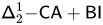


- Kripke-Platek set theory
- is Kripke-Platek set theory with the axiom of infinity.
- is Kripke-Platek set theory, whose universe is an admissible set containing .
- is a weakened version of based on W-types.
- asserts that the universe is a limit of admissible sets.
- is a weakened version of based on W-types.
- asserts that the universe is inaccessible sets.
- asserts that the universe is hyperinaccessible: an inaccessible set and a limit of inaccessible sets.
- asserts that the universe is a Mahlo set.
- is augmented by a certain first-order reflection scheme.
- is KPi augmented by the axiom .
- is KPI augmented by the assertion "at least one recursively Mahlo ordinal exists".
- is with an axiom stating that 'there exists an non-empty and transitive set M such that '.








A superscript zero indicates that -induction is removed (making the theory significantly weaker).

- Type theory
- is the Herbelin-Patey Calculus of Primitive Recursive Constructions.
- is type theory without W-types and with universes.
- is type theory without W-types and with finitely many universes.
- is type theory with a next universe operator.
- is type theory without W-types and with a superuniverse.
- is an automorphism on type theory without W-types.
- is type theory with one universe and Aczel's type of iterative sets.
- is type theory with indexed W-Types.
- is type theory with W-types and one universe.
- is type theory with W-types and finitely many universes.
- is an automorphism on type theory with W-types.
- is type theory with a Mahlo universe.
- is System F, also polymorphic lambda calculus or second-order lambda calculus.


- Constructive set theory
- is Aczel's constructive set theory.
- is plus the regular extension axiom.
- is plus the full-second order induction scheme.
- is with a Mahlo universe.




- Explicit mathematics
- is basic explicit mathematics plus elementary comprehension
- is plus join rule
- is plus join axioms
- is a weak variant of the Feferman's .
- is , where is inductive generation.
- is , where is the full second-order induction scheme.




See also
- Equiconsistency
- Large cardinal property
- Feferman–Schütte ordinal
- Bachmann–Howard ordinal
- Complexity class
- Gentzen's consistency proof
Notes
- 1.^ For
- 2.^ The Veblen function with countably infinitely iterated least fixed points.[clarification needed]
- 3.^ Can also be commonly written as in Madore's ψ.
- 4.^ Uses Madore's ψ rather than Buchholz's ψ.
- 5.^ Can also be commonly written as in Madore's ψ.
- 6.^ represents the first recursively weakly compact ordinal. Uses Arai's ψ rather than Buchholz's ψ.
- 7.^ Also the proof-theoretic ordinal of , as the amount of weakening given by the W-types is not enough.
- 8.^ represents the first inaccessible cardinal. Uses Jäger's ψ rather than Buchholz's ψ.
- 9.^ represents the limit of the -inaccessible cardinals. Uses (presumably) Jäger's ψ.
- 10.^ represents the limit of the -inaccessible cardinals. Uses (presumably) Jäger's ψ.
- 11.^ represents the first Mahlo cardinal. Uses Rathjen's ψ rather than Buchholz's ψ.
- 12.^ represents the first weakly compact cardinal. Uses Rathjen's Ψ rather than Buchholz's ψ.
- 13.^ represents the first -indescribable cardinal. Uses Stegert's Ψ rather than Buchholz's ψ.
- 14.^ is the smallest such that ' is -indescribable') and ' is -indescribable '). Uses Stegert's Ψ rather than Buchholz's ψ.
- 15.^ represents the first Mahlo cardinal. Uses (presumably) Rathjen's ψ.









Citations
- ^ M. Rathjen, "Admissible Proof Theory and Beyond". In Studies in Logic and the Foundations of Mathematics vol. 134 (1995), pp.123--147.
- ^ a b c Rathjen, The Realm of Ordinal Analysis. Accessed 2021 September 29.
- ^ Krajicek, Jan (1995). Bounded Arithmetic, Propositional Logic and Complexity Theory. Cambridge University Press. pp. 18–20. ISBN 9780521452052. defines the rudimentary sets and rudimentary functions, and proves them equivalent to the Δ0-predicates on the naturals. An ordinal analysis of the system can be found in Rose, H. E. (1984). Subrecursion: functions and hierarchies. University of Michigan: Clarendon Press. ISBN 9780198531890.
- ^ a b c d e f M. Rathjen, Proof Theory: From Arithmetic to Set Theory (p.28). Accessed 14 August 2022.
- ^ Rathjen, Michael (2006), "The art of ordinal analysis" (PDF), International Congress of Mathematicians, vol. II, Zürich: Eur. Math. Soc., pp. 45–69, MR 2275588, archived from the original on 2009-12-22
{{citation}}: CS1 maint: bot: original URL status unknown (link) - ^ D. Madore, A Zoo of Ordinals (2017, p.2). Accessed 12 August 2022.
- ^ a b c d e f g J. Avigad, R. Sommer, "A Model-Theoretic Approach to Ordinal Analysis" (1997).
- ^ M. Rathjen, W. Carnielli, "Hydrae and subsystems of arithmetic" (1991)
- ^ Jeroen Van der Meeren; Rathjen, Michael; Weiermann, Andreas (2014). "An order-theoretic characterization of the Howard-Bachmann-hierarchy". arXiv:1411.4481 [math.LO].
- ^ a b c d e f g h i j k G. Jäger, T. Strahm, "Second order theories with ordinals and elementary comprehension".
- ^ a b c d e G. Jäger, "The Strength of Admissibility Without Foundation". Journal of Symbolic Logic vol. 49, no. 3 (1984).
- ^ B. Afshari, M. Rathjen, "Ordinal Analysis and the Infinite Ramsey Theorem" (2012)
- ^ a b Marcone, Alberto; Montalbán, Antonio (2011). "The Veblen functions for computability theorists". The Journal of Symbolic Logic. 76 (2): 575–602. arXiv:0910.5442. doi:10.2178/jsl/1305810765. S2CID 675632.
- ^ S. Feferman, "Theories of finite type related to mathematical practice". In Handbook of Mathematical Logic, Studies in Logic and the Foundations of Mathematics vol. 90 (1977), ed. J. Barwise, pub. North Holland.
- ^ a b c d M. Heissenbüttel, "Theories of ordinal strength and " (2001)
- ^ a b c d e f g D. Probst, "A modular ordinal analysis of metapredicative subsystems of second-order arithmetic" (2017)
- ^ A. Cantini, "On the relation between choice and comprehension principles in second order arithmetic", Journal of Symbolic Logic vol. 51 (1986), pp. 360--373.
- ^ a b c d Fischer, Martin; Nicolai, Carlo; Pablo Dopico Fernandez (2020). "Nonclassical truth with classical strength. A proof-theoretic analysis of compositional truth over HYPE". arXiv:2007.07188 [math.LO].
- ^ a b c S. G. Simpson, "Friedman's Research on Subsystems of Second Order Arithmetic". In Harvey Friedman's Research on the Foundations of Mathematics, Studies in Logic and the Foundations of Mathematics vol. 117 (1985), ed. L. Harrington, M. Morley, A. Šcedrov, S. G. Simpson, pub. North-Holland.
- ^ J. Avigad, "An ordinal analysis of admissible set theory using recursion on ordinal notations". Journal of Mathematical Logic vol. 2, no. 1, pp.91--112 (2002).
- ^ S. Feferman, "Iterated inductive fixed-point theories: application fo Hancock's conjecture". In Patras Logic Symposion, Studies in Logic and the Foundations of Mathematics vol. 109 (1982).
- ^ S. Feferman, T. Strahm, "The unfolding of non-finitist arithmetic", Annals of Pure and Applied Logic vol. 104, no.1--3 (2000), pp.75--96.
- ^ S. Feferman, G. Jäger, "Choice principles, the bar rule and autonomously iterated comprehension schemes in analysis", Journal of Symbolic Logic vol. 48, no. (1983), pp.63--70.
- ^ a b c d e f g h U. Buchholtz, G. Jäger, T. Strahm, "Theories of proof-theoretic strength ψ ( Γ Ω + 1 ) {\displaystyle \psi (\Gamma _{\Omega +1})} ". In Concepts of Proof in Mathematics, Philosophy, and Computer Science (2016), ed. D. Probst, P. Schuster. DOI 10.1515/9781501502620-007.
- ^ T. Strahm, "Autonomous fixed point progressions and fixed point transfinite recursion" (2000). In Logic Colloquium '98, ed. S. R. Buss, P. Hájek, and P. Pudlák . DOI 10.1017/9781316756140.031
- ^ G. Jäger, T. Strahm, "Fixed point theories and dependent choice". Archive for Mathematical Logic vol. 39 (2000), pp.493--508.
- ^ a b c T. Strahm, "Autonomous fixed point progressions and fixed point transfinite recursion" (2000)
- ^ a b c d C. Rüede, "Transfinite dependent choice and ω-model reflection". Journal of Symbolic Logic vol. 67, no. 3 (2002).
- ^ a b c C. Rüede, "The proof-theoretic analysis of Σ11 transfinite dependent choice". Annals of Pure and Applied Logic vol. 122 (2003).
- ^ a b c d T. Strahm, "Wellordering Proofs for Metapredicative Mahlo". Journal of Symbolic Logic vol. 67, no. 1 (2002)
- ^ F. Ranzi, T. Strahm, "A flexible type system for the small Veblen ordinal" (2019). Archive for Mathematical Logic 58: 711–751.
- ^ K. Fujimoto, "Notes on some second-order systems of iterated inductive definitions and -comprehensions and relevant subsystems of set theory". Annals of Pure and Applied Logic, vol. 166 (2015), pp. 409--463.
- ^ a b c Krombholz, Martin; Rathjen, Michael (2019). "Upper bounds on the graph minor theorem". arXiv:1907.00412 [math.LO].
- ^ W. Buchholz, S. Feferman, W. Pohlers, W. Sieg, Iterated Inductive Definitions and Subsystems of Analysis: Recent Proof-Theoretical Studies
- ^ W. Buchholz, Proof Theory of Impredicative Subsystems of Analysis (Studies in Proof Theory, Monographs, Vol 2 (1988)
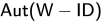
- ^ a b c d e f g h i j k l m n M. Rathjen, "Investigations of Subsystems of Second Order Arithmetic and Set Theory in Strength between Π 1 1 − C A {\displaystyle \Pi _{1}^{1}{\mathsf {-CA}}} and Δ 2 1 − C A + B I {\displaystyle \Delta _{2}^{1}{\mathsf {-CA+BI}}} : Part I". Accessed 21 September 2023.
- ^ M. Rathjen, "The Strength of Some Martin-Löf Type Theories"
- ^ a b A. Setzer, "A Model for a type theory with Mahlo universe" (1996).
- ^ M. Rathjen, "Proof Theory of Reflection". Annals of Pure and Applied Logic vol. 68, iss. 2 (1994), pp.181--224.
- ^ a b Stegert, Jan-Carl, "Ordinal Proof Theory of Kripke-Platek Set Theory Augmented by Strong Reflection Principles" (2010).
- ^ a b c Arai, Toshiyasu (2023-04-01). "Lectures on Ordinal Analysis". arXiv:2304.00246 [math.LO].
- ^ Arai, Toshiyasu (2023-04-07). "Well-foundedness proof for -reflection". arXiv:2304.03851 [math.LO].
- ^ a b Arai, Toshiyasu (2024-02-12). "An ordinal analysis of -Collection". arXiv:2311.12459 [math.LO].
- ^ Valentin Blot. "A direct computational interpretation of second-order arithmetic via update recursion" (2022).


References
- Buchholz, W.; Feferman, S.; Pohlers, W.; Sieg, W. (1981), Definiciones inductivas iteradas y subsistemas de análisis , Lecture Notes in Math., vol. 897, Berlín: Springer-Verlag, doi :10.1007/BFb0091894, ISBN 978-3-540-11170-2
- Pohlers, Wolfram (1989), Proof Theory , Lecture Notes in Mathematics, vol. 1407, Berlín: Springer-Verlag, doi :10.1007/978-3-540-46825-7, ISBN 3-540-51842-8, Sr. 1026933
- Pohlers, Wolfram (1998), "Teoría de conjuntos y teoría de números de segundo orden", Handbook of Proof Theory , Studies in Logic and the Foundations of Mathematics, vol. 137, Ámsterdam: Elsevier Science BV, págs. 210–335, doi :10.1016/S0049-237X(98)80019-0, ISBN 0-444-89840-9, Sr. 1640328
- Rathjen, Michael (1990), "Notaciones ordinales basadas en un cardinal débilmente Mahlo", Arch. Math. Logic , 29 (4): 249–263, doi :10.1007/BF01651328, MR 1062729, S2CID 14125063
- Rathjen, Michael (2006), "El arte del análisis ordinal" (PDF) , Congreso Internacional de Matemáticos , vol. II, Zúrich: Eur. Math. Soc., pp. 45–69, MR 2275588, archivado desde el original el 22 de diciembre de 2009
{{citation}}: CS1 maint: bot: original URL status unknown (link) - Rose, HE (1984), Subrecursion. Funciones y jerarquías , Oxford logic guides, vol. 9, Oxford, Nueva York: Clarendon Press, Oxford University Press
- Schütte, Kurt (1977), Teoría de la prueba , Grundlehren der Mathematischen Wissenschaften, vol. 225, Berlín-Nueva York: Springer-Verlag, págs. xii+299, ISBN 3-540-07911-4, Sr. 0505313
- Setzer, Anton (2004), "Teoría de la prueba de la teoría de tipos de Martin-Löf. Una visión general", Mathématiques et Sciences Humaines. Matemáticas y ciencias sociales (165): 59–99
- Takeuti, Gaisi (1987), Teoría de la prueba , Estudios de lógica y fundamentos de las matemáticas, vol. 81 (segunda edición), Ámsterdam: North-Holland Publishing Co., ISBN 0-444-87943-9, Sr. 0882549
- Rathjen, Michael (1994), "Teoría de la prueba de la reflexión", Anales de lógica pura y aplicada , 68 (2): 181–224, doi :10.1016/0168-0072(94)90074-4
- Stegert, Jan-Carl (2010), Teoría de la prueba ordinal de la teoría de conjuntos de Kripke-Platek aumentada por principios de reflexión fuerte



