 Hispanopedia Wiki
A height function is a function that quantifies the complexity of mathematical objects. In Diophantine geometry, height functions quantify the size of solutions to Diophantine equations and are typically functions from a set of points on algebraic varieties (or a set of algebraic varieties) to the real numbers.[1]
For instance, the classical or naive height over the rational numbers is typically defined to be the maximum of the numerators and denominators of the coordinates (e.g. 7 for the coordinates (3/7, 1/2)), but in a logarithmic scale.
Significance
Height functions allow mathematicians to count objects, such as rational points, that are otherwise infinite in quantity. For instance, the set of rational numbers of naive height (the maximum of the numerator and denominator when expressed in lowest terms) below any given constant is finite despite the set of rational numbers being infinite.[2] In this sense, height functions can be used to prove asymptotic results such as Baker's theorem in transcendental number theory which was proved by AlanBaker (1966, 1967a, 1967b).
In other cases, height functions can distinguish some objects based on their complexity. For instance, the subspace theorem proved by Wolfgang M.Schmidt (1972) demonstrates that points of small height (i.e. small complexity) in projective space lie in a finite number of hyperplanes and generalizes Siegel's theorem on integral points and solution of the S-unit equation.[3]
Height functions were crucial to the proofs of the Mordell–Weil theorem and Faltings' theorem by Weil (1929) and Faltings (1983) respectively. Several outstanding unsolved problems about the heights of rational points on algebraic varieties, such as the Manin conjecture and Vojta's conjecture, have far-reaching implications for problems in Diophantine approximation, Diophantine equations, arithmetic geometry, and mathematical logic.[4][5]
History
An early form of height function was proposed by Giambattista Benedetti (c. 1563), who argued that the consonance of a musical interval could be measured by the product of its numerator and denominator (in reduced form); see Giambattista Benedetti § Music.
Heights in Diophantine geometry were initially developed by André Weil and Douglas Northcott beginning in the 1920s.[6] Innovations in 1960s were the Néron–Tate height and the realization that heights were linked to projective representations in much the same way that ample line bundles are in other parts of algebraic geometry. In the 1970s, Suren Arakelov developed Arakelov heights in Arakelov theory.[7] In 1983, Faltings developed his theory of Faltings heights in his proof of Faltings' theorem.[8]
Height functions in Diophantine geometry
Naive height
Classical or naive height is defined in terms of ordinary absolute value on homogeneous coordinates. It is typically a logarithmic scale and therefore can be viewed as being proportional to the "algebraic complexity" or number of bits needed to store a point.[2] It is typically defined to be the logarithm of the maximum absolute value of the vector of coprime integers obtained by multiplying through by a lowest common denominator. This may be used to define height on a point in projective space over Q, or of a polynomial, regarded as a vector of coefficients, or of an algebraic number, from the height of its minimal polynomial.[9]
The naive height of a rational numberx = p/q (in lowest terms) is
- multiplicative height
- logarithmic height: [10]


Therefore, the naive multiplicative and logarithmic heights of 4/10 are 5 and log(5), for example.
The naive height H of an elliptic curveE given by y2 = x3 + Ax + B is defined to be H(E) = log max(4|A|3, 27|B|2).
Néron–Tate height
The Néron–Tate height, or canonical height, is a quadratic form on the Mordell–Weil group of rational points of an abelian variety defined over a global field. It is named after André Néron, who first defined it as a sum of local heights,[11] and John Tate, who defined it globally in an unpublished work.[12]
Weil height
Let X be a projective variety over a number field K. Let L be a line bundle on X. One defines the Weil height on X with respect to L as follows.
First, suppose that L is very ample. A choice of basis of the space of global sections defines a morphism ϕ from X to projective space, and for all points p on X, one defines , where h is the naive height on projective space.[13][14] For fixed X and L, choosing a different basis of global sections changes , but only by a bounded function of p. Thus is well-defined up to addition of a function that is O(1).



In general, one can write L as the difference of two very ample line bundles L1 and L2 on X and define which again is well-defined up to O(1).[13][14]

Arakelov height
La altura de Arakelov en un espacio proyectivo sobre el cuerpo de los números algebraicos es una función de altura global con contribuciones locales provenientes de las métricas de Fubini-Study en los cuerpos arquimedianos y la métrica usual en los cuerpos no arquimedianos . [ 15 ] [ 16 ] Es la altura usual de Weil equipada con una métrica diferente. [ 17 ]
Altura de Faltings
La altura de Faltings de una variedad abeliana definida sobre un cuerpo numérico es una medida de su complejidad aritmética. Se define en términos de la altura de un fibrado lineal metrizado . Fue introducida por Faltings ( 1983 ) en su demostración de la conjetura de Mordell .
Funciones de altura en álgebra
Altura de un polinomio
Para un polinomio P de grado n dado por

La altura H ( P ) se define como el máximo de las magnitudes de sus coeficientes: [ 18 ]

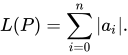
De manera similar, se podría definir la longitud L ( P ) como la suma de las magnitudes de los coeficientes:
Relación con la medida de Mahler
La medida de Mahler M ( P ) de P es también una medida de la complejidad de P . [ 19 ] Las tres funciones H ( P ), L ( P ) y M ( P ) están relacionadas por las desigualdades



dóndees el coeficiente binomial .

Funciones de altura en formas automórficas
Una de las condiciones en la definición de una forma automorfa en el grupo lineal general de un grupo algebraico adélico es el crecimiento moderado , que es una condición asintótica sobre el crecimiento de una función de altura en el grupo lineal general visto como una variedad afín . [ 20 ]
Otras funciones de altura
La altura de un número racional irreducible x = p / q , q > 0 es(esta función se utiliza para construir una biyección entrey). [ 21 ]


Véase también
References
- ↑Lang (1997,pp. 43–67)
- 12BombieriandGubler (2006,pp. 15–21)
- ↑BombieriandGubler (2006,pp. 176–230)
- ↑Vojta (1987)
- ↑Faltings (1991)
- ↑Weil (1929)
- ↑Lang (1988)
- ↑Faltings (1983)
- ↑Bakerand Wüstholz (2007,p. 3)
- ↑mathoverflow question: average-height-of-rational-points-on-a-curve
- ↑Néron (1965)
- ↑Lang (1997)
- 12Silverman (1994,III.10)
- 12BombieriandGubler (2006,Sections 2.2–2.4)
- ↑BombieriandGubler (2006,pp. 66–67)
- ↑Lang (1988,pp. 156–157)
- ↑Fili,Petsche,andPritsker (2017,p. 441)
- ↑Borwein (2002)
- ↑Mahler (1963)
- ↑Bump (1998)
- ↑Kolmogorovand Fomin (1957,p. 5)
Sources
- Baker, Alan (1966). "Linear forms in the logarithms of algebraic numbers. I". Mathematika. 13 (2): 204–216. doi:10.1112/S0025579300003971. ISSN 0025-5793. MR 0220680.
- Baker, Alan (1967a). "Linear forms in the logarithms of algebraic numbers. II". Mathematika. 14: 102–107. doi:10.1112/S0025579300008068. ISSN 0025-5793. MR 0220680.
- Baker, Alan (1967b). "Formas lineales en los logaritmos de números algebraicos. III". Mathematika . 14 (2): 220– 228. doi : 10.1112/S0025579300003843 . ISSN 0025-5793 . MR 0220680 .
- Baker, Alan; Wüstholz, Gisbert (2007). Formas logarítmicas y geometría diofántica . Nuevas monografías matemáticas. Vol. 9. Cambridge University Press . p. 3. ISBN 978-0-521-88268-2. Zbl 1145.11004 .
- Bombieri, Enrico ; Gubler, Walter (2006). Alturas en geometría diofántica . Nuevas monografías matemáticas. Vol. 4. Cambridge University Press . ISBN 978-0-521-71229-3. Zbl 1130.11034 .
- Borwein, Peter (2002). Excursiones computacionales en análisis y teoría de números . CMS Books in Mathematics. Springer-Verlag . pp. 2 , 3, 14148. ISBN 0-387-95444-9. Zbl 1020.12001 .
- Bump, Daniel (1998). Formas y representaciones automórficas . Estudios de Cambridge en matemáticas avanzadas. Vol. 55. Cambridge University Press. pág. 300. ISBN 9780521658188.
- Cornell, Gary; Silverman, Joseph H. (1986). Geometría aritmética . Nueva York: Springer. ISBN 0387963111.→ Contiene una traducción al inglés de Faltings (1983)
- Faltings, Gerd (1983). "Endlichkeitssätze für abelsche Varietäten über Zahlkörpern" [ Teoremas de finitud para variedades abelianas en campos numéricos ] . Inventiones Mathematicae (en alemán). 73 (3): 349– 366. Bibcode : 1983InMat..73..349F . doi : 10.1007/BF01388432 . SEÑOR 0718935 . S2CID 121049418 .
- Faltings, Gerd (1991). " Aproximación diofántica en variedades abelianas". Annals of Mathematics . 123 (3): 549– 576. doi : 10.2307/2944319 . JSTOR 2944319. MR 1109353 .
- Fili, Paul; Petsche, Clayton; Pritsker, Igor (2017). "Integrales de energía y puntos pequeños para la altura de Arakelov". Archiv der Mathematik . 109 (5): 441– 454. arXiv : 1507.01900 . doi : 10.1007/s00013-017-1080-x . S2CID 119161942 .
- Mahler, K. (1963). "Sobre dos propiedades extremas de los polinomios" . Illinois Journal of Mathematics . 7 (4): 681– 701. doi : 10.1215/ijm/1255645104 . Zbl 0117.04003 .
- Neron, André (1965). "Quasi-fonctions et hauteurs sur les variétés abéliennes". Anales de Matemáticas (en francés). 82 (2): 249– 331. doi : 10.2307/1970644 . JSTOR 1970644 . SEÑOR 0179173 .
- Schinzel, Andrzej (2000). Polinomios con especial atención a la reducibilidad . Enciclopedia de Matemáticas y sus Aplicaciones. Vol. 77. Cambridge: Cambridge University Press . p. 212. ISBN 0-521-66225-7. Zbl 0956.12001 .
- Schmidt, Wolfgang M. (1972). "Ecuaciones en forma normal". Anales de Matemáticas . Segunda serie. 96 (3): 526– 551. doi : 10.2307/1970824 . JSTOR 1970824 . MR 0314761 .
- Lang, Serge (1988). Introducción a la teoría de Arakelov . Nueva York: Springer-Verlag . ISBN 0-387-96793-1. SEÑOR 0969124 . Zbl 0667.14001 .
- Lang, Serge (1997). Panorama general de la geometría diofántica . Springer-Verlag . ISBN 3-540-61223-8. Zbl 0869.11051 .
- Weil, André (1929). "La aritmética sur les courbes algébriques" . Acta Matemática . 52 (1): 281– 315. doi : 10.1007/BF02592688 . SEÑOR 1555278 .
- Silverman, Joseph H. (1994). Temas avanzados en la aritmética de curvas elípticas . Nueva York: Springer. ISBN 978-1-4612-0851-8.
- Vojta, Paul (1987). Aproximaciones diofánticas y teoría de la distribución de valores . Lecture Notes in Mathematics. Vol. 1239. Berlín, Nueva York: Springer-Verlag . doi : 10.1007/BFb0072989 . ISBN 978-3-540-17551-3. SEÑOR 0883451 . Zbl 0609.14011 .
- Kolmogorov, Andrey ; Fomin, Sergei (1957). Elementos de la teoría de funciones y análisis funcional . Nueva York: Graylock Press.
Enlaces externos
- Altura polinómica en Mathworld
- Polinomios
- variedades abelianas
- Curvas elípticas
- Geometría diofántica
- Teoría algebraica de números
- Álgebra abstracta