 Hispanopedia Wiki
Agra ( / ˈ ɑː ɡ r ə / AH -grə ; hindi: [ˈaːɡɾaː] ) es una ciudad a orillas delYamunaen el estado indio deUttar Pradesh, a unos 230 kilómetros (140 mi) al sureste de la capital nacionalDelhiy a 330 km al oeste de la capital del estadoLucknow. Con una población de aproximadamente 1,6 millones, Agra es la cuarta ciudad más poblada de Uttar Pradesh yla vigésimo tercera ciudad más pobladade la India.[11]
El período histórico más importante de Agra comenzó durante el reinado de Sikandar Lodi , pero la edad de oro de la ciudad comenzó con los mogoles a principios del siglo XVI. Agra fue la ciudad más importante del subcontinente indio y la capital del Imperio mogol bajo los emperadores mogoles Babur , Humayun , Akbar , Jahangir y Shah Jahan . Bajo el gobierno mogol, Agra se convirtió en un centro de aprendizaje, artes, comercio y religión, y vio la construcción del Fuerte de Agra , Sikandra y el monumento más preciado de Agra, el Taj Mahal , construido entre 1632 y 1648 por Shah Jahan en memoria de su esposa Mumtaz Mahal . Con la decadencia del imperio mogol a fines del siglo XVIII, la ciudad cayó sucesivamente primero en manos de los marathas y luego de la Compañía de las Indias Orientales . Después de la Independencia, Agra se ha convertido en una ciudad industrial, con una industria turística en auge , junto con calzado, cuero y otras manufacturas. El Taj Mahal y el Fuerte de Agra son Patrimonio de la Humanidad por la UNESCO . La ciudad se caracteriza por inviernos suaves, veranos cálidos y secos y una temporada de monzones , y es famosa por su cocina mogol. Agra está incluida en el circuito turístico del Triángulo Dorado , junto con Delhi y Jaipur ; y en el Arco del Patrimonio de Uttar Pradesh , un circuito turístico de Uttar Pradesh, junto con Lucknow y Varanasi .
Nombre
El nombre Agra se explica por diferentes derivaciones, todas las cuales tienen poca verificabilidad. La más aceptada es que tuvo su origen de la palabra hindi agar que significa salina, un nombre que se le dio porque el suelo en la región es salobre y la sal solía producirse aquí por evaporación. Otros lo derivan de la historia hindú afirmando que la palabra sánscrita agra ( अग्र ) significa el primero de los muchos bosques y arboledas donde Krishna retozaba con las gopis de Vrindavan . El término Agravana significa, por lo tanto, bosque de arboledas. [12] [13]
Agra también era conocida como Akbarabad en la era mogol. El nombre fue acuñado por el emperador Shah Jahan en honor a su abuelo Akbar. [14] [15]
Historia
Era premogol
Agra tiene dos historias: una de la ciudad antigua en la orilla este, o izquierda, del río Yamuna , que se remonta tanto que se perdió en las leyendas de Krishna y Mahabharata y fue restablecida por Sikandar Lodhi en 1504-1505; la otra de la ciudad moderna, fundada por Akbar en 1558, en la orilla derecha del río que está asociada con los mogoles , y conocida en todo el mundo como la ciudad del Taj. De la antigua Agra queda poco ahora, excepto algunos rastros de los cimientos. Fue un lugar de importancia bajo varias dinastías hindúes anteriores a las invasiones musulmanas de la India , pero su historia no está clara y posee poco interés histórico. [16] El cronista del siglo XVII llamado Abdullah dijo que era un pueblo antes del reinado de Sikandar Lodi. El rey de Mathura había utilizado el fuerte de Agra como cárcel. La degradación en el estado del sitio fue el resultado de la destrucción provocada por Mahmud de Ghazni . [17] Masud Sa'd Salman afirma haber estado allí cuando Mahmud asaltó Agra, alegando que el rajá Japal se rindió después de ver una pesadilla. Sin embargo, Mahmud procede a saquear la ciudad. [18]

El período de importancia histórica de Agra comenzó durante el reinado de Sikandar Lodi. En 1504-1505, el sultán Sikandar Lodi (que reinó entre 1489 y 1517 [19] ), gobernante afgano del sultanato de Delhi , reconstruyó Agra y la convirtió en la sede del gobierno. [16] [20] Sikandar Lodhi nombró una comisión que inspeccionó y examinó ambos lados del Yamuna desde Delhi hasta Etawah y finalmente eligió un lugar en la orilla izquierda, o el lado este del Yamuna, como el sitio para la ciudad. Agra, en la orilla izquierda del Yamuna, se convirtió en una gran ciudad floreciente con presencia real, funcionarios, comerciantes, eruditos, teólogos y artistas. La ciudad se convirtió en uno de los centros más importantes de aprendizaje islámico en la India. El sultán fundó la aldea de Sikandra en los suburbios del norte de la ciudad y construyó allí un Baradari de arenisca roja en 1495, que fue convertido en tumba por Jahangir, y ahora se erige como la Tumba de Mariam-uz-Zamani , la emperatriz de Akbar. [21] [22]
Tras la muerte del sultán en 1517, la ciudad pasó a manos de su hijo, el sultán Ibrahim Lodi (que reinó entre 1517 y 1526 [19] ). Gobernó su sultanato desde Agra hasta que fue derrotado y asesinado por el emperador mogol Babur en la primera batalla de Panipat , que se libró en 1526. [23]
Era mogol

La época dorada de la ciudad comenzó con los mogoles . Agra fue la ciudad más importante del subcontinente y la capital del Imperio mogol hasta 1658, cuando Aurangzeb trasladó toda la corte a Delhi. [24]
Babur (que reinó entre 1526 y 1530 [25] ), el fundador de la dinastía mogol, adquirió Agra después de derrotar a los lodhis y a los tomaras de Gwalior en la primera batalla de Panipat en 1526. [25] [26] La conexión de Babur con Agra comenzó inmediatamente después de la batalla de Panipat. Envió a su hijo Humayun , que ocupó la ciudad sin oposición. El rajá de Gwalior, asesinado en Panipat, había dejado a su familia y a los jefes de su clan en Agra. En agradecimiento a Humayun, que los trató con magnanimidad y los protegió del saqueo, le obsequiaron una cantidad de joyas y piedras preciosas como muestra de homenaje. Entre ellas se encontraba el famoso diamante Koh-i-nur . [26] Babur procedió a diseñar el primer jardín mogol formal de la India, el Aram Bagh (o Jardín de la Relajación) a orillas del río Yamuna. Babur estaba decidido a establecer la sede de su gobierno en Agra, pero casi lo disuadió el aspecto desolado de la región, como se desprende de esta cita de sus memorias Baburnama : [26]
Siempre me ha parecido que uno de los principales defectos del Indostán es la falta de cursos de agua artificiales. Tenía la intención de construir, dondequiera que estableciera mi residencia, norias, producir un arroyo artificial y diseñar un elegante y regular parque de recreo. Poco después de llegar a Agra, pasé por el Jumna con este objetivo y examiné el terreno para encontrar un lugar adecuado para un jardín. Todo era tan feo y detestable que volví a cruzar el río con repulsión y asco. Como consecuencia de la falta de belleza y del aspecto desagradable del terreno, abandoné mi intención de hacer un charbagh (casa de jardín); pero como no se presentó una situación mejor cerca de Agra, finalmente me vi obligado a aprovechar al máximo ese mismo lugar... En cada rincón planté jardines adecuados, en cada jardín sembré rosas y narcisos con regularidad y en parterres correspondientes. Tres cosas nos molestaban en el Indostán: una era el calor, otra los fuertes vientos y la tercera el polvo. Los baños eran el medio para eliminar los tres inconvenientes.
—Babur , Baburnama
Quedan muy pocos vestigios de la ciudad de Babur, de sus jardines de frutas y flores, palacios, baños, cisternas, pozos y cursos de agua. Los restos del Charbagh de Babur se pueden ver hoy en Aram Bagh , en el lado este del Yamuna. [26] [27] Babur fue sucedido por su hijo Humayun (reinó entre 1530 y 1540 y entre 1555 y 1556 [25] ), pero fue derrotado completamente en Kanauj en 1539, solo nueve años después de su ascensión, por Sher Shah Suri , un noble afgano, que se había sometido a Babur, pero se rebeló contra su hijo. En esta breve interrupción del gobierno mogol entre 1540 y 1556, Sher Shah Suri estableció el efímero Imperio Sur , y la región fue finalmente reconquistada por Akbar en la Segunda Batalla de Panipat en 1556.
Bajo Akbar (que reinó entre 1556 y 1605 [25] ), y seguido por su nieto Shah Jahan , Agra quedó inmortalizada en la historia del mundo. Akbar construyó la ciudad moderna de Agra en la orilla derecha del Yamuna, donde aún se encuentra la mayor parte de su parte. Convirtió la ciudad en un gran centro de importancia política, cultural y económica, conectándola con las diversas partes de su vasto imperio. Akbar levantó las imponentes murallas del Fuerte de Agra, además de convertirla en un centro de aprendizaje, artes, comercio y religión. Akbar también construyó una nueva capital, Fatehpur Sikri , a unos 35 km de Agra. La nueva capital fue abandonada más tarde. [28] [29] Antes de su muerte, Agra se había convertido probablemente en una de las ciudades más grandes del este, con enormes cantidades de comercio y comercio a través de sus bazares . [30] El viajero inglés Ralph Fitch, que visitó Agra en septiembre de 1585 durante la vida de Akbar, escribe sobre la ciudad: [29]
Agra es una ciudad muy grande y populosa, construida con piedra, con calles hermosas y anchas por las que corre un hermoso río... Agra y Fatehpur Sikri son dos ciudades muy grandes, ambas mucho más grandes que Londres y muy pobladas. Entre Agra y Fatehpur hay doce millas ( kos en realidad) y todo el camino es un mercado de víveres y otras cosas tan lleno como si un hombre estuviera todavía en una ciudad, y tanta gente como si un hombre estuviera en un mercado.
Estas impresiones de Fitch son corroboradas por otro viajero europeo, William Finch , quien comentó sobre Agra: [29]
Es espacioso, grande, tan poblado que casi no se puede pasar por la calle...
Agra continuó expandiéndose y floreciendo durante el reinado del sucesor de Akbar, Jahangir , como escribió en su autobiografía Tuzuk-e-Jahangiri : [29] [30]
La parte habitable de Agra se extiende a ambos lados del río. En su lado oeste, que tiene la mayor población, su circunferencia es de siete kos, y su anchura es de un kos. La circunferencia de la parte habitada del otro lado del río, el lado que da al este, es de 2 1 ⁄ 2 kos, su longitud es de un kos y su anchura de medio kos. Pero en cuanto al número de sus edificios es igual a varias ciudades de Irak, Jorasán y Transoxiana juntas. Muchas personas han construido edificios de tres o cuatro pisos en ella. La masa de la gente es tan grande que moverse por las callejuelas y los bazares es difícil.
El sucesor de Akbar, Jahangir (que reinó entre 1605 y 1627 [25] ), tenía un gran amor por la flora y la fauna y dispuso numerosos jardines en el interior del Fuerte Rojo. [31] El mausoleo de Akbar en Sikandra se completó durante el reinado de Jahangir. El Jahangiri Mahal en el fuerte de Agra y la tumba de Itmad-ud-daulah también se construyeron durante el reinado de Jahangir. Jahangir amaba a Lahore y Cachemira más que a Agra, pero esta última siguió siendo la primera ciudad del reino. [24] Sin embargo, fue Shah Jahan (que reinó entre 1628 y 1658 [25] ) cuya actividad constructora elevó a Agra a la cima de su gloria. Shah Jahan, conocido por su gran interés por la arquitectura, le dio a Agra su monumento más preciado, el Taj Mahal . Construido en memoria amorosa de su esposa Mumtaz Mahal , el mausoleo se completó en 1653. La Jama Masjid y varios otros edificios notables como el Diwan-i-Am , el Diwan-i-Khas , el Moti Masjid , etc., dentro del fuerte fueron planeados y ejecutados bajo sus órdenes. [24]
Shah Jahan trasladó más tarde la capital a Shahjahanabad (hoy conocida como Delhi ) en el año 1648, [32] seguido por su hijo Aurangzeb (que reinó entre 1658 y 1707 [25] ) que trasladó toda la corte a Delhi en 1658. Con esto, Agra comenzó a declinar rápidamente. Sin embargo, la importancia cultural y estratégica de Agra no se vio afectada y en la correspondencia oficial se siguió haciendo referencia a ella como la segunda capital del imperio. [24]
Períodos posteriores
.jpg/1280px-Agra_(Baedeker,_1914).jpg)

El declive del imperio mogol provocó el surgimiento de varios reinos regionales, y a finales del siglo XVIII el control de la ciudad recayó sucesivamente en los jats, los marathas, los mogoles, el gobernante de Gwalior y, finalmente, en la Compañía Británica de las Indias Orientales. [33] Los jats de Bharatpur libraron muchas guerras contra la Delhi mogol y en los siglos XVII y XVIII llevaron a cabo numerosas campañas en territorios mogoles, incluida Agra. [34] Después del declive del Imperio mogol, la ciudad quedó bajo la influencia de otra potencia posterior al Imperio mogol, los marathas , antes de caer en manos de la Compañía Británica de las Indias Orientales en 1803. [33] En los años 1834-1836, Agra fue la capital de la efímera Presidencia de Agra , administrada por un gobernador . Fue entonces la capital de la Provincia del Noroeste desde 1836 hasta 1858, gobernada por un teniente gobernador. [35] [36] Agra fue uno de los centros de la rebelión india de 1857. [ 37]
Durante la rebelión india de 1857, cuando el dominio de la Compañía de las Indias Orientales en muchas partes de la India se vio amenazado, la noticia del motín en Meerut llegó a Agra el 14 de mayo. El 30 de mayo, algunas compañías de la 44.ª y la 67.ª Infantería nativa enviadas a Mathura para traer el tesoro se amotinaron y se llevaron el tesoro a los rebeldes en Delhi. Con el temor de que la rebelión se extendiera también a Agra, el resto de estos batallones de infantería nativa, que formaban parte de la guarnición en Agra, fueron desarmados con éxito por los británicos el 31 de mayo. [13] [38] Sin embargo, cuando el contingente de Gwalior se amotinó el 15 de junio, todas las demás unidades nativas lo siguieron. El 2 de julio, la fuerza rebelde de los contingentes de Nimach y Nasirabad llegó a Fatehpur Sikri . Temiendo el avance de los amotinados hacia Agra, unos 6000 europeos y personas asociadas se trasladaron al Fuerte de Agra para protegerse el 3 de julio. El 5 de julio, la fuerza británica estacionada allí intentó atacar a una fuerza de amotinados que se acercaba, pero fue derrotada y los británicos se retiraron al fuerte. [13] El teniente gobernador, JR Colvin , murió allí y más tarde fue enterrado frente al Diwan-i-am . [39] [13] Sin embargo, los amotinados se trasladaron a Delhi , siendo una atracción más importante para los rebeldes. A pesar de un levantamiento de una turba y un desorden extremo en la ciudad, los británicos lograron restaurar parcialmente el orden el 8 de julio. [13] Delhi, a su vez, cayó en manos de los británicos en septiembre, tras lo cual una brigada de infantería dirigida por el brigadier Edward Greathed llegó a Agra el 11 de octubre sin ninguna oposición de los rebeldes. Pero poco después de su llegada, otra fuerza de amotinados atacó a la brigada por sorpresa, pero fue derrotada y derrotada. Esta pequeña victoria para los británicos se denominó Batalla de Agra . [40] [13] Hay que decir que el levantamiento en Agra fue relativamente menor en comparación con Delhi , Jhansi , Meerut y otras grandes ciudades y regiones rebeldes. [39] Después de esto, el dominio británico se aseguró de nuevo, y el Raj británico gobernó la ciudad hasta la independencia de la India en 1947. [41] La capital de las Provincias del Noroeste se trasladó de Agra a Allahabad en 1858. Gradualmente, Agra decayó a la posición de una mera ciudad provincial, y su prosperidad disminuyó: [36]
Pero en la economía de la administración de la India británica, Agra no es más que una ciudad de distrito; su tamaño, proporciones y múltiples actividades se han reducido a sus necesidades actuales, y la vida continua en esta ciudad no supera la media de esa vida monótona y despreocupada de la India que ha sido descrita con tanta frecuencia y tan vívidamente por muchos escritores angloindios talentosos. Agra se ha convertido en los últimos años en un gran centro ferroviario, y su prosperidad comercial parece estar resurgiendo.
— Agra en 1892, como lo describe SC Mukerji, Guía del viajero a Agra, págs. 55-56
El papel de Agra en el movimiento de independencia de la India no está bien documentado. [42] Sin embargo, en los años entre el motín y la independencia, Agra fue un importante centro de periodismo en hindi y urdu. [ cita requerida ] El parque Paliwal (anteriormente parque Hewitt) en Agra debe su nombre a SKD Paliwal , [43] quien publicó el diario en hindi Sainik . [44]
La posindependencia y el legado mogol
Después de la independencia de la India, Agra ha sido parte de Uttar Pradesh y gradualmente se ha convertido en una ciudad industrial, con una contribución significativa a la economía de Uttar Pradesh. La ciudad es ahora un destino turístico popular y recibe turistas de todo el mundo. [45] El Taj Mahal y el Fuerte de Agra recibieron el estatus de Patrimonio de la Humanidad por la UNESCO en 1983. [46] [47] El Taj Mahal es testigo de turistas, fotógrafos, historiadores y arqueólogos en grandes cantidades durante todo el año. El Taj Mahal se ha convertido en un símbolo de la India. [48] [ se necesita una mejor fuente ] [49] Después de la independencia, el Taj Mahal ha sido visitado por líderes mundiales como los presidentes estadounidenses Dwight D. Eisenhower (1959), Bill Clinton (2000) y Donald Trump (2020). La reina Isabel II del Reino Unido había visitado el Taj Mahal en 1961 en su visita a la India. El Taj Mahal también ha sido visitado por el presidente ruso Vladimir Putin (1999), el presidente chino Hu Jintao (2006), el primer ministro israelí Benjamin Netanyahu (2018) y el primer ministro canadiense Justin Trudeau (2018). [50] Agra es el lugar de nacimiento de la religión ahora extinta conocida como Din-i-Ilahi , que fue fundada por Akbar [51] y también de la Fe Radhaswami , [ cita requerida ] que tiene alrededor de dos millones de seguidores en todo el mundo. Agra está incluida en el circuito turístico del Triángulo Dorado , junto con Delhi y Jaipur ; [52] y el Arco del Patrimonio de Uttar Pradesh, un circuito turístico de Uttar Pradesh, junto con Lucknow y Varanasi . [53]
Geografía y clima
Geografía
La región alrededor de Agra consiste casi en su totalidad en una llanura nivelada, con colinas en el extremo suroeste. Los ríos de la región incluyen Yamuna y Chambal . La región también está regada por el Canal de Agra . El mijo, la cebada, el trigo y el algodón se encuentran entre los cultivos que se cultivan en el campo circundante. Se cultivan cultivos tanto de Rabi como de Kharif . La ciudad desierta de Fatehpur Sikri está a unos 40 km al suroeste de Agra. [54] Las colinas de arenisca cerca de Fatehpur Sikri y en las fronteras sureste del distrito son ramificaciones de la cordillera Vindhya de la India central . [55] Agra está a unos 210 km de la capital nacional de Nueva Delhi (a través de la autopista Yamuna ), [56] a unos 336 km de la capital del estado Lucknow (a través de la autopista Agra-Lucknow ), [57] y a unos 227 km de Kanpur (a través de la autopista Agra-Lucknow). [58] La ciudad tiene una elevación media de 170 metros sobre el nivel del mar. [6]
Clima
En términos generales, el clima de Agra está clasificado como BSh por el sistema de clasificación climática de Köppen-Geiger . [59] Este es el clima estepario tropical y subtropical , un tipo de clima importante de la clasificación de Köppen que ocurre principalmente en la periferia de los verdaderos desiertos en regiones de baja latitud, formando una transición entre el clima desértico ( BW ), y los climas subtropicales y tropicales más húmedos . [60] [61]
La ciudad se caracteriza por inviernos cálidos, veranos sofocantes y secos y una temporada de monzones . El distrito de Agra, por su proximidad al desierto arenoso de Thar al oeste, es relativamente seco y tiene temperaturas extremas mayores que los distritos más al este. El cálido viento del oeste, Loo , sopla principalmente durante abril, mayo y junio con gran fuerza y puede causar golpes de calor fatales. [62] La temperatura más alta jamás registrada en Agra fue de 48,6 °C, el 28 de mayo de 2024. Las lluvias monzónicas suelen comenzar en la primera semana de julio y generalmente terminan a mediados de septiembre. Sin embargo, los monzones , aunque sustanciales en Agra, no son tan fuertes como los monzones en otras partes de la India. El clima se modera a mediados de octubre. [13] [63] La región alrededor de Agra, la llanura indogangética del noroeste , es propensa a una niebla extrema en los meses de invierno, lo que se debe a factores naturales como vientos bajos, bajas temperaturas, disponibilidad de humedad además de la contaminación del aire. [64] [65] Este fenómeno suele provocar grandes retrasos y, en ocasiones, la cancelación de trenes debido a la mala visibilidad. Agra tiene altos niveles de contaminación del aire y uno de los peores índices de calidad del aire de la India. En un estudio realizado por la OMS con datos de los años 2010 a 2016, Agra se clasificó como la octava ciudad más contaminada de la India, junto con otras ciudades cercanas, como Delhi , Kanpur y Faridabad . [66]
Agra ha sido clasificada como la tercera mejor "Ciudad con Aire Limpio Nacional" (en la Categoría 1> Ciudades con Población 10L) en India según 'Swachh Vayu Survekshan 2024 Results' [67]
Ambiente
El Taj Mahal ha sufrido daños importantes debido a la contaminación del aire y al vertido de aguas residuales en el cercano río Yamuna. [75] El Taj Mahal, de mármol blanco, se está volviendo amarillo y verde debido al aire sucio en la octava ciudad más contaminada del mundo. El Taj Mahal flanquea el río Yamuna, repleto de basura , y a menudo está envuelto por el polvo y el smog de las chimeneas y los vehículos. [76]
El río Yamuna es uno de los ríos más contaminados del mundo. [77] Agra es el segundo mayor contribuyente a la contaminación del río Yamuna, después de Delhi. [78] La contaminación del río ha causado varios problemas para el Taj Mahal, como 'ataques de insectos y su baba verde', [79] hedor nauseabundo [80] y corrosión de los cimientos del Taj Mahal. [80] El río tiene hasta 90 nalas o desagües que desembocan en él. Aunque el municipio ha afirmado haber detenido 40 de estos desagües, los nalas más grandes, Bhairon , Mantola , Balkeshwar, siguen descargando enormes cantidades de aguas residuales sin tratar sin ningún control. [81] Los activistas dicen que el lecho del río Yamuna entre Itmad-ud-Daula y el Taj Mahal se ha convertido en un vertedero de contaminantes. Polietileno, desechos plásticos, recortes de cuero de fábricas de zapatos, material de construcción, todo se arroja al río. [81]
Menos del 7% del distrito de Agra está cubierto de bosques. [82] El único santuario de vida silvestre importante cerca de Agra es el lago Keetham , también conocido como el Santuario de Aves de Sur Sarovar. El lago tiene casi dos docenas de variedades de aves migratorias y residentes. [83] Dentro del Santuario de Aves de Sur Sarovar se encuentra el Centro de Rescate de Osos de Agra , que es el primer santuario de la India para osos "bailarines" . Operado por Wildlife SOS , Free the Bears Fund y otros, la instalación ha rehabilitado a más de 620 osos perezosos , que fueron explotados por una tribu nómada conocida como los Kalandars como "osos bailarines", a pesar de que la práctica es ilegal desde 1972. [84] [85]
Agra ha sido clasificada como la tercera mejor "Ciudad con Aire Limpio Nacional" (en la Categoría 1 de ciudades con población >10L) en India según los 'Resultados de Swachh Vayu Survekshan 2024' https://prana.cpcb.gov.in/ncapServices/robust/fetchFilesFromDrive/Swachh_Vayu_Survekshan_2024_Result.pdf
Demografía
Con una población de aproximadamente 1,6 millones, Agra es la cuarta ciudad más poblada de Uttar Pradesh y la vigésimo tercera ciudad más poblada de la India. [11] Según el censo de la India de 2011, la ciudad de Agra tiene una población de 1.585.704 habitantes; su población metropolitana es de 1.760.285. La proporción de sexos de la ciudad de Agra es de 875 mujeres por cada 1000 hombres, mientras que la proporción de sexos infantiles es de 857 niñas por cada 1000 niños. La tasa de alfabetización media de la ciudad de Agra es del 73,11%, de las cuales las tasas de alfabetización masculina y femenina son del 77,81% y del 67,74% respectivamente. [87]
El hinduismo es la religión más seguida en la ciudad de Agra, con un 80,68% de su población. El islam es la segunda religión más seguida en la ciudad de Agra, con un 15,37% de la población. Le siguen el jainismo, el sijismo, el cristianismo y el budismo, con un 1,04%, 0,62%, 0,42% y 0,19% respectivamente. Aproximadamente el 1,66% declaró "no tener ninguna religión en particular". [87]
Administración y política
Administración
Administración policial
El distrito de Agra está bajo la Zona de Policía de Agra y el Campo de Policía de Agra; la Zona de Agra está dirigida por un oficial del Servicio de Policía de la India (IPS) con rango de director general (ADG) , y el Campo de Policía de Agra está dirigido por un oficial del IPS con rango de inspector general adjunto (DIG).
La policía del distrito está dirigida por un superintendente superior de policía (SSP), que es un oficial de IPS , y es asistido por seis superintendentes de policía o superintendentes de policía adicionales para la ciudad, este, oeste, crimen, tráfico y protocolo, ya sea del IPS o del Servicio de Policía Provincial . [94] Cada uno de los varios círculos policiales está dirigido por un oficial de círculo con el rango de superintendente adjunto de policía . [94]
Infraestructura y administración cívica
La Corporación Municipal de Agra o Agra Nagar Nigam (AMC o ANN) es la Corporación Municipal responsable de la infraestructura cívica y la administración de la ciudad de Agra. Este organismo administrativo cívico administra los servicios públicos de la ciudad. El alcalde y los concejales municipales son elegidos por un período de cinco años. [95] La Corporación Municipal de Agra supervisa cuatro zonas (Hariparvat, Lohamandi, Tajganj y Chhata) que se subdividen en 100 distritos. El límite de la AMC abarca un área de 121 km cuadrados. [96] [97] La Autoridad de Desarrollo de Agra (ADA), desarrolla nuevas viviendas, infraestructura y colonias en la ciudad. [98]
Política
Porcentaje de votos de los partidos en la Lok Sabha de Agra de 2019. [99]
El diputado en ejercicio Satyapal Singh Baghel del BJP ganó el distrito electoral de Agra Lok Sabha con un margen de 211.546 votos al derrotar a Manoj Kumar Soni del BSP. Satyapal Singh Baghel obtuvo 646.875 votos.
El distrito de Agra tiene dos distritos electorales de Lok Sabha , Agra y Fatehpur Sikri , y nueve distritos electorales de Uttar Pradesh Vidhan Sabha ( Asamblea Legislativa de Uttar Pradesh ). [100] El diputado del distrito electoral de Agra es SP Singh Baghel , del Partido Bharatiya Janata . [101] Antes de las elecciones para la Asamblea Legislativa de Uttar Pradesh de 2022, se anunció que dos distritos más, incluido Agra, podrían convertirse en una comisaría de policía antes de las elecciones. [102]
Utilidades
La distribución de energía eléctrica y la recaudación de facturas en Agra son responsabilidad de Torrent Power , una empresa del sector privado, así como de DVVNL (Dakshinanchal Vidhyut Vitran Nigam Limited), una entidad estatal de UPPCL. El control de la distribución de energía en Agra fue entregado a Torrent Power de la estatal UP Power Corporation Ltd en 2010, en un esfuerzo por avanzar hacia reformas energéticas y reducir las enormes pérdidas de distribución en el estado. Esta fue la primera vez que se privatizó la distribución de energía en Uttar Pradesh, a excepción de Noida-Greater Noida, que está bajo la NCR . [103] [104]
Agra tiene tres fuentes principales de suministro de agua municipal: plantas de tratamiento de agua en Sikandra y Jeoni Mandi, y agua subterránea mediante pozos entubados. [105] Dado que una gran parte de la demanda de agua se satisface con el río Yamuna , que es un río altamente contaminado, la calidad del agua en Agra suele ser mala, con niveles insalubres de cloro necesarios para su purificación. El agua subterránea de la ciudad tampoco es apta para beber, y es salina y tiene un alto contenido de flúor. Ambas fuentes incumplen las normas CPCB . [106] Para proporcionar a la ciudad un suministro de agua adecuado, se ha iniciado el proyecto del oleoducto Gangajal. [107] Incluye una tubería de 130 km de longitud tendida para llevar agua del Ganges desde el canal superior del Ganges de Bulandshahr hasta Agra. El proyecto se ha puesto en marcha, [108] pero ha enfrentado críticas debido a las frecuentes fugas de la tubería. [109] [110] [111]
Aunque la mayor parte de la ciudad utiliza cilindros para cocinar con gas, también hay gas natural por cañería disponible en muchas localidades, entre ellas Kamla Nagar , Sikandra y otras. El servicio lo proporciona Green Gas Limited. [112] [113]
Economía
Debido a la presencia del Taj Mahal y otros monumentos históricos, Agra tiene una industria turística en auge, así como artesanías reales como Pietra Dura , incrustaciones de mármol y alfombras. [114]
El 40% de la población depende en gran medida de la agricultura, y el resto del sector del cuero y el calzado y de las fundiciones de hierro. Agra fue la segunda ciudad con más trabajadores autónomos de la India en 2007, detrás de Varanasi, seguida de Bhopal, Indore y Patna. Según la Organización Nacional de Encuestas por Muestreo, en 1999-2000, 431 de cada 1.000 hombres empleados eran trabajadores autónomos en la ciudad, cifra que aumentó a 603 por 1.000 en 2004-05. [115]
El turismo tiene un papel importante en la economía de Agra, con más de 9,5 millones de turistas que visitaron Agra y los monumentos circundantes en 2019. [116] La ciudad alberga el spa más grande de Asia llamado Kaya Kalp - The Royal Spa, en el ITC Hotel Mughal en Agra. [117] [118] Otros hoteles incluyen Taj Hotel and Convention Centre. [119]
Sanjay Place is the trade centre of Agra. There are about 12 major and medium scale industries, producing electrical goods, pipes, leather goods etc. There are about 7,200 small scale industrial units. Above 1.5 lakh pairs of shoes per day are manufactured in Agra by the various footwear units.[120] Agra city is also known for its leather goods, the oldest and famous leather firm Taj Leather World is in Sadar bazar. The carpets, handicrafts, zari and zardozi (embroidery work), marble and stone carving and inlay work.[121][122]
Agra amassed a GDP of[clarification needed] 40.21 billions / 40,210 crores as per the data released by UP Government for the year 2018–19, thus the 3rd rank in the state.[123]
In the Swachh Survekshan 2020, Agra ranked 16th nation-wide, and 2nd in the state after Lucknow, which was a big jump after 86th in 2019, 102nd in 2018, and 263rd in 2017.[124][125] In the Smart city Rankings, which are pan-India rankings for 100 cities which is released by the Ministry of Housing and Urban Affairs based on the progress/completion rate of Smart City projects, Agra ranked 1st, based on the rankings released based on work done by department concerned under the Smart City project from 1 October 2019, to 1 March 2020.[126][127]
As of August 2020, Industrial activity in Agra has been affected as a result of the restrictions imposed due to the COVID-19 pandemic that has forced people to remain confined to their homes. The sectors worst-hit are the iron foundries, tourism, leather shoe industry in Agra.[128] It is estimated that the loss in the tourism industry due to COVID-19 restrictions is approximately ₹ 22 billions / 2,200 crores.[129]
Monuments and architecture
Taj Mahal
The Taj Mahal rises above the banks of the river like a solitary tear suspended on the cheek of time.
— Rabindranath Tagore, (translated by Kshitish Roy) from One Hundred and One Poems by Rabindranath Tagore (pp. 95–96)
Taj Mahal is a mausoleum complex in Agra, built by the Mughal emperor Shah Jahan as a tomb for his wife Mumtaz Mahal ("Chosen One of the Palace"), who died in childbirth in 1631, having been the emperor's inseparable companion since their marriage in 1612. India's most famed building, it is situated in the eastern part of the city on the southern (right) bank of the Yamuna River, about 1.6 km east of the Agra Fort, also on the right bank of the Yamuna. The Taj Mahal is distinguished as the finest example of Mughal architecture, a blend of Indian, Persian, and Islamic styles. Other attractions include twin mosque buildings (placed symmetrically on either side of the mausoleum), pleasant gardens, and a museum. The complex was designated a UNESCO World Heritage site in 1983,[130] and is one of the New Seven Wonders of the world.[131] The Taj Mahal is the most visited tourist spot in the India, attracting nearly 6.9 million visitors in 2018–19.[132][133]
The chief architect was probably the Persian architect Ustad Ahmad Lahori. Designed as a unified entity according to the principles of Mughal architecture, the five principal elements of the complex were the main gateway, garden, mosque, jawab (literally 'answer', a building mirroring the mosque), and the mausoleum, with its four minarets. The construction commenced in 1632 with upwards of twenty thousand workers from India, Persia, the Ottoman Empire, and Europe working to complete the mausoleum itself by 1639, the adjunct buildings by 1643, with decoration work continuing until at least 1647. In total, construction of the 42 acre (17 hectare) complex spanned 22 years.[133]
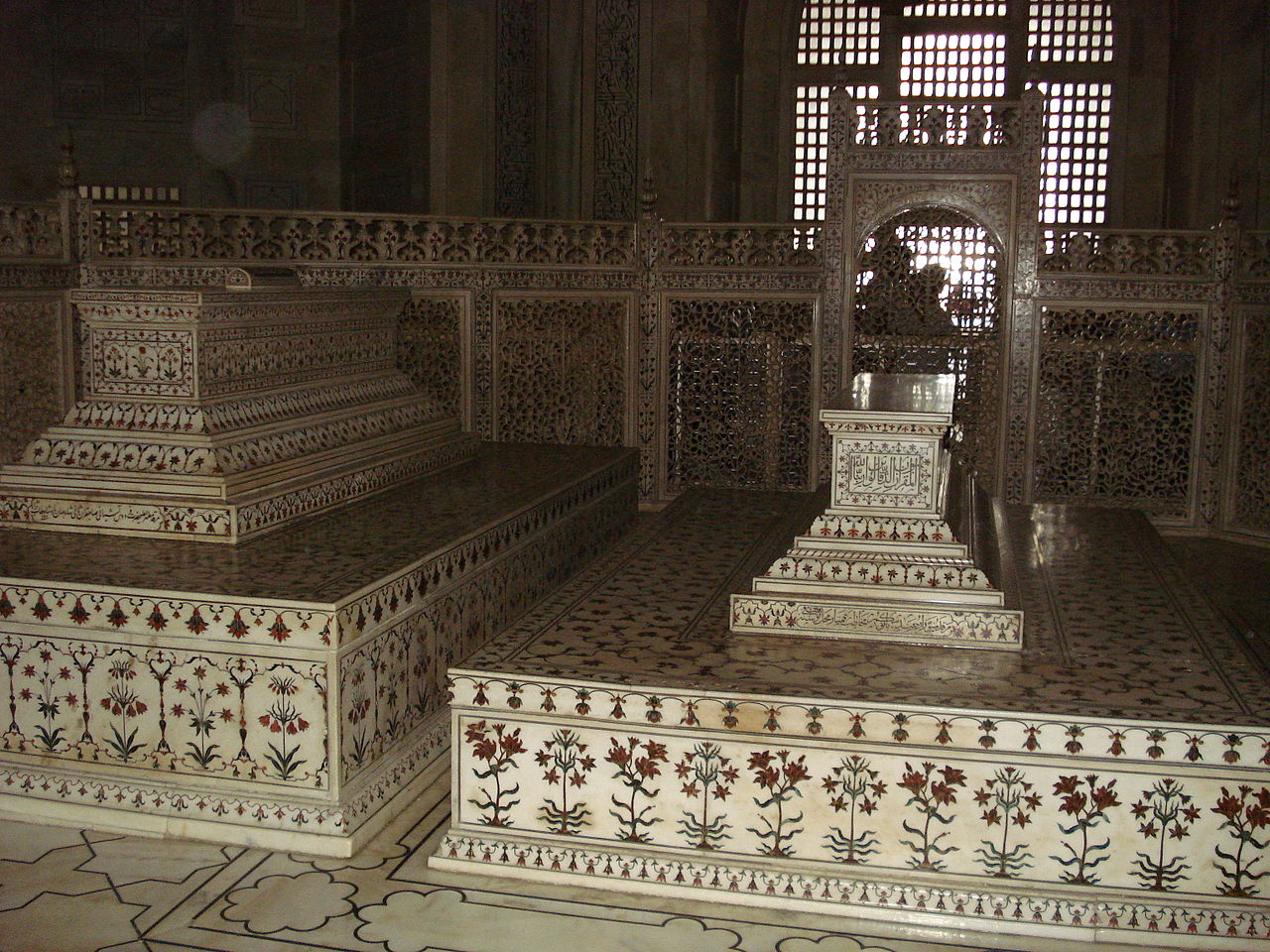
It can be observed from Agra Fort from where Emperor Shah Jahan gazed at it for the last eight years of his life, a prisoner of his son Aurangzeb. Verses of the Quran are inscribed on it and at the top of the gate are 22 small domes, signifying the number of years the monument took to build. The Taj Mahal was built on a marble platform that stands above a sandstone one. The most elegant and largest dome of the Taj Mahal has a diameter of 60 feet (18 m), and has a height of 80 feet (24 m); directly under this dome is the tomb of Mumtaz Mahal. Shah Jahan's tomb was erected next to hers by his son Aurangzeb. The interiors are decorated with fine pietra dura inlay work, incorporating semi-precious stones.
However, air pollution caused by emissions from foundries and other nearby factories and exhaust from motor vehicles has damaged the Taj, notably its marble facade.[134] A number of measures have been taken to reduce the threat to the monument, among them the closing of some foundries and the installation of pollution-control equipment at others, the creation of a parkland buffer zone around the complex, and the banning of nearby vehicular traffic, and more recently, use of 'mud pack' therapy.[135] Perhaps most importantly, the 10,400 km2 (4,000 sq mi) Taj Trapezium Zone has been created around the Taj Mahal and other nearby monuments where strict pollution restrictions are in place on industries, following a 1996 Supreme Court of India ruling.[136]
Some antique views were published in the Fisher's Drawing Room Scrap Books, namely  Tâj-Mahal, Agra. by Samuel Prout from a mid-distant angle (1832)[137] and Ruins about the Taj Mahal. by S. Austin from those said ruins (1836).[138] Both are accompanied by poetical illustrations by Letitia Elizabeth Landon.
-
 The most common front view of the Taj Mahal
 -
 Taj Mahal and outlying buildings as seen from across the Yamuna River (northern view)
 -
 Tombs of Shah Jahan and his beloved wife, Mumtaz Mahal
 -

.jpeg/1280px-Taj_Mahal_(Edited).jpeg)
.jpg/1280px-Taj_Mahal-10_(cropped).jpg)

Agra Fort
The Agra Fort is a large 16th-century fortress of red sandstone located by the Yamuna River in Agra. It was first established by the Mughal Emperor Akbar and served as the seat of royal government when Agra was the capital of the Mughal empire in addition to being a military base and a royal residence. Built on the site of earlier fortifications by Islam Shah Suri[139](son of Sher Shah Suri), the Agra Fort lies on the right bank of the Yamuna River and is connected to the Taj Mahal (downstream, around a bend in the Yamuna), by a stretch of parkland. The fort was commissioned by Akbar in 1565, taking around eight years to build.[140] Though much of the structure of the fort was founded by Akbar, both the interior and exterior underwent considerable changes under his son Jahangir and grandson Shah Jahan, who added many new structures, often of marble.[141] The red sandstone walls of the roughly semi-circular structure[142] have a perimeter of about 2.5 km, rise 21 metres high, and are surrounded by a moat.[140] There are two entrances in the walls: the Delhi Gate facing west, the original entrance, situated nearly opposite to the Agra Fort railway station and Jama Masjid, and decorated with intricate marble inlays; and the Amar Singh Gate(also known as Hathi Pol[139], or Elephant Gate) facing south, presently the only means in or out of the fort complex).[140] The complex of buildings in the fort—reminiscent of Persian and Timurid architecture,[140] with great inspiration from Jain and Hindu architecture[139]—forms a city within a city.[140]
Among the major attractions in the fort is Jahangiri Mahal, the largest residence in the complex, built by Akbar as a private palace for his Rajput wives. In the Diwan-i-Am (Hall of Public Audience), the emperor would listen to public petitions and meet state officials. The Diwan-i-Khas (Hall of Private Audience) was used for receiving distinguished visitors. The famous Peacock Throne was once kept there, before Aurangzeb took it to Delhi. Near the Diwan-i-Khas stands the Musamman Burj, an octagonal Tower which was the residence of Shah Jahan's favourite empress, Mumtaz Maḥal. The Moti Masjid (Pearl Mosque), constructed by Shah Jahan, is a structure made entirely of white marble. The emperor's private residence was the Khas Mahal, whose marble walls were once adorned with flowers depicted by precious gems. Located to its northeast is the Sheesh Mahal (Palace of Mirrors), its walls and ceilings inlaid with thousands of small mirrors.[140] Numerous other structures are there in the complex, including the Anguri Bagh, the Mina Bazaar etc.[139]
In addition to its other functions, the fort also served as a prison for Shah Jahan when Aurangzeb, his son and successor as emperor, had him confined there from 1658 until his death in 1666.[140]
-
 The Jahangiri Mahal, the largest residence in the complex
 -
 Musamman Burj, an octagonal Tower which was the residence of Shah Jahan's favourite empress, Mumtaz Maḥal
 -
 The Moti Masjid or the Pearl Mosque
 -
 Amar Singh Gate, one of two entrances into Agra's Red Fort
-2.jpg/1280px-Musamman_Burj_(Agra_Fort)-2.jpg)


I'timād-ud-Daulah's tomb

Nur Jahan commissioned I'timād-ud-Daulah's tomb, sometimes called the "Baby Taj", for her father, Mirza Ghiyas Beg, the Chief Minister of the Emperor Jahangir. Located on the left bank of the Yamuna river, the mausoleum is set in a large cruciform garden, crisscrossed by water courses and walkways. The area of the mausoleum itself is about 23 m2 (250 sq ft), and is built on a base that is about 50 m2 (540 sq ft) and about one metre (3.3 feet) high. On each corner are hexagonal towers, about thirteen metres (43 feet) tall. Small in comparison to many other Mughal-era tombs, it is sometimes described as a jewel box. Its garden layout and use of white marble, pietra dura, inlay designs, and latticework presage many elements of the Taj Mahal.
The walls are white marble from Rajasthan encrusted with semi-precious stone decorations – cornelian, jasper, lapis lazuli, onyx, and topaz in images of cypress trees and wine bottles or more elaborate decorations like cut fruit or vases containing bouquets. Light penetrates the interior through delicate Jali screens of intricately carved white marble.
Akbar's Tomb, Sikandra

Sikandra, the last resting place of the Mughal Emperor Akbar the Great, is on the Delhi-Agra Highway, about 13 kilometres (8.1 miles) from the Agra Fort.[143] The four-storied tomb combines both marble and sandstone in its exterior. The construction of Sikandra was commenced in Akbar's reign and was completed by his heir and son Jahangir in 1613. The tomb is set amidst a large garden and is enclosed by four battlemented walls, each with a large gateway. The 99 names of Allah have been inscribed on the tomb. The tomb has seen some damage to its minarets and other aspects, which was inflicted by the Jats of Bharatpur.[144] The vast gardens around Sikandra are inhabited by several Blackbucks, which are in the process of being shifted to the Etawah Safari Park.[145] Next to Akbar's tomb, stands the Tomb of Mariam-uz-Zamani, the favourite wife of Akbar.[146]
Other places of Interest
Agra also has several other places of interest, most of them from its Mughal past. They include the Jama Masjid, Chini Ka Rauza, Aram Bagh, Mariam's Tomb, and Mehtab Bagh among others. The Jama Masjid is a large mosque attributed to Shah Jahan's daughter Jahanara Begum, built-in 1648, notable for its unusual dome and absence of minarets. The Chini Ka Rauza, notable for its Persian influenced dome of blue glazed tiles, is dedicated to the prime minister of Shah Jahan, Afzal Khan.[147] The Aram Bagh, commonly known as Ram Bagh today, is one of the oldest Mughal garden in India, and was built by the Mughal emperor Babur in 1528 on the bank of the Yamuna.[148] It lies about 2.3 km (1 mi) north of the Taj Mahal. The original name of the gardens was Aram Bagh, or 'Garden of Relaxation', and this was where Babur used to spend his leisure time. Tomb of Mariam-uz-Zamani is the tomb of Mariam, the favourite wife of Emperor Akbar.[149] The tomb is within the compound of the Christian Missionary Society. The Mehtab Bagh, or 'Moonlight Garden', is on the opposite bank of the River Yamuna from the Taj Mahal. Agra also has a nearby bird sanctuary, Keetham Lake. Also known as Sur Sarovar Bird Sanctuary, it is situated within the Surdas Reserved Forest. The lake has nearly two dozen varieties of migratory and resident birds.[83]
City
- Jahangiri Mahal
- Mina Mosque
- Moti Masjid (Agra Fort)
- Musamman Burj (Agra Fort)
- Nagina Masjid
- Shah Jahani Mahal
- Throne of Jahangir
- Dayal Bagh temple
- Aram Bagh, Agra
- Chini Ka Rauza
- Akbar's Church
- Jama Mosque, Agra
- Jaswant Ki Chhatri
- Mehtab Bagh
- Gyarah Sidi
- Black Taj Mahal
- Ram Barat
- Taj Mahotsav
- Paliwal Park
Around
Culture
Cuisine

Agra falls under Braj region[151] and its local language is Braj Bhakha. Agra is known for its Braj cuisine[152] and shares common culinary heritage with twin cities of Mathura and Vrindavan. Among Muslims of Agra, non vegetarian food is popular. [153][154] Petha, a sweet made using ash gourd, is one of the famous dishes of Agra, and is available in many varieties. Another dish that is endemic to Agra is dalmoth, which is a dry snack made with spicy fried dal (lentils), nuts and raisins. The breakfast specialties include Bedai, which is a puffy kachori (made with all purpose flour, which is deep fried) with spicy filling inside and is generally served with spicy aloo bhaaji and dahi (curd).[155][150] Equally popular as a snack is chaat, a collective term which includes snacks like dahi bhalla, raj kachori, samosas, and gol gappa, among others. Paratha, a pan fried flat wheat bread which is stuffed with potatoes, cauliflower, carrots or chhena, is also popular, and eaten accompanied with curd, pickle and chutney.[153]
Taj Mahotsav
Taj Mahotsav is a cultural festival and craft fair that was started in the year 1992 and has grown since then. The year 2019 was the 28th year of this Mahotsav. The fair is held in a big field in Shilpgram, near the eastern gate of the Taj Mahal. This festival also figures in the calendar of events of the Department of Tourism, Government of India. A large number of Indian and foreign tourists coming to Agra join this festivity. One of the objectives of this craft fair is to provide encouragement to the artisans. It also makes available works of art and craft at reasonable prices that are not inflated by high maintenance cost.[156] The Mahotsav is hosted from 18 to 27 February every year. The theme for the 2020 Taj Mahotsav was Sanskriti ke Rang, Taj ke Sang.[157] For the first time since 1992, Taj Mahotsav 2021 has been cancelled, because of tourism restrictions during the COVID-19 pandemic.[158]
Transport
Air
As of April 2021, Indigo operates regular flights between Agra Airport and Mumbai, Ahmedabad, Bhopal, and Bangalore. The Agra Airport at Kheria is controlled by the Indian Air Force.[159]
Rail


The city of Agra is served by 7 railway stations, viz., Agra Cantonment (major station for Delhi - Mumbai line), Raja-Ki-Mandi, Agra Fort (Major station for Jodhpur - Howrah Line), Idgah, Agra City, Jamuna Bridge, and Billochpura. It comes under the jurisdiction of the Agra Division of North Central Railways Zone of the Indian Railways. The city is served by multiple mail/express trains, as well as Rajdhani, Shatabdi, and Gatiman express.[160] The Gatiman express is India's first semi-high train speed service, and has cut travel time between Agra and Delhi to 100 minutes.[161] Being a major tourist destination, Agra is also served by the luxury train Maharajas' Express.[162]

Road
.jpg/1280px-Agra-Inner-Ring-Road02_(32944081270).jpg)
Inter-State Bus Terminal (I.S.B.T.), Idgah Bus Stand, Taj Depot and Fort Depot are the major bus stands in Agra, connecting Agra to most of the bigger cities in northern India. It is a major junction of highways with three national highways and two expressways (Yamuna Expressway & Agra Lucknow Expressway) originating from Agra.
- From Delhi: NH 19 (old number: NH 2), a modern divided highway, connects the 200 km (124 mi) distance from Delhi to Agra.
- From Delhi / Noida: Yamuna Expressway, a modern access controlled highway connects the 200 km (124 mi) distance from Delhi to Agra.
- Yamuna Expressway (formerly Taj Expressway) is a six lane, 165 km (103 mi) long, controlled-access expressway, that connects New Delhi with Agra via Greater Noida and Mathura in the Indian state of Uttar Pradesh.
- NH 509 (old number: NH 93) connects Agra to Moradabad via Aligarh.
- Section of NH 44 (old number: NH 3 Agra Mumbai national highway) connects Agra to Gwalior via Dholpur.
- NH 21 (old number: NH 11 Agra Jaipur Highway) connects Jaipur to Bareilly via Agra.
- Agra Lucknow Expressway is a six lane, 302 km (188 mi) long, controlled-access expressway, that connects Lucknow with Agra via Kannauj and Etawah in the Indian state of Uttar Pradesh.
Bus services are run by the UPSRTC([1] Other para-transit modes include rickshaws. Polluting vehicles are not allowed near the Taj Mahal. Within the city, Mahatma Gandhi Marg is the main artery.
Agra Metro
Rail India Technical and Economic Service (RITES) had proposed 30 stations, 11 underground and 19 elevated, for two corridors of the Metro Rail in the city. The two lines are Sikandra to the Taj Mahal's east gate via Agra Fort and Agra Cantt to Kalindi Vihar. On 24 March 2017, State Chief Minister Yogi Aditya Nath approved the project. In December 2017, the cabinet of the UP Government approved the DPR as per New Metro Policy. Prime Minister Narendra Modi laid the foundation stone of Agra Metro on 8 March 2019.[163]
Education


It was during the advent of the Mughal era that Agra grew as a centre of Islamic education. In the year 1823, Agra College, one of the oldest colleges in India was formed out of a Sanskrit school established by the Scindia rulers. In the British era, Agra became a great centre of Hindi literature with people like Babu Gulab Rai at the helm.
Universities and colleges

Agra University was established on 1 July 1927 and catered to colleges spread across the United Provinces, the Rajputana, the Central Provinces and almost to entire northern India. There are 10 institutes comprising various departments and around 700 Colleges are affiliated to this university. The historic Agra University was later rechristened as Dr. Bhimrao Ambedkar University by the then Chief Minister of Uttar Pradesh, Mayawati.
- The Institute of Mental Health and Hospital, formerly known as Agra Lunatic Asylum, was established in September 1859 governed by the State of Uttar Pradesh. It is spread over an extensive ground of 172.8 acres (69.9 ha) land and is well-known centre for the treatment, training, and research on mental disorders in Northern India. The institute was renamed as Mental Hospital, Agra in 1925. Presently all admissions and discharges are being done under the provisions of Mental Health Act, 1987.
- Central Institute of Hindi (also known as Kendriya Hindi Sansthan) is an autonomous institute under Ministry of Human Resource Development, Government of India engaged in teaching Hindi as a foreign and second language. Apart from running residential Hindi language courses for foreign students, the institute also conducts regular training programmes for teachers of Hindi belonging to non-Hindi states of India. The institute is situated at an 11 acres (4.5 ha) campus on the outskirts of Agra city. Headquartered in Agra the institute has eight regional centres in Delhi, Hyderabad, Mysore, Shillong, Dimapur, Guwahati, Ahmedabad and Bhubneshwar. The institute is the only government-run institution in India established solely for research and teaching of Hindi as a foreign and second language.
- Sarojini Naidu Medical College is one of the three oldest medical colleges of India. It is located in Agra, Uttar Pradesh state. It is named after the first lady Governess of Uttar Pradesh, poet and freedom fighter, Bharat Kokila Smt. Sarojini Naidu.
- Agra College is one of the oldest institutions in India. Pandit Gangadhar Shastri, a noted Sanskrit scholar, founded the college in 1823. Till 1883 the institute was a government college and after that, a board of trustees and a Committee of Management managed the college. Agra College produced the first graduate in Uttar Pradesh and the first Law graduate to Northern India.
- St. John's College, Agra, is a college established in 1850, now part of the Dr. Bhim Rao Ambedkar University, earlier known as Agra University. It is amongst the oldest Christian colleges in India. The college runs a study centre of Indira Gandhi National Open University, a central university.
- Raja Balwant Singh College, established in 1885, owes its existence to Raja Balwant Singh Ji of Awagarh, who enabled the institution to grow as one of the oldest and biggest colleges of Uttar Pradesh. Raja Balwant Singh College is located at Bichpuri, Agra, Uttar Pradesh, India. The college is affiliated to Uttar Pradesh Technical University, Lucknow, and Dr. B.R. Ambedkar University, Agra.
- Dayalbagh Educational Institute, Radha Soami Satsang Sabha, started the Radhasoami Educational Institute, as a co-educational Middle School, open to all, on 1 January 1917. It became a Degree College in 1947, affiliated to Agra University. In 1975, it formulated a programme of undergraduate studies which received approbation from the Government of Uttar Pradesh and the University Grants Commission, as a result of which in 1981 the Ministry of Education, Government of India, conferred the status of an institution deemed to be a University on the Dayalbagh Educational Institute, to implement the new scheme.
- Bhadawar Vidya Mandir PG College (1942)
Schools
- St. George's College, Agra, is one of the oldest convent schools in India. It is a Minority Anglo-Indian Christian Institution granted Minority Rights under Article 30 of the Indian Constitution. It is located near Mall Road and near to Targhar.
- St. Peter's College, Agra, founded in the year 1846, is one of the oldest convent schools in India. It is a Roman Catholic Institution granted Minority Rights under Article 30 of the Indian Constitution.
Media
Agra is home to the Dainik Jagran newspaper, the most read Hindi newspaper in India.[164] Other widely read papers include Amar Ujala, Rajasthan Patrika, Aaj, Hindustan, The Sea Express, daily Amar Bharti, Deepsheel Bharat, and DLA. The English dailies published are The Times of India, Hindustan Times, Economic Times, and The Pioneer. The Urdy dailies published are Prabhanjan Sanket and Inksaaf. There is also the Hindi and English mixed newspaper tabloid I-Next.
State-owned All India Radio has a local station in Agra which transmits various programs of mass interest. There are four private FM radio stations, 92.7 BIG FM (Reliance Broadcast Network Limited), 93.7 Fever FM, 94.5 Tadka FM, and Radio City 91.9 FM.[165] There is a community Radio Station 90.4 FM.
Notable people
- Aakash Chopra
- Abdul Karim (the Munshi)
- Acharya Prashant
- Alok Sharma
- Alvin Robert Cornelius
- Amritlal Nagar
- Anand Swarup
- Ashi Singh
- Dalip Tahil
- Deepak Chahar
- Deepti Sharma
- Dhruv Jurel
- Girraj Singh Dharmesh
- Jagan Prasad Garg
- Kalyan Das Jain
- Makund Behari Lal
- Mamnoon Hussain
- Mirza Ghalib
- Mir Taqi Mir
- Motilal Nehru
- Nazeer Akbarabadi
- Nimmi
- Poonam Yadav
- Raj Babbar
- Rajendra Yadav
- Rahul Chahar
- R. K. S. Bhadauria
- S. P. Singh Baghel
- Salig Ram[166]
- Seth Achal Singh
- Shiv Dayal Singh[167]
Sister cities
Agra is twinned with:
- Chengdu, Sichuan, China[168]
- Petra, Jordan[169]
- Tempe, Arizona[170]
- Samarkand[171]
See also
Tehsils of Agra:
References
- ^ "Metropolitan Cities of India" (PDF). cpcb.nic.in. Archived from the original (PDF) on 23 September 2015. Retrieved 22 December 2020.
- ^ "District census handbook (Part A & B) – Agra" (PDF). Directorate Of Census Operations, Uttar Pradesh. 2001. Archived (PDF) from the original on 13 April 2021.
- ^ "BJP's Hemlata Diwakar Is New Mayor Of Agra, Wins By 1.13 Lakh Votes". Jagran English. Retrieved 22 May 2023.
- ^ "Administration : Agra Municipal Corporation". 26 June 2024.
- ^ "Agra Nagar Nigam" (PDF). nagarnigamagra.com. Retrieved 21 November 2020.
- ^ a b "Elevation of Agra - Wolfram|Alpha". www.wolframalpha.com. Retrieved 26 September 2020.
- ^ "Census 2011". The Registrar General & Census Commissioner, India. Retrieved 21 May 2016.
- ^ "Uttar Pradesh (India): State, Major Agglomerations & Cities – Population Statistics, Maps, Charts, Weather and Web Information". citypopulation.de. Archived from the original on 12 November 2017. Retrieved 11 November 2017.
- ^ a b "52nd Report of the Commissioner for Linguistic Minorities in India" (PDF). nclm.nic.in. Ministry of Minority Affairs. Archived from the original (PDF) on 25 May 2017. Retrieved 7 December 2018.
- ^ "Metroverse - Agra, India". Harvard Growth Lab. Retrieved 16 August 2024.
- ^ a b "Cities in India with population more than 100,000". Census2011. Archived from the original on 28 July 2012. Retrieved 10 June 2016.
- ^ Mukerji, Satya Chandra (1892). The traveller's guide to Agra, containing an account of the past history, the antiquities, and the principal sights of Agra, together with some information about Agra as it is. University of California Libraries. Delhi, Sen & Co. p. 3.
- ^ a b c d e f g Agra Vol Xiv. 1944. p. 22.
- ^ Bosworth, Clifford Edmund (2008). Historic cities of the Islamic world. Brill. p. 2. ISBN 978-90-04-15388-2. OCLC 231801473.
- ^ Koch, Ebba (1 January 2008), "Mughal Agra: A Riverfront Garden City", The City in the Islamic World (2 Vols.), BRILL: 555–588, doi:10.1163/ej.9789004162402.i-1500.148, ISBN 978-90-474-4265-3, retrieved 4 July 2021
- ^ a b "Part One: Babar". www.columbia.edu. Archived from the original on 8 February 2007. Retrieved 3 April 2021.
- ^ Abraham Eraly, The Age of Wrath: A History of the Delhi Sultanate
- ^ Sunil Sharma, Persian Poetry at the Indian Frontier: Masʻŝud Saʻd Salmân of Lahore
- ^ a b "Lodī dynasty | Indian history". Encyclopedia Britannica. Retrieved 10 April 2021.
- ^ Bhanu, Dharma (1979). The Province of Agra: Its History and Administration. Concept Publishing Company.
- ^ Bhanu, Dharma (1979). The Province of Agra: Its History and Administration. Concept Publishing Company. pp. 2–3.
- ^ "Part Fourteen: Sikandra". www.columbia.edu. Archived from the original on 4 March 2007. Retrieved 4 April 2021.
- ^ "01babur". www.columbia.edu. Retrieved 3 April 2021.
- ^ a b c d Bhanu, Dharma (1979). The Province of Agra: Its History and Administration. Concept Publishing Company. p. 1.
- ^ a b c d e f g "Mughal dynasty | History, Map, Rulers, & Facts". Encyclopedia Britannica. Retrieved 10 April 2021.
- ^ a b c d "Historical Introduction, Part One: Babar - Babar's connection with Agra". www.columbia.edu. Retrieved 3 April 2021.
- ^ Bhanu, Dharma (1979). The Province of Agra: Its History and Administration. Concept Publishing Company. p. 4.
- ^ "Part Sixteen: Fatehpur Sikri". www.columbia.edu. Archived from the original on 8 February 2007. Retrieved 14 September 2020.
- ^ a b c d Bhanu, Dharma (1979). The Province of Agra: Its History and Administration. Concept Publishing Company. pp. 4–5.
- ^ a b Mukerji, Satya Chandra (1892). The traveller's guide to Agra, containing an account of the past history, the antiquities, and the principal sights of Agra, together with some information about Agra as it is. University of California Libraries. Delhi, Sen & Co. pp. 20–21.
- ^ Siddiqi, Zeba (2006). "City of Agra under the Mughal from 1526-1707" (PDF). Centre of Advance Study Department of History Augarh Muslim University Aligarh (India): 10, 11.
- ^ Richards, John F. (1995). The Mughal Empire. Cambridge University Press. ISBN 9780521566032.
- ^ a b "Agra | India". Encyclopedia Britannica. Retrieved 16 September 2020.
- ^ The Gazetteer of India: History and culture. Publications Division, Ministry of Information and Broadcasting, India. 1973. p. 348. OCLC 186583361.
- ^ Imperial Gazetteer of India vol. V. 1908. pp. 72, 158.
- ^ a b Mukerji, Satya Chandra (1892). The traveller's guide to Agra, containing an account of the past history, the antiquities, and the principal sights of Agra, together with some information about Agra as it is. University of California Libraries. Delhi, Sen & Co. pp. 51, 55–56.
- ^ Pletcher, Kenneth (15 August 2010). The Geography of India: Sacred and Historic Places. The Rosen Publishing Group, Inc. p. 95. ISBN 978-1-61530-142-3.
- ^ Mukerji, Satya Chandra (1892). The traveller's guide to Agra, containing an account of the past history, the antiquities, and the principal sights of Agra, together with some information about Agra as it is. University of California Libraries. Delhi, Sen & Co. p. 45.
- ^ a b "Part Seven: Agra and the Later Mogul Emperors". www.columbia.edu. Archived from the original on 29 February 2008. Retrieved 13 September 2020.
- ^ Edwardes, Michael (1963). Battles of the Indian mutiny. pp. 50–53.
- ^ "Agra City" (GIF). Imperial Gazetteer of India (Digital South Asia Library of University of Chicago). 5: 83–84. Archived from the original on 22 May 2010. Retrieved 8 November 2009.
- ^ "Agra's crucial role in freedom movement not documented: Historians". Business Standard India. 14 August 2015. Retrieved 2 October 2020.
- ^ "The heritage of British period statues". The Statesman. 13 June 2019. Retrieved 2 October 2020.
- ^ "History of Hindi Journalism". www.indianfaculty.com. Retrieved 2 October 2020.
- ^ "Agra | India". Encyclopedia Britannica. Retrieved 14 April 2021.
- ^ "Taj Mahal". UNESCO World Heritage Centre. Retrieved 26 September 2020.
- ^ "Agra Fort". UNESCO World Heritage Centre. Retrieved 26 September 2020.
- ^ "India has an edge over China in soft power, divisive politics must not harm it". www.dailyo.in. Retrieved 12 September 2020.
- ^ "Distinguished Lectures Details". www.mea.gov.in. Retrieved 12 September 2020.
- ^ S, Deepika (25 February 2020). "Top world leaders who visited the iconic Taj Mahal". OneIndia. Retrieved 12 September 2020.
- ^ "Dīn-i Ilāhī | Indian religion". Encyclopedia Britannica. Retrieved 12 September 2020.
- ^ "Exploring UNESCO World Heritage sites on India's Golden Triangle tour". The Times of India. Retrieved 14 April 2021.
- ^ "The Heritage Arc". Department of Tourism, Government of Uttar Pradesh. Archived from the original on 10 September 2015.
- ^ Pletcher, Kenneth (15 August 2010). The Geography of India: Sacred and Historic Places. The Rosen Publishing Group, Inc. p. 95. ISBN 978-1-61530-142-3.
- ^ Mukerji, Satya Chandra (1892). The traveller's guide to Agra, containing an account of the past history, the antiquities, and the principal sights of Agra, together with some information about Agra as it is. University of California Libraries. Delhi, Sen & Co. p. 152.
- ^ "Agra to New Delhi". Agra to New Delhi. Retrieved 24 September 2020.
- ^ "Agra to Lucknow". Agra to Lucknow. Retrieved 24 September 2020.
- ^ "Agra to Kanpur". Agra to Kanpur. Retrieved 24 September 2020.
- ^ "Agra climate: Average Temperature, weather by month, Agra weather averages - Climate-Data.org". en.climate-data.org. Retrieved 25 September 2020.
- ^ Strahler, Alan H. (10 December 2008). Modern Physical Geography, 4Th Ed. Wiley India Pvt. Limited. ISBN 978-81-265-1924-8.
- ^ "Tropical and subtropical steppe climate". Encyclopedia Britannica. Retrieved 25 September 2020.
- ^ S.V.S. Rana (2007), Essentials of Ecology and Environmental Science, Prentice Hall of India, ISBN 978-81-203-3300-0,
... In the plains of northern India and Pakistan, sometimes a very hot and dry wind blows from the west in the months of May and June, usually in the afternoons. It is known as loo. Its temperature invariably ranges above 45 °C .. People, when exposed to loo ...
- ^ "Profile of the study area (Agra and Khajuraho)" (PDF). shodhganga.inflibnet.ac.in. Retrieved 5 March 2022.
- ^ "A pollution link to why Delhi gets heavy winter fog". Hindustan Times. 30 December 2020. Retrieved 24 September 2020.
- ^ Choudhary, Srishti (30 December 2019). "Delhi records its coldest day in December since 1901". mint. Retrieved 24 September 2020.
- ^ "Air Pollution: India tops world in bad air quality: Kanpur, Delhi among top 15, Mumbai 4th most polluted megacity". The Times of India. 2 May 2018. Retrieved 24 September 2020.
- ^ "Swachh Vayu Survekshan 2024 Results" (PDF). prana.cpcb.gov.in. 2024.
- ^ "Station: Agra Climatological Table 1991–2020" (PDF). Climatological Normals 1991–2020. India Meteorological Department. Archived from the original (PDF) on 8 April 2024. Retrieved 7 July 2024.
- ^ "Ever recorded Maximum and minimum temperatures upto 2010" (PDF). India Meteorological Department. Archived from the original (PDF) on 16 March 2014. Retrieved 18 January 2014.
- ^ "Extremes of Temperature & Rainfall for Indian Stations (Up to 2012)" (PDF). India Meteorological Department. December 2016. p. M210. Archived from the original (PDF) on 5 February 2020. Retrieved 19 April 2020.
- ^ "Climate & Weather Averages in Agra, Uttar Pradesh, India". Time and Date. Retrieved 9 August 2022.
- ^ "Climatological Tables 1991-2020" (PDF). India Meteorological Department. p. 21. Archived from the original (PDF) on 1 January 2023. Retrieved 1 January 2023.
- ^ "Agra Climate Normals 1971-1990". National Oceanic and Atmospheric Administration. Retrieved 18 January 2014.
- ^ "Climate and monthly weather forecast Agra, India". Weather Atlas. Retrieved 15 June 2022.
- ^ "Taj Mahal Facing the Brunt of Environmental Degradation". NDTV.com. Retrieved 27 September 2020.
- ^ Kataria, Sunil (22 May 2018). "Pollution turns India's white marble Taj Mahal yellow and green". Reuters. Retrieved 27 September 2020.
- ^ "A River about to Die: Yamuna". ResearchGate. Retrieved 27 September 2020.
- ^ "Heavy Metal Pollution of the Yamuna River: An Introspection" (PDF). 2014. p. 857.[permanent dead link]
- ^ Najar, Nida; Raj, Suhasini (17 May 2016). "Taj Mahal Under Attack by Bugs and Their Green Slime". The New York Times. ISSN 0362-4331. Retrieved 3 April 2021.
- ^ a b "Stink is still the flavour of Yamuna in the city of Taj Mahal". National Herald. 25 October 2019. Retrieved 3 April 2021.
- ^ a b "Dry Yamuna remains a threat to Mughal monuments". India Today. 21 July 2019. Retrieved 3 April 2021.
- ^ "Uttar Pradesh" (PDF). Forest Survey of India. Retrieved 25 January 2021.
- ^ a b "Incredible India | Keetham Lake". www.incredibleindia.org. Retrieved 16 September 2020.
- ^ Shefali Apte. Lonely Planet Guide To India. p. 388.
- ^ "Bears - Wildlife SOS". wildlifesos.org. Retrieved 5 October 2020.
- ^ "Historical Census of India". Archived from the original on 17 February 2013. Retrieved 29 December 2014.
- ^ a b c http://www.census2011.co.in/census/city/115-agra.html Archived 12 April 2016 at the Wayback Machine Agra City Population Census 2011
- ^ a b "Agra Municipal Corporation::". www.nagarnigamagra.com. Retrieved 7 September 2020.
- ^ "ADA Staff". www.adaagra.in. Archived from the original on 25 September 2020. Retrieved 8 September 2020.
- ^ "Agra Smart City". agrasmartcity.in. Retrieved 16 September 2020.
- ^ "IAS Posting Detail". niyuktionline.upsdc.gov.in. Archived from the original on 4 August 2020. Retrieved 13 September 2020.
- ^ "Transfer: प्रभाकर चौधरी बने आगरा के नए एसएसपी, सुधीर कुमार सिंह बनाए गए सहारनपुर रेंज के डीआईजी". Amar Ujala (in Hindi). Retrieved 18 October 2022.
- ^ "Officers posted at Agra Zone". Uttar Pradesh Police. Archived from the original on 22 August 2017. Retrieved 12 September 2018.
- ^ a b "Officers posted at A[gra]". Uttar Pradesh Police. Archived from the original on 22 August 2017. Retrieved 12 September 2018.
- ^ "Corporation – Nagar Nigam Agra". Retrieved 15 April 2021.
- ^ "Agra Nagar Nigam – Ward Wise details" (PDF). Archived (PDF) from the original on 11 July 2019.
- ^ "Zones & Wards – Nagar Nigam Agra". Retrieved 15 April 2021.
- ^ "ADA Agra Development Authority". www.adaagra.in. Archived from the original on 15 April 2021. Retrieved 15 April 2021.
- ^ "Agra MP (Lok Sabha) Election Results 2019 Live: Candidate List, Constituency Map, Winner & Runner Up - Oneindia". www.oneindia.com. Retrieved 14 September 2020.
- ^ "Constituencies | District Agra, Government Of Uttar Pradesh". Retrieved 8 September 2020.
- ^ "Agra MP (Lok Sabha) Election Results 2019 Live: Candidate List, Constituency Map, Winner & Runner Up - Oneindia". www.oneindia.com. Retrieved 8 September 2020.
- ^ Qureshi, Siraj (11 November 2021). "Agra could become a police commissionerate before UP assembly polls". India Today. Retrieved 15 November 2021.
- ^ "UPPCL to hand over Agra power network to Torrent Power". The Economic Times. Retrieved 29 September 2020.
- ^ Rawat, Virendra Singh (2 April 2010). "Torrent Power begins power distribution in Agra". Business Standard India. Retrieved 29 September 2020.
- ^ "Assessment of Non-Revenue Water & Developing Strategies and Implementation Action Plan for Reduction of Non Revenue Water in Agra" (PDF). Nagar Nigam Agra. Retrieved 29 September 2020.
- ^ "Agra's water woes". www.downtoearth.org.in. Retrieved 29 September 2020.
- ^ "Gangajal pipeline ready for use, city to get Ganga water by month end". The Times of India. 7 December 2018. Retrieved 30 September 2020.
- ^ "PM Narendra Modi launches projects worth Rs 2,980 cr in Agra". The Economic Times. Retrieved 30 September 2020.
- ^ Lavania, Deepak (1 February 2020). "On opening day, leaks detected in Gangajal treatment facility". The Times of India. Retrieved 30 September 2020.
- ^ "Taps run dry in 15 wards due to pipeline leaks". The Times of India. 29 December 2019. Retrieved 30 September 2020.
- ^ "शहर में प्रतिदिन हो रही हजारों लीटर गंगाजल की बर्बादी". Hindustan (in Hindi). Retrieved 30 September 2020.
- ^ Lavania, Deepak (24 May 2018). "UP cabinet approves proposal for piped gas supply in state". The Times of India. Retrieved 29 September 2020.
- ^ Chauhan, Arvind (28 April 2015). "Agra residents to get PNG". The Times of India. Retrieved 29 September 2020.
- ^ "The Splendid Radhasoami Satsangs Temple at Agra". Outlook. 7 March 2020. Retrieved 7 September 2020.
- ^ "India's new Entrepreneurs". Mint. 16 May 2007. Archived from the original on 18 August 2007. Retrieved 25 March 2011.
- ^ "Year-wise Tourist Statistics". www.uptourism.gov.in. Archived from the original on 26 June 2020. Retrieved 15 September 2020.
- ^ "ITC unveils Asia's largest spa in Agra". Economic Times (India). 9 March 2008. Archived from the original on 26 December 2008. Retrieved 8 November 2009.
- ^ "ITC Hotels, Welcomhotel present Ollie's Virtual Summer Camp". Business World. 20 August 2020. Retrieved 7 September 2020.
- ^ Chaudhuri, Sharmistha (31 October 2019). "A Moment In Time: The Taj Hotel and Convention Centre Agra". Outlook. Retrieved 7 September 2020.
- ^ "Economy | District Agra, Government Of Uttar Pradesh". Retrieved 7 September 2020.
- ^ "Cultural extravaganza: Taj Mahotsav". Deccan Herald. 25 February 2020. Retrieved 7 September 2020.
- ^ "Beyond the Taj Mahal". Tribuneindia News Service. 1 March 2020. Retrieved 7 September 2020.
- ^ "Noida tops Uttar Pradesh GDP & per capita income again, Lucknow is second". The Times of India. 13 March 2020. Retrieved 6 September 2020.
- ^ "Swachh Survekshan 2020: स्वच्छता में आगरा की लंबी छलांग, देश में पाया 16वां स्थान". Amar Ujala (in Hindi). Retrieved 6 September 2020.
- ^ "Swachh Survekshan 2020: Top 20 cleanest cities in India". www.timesnownews.com. 20 August 2020. Retrieved 6 September 2020.
- ^ "Uttar Pradesh: Agra tops smart cities chart with 2 other cities - ET Government". ETGovernment.com. Retrieved 6 September 2020.
- ^ Qureshi, Siraj (15 March 2020). "Agra residents surprised as city ranks No. 1 in list of smart cities". India Today. Retrieved 6 September 2020.
- ^ "Agra's industrial growth takes a hit from COVID-19". National Herald. 14 August 2020. Retrieved 7 September 2020.
- ^ Qureshi, Siraj (9 September 2020). "Agra tourism industry lost Rs 2,200 crores in past 6 months due to Taj closure in lockdown". India Today. Retrieved 15 September 2020.
- ^ "UNESCO - World Heritage Site". www.tajmahal.gov.in. Retrieved 15 September 2020.
- ^ "New Seven Wonders of the World". Encyclopedia Britannica. Retrieved 15 September 2020.
- ^ Sharma, Aman. "Tourists up at Taj Mahal and Red Fort but Qutub Minar loses its No.2 Spot". The Economic Times. Retrieved 15 September 2020.
- ^ a b "Taj Mahal". Encyclopedia Britannica. Retrieved 7 April 2021.
- ^ "Taj Mahal". Encyclopedia Britannica. Retrieved 15 September 2020.
- ^ Jaiswal, Anuja (22 February 2020). "Shah Jahan, Mumtaz graves undergo 'mud pack' therapy". The Times of India. Retrieved 12 September 2020.
- ^ "Why is the Taj Trapezium Zone and why is it called so?". The Times of India. 4 May 2008. Retrieved 12 September 2020.
- ^ Landon, Letitia Elizabeth (1831). "poetical illustration". Fisher's Drawing Room Scrap Book, 1832. Fisher, Son & Co.Landon, Letitia Elizabeth (1831). "picture". Fisher's Drawing Room Scrap Book, 1832. Fisher, Son & Co.
- ^ Landon, Letitia Elizabeth (1835). "picture". Fisher's Drawing Room Scrap Book, 1836. Fisher, Son & Co.Landon, Letitia Elizabeth (1835). "poetical illustration". Fisher's Drawing Room Scrap Book, 1836. Fisher, Son & Co.
- ^ a b c d "Part Eight: The Fort". www.columbia.edu. Archived from the original on 10 February 2007. Retrieved 6 April 2021.
- ^ a b c d e f g "Agra Fort". Encyclopedia Britannica. Retrieved 6 April 2021.
- ^ Mukerji, Satya Chandra (1892). The traveller's guide to Agra, containing an account of the history, the antiquities, and the principal sights of Agra, together with some information about Agra as it is. University of California Libraries. Delhi, Sen & Co. p. 83.
- ^ "Incredible India | Agra Fort". www.incredibleindia.org. Retrieved 7 April 2021.
- ^ "Agra Fort to Sikandra". Agra Fort to Sikandra. Retrieved 16 September 2020.
- ^ "Part Fourteen: Sikandra". www.columbia.edu. Archived from the original on 4 March 2007. Retrieved 16 September 2020.
- ^ "About 80 Blackbucks Inhabiting Grounds Around Akbar's Tomb in Sikandra to Get a New Home". News18. 18 November 2019. Retrieved 16 September 2020.
- ^ Hindu Shah, Muhammad Qasim (1595–1612). Gulshan-I-Ibrahimi. Vol. 2. p. 223.
Akbur, after this conquest, made pilgrimage to Khwaja Moyin-ood-Deen Chishty at Ajmere and returned to Agra; from whence he proceeded to visit the venerable Sheikh Sulim Chishty, in the village of Seekry. As all the king's children had hitherto died, he solicited the Sheikh's prayers, who consoled him, by assuring him he would soon have a son, who would live to a good old age. Shortly after, his favourite sooltana, being then pregnant, on Wednesday the 17th of Rubbee-ool-Awul, in the year 997 was delivered of a son, who was called Sulim.
- ^ "Part Twelve: The Chînî-ka-Rauza". www.columbia.edu. Archived from the original on 1 March 2008. Retrieved 16 September 2020.
- ^ "Part Thirteen: The Ram Bagh". www.columbia.edu. Archived from the original on 1 March 2008. Retrieved 16 September 2020.
- ^ "Part Fourteen: Sikandra – Mariam Zamâni's Tomb". www.columbia.edu. Archived from the original on 4 March 2007. Retrieved 16 September 2020.
- ^ a b Sharma, Sudhirendar (12 October 2019). "Name, place, confection, thing". The Hindu. ISSN 0971-751X. Retrieved 12 September 2020.
- ^ Chaturvedi, Hemendra (6 February 2017). "Braj, the harbinger of UP polls". Hindustan Times. Retrieved 23 August 2024.
The Braj region comprises of seven districts -- Agra, Mathura and Firozabad in Agra division and Aligarh, Etah, Hathras and Kasganj in Aligarh division.
- ^ Experts, Disha (1 July 2020). Amazing Uttar Pradesh - General Knowledge for UPPSC, UPSSSC & other Competitive Exams. Disha Publications. ISBN 978-93-90486-72-4.
Agra is a colorful display of the Arts, crafts, culture and cuisine of the Braj area.
- ^ a b "About Agra". www.tajmahal.gov.in. Retrieved 5 April 2021.
- ^ "Shahi Paneer – Indianlife Foods Inc". Archived from the original on 9 March 2023. Retrieved 5 April 2021.
- ^ "Agra Street Food: Ultimate Guide To The 'Khao-Galis' Of The City". NDTV Food. 30 January 2020. Retrieved 17 September 2020.
- ^ "Taj Mahotsav ::Taj Mahotsav, a 10 days festival is organized from 18th to 27 February. In this carnival you can see India's rich arts, crafts, cultures, cuisine, dance, music and many more things of incredible India". www.tajmahotsav.org. Retrieved 26 September 2020.
- ^ "Taj Mahotsav 2020 continues to woo tourists from across the globe". The Times of India. Retrieved 26 September 2020.
- ^ "Pandemic forces Taj Mahotsav cancellation for the first time since 1992". Hindustan Times. 9 January 2021. Retrieved 7 April 2021.
- ^ Lavania, Deepak (29 March 2021). "Agra gets air connectivity with Mumbai, Ahmedabad, Bhopal & Bengaluru". The Times of India. Retrieved 15 April 2021.
- ^ "North Central Railways / Indian Railways Portal". ncr.indianrailways.gov.in. Retrieved 14 April 2021.
- ^ "Delhi-Agra semi-high speed train to be named Gatimaan Express". Zee News. 12 October 2014. Retrieved 14 April 2021.
- ^ "IRCTC Maharaja Express: Experience royalty with the Indian Panorama tour across heritage sites". Scroll.in. 10 September 2019. Retrieved 14 April 2021.
- ^ "कानपुर से पीएम मोदी ने किया आगरा मेट्रो का शिलान्यास, ताजनगरी में हुआ सीधा प्रसारण". Amar Ujala (in Hindi). 8 March 2019. Archived from the original on 9 March 2019. Retrieved 20 March 2019.
- ^ "IRS 2019 Q4: Dainik Jagran & Times of India top most-read Hindi and English newspaper list - Exchange4media". Indian Advertising Media & Marketing News – exchange4media. Retrieved 11 September 2020.
- ^ "Radio City 91.1 FM Agra – Top 10 Songs of the Week". www.radiocity.in. Archived from the original on 18 June 2017. Retrieved 11 November 2017.
- ^ "Huzur Maharaj". www.radhasoami-faith.info. Archived from the original on 10 December 2017. Retrieved 11 November 2017.
- ^ "Soamiji Maharaj". www.radhasoami-faith.info. Archived from the original on 27 January 2018. Retrieved 11 November 2017.
- ^ Lavania, Deepak (23 December 2016). "Agra, Chengdu of China are now sister cities". The Times of India. Retrieved 19 June 2022.
- ^ "List of MoUs/Agreements signed during the Visit of the King of Jordan to India (March 01, 2018)". pib.nic.in. Archived from the original on 12 August 2018. Retrieved 11 August 2018.
- ^ "Data Visualizations – Asia – Sister Partnerships – United States – Asia Matters for America". Data Visualizations – Asia – Sister Partnerships – United States – Asia Matters for America. Retrieved 10 January 2020.
- ^ Roche, Elizabeth (1 October 2018). "India, Uzbekistan ink agreements to bolster cooperation on defence, connectivity, science". Mint. Retrieved 14 March 2021.
Further reading
- Cole, Henry Hardy (1873). Illustrations of buildings near Muttra and Agra. India Office.
- Agra, Archaeological Society of (1874). Transactions of the Archaeological Society of Agra, Jan–June 1874. Delhi Gazette Press.
- Mukerji, Satya Chandra (1892). The Traveller's Guide to Agra. Sen & Co., Delhi.
- Fanthome, Frederic (1895). Reminiscences of Agra. Thacker, Spink & Co.
- Latif, Muḥammad (1896). Agra, Historical & Descriptive. Calcutta Central Press.
- Keene, Henry George (1899). A Handbook for Visitors to Agra and Its Neighbourhood (Sixth ed.). Thacker, Spink & Co.
- Smith, Edmund W. (1901). Moghul Colour Decoration of Agra, Part I. Govt. Press, Allahabad.
- Havell, Ernest Binfield (1904). A Handbook to Agra and the Taj, Sikandra, Fatehpur-Sikri, and the Neighbourhood. Longmans, Green & Co., London.
- Agranama: The authentic book about the history of Agra by Satish Chandra Chaturvedi
- Ashirbadi Lal Srivastava, History and Culture of Agra (Souvenir), 1956
External links
- Official website of Agra district
- Agra at Curlie
- University of Washington digital collections