 Hispanopedia Wiki
In mathematics, quaternionic analysis is the study of functions with quaternions as the domain and/or range. Such functions can be called functions of a quaternion variable just as functions of a real variable or a complex variable are called.
As with complex and real analysis, it is possible to study the concepts of analyticity, holomorphy, harmonicity and conformality in the context of quaternions. Unlike the complex numbers and like the reals, the four notions do not coincide.
Properties
The projections of a quaternion onto its scalar part or onto its vector part, as well as the modulus and versor functions, are examples that are basic to understanding quaternion structure.
An important example of a function of a quaternion variable is
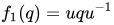
which rotates the vector part of q by twice the angle represented by the versor u.
The quaternion multiplicative inverse is another fundamental function, but as with other number systems, and related problems are generally excluded due to the nature of dividing by zero.


Affine transformations of quaternions have the form

Linear fractional transformations of quaternions can be represented by elements of the matrix ring operating on the projective line over . For instance, the mappings where and are fixed versors serve to produce the motions of elliptic space.


Quaternion variable theory differs in some respects from complex variable theory. For example: The complex conjugate mapping of the complex plane is a central tool but requires the introduction of a non-arithmetic, non-analytic operation. Indeed, conjugation changes the orientation of plane figures, something that arithmetic functions do not change.
In contrast to the complex conjugate, the quaternion conjugation can be expressed arithmetically, as

This equation can be proven, starting with the basis {1, i, j, k}:
- .

Consequently, since is linear,


The success of complex analysis in providing a rich family of holomorphic functions for scientific work has engaged some workers in efforts to extend the planar theory, based on complex numbers, to a 4-space study with functions of a quaternion variable.[1] These efforts were summarized in Deavours (1973).[a]
Though appears as a union of complex planes, the following proposition shows that extending complex functions requires special care:
Let be a function of a complex variable, . Suppose also that is an even function of and that is an odd function of . Then is an extension of to a quaternion variable where and . Then, let represent the conjugate of , so that . The extension to will be complete when it is shown that . Indeed, by hypothesis







- one obtains