 Hispanopedia Wiki
In number theory, a congruent number is a positive integer that is the area of a right triangle with three rational number sides.[1][2] A more general definition includes all positive rational numbers with this property.[3]
The sequence of (integer) congruent numbers starts with
- 5, 6, 7, 13, 14, 15, 20, 21, 22, 23, 24, 28, 29, 30, 31, 34, 37, 38, 39, 41, 45, 46, 47, 52, 53, 54, 55, 56, 60, 61, 62, 63, 65, 69, 70, 71, 77, 78, 79, 80, 84, 85, 86, 87, 88, 92, 93, 94, 95, 96, 101, 102, 103, 109, 110, 111, 112, 116, 117, 118, 119, 120, ... (sequence A003273 in the OEIS)
For example, 5 is a congruent number because it is the area of a (20/3, 3/2, 41/6) triangle. Similarly, 6 is a congruent number because it is the area of a (3,4,5) triangle. 3 and 4 are not congruent numbers. The triangle sides demonstrating a number is congruent can have very large numerators and denominators, for example 263 is the area of a triangle whose two shortest sides are 16277526249841969031325182370950195/2303229894605810399672144140263708 and 4606459789211620799344288280527416/61891734790273646506939856923765.[4]
If q is a congruent number then s2q is also a congruent number for any natural numbers (just by multiplying each side of the triangle by s), and vice versa. This leads to the observation that whether a nonzero rational number q is a congruent number depends only on its residue in the group

where is the set of nonzero rational numbers.

Every residue class in this group contains exactly one square-free integer, and it is common, therefore, only to consider square-free positive integers when speaking about congruent numbers.
History
El problema de los números congruentes fue formulado por primera vez por el matemático persa del siglo X, Al-Khazin . [ 5 ] Según los historiadores de las matemáticas Norbert Schappacher y Roshdi Rashed , Diofanto no formuló el problema de los números congruentes. [ 5 ] [ 6 ] Si bien las ecuaciones cuadráticas y las ternas pitagóricas eran conocidas en la antigüedad y se transmitieron a través de las matemáticas griegas e indias , los números congruentes fueron tabulados por primera vez en manuscritos árabes en el siglo X, con 5 y 6 entre los primeros ejemplos conocidos. En el siglo XIII, Fibonacci identificó a 7 como un número congruente y señaló que 1 no lo es. La primera prueba aceptada de la no congruencia de 1 fue dada posteriormente por Pierre de Fermat, quien también demostró que 2 y 3 no son números congruentes. [ 7 ] [ 8 ] Algunos estudiosos especulan sobre un origen indio para el problema de los números congruentes; el matemático Frans Oort considera que dicho origen no está claro, ya que no se evidencia en la literatura estándar, a pesar de que se estudiaron ecuaciones cuadráticas relacionadas en la India medieval . [ 9 ]
Problema de números congruentes
La cuestión de determinar si un número racional dado es un número congruente se denomina problema de los números congruentes . A partir de 2019Este problema aún no se ha resuelto satisfactoriamente. El teorema de Tunnell proporciona un criterio fácilmente comprobable para determinar si un número es congruente; pero su resultado se basa en la conjetura de Birch y Swinnerton-Dyer , que todavía no ha sido demostrada.
El teorema del triángulo rectángulo de Fermat , que lleva el nombre de Pierre de Fermat , establece que ningún número cuadrado puede ser congruente. Sin embargo, Fibonacci ya conocía (sin demostración) que todo congruum (la diferencia entre elementos consecutivos en una progresión aritmética de tres cuadrados) no es cuadrado . [ 10 ] Todo congruum es un número congruente, y todo número congruente es el producto de un congruum y el cuadrado de un número racional. [ 11 ] Sin embargo, determinar si un número es un congruum es mucho más fácil que determinar si es congruente, porque existe una fórmula parametrizada para los congruums para la cual solo es necesario probar un número finito de valores de parámetros. [ 12 ]
Soluciones
n is a congruent number if and only if the system
- ,
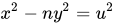
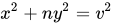
has a solution where , and are integers.[13]


Given a solution, the three numbers , , and will be in an arithmetic progression with common difference .


Furthermore, if there is one solution (where the right-hand sides are squares), then there are infinitely many: given any solution , another solution can be computed from[14]




For example, with , the equations are:

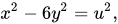
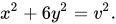
One solution is (so that ). Another solution is




With this new and , the new right-hand sides are still both squares:




Using as above gives



Given , and , one can obtain , and such that


- , and


from

Then and are the legs and hypotenuse of a right triangle with area .

The above values produce . The values give . Both of these right triangles have area .




Relation to elliptic curves
According to Leonard Eugene Dickson's compilation of historical texts, a tenth-century Arabic manuscript by Mohammed Ben Alhocain states that the core goal of the theory of rational right triangles is to identify a square that, when increased or decreased by a given number, results in another square. In modern terminology, this task translates to locating a rational point of infinite order on the elliptic curve .[15]

The question of whether a given number is congruent turns out to be equivalent to the condition that a certain elliptic curve has positive rank.[3] An alternative approach to the idea is presented below (as can essentially also be found in the introduction to Tunnell's paper).
Fix nonzero n. Suppose a, b, c are numbers (not necessarily positive or rational) which satisfy the following two equations:
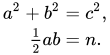
Then set x = n(a + c)/b and y = 2n2(a + c)/b2. A calculation shows
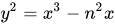
and y is not 0 (if y = 0 then a = −c, so b = 0, but (1⁄2)ab = n is nonzero, a contradiction).
Conversely, if x and y are numbers which satisfy the above equation and y is not 0, set a = (x2 − n2)/y, b = 2nx/y, and c = (x2 + n2)/y. A calculation shows these three numbers satisfy the two equations for a, b, and c above.
These two correspondences between (a,b,c) and (x,y) are inverses of each other, so we have a one-to-one correspondence between any solution of the two equations in a, b, and c and any solution of the equation in x and y with y nonzero. In particular, from the formulas in the two correspondences, for rational n we see that a, b, and c are rational if and only if the corresponding x and y are rational, and vice versa. (We also have that a, b, and c are all positive if and only if x and y are all positive; from the equation y2 = x3 − xn2 = x(x2 − n2) we see that if x and y are positive then x2 − n2 must be positive, so the formula for a above is positive.)
Thus a positive rational number n is congruent if and only if the equation y2 = x3 − n2x has a rational point with y not equal to 0. It can be shown (as an application of Dirichlet's theorem on primes in arithmetic progression) that the only torsion points on this elliptic curve are those with y equal to 0, hence the existence of a rational point with y nonzero is equivalent to saying the elliptic curve has positive rank.
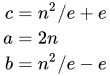
Another approach to solving is to start with integer value of n denoted as N and solve

where
Current progress
For example, it is known that for a prime number p, the following holds:[16]
- if p ≡ 3 (mod 8), then p is not a congruent number, but 2p is a congruent number.
- if p ≡ 5 (mod 8), then p is a congruent number.
- if p ≡ 7 (mod 8), then p and 2p are congruent numbers.
It is also known that in each of the congruence classes 5, 6, 7 (mod 8), for any given k there are infinitely many square-free congruent numbers with k prime factors.[17]
Notes
- ↑Weisstein, Eric W."Congruent Number". MathWorld.
- ↑Guy, Richard K. (2004). Unsolved problems in number theory ([3rd ed.] ed.). New York: Springer. pp. 195–197. ISBN 0-387-20860-7. OCLC 54611248.
- 12Koblitz, Neal (1993), Introduction to Elliptic Curves and Modular Forms, New York: Springer-Verlag, p. 3, ISBN 0-387-97966-2
- ↑Goldberg, David (2021). "Triangle Sides for Congruent Numbers less than 10,000". arXiv:2106.07373 [math.NT].
- 12Norbert Schappacher. "Diophantus of Alexandria: A Text and its History"(PDF).
- ↑Rashed, Roshdi (2022-05-16), "Science in Islam and Classical Modernity", Mathematics and Physics in Classical Islam, Brill, pp. 8–21, ISBN 9789004513402, retrieved 2026-06-06
- ↑Conrad, Keith (2008). "The Congruent Number Problem"(PDF). University of Connecticut.
- ↑Izadi, Farzali (2010-12-30). "Congruent Numbers Via the Pell Equation and its Analogous Counterpart". arXiv:1004.0261 [math.HO].
- ↑Vrolijk, Arnoud; Hogendijk, Jan (2007-10-31). O ye Gentlemen: Arabic Studies on Science and Literary Culture: In Honour of Remke Kruk. Brill. p. 95. ISBN 978-90-474-2205-1.
- ↑ Ore, Øystein (2012), Teoría de los números y su historia , Courier Dover Corporation, págs. 202–203 , ISBN 978-0-486-13643-1.
- ↑ Conrad, Keith (otoño de 2008), "El problema de los números congruentes" (PDF) , Harvard College Mathematical Review , 2 (2): 58–73 , archivado del original (PDF) el 20 de enero de 2013..
- ↑ Darling, David (2004), El libro universal de las matemáticas: De Abracadabra a las paradojas de Zenón , John Wiley & Sons, pág. 77, ISBN 978-0-471-66700-1.
- ↑ Uspensky, JV ; Heaslet, MA (1939). Teoría elemental de números . Vol. 2. McGraw Hill. pág. 419.
- ↑ Dickson, Leonard Eugene (1966). Historia de la teoría de los números . Vol. 2. Chelsea. pp. 468–469 .
- ↑ Tian, Ye (26-12-2012). " Números congruentes con muchos factores primos" . Actas de la Academia Nacional de Ciencias . 109 (52): 21256– 21258. Bibcode : 2012PNAS..10921256T . doi : 10.1073/pnas.1216991109 . PMC 3535615. PMID 23213259 .
- ^ Paul Monsky (1990), "Puntos simulados de Heegner y números congruentes", Mathematische Zeitschrift , 204 (1): 45– 67, doi : 10.1007/BF02570859 , S2CID 121911966
- ↑ Tian, Ye (2014), "Números congruentes y puntos de Heegner", Cambridge Journal of Mathematics , 2 (1): 117– 161, arXiv : 1210.8231 , doi : 10.4310/CJM.2014.v2.n1.a4 , MR 3272014 , S2CID 55390076 .
Referencias
- Alter, Ronald (1980), "El problema de los números congruentes", American Mathematical Monthly , 87 (1), Mathematical Association of America: 43– 45, doi : 10.2307/2320381 , JSTOR 2320381
- Chandrasekar, V. (1998), "The Congruent Number Problem"(PDF), Resonance, 3 (8): 33–45, doi:10.1007/BF02837344, S2CID 123495100
- Dickson, Leonard Eugene (2005), "Chapter XVI", History of the Theory of Numbers, Dover Books on Mathematics, vol. II: Diophantine Analysis, Dover Publications, ISBN 978-0-486-44233-4 – see, for a history of the problem.
- Guy, Richard (2004), Unsolved Problems in Number Theory, Problem Books in Mathematics (Book 1) (3rd ed.), Springer, ISBN 978-0-387-20860-2, Zbl 1058.11001 – Many references are given in it.
- Tunnell, Jerrold B. (1983), "A classical Diophantine problem and modular forms of weight 3/2", Inventiones Mathematicae, 72 (2): 323–334, Bibcode:1983InMat..72..323T, doi:10.1007/BF01389327, hdl:10338.dmlcz/137483
External links
- Weisstein, Eric W."Congruent Number". MathWorld.
- A short discussion of the current state of the problem with many references can be found in Alice Silverberg's Open Questions in Arithmetic Algebraic Geometry (Postscript).
- A Trillion Triangles - mathematicians have resolved the first one trillion cases (conditional on the Birch and Swinnerton-Dyer conjecture).
- Arithmetic problems of plane geometry
- Elliptic curves
- Triangle geometry
- Unsolved problems in number theory