 Hispanopedia Wiki
In algebra, the Amitsur complex is a natural complex associated to a ring homomorphism. It was introduced by ShimshonAmitsur (1959). When the homomorphism is faithfully flat, the Amitsur complex is exact (thus determining a resolution), which is the basis of the theory of faithfully flat descent.
The notion should be thought of as a mechanism to go beyond the conventional localization of rings and modules.[1]
Definition
Let be a homomorphism of (not-necessary-commutative) rings. First define the cosimplicial set (where refers to , not ) as follows. Define the face maps by inserting at the th spot:[a]






Define the degeneracies by multiplying out the th and th spots:



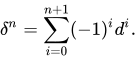
They satisfy the "obvious" cosimplicial identities and thus is a cosimplicial set. It then determines the complex with the augumentation , the Amitsur complex:[2]



where
Exactness of the Amitsur complex
Faithfully flat case
In the above notations, if is right faithfully flat, then a theorem of Alexander Grothendieck states that the (augmented) complex is exact and thus is a resolution. More generally, if is right faithfully flat, then, for each left -module ,
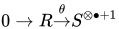



is exact.[3]
Proof:
Step 1: The statement is true if splits as a ring homomorphism.
That " splits" is to say for some homomorphism ( is a retraction and a section). Given such a , define



by

An easy computation shows the following identity: with ,

- .

This is to say that is a homotopy operator and so determines the zero map on cohomology: i.e., the complex is exact.


Step 2: The statement is true in general.
We remark that is a section of . Thus, Step 1 applied to the split ring homomorphism implies:




where , is exact. Since , etc., by "faithfully flat", the original sequence is exact.



Arc topology case
BhargavBhattandPeter Scholze (2019,§8) show that the Amitsur complex is exact if and are (commutative) perfect rings, and the map is required to be a covering in the arc topology (which is a weaker condition than being a cover in the flat topology).

Notes
- ↑The reference (M. Artin) seems to have a typo, and this should be the correct formula; see the calculation of and in the note.


Citations
- ↑Artin 1999, III.7
- ↑Artin 1999, III.6
- ↑Artin 1999, Theorem III.6.6
References
- Artin, Michael (1999), Noncommutative rings (Berkeley lecture notes)(PDF)
- Amitsur, Shimshon (1959), "Simple algebras and cohomology groups of arbitrary fields", Transactions of the American Mathematical Society, 90 (1): 73–112
- Bhatt, Bhargav; Scholze, Peter (2019), Prisms and Prismatic Cohomology, arXiv:1905.08229
- Amitsur complex at the nLab
- Homological algebra
- Ring theory