Articulo de referencia

Prewellordering

In set theory , a prewellordering on a set X {\displaystyle X} is a preorder ≤ {\displaystyle \leq } on X {\displaystyle X} (a transitive and reflexive relation on X {\displayst...

In set theory, a prewellordering on a set X {\displaystyle X} is a preorder {\displaystyle \leq } on X {\displaystyle X} (a transitive and reflexive relation on X {\displaystyle X} ) that is strongly connected (meaning that any two points are comparable) and well-founded in the sense that the induced relation x < y {\displaystyle x<y} defined by x y  and  y x {\displaystyle x\leq y{\text{ and }}y\nleq x} is a well-founded relation.

Prewellordering on a set

A prewellordering on a set X {\displaystyle X} is a homogeneous binary relation {\displaystyle \,\leq \,} on X {\displaystyle X} that satisfies the following conditions:[1]

  1. Reflexivity: x x {\displaystyle x\leq x} for all x X . {\displaystyle x\in X.}
  2. Transitivity: if x < y {\displaystyle x<y} and y < z {\displaystyle y<z} then x < z {\displaystyle x<z} for all x , y , z X . {\displaystyle x,y,z\in X.}
  3. Total/Strongly connected: x y {\displaystyle x\leq y} or y x {\displaystyle y\leq x} for all x , y X . {\displaystyle x,y\in X.}
  4. for every non-empty subset S X , {\displaystyle S\subseteq X,} there exists some m S {\displaystyle m\in S} such that m s {\displaystyle m\leq s} for all s S . {\displaystyle s\in S.}
    • This condition is equivalent to the induced strict preorder x < y {\displaystyle x<y} defined by x y {\displaystyle x\leq y} and y x {\displaystyle y\nleq x} being a well-founded relation.

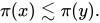
A homogeneous binary relation {\displaystyle \,\leq \,} on X {\displaystyle X} is a prewellordering if and only if there exists a surjection π : X Y {\displaystyle \pi :X\to Y} into a well-ordered set ( Y , ) {\displaystyle (Y,\lesssim )} such that for all x , y X , {\displaystyle x,y\in X,} x y {\textstyle x\leq y} if and only if π ( x ) π ( y ) . {\displaystyle \pi (x)\lesssim \pi (y).} [1]

Examples

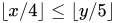
Hasse diagram of the prewellordering x / 4 y / 5 {\displaystyle \lfloor x/4\rfloor \leq \lfloor y/5\rfloor } on the non-negative integers, shown up to 29. Cycles are indicated in red and {\displaystyle \lfloor \cdot \rfloor } denotes the floor function.
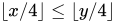
Hasse diagram of the prewellordering x / 4 y / 4 {\displaystyle \lfloor x/4\rfloor \leq \lfloor y/4\rfloor } on the non-negative integers, shown up to 18. The associated equivalence relation is x / 4 = y / 4 ; {\displaystyle \lfloor x/4\rfloor =\lfloor y/4\rfloor ;} it identifies the numbers in each light red square.

Given a set A , {\displaystyle A,} the binary relation on the set X := Finite ( A ) {\displaystyle X:=\operatorname {Finite} (A)} of all finite subsets of A {\displaystyle A} defined by S T {\displaystyle S\leq T} if and only if | S | | T | {\displaystyle |S|\leq |T|} (where | | {\displaystyle |\cdot |} denotes the set's cardinality) is a prewellordering.[1]

Properties

If {\displaystyle \leq } is a prewellordering on X , {\displaystyle X,} then the relation {\displaystyle \sim } defined by x y  if and only if  x y y x {\displaystyle x\sim y{\text{ if and only if }}x\leq y\land y\leq x} is an equivalence relation on X , {\displaystyle X,} and {\displaystyle \leq } induces a wellordering on the quotient X / . {\displaystyle X/{\sim }.} The order-type of this induced wellordering is an ordinal, referred to as the length of the prewellordering.

A norm on a set X {\displaystyle X} is a map from X {\displaystyle X} into the ordinals. Every norm induces a prewellordering; if ϕ : X O r d {\displaystyle \phi :X\to Ord} is a norm, the associated prewellordering is given by x y  if and only if  ϕ ( x ) ϕ ( y ) {\displaystyle x\leq y{\text{ if and only if }}\phi (x)\leq \phi (y)} Conversely, every prewellordering is induced by a unique regular norm (a norm ϕ : X O r d {\displaystyle \phi :X\to Ord} is regular if, for any x X {\displaystyle x\in X} and any α < ϕ ( x ) , {\displaystyle \alpha <\phi (x),} there is y X {\displaystyle y\in X} such that ϕ ( y ) = α {\displaystyle \phi (y)=\alpha } ).

Prewellordering property

If Γ {\displaystyle {\boldsymbol {\Gamma }}} is a pointclass of subsets of some collection F {\displaystyle {\mathcal {F}}} of Polish spaces, F {\displaystyle {\mathcal {F}}} closed under Cartesian product, and if {\displaystyle \leq } is a prewellordering of some subset P {\displaystyle P} of some element X {\displaystyle X} of F , {\displaystyle {\mathcal {F}},} then {\displaystyle \leq } is said to be a Γ {\displaystyle {\boldsymbol {\Gamma }}} -prewellordering of P {\displaystyle P} if the relations < {\displaystyle <^{*}} and {\displaystyle \leq ^{*}} are elements of Γ , {\displaystyle {\boldsymbol {\Gamma }},} where for x , y X , {\displaystyle x,y\in X,}

  1. x < y  if and only if  x P ( y P ( x y y x ) ) {\displaystyle x<^{*}y{\text{ if and only if }}x\in P\land (y\notin P\lor (x\leq y\land y\not \leq x))}
  2. x y  if and only if  x P ( y P x y ) {\displaystyle x\leq ^{*}y{\text{ if and only if }}x\in P\land (y\notin P\lor x\leq y)}

Γ {\displaystyle {\boldsymbol {\Gamma }}} is said to have the prewellordering property if every set in Γ {\displaystyle {\boldsymbol {\Gamma }}} admits a Γ {\displaystyle {\boldsymbol {\Gamma }}} -prewellordering.

The prewellordering property is related to the stronger scale property; in practice, many pointclasses having the prewellordering property also have the scale property, which allows drawing stronger conclusions.

Examples

Π 1 1 {\displaystyle {\boldsymbol {\Pi }}_{1}^{1}} and Σ 2 1 {\displaystyle {\boldsymbol {\Sigma }}_{2}^{1}} both have the prewellordering property; this is provable in ZFC alone. Assuming sufficient large cardinals, for every n ω , {\displaystyle n\in \omega ,} Π 2 n + 1 1 {\displaystyle {\boldsymbol {\Pi }}_{2n+1}^{1}} and Σ 2 n + 2 1 {\displaystyle {\boldsymbol {\Sigma }}_{2n+2}^{1}} have the prewellordering property.

Consequences

Reduction

If Γ {\displaystyle {\boldsymbol {\Gamma }}} is an adequate pointclass with the prewellordering property, then it also has the reduction property: For any space X F {\displaystyle X\in {\mathcal {F}}} and any sets A , B X , {\displaystyle A,B\subseteq X,} A {\displaystyle A} and B {\displaystyle B} both in Γ , {\displaystyle {\boldsymbol {\Gamma }},} the union A B {\displaystyle A\cup B} may be partitioned into sets A , B , {\displaystyle A^{*},B^{*},} both in Γ , {\displaystyle {\boldsymbol {\Gamma }},} such that A A {\displaystyle A^{*}\subseteq A} and B B . {\displaystyle B^{*}\subseteq B.}

Separation

If Γ {\displaystyle {\boldsymbol {\Gamma }}} is an adequate pointclass whose dual pointclass has the prewellordering property, then Γ {\displaystyle {\boldsymbol {\Gamma }}} has the separation property: For any space X F {\displaystyle X\in {\mathcal {F}}} and any sets A , B X , {\displaystyle A,B\subseteq X,} A {\displaystyle A} and B {\displaystyle B} disjoint sets both in Γ , {\displaystyle {\boldsymbol {\Gamma }},} there is a set C X {\displaystyle C\subseteq X} such that both C {\displaystyle C} and its complement X C {\displaystyle X\setminus C} are in Γ , {\displaystyle {\boldsymbol {\Gamma }},} with A C {\displaystyle A\subseteq C} and B C = . {\displaystyle B\cap C=\varnothing .}

For example, Π 1 1 {\displaystyle {\boldsymbol {\Pi }}_{1}^{1}} has the prewellordering property, so Σ 1 1 {\displaystyle {\boldsymbol {\Sigma }}_{1}^{1}} has the separation property. This means that if A {\displaystyle A} and B {\displaystyle B} are disjoint analytic subsets of some Polish space X , {\displaystyle X,} then there is a Borel subset C {\displaystyle C} of X {\displaystyle X} such that C {\displaystyle C} includes A {\displaystyle A} and is disjoint from B . {\displaystyle B.}

See also

  • Descriptive set theory – Subfield of mathematical logic
  • Graded poset – partially ordered set equipped with a rank functionPages displaying wikidata descriptions as a fallback – a graded poset is analogous to a prewellordering with a norm, replacing a map to the ordinals with a map to the natural numbers
  • Scale property – kind of object in descriptive set theoryPages displaying wikidata descriptions as a fallback

References

  1. ^ a b c Moschovakis 2006, p. 106.
Retrieved from "https://en.wikipedia.org/w/index.php?title=Prewellordering&oldid=1211751011"