 Hispanopedia Wiki
En la enseñanza de las matemáticas , el precálculo es un curso, o un conjunto de cursos, que incluye álgebra y trigonometría a un nivel diseñado para preparar a los estudiantes para el estudio del cálculo ; de ahí su nombre (del pre- , ' antes ' ). Las escuelas suelen distinguir entre álgebra y trigonometría como dos partes separadas del plan de estudios. [ 1 ]
Concepto
Para que los estudiantes tengan éxito en encontrar derivadas y antiderivadas con cálculo , necesitarán facilidad con expresiones algebraicas , particularmente en la modificación y transformación de dichas expresiones. Leonhard Euler escribió el primer libro de precálculo en 1748 llamado Introductio in analysin infinitorum ( latín : Introducción al análisis del infinito), que "fue concebido como un estudio de conceptos y métodos en análisis y geometría analítica preliminar al estudio del cálculo diferencial e integral". [ 2 ] Comenzó con los conceptos fundamentales de variables y funciones . Su innovación se destaca por su uso de la exponenciación para introducir las funciones trascendentales . El logaritmo general, en una base positiva arbitraria, Euler lo presenta como el inverso de una función exponencial .
Luego, el logaritmo natural se obtiene tomando como base "el número para el cual el logaritmo hiperbólico es uno", a veces llamado número de Euler , y se escribeEsta apropiación del número significativo del cálculo de Grégoire de Saint-Vincent es suficiente para establecer el logaritmo natural. Esta parte del precálculo prepara al estudiante para la integración del monomio.en el caso de.


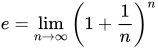
El texto de precálculo de hoy calculacomo límite. An exposition on compound interest in financial mathematics may motivate this limit. Another difference in the modern text is avoidance of complex numbers, except as they may arise as roots of a quadratic equation with a negative discriminant, or in Euler's formula as application of trigonometry. Euler used not only complex numbers but also infinite series in his precalculus. Today's course may cover arithmetic and geometric sequences and series, but not the application by Saint-Vincent to gain his hyperbolic logarithm, which Euler used to finesse his precalculus.
Variable content
Precalculus prepares students for calculus somewhat differently from how pre-algebra prepares students for algebra. While pre-algebra often has extensive coverage of basic algebraic concepts, precalculus courses might see only small amounts of calculus concepts, if at all, and usually involve covering algebraic topics that might not have been given attention in earlier algebra courses. Some precalculus courses might differ from others in terms of content. For example, an honors-level course might spend more time on conic sections, Euclidean vectors, and other topics needed for calculus, used in fields such as medicine or engineering. A college preparatory/regular class might focus on topics used in business-related careers, such as matrices, or power functions.
A standard course considers functions, function composition, and inverse functions, often in connection with sets and real numbers. In particular, polynomials and rational functions are developed. Algebraic skills are exercised with trigonometric functions and trigonometric identities. The binomial theorem, polar coordinates, parametric equations, and the limits of sequences and series are other common topics of precalculus. Sometimes the mathematical induction method of proof for propositions dependent upon a natural number may be demonstrated, but generally, coursework involves exercises rather than theory.
Sample texts
- Roland E. Larson & Robert P. Hostetler (1989) Precalculus, second edition, D.C. Heath and CompanyISBN 0-669-16277-9
- Margaret L. Lial & Charles D. Miller (1988) Precalculus, Scott ForesmanISBN 0-673-15872-1
- Jerome E. Kaufmann (1988) Precalculus, PWS-Kent Publishing Company (Wadsworth)
- Karl J. Smith (1990) Precalculus Mathematics: a functional approach, fourth edition, Brooks/ColeISBN 0-534-11922-0
- Michael Sullivan (1993) Precalculus, third edition, Dellen imprint of Macmillan PublishersISBN 0-02-418421-7
Online access
- Jay Abramson and others (2014) Precalculus from OpenStax
- David Lippman & Melonie Rasmussen (2017) Precalculus: an investigation of functions
- Carl Stitz & Jeff Zeager (2013) Precalculus (pdf)
See also
References
- ↑Cangelosi, J. S. (2012). Teaching mathematics in secondary and middle school, an interactive approach. Prentice Hall.
- ↑Bos, H. J. M. (1980). "Chapter 2: Newton, Leibniz and the Leibnizian tradition chapter 2". In Grattan-Guinness, Ivor (ed.). From the Calculus to Set Theory, 1630 – 1910: An Introductory History. Duckworth Overlook. p. 76. ISBN 0-7156-1295-6.
External links

- Precalculus information at Mathworld
- Mathematics education