Articulo de referencia

Negative multinomial distribution

\\textrm{NM}(x_0,\\,\\mathbf{p}) "},"parameters":{"wt":" x_0>0 — the number of failures before the experiment is stopped, \\mathbf{p} ∈ '''R''' ''m'' — ''m''-vector of \"success...

In probability theory and statistics, the negative multinomial distribution is a generalization of the negative binomial distribution (NB(x0,p)) to more than two outcomes.[1]

As with the univariate negative binomial distribution, if the parameter x0{\displaystyle x_{0}} is a positive integer, the negative multinomial distribution has an urn model interpretation. Suppose we have an experiment that generates m+1≥2 possible outcomes, {X0,...,Xm}, each occurring with non-negative probabilities {p0,...,pm} respectively. If sampling proceeded until n observations were made, then {X0,...,Xm} would have been multinomially distributed. However, if the experiment is stopped once X0 reaches the predetermined value x0 (assuming x0 is a positive integer), then the distribution of the m-tuple {X1,...,Xm} is negative multinomial. These variables are not multinomially distributed because their sum X1+...+Xm is not fixed, being a draw from a negative binomial distribution.

Properties

Marginal distributions

If m-dimensional x is partitioned as follows X=[X(1)X(2)] with sizes [n×1(mn)×1]{\displaystyle \mathbf {X} ={\begin{bmatrix}\mathbf {X} ^{(1)}\\\mathbf {X} ^{(2)}\end{bmatrix}}{\text{ with sizes }}{\begin{bmatrix}n\times 1\\(m-n)\times 1\end{bmatrix}}} and accordingly p{\displaystyle {\boldsymbol {p}}}p=[p(1)p(2)] with sizes [n×1(mn)×1]{\displaystyle {\boldsymbol {p}}={\begin{bmatrix}{\boldsymbol {p}}^{(1)}\\{\boldsymbol {p}}^{(2)}\end{bmatrix}}{\text{ with sizes }}{\begin{bmatrix}n\times 1\\(m-n)\times 1\end{bmatrix}}} and let q=1ipi(2)=p0+ipi(1){\displaystyle q=1-\sum _{i}p_{i}^{(2)}=p_{0}+\sum _{i}p_{i}^{(1)}}

The marginal distribution of X(1){\displaystyle {\boldsymbol {X}}^{(1)}} is NM(x0,p0/q,p(1)/q){\displaystyle \mathrm {NM} (x_{0},p_{0}/q,{\boldsymbol {p}}^{(1)}/q)}. That is the marginal distribution is also negative multinomial with the p(2){\displaystyle {\boldsymbol {p}}^{(2)}} removed and the remaining p's properly scaled so as to add to one.

The univariate marginal m=1{\displaystyle m=1} is said to have a negative binomial distribution.

Conditional distributions

The conditional distribution of X(1){\displaystyle \mathbf {X} ^{(1)}} given X(2)=x(2){\displaystyle \mathbf {X} ^{(2)}=\mathbf {x} ^{(2)}} is NM(x0+xi(2),p(1)){\textstyle \mathrm {NM} (x_{0}+\sum {x_{i}^{(2)}},\mathbf {p} ^{(1)})}. That is, Pr(x(1)x(2),x0,p)=Γ(i=0mxi)(1i=1npi(1))x0+i=1mnxi(2)Γ(x0+i=1mnxi(2))i=1n(pi(1))xi(xi(1))!.{\displaystyle \Pr(\mathbf {x} ^{(1)}\mid \mathbf {x} ^{(2)},x_{0},\mathbf {p} )=\Gamma \!\left(\sum _{i=0}^{m}{x_{i}}\right){\frac {(1-\sum _{i=1}^{n}{p_{i}^{(1)}})^{x_{0}+\sum _{i=1}^{m-n}x_{i}^{(2)}}}{\Gamma (x_{0}+\sum _{i=1}^{m-n}x_{i}^{(2)})}}\prod _{i=1}^{n}{\frac {(p_{i}^{(1)})^{x_{i}}}{(x_{i}^{(1)})!}}.}

Independent sums

If X1NM(r1,p){\displaystyle \mathbf {X} _{1}\sim \mathrm {NM} (r_{1},\mathbf {p} )} and If X2NM(r2,p){\displaystyle \mathbf {X} _{2}\sim \mathrm {NM} (r_{2},\mathbf {p} )} are independent, then X1+X2NM(r1+r2,p){\displaystyle \mathbf {X} _{1}+\mathbf {X} _{2}\sim \mathrm {NM} (r_{1}+r_{2},\mathbf {p} )}. Similarly and conversely, it is easy to see from the characteristic function that the negative multinomial is infinitely divisible.

Aggregation

If X=(X1,,Xm)NM(x0,(p1,,pm)){\displaystyle \mathbf {X} =(X_{1},\ldots ,X_{m})\sim \operatorname {NM} (x_{0},(p_{1},\ldots ,p_{m}))} then, if the random variables with subscripts i and j are dropped from the vector and replaced by their sum, X=(X1,,Xi+Xj,,Xm)NM(x0,(p1,,pi+pj,,pm)).{\displaystyle \mathbf {X} '=(X_{1},\ldots ,X_{i}+X_{j},\ldots ,X_{m})\sim \operatorname {NM} (x_{0},(p_{1},\ldots ,p_{i}+p_{j},\ldots ,p_{m})).}

This aggregation property may be used to derive the marginal distribution of Xi{\displaystyle X_{i}} mentioned above.

Correlation matrix

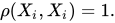
The entries of the correlation matrix are ρ(Xi,Xi)=1.{\displaystyle \rho (X_{i},X_{i})=1.}ρ(Xi,Xj)=cov(Xi,Xj)var(Xi)var(Xj)=pipj(p0+pi)(p0+pj).{\displaystyle \rho (X_{i},X_{j})={\frac {\operatorname {cov} (X_{i},X_{j})}{\sqrt {\operatorname {var} (X_{i})\operatorname {var} (X_{j})}}}={\sqrt {\frac {p_{i}p_{j}}{(p_{0}+p_{i})(p_{0}+p_{j})}}}.}
Parameter estimation

Method of Moments

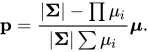
If we let the mean vector of the negative multinomial be μ=x0p0p{\displaystyle {\boldsymbol {\mu }}={\frac {x_{0}}{p_{0}}}\mathbf {p} } and covariance matrixΣ=x0p02pp+x0p0diag(p),{\displaystyle {\boldsymbol {\Sigma }}={\tfrac {x_{0}}{p_{0}^{2}}}\,\mathbf {p} \mathbf {p} '+{\tfrac {x_{0}}{p_{0}}}\,\operatorname {diag} (\mathbf {p} ),} then it is easy to show through properties of determinants that |Σ|=1p0i=1mμi{\textstyle |{\boldsymbol {\Sigma }}|={\frac {1}{p_{0}}}\prod _{i=1}^{m}{\mu _{i}}}. From this, it can be shown that x0=μiμi|Σ|μi{\displaystyle x_{0}={\frac {\sum {\mu _{i}}\prod {\mu _{i}}}{|{\boldsymbol {\Sigma }}|-\prod {\mu _{i}}}}} and p=|Σ|μi|Σ|μiμ.{\displaystyle \mathbf {p} ={\frac {|{\boldsymbol {\Sigma }}|-\prod {\mu _{i}}}{|{\boldsymbol {\Sigma }}|\sum {\mu _{i}}}}{\boldsymbol {\mu }}.}

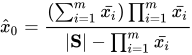
Substituting sample moments yields the method of moments estimates x^0=(i=1mxi¯)i=1mxi¯|S|i=1mxi¯{\displaystyle {\hat {x}}_{0}={\frac {(\sum _{i=1}^{m}{{\bar {x_{i}}})}\prod _{i=1}^{m}{\bar {x_{i}}}}{|\mathbf {S} |-\prod _{i=1}^{m}{\bar {x_{i}}}}}} and p^=(|S|i=1mx¯i|S|i=1mx¯i)x¯{\displaystyle {\hat {\mathbf {p} }}=\left({\frac {|{\boldsymbol {S}}|-\prod _{i=1}^{m}{{\bar {x}}_{i}}}{|{\boldsymbol {S}}|\sum _{i=1}^{m}{{\bar {x}}_{i}}}}\right){\boldsymbol {\bar {x}}}}

References

  1. Le Gall, F. The modes of a negative multinomial distribution, Statistics & Probability Letters, Volume 76, Issue 6, 15 March 2006, Pages 619-624, ISSN 0167-7152, 10.1016/j.spl.2005.09.009.

Waller LA and Zelterman D. (1997). Log-linear modeling with the negative multi- nomial distribution. Biometrics 53: 971–82.

Further reading

Johnson, Norman L.; Kotz, Samuel; Balakrishnan, N. (1997). "Chapter 36: Negative Multinomial and Other Multinomial-Related Distributions". Discrete Multivariate Distributions. Wiley. ISBN 978-0-471-12844-1.

Retrieved from "https://en.wikipedia.org/w/index.php?title=Negative_multinomial_distribution&oldid=1294922537"