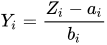
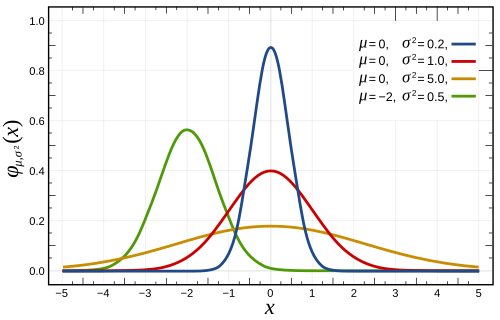
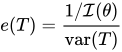
In statistics , local asymptotic normality is a property of a sequence of statistical models , which allows this sequence to be asymptotically approximated by a normal location ...
Hispanopedia WikiContenido en espanolLectura gratuita
The notion of local asymptotic normality was introduced by Le Cam (1960) and is fundamental in the treatment of estimator and test efficiency.[1]
Definition
A sequence of parametric statistical models{ Pn,θ: θ ∈ Θ } is said to be locally asymptotically normal (LAN) at θ if there exist matricesrn and Iθ and a random vectorΔn,θ ~ N(0, Iθ) such that, for every converging sequence hn → h,[2]
The sequences of distributions and are contiguous.[2]
Example
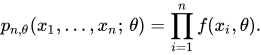
The most straightforward example of a LAN model is an iid model whose likelihood is twice continuously differentiable. Suppose { X1, X2, …, Xn} is an iid sample, where each Xi has density function f(x, θ). The likelihood function of the model is equal to
If f is twice continuously differentiable in θ, then
Plugging in , gives
By the central limit theorem, the first term (in parentheses) converges in distribution to a normal random variable Δθ ~ N(0, Iθ), whereas by the law of large numbers the expression in second parentheses converges in probability to Iθ, which is the Fisher information matrix:
Thus, the definition of the local asymptotic normality is satisfied, and we have confirmed that the parametric model with iid observations and twice continuously differentiable likelihood has the LAN property.
 Hispanopedia Wiki



![{\displaystyle {\begin{aligned}\ln p_{n,\theta +\delta \theta }&\approx \ln p_{n,\theta }+\delta \theta '{\frac {\partial \ln p_{n,\theta }}{\partial \theta }}+{\frac {1}{2}}\delta \theta '{\frac {\partial ^{2}\ln p_{n,\theta }}{\partial \theta \,\partial \theta '}}\delta \theta \\&=\ln p_{n,\theta }+\delta \theta '\sum _{i=1}^{n}{\frac {\partial \ln f(x_{i},\theta )}{\partial \theta }}+{\frac {1}{2}}\delta \theta '{\bigg [}\sum _{i=1}^{n}{\frac {\partial ^{2}\ln f(x_{i},\theta )}{\partial \theta \,\partial \theta '}}{\bigg ]}\delta \theta .\end{aligned}}}](https://wikimedia.org/api/rest_v1/media/math/render/svg/da20e3a17ff279c0f91a2c2e89448b7654bd0e3f)


![{\displaystyle I_{\theta }=\mathrm {E} {\bigg [}{-{\frac {\partial ^{2}\ln f(X_{i},\theta )}{\partial \theta \,\partial \theta '}}}{\bigg ]}=\mathrm {E} {\bigg [}{\bigg (}{\frac {\partial \ln f(X_{i},\theta )}{\partial \theta }}{\bigg )}{\bigg (}{\frac {\partial \ln f(X_{i},\theta )}{\partial \theta }}{\bigg )}'\,{\bigg ]}.}](https://wikimedia.org/api/rest_v1/media/math/render/svg/64ff1762959d7543772d8ce17c04e91a80c2f878)