Articulo de referencia

espacio de Dirichlet

En matemáticas , el espacio de Dirichlet en el dominio Ω ⊆ do , D ( Ω ) {\displaystyle \Omega \subseteq \mathbb {C} ,\,{\mathcal {D}}(\Omega )} (nombrado en honor a Peter Gustav...
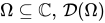
En matemáticas , el espacio de Dirichlet en el dominio Ωdo,D(Ω){\displaystyle \Omega \subseteq \mathbb {C} ,\,{\mathcal {D}}(\Omega )}(nombrado en honor a Peter Gustav Lejeune Dirichlet ), es el espacio de Hilbert de núcleo reproductor de funciones holomorfas , contenido dentro del espacio de Hardy.H2(Ω){\displaystyle H^{2}(\Omega)}, para la cual la integral de Dirichlet , definida por

D(F):=1πΩ|F(z)|2dA=14πΩ|incógnitaF|2+|yF|2dincógnitady{\displaystyle {\mathcal {D}}(f):={1 \over \pi }\iint _ {\Omega }|f^{\prime }(z)|^{2}\,dA={1 \over 4\pi }\iint _ {\Omega }|\partial _ {x}f|^{2}+|\partial _ {y}f|^{2}\,dx\,dy}

es finito (aquí dA denota la medida de Lebesgue del área en el plano complejo)do{\displaystyle \mathbb {C} }). Esta última es la integral que aparece en el principio de Dirichlet para funciones armónicas . La integral de Dirichlet define una seminorma enD(Ω){\displaystyle {\mathcal {D}}(\Omega)}No es una norma en general, ya queD(F)=0{\displaystyle {\mathcal {D}}(f)=0}siempre que f sea una función constante .

ParaF,gramoD(Ω){\displaystyle f,\,g\in {\mathcal {D}}(\Omega )}, definimos

D(F,gramo):=1πΩF(z)gramo(z)¯dA(z).{\displaystyle {\mathcal {D}}(f,\,g):={1 \over \pi }\iint _{\Omega }f'(z){\overline {g'(z)}}\,dA(z).}

Este es un producto semi-interno y claramenteD(F,F)=D(F){\displaystyle {\mathcal {D}}(f,\,f)={\mathcal {D}}(f)}Podemos equiparD(Ω){\displaystyle {\mathcal {D}}(\Omega)}con un producto interno dado por

F,gramoD(Ω):=F,gramoH2(Ω)+D(F,gramo)(F,gramoD(Ω)),{\displaystyle \langle f,g\rangle _{{\mathcal {D}}(\Omega )}:=\langle f,\,g\rangle _{H^{2}(\Omega )}+{\mathcal {D}}(f,\,g)\;\;\;\;\;(f,\,g\in {\mathcal {D}}(\Omega )),}

dónde,H2(Ω){\displaystyle \langle \cdot ,\,\cdot \rangle _{H^{2}(\Omega )}}es el producto interno habitual enH2(Ω).{\displaystyle H^{2}(\Omega).}La norma correspondienteD(Ω){\displaystyle \|\cdot \|_{{\mathcal {D}}(\Omega )}}es dado por

FD(Ω)2:=FH2(Ω)2+D(F)(FD(Ω)).{\displaystyle \|f\|_{{\mathcal {D}}(\Omega )}^{2}:=\|f\|_{H^{2}(\Omega )}^{2}+{\mathcal {D}}(f)\;\;\;\;\;(f\in {\mathcal {D}}(\Omega )).}

Tenga en cuenta que esta definición no es única, otra opción común es tomarF2=|F(do)|2+D(F){\displaystyle \|f\|^{2}=|f(c)|^{2}+{\mathcal {D}}(f)}, para algún fijodoΩ{\displaystyle c\in \Omega }.

El espacio de Dirichlet no es un álgebra , sino el espacioD(Ω)H(Ω){\displaystyle {\mathcal {D}}(\Omega )\cap H^{\infty }(\Omega )}es un álgebra de Banach , con respecto a la norma


FD(Ω)H(Ω):=FH(Ω)+D(F)1/2(FD(Ω)H(Ω)).{\displaystyle \|f\|_{{\mathcal {D}}(\Omega )\cap H^{\infty }(\Omega )}:=\|f\|_{H^{\infty }(\Omega )}+{\mathcal {D}}(f)^{1/2}\;\;\;\;\;(f\in {\mathcal {D}}(\Omega )\cap H^{\infty }(\Omega )).}

Normalmente tenemosΩ=D{\displaystyle \Omega =\mathbb {D} }(el disco unitario del plano complejo)do{\displaystyle \mathbb {C} }), en ese casoD(D):=D{\displaystyle {\mathcal {D}}(\mathbb {D} ):={\mathcal {D}}}y si

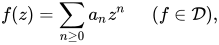
F(z)=norte0anorteznorte(FD),{\displaystyle f(z)=\sum _{n\geq 0}a_{n}z^{n}\;\;\;\;\;(f\in {\mathcal {D}}),}

entonces

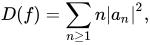
D(F)=norte1norte|anorte|2,{\displaystyle D(f)=\sum _{n\geq 1}n|a_{n}|^{2},}

y

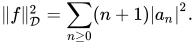
FD2=norte0(norte+1)|anorte|2.{\displaystyle \|f\|_{\mathcal {D}}^{2}=\sum _{n\geq 0}(n+1)|a_{n}|^{2}.}

Claramente,D{\displaystyle {\mathcal {D}}}contiene todos los polinomios y, más generalmente, todas las funcionesF{\displaystyle f}, holomorfo enD{\displaystyle \mathbb {D} }de tal manera queF{\displaystyle f'}está delimitado porD{\displaystyle \mathbb {D} }.

El núcleo reproductor deD{\displaystyle {\mathcal {D}}}enwdo{0}{\displaystyle w\in \mathbb {C} \setminus \{0\}}es dado por

kw(z)=1zw¯registro(11zw¯)(zdo{0}).{\displaystyle k_{w}(z)={\frac {1}{z{\overline {w}}}}\log \left({\frac {1}{1-z{\overline {w}}}}\right)\;\;\;\;\;(z\in \mathbb {C} \setminus \{0\}).}

Véase también

Referencias

  • Arcozzi, Nicola; Rochberg, Richard; Sawyer, Eric T.; Wick, Brett D. (2011), " El espacio de Dirichlet: una revisión" (PDF) , New York J. Math. , 17a : 45–86
  • El-Fallah, Omar; Kellay, Karim; Mashreghi, Javad; Ransford, Thomas (2014). Introducción al espacio de Dirichlet . Cambridge, Reino Unido: Cambridge University Press. ISBN 978-1-107-04752-5.