Articulo de referencia

Absorbing set

In functional analysis and related areas of mathematics an absorbing set in a vector space is a set S {\displaystyle S} which can be "inflated" or "scaled up" to eventually alwa...

In functional analysis and related areas of mathematics an absorbing set in a vector space is a set S {\displaystyle S} which can be "inflated" or "scaled up" to eventually always include any given point of the vector space. Alternative terms are radial or absorbent set. Every neighborhood of the origin in every topological vector space is an absorbing subset.

Definition

Notation for scalars

Suppose that X {\displaystyle X} is a vector space over the field K {\displaystyle \mathbb {K} } of real numbers R {\displaystyle \mathbb {R} } or complex numbers C , {\displaystyle \mathbb {C} ,} and for any r , {\displaystyle -\infty \leq r\leq \infty ,} let B r = { a K : | a | < r }  and  B r = { a K : | a | r } {\displaystyle B_{r}=\{a\in \mathbb {K} :|a|<r\}\quad {\text{ and }}\quad B_{\leq r}=\{a\in \mathbb {K} :|a|\leq r\}} denote the open ball (respectively, the closed ball) of radius r {\displaystyle r} in K {\displaystyle \mathbb {K} } centered at 0. {\displaystyle 0.} Define the product of a set K K {\displaystyle K\subseteq \mathbb {K} } of scalars with a set A {\displaystyle A} of vectors as K A = { k a : k K , a A } , {\displaystyle KA=\{ka:k\in K,a\in A\},} and define the product of K K {\displaystyle K\subseteq \mathbb {K} } with a single vector x {\displaystyle x} as K x = { k x : k K } . {\displaystyle Kx=\{kx:k\in K\}.}

Preliminaries

Balanced core and balanced hull

A subset S {\displaystyle S} of X {\displaystyle X} is said to be balanced if a s S {\displaystyle as\in S} for all s S {\displaystyle s\in S} and all scalars a {\displaystyle a} satisfying | a | 1 ; {\displaystyle |a|\leq 1;} this condition may be written more succinctly as B 1 S S , {\displaystyle B_{\leq 1}S\subseteq S,} and it holds if and only if B 1 S = S . {\displaystyle B_{\leq 1}S=S.}

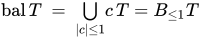
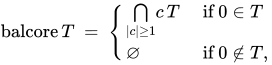
Given a set T , {\displaystyle T,} the smallest balanced set containing T , {\displaystyle T,} denoted by bal T , {\displaystyle \operatorname {bal} T,} is called the balanced hull of T {\displaystyle T} while the largest balanced set contained within T , {\displaystyle T,} denoted by balcore T , {\displaystyle \operatorname {balcore} T,} is called the balanced core of T . {\displaystyle T.} These sets are given by the formulas bal T   =   | c | 1 c T = B 1 T {\displaystyle \operatorname {bal} T~=~{\textstyle \bigcup \limits _{|c|\leq 1}}c\,T=B_{\leq 1}T} and balcore T   =   { | c | 1 c T  if  0 T  if  0 T , {\displaystyle \operatorname {balcore} T~=~{\begin{cases}{\textstyle \bigcap \limits _{|c|\geq 1}}c\,T&{\text{ if }}0\in T\\\varnothing &{\text{ if }}0\not \in T,\\\end{cases}}} (these formulas show that the balanced hull and the balanced core always exist and are unique). A set T {\displaystyle T} is balanced if and only if it is equal to its balanced hull ( T = bal T {\displaystyle T=\operatorname {bal} T} ) or to its balanced core ( T = balcore T {\displaystyle T=\operatorname {balcore} T} ), in which case all three of these sets are equal: T = bal T = balcore T . {\displaystyle T=\operatorname {bal} T=\operatorname {balcore} T.}

If c {\displaystyle c} is any scalar then bal ( c T ) =