Streamlines around a sphere in axisymmetric Stokes flow . At terminal velocity the drag force F d balances the force F g propelling the object. In fluid dynamics , the Stokes st...
Hispanopedia WikiContenido en espanolLectura gratuita
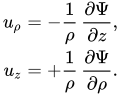
Consider a cylindrical coordinate system ( ρ , φ , z ), with the z–axis the line around which the incompressible flow is axisymmetrical, φ the azimuthal angle and ρ the distance to the z–axis. Then the flow velocity components uρ and uz can be expressed in terms of the Stokes stream function by:[1]
The azimuthal velocity component uφ does not depend on the stream function. Due to the axisymmetry, all three velocity components ( uρ , uφ , uz ) only depend on ρ and z and not on the azimuth φ.
The volume flux, through the surface bounded by a constant value ψ of the Stokes stream function, is equal to 2π ψ.
Spherical coordinates
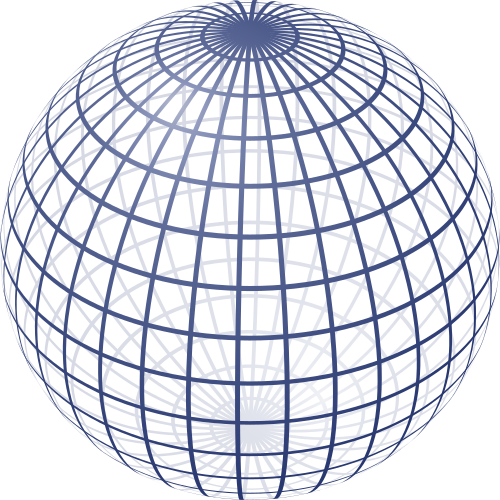
A point plotted using the spherical coordinate system
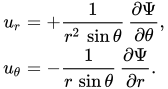
In spherical coordinates ( r , θ , φ ), r is the radial distance from the origin, θ is the zenith angle and φ is the azimuthal angle. In axisymmetric flow, with θ = 0 the rotational symmetry axis, the quantities describing the flow are again independent of the azimuth φ. The flow velocity components ur and uθ are related to the Stokes stream function through:[2]
Again, the azimuthal velocity component uφ is not a function of the Stokes stream function ψ. The volume flux through a stream tube, bounded by a surface of constant ψ, equals 2π ψ, as before.
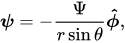
As a result, from the calculation the vorticity vector is found to be equal to:
Comparison with cylindrical
The cylindrical and spherical coordinate systems are related through
and
Alternative definition with opposite sign
As explained in the general stream function article, definitions using an opposite sign convention – for the relationship between the Stokes stream function and flow velocity – are also in use.[3]
Zero divergence
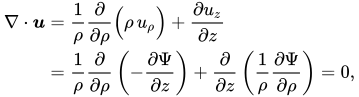
In cylindrical coordinates, the divergence of the velocity field u becomes:[4]
as expected for an incompressible flow.
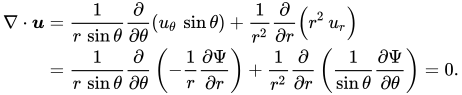
And in spherical coordinates:[5]
Streamlines as curves of constant stream function
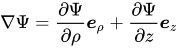
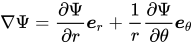
From calculus it is known that the gradient vector is normal to the curve (see e.g. Level set#Level sets versus the gradient). If it is shown that everywhere using the formula for in terms of then this proves that level curves of are streamlines.
Cylindrical coordinates
In cylindrical coordinates,
.
and
So that
Spherical coordinates
And in spherical coordinates
and
So that
Notes
^Batchelor (1967), p. 78.
^Batchelor (1967), p. 79.
^E.g. Brenner, Howard (1961). "The slow motion of a sphere through a viscous fluid towards a plane surface". Chemical Engineering Science. 16 (3–4): 242–251. doi:10.1016/0009-2509(61)80035-3.
^Batchelor (1967), p. 602.
^Batchelor (1967), p. 601.
References
Batchelor, G.K. (1967). An Introduction to Fluid Dynamics. Cambridge University Press. ISBN 0-521-66396-2.
Lamb, H. (1994). Hydrodynamics (6th ed.). Cambridge University Press. ISBN 978-0-521-45868-9. Originally published in 1879, the 6th extended edition appeared first in 1932.
Stokes, G.G. (1842). "On the steady motion of incompressible fluids". Transactions of the Cambridge Philosophical Society. 7: 439–453. Bibcode:1848TCaPS...7..439S. Reprinted in: Stokes, G.G. (1880). Mathematical and Physical Papers, Volume I. Cambridge University Press. pp. 1–16.
 Hispanopedia Wiki






![{\displaystyle {\boldsymbol {\omega }}={\begin{pmatrix}0\\[1ex]0\\[1ex]\displaystyle -{\frac {1}{r\sin \theta }}\left({\frac {\partial ^{2}\Psi }{\partial r^{2}}}+{\frac {\sin \theta }{r^{2}}}{\partial \over \partial \theta }\left({\frac {1}{\sin \theta }}{\frac {\partial \Psi }{\partial \theta }}\right)\right)\end{pmatrix}}.}](https://wikimedia.org/api/rest_v1/media/math/render/svg/6f9fb7b9db57674b0172810e4c521b5c9207b649)