 Hispanopedia Wiki
- Inversor de cadena solar y otros componentes BOS
- BIPV en un balcón en Helsinki, Finlandia
- Sistema de tejado en Boston, Estados Unidos
- Parque solar de Westmill en el Reino Unido
- Seguidor de dos ejes con módulos CPV
- Topaz , una de las centrales solares más grandes del mundo , vista desde el espacio
- Sistema fotovoltaico comercial sobre tejado de unos 400 kWh /h
- Central eléctrica en el monte Komekura, Japón
- Sistema solar fotovoltaico en Zugspitze , la cima más alta de Alemania
Un sistema fotovoltaico , también llamado sistema FV o sistema de energía solar , es un sistema de energía eléctrica diseñado para suministrar energía solar utilizable por medio de energía fotovoltaica . Consiste en una disposición de varios componentes, incluidos paneles solares para absorber y convertir la luz solar en electricidad, un inversor solar para convertir la salida de corriente continua a corriente alterna , así como montaje , cableado y otros accesorios eléctricos para configurar un sistema en funcionamiento. Muchos sistemas fotovoltaicos a gran escala utilizan sistemas de seguimiento que siguen la trayectoria diaria del sol a través del cielo para generar más electricidad que los sistemas montados de forma fija. [1]
Los sistemas fotovoltaicos convierten la luz directamente en electricidad y no deben confundirse con otras tecnologías solares, como la energía solar concentrada o la energía solar térmica , que se utilizan para calefacción y refrigeración. Un conjunto solar solo comprende los paneles solares, la parte visible del sistema fotovoltaico, y no incluye todo el resto del hardware, que a menudo se resume como el equilibrio del sistema (BOS). Los sistemas fotovoltaicos varían desde pequeños sistemas montados en tejados o integrados en edificios con capacidades que van desde unos pocos hasta varias decenas de kilovatios hasta grandes centrales eléctricas a escala de servicios públicos de cientos de megavatios. Hoy en día, los sistemas fuera de la red o autónomos representan una pequeña parte del mercado.
Los sistemas fotovoltaicos, que funcionan de manera silenciosa y sin partes móviles ni contaminación del aire , han evolucionado desde aplicaciones de nicho de mercado hasta convertirse en una tecnología madura utilizada para la generación de electricidad convencional. Debido al crecimiento de la energía fotovoltaica , los precios de los sistemas fotovoltaicos han disminuido rápidamente desde su introducción; sin embargo, varían según el mercado y el tamaño del sistema. Hoy en día, los módulos solares fotovoltaicos representan menos de la mitad del costo total del sistema, [2] dejando el resto a los componentes restantes del BOS y a los costos indirectos, que incluyen la adquisición de clientes, los permisos, la inspección y la interconexión, la mano de obra de instalación y los costos de financiamiento. [3] : 14
Sistema moderno
Descripción general

Un sistema fotovoltaico convierte la radiación del sol , en forma de luz, en electricidad utilizable . Está compuesto por el conjunto solar y el resto de componentes del sistema. Los sistemas fotovoltaicos se pueden clasificar en función de diversos aspectos, como sistemas conectados a la red o independientes , sistemas integrados en edificios o montados en bastidores, sistemas residenciales o de servicios públicos, sistemas distribuidos o centralizados, sistemas en tejados o montados en el suelo, sistemas de seguimiento o de inclinación fija y sistemas de nueva construcción o modernizados . Otras distinciones pueden incluir sistemas con microinversores o inversores centrales, sistemas que utilizan silicio cristalino o tecnología de película fina y sistemas con módulos.
Alrededor del 99 por ciento de todos los sistemas de energía solar europeos y el 90 por ciento de todos los sistemas de energía solar de los EE. UU. están conectados a la red eléctrica , mientras que los sistemas fuera de la red son algo más comunes en Australia y Corea del Sur. [4] : 14 Los sistemas fotovoltaicos rara vez utilizan almacenamiento de baterías. Esto puede cambiar, a medida que se implementen incentivos gubernamentales para el almacenamiento de energía distribuida y las inversiones en soluciones de almacenamiento se vuelvan gradualmente económicamente viables para sistemas pequeños. [5] [6] En el Reino Unido, el número de sistemas comerciales que utilizan almacenamiento de baterías está aumentando gradualmente como resultado de las limitaciones de la red que impiden la retroalimentación de electricidad no utilizada a la red, así como el aumento de los costos de electricidad, lo que resulta en una mejora económica. [7] Un conjunto solar residencial típico está montado en bastidores en el techo, en lugar de integrado en el techo o la fachada del edificio, lo que es significativamente más caro. Las centrales solares a escala de servicios públicos están montadas en el suelo, con paneles solares inclinados fijos en lugar de utilizar costosos dispositivos de seguimiento. El silicio cristalino es el material predominante utilizado en el 90 por ciento de los módulos solares producidos en todo el mundo, mientras que su rival, la película delgada, ha perdido participación de mercado. [8] : 17–20 Alrededor del 70 por ciento de todas las células y módulos solares se producen en China y Taiwán, y solo el 5 por ciento lo hacen fabricantes europeos y estadounidenses . [8] : 11–12 La capacidad instalada tanto para pequeños sistemas en azoteas como para grandes centrales solares está creciendo rápidamente y en partes iguales, aunque hay una tendencia notable hacia sistemas a escala de servicios públicos, ya que el foco en nuevas instalaciones se está alejando de Europa hacia regiones más soleadas, como el Sunbelt en los EE. UU., que se oponen menos a las granjas solares montadas en el suelo y los inversores enfatizan más la relación costo-beneficio. [4] : 43
Impulsado por los avances en la tecnología y el aumento de la escala y sofisticación de la fabricación, el costo de la energía fotovoltaica está disminuyendo continuamente. [9] Hay varios millones de sistemas fotovoltaicos distribuidos por todo el mundo, principalmente en Europa, con 1,4 millones de sistemas solo en Alemania [8] : 5 - así como América del Norte con 440.000 sistemas en los Estados Unidos. [10] La eficiencia de conversión de energía de un módulo solar convencional aumentó del 15 al 20 por ciento desde 2004 [8] : 17 y un sistema fotovoltaico recupera la energía necesaria para su fabricación en aproximadamente 2 años. En lugares excepcionalmente irradiados, o cuando se utiliza tecnología de película delgada, el llamado tiempo de recuperación de la energía disminuye a un año o menos. [8] : 30–33 La medición neta y los incentivos financieros, como las tarifas de alimentación preferenciales para la electricidad generada por energía solar, también han apoyado en gran medida las instalaciones de sistemas fotovoltaicos en muchos países. [11] El costo nivelado de la electricidad proveniente de sistemas fotovoltaicos a gran escala se ha vuelto competitivo con respecto a las fuentes de electricidad convencionales en una lista cada vez mayor de regiones geográficas, y se ha logrado la paridad de red en unos 30 países. [12] [13] [14] [15]
En 2015, el mercado mundial de energía fotovoltaica, que crece rápidamente, se acerca rápidamente a la marca de los 200 GW, unas 40 veces la capacidad instalada en 2006. [16] Estos sistemas contribuyen actualmente con alrededor del 1 por ciento de la generación de electricidad mundial. Los principales instaladores de sistemas fotovoltaicos en términos de capacidad son actualmente China, Japón y Estados Unidos, mientras que la mitad de la capacidad mundial está instalada en Europa, y Alemania e Italia suministran entre el 7% y el 8% de su respectivo consumo eléctrico doméstico con energía solar fotovoltaica. [17] La Agencia Internacional de la Energía espera que la energía solar se convierta en la mayor fuente de electricidad del mundo para 2050, y que la energía solar fotovoltaica y la energía solar térmica concentrada contribuyan con el 16% y el 11% de la demanda mundial, respectivamente. [3]
Conexión a red solar

Un sistema conectado a la red está conectado a una red independiente más grande (normalmente la red eléctrica pública) y alimenta directamente la energía a la red. Esta energía puede ser compartida por un edificio residencial o comercial antes o después del punto de medición de ingresos, dependiendo de si la producción de energía acreditada se calcula independientemente del consumo de energía del cliente ( tarifa de alimentación ) o solo sobre la diferencia de energía ( medición neta ). Estos sistemas varían en tamaño desde residenciales (2-10 kW p ) hasta centrales solares (hasta decenas de MW p ). Esta es una forma de generación de electricidad descentralizada . La alimentación de electricidad a la red requiere la transformación de CC en CA mediante un inversor de conexión a la red especial y sincronizado . En instalaciones de tamaño de kilovatios, el voltaje del sistema del lado de CC es tan alto como se permite (normalmente 1000 V, excepto 600 V en el sector residencial de EE. UU.) para limitar las pérdidas óhmicas. La mayoría de los módulos (60 o 72 celdas de silicio cristalino) generan de 160 W a 300 W a 36 voltios. A veces es necesario o deseable conectar los módulos parcialmente en paralelo en lugar de todos en serie. Un conjunto individual de módulos conectados en serie se conoce como "cadena". [18] Un conjunto de "cadenas" conectadas en serie se conoce como "matriz".
Escala del sistema
Los sistemas fotovoltaicos se clasifican generalmente en tres segmentos de mercado distintos: sistemas residenciales sobre tejados, sistemas comerciales sobre tejados y sistemas a gran escala montados sobre el suelo. Sus capacidades varían desde unos pocos kilovatios hasta cientos de megavatios. Un sistema residencial típico tiene alrededor de 10 kilovatios y se monta sobre un tejado inclinado, mientras que los sistemas comerciales pueden alcanzar una escala de megavatios y generalmente se instalan sobre tejados de poca pendiente o incluso planos. Aunque los sistemas montados sobre tejados son pequeños y tienen un coste por vatio más alto que las grandes instalaciones a gran escala, representan la mayor parte del mercado. Sin embargo, existe una tendencia creciente hacia plantas de energía a gran escala de servicios públicos más grandes, especialmente en la región del "cinturón solar" del planeta. [4] : 43 [19]
Escala de utilidad

Los parques o granjas solares a gran escala son centrales eléctricas capaces de proporcionar un suministro de energía a un gran número de consumidores. La electricidad generada se introduce en la red de transmisión alimentada por plantas de generación centrales (plantas conectadas a la red o ligadas a la red), o se combina con uno o muchos generadores de electricidad domésticos para alimentar una pequeña red eléctrica (planta híbrida). En casos excepcionales, la electricidad generada se almacena o se utiliza directamente en plantas independientes. [20] [21] Los sistemas fotovoltaicos generalmente se diseñan para garantizar el mayor rendimiento energético para una inversión determinada. Algunas grandes centrales fotovoltaicas, como Solar Star , Waldpolenz Solar Park y Topaz Solar Farm, cubren decenas o cientos de hectáreas y tienen una potencia de hasta cientos de megavatios .
Azotea, móvil y portátil

Un sistema fotovoltaico pequeño es capaz de proporcionar suficiente electricidad de CA para alimentar una sola casa o un dispositivo aislado en forma de electricidad de CA o CC. Los satélites de observación de la Tierra militares y civiles , las luces de la calle , las señales de construcción y de tráfico, los automóviles eléctricos , las tiendas de campaña alimentadas por energía solar [22] y los aviones eléctricos pueden contener sistemas fotovoltaicos integrados para proporcionar una fuente de energía primaria o auxiliar en forma de energía de CA o CC, según el diseño y las demandas de energía. En 2013, los sistemas de azotea representaron el 60 por ciento de las instalaciones en todo el mundo. Sin embargo, existe una tendencia a alejarse de los sistemas fotovoltaicos de azotea y a acercarse a los sistemas fotovoltaicos a escala de servicios públicos, ya que el foco de las nuevas instalaciones fotovoltaicas también se está desplazando de Europa a los países de la región del cinturón solar del planeta donde la oposición a las granjas solares montadas en el suelo es menos acentuada. [4] : 43 Los sistemas fotovoltaicos portátiles y móviles proporcionan energía eléctrica independientemente de las conexiones de servicios públicos, para un funcionamiento "fuera de la red". Dichos sistemas se utilizan con tanta frecuencia en vehículos recreativos y barcos que hay minoristas especializados en estas aplicaciones y productos específicamente dirigidos a ellos. Dado que los vehículos recreativos (RV) normalmente llevan baterías y hacen funcionar la iluminación y otros sistemas con una corriente continua nominal de 12 voltios, los sistemas de RV normalmente funcionan en un rango de voltaje que puede cargar baterías de 12 voltios directamente, por lo que la adición de un sistema fotovoltaico requiere solo paneles, un controlador de carga y cableado. Los sistemas solares en vehículos recreativos generalmente están limitados en potencia por el tamaño físico del espacio del techo del RV. [23]
Integrado en el edificio

En las zonas urbanas y suburbanas, los paneles fotovoltaicos se utilizan a menudo en los tejados para complementar el uso de energía; a menudo, el edificio tendrá una conexión a la red eléctrica , en cuyo caso la energía producida por el panel fotovoltaico se puede vender a la empresa de servicios públicos en algún tipo de acuerdo de medición neta . Algunas empresas de servicios públicos utilizan los tejados de los clientes comerciales y los postes telefónicos para respaldar su uso de paneles fotovoltaicos. [24] Los árboles solares son conjuntos que, como su nombre lo indica, imitan el aspecto de los árboles, brindan sombra y, por la noche, pueden funcionar como farolas .
Actuación
Las incertidumbres en los ingresos a lo largo del tiempo se relacionan principalmente con la evaluación del recurso solar y el desempeño del sistema en sí. En el mejor de los casos, las incertidumbres son típicamente del 4% para la variabilidad climática de un año a otro, del 5% para la estimación del recurso solar (en un plano horizontal), del 3% para la estimación de la irradiación en el plano del conjunto, del 3% para la potencia nominal de los módulos, del 2% para las pérdidas debidas a la suciedad y la mugre , del 1,5% para las pérdidas debidas a la nieve y del 5% para otras fuentes de error. Identificar y reaccionar ante pérdidas manejables es fundamental para los ingresos y la eficiencia de O&M. El monitoreo del desempeño del conjunto puede ser parte de los acuerdos contractuales entre el propietario del conjunto, el constructor y la empresa de servicios públicos que compra la energía producida. [ cita requerida ] Un método para crear "días sintéticos" utilizando datos meteorológicos fácilmente disponibles y la verificación utilizando el campo de prueba Open Solar Outdoors permite predecir el desempeño de los sistemas fotovoltaicos con altos grados de precisión. [25] Este método se puede utilizar para determinar los mecanismos de pérdida a escala local, como los de la nieve [26] [27] o los efectos de los revestimientos de la superficie (por ejemplo, hidrófobos o hidrófilos ) sobre la suciedad o las pérdidas de nieve. [28] (Aunque en entornos de nieve intensa con interferencias graves del suelo puede resultar en pérdidas anuales por nieve del 30%. [29] ) El acceso a Internet ha permitido una mejora adicional en el monitoreo y la comunicación de la energía. Hay sistemas dedicados disponibles de varios proveedores. Para los sistemas solares fotovoltaicos que utilizan microinversores (conversión de CC a CA a nivel de panel), los datos de potencia del módulo se proporcionan automáticamente. Algunos sistemas permiten configurar alertas de rendimiento que activan advertencias por teléfono/correo electrónico/mensaje de texto cuando se alcanzan los límites. Estas soluciones proporcionan datos para el propietario del sistema y el instalador. Los instaladores pueden monitorear de forma remota varias instalaciones y ver de un vistazo el estado de toda su base instalada. [ cita requerida ]
Componentes

A photovoltaic system for residential, commercial, or industrial energy supply consists of the solar array and a number of components often summarized as the balance of system (BOS). This term is synonymous with "Balance of plant" q.v. BOS-components include power-conditioning equipment and structures for mounting, typically one or more DC to AC power converters, also known as inverters, an energy storage device, a racking system that supports the solar array, electrical wiring and interconnections, and mounting for other components.
Optionally, a balance of system may include any or all of the following: renewable energy credit revenue-grade meter, maximum power point tracker (MPPT), battery system and charger, GNSS solar tracker, energy management software, solar irradiance sensors, anemometer, or task-specific accessories designed to meet specialized requirements for a system owner. In addition, a CPV system requires optical lenses or mirrors and sometimes a cooling system.
The terms "solar array" and "PV system" are often incorrectly used interchangeably, despite the fact that the solar array does not encompass the entire system. Moreover, "solar panel" is often used as a synonym for "solar module", although a panel consists of a string of several modules. The term "solar system" is also an often used misnomer for a PV system.
Solar array


The building blocks of a photovoltaic system are solar cells. A solar cell is the electrical device that can directly convert photons energy into electricity. There are three technological generations of solar cells: the first generation (1G) of crystalline silicon cells (c-Si), the second generation (2G) of thin-film cells (such as CdTe, CIGS, Amorphous Silicon, and GaAs), and the third generation (3G) of organic, dye-sensitized, Perovskite and multijunction cells.[30][31]
Conventional c-Si solar cells, normally wired in series, are encapsulated in a solar module to protect them from the weather. The module consists of a tempered glass as cover, a soft and flexible encapsulant, a rear backsheet made of a weathering and fire-resistant material and an aluminium frame around the outer edge. Electrically connected and mounted on a supporting structure, solar modules build a string of modules, often called solar panel. A solar array consists of one or many such panels.[32] A photovoltaic array, or solar array, is a linked collection of solar modules. The power that one module can produce is seldom enough to meet requirements of a home or a business, so the modules are linked together to form an array. Most PV arrays use an inverter to convert the DC power produced by the modules into alternating current that can power lights, motors, and other loads. The modules in a PV array are usually first connected in series to obtain the desired voltage; the individual strings are then connected in parallel to allow the system to produce more current. Solar panels are typically measured under STC (standard test conditions) or PTC (PVUSA test conditions), in watts.[33] Typical panel ratings range from less than 100 watts to over 400 watts.[34] The array rating consists of a summation of the panel ratings, in watts, kilowatts, or megawatts.
Modules and efficiency
A typical 150 watt PV module is about a square meter in size. Such a module may be expected to produce 0.75 kilowatt-hour (kWh) every day, on average, after taking into account the weather and the latitude, for an insolation of 5 sun hours/day. Module output degrades faster at increased temperature. Allowing ambient air to flow over, and if possible behind, PV modules reduces this problem, as the airflow tend to reduce the operating temperature and, as consequence, increase the module efficiency. However, it was recently demonstrated that, in the real-world operation, considering a larger scale photovoltaic generator, increase in wind speed can increase the energy losses,[35] following the fluid mechanics theory, as the wind interaction with the PV generator induces air flux variations that modify the heat transfer from the modules to the air.
Effective module lives are typically 25 years or more.[36] The payback period for an investment in a PV solar installation varies greatly and is typically less useful than a calculation of return on investment.[37] While it is typically calculated to be between 10 and 20 years, the financial payback period can be far shorter with incentives.[38]
The temperature effect on photovoltaic modules is usually quantified by means of some coefficients relating the variations of the open‐circuit voltage, of the short‐circuit current, and of the maximum power to temperature changes. In this paper, comprehensive experimental guidelines to estimate the temperature coefficients.[39]
Due to the low voltage of an individual solar cell (typically ca. 0.5V), several cells are wired (see Copper in renewable energy#Solar photovoltaic power generation) in series in the manufacture of a "laminate". The laminate is assembled into a protective weatherproof enclosure, thus making a photovoltaic module or solar panel. Modules may then be strung together into a photovoltaic array. In 2012, solar panels available for consumers had an efficiency of up to about 17%,[40] while commercially available panels can go as far as 27%. By concentrating the sunlight it is possible to achieve higher efficiencies. A group from The Fraunhofer Institute for Solar Energy Systems has created a cell that can reach 44.7% efficiency using the equivalent of "297 suns".[41][42][43][44]
Shading and dirt
Photovoltaic cell electrical output is extremely sensitive to shading (the so-called "Christmas light effect").[45][46][47] When even a small portion of a cell or of a module or array of cells in parallel is shaded, with the remainder in sunlight, the output falls dramatically due to internal 'short-circuiting' (the electrons reversing course through the shaded portion). When connected in series, the current drawn from a string of cells is no greater than the normally small current that can flow through the shaded cell, so the current (and therefore power) developed by the string is limited. If the external load is of low enough impedance, there may be enough voltage available from the other cells in a string to force more current through the shaded cell by breaking down the junction. This breakdown voltage in common cells is between 10 and 30 volts. Instead of adding to the power produced by the panel, the shaded cell absorbs power, turning it into heat. Since the reverse voltage of a shaded cell is much greater than the forward voltage of an illuminated cell, one shaded cell can absorb the power of many other cells in the string, disproportionately affecting panel output. For example, a shaded cell may drop 8 volts, instead of adding 0.5 volts, at a high current level, thereby absorbing the power produced by 16 other cells.[48] It is thus important that a PV installation not be shaded by trees or other obstructions. There are techniques to mitigate the losses with diodes, but these techniques also entail losses.
Several methods have been developed to determine shading losses from trees to PV systems over both large regions using LiDAR,[49] but also at an individual system level using 3D modeling software.[50] Most modules have bypass diodes between each cell or string of cells that minimize the effects of shading and only lose the power that the shaded portion of the array would have supplied, as well as the power dissipated in the diodes. The main job of the bypass diode is to eliminate hot spots that form on cells that can cause further damage to the array, and cause fires.

Sunlight can be absorbed by dust, snow, or other impurities at the surface of the module (collectively referred to as soiling). Soiling reduces the light that strikes the cells, which in turn reduces the power output of the PV system. Soiling losses aggregate over time, and can become large without adequate cleaning. In 2018, the global annual energy loss due to soiling was estimated to at least 3–4%.[51] However, soiling losses vary significantly from region to region, and within regions.[52][53][54][55] Maintaining a clean module surface will increase output performance over the life of the PV system. In one study performed in a snow-rich area (Ontario), cleaning flat mounted solar panels after 15 months increased their output by almost 100%. However, 5° tilted arrays were adequately cleaned by rainwater.[27][56] In many cases, especially in arid regions, or in locations in close proximity to deserts, roads, industry, or agriculture, regular cleaning of the solar panels is cost-effective. In 2018, the estimated soiling-induced revenue loss was estimated to between 5 and 7 billion euros.[51]
The long‐term reliability of photovoltaic modules is crucial to ensure the technical and economic viability of PV as a successful energy source. The analysis of degradation mechanisms of PV modules is key to ensure current lifetimes exceeding 25 years.[57]
Insolation and energy

Solar insolation is made up of direct, diffuse, and reflected radiation. The absorption factor of a PV cell is defined as the fraction of incident solar irradiance that is absorbed by the cell.[58] When the sun is at the zenith on a cloudless day, the power of the sun is about 1 kW/m2,[59] on the Earth's surface, to a plane that is perpendicular to the sun's rays. As such, PV arrays can track the sun through each day to greatly enhance energy collection. However, tracking devices add cost, and require maintenance, so it is more common for PV arrays to have fixed mounts that tilt the array and face due south in the northern hemisphere or due north in the southern hemisphere. The tilt angle from horizontal can be varied for season,[60] but if fixed, should be set to give optimal array output during the peak electrical demand portion of a typical year for a stand-alone system. This optimal module tilt angle is not necessarily identical to the tilt angle for maximum annual array energy output.[61] The optimization of the photovoltaic system for a specific environment can be complicated as issues of solar flux, soiling, and snow losses should be taken into effect. In addition, later work has shown that spectral effects can play a role in optimal photovoltaic material selection. For example, the spectrum of the albedo of the surroundings can play a significant role in output depending on the surface around the photovoltaic system[62] and the type of solar cell material.[63] A photovoltaic installation in the northern latitudes of Europe or the United States may expect to produce 1 kWh/m2/day.[citation needed] A typical 1 kW photovoltaic installation in Australia or the southern latitudes of Europe or United States, may produce 3.5–5 kWh per day, dependent on location, orientation, tilt, insolation and other factors.[citation needed] In the Sahara desert, with less cloud cover and a better solar angle, one could ideally obtain closer to 8.3 kWh/m2/day provided the nearly ever present wind would not blow sand onto the units. The area of the Sahara desert is over 9 million km2. 90,600 km2, or about 1%, could generate as much electricity as all of the world's power plants combined.[64]
Mounting

Modules are assembled into arrays on some kind of mounting system, which may be classified as ground mount, roof mount or pole mount. For solar parks a large rack is mounted on the ground, and the modules mounted on the rack. For buildings, many different racks have been devised for pitched roofs. For flat roofs, racks, bins and building integrated solutions are used.[citation needed] Solar panel racks mounted on top of poles can be stationary or moving, see Trackers below. Side-of-pole mounts are suitable for situations where a pole has something else mounted at its top, such as a light fixture or an antenna. Pole mounting raises what would otherwise be a ground mounted array above weed shadows and livestock, and may satisfy electrical code requirements regarding inaccessibility of exposed wiring. Pole mounted panels are open to more cooling air on their underside, which increases performance. A multiplicity of pole top racks can be formed into a parking carport or other shade structure. A rack which does not follow the sun from left to right may allow seasonal adjustment up or down.[citation needed]
Cabling
Due to their outdoor usage, solar cables are designed to be resistant against UV radiation and extremely high temperature fluctuations and are generally unaffected by the weather. Standards specifying the usage of electrical wiring in PV systems include the IEC 60364 by the International Electrotechnical Commission, in section 712 "Solar photovoltaic (PV) power supply systems", the British Standard BS 7671, incorporating regulations relating to microgeneration and photovoltaic systems, and the US UL4703 standard, in subject 4703 "Photovoltaic Wire".

A solar cable is the interconnection cable used in photovoltaic power generation. Solar cables interconnect solar panels and other electrical components of a photovoltaic system. Solar cables are designed to be UV resistant and weather resistant. They can be used within a large temperature range.
Specific performance requirements for material used for wiring a solar panel installation are given in national and local electrical codes which regulate electrical installations in an area. General features required for solar cables are resistance to ultraviolet light, weather, temperature extremes of the area and insulation suitable for the voltage class of the equipment. Different jurisdictions will have specific rules regarding grounding (earthing) of solar power installations for electric shock protection and lightning protection.
Tracker

A solar tracking system tilts a solar panel throughout the day. Depending on the type of tracking system, the panel is either aimed directly at the Sun or the brightest area of a partly clouded sky. Trackers greatly enhance early morning and late afternoon performance, increasing the total amount of power produced by a system by about 20–25% for a single axis tracker and about 30% or more for a dual axis tracker, depending on latitude.[65][66] Trackers are effective in regions that receive a large portion of sunlight directly. In diffuse light (i.e. under cloud or fog), tracking has little or no value. Because most concentrated photovoltaics systems are very sensitive to the sunlight's angle, tracking systems allow them to produce useful power for more than a brief period each day.[67] Tracking systems improve performance for two main reasons. First, when a solar panel is perpendicular to the sunlight, it receives more light on its surface than if it were angled. Second, direct light is used more efficiently than angled light.[68] Special anti-reflective coatings can improve solar panel efficiency for direct and angled light, somewhat reducing the benefit of tracking.[69]
Trackers and sensors to optimise the performance are often seen as optional, but they can increase viable output by up to 45%.[70] Arrays that approach or exceed one megawatt often use solar trackers. Considering clouds, and the fact that most of the world is not on the equator, and that the sun sets in the evening, the correct measure of solar power is insolation – the average number of kilowatt-hours per square meter per day. For the weather and latitudes of the United States and Europe, typical insolation ranges from 2.26 kWh/m2/day in northern climes to 5.61 kWh/m2/day in the sunniest regions.[71][72]
For large systems, the energy gained by using tracking systems can outweigh the added complexity. For very large systems, the added maintenance of tracking is a substantial detriment.[73] Tracking is not required for flat panel and low-concentration photovoltaic systems. For high-concentration photovoltaic systems, dual axis tracking is a necessity.[74] Pricing trends affect the balance between adding more stationary solar panels versus having fewer panels that track.
As pricing, reliability and performance of single-axis trackers have improved, the systems have been installed in an increasing percentage of utility-scale projects. According to data from WoodMackenzie/GTM Research, global solar tracker shipments hit a record 14.5 gigawatts in 2017. This represents growth of 32 percent year-over-year, with similar or greater growth projected as large-scale solar deployment accelerates.[75]
Inverter


Systems designed to deliver alternating current (AC), such as grid-connected applications need an inverter to convert the direct current (DC) from the solar modules to AC. Grid connected inverters must supply AC electricity in sinusoidal form, synchronized to the grid frequency, limit feed in voltage to no higher than the grid voltage and disconnect from the grid if the grid voltage is turned off.[76] Islanding inverters need only produce regulated voltages and frequencies in a sinusoidal waveshape as no synchronisation or co-ordination with grid supplies is required.
A solar inverter may connect to a string of solar panels. In some installations a solar micro-inverter is connected at each solar panel.[77] For safety reasons a circuit breaker is provided both on the AC and DC side to enable maintenance. AC output may be connected through an electricity meter into the public grid.[78] The number of modules in the system determines the total DC watts capable of being generated by the solar array; however, the inverter ultimately governs the amount of AC watts that can be distributed for consumption. For example, a PV system comprising 11 kilowatts DC (kWDC) worth of PV modules, paired with one 10-kilowatt AC (kWAC) inverter, will be limited to the inverter's output of 10 kW. As of 2019, conversion efficiency for state-of-the-art converters reached more than 98 percent. While string inverters are used in residential to medium-sized commercial PV systems, central inverters cover the large commercial and utility-scale market. Market-share for central and string inverters are about 44 percent and 52 percent, respectively, with less than 1 percent for micro-inverters.[79]
Maximum power point tracking (MPPT) is a technique that grid connected inverters use to get the maximum possible power from the photovoltaic array. In order to do so, the inverter's MPPT system digitally samples the solar array's ever changing power output and applies the proper impedance to find the optimal maximum power point.[80]
Anti-islanding is a protection mechanism to immediately shut down the inverter, preventing it from generating AC power when the connection to the load no longer exists. This happens, for example, in the case of a blackout. Without this protection, the supply line would become an "island" with power surrounded by a "sea" of unpowered lines, as the solar array continues to deliver DC power during the power outage. Islanding is a hazard to utility workers, who may not realize that an AC circuit is still powered, and it may prevent automatic re-connection of devices.[81] Anti-Islanding feature is not required for complete Off-Grid Systems.
Battery
Although still expensive, PV systems increasingly use rechargeable batteries to store a surplus to be later used at night. Batteries used for grid-storage also stabilize the electrical grid by leveling out peak loads, and play an important role in a smart grid, as they can charge during periods of low demand and feed their stored energy into the grid when demand is high.
Common battery technologies used in today's PV systems include the valve regulated lead-acid battery – a modified version of the conventional lead–acid battery – nickel–cadmium and lithium-ion batteries. Compared to the other types, lead-acid batteries have a shorter lifetime and lower energy density. However, due to their high reliability, low self discharge as well as low investment and maintenance costs, they are currently (as of 2014) the predominant technology used in small-scale, residential PV systems, as lithium-ion batteries are still being developed and about 3.5 times as expensive as lead-acid batteries. Furthermore, as storage devices for PV systems are stationary, the lower energy and power density and therefore higher weight of lead-acid batteries are not as critical as, for example, in electric transportation[5]: 4, 9 Other rechargeable batteries considered for distributed PV systems include sodium–sulfur and vanadium redox batteries, two prominent types of a molten salt and a flow battery, respectively.[5]: 4 In 2015, Tesla Motors launched the Powerwall, a rechargeable lithium-ion battery with the aim to revolutionize energy consumption.[82]
PV systems with an integrated battery solution also need a charge controller, as the varying voltage and current from the solar array requires constant adjustment to prevent damage from overcharging.[83] Basic charge controllers may simply turn the PV panels on and off, or may meter out pulses of energy as needed, a strategy called PWM or pulse-width modulation. More advanced charge controllers will incorporate MPPT logic into their battery charging algorithms. Charge controllers may also divert energy to some purpose other than battery charging. Rather than simply shut off the free PV energy when not needed, a user may choose to heat air or water once the battery is full.
Monitoring and metering
The metering must be able to accumulate energy units in both directions, or two meters must be used. Many meters accumulate bidirectionally, some systems use two meters, but a unidirectional meter (with detent) will not accumulate energy from any resultant feed into the grid.[84] In some countries, for installations over 30 kWp a frequency and a voltage monitor with disconnection of all phases is required. This is done where more solar power is being generated than can be accommodated by the utility, and the excess can not either be exported or stored. Grid operators historically have needed to provide transmission lines and generation capacity. Now they need to also provide storage. This is normally hydro-storage, but other means of storage are used. Initially storage was used so that baseload generators could operate at full output. With variable renewable energy, storage is needed to allow power generation whenever it is available, and consumption whenever needed.

The two variables a grid operator has are storing electricity for when it is needed, or transmitting it to where it is needed. If both of those fail, installations over 30kWp can automatically shut down, although in practice all inverters maintain voltage regulation and stop supplying power if the load is inadequate. Grid operators have the option of curtailing excess generation from large systems, although this is more commonly done with wind power than solar power, and results in a substantial loss of revenue.[85] Three-phase inverters have the unique option of supplying reactive power which can be advantageous in matching load requirements.[86]
Photovoltaic systems need to be monitored to detect breakdown and optimize operation. There are several photovoltaic monitoring strategies depending on the output of the installation and its nature. Monitoring can be performed on site or remotely. It can measure production only, retrieve all the data from the inverter or retrieve all of the data from the communicating equipment (probes, meters, etc.). Monitoring tools can be dedicated to supervision only or offer additional functions. Individual inverters and battery charge controllers may include monitoring using manufacturer specific protocols and software.[87] Energy metering of an inverter may be of limited accuracy and not suitable for revenue metering purposes. A third-party data acquisition system can monitor multiple inverters, using the inverter manufacturer's protocols, and also acquire weather-related information. Independent smart meters may measure the total energy production of a PV array system. Separate measures such as satellite image analysis or a solar radiation meter (a pyranometer) can be used to estimate total insolation for comparison.[88] Data collected from a monitoring system can be displayed remotely over the World Wide Web, such as OSOTF.[89][90][91][92]
Sizing of the photovoltaic system
Knowing the annual energy consumption in Kwh of an institution or a family, for example of 2300Kwh, legible in its electricity bill, it is possible to calculate the number of photovoltaic panels necessary to satisfy its energy needs. By connecting to the site https://re.jrc.ec.europa.eu/pvg_tools/en/ , after selecting the location in which to install the panels or clicking on the map or typing the name of the location, you must select "Grid connected" and "Visualize results" obtaining the following table for example relating to the city of Palermo:

Provided inputs:;
Location [Lat/Lon]:;38.111,13.352
Horizon:;Calculated
Database used:;PVGIS-SARAH2
PV technology:;Crystalline silicon
PV installed [kWp]:;1
System loss [%]:;14
Simulation outputs:;
Slope angle [°]:;35
Azimuth angle [°]:;0
Yearly PV energy production [kWh]:;1519.1
Yearly in-plane irradiation [kWh/m2]:;1944.62
Year-to-year variability [kWh]:;47.61
Changes in output due to:;
Angle of incidence [%]:;-2.68
Spectral effects [%]:;0.88
Temperature and low irradiance [%]:;-7.48
Total loss [%]:;-21.88
PV electricity cost [per kWh]:;
Using the wxMaxima program, the number of panels required for an annual consumption of 2300 kWh and for a crystalline silicon technology with a slope angle of 35°, an azimut angle of 0° and total losses equal to 21.88% is 6 rounded up:
E_d : 2300 ;
E_s : 1519.1 ;
P : 300 ;
Number_panels : 1000 * E_d / ( P * E_s ) ;

5.046847914335243
On average, each family manages to consume 30% of energy directly from the photovoltaic. The storage system can bring its self-consumption to a maximum of 70%, therefore the battery storage capacity that should be in the specific case is: 4.41 Kwh which rounded up is 4.8 Kwh
Battery_capacity : 0.70 * E_d/365 ;

4.410958904109589
If the price of energy is 0.5 €/Kwh then the cost of energy excluding taxes will be 1150€ per year:
Energy_cost : E_d * 0.5;

1150.0
So if a 300W panel costs €200, the 4.8Kwh battery costs €3000, the inverter to convert the direct current into alternating current €1000, the charge regulator €100, the installation costs €1000 the total cost will be €6,300 :
Total_cost :  200*6 + 3000 + 1000 + 100 + 1000  ;

3150
which are amortized over 5.46 years:
Years : Total_cost / Energy_cost ;

5.46...
having the battery a life of 10 years and the panels 25–30 years
Other systems
This section includes systems that are either highly specialized and uncommon or still an emerging new technology with limited significance. However, standalone or off-grid systems take a special place. They were the most common type of systems during the 1980s and 1990s, when PV technology was still very expensive and a pure niche market of small scale applications. Only in places where no electrical grid was available, they were economically viable. Although new stand-alone systems are still being deployed all around the world, their contribution to the overall installed photovoltaic capacity is decreasing. In Europe, off-grid systems account for 1 percent of installed capacity. In the United States, they account for about 10 percent. Off-grid systems are still common in Australia and South Korea, and in many developing countries.[4]: 14
CPV

Concentrator photovoltaics (CPV) and high concentrator photovoltaic (HCPV) systems use optical lenses or curved mirrors to concentrate sunlight onto small but highly efficient solar cells. Besides concentrating optics, CPV systems sometime use solar trackers and cooling systems and are more expensive.
Especially HCPV systems are best suited in location with high solar irradiance, concentrating sunlight up to 400 times or more, with efficiencies of 24–28 percent, exceeding those of regular systems. Various designs of systems are commercially available but not very common. However, ongoing research and development is taking place.[8]: 26
CPV is often confused with CSP (concentrated solar power) that does not use photovoltaics. Both technologies favor locations that receive much sunlight and directly compete with each other.
Hybrid

A hybrid system combines PV with other forms of generation, usually a diesel generator.[citation needed] Biogas is also used. The other form of generation may be a type able to modulate power output as a function of demand. However more than one renewable form of energy may be used e.g. wind. The photovoltaic power generation serves to reduce the consumption of non renewable fuel. Hybrid systems are most often found on islands. Pellworm island in Germany and Kythnos island in Greece are notable examples (both are combined with wind).[93][94] The Kythnos plant has reduced diesel consumption by 11.2%.[95]
In 2015, a case-study conducted in seven countries concluded that in all cases generating costs can be reduced by hybridising mini-grids and isolated grids. However, financing costs for such hybrids are crucial and largely depend on the ownership structure of the power plant. While cost reductions for state-owned utilities can be significant, the study also identified economic benefits to be insignificant or even negative for non-public utilities, such as independent power producers.[96][97]
There has also been work showing that the PV penetration limit can be increased by deploying a distributed network of PV+CHP hybrid systems in the U.S.[98] The temporal distribution of solar flux, electrical and heating requirements for representative U.S. single family residences were analyzed and the results clearly show that hybridizing CHP with PV can enable additional PV deployment above what is possible with a conventional centralized electric generation system. This theory was reconfirmed with numerical simulations using per second solar flux data to determine that the necessary battery backup to provide for such a hybrid system is possible with relatively small and inexpensive battery systems.[99] In addition, large PV+CHP systems are possible for institutional buildings, which again provide back up for intermittent PV and reduce CHP runtime.[100]
- PVT system (hybrid PV/T), also known as photovoltaic thermal hybrid solar collectors, convert solar radiation into thermal and electrical energy. Such a system combines a solar (PV) module with a solar thermal collector in a complementary way.
- CPVT system. A concentrated photovoltaic thermal hybrid (CPVT) system is similar to a PVT system. It uses concentrated photovoltaics (CPV) instead of conventional PV technology, and combines it with a solar thermal collector.
- CPV/CSP system is a proposed novel solar hybrid system, combining concentrator photovoltaics with the non-PV technology of concentrated solar power (CSP), or also known as concentrated solar thermal.[101]
- PV diesel system combines a photovoltaic system with a diesel generator.[102] Combinations with other renewables are possible and include wind turbines.[103]
Floating solar arrays

Floating solar or floating photovoltaics (FPV), sometimes called floatovoltaics, are solar panels mounted on a structure that floats on a body of water, typically a reservoir or a lake such as drinking water reservoirs, quarry lakes, irrigation canals or remediation and tailing ponds.[104][105][106][107][108]
The systems can have advantages over photovoltaics (PV) on land. Water surfaces may be less expensive than the cost of land, and there are fewer rules and regulations for structures built on bodies of water not used for recreation. Life cycle analysis indicates that foam-based FPV[109] have some of the shortest energy payback times (1.3 years) and the lowest greenhouse gas emissions to energy ratio (11 kg CO2 eq/MWh) in crystalline silicon solar photovoltaic technologies reported.[110]
Floating arrays can achieve higher efficiencies than PV panels on land because water cools the panels. The panels can have a special coating to prevent rust or corrosion.[111]
The market for this renewable energy technology has grown rapidly since 2016. The first 20 plants with capacities of a few dozen kWp were built between 2007 and 2013.[112] Installed power grew from 3 GW in 2020, to 13 GW in 2022,[113] surpassing a prediction of 10 GW by 2025.[114] The World Bank estimated there are 6,600 large bodies of water suitable for floating solar, with a technical capacity of over 4,000 GW if 10% of their surfaces were covered with solar panels.[113]
The costs for a floating system are about 10-20% higher than for ground-mounted systems.[115][116][117] According to a researcher at the National Renewable Energy Laboratory (NREL), this increase is primarily due to the need for anchoring systems to secure the panels on water, which contributes to making floating solar installations about 25% more expensive than those on land.[118]Direct current grid
DC grids are found in electric powered transport: railways trams and trolleybuses. A few pilot plants for such applications have been built, such as the tram depots in Hannover Leinhausen, using photovoltaic contributors[119] and Geneva (Bachet de Pesay).[120] The 150 kWp Geneva site feeds 600 V DC directly into the tram/trolleybus electricity network whereas before it provided about 15% of the electricity at its opening in 1999.
Standalone
A stand-alone or off-grid system is not connected to the electrical grid. Standalone systems vary widely in size and application from wristwatches or calculators to remote buildings or spacecraft. If the load is to be supplied independently of solar insolation, the generated power is stored and buffered with a battery.[121] In non-portable applications where weight is not an issue, such as in buildings, lead acid batteries are most commonly used for their low cost and tolerance for abuse.
A charge controller may be incorporated in the system to avoid battery damage by excessive charging or discharging. It may also help to optimize production from the solar array using a maximum power point tracking technique (MPPT). However, in simple PV systems where the PV module voltage is matched to the battery voltage, the use of MPPT electronics is generally considered unnecessary, since the battery voltage is stable enough to provide near-maximum power collection from the PV module. In small devices (e.g. calculators, parking meters) only direct current (DC) is consumed. In larger systems (e.g. buildings, remote water pumps) AC is usually required. To convert the DC from the modules or batteries into AC, an inverter is used.
In agricultural settings, the array may be used to directly power DC pumps, without the need for an inverter. In remote settings such as mountainous areas, islands, or other places where a power grid is unavailable, solar arrays can be used as the sole source of electricity, usually by charging a storage battery. Stand-alone systems closely relate to microgeneration and distributed generation.
Costs and economy
in Japan, Germany and the United States ($/W)
The cost of producing photovoltaic cells has dropped because of economies of scale in production and technological advances in manufacturing. For large-scale installations, prices below $1.00 per watt were common by 2012.[124] A price decrease of 50% had been achieved in Europe from 2006 to 2011, and there was a potential to lower the generation cost by 50% by 2020.[125] Crystal silicon solar cells have largely been replaced by less expensive multicrystalline silicon solar cells, and thin film silicon solar cells have also been developed at lower costs of production. Although they are reduced in energy conversion efficiency from single crystalline "siwafers", they are also much easier to produce at comparably lower costs.[126]
The table below shows the total (average) cost in US cents per kWh of electricity generated by a photovoltaic system.[127][128] The row headings on the left show the total cost, per peak kilowatt (kWp), of a photovoltaic installation. Photovoltaic system costs have been declining and in Germany, for example, were reported to have fallen to USD 1389/kWp by the end of 2014.[129] The column headings across the top refer to the annual energy output in kWh expected from each installed kWp. This varies by geographic region because the average insolation depends on the average cloudiness and the thickness of atmosphere traversed by the sunlight. It also depends on the path of the sun relative to the panel and the horizon. Panels are usually mounted at an angle based on latitude, and often they are adjusted seasonally to meet the changing solar declination. Solar tracking can also be utilized to access even more perpendicular sunlight, thereby raising the total energy output.
The calculated values in the table reflect the total (average) cost in cents per kWh produced. They assume a 10% total capital cost (for instance 4% interest rate, 1% operating and maintenance cost,[130] and depreciation of the capital outlay over 20 years). Normally, photovoltaic modules have a 25-year warranty.[131][132]
Learning curve
Photovoltaic systems demonstrate a learning curve in terms of levelized cost of electricity (LCOE), reducing its cost per kWh by 32.6% for every doubling of capacity.[134][135][136] From the data of LCOE and cumulative installed capacity from International Renewable Energy Agency (IRENA) from 2010 to 2017,[135][136] the learning curve equation for photovoltaic systems is given as[134]

- LCOE : levelized cost of electricity (in USD/kWh)
- Capacity : cumulative installed capacity of photovoltaic systems (in MW)
Regulation
Standardization
Increasing use of photovoltaic systems and integration of photovoltaic power into existing structures and techniques of supply and distribution increases the need for general standards and definitions for photovoltaic components and systems.[citation needed] The standards are compiled at the International Electrotechnical Commission (IEC) and apply to efficiency, durability and safety of cells, modules, simulation programs, plug connectors and cables, mounting systems, overall efficiency of inverters etc.[137]
National regulations
United Kingdom
In the UK, PV installations are generally considered permitted development and do not require planning permission. If the property is listed or in a designated area (National Park, Area of Outstanding Natural Beauty, Site of Special Scientific Interest or Norfolk Broads) then planning permission is required.[138]
UK Solar PV installations are also subject to control under the Building Regulations 2010. Buildings regulation approval is therefore necessary for both domestic and commercial solar PV rootop installations to ensure that they meet the required safety standards. This includes ensuring that the roof can support the weight of the solar panels, that the electrical connections are safe, and that there are no fire risks.[139]
United States
In the United States, article 690 of the National Electric Code provides general guidelines for the installation of photovoltaic systems; these may be superseded by local laws and regulations. Often a permit is required necessitating plan submissions and structural calculations before work may begin. Additionally, many locales require the work to be performed under the guidance of a licensed electrician.
The Authority Having Jurisdiction (AHJ) will review designs and issue permits, before construction can lawfully begin. Electrical installation practices must comply with standards set forth within the National Electrical Code (NEC) and be inspected by the AHJ to ensure compliance with building code, electrical code, and fire safety code. Jurisdictions may require that equipment has been tested, certified, listed, and labeled by at least one of the Nationally Recognized Testing Laboratories (NRTL).[140] Many localities require a permit to install a photovoltaic system. A grid-tied system normally requires a licensed electrician to connect between the system and the grid-connected wiring of the building.[141] Installers who meet these qualifications are located in almost every state.[140] Several states prohibit homeowners' associations from restricting solar devices.[142][143][144]
Spain
Although Spain generates around 40% of its electricity via photovoltaic and other renewable energy sources, and cities such as Huelva and Seville boast nearly 3,000 hours of sunshine per year, in 2013 Spain issued a solar tax to account for the debt created by the investment done by the Spanish government. Those who do not connect to the grid can face up to a fine of 30 million euros (US$40 million).[145] Such measures were finally withdrawn by 2018, when new legislation was introduced banning any taxes on renewable energy self-consumption.[146]
Limitations
Impact on electricity network
With the increasing levels of rooftop photovoltaic systems, the energy flow becomes two-way. When there is more local generation than consumption, electricity is exported to the grid. However, electricity network traditionally is not designed to deal with the two-way energy transfer. Therefore, some technical issues may occur. For example, in Queensland, Australia, there have been more than 30% of households with rooftop PV by the end of 2017. The famous Californian 2020 duck curve appears very often for a lot of communities from 2015 onwards. An over-voltage issue may come out as the electricity flows back to the network.[147] There are solutions to manage the over voltage issue, such as regulating PV inverter power factor, new voltage and energy control equipment at electricity distributor level, re-conductor the electricity wires, demand side management, etc. There are often limitations and costs related to these solutions. A way to calculate these costs and benefits is to use the concept of 'value of solar' (VOS),[148] which includes the avoided costs/losses including: plant operations ans maintenance (fixed and variable); fuel; generation capacity, reserve capacity, transmission capacity, distribution capacity, and environmental and health liability. Popular Mechanics reports that VOS results show that grid-tied utility customers are being grossly under-compensated in most of the U.S. as the value of solar eclipses the net metering rate as well as two-tiered rates, which means "your neighbor's solar panels are secretly saving you money".[149]
Implications for electricity bill management and energy investment
Customers have different specific situations, e.g. different comfort/convenience needs, different electricity tariffs, or different usage patterns. An electricity tariff may have a few elements, such as daily access and metering charge, energy charge (based on kWh, MWh) or peak demand charge (e.g. a price for the highest 30min energy consumption in a month). PV is a promising option for reducing energy charge when electricity price is reasonably high and continuously increasing, such as in Australia and Germany. However, for sites with peak demand charge in place, PV may be less attractive if peak demands mostly occur in the late afternoon to early evening, for example residential communities. Overall, energy investment is largely an economic decision and investment decisions are based on systematical evaluation of options in operational improvement, energy efficiency, onsite generation and energy storage.[150][151]
Grid-connected photovoltaic system

A grid-connected photovoltaic system, or grid-connected PV system is an electricity generating solar PV power system that is connected to the utility grid. A grid-connected PV system consists of solar panels, one or several inverters, a power conditioning unit and grid connection equipment. They range from small residential and commercial rooftop systems to large utility-scale solar power stations. When conditions are right, the grid-connected PV system supplies the excess power, beyond consumption by the connected load, to the utility grid.[152]
Operation

Residential, grid-connected rooftop systems which have a capacity more than 10 kilowatts can meet the load of most consumers.[153] They can feed excess power to the grid where it is consumed by other users. The feedback is done through a meter to monitor power transferred. Photovoltaic wattage may be less than average consumption, in which case the consumer will continue to purchase grid energy, but a lesser amount than previously. If photovoltaic wattage substantially exceeds average consumption, the energy produced by the panels will be much in excess of the demand. In this case, the excess power can yield revenue by selling it to the grid. Depending on their agreement with their local grid energy company, the consumer only needs to pay the cost of electricity consumed less the value of electricity generated. This will be a negative number if more electricity is generated than consumed.[154] Additionally, in some cases, cash incentives are paid from the grid operator to the consumer.
Connection of the photovoltaic power system can be done only through an interconnection agreement between the consumer and the utility company. The agreement details the various safety standards to be followed during the connection.[155]
Features
Electric power from photovoltaic panels must be converted to alternating current by a special power inverter if it is intended for delivery to a power grid. The inverter sits between the solar array and the grid, and may be a large stand-alone unit or may be a collection of small inverters attached to individual solar panels as an AC module. The inverter must monitor grid voltage, waveform, and frequency. The inverter must detect failure of the grid supply, and then, must not supply power to the grid. An inverter connected to a malfunctioning power line will automatically disconnect in accordance with safety rules, which vary by jurisdiction. The location of the fault current plays a crucial part in deciding whether the protection mechanism of the inverter will kick in, especially for low and medium electricity supply network. A protection system must ensure proper operation for faults external to the inverter on the supply network. The special inverter must also be designed to synchronize its AC frequency with the grid, to ensure the correct integration of the inverter power flow into the grid according to the waveform.
Advantages
- Systems such as Net Metering and Feed-in Tariff which are offered by some system operators, can offset a customer's electricity usage costs. In some locations though, grid technologies cannot cope with distributed generation feeding into the grid, so the export of surplus electricity is not possible and that surplus is earthed.[citation needed]
- Grid-connected PV systems are comparatively easier to install as they do not require a battery system.[152][156]
- Grid interconnection of photovoltaic (PV) power generation systems has the advantage of effective utilization of generated power because there are no storage losses involved.[157]
- A photovoltaic power system is carbon negative over its lifespan, as any energy produced over and above that to build the panel initially offsets the need for burning fossil fuels. Even though the sun doesn't always shine, any installation gives a reasonably predictable average reduction in carbon consumption.[citation needed]
Disadvantages
- Grid-connected PV can cause issues with voltage regulation. The traditional grid operates under the assumption of one-way, or radial, flow. But electricity injected into the grid increases voltage, and can drive levels outside the acceptable bandwidth of ±5%.[158]
- Grid-connected PV can compromise power quality. PV's intermittent nature means rapid changes in voltage. This not only wears out voltage regulators due to frequent adjusting, but also can result in voltage flicker.[159]
- Connecting to the grid poses many protection-related challenges. In addition to islanding, as mentioned above, too high levels of grid-connected PV result in problems like relay desensitization, nuisance tripping, interference with automatic reclosers, and ferroresonance.[160]
Islanding

Islanding is the condition in which a distributed generator continues to power a location even though power from the electric utility grid is no longer present. Islanding can be dangerous to utility workers, who may not realize that a circuit is still powered, even though there is no power from the electrical grid. For that reason, distributed generators must detect islanding and immediately stop producing power;[citation needed] this is referred to as anti-islanding.
Anti-islanding
In the case of a utility blackout in a grid-connected PV system, the solar panels will continue to deliver power as long as the sun is shining. In this case, the supply line becomes an "island" with power surrounded by a "sea" of unpowered lines. For this reason, solar inverters that are designed to supply power to the grid are generally required to have automatic anti-islanding circuitry in them. In intentional islanding, the generator disconnects from the grid, and forces the distributed generator to power the local circuit. This is often used as a power backup system for buildings that normally sell their power to the grid.
There are two types of anti-islanding control techniques:
- Passive: The voltage and/or the frequency change during the grid failure is measured and a positive feedback loop is employed to push the voltage and/or the frequency further away from its nominal value. Frequency or voltage may not change if the load matches very well with the inverter output or the load has a very high quality factor (reactive to real power ratio). So there exists some Non Detection Zone (NDZ).
- Active: This method employs injecting some error in frequency or voltage. When grid fails, the error accumulates and pushes the voltage and/or frequency beyond the acceptable range.[161]
See also


- Building-integrated photovoltaics
- Distributed generation
- Grid energy storage
- List of countries by electricity production from renewable sources
- Photovoltaics
- Solar power
- Renewable energy
- Variable renewable energy
- Copper conductor
- Polyolefin
- Low smoke zero halogen
- MC4 connector
- Solar micro-inverter
- Tinning
- Energy demand management
- List of photovoltaic power stations
- List of rooftop photovoltaic installations
- Panel generation factor
- Photovoltaic power station
- Renewable energy
- Rooftop photovoltaic power station
- Solar energy
- Solar vehicle
References
- ^ Hoff, Sara; DeVilbiss, Jonathan (April 24, 2017). "More than half of utility-scale solar photovoltaic systems track the sun through the day". U.S. Energy Information Administration.
- ^ Fraunhofer ISE Levelized Cost of Electricity Study, November 2013, p. 19
- ^ a b "Technology Roadmap: Solar Photovoltaic Energy" (PDF). IEA. 2014. Archived from the original (PDF) on 1 October 2014. Retrieved 7 October 2014.
- ^ a b c d e "Global Market Outlook for Photovoltaics 2014-2018" (PDF). www.epia.org. EPIA - European Photovoltaic Industry Association. Archived from the original (PDF) on 25 June 2014. Retrieved 12 June 2014.
- ^ a b c Joern Hoppmann; Jonas Volland; Tobias S. Schmidt; Volker H. Hoffmann (July 2014). "The Economic Viability of Battery Storage for Residential Solar Photovoltaic Systems - A Review and a Simulation Model". Renewable and Sustainable Energy Reviews. 39: 1101–1118. Bibcode:2014RSERv..39.1101H. doi:10.1016/j.rser.2014.07.068. Retrieved December 28, 2018.
- ^ FORBES, Justin Gerdes, Solar Energy Storage About To Take Off In Germany and California, 18 July 2013
- ^ "Solar Panels and Battery Storage: The Rise".
- ^ a b c d e f "Photovoltaics Report" (PDF). Fraunhofer ISE. 28 July 2014. Archived (PDF) from the original on 9 August 2014. Retrieved 31 August 2014.
- ^ Bazilian, Morgan; Onyeji, Ijeoma; Liebreich, Michael; MacGill, Ian; Chase, Jennifer; Shah, Jigar; Gielen, Dolf; Arent, Doug; Landfear, Doug; Zhengrong, Shi (May 2013). "Re-considering the economics of photovoltaic power". Renewable Energy. 53: 329–338. Bibcode:2013REne...53..329B. doi:10.1016/j.renene.2012.11.029.
- ^ US Solar Market Grew 41%, Had Record Year in 2013 | Greentech Media
- ^ Renewable Energy Policy Network for the 21st century (REN21), Renewables 2010 Global Status Report Archived 2014-09-13 at the Wayback Machine, Paris, 2010, pp. 1–80.
- ^ Branker, K.; Pathak, M.J.M.; Pearce, J.M. (2011). "A Review of Solar Photovoltaic Levelized Cost of Electricity". Renewable and Sustainable Energy Reviews. 15 (9): 4470–4482. Bibcode:2011RSERv..15.4470B. doi:10.1016/j.rser.2011.07.104. hdl:1974/6879. S2CID 73523633.
- ^ Yang, C. (2010). "Reconsidering solar grid parity". Energy Policy. 38 (7): 3270–3273. Bibcode:2010EnPol..38.3270Y. doi:10.1016/j.enpol.2010.03.013.
- ^ "Levelized Cost of Electricity—Renewable Energy Technologies" (PDF). www.ise.fraunhofer.de. Fraunhofer ISE. November 2013. p. 4. Archived (PDF) from the original on 24 August 2014. Retrieved 3 August 2014.
- ^ "Crossing the Chasm" (PDF). Deutsche Bank Markets Research. 27 February 2015. p. 9. Archived (PDF) from the original on 30 March 2015.
- ^ Tam Hunt (9 March 2015). "The Solar Singularity Is Nigh". Greentech Media. Retrieved 29 April 2015.
- ^ "Snapshot of Global PV 1992-2014" (PDF). www.iea-pvps.org/index.php?id=32. International Energy Agency — Photovoltaic Power Systems Programme. 30 March 2015. Archived from the original on 7 April 2015.
- ^ "Photovoltaic... Cell, Module, String, Array". WordPower—Ian Woofenden. 2006. Archived from the original (PDF) on August 19, 2016. Retrieved December 28, 2018.
- ^ NREL.gov Residential, Commercial, and Utility-Scale Photovoltaic (PV) System Prices in the United States, p.6 February 2012
- ^ Types of PV systems. Florida Solar Energy Center (FSEC), a research institute of the University of Central Florida.
- ^ Rahmani, R.; Fard, M.; Shojaei, A.A.; Othman, M.F.; Yusof, R., A complete model of stand-alone photovoltaic array in MATLAB-Simulink environment, 2011 IEEE Student Conference on Research and Development (SCOReD), pp 46–51, 2011.
- ^ Army evaluating transportable solar-powered tents | Article | The United States Army. Army.mil (2010-12-08). Retrieved on 2013-07-17.
- ^ "RV Solar Guide". www.outsidesupply.com. Retrieved 2018-08-15.
- ^ MacKenzie, Pam (July 1, 2014). "PSE&G completes utility-pole solar installation". MY CENTRAL JERSEY. Retrieved December 29, 2018.
- ^ Andrews, Rob W; Pollard, Andrew; Pearce, Joshua M (2012). "Improved parametric empirical determination of module short circuit current for modelling and optimization of solar photovoltaic systems". Solar Energy. 86 (9): 2240. Bibcode:2012SoEn...86.2240A. doi:10.1016/j.solener.2012.04.016. S2CID 18111360.
- ^ Andrews, Rob W; Pearce, Joshua M (2012). "Prediction of energy effects on photovoltaic systems due to snowfall events" (PDF). 2012 38th IEEE Photovoltaic Specialists Conference. p. 003386. doi:10.1109/PVSC.2012.6318297. ISBN 978-1-4673-0066-7. S2CID 40053323.
- ^ a b Andrews, Rob W.; Pollard, Andrew; Pearce, Joshua M. (2013). "The Effects of Snowfall on Solar Photovoltaic Performance". Solar Energy. 92 (8497): 84–97. Bibcode:2013SoEn...92...84A. doi:10.1016/j.solener.2013.02.014.
- ^ Andrews, Rob W; Pollard, Andrew; Pearce, Joshua M (2013). "A new method to determine the effects of hydrodynamic surface coatings on the snow shedding effectiveness of solar photovoltaic modules". Solar Energy Materials and Solar Cells. 113: 71–78. Bibcode:2013SEMSC.113...71A. doi:10.1016/j.solmat.2013.01.032.
- ^ Heidari, Negin; Gwamuri, Jephias; Townsend, Tim; Pearce, Joshua M (2015). "Impact of Snow and Ground Interference on Photovoltaic Electric System Performance" (PDF). IEEE Journal of Photovoltaics. 5 (6): 1680. doi:10.1109/JPHOTOV.2015.2466448. S2CID 45625281.
- ^ Shubbak, Mahmood (2018). Forging Ahead: Technology Development and Emerging Economies. Universität Bremen. pp. 41–46.
- ^ Shubbak, Mahmood H. (2019-11-01). "Advances in solar photovoltaics: Technology review and patent trends". Renewable and Sustainable Energy Reviews. 115: 109383. Bibcode:2019RSERv.11509383S. doi:10.1016/j.rser.2019.109383. ISSN 1364-0321. S2CID 204164204.
- ^ PV Education.org Module Materials
- ^ Key Factors in selecting solar components
- ^ List of Eligible SB1 Guidelines Compliant Photovoltaic Modules
- ^ Rossa, Carlos (2023). "Energy losses in photovoltaic generators due to wind patterns". Nature Communications Engineering. 2 (66): 66. Bibcode:2023CmEng...2...66R. doi:10.1038/s44172-023-00119-7. PMC 10956078.
- ^ "Solar Power (Photovoltaic, PV)". Agriculture and Agri-Food Canada. Archived from the original on 16 September 2010. Retrieved 5 February 2010.
- ^ The Worst Metric in Renewables: 'The Payback Period' Archived 2014-11-13 at the Wayback Machine. Renewable Energy World (2010-04-19). Retrieved on 2012-10-01.
- ^ "It's payback time for home generation". BBC News. 22 June 2010. Retrieved 2012-04-23.
- ^ Piliougine, M.; Oukaja, A.; Sidrach-De-Cardona, M.; Spagnuolo, G. (2021). "Temperature coefficients of degraded crystalline silicon photovoltaic modules at outdoor conditions". Progress in Photovoltaics: Research and Applications. 29 (5): 558–570. doi:10.1002/pip.3396. S2CID 233976803.
- ^ "Solar Panel Comparison Table". July 2009. Retrieved 2012-10-21.
- ^ Andresen, Bjarne; R. Stephen Berry (May 1977). "Thermodynamics in finite time. I. The step-Carnot cycle". Physical Review A. 15 (5): 2086–2093. Bibcode:1977PhRvA..15.2086A. doi:10.1103/PhysRevA.15.2086.
- ^ Fraunhofer Institute for Solar Energy Systems (23 September 2013). "World Record Solar Cell with 44.7% Efficiency". Fraunhofer ISE.
- ^ "Concentrix Solar: Concentrator Modules". Archived from the original on 2016-01-26. Retrieved 2008-12-03.
- ^ CPV Solar Cell Reach 27% System Efficiency
- ^ Kajihara, Atsushi, and A. T. Harakawa. "Model of photovoltaic cell circuits under partial shading." Industrial Technology, 2005. ICIT 2005. IEEE International Conference on. IEEE, 2005.
- ^ Drif, M.; Perez, P. J.; Aguilera, J.; Aguilar, J. D. (2008). "A new estimation method of irradiance on a partially shaded PV generator in grid-connected photovoltaic systems". Renewable Energy. 33 (9): 2048–2056. Bibcode:2008REne...33.2048D. doi:10.1016/j.renene.2007.12.010.
- ^ VENTRE, JERRY AUTOR. Photovoltaic systems engineering. CRC press, 2004.
- ^ Ursula Eicker, Solar Technologies for Buildings, Wiley 2003, ISBN 0-471-48637-X, page 226
- ^ Nguyen, Ha T; Pearce, Joshua M (2012). "Incorporating shading losses in solar photovoltaic potential assessment at the municipal scale". Solar Energy. 86 (5): 1245. Bibcode:2012SoEn...86.1245N. doi:10.1016/j.solener.2012.01.017. S2CID 15435496.
- ^ Dereli, Z; Yücedağ, C; Pearce, J.M (2013). "Simple and low-cost method of planning for tree growth and lifetime effects on solar photovoltaic systems performance". Solar Energy. 95: 300–307. Bibcode:2013SoEn...95..300D. doi:10.1016/j.solener.2013.06.019.
- ^ a b Ilse K, Micheli L, Figgis BW, Lange K, Dassler D, Hanifi H, Wolfertstetter F, Naumann V, Hagendorf C, Gottschalg R, Bagdahn J (2019). "Techno-Economic Assessment of Soiling Losses and Mitigation Strategies for Solar Power Generation". Joule. 3 (10): 2303–2321. Bibcode:2019Joule...3.2303I. doi:10.1016/j.joule.2019.08.019. hdl:11573/1625631.
- ^ "Photovoltaic Module Soiling Map". National Renewable Energy Laboratory. 2017-10-11. Retrieved 2020-12-03.
- ^ Li X, Mauzerall D, Bergin M (2020). "Global reduction of solar power generation efficiency due to aerosols and panel soiling". Nature Sustainability. 3 (9): 720–727. Bibcode:2020NatSu...3..720L. doi:10.1038/s41893-020-0553-2. S2CID 219976569. Retrieved 2020-12-04.
- ^ Boyle L, et al. (2017). "Regional and National Scale Spatial Variability of Photovoltaic Cover Plate Soiling and Subsequent Solar Transmission Losses". IEEE Journal of Photovoltaics. 7 (5): 1354–1361. doi:10.1109/JPHOTOV.2017.2731939.
- ^ Gostein M, et al. (2018). "Local Variability in PV Soiling Rate". 2018 IEEE 7th World Conference on Photovoltaic Energy Conversion (WCPEC) (A Joint Conference of 45th IEEE PVSC, 28th PVSEC & 34th EU PVSEC). pp. 3421–3425. doi:10.1109/PVSC.2018.8548049. ISBN 978-1-5386-8529-7. S2CID 54442001. Retrieved 2020-12-04.
- ^ Should you spring clean your solar panels?
- ^ Sánchez-Friera, Paula; Piliougine, Michel; Peláez, Javier; Carretero, Jesús; Sidrach De Cardona, Mariano (2011). "Analysis of degradation mechanisms of crystalline silicon PV modules after 12 years of operation in Southern Europe". Progress in Photovoltaics: Research and Applications. 19 (6): 658–666. doi:10.1002/pip.1083. S2CID 98693018.
- ^ Santbergen, R; R.J.C. van Zolingen (22 October 2007). "The absorption factor of crystalline silicon PV cells: A numerical and experimental study". Solar Energy Materials & Solar Cells.
- ^ El-Sharkawi, Mohamed A. (2005). Electric energy. CRC Press. pp. 87–88. ISBN 978-0-8493-3078-0.
- ^ Optimum Tilt of Solar Panels Archived 2015-08-11 at the Wayback Machine
- ^ Stand Alone Photovoltaic Lighting Systems
- ^ Andrews, Rob W.; Pearce, Joshua M. (2013). "The effect of spectral albedo on amorphous silicon and crystalline silicon solar photovoltaic device performance". Solar Energy. 91: 233–241. Bibcode:2013SoEn...91..233A. doi:10.1016/j.solener.2013.01.030.
- ^ Brennan, M.P.; Abramase, A.L.; Andrews, R.W.; Pearce, J. M. (2014). "Effects of spectral albedo on solar photovoltaic devices". Solar Energy Materials and Solar Cells. 124: 111–116. Bibcode:2014SEMSC.124..111B. doi:10.1016/j.solmat.2014.01.046.
- ^ Sahara's solar power potential underlined Archived 2013-06-30 at the Wayback Machine
- ^ A Performance Calculator Archived 2012-01-18 at the Wayback Machine. Rredc.nrel.gov. Retrieved on 2012-04-23.
- ^ Technological advantages Archived 2012-04-06 at the Wayback Machine. Mecasolar.com. Retrieved on 2012-04-23.
- ^ Al-Mohamad, Ali (2004). "Efficiency improvements of photo-voltaic panels using a Sun-tracking system". Applied Energy. 79 (3): 345–354. Bibcode:2004ApEn...79..345A. doi:10.1016/j.apenergy.2003.12.004.
- ^ Shining More Light on Solar Panels. mtu.edu. Retrieved on 2018-04-25.
- ^ Reflective Coating Silicon Solar Cells Boosts Absorption Over 96 Percent. Scientificblogging.com (2008-11-03). Retrieved on 2012-04-23.
- ^ Beginners' Guide to Solar Trackers: How to Increase Output for Your Home Solar Panel System, 17 August 2011 (archived)
- ^ "Insolation Levels (Europe)". Archived from the original on 2012-04-17. Retrieved 2012-07-09.
- ^ 10 years Average Insolation Data
- ^ Utility Scale Solar Power Plants
- ^ Should You Install a Solar Tracker?
- ^ "Global Solar Tracker Shipments Grow 32% in 2017, NEXTracker Leads the Market | Greentech Media".
- ^ Grid-Tied Inverter Safety Archived 2010-11-25 at the Wayback Machine. Homepower.com. Retrieved on 2012-04-23.
- ^ Trend watch: Microinverters invade solar
- ^ Services and Solutions for Photovoltaic Systems
- ^ a b "PHOTOVOLTAICS REPORT" (PDF). Fraunhofer Institute for Solar Energy Systems. 16 September 2020. p. 39.
- ^ http://www.solar-electric.com All About Maximum Power Point Tracking (MPPT)
- ^ EDN.com Solar power anti-islanding and control, 7 August 2012
- ^ "Tesla launches Powerwall home battery with aim to revolutionize energy consumption". Associated Press. May 1, 2015.
- ^ Dan Fink, www.homepower.com Charge Controller Buyer's Guide, January 2012
- ^ "Residential Photovoltaic Metering and Interconnection Study" (PDF). Archived from the original (PDF) on 2013-09-11. Retrieved 2012-07-11.
- ^ Integrating Variable Renewable Energy in Electric Power Markets
- ^ "Smart PV Inverter Benefits for Utilities". Archived from the original on 2012-10-17. Retrieved 2012-07-11.
- ^ Enphase Solar Monitoring
- ^ Solar Irradiance Measurements
- ^ Pearce, Joshua. M; Adegboyega Babasola; Rob Andrews (2012). "Open Solar Photovoltaic Systems Optimization". Proceedings of the 16th Annual National Collegiate Inventors and Innovators Alliance Conference: 1–7.
- ^ CSI—Metering and Performance Monitoring Archived 2012-08-10 at the Wayback Machine
- ^ Solar Energy
- ^ SolarGuard
- ^ PV resources website Archived 2010-11-28 at the Wayback Machine, Hybrid power station accessed 10 Feb 08
- ^ "Daten und Fakten". Archived from the original on July 19, 2011. Retrieved 2008-02-10.
{{cite web}}: CS1 maint: bot: original URL status unknown (link). Pellworm island website (in German) - ^ Darul'a, Ivan; Stefan Marko (2007). "Large scale integration of renewable electricity production into the grids" (PDF). Journal of Electrical Engineering. 58 (1): 58–60. ISSN 1335-3632. Retrieved 2008-02-10.
- ^ "New study: Hybridising electricity grids with solar PV saves costs, especially benefits state-owned utilities". SolarServer.com. 31 May 2015. Archived from the original on 26 July 2015.
- ^ "Renewable Energy in Hybrid Mini-Grids and Isolated Grids: Economic Benefits and Business Cases". Frankfurt School – UNEP Collaborating Centre for Climate & Sustainable Energy Finance. May 2015. Archived from the original on 2018-08-20. Retrieved 2015-06-01.
- ^ J. M. Pearce (2009). "Expanding Photovoltaic Penetration with Residential Distributed Generation from Hybrid Solar Photovoltaic + Combined Heat and Power Systems". Energy. 34 (11): 1947–1954. Bibcode:2009Ene....34.1947P. CiteSeerX 10.1.1.593.8182. doi:10.1016/j.energy.2009.08.012. hdl:1974/5307. S2CID 109780285.
- ^ P. Derewonko and J.M. Pearce, "Optimizing Design of Household Scale Hybrid Solar Photovoltaic + Combined Heat and Power Systems for Ontario", Photovoltaic Specialists Conference (PVSC), 2009 34th IEEE, pp.1274–1279, 7–12 June 2009.
- ^ M. Mostofi, A. H. Nosrat, and J. M. Pearce, "Institutional-Scale Operational Symbiosis of Photovoltaic and Cogeneration Energy Systems" International Journal of Environmental Science and Technology 8(1), pp. 31–44, 2011. Available open access: [1]
- ^ Phys.org A novel solar CPV/CSP hybrid system proposed, 11 February 2015
- ^ Amanda Cain (22 January 2014). "What Is a Photovoltaic Diesel Hybrid System?". RenewableEnergyWorld.com. Archived from the original on 25 May 2017.
- ^ "Hybrid Wind and Solar Electric Systems". energy.gov. DOE. 2 July 2012.
- ^ "Kyocera, partners announce construction of the world's largest floating solar PV Plant in Hyogo prefecture, Japan". SolarServer.com. 4 September 2014. Archived from the original on 24 September 2015. Retrieved 11 June 2016.
- ^ "Running Out of Precious Land? Floating Solar PV Systems May Be a Solution". EnergyWorld.com. 7 November 2013. Archived from the original on 26 December 2014. Retrieved 11 June 2016.
- ^ "Vikram Solar commissions India's first floating PV plant". SolarServer.com. 13 January 2015. Archived from the original on 2 March 2015.
- ^ "Sunflower Floating Solar Power Plant In Korea". CleanTechnica. 21 December 2014. Archived from the original on 15 May 2016. Retrieved 11 June 2016.
- ^ "Short Of Land, Singapore Opts For Floating Solar Power Systems". CleanTechnica. 5 May 2014. Archived from the original on 14 March 2016. Retrieved 11 June 2016.
- ^ Mayville, Pierce; Patil, Neha Vijay; Pearce, Joshua M. (2020-12-01). "Distributed manufacturing of after market flexible floating photovoltaic modules". Sustainable Energy Technologies and Assessments. 42: 100830. Bibcode:2020SETA...4200830M. doi:10.1016/j.seta.2020.100830. ISSN 2213-1388. S2CID 225132653.
- ^ Hayibo, Koami Soulemane; Mayville, Pierce; Pearce, Joshua M. (2022-03-01). "The greenest solar power? Life cycle assessment of foam-based flexible floatovoltaics". Sustainable Energy & Fuels. 6 (5): 1398–1413. doi:10.1039/D1SE01823J. ISSN 2398-4902. S2CID 246498822.
- ^ Goode, Erica (2016-05-20). "New Solar Plants Generate Floating Green Power". The New York Times. ISSN 0362-4331. Retrieved 2023-01-25.
- ^ Trapani, Kim; Redón Santafé, Miguel (2015). "A review of floating photovoltaic installations: 2007-2013". Progress in Photovoltaics: Research and Applications. 23 (4): 524–532. doi:10.1002/pip.2466. hdl:10251/80704. S2CID 98460653.
- ^ a b "Floating Solar Panels Turn Old Industrial Sites Into Green Energy Goldmines". Bloomberg.com. 2023-08-03. Retrieved 2023-08-03.
- ^ Hopson, Christopher (2020-10-15). "Floating solar going global with 10GW more by 2025: Fitch | Recharge". Recharge | Latest renewable energy news. Retrieved 2021-10-18.
- ^ Martín, José Rojo (2019-10-27). "BayWa r.e. adds to European floating solar momentum with double project completion". PV Tech. Archived from the original on 2019-11-11. Retrieved 2019-11-11.
- ^ "Long popular in Asia, floating solar catches on in US". AP NEWS. 2023-05-10. Retrieved 2023-05-11.
- ^ Ludt, Billy (2023-01-20). "Buoyant racking turns water into an ideal solar site". Solar Power World. Retrieved 2024-07-15.
- ^ "How Floating Solar Panels Are Being Used to Power Electric Grids". Bloomberg.com. 2023-03-07. Retrieved 2024-04-21.
- ^ "Innovative Electrical Concepts" (PDF). Archived from the original on March 18, 2009. Retrieved 2008-02-11.
{{cite web}}: CS1 maint: bot: original URL status unknown (link). International Energy Agency (2001) - ^ site7. Ecotourisme.ch. Retrieved on 2012-04-23.
- ^ Ramirez Camargo, Luis; Nitsch, Felix; Gruber, Katharina; Dorner, Wolfgang (2018-10-15). "Electricity self-sufficiency of single-family houses in Germany and the Czech Republic". Applied Energy. 228: 902–915. Bibcode:2018ApEn..228..902R. doi:10.1016/j.apenergy.2018.06.118. ISSN 0306-2619.
- ^ a b c "Comparing Photovoltaic (PV) Costs and Deployment Drivers in the Japanese and U.S. Residential and Commercial Markets" (PDF). www.nrel.gov/. NREL.gov. June 2014. pp. 16, 27. Archived (PDF) from the original on 27 February 2015. Retrieved 24 September 2014.
- ^ a b "History of average turn-key prices for rooftop PV systems up to 100 kWp in Germany. photovoltaik-guide.de, pv-preisindex since 2009 Archived 2017-07-10 at the Wayback Machine, using month of January figures, and Bundesverband Solarwirtschaft e.V. (BSW-Solar), September 2009, page 4, quarterly figures from EUPD-Researchfor, data for years 2006–2008. Used exchange rate of 0.74 euro-cents per US$.
- ^ John Quiggin (January 3, 2012). "The End of the Nuclear Renaissance |". National Interest.
- ^ "Solar photovoltaics: Competing in the energy sector". European Photovoltaic Industry Association (EPIA). 2011-09-01. Archived from the original on 2014-11-03. Retrieved 2014-04-05.
- ^ A Comparison of PV Technologies Archived 2012-07-09 at the Wayback Machine
- ^
- ^ What is Levelized Cost?
- ^ "PV price index Germany". Archived from the original on 2017-07-10. Retrieved 2014-08-21.
- ^ PV operation and maintenance costs. (PDF) . Retrieved on 2012-04-23.
- ^ Solar PV warranties
- ^ Understanding Solar Panel Warrantees
- ^ Map-Photovoltaic Resource of the United States
- ^ a b "Learning Curve Analysis: Solar PV to be the Cheapest Renewables in 2024 - Inspecro Blog". Inspecro Blog. 2018-05-05. Archived from the original on 2021-03-22. Retrieved 2018-05-15.
- ^ a b "Renewable Power Generation Costs 2017" (PDF). International Renewable Energy Agency.
- ^ a b "Renewable Capacity Statistics 2018" (PDF). International Renewable Energy Agency.
- ^ Regan Arndt and Ing Robert Puto. Basic Understanding of IEC Standard Testing For Photovoltaic Panels. Available: http://tuvamerica.com/services/photovoltaics/ArticleBasicUnderstandingPV.pdf Archived 2017-10-13 at the Wayback Machine
- ^ Solar Panels. Planning Portal. Retrieved on 2013-07-17.
- ^ Building Regulations Requirements for Non-Domestic Rooftop Solar PV - GB NRG
- ^ a b Solar Power World
- ^ "Requirements for Solar Installations". bootsontheroof.com. 2011. Retrieved March 31, 2011.
- ^ "California Solar Rights Act". Archived from the original on October 19, 2012. Retrieved February 25, 2012.
- ^ "Solar does work within HOAs, but installers have to stay vigilant". Solar Power World. 2018-08-13. Retrieved 2019-11-17.
- ^ "The Ins and Outs of Solar Panels In HOA Communities". Homeowners Protection Bureau, LLC. 18 August 2018. Retrieved 2019-11-17.
- ^ Hunt, Tam (7 February 2011). "Spain and Portugal Lead the Way on Renewable Energy Transformation". Renewable Energy World.
- ^ Jiménez, Javiier (8 October 2018). "Así queda la regulación del autoconsumo en España tras la eliminación del "impuesto al sol"". Xataka. Retrieved 28 April 2020.
- ^ W. Miller, A. L. Liu, Z. Amin, and A. Wagner, "Power quality and rooftop-PV households: an examination of measured data at point of customer connection," Sustainability, http://www.mdpi.com/2071-1050/10/4/1224 (Open Access), p. 29, 2018.
- ^ Hayibo, Koami Soulemane; Pearce, Joshua M. (2021-03-01). "A review of the value of solar methodology with a case study of the U.S. VOS". Renewable and Sustainable Energy Reviews. 137: 110599. Bibcode:2021RSERv.13710599H. doi:10.1016/j.rser.2020.110599. ISSN 1364-0321. S2CID 229415163.
- ^ "Your Neighbor's Solar Panels Are Secretly Saving You Money". Popular Mechanics. 2021-02-11. Retrieved 2023-03-04.
- ^ L. Liu, W. Miller, and G. Ledwich (October 27, 2017). "Solutions for reducing facility electricity costs". Australian Ageing Agenda. Archived from the original on May 20, 2019. Retrieved December 29, 2018.
{{cite web}}: CS1 maint: multiple names: authors list (link) - ^ Miller, Wendy; Liu, Lei Aaron; Amin, Zakaria; Gray, Matthew (2018). "Involving occupants in net-zero-energy solar housing retrofits: An Australian sub-tropical case study". Solar Energy. 159: 390–404. Bibcode:2018SoEn..159..390M. doi:10.1016/j.solener.2017.10.008.
- ^ a b Elhodeiby, A.S.; Metwally, H.M.B; Farahat, M.A (March 2011). "PERFORMANCE ANALYSIS OF 3.6 KW ROOFTOP GRID CONNECTED PHOTOVOLTAIC SYSTEM IN EGYP" (PDF). International Conference on Energy Systems and Technologies (ICEST 2011): 151–157. Retrieved 2011-07-21.[2]
- ^ "Grid Connected PV Systems". Acmepoint Energy Services. Archived from the original on 31 October 2015. Retrieved 28 April 2015.
- ^ "Homeowners Guide to Financing a Grid-Connected Solar Electric System" (PDF). DOE Office of Energy Efficiency & Renewable Energy. Retrieved 28 April 2015.
- ^ "Grid Connected Solar Electric - Photovoltaic (PV) Systems". powernaturally.org. Retrieved 2011-07-21.
- ^ "Grid-connected photovoltaic system" (PDF). soe-townsville.org. Retrieved 2011-07-21.
- ^ "International Guideline For The Certification Of Photovoltaic System Components and Grid-Connected Systems". iea-pvps.org. Retrieved 2011-07-21.
- ^ Steffel, Steve. "Challenges for Distribution Feeder Voltage Regulation with Increasing Amounts of PV" (PDF). DOE Office of Energy Efficiency & Renewable Energy. Retrieved 28 April 2015.
- ^ "MIT Study on the Future of the Electric Grid" (PDF). MIT Energy Initiative. MIT. Archived from the original (PDF) on 5 March 2016. Retrieved 28 April 2015.
- ^ Kaur, Gurkiran (2006). "Effects of distributed generation (DG) interconnections on protection of distribution feeders". 2006 IEEE Power Engineering Society General Meeting. pp. 8 pp. doi:10.1109/PES.2006.1709551. ISBN 1-4244-0493-2. S2CID 24433656.
{{cite book}}:|journal=ignored (help) - ^ "Grid-interactive Solar Inverters and Their Impact on Power System Safety and Quality" (PDF). eng.wayne.edu. p. 30. Archived from the original (PDF) on 2012-05-23. Retrieved 2011-06-10.
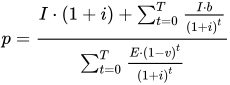
External links
- Summary of Photovoltaic Wire Requirements as Outlined in UL 4703
- Photovoltaic Energy Factsheet by the University of Michigan's Center for Sustainable Systems
- Home Power Magazine
- Solar project management
- Best Practices for Siting Solar Photovoltaics on Municipal Solid Waste Landfills: A Study Prepared in Partnership with the Environmental Protection Agency for the RE-Powering America's Land Initiative: Siting Renewable Energy on Potentially Contaminated Land and Mine Sites National Renewable Energy Laboratory