 Hispanopedia Wiki
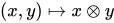
In functional analysis, an area of mathematics, the projective tensor product of two locally convex topological vector spaces is a natural topological vector space structure on their tensor product. Namely, given locally convex topological vector spaces and , the projective topology, or π-topology, on is the strongest topology which makes a locally convex topological vector space such that the canonical map (from to ) is continuous. When equipped with this topology, is denoted and called the projective tensor product of and .




Definitions
Let and be locally convex topological vector spaces. Their projective tensor product is the unique locally convex topological vector space with underlying vector space having the following universal property:[1]
- For any locally convex topological vector space , if is the canonical map from the vector space of bilinear maps to the vector space of linear maps , then the image of the restriction of to the continuous bilinear maps is the space of continuous linear maps .



When the topologies of and are induced by seminorms, the topology of is induced by seminorms constructed from those on and as follows. If is a seminorm on , and is a seminorm on , define their tensor product to be the seminorm on given by for all in , where is the balanced convex hull of the set . The projective topology on is generated by the collection of such tensor products of the seminorms on and .[2][1] When and are normed spaces, this definition applied to the norms on and gives a norm, called the projective norm, on which generates the projective topology.[3]






Properties
Throughout, all spaces are assumed to be locally convex. The symbol