 Hispanopedia Wiki
In the mathematical field of enumerative combinatorics, identities are sometimes established by arguments that rely on singling out one "distinguished element" of a set.
Definition
Let be a family of subsets of the set and let be a distinguished element of set . Then suppose there is a predicate that relates a subset to . Denote to be the set of subsets from for which is true and to be the set of subsets from for which is false, Then and are disjoint sets, so by the method of summation, the cardinalities are additive[1]



Thus the distinguished element allows for a decomposition according to a predicate that is a simple form of a divide and conquer algorithm. In combinatorics, this allows for the construction of recurrence relations. Examples are in the next section.
Examples
- The binomial coefficient is the number of size-k subsets of a size-n set. A basic identity—one of whose consequences is that the binomial coefficients are precisely the numbers appearing in Pascal's triangle—states that:

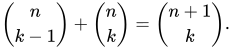
- Proof: In a size-(n + 1) set, choose one distinguished element. The set of all size-k subsets contains: (1) all size-k subsets that do contain the distinguished element, and (2) all size-k subsets that do not contain the distinguished element. If a size-k subset of a size-(n + 1) set does contain the distinguished element, then its other k − 1 elements are chosen from among the other n elements of our size-(n + 1) set. The number of ways to choose those is therefore . If a size-k subset does not contain the distinguished element, then all of its k members are chosen from among the other n "non-distinguished" elements. The number of ways to choose those is therefore .

- The number of subsets of any size-n set is 2n.
- Demostración: Usamos inducción matemática . La base de la inducción es la veracidad de esta proposición en el caso n = 0. El conjunto vacío tiene 0 elementos y 1 subconjunto, y 2 0 = 1. La hipótesis de inducción es la proposición en el caso n ; la usamos para probar el caso n + 1. En un conjunto de tamaño ( n + 1), escojamos un elemento distinguido. Cada subconjunto contiene o no el elemento distinguido. Si un subconjunto contiene el elemento distinguido, entonces sus elementos restantes se eligen entre los otros n elementos. Por la hipótesis de inducción, el número de maneras de hacer eso es 2 n . Si un subconjunto no contiene el elemento distinguido, entonces es un subconjunto del conjunto de todos los elementos no distinguidos. Por la hipótesis de inducción, el número de tales subconjuntos es 2 n . Finalmente, la lista completa de subconjuntos de nuestro conjunto de tamaño ( n + 1) contiene 2 n + 2 n = 2 n + 1 elementos.
- Sea B n el n -ésimo número de Bell , es decir, el número de particiones de un conjunto de n elementos. Sea C n el número total de "partes" (o "bloques", como suelen llamarlos los combinatorialistas) entre todas las particiones de ese conjunto. Por ejemplo, las particiones del conjunto de tamaño 3 { a , b , c } se pueden escribir así:

- Vemos 5 particiones, que contienen 10 bloques, por lo que B 3 = 5 y C 3 = 10. Una identidad establece:

- Demostración: En un conjunto de tamaño ( n + 1), elijamos un elemento distinguido. En cada partición de nuestro conjunto de tamaño ( n + 1), o bien el elemento distinguido es un "singleton", es decir, el conjunto que contiene solo el elemento distinguido es uno de los bloques, o bien el elemento distinguido pertenece a un bloque mayor. Si el elemento distinguido es un singleton, entonces su eliminación deja una partición del conjunto que contiene los n elementos no distinguidos. Hay B n maneras de hacer esto. Si el elemento distinguido pertenece a un bloque mayor, entonces su eliminación deja un bloque en una partición del conjunto que contiene los n elementos no distinguidos. Hay C n tales bloques.
Véase también
Referencias
- ↑ Petkovšek, Marko; Tomaž Pisanski (noviembre de 2002). "Interpretación combinatoria de números de Stirling y Lah sin firmar" (PDF) . Serie de preimpresiones de la Universidad de Ljubljana . 40 (837) : 1–6 . Consultado el 12 de julio de 2013 .
- Combinatoria
- Principios matemáticos