 Hispanopedia Wiki
In mathematics, a periodic sequence (sometimes called a cycle or orbit) is a sequence for which the same terms are repeated over and over:
- a1, a2, ..., ap, a1, a2, ..., ap, a1, a2, ..., ap, ...
The number p of repeated terms is called the period (period).[1]
Definition
A (purely) periodic sequence (with period p), or a p-periodic sequence, is a sequence a1, a2, a3, ... satisfying
- an+p = an
for all values of n.[1][2][3] If a sequence is regarded as a function whose domain is the set of natural numbers, then a periodic sequence is simply a special type of periodic function.[4] The smallest p for which a periodic sequence is p-periodic is called its least period[1] or exact period.
Examples
Every constant function is 1-periodic.
The sequence is periodic with least period 2.

The sequence of digits in the decimal expansion of 1/7 is periodic with period 6:

More generally, the sequence of digits in the decimal expansion of any rational number is eventually periodic (see below).[5]
The sequence of powers of −1 is periodic with period two:

More generally, the sequence of powers of any root of unity is periodic. The same holds true for the powers of any element of finite order in a group. Every periodic sequence of numbers can be written as a polynomial, evaluated at the powers of a root of unity: where is a root of unity whose order is the period of the sequence.[4]


A periodic point for a function f : X → X is a point x whose orbit

is a periodic sequence. Here, means the n-foldcomposition of f applied to x. Periodic points are important in the theory of dynamical systems. Every function from a finite set to itself has a periodic point; cycle detection is the algorithmic problem of finding such a point.

Partial sums and products
- ,

where and are positive integers.


Periodic 0, 1 sequences
Any periodic sequence can be constructed by element-wise addition, subtraction, multiplication and division of periodic sequences consisting of zeros and ones. Periodic zero and one sequences can be expressed as sums of trigonometric functions:


One standard approach for proving these identities is to apply De Moivre's formula to the corresponding root of unity. Such sequences are foundational in the study of number theory.
Generalizations
A sequence is eventually periodic or ultimately periodic[1] if it can be made periodic by dropping some finite number of terms from the beginning. Equivalently, the last condition can be stated as for some r and sufficiently large k. For example, the sequence of digits in the decimal expansion of 1/56 is eventually periodic:

- 1 / 56 = 0 . 0 1 7 8 5 7 1 4 2 8 5 7 1 4 2 8 5 7 1 4 2 ...
A sequence is asymptotically periodic if its terms approach those of a periodic sequence. That is, the sequence x1, x2, x3, ... is asymptotically periodic if there exists a periodic sequence a1, a2, a3, ... for which
- [3]
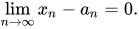
For example, the sequence
- 1 / 3, 2 / 3, 1 / 4, 3 / 4, 1 / 5, 4 / 5, ...
is asymptotically periodic, since its terms approach those of the periodic sequence 0, 1, 0, 1, 0, 1, ....
References
- 1234"Ultimately periodic sequence". Encyclopedia of Mathematics. EMS Press. 2001 [1994].
- ↑Bosma, Wieb. "Complexity of Periodic Sequences"(PDF). www.math.ru.nl. Retrieved 13 August 2021.
- 12Janglajew, Klara; Schmeidel, Ewa (2012-11-14). "Periodicity of solutions of nonhomogeneous linear difference equations". Advances in Difference Equations. 2012 (1): 195. doi:10.1186/1687-1847-2012-195. ISSN 1687-1847. S2CID 122892501.
- 12Beck, Matthias; Robins, Sinai. "Chapter 7: Finite Fourier analysis". Computing the Continuous Discretely: Integer-point Enumeration in Polyhedra. Undergraduate Texts in Mathematics. New York: Springer. pp. 123–137. doi:10.1007/978-0-387-46112-0_7. ISBN 9780387291390.
- ↑Hosch, William L. (1 June 2018). "Rational number". Encyclopedia Britannica. Retrieved 13 August 2021.
External links
- All periodic sequences in OEIS
- Sequences and series