 Hispanopedia Wiki
In astronomy, the bolometric correction is the correction made to the absolute visual magnitude of an object in order to convert it to an absolute bolometric magnitude. It is large for stars which radiate most of their energy outside of the visible range. A uniform scale for the correction has not yet been standardized.
Description
Mathematically, such a calculation can be expressed:

The bolometric correction for a range of stars with different spectral types and groups is shown in the following table:[1][2][3]
The bolometric correction is large and negative both for early type (hot) stars and for late type (cool) stars. The former because a substantial part of the produced radiation is in the ultraviolet, the latter because a large part is in the infrared. For a star like the Sun, the correction is only marginal because the Sun radiates most of its energy in the visual wavelength range. Bolometric correction is the correction made to the absolute magnitude of an object in order to convert an object's visible magnitude to its bolometric magnitude.
Alternatively, the bolometric correction can be made to absolute magnitudes based on other wavelength bands beyond the visible electromagnetic spectrum.[4] For example, and somewhat more commonly for those cooler stars where most of the energy is emitted in the infrared wavelength range, sometimes a different value set of bolometric corrections is applied to the absolute infrared magnitude, instead of the absolute visual magnitude.
Mathematically, such a calculation could be expressed:[5]
Where MK is the absolute magnitude value and BCK is the bolometric correction value in the K-band.[6]

Setting the correction scale
La escala de corrección bolométrica se establece mediante la magnitud absoluta del Sol y una magnitud bolométrica absoluta adoptada (arbitraria) para el Sol . Por lo tanto, mientras que la magnitud absoluta del Sol en diferentes filtros es una cantidad física y no arbitraria, la magnitud bolométrica absoluta del Sol es arbitraria, y por ende, el punto cero de la escala de corrección bolométrica que se deriva de ella. Esto explica por qué las referencias clásicas han tabulado valores aparentemente incompatibles entre sí para estas cantidades. [ 7 ] Históricamente, la escala bolométrica ha variado ligeramente en la literatura, con la corrección bolométrica del Sol en banda V variando de -0,19 a -0,07 magnitudes. De ello se deduce que cualquier valor para la magnitud bolométrica absoluta del Sol es legítimo, siempre que, una vez elegido, todas las correcciones bolométricas se reescalen en consecuencia. De lo contrario, esto inducirá errores sistemáticos en la determinación de las luminosidades estelares. [ 7 ] [ 8 ]
La XXIX Asamblea General de la Unión Astronómica Internacional (IAU) en Honolulu adoptó en agosto de 2015 la Resolución B2 sobre los puntos cero recomendados para las escalas de magnitud bolométrica absoluta y aparente. [ 9 ] [ 10 ]
Aunque las magnitudes bolométricas se han utilizado durante más de ocho décadas, existen diferencias sistemáticas en las escalas de magnitud-luminosidad absolutas presentadas en diversas referencias astronómicas, sin una estandarización internacional. Esto ha dado lugar a diferencias sistemáticas en las escalas de corrección bolométrica. Al combinarse con magnitudes bolométricas absolutas incorrectas asumidas para el Sol, esto puede generar errores sistemáticos en las luminosidades estelares estimadas. Muchas propiedades estelares se calculan en función de la luminosidad estelar, como los radios, las edades, etc.
La Resolución B2 de la IAU de 2015 propuso una escala de magnitud bolométrica absoluta donde corresponde a la luminosidad3,0128 × 10 28 W , con la luminosidad del punto cero elegida de tal manera que el Sol (con luminosidad nominal)3.828×1026 W) corresponds to absolute bolometric magnitude. Placing a radiation source (e.g. star) at the standard distance of 10 parsecs, it follows that the zero point of the apparent bolometric magnitude scale corresponds to irradiance, where the nominal total solar irradiance measured at 1 astronomical unit (1361 W/m2) corresponds to an apparent bolometric magnitude of the Sun of .

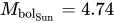



A similar IAU proposal in 1999 (with a slightly different zero point, tied to an obsolete solar luminosity estimate) was adopted by IAU Commissions 25 and 36. However it never reached a General Assembly vote, and subsequently was only adopted sporadically by astronomers in the literature.
See also
External links
- https://github.com/casaluca/bolometric-corrections - most up to date tables of bolometric corrections across the HR diagram and interpolation routines in different photometric filters[7][8]
- https://web.archive.org/web/20080312151621/http://www.peripatus.gen.nz/Astronomy/SteMag.html - contains table of bolometric corrections
- http://articles.adsabs.harvard.edu//full/1996ApJ...469..355F/0000360.000.html - contains detailed tables[11] of bolometric corrections (note that these second set of tables are consistent with a bolometric magnitude of 4.73[12] for the Sun and also be aware that there are misprint[12] errors for a few of the figures in the tables)
References
- ^Popper, Daniel M. (1980-09-01). "Stellar Masses". Annual Review of Astronomy and Astrophysics. 18 (1): 115–164. Bibcode:1980ARA&A..18..115P. doi:10.1146/annurev.aa.18.090180.000555. ISSN 0066-4146.
- ^Humphreys, R. M.; McElroy, D. B. (1984). "The initial mass function for massive stars in the Galaxy and the Magellanic Clouds". The Astrophysical Journal. 284: 565–577. Bibcode:1984ApJ...284..565H. doi:10.1086/162439. ISSN 0004-637X.
- ^B., Kaler, James (1989). Stars and their spectra: an introduction to the spectral sequence. Cambridge [Cambridgeshire]: Cambridge University Press. ISBN 978-0521304948. OCLC 17731797.
{{cite book}}: CS1 maint: varios nombres: lista de autores ( enlace ) - ^Bessell, M. S.; et al. (May 1998). "Model atmospheres broad-band colors, bolometric corrections and temperature calibrations for O - M stars". Astronomy and Astrophysics. 333: 231–250. Bibcode:1998A&A...333..231B.
- ^Salaris, Maurizio; et al. (November 2002). "Population effects on the red giant clump absolute magnitude: the K band". Monthly Notices of the Royal Astronomical Society. 337 (1): 332–340. arXiv:astro-ph/0208057. Bibcode:2002MNRAS.337..332S. doi:10.1046/j.1365-8711.2002.05917.x. S2CID 17930469.
Lower effective temperatures correspond to higher values of ; since , cooler RC stars tend to be brighter.
- ^Buzzoni, A.; et al. (April 2010). "Bolometric correction and spectral energy distribution of cool stars in Galactic clusters". Monthly Notices of the Royal Astronomical Society. 403 (3): 1592–1610. arXiv:1002.1972. Bibcode:2010MNRAS.403.1592B. doi:10.1111/j.1365-2966.2009.16223.x. S2CID 119181086.
- ^ abcCasagrande, Luca; VandenBerg, Don A. (October 2014), "Synthetic stellar photometry: general considerations and new transformations for broad-band systems", Monthly Notices of the Royal Astronomical Society, 444 (1): 392, arXiv:1407.6095, Bibcode:2014MNRAS.444..392C, doi:10.1093/mnras/stu1476 with up-to-date interpolation codes https://github.com/casaluca/bolometric-corrections
- ^ a b Casagrande, L; VandenBerg, Don A (2018-01-18). "Fotometría estelar sintética – II. Prueba de la escala de flujo bolométrico y tablas de correcciones bolométricas para los sistemas Hipparcos/Tycho, Pan-STARRS1, SkyMapper y JWST" . Monthly Notices of the Royal Astronomical Society . 475 (4): 5023– 5040. arXiv : 1801.05508 . Bibcode : 2018MNRAS.475.5023C . doi : 10.1093/mnras/sty149 . ISSN 0035-8711 .
- ^ Se anuncian los proyectos de resolución de la XXIX Asamblea General de la IAU , consultado el 8 de julio de 2015.
- ^ Mamajek, EE; et al. (2015). "Resolución B2 de la IAU de 2015 sobre los puntos cero recomendados para las escalas de magnitud bolométrica absoluta y aparente". arXiv : 1510.06262v2 [ astro-ph.SR ].
- ^ Flower, Phillip J. (septiembre de 1996), "Transformaciones de diagramas teóricos de Hertzsprung-Russell a diagramas color-magnitud: temperaturas efectivas, colores BV y correcciones bolométricas", The Astrophysical Journal , 469 : 355, Bibcode : 1996ApJ...469..355F , doi : 10.1086/177785
- ^ a b Torres, Guillermo (noviembre de 2010). "Sobre el uso de correcciones bolométricas empíricas para estrellas" . The Astronomical Journal . 140 (5): 1158– 1162. arXiv : 1008.3913 . Bibcode : 2010AJ....140.1158T . doi : 10.1088/0004-6256/140/5/1158 . S2CID 119219274 .


- astronomía observacional